As an Amazon Associate we earn from qualifying purchases. Disclosure
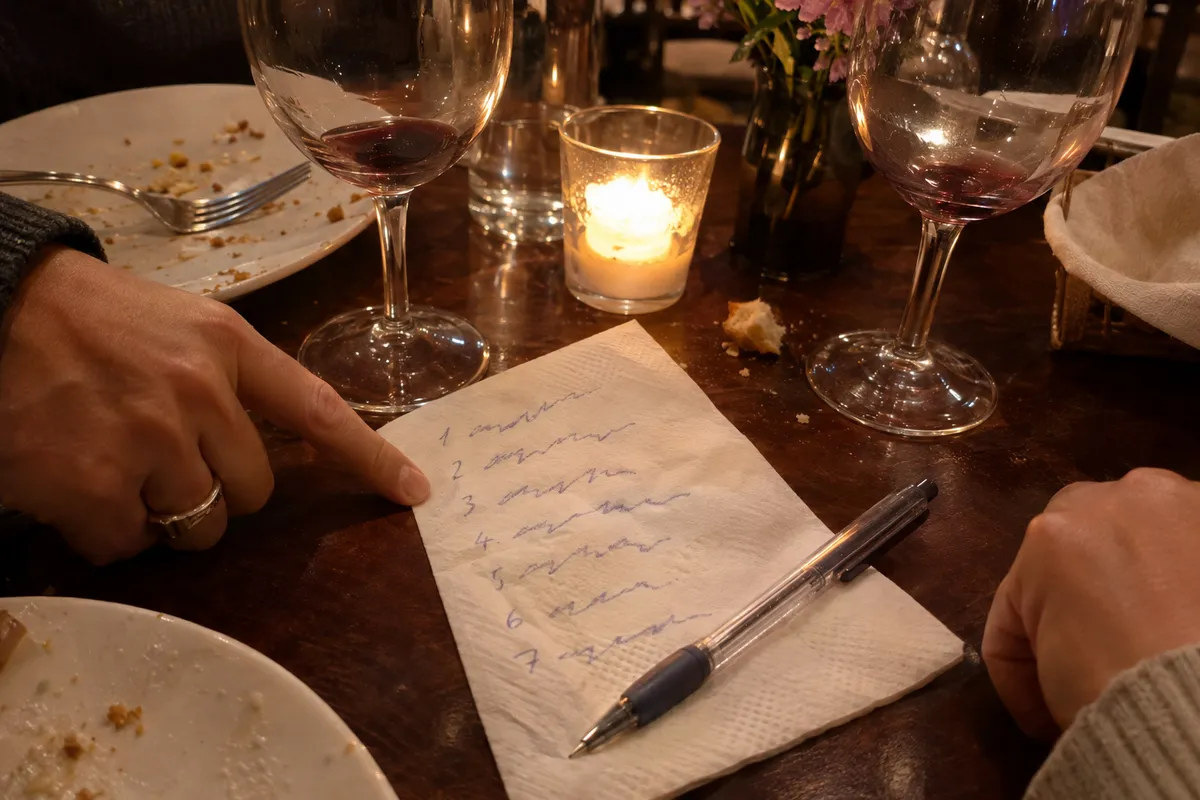
A few months after I left CERN, a friend’s husband asked me at dinner what I had actually done there. I explained detector calibration for about four minutes. He listened, nodded and asked the question I have heard more than any other since: “Is there a book I could read that wouldn’t make me feel stupid?” I wrote seven titles on a paper napkin. He took a photo of it before the waiter cleared the table.
That napkin list has grown into this guide to the best science books for non-scientists. The best science book for a non-scientist is A Short History of Nearly Everything by Bill Bryson, because it covers the whole of science, from the Big Bang to human evolution, and it was written by someone who started out knowing none of it. If you want something short, read Seven Brief Lessons on Physics, which is 96 pages. If you want to laugh, read What If?. If what you really want is to get better at science, the book for that is A Mind for Numbers, and for children aged 9 to 12 it is DK’s How to Be Good at Science, Technology and Engineering.
I have a PhD in particle physics from Imperial College London. I taught first-year undergraduate labs for three years and spent five years at CERN calibrating particle detectors, and I left the lab because I enjoyed explaining the work more than doing it. The 23 books below are the ones that answer my friend’s question: no equations you have to follow, no background assumed, and a reason to keep turning pages.
Quick picks
| Book | Best for | Pages |
|---|---|---|
| A Short History of Nearly Everything | Best first science book | 544 |
| Seven Brief Lessons on Physics | Shortest, read it in an evening | 96 |
| What If? | Funniest, good for teens too | 352 |
| Astrophysics for People in a Hurry | Space, in short chapters | 224 |
| The Body | How your own body works | 464 |
| The Immortal Life of Henrietta Lacks | Readers who prefer stories to explanations | 381 |
| The Demon-Haunted World | Learning how scientists think | 457 |
| A Mind for Numbers | Getting better at science and math | 336 |
| How to Be Good at Science, Technology and Engineering | Kids 9 to 12 | 320 |
How to pick your first science book
Most lists of the best science books for beginners are lists of famous science books. Those are not the same thing. A Brief History of Time is the most famous popular science book ever written and one of the most often abandoned. A good first book depends on three things.
What you already wonder about. People finish books that answer a question they already have. If you look at the night sky and wonder how big it is, start with space. If you have ever wondered why your knee clicks or how a cold virus gets in, start with the body. Interest carries you through the hard chapters; duty does not.
Whether you want a story or an explanation. Some readers want to understand how something works. Others want to know who found it out, what went wrong and who got the credit. The Immortal Life of Henrietta Lacks and The Disappearing Spoon are mostly stories, with the science folded in. Seven Brief Lessons and Astrophysics for People in a Hurry are mostly explanation. Both kinds teach science. Pick the kind you already like reading.
How much time you have. A 600-page book read ten pages a night takes two months, and most people give up somewhere in the middle. If you read on a commute or before sleep, start with short chapters: What If?, Astrophysics for People in a Hurry and Seven Brief Lessons all break into pieces you can finish in fifteen minutes.
Math needed: none of the 23 books below requires you to solve anything. A few show an equation or two. Hawking famously kept only E = mc² in A Brief History of Time because his editor warned that each equation would halve sales. You can read past any equation in this list and still follow the argument.
The best first science books
These three are the books I would hand to anyone who asks where to start, whatever their interests. Each covers a lot of ground, and each was written for a reader with no science background.
Best first science book
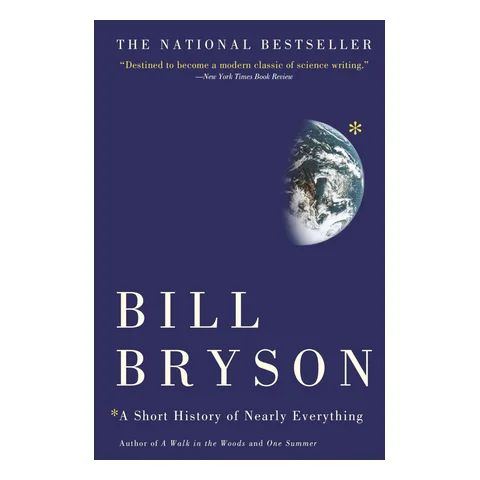
1. A Short History of Nearly Everything
Bill Bryson is a travel writer, not a scientist. He wrote this book because he realized he did not know why the sea was salty, how anyone weighed the Earth or what a proton was, and he spent three years asking scientists to explain. The result runs from the Big Bang to the first humans, through atoms, geology, cells, dinosaurs and ice ages, and it spends as much time on the odd people who made each discovery as on the discovery itself.
That is why it works as a first book. Bryson asks the questions a non-scientist would ask, in the order they would ask them. It won the Aventis Prize for Science Books in 2004 and the EU’s Descartes Prize for science communication in 2005, and it has close to 20,000 Amazon ratings at 4.6 stars.
- Bill Bryson, 2003
- Paperback, 544 pages, 30 chapters
- Covers: physics, chemistry, geology, biology, evolution
Good: the widest single tour of science in print, and funny on almost every page. Not great: it was published in 2003, so it predates the Higgs boson, the first detection of gravitational waves and Pluto’s demotion to dwarf planet. A special illustrated edition exists for readers who want pictures.
Check on Amazon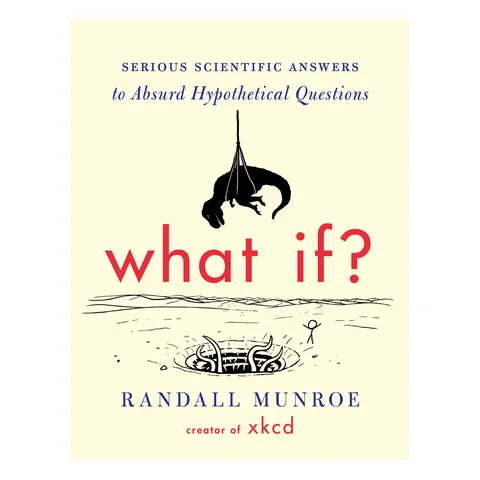
Funniest
2. What If?
Randall Munroe worked on robotics at NASA before he started the webcomic xkcd. Readers sent him absurd questions, and he answered them with real physics: what would happen if a baseball were pitched at 90 percent of the speed of light, how many Lego bricks it would take to build a bridge from London to New York, what would happen if everyone on Earth pointed a laser pointer at the Moon at the same time.
Each answer is a few pages long, with stick-figure drawings, and each one quietly teaches a real idea: air resistance, nuclear fusion, orbital mechanics, the strength of materials. It is the book on this list most likely to be read by a teenager who would never pick up a book called science.
- Randall Munroe, 2014
- 352 pages, illustrated
- Sequel: What If? 2 (2022), same format, new questions
Good: any chapter can be read on its own, and the jokes carry real science. Not great: it is a collection of answers, not a course, so you finish with many facts and no overall picture. Read it alongside Bryson, not instead of him.
Check on Amazon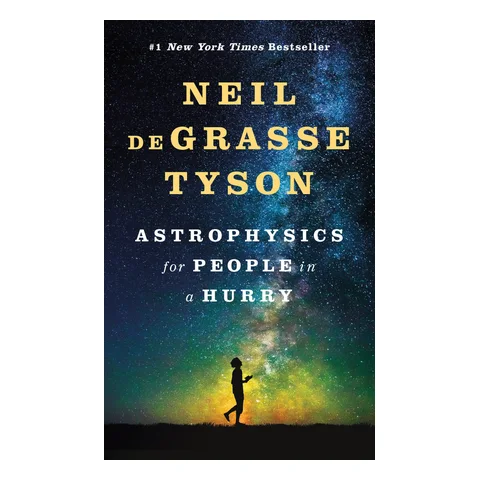
Best short book on space
3. Astrophysics for People in a Hurry
Neil deGrasse Tyson directs the Hayden Planetarium in New York, and this is the book he wrote for people who read in short bursts. Each of the twelve chapters takes one idea and explains it from the start: the first minutes after the Big Bang, why the universe is mostly empty, what dark matter and dark energy are, why planets and stars are round, and why the periodic table is a list of things made in stars.
It has over 38,000 Amazon ratings, more than any other book on this list. Readers who like it say the same thing: each chapter can be read in one sitting and makes sense on its own.
- Neil deGrasse Tyson, 2017
- 224 pages, 12 chapters
- Teen version: Astrophysics for Young People in a Hurry, 176 pages, ages 8 to 12
Good: the fastest way to get the modern picture of the universe. Not great: short chapters mean some ideas are named rather than explained. Readers who want the why behind dark matter should follow it with We Have No Idea.
Check on AmazonPhysics and space books for beginners
Physics is where non-scientists most often feel shut out, because the textbook version runs on math. These books keep the ideas and drop the math. When you want the math too, move on to our physics books for self-study. If you want background first, our explainers on black holes and the difference between dark matter and dark energy are short reads.
Shortest book on this list
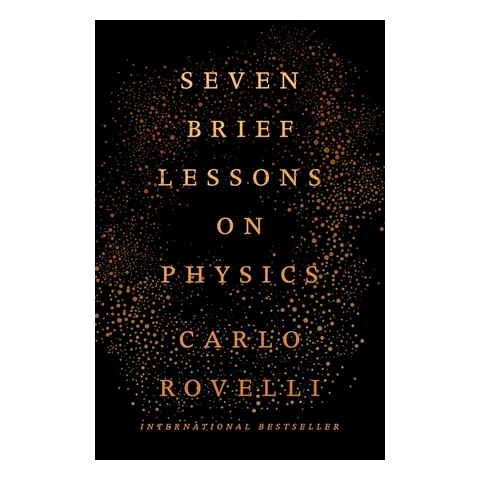
4. Seven Brief Lessons on Physics
Carlo Rovelli is a theoretical physicist and one of the founders of loop quantum gravity. He wrote these seven lessons as newspaper articles for the Italian paper Il Sole 24 Ore, and they cover the two big theories of modern physics in about 80 pages of text: Einstein’s general relativity, quantum mechanics, the structure of the cosmos, elementary particles, the attempt to join gravity and quantum theory, heat and black holes, and a closing lesson on where people fit in.
It is the book I suggest to people who say they do not have time to read. It takes an evening.
- Carlo Rovelli, 2014 (English translation 2016)
- 96 pages, small format
- Translated by Simon Carnell and Erica Segre
Good: beautifully written, and short enough to reread. Not great: it is more a tour than a lesson; you will come away knowing what general relativity says, not how it works. Its 4.3-star rating is the lowest here, and most low ratings say the same thing: too short.
Check on Amazon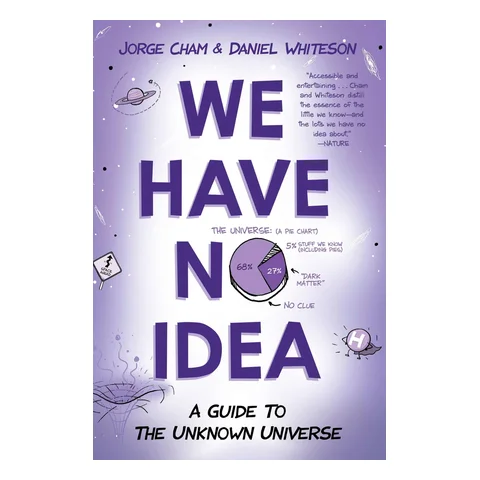
Best on what science does not know
5. We Have No Idea
Most science books tell you what is known. This one is about what is not: what dark matter is, what dark energy is, why there is more matter than antimatter, what space is made of, and how many dimensions there are. Ordinary matter, the stuff of stars, planets and people, is only about 5 percent of the universe, and the book is about the other 95 percent.
Daniel Whiteson is a particle physicist at UC Irvine who works on the ATLAS experiment at CERN. Jorge Cham drew PhD Comics. The result is half text and half cartoon, and the cartoons do real explaining. It is the book I wish I had been able to hand to visitors at CERN who asked, reasonably, what all that equipment was looking for.
- Jorge Cham and Daniel Whiteson, 2017
- 368 pages, cartoons throughout
- Follow-up: Frequently Asked Questions about the Universe (2021)
Good: honest about the limits of physics, and the cartoons make particle physics concrete. Not great: the joke-per-page rate is high, and readers who want a straight explanation sometimes find it tiring.
Check on Amazon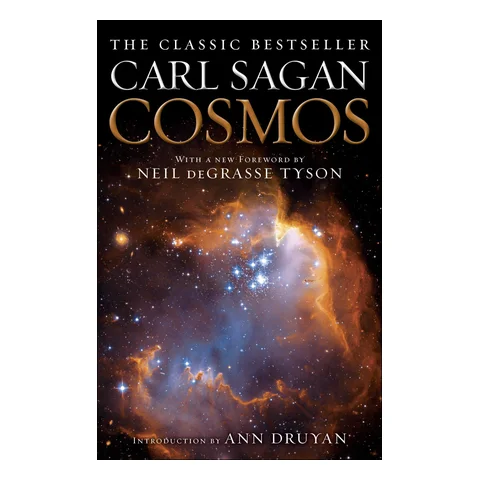
The classic
6. Cosmos
Carl Sagan wrote Cosmos as the companion to his 13-part television series of 1980, and it covers far more than astronomy: the ancient library of Alexandria, Kepler’s struggle with the orbit of Mars, the origin of life, the Voyager probes and the risk of nuclear war. Its thread is how humans worked out where they are in the universe, and what that knowledge cost the people who found it.
Many working scientists name this as the book that made them choose science. It has 8,800 Amazon ratings at 4.7 stars, 45 years after publication.
- Carl Sagan, 1980 (this edition 2013)
- 432 pages
- Best chapters for a first read: “The Harmony of Worlds” (Kepler) and “Who Speaks for Earth?”
Good: the best writing about science in this list, and it ties science to history and culture. Not great: the planetary science is from 1980, before every space telescope and most planetary missions. Read it for the ideas, not the latest numbers.
Check on Amazon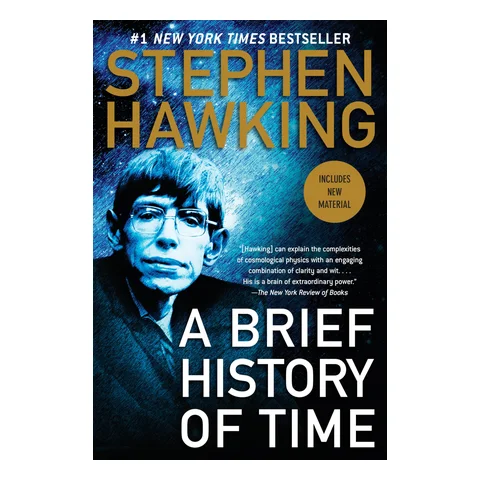
Famous, but read the shorter version first
7. A Brief History of Time
Stephen Hawking’s book has sold more than 25 million copies and stayed on the London Sunday Times bestseller list for 237 weeks. It explains how physicists think about space, time, the Big Bang and black holes, and it includes Hawking’s own work on the radiation black holes give off.
It is also hard. The early chapters on gravity and light are clear; the later ones on quantum gravity, imaginary time and the arrow of time lose many readers. In 2005 Hawking and Leonard Mlodinow rewrote it as A Briefer History of Time, 176 pages, with more illustrations and the hardest sections expanded and simplified. For a non-scientist, the Briefer version is the better book.
- Stephen Hawking, 1988 (10th anniversary edition 1998)
- 212 pages
- Easier version: A Briefer History of Time, with Leonard Mlodinow, 2005
Good: a famous scientist explaining his own field in his own words. Not great: it was written before dark energy was discovered in 1998, and the second half is the hardest stretch of any book here.
Check on Amazon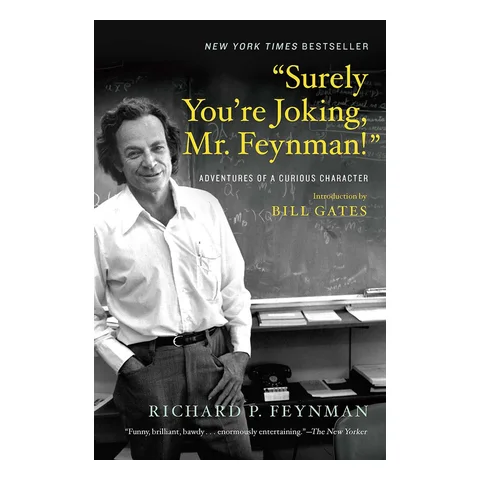
Best book about being a scientist
8. “Surely You’re Joking, Mr. Feynman!”
Richard Feynman shared the 1965 Nobel Prize in Physics for quantum electrodynamics, and this book contains almost none of it. It is a set of stories told to his drumming partner Ralph Leighton: cracking colleagues’ safes at Los Alamos during the Manhattan Project, learning to draw, playing in a samba band in Rio, and refusing to accept any answer he had not worked out himself.
It belongs on a list for non-scientists because it shows how a scientist thinks: curious about everything, impatient with jargon, and happy to look foolish while finding out. Some stories, especially about women, read badly today.
- Richard P. Feynman, as told to Ralph Leighton, 1985
- 400 pages
- Sequel: “What Do You Care What Other People Think?” (1988), which includes his work on the Challenger disaster inquiry
Good: funny, fast and the clearest picture of scientific curiosity in print. Not great: you learn about a scientist, not much science. Some anecdotes have dated poorly.
Check on Amazon
Biology books for non-scientists
Biology is the easiest science to start with, because the subject is already familiar: your body, your food, your pets, the trees on your street. These seven books cover the body, evolution, genes, cells and the living world outside us.
Best on the human body
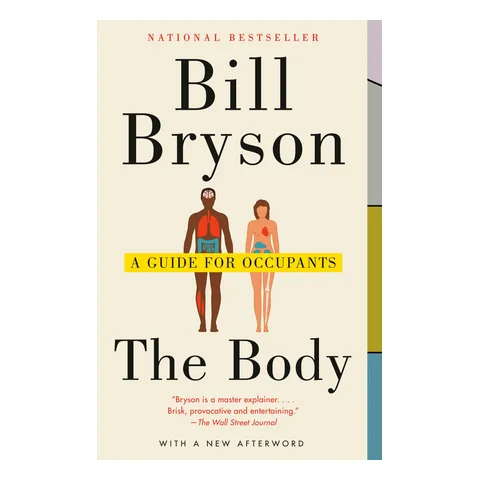
9. The Body: A Guide for Occupants
Bryson’s second science book does for the human body what A Short History did for the universe. Each chapter takes one system, the skin, the brain, the immune system, the gut, sleep, the heart, and explains how it works and what still puzzles the doctors who study it. He mixes in the history of medicine, from the first blood transfusions to antibiotics.
It has nearly 22,000 Amazon ratings at 4.7 stars, the highest-rated of the big sellers on this list. If someone in your life has a medical question every week, this is their book.
- Bill Bryson, 2019
- 464 pages, 23 chapters
- Pairs with: our interactive cell 3D model for the cell chapters
Good: practical and surprising, and you can read the chapters in any order. Not great: the pandemic and the newest vaccines came after it was published.
Check on Amazon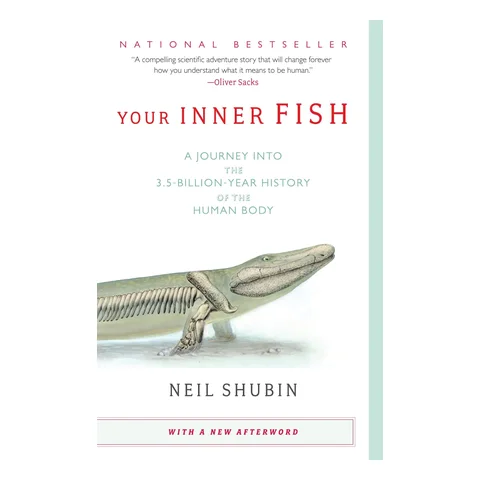
Best introduction to evolution
10. Your Inner Fish
In 2004 Neil Shubin and his team found Tiktaalik on Ellesmere Island in the Canadian Arctic, a 375-million-year-old fish with a neck, a flat head and fins that had wrist bones. This book starts from that fossil and traces parts of the human body back through fish, reptiles and early mammals: why our hands have the bones they have, why men get hernias, why our hiccups resemble a reflex in tadpoles.
It explains evolution through anatomy you can feel in your own body, which makes it a better first book on evolution than the more famous ones. At 256 pages it is also short. Our list of myths about human evolution is a good companion.
- Neil Shubin, 2008
- 256 pages
- Became a three-part PBS series in 2014
Good: evolution from the evidence up, told by the scientist who found the fossil. Not great: it covers the human body only, so it is not a full account of evolution.
Check on Amazon
Best on genetics
11. The Gene: An Intimate History
Siddhartha Mukherjee is a cancer physician who won the 2011 Pulitzer Prize for The Emperor of All Maladies. The Gene tells the story of heredity from Mendel’s peas to gene editing, and he ties it to his own family, in which several men had schizophrenia or bipolar disorder. That thread turns a history of science into a question every reader has: how much of me was decided before I was born?
It is long, and it is the most demanding biology book here. It is also the one that best explains why genetics matters for medicine, ethics and family history.
- Siddhartha Mukherjee, 2016
- 608 pages
- Pairs with: our DNA 3D model
Good: complete, personal and current up to CRISPR. Not great: at 608 pages it is a commitment. Read Your Inner Fish or The Body first.
Check on Amazon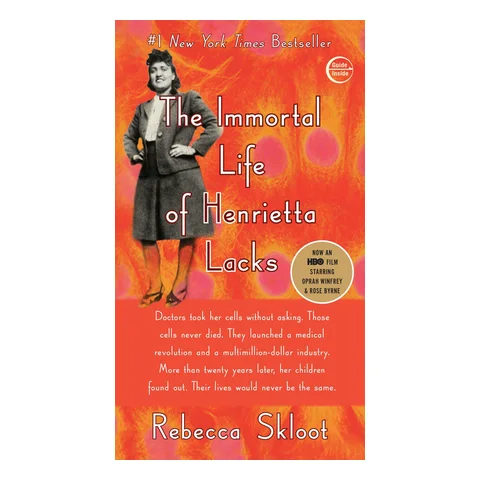
Best for readers who prefer stories
12. The Immortal Life of Henrietta Lacks
In 1951 a doctor at Johns Hopkins took a sample of cervical cancer cells from Henrietta Lacks, a Black tobacco farmer from Virginia, without asking her. Her cells became HeLa, the first human cells that kept dividing in a lab, and they were used to develop the polio vaccine, map genes and test cancer drugs. Her family did not know for more than twenty years.
Rebecca Skloot spent a decade on the story, much of it with Henrietta’s daughter Deborah. The book explains cell culture clearly and never lets the science drift away from the people. It has over 31,000 Amazon ratings and is assigned in many high school and college courses.
- Rebecca Skloot, 2010
- 381 pages
- Adapted as an HBO film in 2017
Good: reads like a novel, and it raises the ethics questions every science reader should think about. Not great: the science is a minority of the pages. Readers who want explanation should pair it with The Body.
Check on Amazon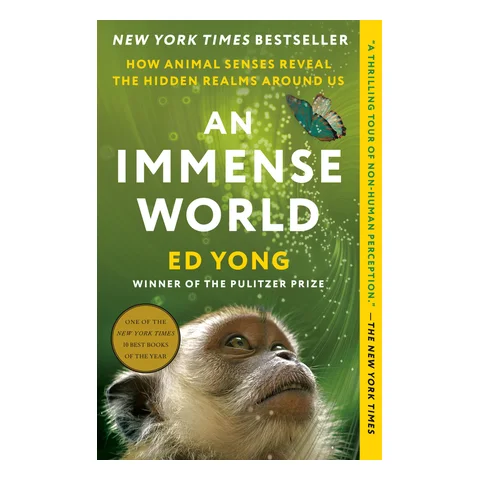
Best on animals
13. An Immense World
Every animal lives inside its own slice of reality, which biologists call its umwelt. A bat hears its world, a bee sees ultraviolet patterns on flowers, a shark feels electric fields and a scallop has up to 200 eyes. Ed Yong, who won the 2021 Pulitzer Prize for Explanatory Reporting, takes one sense per chapter and explains what it would be like to have it.
It changes how you see your own dog or garden, and it does so with careful science reporting, not guesswork about animal minds.
- Ed Yong, 2022 (paperback 2023)
- 480 pages
- Earlier book: I Contain Multitudes (2016), on microbes
Good: one of the best-reported science books of the decade. Not great: the senses chapters follow the same pattern, and some readers slow down in the middle.
Check on Amazon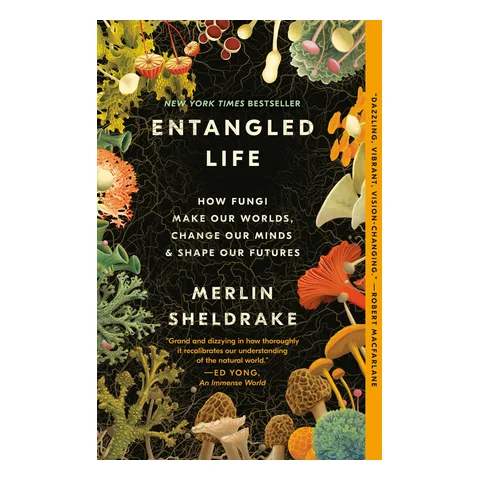
Best on fungi and plants
14. Entangled Life
Merlin Sheldrake is a biologist who did his doctoral research on the fungal networks under the forests of Panama. His book is about fungi: the threads in the soil that connect the roots of trees, the yeasts that make bread and beer, the lichens that are two organisms living as one, and the fungi that can steer the behavior of the insects they infect.
Most readers know fungi only as mushrooms, so this book teaches more new science per page than almost any other here. Our facts about fungi cover the basics if you want a preview.
- Merlin Sheldrake, 2020
- 368 pages
- An illustrated edition was published in 2023
Good: a subject most readers have never met, written with real enthusiasm. Not great: Sheldrake reaches into philosophy at times, and readers who want plain science find those passages long.
Check on Amazon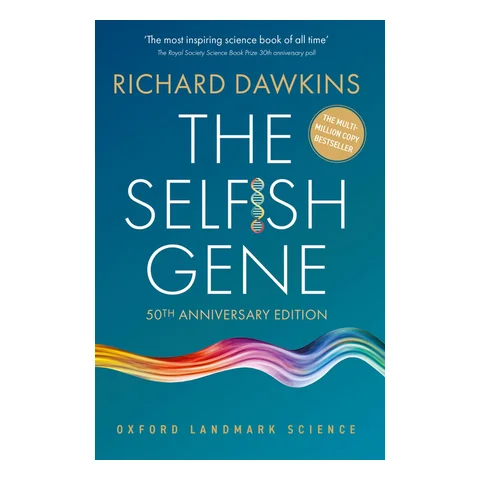
The classic on evolution
15. The Selfish Gene
Richard Dawkins’s argument is that natural selection works on genes, not on individuals or species, and that bodies are the vehicles genes build to copy themselves. It explains why animals cooperate, why parents and children compete, and why altruism can evolve. It also coined the word “meme” in its final chapter.
Oxford University Press published a 50th anniversary edition in 2026. The original has more than 9,000 ratings across its editions.
- Richard Dawkins, 1976 (50th anniversary edition 2026)
- 544 pages in the anniversary edition
- Read after: Your Inner Fish
Good: the book that changed how a generation explained evolution, and still clear. Not great: the gene-centered view is one side of a debate among biologists, and the book argues it hard. Treat it as an argument, not a textbook.
Check on AmazonChemistry, materials and math
School chemistry is where many people decided they were not science people. These three books go back to the same subjects from a different direction: stories, everyday objects and mistakes.
Best on chemistry
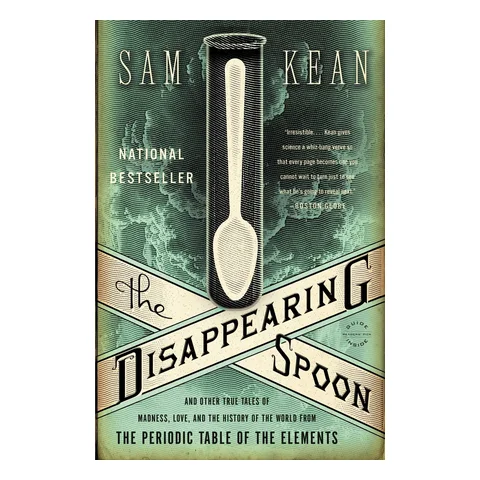
16. The Disappearing Spoon
The title comes from a prank: a spoon made of gallium looks like ordinary metal and melts in a cup of hot tea, because gallium melts at 29.76 °C (85.57 °F). Sam Kean tells the history of the periodic table through stories like that one: the elements behind wars, poisonings, Nobel Prize feuds and the madness of the scientists who chased them.
It is chemistry for people who hated chemistry class. Keep our interactive periodic table open while you read and the stories land in their places on the table.
- Sam Kean, 2010
- 416 pages
- Also by Kean: The Violinist’s Thumb (genetics), Caesar’s Last Breath (gases)
Good: the most entertaining route back into chemistry. Not great: the structure follows the table, not a story, so it can feel like a series of anecdotes.
Check on Amazon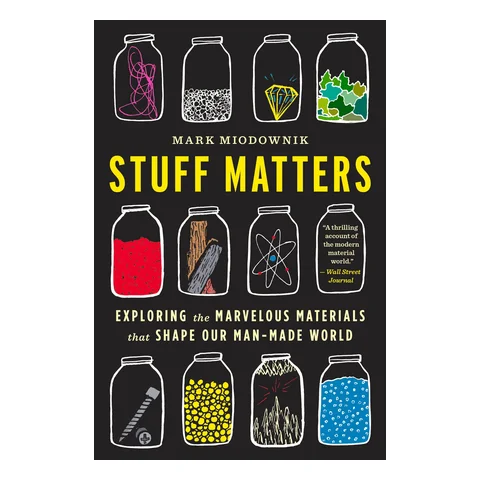
Best on everyday science
17. Stuff Matters
Mark Miodownik is a materials scientist at University College London. As a schoolboy he was stabbed in the back with a razor blade on his way to school, and he became fascinated by how a tiny piece of steel could do so much damage. Each chapter of this book takes one material, steel, paper, concrete, chocolate, foam, plastic, glass, graphite, porcelain and the implants used in surgery, and explains why it behaves as it does.
It won the Royal Society Winton Prize for Science Books in 2014. Every object in your kitchen looks different after reading it.
- Mark Miodownik, 2014
- 272 pages
- Follow-ups: Liquid Rules and It’s a Gas
Good: science you can touch, with a clear chapter per material. Not great: it is light on the chemistry behind the bonds, so readers who want depth will need more.
Check on Amazon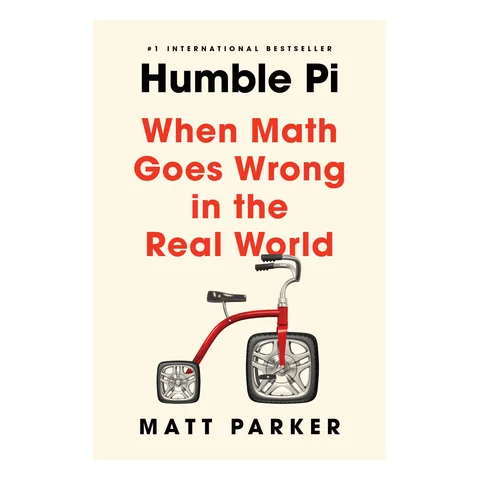
Best for people afraid of math
18. Humble Pi
Matt Parker is a former math teacher who runs the Stand-up Maths channel on YouTube. Humble Pi is a book of math mistakes from the real world: bridges that wobbled, spreadsheets that cost banks billions, calendars that drifted, and software that could not count past a certain number. Each mistake explains the math it got wrong.
Science runs on numbers, and many non-scientists stop at the first one. This book makes math feel like something people get wrong in interesting ways, not a test you failed.
- Matt Parker, 2019 (US edition 2021)
- 336 pages
- Parker’s Stand-up Maths videos cover many of the same stories
Good: funny, practical and gentle with readers who are anxious about math. Not great: it is about math more than science, so it fits best as a second or third book.
Check on AmazonBooks about how science works
The facts in any science book will date. The method will not. These three books are about how scientists decide what is true, which is the most useful thing a non-scientist can learn. If the idea of a scientific law or model is new to you, start with our pages on examples of scientific laws and scientific models.
Best on scientific thinking
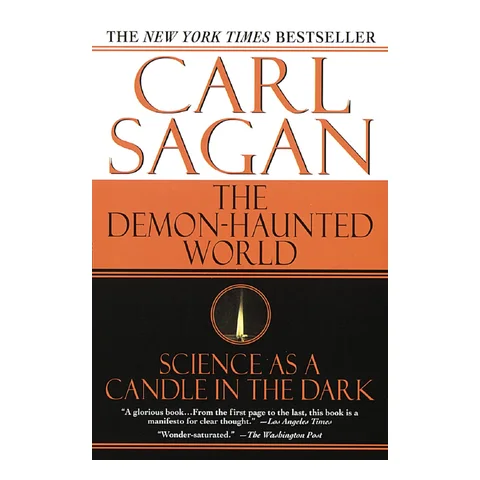
19. The Demon-Haunted World
Sagan’s last book published in his lifetime (he died in 1996) is about the difference between science and pseudoscience: alien abductions, faces on Mars, faith healing and witch trials. Its best-known chapter, “The Fine Art of Baloney Detection,” is a toolkit for testing any claim, and it reads as if it were written for the internet: look for independent confirmation, encourage debate, ask whether the claim can be tested at all.
If you only read one book about how science works, read this one. It gives you the questions to ask of every science headline you will ever see.
- Carl Sagan, 1995 (paperback 1997)
- 457 pages
- Key chapters: “The Dragon in My Garage” and “The Fine Art of Baloney Detection”
Good: the clearest case for scientific thinking ever written for general readers. Not great: the examples are from the 1990s, and some chapters on education repeat the same point.
Check on Amazon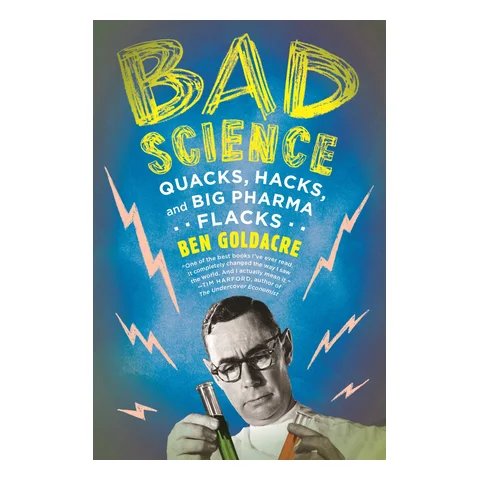
Best on health claims
20. Bad Science
Ben Goldacre is a British doctor who wrote a newspaper column of the same name for The Guardian. The book takes apart homeopathy, detox products, nutrition gurus and the vaccine scare of the late 1990s, and in doing so it teaches how a fair test works: the placebo effect, blinding, randomized trials and why one study proves little.
By the end you can read a health headline and know which questions to ask. That skill is worth more than any single fact in this list.
- Ben Goldacre, 2008 (US edition 2010)
- 304 pages
- Follow-up: Bad Pharma (2012), on drug company trials
Good: teaches the logic of medical evidence without a single formula. Not great: the examples are British and from the 2000s, and the tone is angry in places.
Check on Amazon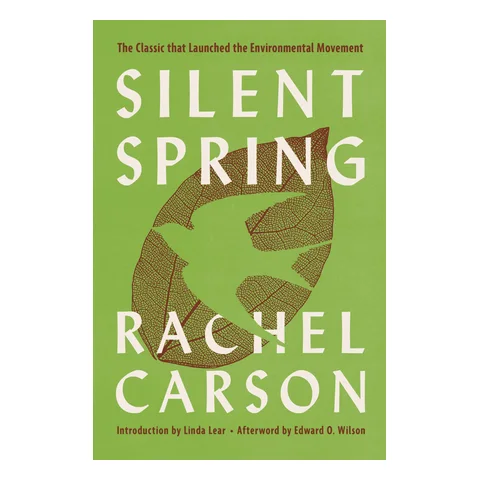
The book that changed policy
21. Silent Spring
Rachel Carson was a marine biologist at the US Fish and Wildlife Service. Silent Spring, published in 1962, documented what DDT and other pesticides were doing to birds, fish and people, and it was attacked by the chemical industry before it was printed. Ten years later the EPA cancelled DDT for most uses in the United States.
It shows how one scientist, careful evidence and clear writing can change a country. It is also the starting point for modern environmental science.
- Rachel Carson, 1962 (this edition 2002)
- 400 pages
- Introduction by Linda Lear, Carson’s biographer
Good: a short history of how science reaches the public and the law. Not great: the chemistry and the data are from the 1950s, and some passages are slow for modern readers.
Check on AmazonHow to be good at science: books for learning it
When I taught first-year labs, the sentence I heard most from struggling students was “I’m just not a science person.” Almost none of them were right. What they lacked was a way to study: they reread their notes, highlighted everything and crammed the night before, which are the methods that work worst for science and math. Two books fix that, one for adults and one for children.
Best for teens and adults learning science
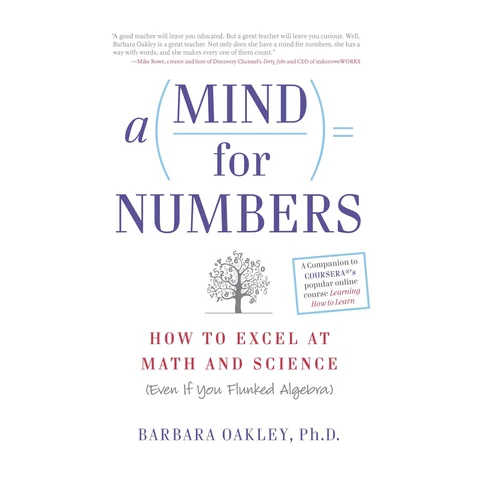
22. A Mind for Numbers
Barbara Oakley failed math and science in high school, joined the US Army and learned Russian. Years later she went back to study engineering and became an engineering professor at Oakland University in Michigan. This book is what she learned about learning: the switch between focused and diffuse thinking, why practice beats rereading, how to break problems into chunks, and how to use the Pomodoro technique, 25 minutes of work and then a break, to get past procrastination.
It became the basis of Learning How to Learn, the free Coursera course she teaches with neuroscientist Terrence Sejnowski, one of the most-taken online courses in the world. If the search that brought you here was “how to be good at science,” this is the book for anyone over 14. If math is the subject you want to rebuild, our guide to the best math books for self study starts with a placement check.
- Barbara Oakley, 2014
- 336 pages
- Kids and teens version: Learning How to Learn (2018)
Good: practical study methods backed by memory research, written by someone who once failed the same subjects. Not great: some readers find the chapter summaries repetitive. The free course covers much of the same ground.
Check on Amazon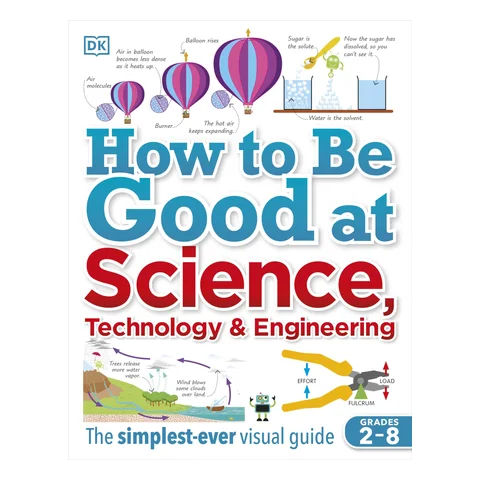
Best for kids 9 to 12
23. How to Be Good at Science, Technology and Engineering
This is the DK book people mean when they search for the “how to be good at science book.” It covers the science school curriculum for roughly ages 9 to 12, from cells and forces to circuits, materials and the solar system, with DK’s usual layout: one topic per spread, labeled diagrams, short blocks of text and simple experiments to try at home.
It works as a reference for a child doing homework and for a parent who has forgotten what a lever class is. It has 4.7 stars from over 700 Amazon ratings.
- DK, 2018
- 320 pages, full color
- Workbooks for grades 2 to 5 and 6 to 8 are sold separately
Good: clear diagrams for every topic, and it doubles as a homework reference. Not great: it is a visual encyclopedia, not a story, so it suits looking things up more than reading cover to cover. For parents helping older children, Help Your Kids with Science goes up to high school level.
Check on Amazon
A reading order for your first year
If you want a plan, this sequence takes a non-scientist from no background to a working picture of the sciences in about a year at one book a month. Each book prepares the next.
| Month | Book | Why now |
|---|---|---|
| 1 | A Short History of Nearly Everything | The map of all the sciences |
| 2 | Seven Brief Lessons on Physics | A short break after a long book |
| 3 | Your Inner Fish | Evolution, through your own body |
| 4 | The Demon-Haunted World | How to judge what you read |
| 5 | The Disappearing Spoon | Chemistry, through stories |
| 6 | We Have No Idea | The open questions in physics |
| 7 | The Immortal Life of Henrietta Lacks | Science and ethics |
| 8 | Stuff Matters | Science in everyday objects |
| 9 | An Immense World | The living world beyond humans |
| 10 | Cosmos | The classic, now with context |
| 11 | The Gene | The long one, once you are ready |
| 12 | “Surely You’re Joking, Mr. Feynman!” | A reward, and how a scientist thinks |
Readers short on time can stop after month four. Bryson, Rovelli, Shubin and Sagan together cover physics, biology, evolution and scientific thinking in under 1,400 pages. If you want to learn the anatomy itself after them, see our picks of the anatomy books for beginners.
What is out of date in the classics
Popular science books age. The writing stays good long after some of the facts have moved on, so it helps to know what changed after each classic was published.
- A Brief History of Time (1988): written before the 1998 discovery that the expansion of the universe is speeding up. Dark energy, which makes up most of the universe, is absent.
- Cosmos (1980): written before the Hubble Space Telescope, the first exoplanets around a Sun-like star (1995) and the James Webb Space Telescope. The planetary science is the part that has aged most.
- A Short History of Nearly Everything (2003): before the Higgs boson was found at CERN in 2012, before gravitational waves were detected in 2015 and before Pluto was reclassified as a dwarf planet in 2006.
- The Selfish Gene (1976): before genome sequencing and epigenetics. The 50th anniversary edition adds new material, but the core text is the original.
- Silent Spring (1962): DDT is now banned for agricultural use in most countries, and some of the data on specific chemicals has been revised. The argument about testing chemicals before releasing them still stands.
None of this is a reason to skip them. Read an old classic for how the writer thinks, and a recent book for where the field stands. Our explainers on myths about quantum mechanics and the top scientific discoveries of the 18th century are useful for checking a book’s claims against current understanding.
How to read a science book when you are not a scientist
Popular science books are written for people who are not scientists, but a few habits make them easier to finish.
- Skip the equation, keep the sentence. When a book shows an equation, the sentence before or after it nearly always says what it means in words. Read that sentence and move on.
- Read with a search bar nearby. Looking up one picture of a cell, a fossil or a galaxy turns a hard paragraph into an easy one. This is what our cell, DNA and atom 3D models are for.
- Do not read the hard chapter twice in a row. If a chapter loses you, move to the next one and come back later. Most of these books are built so that chapters can be read out of order.
- Read the notes. The endnotes in science books are where authors put the best stories that would not fit in the main text, especially in Bryson, Kean and Yong.
- Talk about it. Explaining a chapter to someone else at dinner is the best test of whether you understood it. I know this from both sides of the table.
- Use audiobooks for stories, print for explanations. Henrietta Lacks, Feynman and Bryson work well as audio. Books that depend on diagrams, such as We Have No Idea, What If? and the DK book, need the page.
If you would rather give one of these as a gift, see our science coffee table books for big illustrated picks and our science kits for adults for something hands-on. All of our guides are listed on the buying guides page.
FAQ
A Short History of Nearly Everything by Bill Bryson is the best science book for non-scientists. It covers physics, chemistry, geology, biology and evolution in one book, it was written by a travel writer who started out knowing no science, and it won the Aventis Prize for Science Books in 2004.
For a beginner, the best choices are A Short History of Nearly Everything for a broad overview, Seven Brief Lessons on Physics if you want something short (96 pages), What If? by Randall Munroe if you want humor, and The Body by Bill Bryson if you want to understand your own body. None of them requires any math.
How to Be Good at Science, Technology and Engineering is a 320-page DK visual guide published in 2018 for children aged about 9 to 12. It covers school science topics such as cells, forces, electricity, materials and space, one topic per illustrated spread, with experiments to try at home. DK also sells companion workbooks for grades 2 to 5 and 6 to 8.
Read A Mind for Numbers by Barbara Oakley, who failed high school math and science and later became an engineering professor. It explains study methods that work for science: practicing problems instead of rereading, spacing study over days, switching between focused and relaxed thinking and working in 25-minute blocks. Her free Coursera course, Learning How to Learn, covers the same methods.
A Brief History of Time is readable for beginners in its first half, but the later chapters on quantum gravity and imaginary time are hard without a physics background. A Briefer History of Time (2005), written by Stephen Hawking with Leonard Mlodinow, is shorter at 176 pages, more illustrated and easier to follow. Beginners should read the Briefer version.
Four books give an adult a working picture of science: A Short History of Nearly Everything (all the sciences), Your Inner Fish (evolution), The Demon-Haunted World (how to judge scientific claims) and Seven Brief Lessons on Physics (modern physics). Together they run under 1,400 pages.
What If? by Randall Munroe, Astrophysics for Young People in a Hurry by Neil deGrasse Tyson and The Immortal Life of Henrietta Lacks are the most popular science books with teenagers. For a teen who wants to do better in science classes, Learning How to Learn by Barbara Oakley and Terrence Sejnowski is the study-skills version of A Mind for Numbers.
Popular science books by working scientists and established science journalists are accurate when published, but facts date. Check the publication year: A Brief History of Time (1988) predates the discovery of dark energy, and A Short History of Nearly Everything (2003) predates the Higgs boson. Read older classics for the ideas and recent books for the current state of a field.
Read a science book built on stories rather than explanations. The Disappearing Spoon tells chemistry through the people behind each element, The Immortal Life of Henrietta Lacks tells cell biology through one family, and “Surely You’re Joking, Mr. Feynman!” is about a physicist’s life rather than his physics. Humble Pi is the best choice for readers who are anxious about math.
Sources
- Royal Society Science Book Prize (Stuff Matters, 2014 winner)
- Nobel Prize: Richard P. Feynman, facts
- The Emperor of All Maladies (2011 Pulitzer Prize for General Nonfiction)
- Ed Yong (2021 Pulitzer Prize for Explanatory Reporting)
- Tiktaalik roseae
- A Short History of Nearly Everything (Aventis and Descartes prizes)
- Johns Hopkins Medicine: Henrietta Lacks and HeLa cells
- CERN: Dark matter
- US EPA: DDT, a brief history and status
- Coursera: Learning How to Learn (Barbara Oakley and Terrence Sejnowski)