The first science kit I bought as an adult was a Geiger counter, and I bought it out of homesickness. I had just left CERN after five years of calibrating particle detectors, and my new flat was very quiet. No beam schedule, no control room, no clicking. So I ordered a small handheld counter, walked it around the flat and found that the old orange-glazed plate my grandmother left me was the most radioactive object I owned. I spent the rest of that weekend reading about uranium glazes and checking every piece of vintage glass at the local flea market.
That is what a good science kit for an adult does. It hands you a real measurement and lets your curiosity take it from there. Most products sold as “science kits” are built for eight-year-olds: a volcano mold, a bag of baking soda, a booklet with cartoons. Adults want real glassware, real instruments and explanations that do not stop at “and it fizzes!”
The best science kit for adults is the Thames & Kosmos CHEM C3000. It is the most complete home chemistry set you can buy, with 333 experiments, real glassware, an alcohol burner and a 192-page manual that reads like a textbook. If chemistry is not your subject, the Sunnytech low-temperature Stirling engine is the best physics kit, the GQ GMC-300S Geiger counter is the best measuring instrument, the Back to the Roots oyster mushroom kit is the best biology starter and the National Geographic rock tumbler is the best geology kit.
33Science earns a commission on qualifying Amazon purchases made through links on this page, at no extra cost to you. See our affiliate disclosure.
Quick picks
| Pick | Best for | Science | Tier |
|---|---|---|---|
| Thames & Kosmos CHEM C3000 | Best overall, serious chemistry | Chemistry | Premium |
| Thames & Kosmos CHEM C2000 | Chemistry with a smaller box | Chemistry | Premium |
| Illustrated Guide to Home Chemistry Experiments | Building your own home lab | Chemistry | Budget |
| Old Nobby 239-piece molecular model kit | Seeing molecules in 3D | Chemistry | Budget |
| Sunnytech LT001 Stirling engine | Best physics kit, desk display | Physics | Mid-range |
| EISCO quantitative spectroscope | Measuring light | Physics | Budget |
| GQ GMC-300S Geiger counter | Best instrument, radiation | Physics | Mid-range |
| CMS Magnetics ferrofluid kit | Magnetism you can see | Physics | Mid-range |
| Back to the Roots oyster mushroom kit | Best biology starter | Biology | Budget |
| PyroFarms Bio-Orb | Living bioluminescence | Biology | Mid-range |
| Swift SW380T microscope | A microscope you keep for life | Biology | Splurge |
| National Geographic Hobby Rock Tumbler | Best geology kit | Geology | Mid-range |
| ELEGOO UNO R3 Super Starter Kit | Electronics and coding | Electronics | Mid-range |
What makes a science kit right for adults
I taught first-year undergraduate labs for three years before CERN, and the students who stayed curious were the ones who got a real result early: a spectrum line where the textbook said it would be, a titration that hit its endpoint, a count rate that dropped with distance the way the inverse-square law predicts. The same holds for adults at home. A kit is worth buying if it does four things.
- It uses real equipment. Glass test tubes, a burner, a calibrated scale, a detector that logs data. Plastic stand-ins limit what you can do and what you learn.
- It explains the science. The manual should give you the chemical equation, the physical principle or the biology behind each step, not only the steps.
- It has room to grow. The best kits lead somewhere: a chemistry set leads to a home lab, a Geiger counter leads to a mineral collection, a mushroom kit leads to growing from spores.
- It fits your space. A chemistry set needs a table you can clear, ventilation and somewhere to store chemicals away from food. A Stirling engine needs a mug of coffee.
Age labels mislead in this category. The CHEM C3000 says 12+ and sits in the toy aisle, yet it covers more chemistry than many high school courses. A rock tumbler says 8+ and makes a better gift for a 60-year-old than for most 8-year-olds. Judge a kit by its equipment and its manual. If you are shopping for a child, our best science kit for kids guide has a quiz that matches kits to age and interest.
Chemistry sets for adults
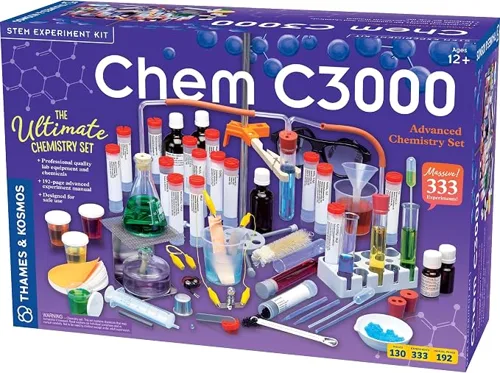
Best science kit for adults overall
1. Thames & Kosmos CHEM C3000
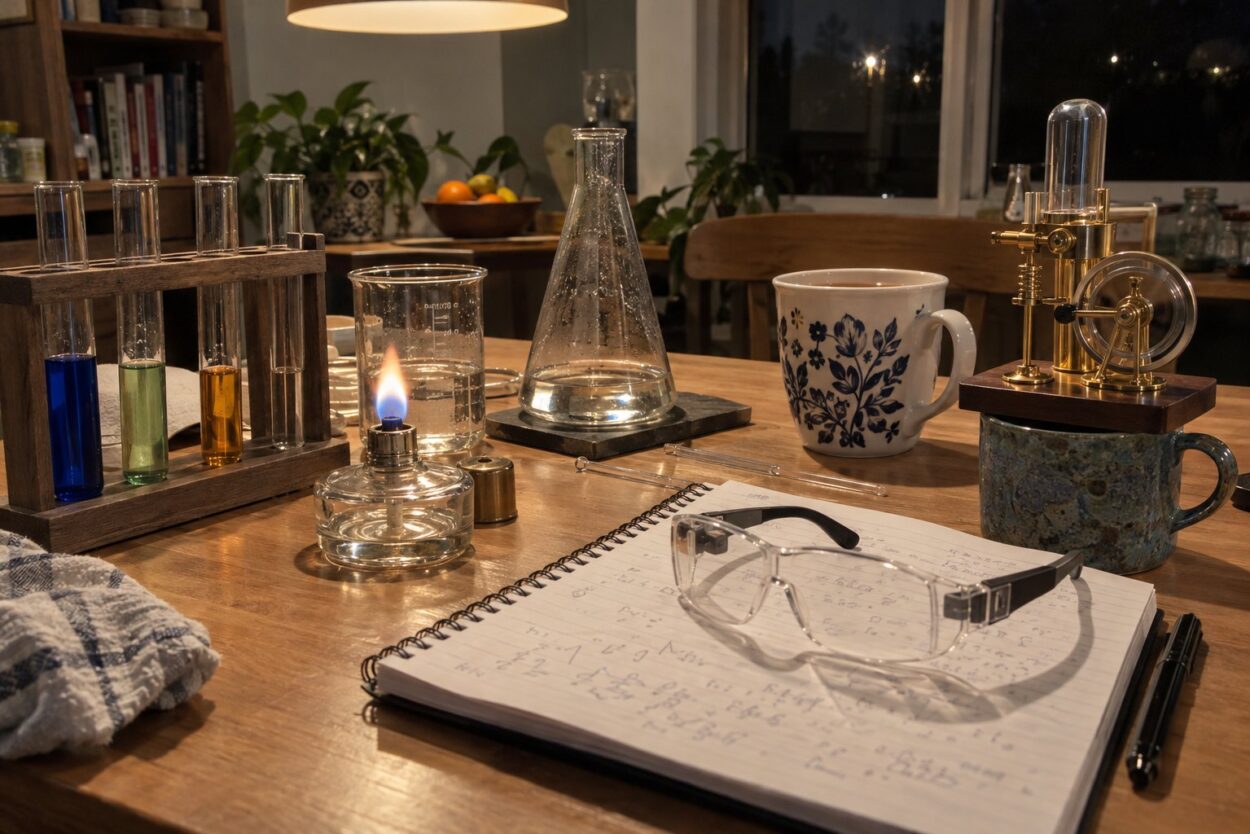
The CHEM C3000 is the closest thing to a school chemistry lab that fits in a closet. It is made in Germany by Kosmos, the company that has sold chemistry sets in Europe for about a century, and it includes everything in the smaller C2000 plus dozens of extra tools and chemicals: test tubes and rack, beakers, an Erlenmeyer flask, a tripod stand with wire mesh, an alcohol burner, an evaporating dish, pipettes and syringes. The 333 experiments run across 27 chapters of inorganic chemistry, organic chemistry and electrochemistry.
The manual is the reason I recommend it. It is 192 full-color pages, and it reads like a good textbook: each experiment comes with the balanced equation and an explanation of what the atoms are doing. My partner and I worked through the electrolysis and redox chapters over a winter of Sunday evenings at the kitchen table. Splitting water and catching the hydrogen in an inverted test tube, then popping it with a burning splint, is as satisfying as an adult as it would have been at 12.
- Experiments: 333 in 27 chapters, 192-page manual
- Equipment: real glassware, alcohol burner, tripod stand, electrolysis setup
- Watch out: it ships with only small amounts of some reagents, and a few experiments need household extras such as a battery or vinegar. Store it away from food and away from children.
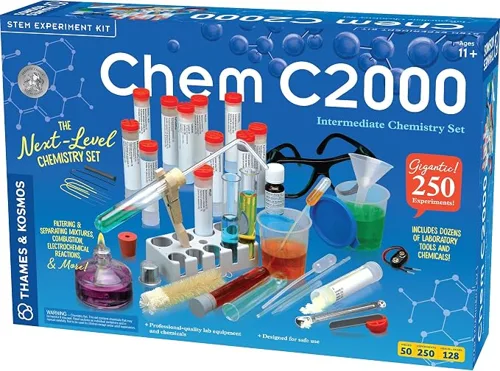
Chemistry set for a smaller budget
2. Thames & Kosmos CHEM C2000
The C2000 is the middle set in the same series. It has 250 experiments in 18 chapters and a 128-page manual, and it is the first set in the line with an alcohol burner, which opens up heating, combustion and distillation-style experiments. The topics are practical: acids and bases, water chemistry, acid rain, iron and copper, food chemistry, soaps, paper chromatography and the cold glow of luminol.
Buy the C2000 if you want real chemistry but are not sure you will finish 333 experiments. Most adults I know who buy a set use it heavily for a season and then come back to it. The C2000 covers that season well. The C3000 is the better buy if you already know you love the subject, because you get organic chemistry and much more electrochemistry.
- Experiments: 250 in 18 chapters, 128-page manual
- Equipment: glassware, alcohol burner, test papers and indicators
- Watch out: the smallest set in the series, the C1000, has no burner and is too basic for most adults
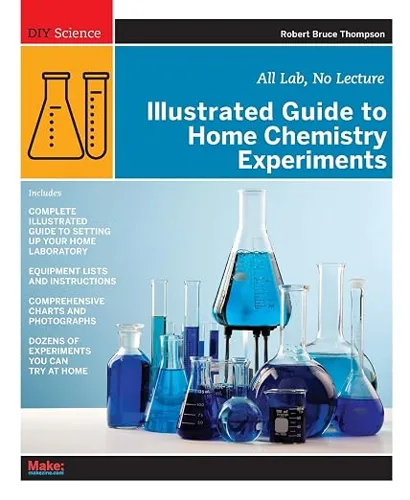
Best for building your own home lab
3. Illustrated Guide to Home Chemistry Experiments
Robert Bruce Thompson’s book is not a kit, but it is what serious hobby chemists buy instead of one. It is 432 pages on setting up a home lab: which glassware to buy, which chemicals you can legally and safely keep, how to store and dispose of them, and then a full course of lab sessions on separations, solutions, gas chemistry, titration, electrochemistry and qualitative analysis. When an adult asked r/chemistry for a starter chemistry set, the top answer named this book first.
I keep a copy next to the C3000 manual. The kit tells you what to do with its own chemicals. Thompson tells you how to keep going once they run out, and he is careful about safety without being precious about it.
- Format: 432-page paperback, Make: DIY Science series
- Pairs with: a basic glassware set, a digital scale and splash-rated lab goggles
- Watch out: published in 2008, so a few supplier names are out of date
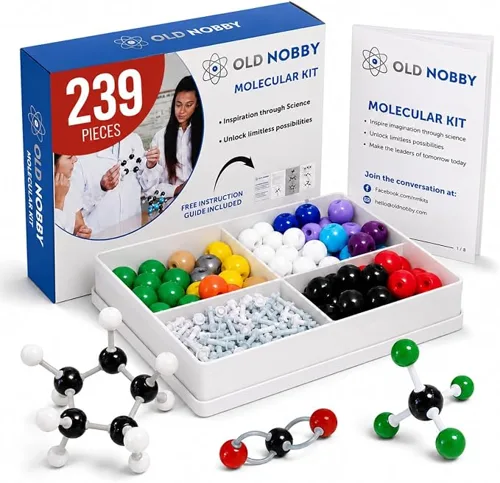
Best chemistry kit without chemicals
4. Old Nobby 239-Piece Molecular Model Kit
A molecular model kit is the cheapest way to understand chemistry that a drawing cannot show you: bond angles, why methane is a tetrahedron, why your two hands are a model of chirality and why cyclohexane folds into a chair. This one has 239 color-coded atoms and bonds, flexible bonds for double bonds, triple bonds and rings, and a small tool for pulling tight bonds apart. It has close to 7,000 ratings at 4.7 stars.
I bought one to help a friend’s daughter through organic chemistry and ended up keeping it on my own desk. Building caffeine from the structure in a textbook takes about ten minutes and teaches you more about the molecule than an hour of reading. It also suits anyone who wants chemistry with no fumes, no stains and no storage rules.
- Pieces: 239 atoms and bonds, with bond remover tool
- Covers: organic and inorganic structures, rings, isomers
- Watch out: it shows geometry, not bond lengths to scale
Physics kits and instruments
Best physics kit for adults
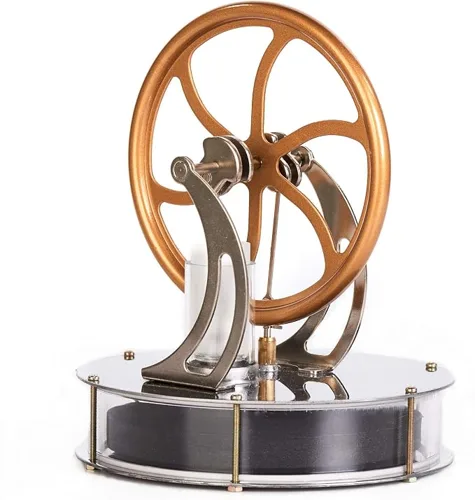
5. Sunnytech LT001 Low-Temperature Stirling Engine
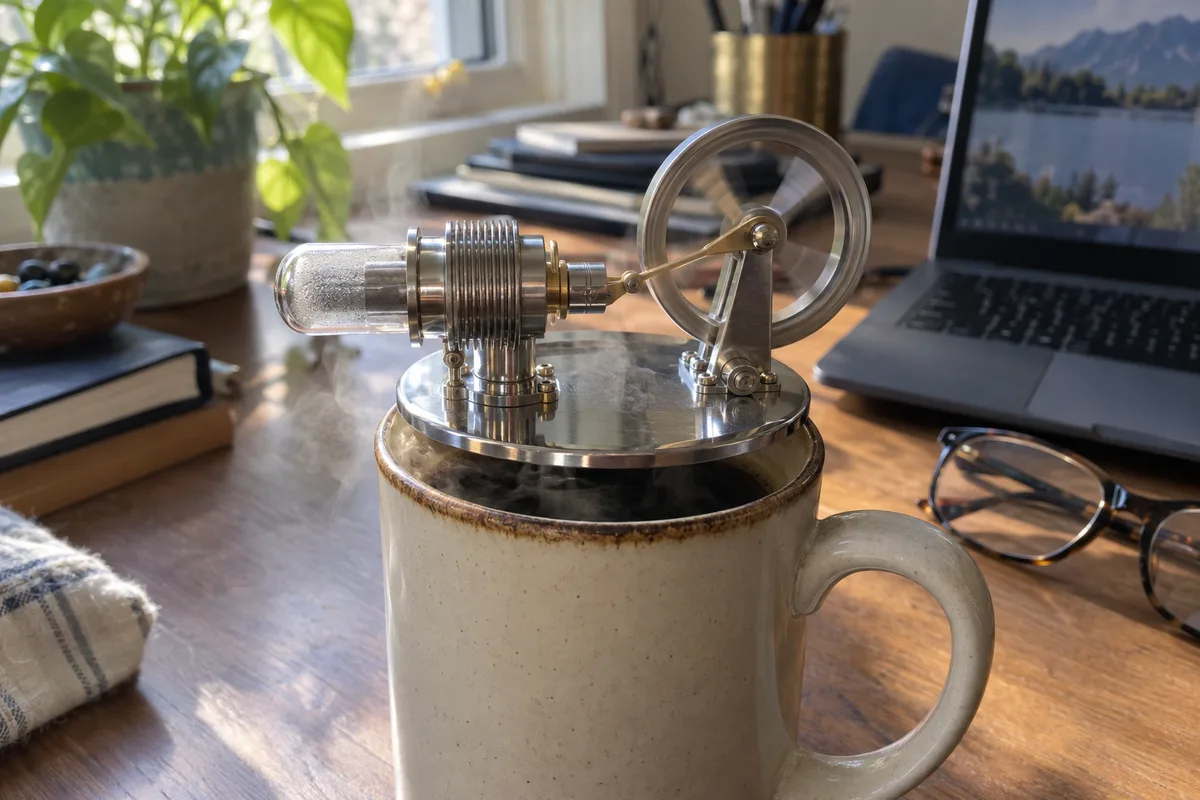
A Stirling engine turns a temperature difference into motion. This one runs on the heat from a cup of coffee: set it on the mug, give the flywheel a nudge, and it spins for as long as the bottom plate is warmer than the top. Put an ice cube on the top plate and it runs faster. It also runs on a block of ice, turning the other way, which surprises everyone who sees it.
Mine has run on my desk most mornings for three years. It is a working demonstration of the second law of thermodynamics: the engine only moves while heat flows from hot to cold, and it slows as the coffee cools. When a visitor asks how it works, I can explain the gas in the displacer chamber expanding and contracting in about two minutes. The build quality is good, with a mirror-finish stainless base, a glass cylinder and a zinc alloy flywheel, and it needs no oil.
- Runs on: hot drinks, hot water, ice or a warm palm on a cold day
- Build: stainless base, glass cylinder liner, oil-free
- Watch out: it arrives assembled, so it is a demonstration piece rather than a build project
Best kit for measuring light
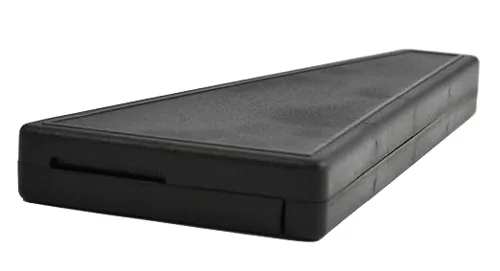
6. EISCO Premium Quantitative Spectroscope
Point this spectroscope at a light source and you see its spectrum spread across a printed wavelength scale from 400 to 700 nanometers, readable to about 5 nanometers. A fluorescent tube shows the sharp mercury lines. A candle shows a smooth band. A sodium streetlamp shows its bright yellow pair. Sprinkle a little table salt in a gas flame and you see the same yellow line that gave sodium away in the Sun’s spectrum in the 1800s.
It is the cheapest pick on this list, and it is the one I lend out most. The grating and scale are held in a rigid metal body, so you do not have to tape anything in place as you do with cardboard spectroscopes. Pair it with the flame-test chapter of a chemistry set and you have a full afternoon of atomic physics.
- Range: 400 to 700 nm, about 5 nm accuracy
- Good for: gas tubes, flame tests, streetlights, LED and fluorescent lamps
- Watch out: never point it at the Sun
Best science instrument for adults
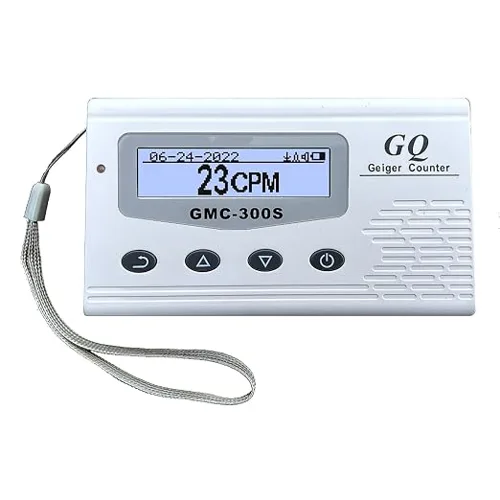
7. GQ GMC-300S Geiger Counter
This is the counter I bought for my first flat, and it is still the one I recommend. It detects beta, gamma and X-ray radiation, shows counts per minute and dose rate, logs a reading every second to internal memory and downloads the log to a computer with free software. It runs on a rechargeable battery and clicks with each count, which matters more than it sounds: you hear the rate change before you read it.
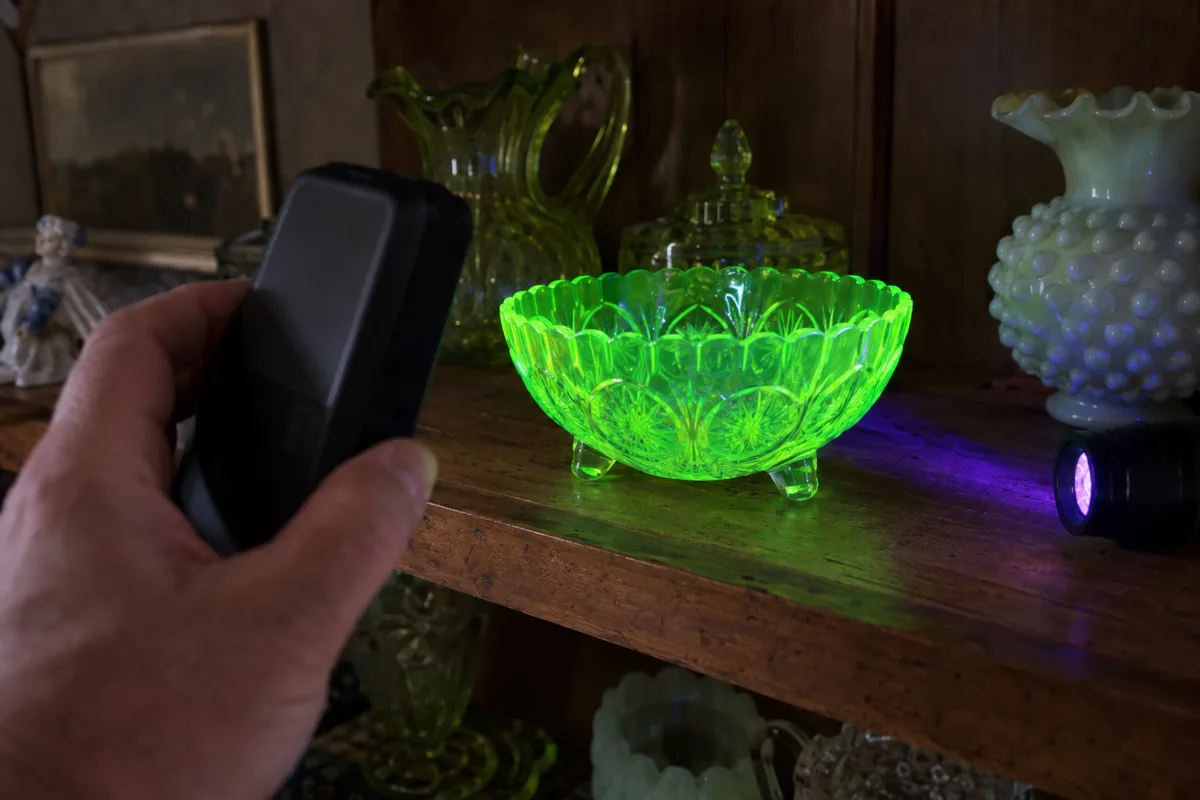
What you can do with it: measure background radiation in your home and compare it with your basement, check the count on a flight (it climbs at altitude), test old orange-red ceramic glazes and green uranium glass, and log radon progeny on a rainy day, when the background often rises. Every one of those is a real experiment with a real answer. GQ also makes the newer GMC-800 with a large color screen if you prefer a bigger display.
- Detects: beta, gamma and X-ray, with CPM, dose and graph modes
- Data: logs every second, free PC viewer software
- Watch out: like most hobby counters, it does not detect alpha particles
Best kit for seeing magnetic fields
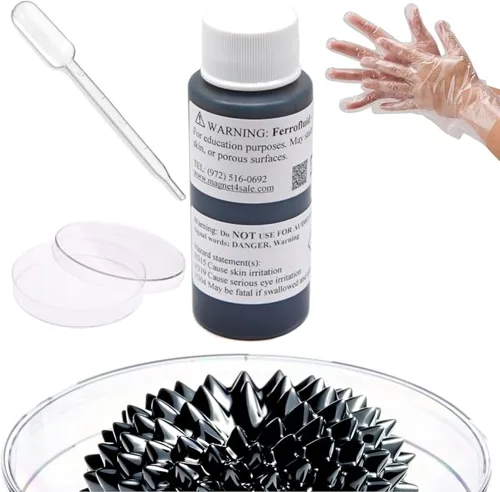
8. CMS Magnetics Ferrofluid Kit
Ferrofluid is a liquid full of magnetic nanoparticles, and under a magnet it pulls itself into spikes that trace the field lines. This kit has 2 fluid ounces of educational grade fluid, a pipette, disposable gloves and petri dishes. Put a few drops in a dish, slide a neodymium magnet underneath and watch the spikes form, merge and follow the magnet around.
Wear the gloves and cover the table. Ferrofluid stains skin, fabric and wood, and I still have a grey ring on an old cutting board from my first attempt. The sealed bottle displays sold as desk toys are cleaner, but an open dish lets you experiment: stack magnets, try different distances and see how the spike spacing changes with field strength.
- Includes: 2 oz ferrofluid, pipette, gloves, petri dishes
- You need: a strong magnet (not included in this kit)
- Watch out: it stains almost everything it touches
Biology kits for adults

Best biology kit for adults
9. Back to the Roots Organic Oyster Mushroom Kit
This box holds a block of plant-based substrate already colonized by oyster mushroom mycelium. You cut the front open, mist it twice a day near a window, and pale grey clusters push out of the opening in about ten days. Then you cook them. It has more than 17,000 ratings, and it is the gentlest introduction there is to mycology, a field where amateurs still do useful work.
The first time I set one up, I forgot it behind the bread bin for four days and found a flush of mushrooms the size of my palm when I came back. That is the other lesson the kit teaches: fungi grow on their own schedule. You can soak the block and get a second, smaller flush. When you want more, the next step is grain spawn and sterilized substrate, which is where the hobby gets interesting.
- Grows: oyster mushrooms, first harvest in about 10 days
- Needs: indirect light, misting twice a day
- Watch out: a dry room slows it down, and some boxes produce a smaller first flush than the photos

Best living science kit
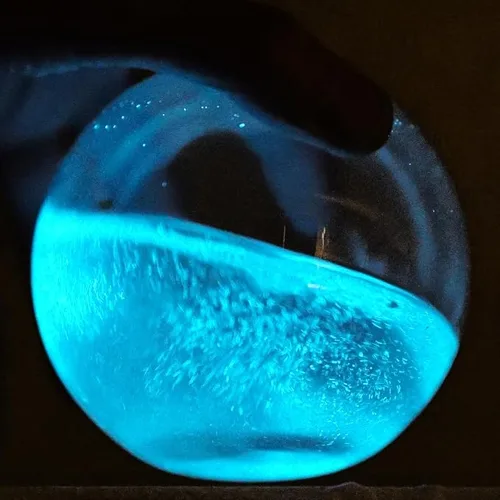
10. PyroFarms Bio-Orb
The Bio-Orb is a 600 ml glass sphere of seawater holding bioluminescent dinoflagellates, single-celled plankton that flash blue when the water moves. Keep it in daylight, swirl it after dark and the whole sphere lights up. The light comes from the same luciferin and luciferase chemistry that makes some ocean waves glow at night.
The detail that makes it a science kit rather than a lamp: the plankton only glow during their own night. They run on a circadian clock, so if you swirl the orb at noon in a dark closet, nothing happens. Keep it on a regular light cycle and it glows on schedule. I spent a week shifting mine by a few hours to see whether the clock would follow. It did, slowly.
- Volume: 600 ml glass sphere, with DinoNutrients for feeding
- Needs: daylight or a grow light, a steady room temperature
- Watch out: the culture is alive and can crash in heat or cold, and ratings are mixed at 4.1 stars
Best microscope for adults
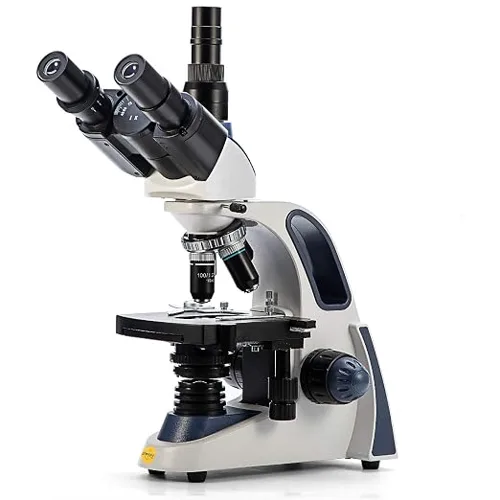
11. Swift SW380T Trinocular Microscope
If one science purchase is going to last you decades, make it a real compound microscope. The SW380T has a Siedentopf binocular head that rotates and adjusts without losing focus, four DIN achromatic objectives on a revolving turret, coarse and fine focus, LED illumination and a third port on top for a camera. It weighs about 4.3 kg, which is a good sign in a microscope: heavy stands do not shake.
Ignore the 2500x on the box. Light microscopes stop resolving new detail at about 1000x to 1500x, and anything beyond that is empty magnification. The 40x to 400x range is where you will spend most of your time: pond water, onion skin, cheek cells, yeast, the gills of a store-bought mushroom. If you want help choosing between this and a cheaper scope, our microscope finder asks five questions and recommends one.
- Head: trinocular Siedentopf, 30-degree tilt, 10x and 25x eyepieces
- Objectives: 4x, 10x, 40x, 100x achromatic (oil on the 100x)
- Watch out: camera not included, and the 25x eyepiece adds magnification without detail
Geology and electronics kits
Best geology kit for adults
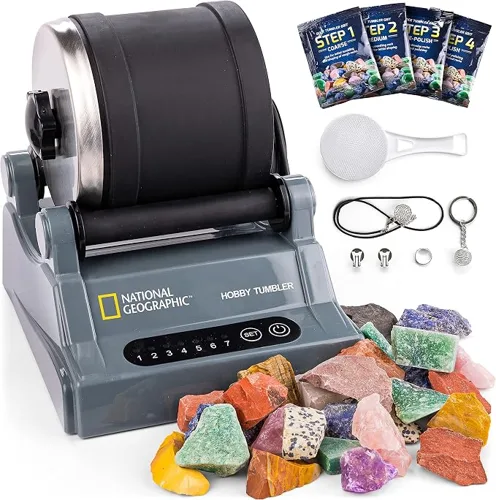
12. National Geographic Hobby Rock Tumbler
A rock tumbler does in a month what a river does in a thousand years. You load the rubber barrel with rough stones, water and coarse silicon carbide grit, and it turns day and night. A week later you rinse, step down to a finer grit and run it again. After four grits, dull pebbles come out glossy and you can see the banding in agate and the crystal structure in quartz.
The kit has more than 25,000 ratings, and the rubber barrel is quieter than the plastic ones on cheaper tumblers, which matters because it runs for weeks. I keep mine in the garage and run beach stones from every trip. Add a United Scientific mineral ID kit with streak plates, a glass plate, a magnet and a hand lens, and you can identify what you polish by hardness, streak color and magnetism.
- Includes: tumbler, four grits, sifter, nine types of rough gemstones, learning guide
- Time: about a week per grit stage
- Watch out: never pour used grit down a drain, it settles and clogs pipes
Best electronics kit for adults
13. ELEGOO UNO R3 Super Starter Kit
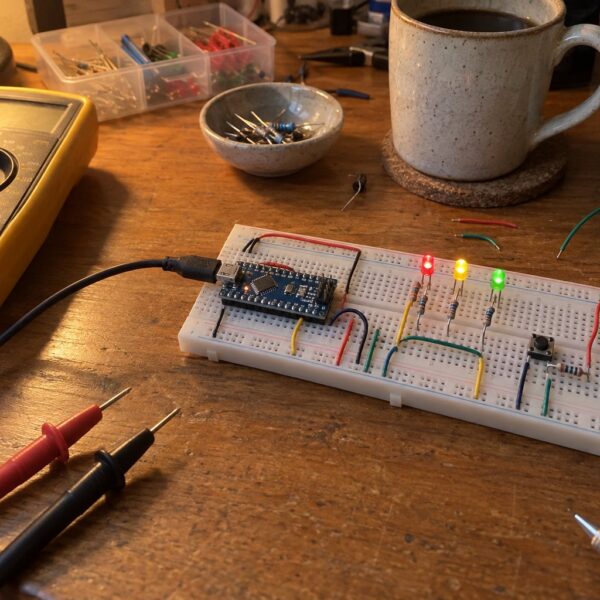
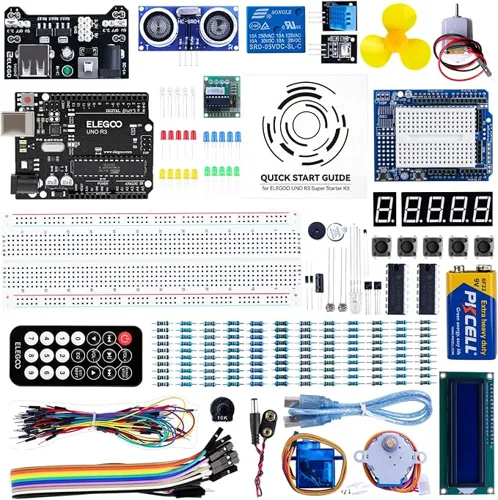
An Arduino kit turns every other kit on this list into a data project. The ELEGOO Super Starter has an Arduino-compatible UNO R3 board, a solderless breadboard, a temperature and humidity sensor, an ultrasonic distance sensor, a servo, a stepper motor, an LCD and more than 20 guided lessons. It has more than 16,000 ratings at 4.7 stars.
I used mine to log the temperature of both Stirling engine plates and plot engine speed against the difference between them. That is the kind of project that makes an adult hobby stick: you ask a question, wire a sensor and get a graph. No soldering is needed. If electronics becomes the main hobby, our best breadboard kit guide covers the next steps.
- Board: ELEGOO UNO R3 (Arduino-compatible), USB-B cable
- Lessons: 22+ projects with PDF tutorial and example code
- Watch out: the PDF explains what to wire more than why
How to choose a science kit for an adult
Start with the subject the person already reads about, not the kit with the most pieces. A friend who listens to geology podcasts will use a rock tumbler for years. The same friend will open a chemistry set once and put it in a cupboard.
- For a chemistry lover: the CHEM C3000 if they have a table and some patience, the molecular model kit if they live in a small flat, the Thompson book if they already own glassware.
- For a physics or engineering mind: the Stirling engine for the desk, the Geiger counter for someone who likes measuring things, the spectroscope as a small add-on gift.
- For a biology or nature person: the mushroom kit as a first step, the Bio-Orb as a conversation piece, the Swift microscope if you want to give one thing that lasts.
- For a maker: the ELEGOO kit, which works with everything else on this list.
- For a couple or a family: the C3000 or the rock tumbler. Both reward working together over several weeks.
Two practical checks before buying. First, space and storage: a chemistry set needs a ventilated table and a locked shelf, a tumbler needs a garage or utility room. Second, time: a Stirling engine works in a minute, a mushroom kit in ten days, a tumbler in a month. Match the kit to how the person spends their evenings.
Home lab safety for adults
When I ran undergraduate labs, every injury I saw came from one of three things: no eye protection, heating a closed container, or eating and drinking at the bench. Adults at home are not more careful than students. They are less supervised.
- Wear splash goggles for any chemistry experiment. Regular glasses leave gaps at the sides. Our lab safety goggles guide lists models with the right rating.
- Keep chemistry off the kitchen counters where food is prepared, and use a dedicated set of spoons and containers.
- Read the hazard information for every chemical in the kit before you start, and keep the kit’s chemicals in their original labelled bottles.
- Never heat a stoppered tube or flask. Gas expands, and glass breaks.
- Keep an alcohol burner away from paper towels and hair, and keep a damp cloth ready to smother small flames.
- Dispose of chemicals the way the manual says, not down whichever drain is closest.
Physics and biology kits are lower risk, but not zero. Ferrofluid stains, neodymium magnets pinch hard enough to blister, and dinoflagellate cultures need to be disposed of in the trash, not a river or a drain that leads to one.
What adult hobbyists recommend
On r/chemistry, when an adult asked for a starter chemistry set for self-study, the most upvoted reply recommended Thompson’s Illustrated Guide to Home Chemistry Experiments and suggested starting with electrochemistry, because it is cheap to set up, the materials are easy to find and it is safe at low voltages. Another reply recommended microscale chemistry: small quantities limit the consequences of mistakes. In a similar thread from someone starting chemistry as a hobby, the top reply was: “Safety. Do not screw around on safety.”
The same pattern shows up among working scientists. In an r/labrats thread about science gifts, the most detailed reply described gifts the writer still treasures years later, a pair of DNA helix earrings and a molecule necklace, because of who gave them. And when a lab director on r/chemistry asked for a new science hobby, mycology and fossil hunting were on the shortlist, which matches what I see: the kits adults keep using are the ones that open into a hobby.
FAQ
The Thames & Kosmos CHEM C3000 is the best science kit for adults. It has 333 experiments, real glassware, an alcohol burner and a 192-page manual that explains the chemistry behind each step. For physics, the best kit is a low-temperature Stirling engine, and for biology it is an oyster mushroom grow kit.
Yes, but most are sold in the kids section. Advanced chemistry sets like the CHEM C3000, instruments like Geiger counters and spectroscopes, Stirling engines, rock tumblers, mushroom grow kits and Arduino electronics kits all suit adults. Judge a kit by its equipment and manual, not its age label.
The Thames & Kosmos CHEM C3000 is the most complete chemistry set for adults, and the CHEM C2000 is a smaller version with 250 experiments. Adults who want to build their own lab should start with Robert Bruce Thompson’s Illustrated Guide to Home Chemistry Experiments, which explains what glassware and chemicals to buy.
Yes. Consumer chemistry sets like the Thames & Kosmos CHEM series are legal to buy and own in the United States. Some individual chemicals are regulated or restricted by federal or state law, so check local rules before buying chemicals beyond what a kit includes.
A good science gift for an adult matches a subject they already enjoy. A Stirling engine suits engineers and physics fans, a Geiger counter suits people who like measuring things, a rock tumbler suits geology fans and a mushroom grow kit or Bio-Orb suits nature lovers. A molecular model kit is a good low-cost gift for chemistry students.
A Stirling engine, a spectroscope, a molecular model kit, a mushroom grow kit and a Geiger counter all work at home with no lab space and no chemicals. A rock tumbler needs a garage or utility room because it runs for weeks and makes noise.
A rock tumbler takes about four weeks to polish stones: roughly one week for each of the four grit stages, from coarse to polish. Harder stones like agate and jasper can need longer in the coarse stage.
A hobby Geiger counter cannot measure radon gas directly, because radon emits alpha particles that most handheld counters do not detect. It can show a rise in background when radon decay products build up, but use a dedicated radon test kit to measure radon in a home.
Yes. A kit gives you a real result to explain, which makes the theory stick. Pair a kit with a textbook, a free online course or a good manual like the CHEM C3000’s, and work through it in order rather than picking the flashiest experiments.
Sources
- Thames & Kosmos: CHEM series product information
- r/chemistry: Recommended starter chemistry set for an adult
- r/chemistry: Looking for a new science hobby
- r/labrats: What is a cool science gift?
- US EPA: Radon
- Wikipedia: Stirling engine
- Wikipedia: Uranium glass
- Wikipedia: Pyrocystis fusiformis
Buying for a younger scientist? See our best science gifts for kids, with a quiz that picks by age and interest.