Table of Contents
- What Is a Black Hole, Actually?
- How Black Holes Form
- Types of Black Holes
- The Event Horizon: Where Physics Gets Weird
- Sagittarius A*: Our Galactic Backyard Has One
- How We Detect Something That Emits No Light
- Hawking Radiation and the Information Paradox
- What Recent Discoveries Are Changing
- What We Still Don’t Know
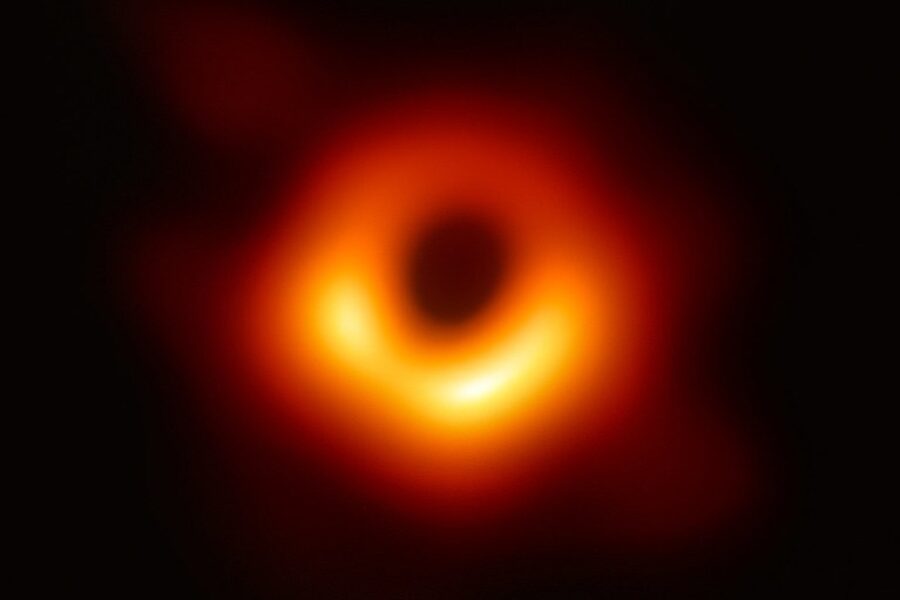
In April 2019, humanity looked at a black hole for the first time. The image — a blurry orange ring surrounding a dark center — was produced by the Event Horizon Telescope, a planet-spanning network of radio observatories that together acted as a single Earth-sized dish. The target was M87*, a supermassive black hole 6.5 billion times the mass of the Sun, sitting 55 million light-years away. The image required eight telescopes on four continents, five petabytes of data, and two years of processing.
And it mostly confirmed what physicists already expected from Einstein’s equations. That’s not a disappointment — it’s extraordinary. A 100-year-old theory survived its hardest observational test yet.
But the image also made clear just how much remains unknown. The bright ring you see isn’t the black hole itself. It’s superheated gas orbiting so fast it glows. The black part in the center? That’s the shadow cast by the event horizon — the point of no return. What’s actually inside remains, in the most literal sense, unknowable from the outside.
Here’s what we do know, and where the physics genuinely runs out.
What Is a Black Hole, Actually? {#what-is-a-black-hole}
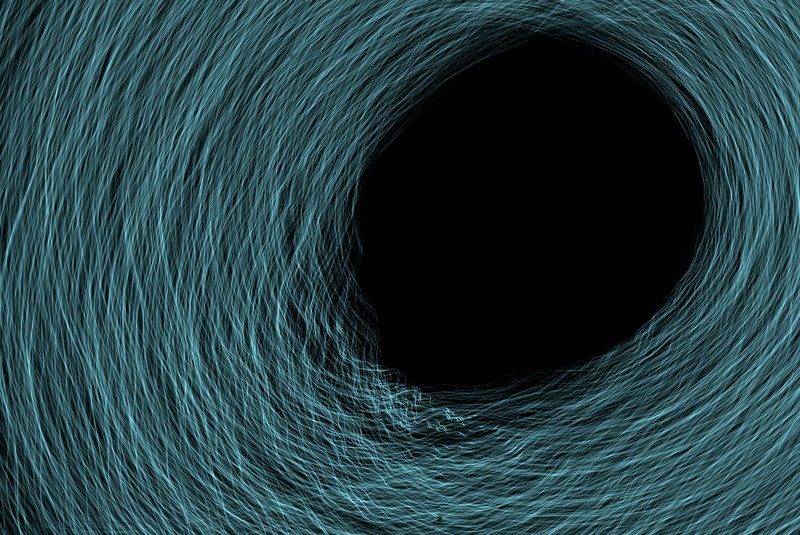
A black hole is a region of space where gravity is so intense that nothing — not matter, not light — can escape once it crosses the boundary called the event horizon. That’s not a metaphor. The escape velocity exceeds the speed of light, which is the universe’s hard speed limit.
The key concept is the singularity: a point (or ring, depending on the type) at the center where, under current physics, density becomes infinite and the known laws of physics break down. “Break down” here doesn’t mean things get weird. It means our equations produce nonsense — infinities where there should be answers — which tells physicists that general relativity, the theory describing gravity, is incomplete at that scale. Something else takes over. We don’t know what.
Think of a black hole not as a vacuum cleaner sucking everything in, but as a region where spacetime itself is so curved that all possible paths lead inward. If you were unfortunate enough to cross the event horizon of a large enough black hole, you might not feel anything dramatic at first — tidal forces at the event horizon of a supermassive black hole are actually quite gentle. You’d cross it without noticing. Then you’d have a finite amount of time before reaching the singularity, and no ability to communicate that fact to anyone outside.
How Black Holes Form {#how-black-holes-form}
The most common route is the death of a massive star. When a star more than roughly 20 times the mass of our Sun exhausts its nuclear fuel, the outward pressure that counteracted gravity disappears. The core collapses catastrophically in less than a second, triggering a supernova explosion. If the remaining core exceeds about 3 solar masses, not even neutron degeneracy pressure can stop the collapse, and a black hole forms.
This produces a stellar-mass black hole — typically between 5 and 100 times the mass of the Sun. These are the most common type.
What creates the supermassive black holes at the centers of galaxies — ranging from millions to billions of solar masses — is a genuinely open question. The leading hypotheses include: direct collapse of massive gas clouds in the early universe, rapid mergers of smaller black holes, or runaway stellar mergers in dense early star clusters. Probably some combination, and probably depending on the environment. Research published in Nature continues to refine these formation models, but no single mechanism has been confirmed.
There’s also a theorized class called primordial black holes, potentially formed from density fluctuations in the early universe — before any stars existed. These remain undetected, but they’re a live candidate for dark matter.
Types of Black Holes {#types-of-black-holes}
| Type | Mass Range | How They Form |
|---|---|---|
| Stellar-mass | 5–100 solar masses | Core collapse of massive stars |
| Intermediate-mass (IMBH) | 100–100,000 solar masses | Unclear — possibly mergers or dense clusters |
| Supermassive | Millions to billions of solar masses | Early universe processes, still debated |
| Primordial (theoretical) | Varies — possibly sub-gram to large | Quantum fluctuations after the Big Bang |
Intermediate-mass black holes are the awkward middle child: theoretically necessary to bridge the gap between stellar and supermassive, but observationally rare. A handful of strong candidates exist, including one found in the star cluster Omega Centauri, but definitive confirmation has been elusive.
The Event Horizon: Where Physics Gets Weird {#the-event-horizon}
The event horizon isn’t a physical surface. There’s no wall, no barrier you’d bump into. It’s a mathematical boundary — the radius at which the escape velocity equals the speed of light. Cross it and you can never return; you haven’t hit anything.
For a non-rotating black hole (a Schwarzschild black hole), the event horizon radius is proportional to mass: twice the mass, twice the radius. A black hole with the Sun’s mass would have an event horizon about 3 kilometers across. M87* — six and a half billion solar masses — has an event horizon larger than our entire solar system.
For rotating black holes (Kerr black holes), which is what most real black holes are, there’s an additional region called the ergosphere outside the event horizon where spacetime itself is dragged around by the rotation. Objects in the ergosphere can still escape, but they’re forced to rotate with the black hole. The Penrose process theorizes that energy can actually be extracted from a rotating black hole via this region — not science fiction, genuine physics. Black holes are, in this sense, one of the most extreme subjects in astrophysics, sitting at the boundary of almost every major subfield.
Sagittarius A*: Our Galactic Backyard Has One {#sagittarius-a}
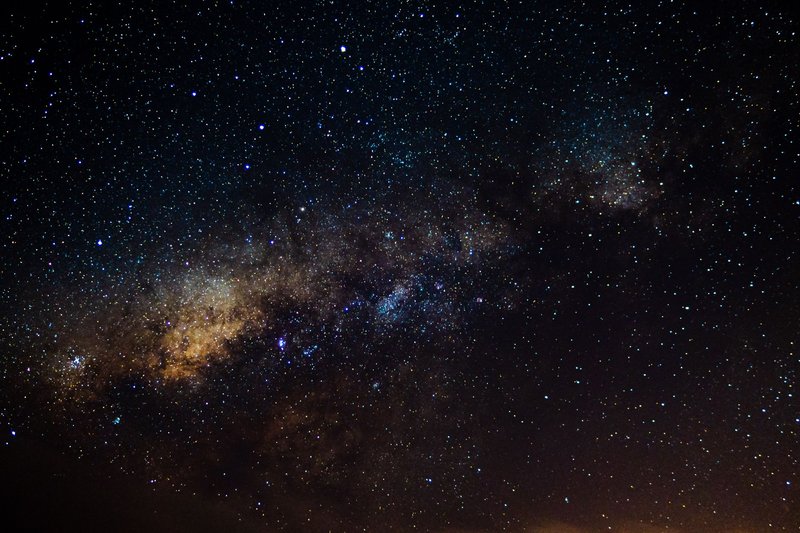
The center of the Milky Way is about 26,000 light-years away. There, a black hole called Sagittarius A* — pronounced “Sagittarius A-star” — sits at the galactic core, containing roughly 4 million solar masses. It’s a relatively quiet supermassive black hole, not actively consuming large amounts of material, which is why our galaxy doesn’t have an active galactic nucleus blasting jets of energy into space.
In May 2022, the Event Horizon Telescope released the first image of Sagittarius A* — far harder to capture than M87 despite being much closer. The challenge: Sgr A is much smaller, so the gas around it orbits faster. The orbital period of material near the event horizon is just minutes, compared to weeks for M87*. The image kept changing while they were trying to photograph it — like trying to photograph a child who won’t stop moving.
The image they produced matches general relativity predictions with impressive precision. The shadow size, the bright ring structure, the overall morphology — all consistent. Einstein, again, holds.
Astronomers have been tracking stars orbiting Sgr A* for over 30 years, and the orbital dynamics provide some of the strongest indirect evidence for a supermassive black hole. One star, S2, completes an orbit in about 16 years and passes within 120 AU of the black hole — close enough to measure relativistic effects directly.
How We Detect Something That Emits No Light {#how-we-detect-black-holes}
Black holes don’t emit light, so detecting them requires catching their effects on surrounding matter and spacetime.
X-ray binaries: When a stellar-mass black hole is paired with a normal star, it can strip gas from its companion. That infalling gas forms an accretion disk — a swirling structure of superheated material that emits intense X-rays before crossing the event horizon. Cygnus X-1, discovered in 1964, was the first strong black hole candidate identified this way.
Gravitational waves: In 2015, the LIGO observatory detected gravitational waves — ripples in spacetime — from two merging black holes, 1.3 billion light-years away. The signal lasted about 0.2 seconds. It confirmed a prediction of general relativity that had never been directly observed, and opened an entirely new way to study black holes. LIGO and its partners have since cataloged dozens of black hole mergers.
Active galactic nuclei and quasars: When supermassive black holes are actively feeding, the surrounding accretion disk can outshine the entire host galaxy. Quasars — the most luminous objects in the universe — are powered by supermassive black holes consuming material at enormous rates.
Stellar orbits: As with Sagittarius A*, tracking the paths of stars near a galactic center reveals the gravitational influence of whatever lurks there, even without seeing it directly.
Hawking Radiation and the Information Paradox {#hawking-radiation-and-the-information-paradox}
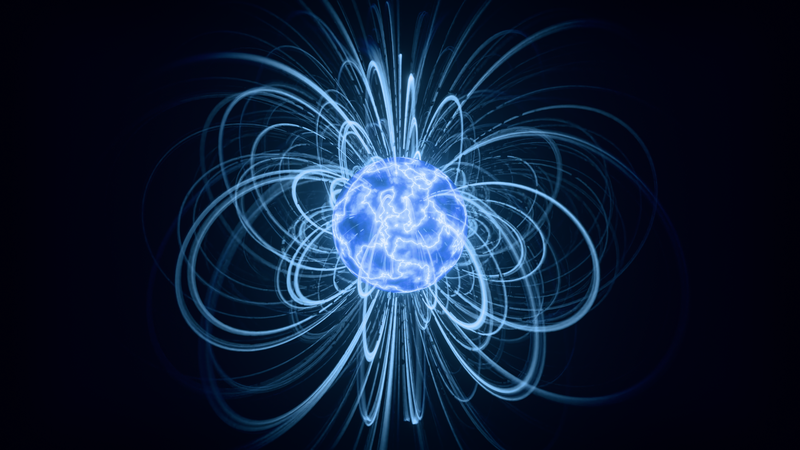
In 1974, Stephen Hawking combined quantum mechanics with general relativity and arrived at a deeply strange result: black holes should slowly radiate energy and eventually evaporate. The mechanism involves quantum fluctuations near the event horizon, where pairs of virtual particles constantly pop in and out of existence. Near the horizon, one particle can fall in while the other escapes as real radiation. The black hole slowly loses mass.
Hawking radiation has never been directly observed — for any black hole we know about, the radiation temperature is so low as to be undetectable against the cosmic microwave background. But the prediction is taken seriously because it follows from well-established physics, and small primordial black holes (if they exist) would have evaporated long ago, ending in a burst of radiation.
The problem it creates is profound: the information paradox. In quantum mechanics, information is conserved. Every physical state, every configuration of particles, is in principle recoverable. But if a black hole forms, swallows information-laden matter, and then evaporates into featureless thermal radiation, where does the information go? Understanding why this matters requires grasping some of the stranger aspects of quantum theory — the facts about quantum physics that make it so fundamentally unlike classical mechanics.
Three proposed answers, none fully satisfying:
- Information is truly lost — quantum mechanics needs to be modified. Most physicists reject this because it would break the theory at a foundational level.
- Information escapes in the Hawking radiation — encoded in subtle correlations in the radiation, too complex to decode. This is the dominant view, but how it escapes is unresolved. The firewall paradox (2012) showed that if information escapes this way, there must be a wall of energy at the event horizon that would incinerate anything crossing it — which contradicts general relativity’s prediction of a smooth crossing.
- Information is stored in a “remnant” or in a companion universe — various speculative proposals that don’t have mainstream support.
The information paradox is not a fringe debate. It’s where quantum mechanics and general relativity directly clash, and resolving it likely requires the theory of quantum gravity that physicists have been working toward for decades.
What Recent Discoveries Are Changing {#recent-discoveries}
The last few years have accelerated black hole science considerably.
The James Webb Space Telescope, launched in late 2021, has detected supermassive black holes in galaxies that existed just 400–600 million years after the Big Bang — far earlier than models predicted. Some of these black holes are surprisingly massive for their age, suggesting they grew faster than standard formation channels allow. This is an active tension in the field: the early universe apparently had ways of building large black holes quickly that we don’t fully understand.
Gravitational wave astronomy has matured rapidly. The LIGO-Virgo-KAGRA network has now cataloged over 90 confirmed compact binary mergers, including black hole-black hole, neutron star-neutron star, and mixed events. The mass distribution of merging black holes shows features — gaps and peaks — that constrain stellar evolution models.
In 2023, pulsar timing arrays (including NANOGrav) announced evidence for a gravitational wave background — a low-frequency hum permeating spacetime, likely from the orbital inspiral of supermassive black hole binaries at the centers of merging galaxies across the universe. It’s the first evidence of this long-predicted signal.
What We Still Don’t Know {#what-we-still-dont-know}
After everything above, here’s an honest accounting of what remains genuinely open:
What’s inside the event horizon? General relativity predicts a singularity. Physicists broadly agree singularities signal where the theory fails, not where something infinite actually exists. But what quantum gravity replaces the singularity with — whether it’s a Planck-scale structure, some kind of “quantum foam,” or something else entirely — is unknown.
How do supermassive black holes grow so fast? The early-universe observations from Webb push this harder. Standard Eddington-limited accretion (the theoretical maximum rate at which a black hole can consume matter) is too slow to explain the masses we’re seeing at high redshift.
Does information escape black holes, and if so, how? The information paradox remains formally unsolved. Various approaches — holography, quantum extremal surfaces, the island formula — show mathematical progress, but a complete, physically satisfying picture doesn’t exist yet.
Are there primordial black holes? If they exist in the right mass range, they could explain part or all of dark matter. Searches via gravitational microlensing and gravitational waves have constrained but not ruled out various mass windows.
What exactly happens at the singularity? This question won’t be answered without a theory of quantum gravity. String theory and loop quantum gravity both propose answers; neither is confirmed.
Black holes sit at the intersection of every major open question in fundamental physics. They’re where general relativity meets quantum mechanics and neither one fully works. The fact that we’ve now imaged two of them, detected dozens more through gravitational waves, and tracked stars orbiting the one in our own galaxy is extraordinary. But the EHT image, for all its historic significance, shows you the edge of the unknown — not the resolution of it.
For a deeper look at current black hole research, NASA’s black hole science hub is a solid starting point, regularly updated with mission data.