As an Amazon Associate we earn from qualifying purchases. Disclosure
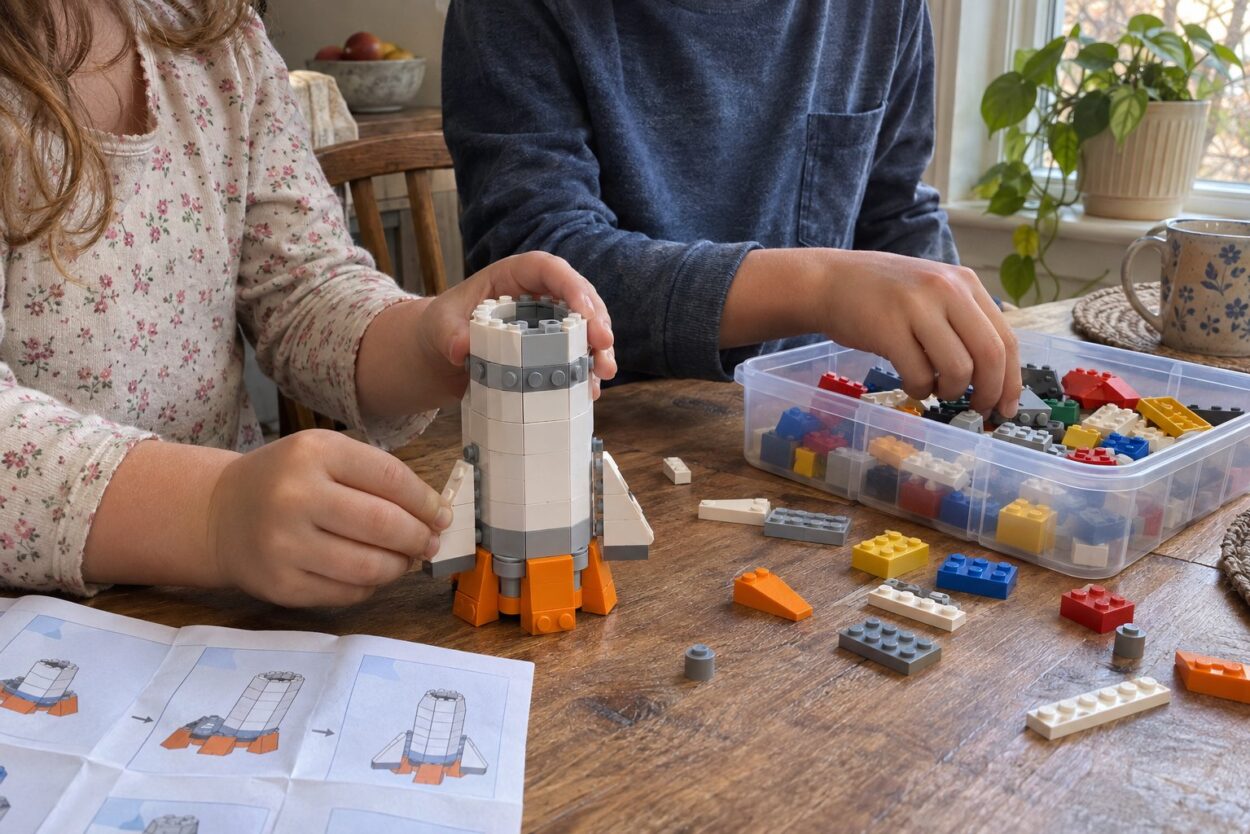
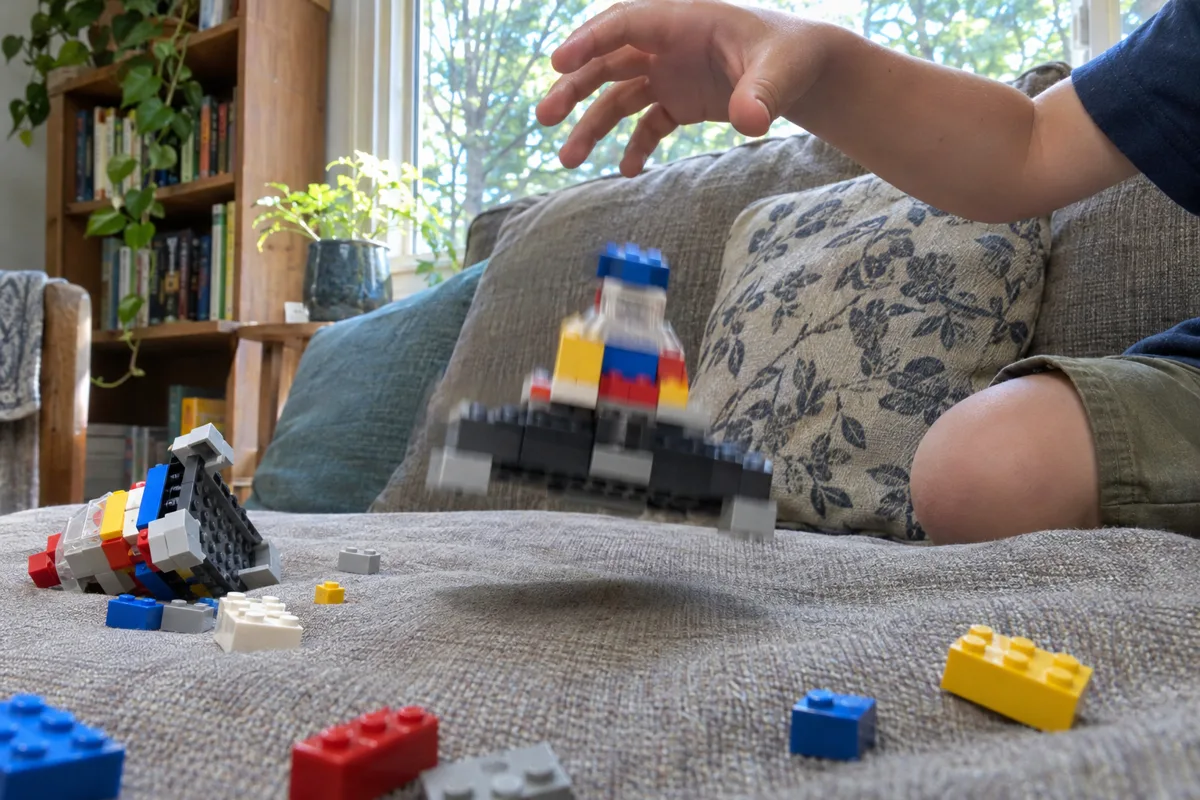
Last spring my son Sami, then six, built a “Moon lander” out of our mixed brick bin and dropped it off the arm of the couch to see if it would land on its feet. It landed on its nose. He rebuilt the top. It landed on its nose again. His sister Noor, watching from the floor, told him to put the heavy bricks at the bottom. On the next drop it landed upright, and Sami had worked out center of gravity without anyone saying the words.
The best science LEGO sets do what that bin of loose bricks did: they let a child build a working model of something real, test it, and change it. For most kids aged 10 and up, the best pick is the LEGO Technic Planet Earth and Moon in Orbit (42179), a hand-cranked model that shows days, seasons and Moon phases with real gears. For kids aged 8 to 10, start with Klutz LEGO Chain Reactions. For teens and adults, the LEGO Icons Hubble Space Telescope (11382) and the LEGO Ideas Mineral Collection (21362) are the most accurate science models LEGO sells right now.
I trained as a geoscientist and spent my field years on Antarctic ice cores and East African volcanoes. At home, Noor is 11 and Sami is 7, and our living room floor has not been brick-free in years. The 18 sets below are sorted by age, with LEGO’s own age rating on each one, and each pick names the science it actually teaches.
Quick picks
| Set | Best for | LEGO age |
|---|---|---|
| Technic Planet Earth and Moon in Orbit (42179) | Best overall: astronomy with working gears | 10+ |
| Klutz LEGO Chain Reactions | Ages 8 to 10: energy and simple machines | 8+ |
| Technic NASA Mars Rover Perseverance (42158) | Engineering and Mars science | 10+ |
| Creator 3in1 Space Shuttle (31134) | Cheapest first space set | 6+ |
| Icons Hubble Space Telescope (11382) | Adults who love astronomy | 18+ |
| Ideas Mineral Collection (21362) | Rock and mineral lovers | 18+ |
| Ideas The Insect Collection (21342) | Biology and nature lovers | 18+ |
| Dinosaur Fossils: Tyrannosaurus rex (76968) | Paleontology display piece | 18+ |
What makes a LEGO set a science set
LEGO does not sort its catalog by science. A set ends up in this guide if it passes one of three tests. It has a working mechanism that behaves like the real thing (an orrery that turns the Moon around the Earth, a rover suspension that keeps six wheels on uneven ground). It is an accurate model of a real scientific object that teaches something while it is being built (a telescope with its mirrors inside, a mineral in its real crystal habit). Or it is built around experiments the child runs and changes.
A set that only borrows a science theme fails all three. A space base with laser cannons is a fine toy, but it teaches no more science than a castle does. A few pretend-play sets made this list anyway because they put a lab, a telescope or a rover in a young child’s hands, and that is often where the questions start.
The building itself has value. In a large sample of U.S. children, Jirout and Newcombe (2015) found that kids who played more often with construction toys, blocks and puzzles scored higher on spatial reasoning tests. Spatial skill predicts later success in science, math and engineering, and following a 3D build from 2D instructions is spatial practice on every page.
In January 2026, LEGO Education also started selling science kits for home use. The four kits (Moon Mission 45200, Antarctic Animals 45201, Mars Mission 45202 and Arctic Animals 45203, ages 7 to 9+) are built around small engineering problems: a lander that tips on its nose until the child shifts its center of gravity, a drop tower that needs a shock absorber, a balance arm that needs a counterweight. They have no app and no electronics, and the adult does most of the explaining. They are sold through LEGO.com and LEGO Stores, not Amazon, so they have no card below.
Best science LEGO sets for kids aged 6 to 9
At this age the science is in the testing, not in the model. Pick sets a child can build alone in one sitting and then change, crash and rebuild. The Klutz kits here are the strongest science picks for young kids, because each one comes with a book that explains the physics behind every build.
Best for ages 8 to 10
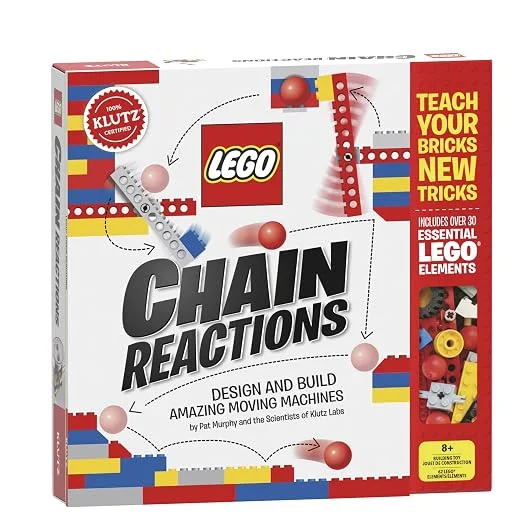
1. Klutz LEGO Chain Reactions
Chain Reactions is a spiral-bound book with the LEGO elements and paper parts needed to build a series of moving machines, each one triggering the next: a ball rolls down a ramp, knocks a lever, which swings a hammer, which starts a car. The author, Pat Murphy, spent years writing hands-on science activities at the Exploratorium in San Francisco, and it shows. Every build comes with a short explanation of the energy transfer, friction or lever it uses.
It is the best science LEGO set for young kids because the machines rarely work on the first try. A ball that stops halfway down the ramp leads straight to a question about slope and friction, and the child has to answer it to get the chain going. It also works with any LEGO bricks a family already has, so it stretches a basic collection into a physics lab.
- LEGO age: 8+
- Book with LEGO elements and paper parts
- Works alongside an existing LEGO collection
Good: real physics explained at a child’s level; every machine can be changed and retested. Not great: the paper ramps wear out with heavy use.
Check on Amazon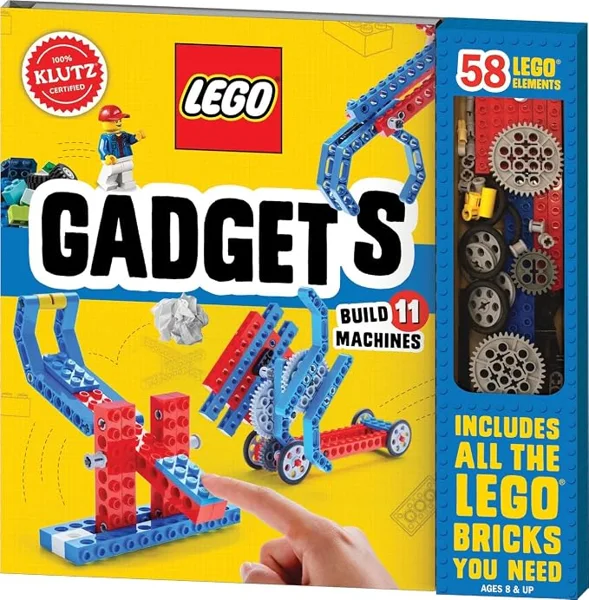
Best for simple machines
2. Klutz LEGO Gadgets
LEGO Gadgets moves from chain reactions to individual machines. It comes with 58 LEGO elements and 6 sheets of papercraft, and the book walks through builds that use gears, levers, cranks and wheels and axles. Each machine is small enough to build at a kitchen table in under an hour.
It pairs well with Chain Reactions. Chain Reactions teaches how energy moves from one machine to the next. Gadgets teaches how a single machine trades force for distance, which is the core idea behind every simple machine.
- LEGO age: 8+
- 58 LEGO elements, 6 papercraft sheets
- Book covers gears, levers and cranks
Good: one of the best-reviewed LEGO activity kits on Amazon; short, finishable builds. Not great: fewer pieces than a regular set, so it feels small to kids used to big boxes.
Check on Amazon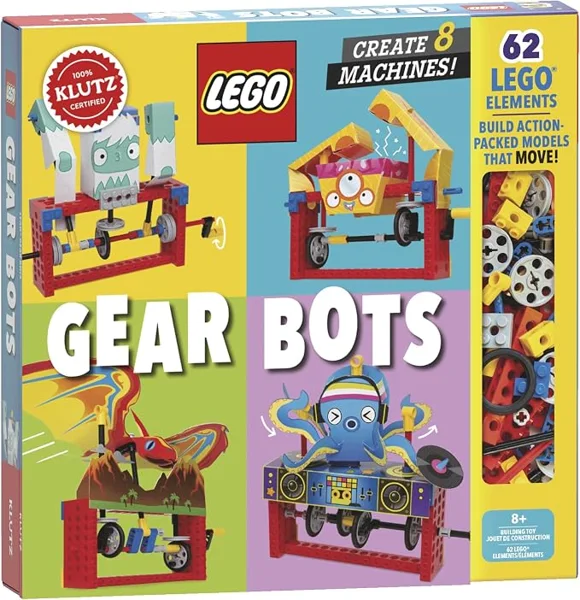
Best first Technic kit
3. Klutz LEGO Gear Bots
Gear Bots uses 62 LEGO Technic elements and papercraft to build 8 kinetic creatures that walk, flap or bob when a crank is turned. The 64-page book explains the axles, cams and cranks inside each one and points out where the same mechanisms show up in everyday machines.
A cam is the part most kids have never heard of and see every day: it turns rotation into an up-and-down push, the same way a camshaft opens the valves in a car engine. Gear Bots makes that visible, and it is a gentle step from regular bricks toward the Technic sets in the next section.
- LEGO age: 8 to 12
- 62 Technic elements, 8 builds
- 64-page book on axles, cams and cranks
Good: teaches real mechanisms with real Technic parts. Not great: the paper bodies are fragile, so the creatures are better for building than for rough play.
Check on Amazon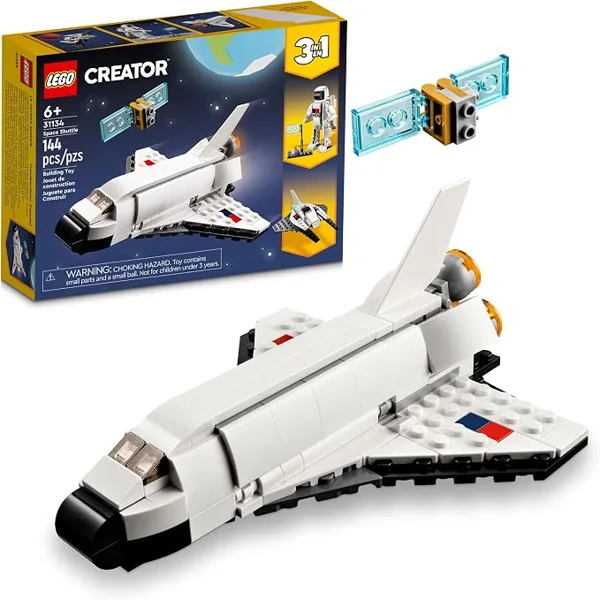
Cheapest first space set
4. LEGO Creator 3in1 Space Shuttle (31134)
This 144-piece set builds a space shuttle with an opening cargo hatch and a removable satellite inside, then rebuilds into a posable astronaut or a spaceship. It is the cheapest LEGO set on this list and a good test of whether a young child cares about space before buying anything bigger.
The satellite in the cargo bay is the science hook. The real shuttle fleet carried satellites and telescopes into orbit in exactly that way, including the Hubble Space Telescope, which Discovery launched in April 1990. That is an easy story to tell while a six-year-old snaps the hatch shut.
- LEGO age: 6+
- 144 pieces
- 3 builds: shuttle, astronaut, spaceship
Good: low cost, quick build, three models from one box. Not great: a toy model, not an engineering set; the science comes from the adult.
Check on Amazon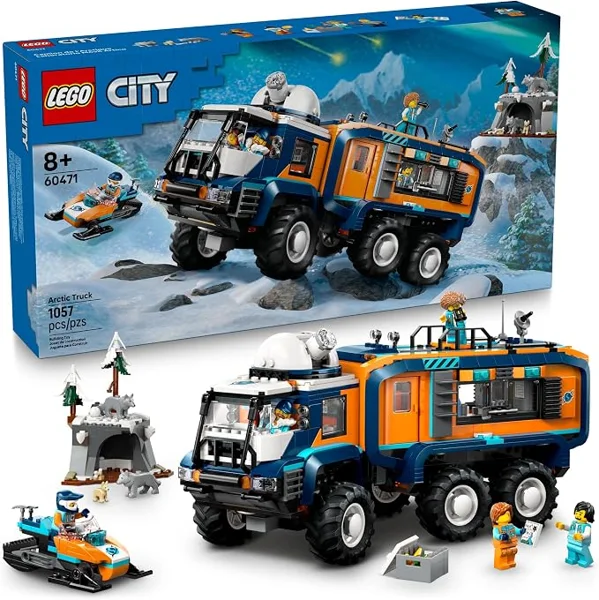
Best for animal lovers
5. LEGO City Arctic Explorer Science Lab Truck (60471)
A 1,057-piece research truck with a laboratory, living quarters and a rotating rooftop observatory, plus a snowmobile, 5 explorer minifigures and 3 Arctic wolves, including a pup. It is a pretend-play set, but the play is fieldwork: tracking a wolf family, collecting samples, bringing them back to the lab.
Polar research really does look like this. Our camp in Antarctica had a heated lab tent where every sample was labeled before it was opened, and a mobile lab is the same idea on wheels. For a child who loves animals more than machines, this is the set that turns “scientist” into a job they can picture.
- LEGO age: 8+
- 1,057 pieces
- 5 minifigures, 3 Arctic wolf figures
Good: fieldwork-style play with a lab and an observatory. Not great: no working mechanism to experiment with.
Check on Amazon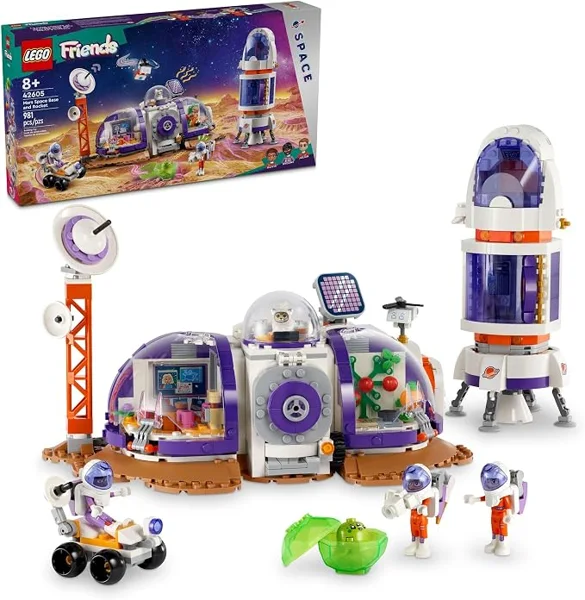
Best space pretend-play set
6. LEGO Friends Mars Space Base and Rocket (42605)
This 981-piece set has a rocket, a Mars research base made of separate living and research pods, a rover and a drone, with three astronaut mini-dolls and a space cat. The pods can be rearranged, so the base layout changes from one play session to the next.
The rover and drone pair copies NASA’s real setup on Mars, where the Perseverance rover carried the small Ingenuity helicopter. Ingenuity made 72 flights before its mission ended in January 2024, the first powered flights on another planet.
- LEGO age: 8+
- 981 pieces
- Rocket, modular base, rover, drone
Good: large, rearrangeable base that holds a child’s interest. Not great: on Amazon it is often sold by third-party sellers, so compare with LEGO.com.
Check on AmazonBest LEGO Technic science sets for ages 9 to 12
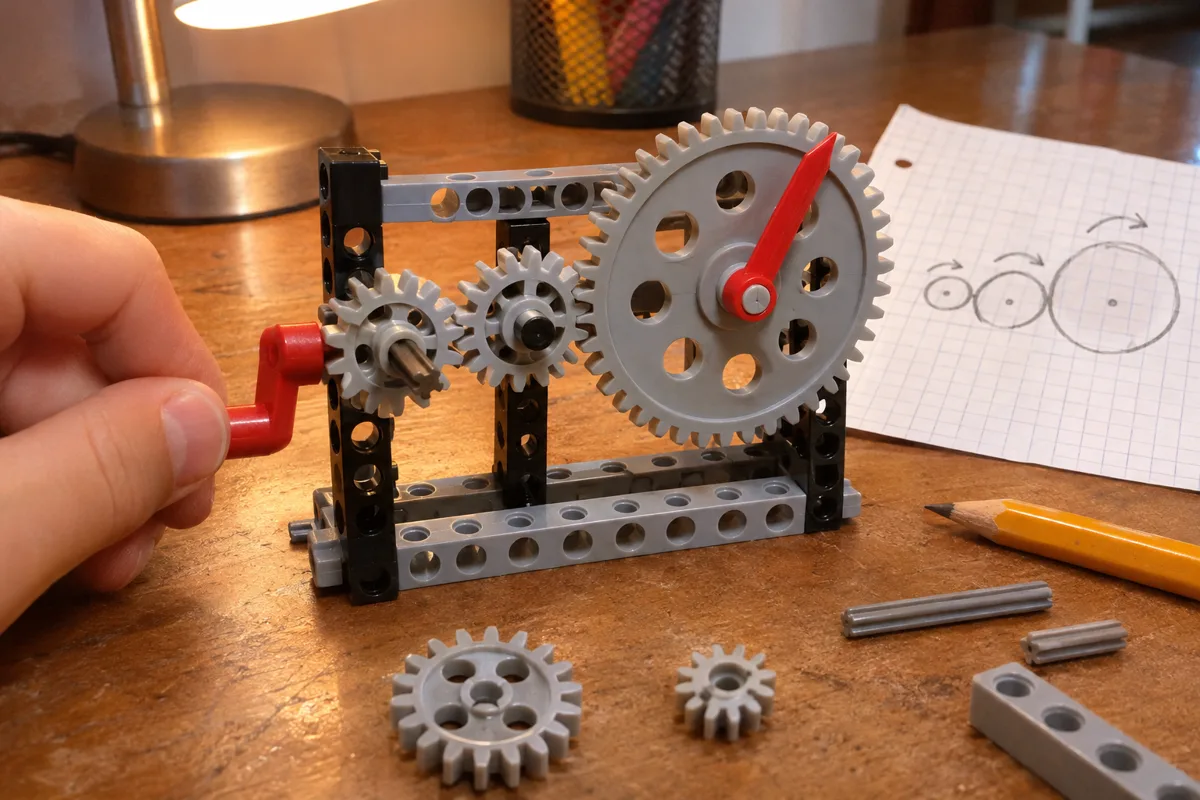
LEGO Technic uses beams, pins, axles and gears instead of studded bricks, and that is where LEGO starts to work like real engineering. A Technic model moves because of a gear train or a linkage the child built, and taking it apart shows exactly how.
Best overall
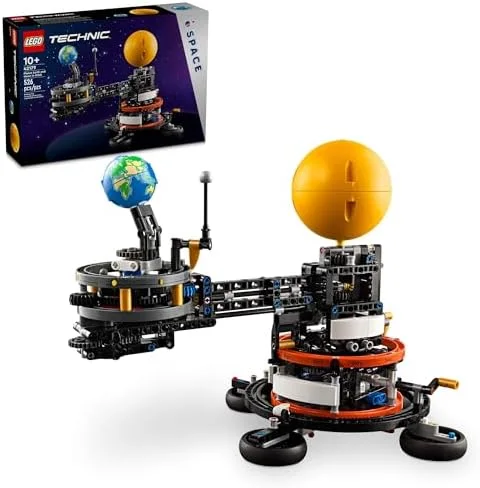
7. LEGO Technic Planet Earth and Moon in Orbit (42179)
This 526-piece set is an orrery: a geared model of the Sun, Earth and Moon. Turning one crank carries the Earth around the Sun, spins the Earth on its tilted axis and swings the Moon around the Earth, all at once. Printed months and Moon phases around the base show where you are in the year. When it came out in 2024, Brickset noted it was the first static, non-vehicle Technic model in about 34 years.
It is the best science LEGO set overall because the science is in the gears, and it is close to right. A spacecraft engineer, Joseph Shoer, checked the gearing in detail. The model’s Earth makes 364.5 rotations per orbit, 0.2 percent off the real year of 365.25 days. Its axial tilt is 22.5 degrees against the real 23.4. The Moon is less exact: it completes a cycle of phases every 27 days, where the real cycle is 29.5, so the model shows about 13 lunar months a year instead of about 12.4. Those numbers are the lesson. Ask a child to count crank turns for one orbit, then ask why the Moon runs fast.
The tilt is what makes seasons, and the model makes it obvious: the Earth’s axis keeps pointing the same direction as it travels around the Sun, so each hemisphere leans toward the Sun for half the year. That idea is hard to get from a diagram and easy to get from a crank.
- LEGO age: 10+
- 526 pieces
- Hand crank drives orbit, rotation and Moon phases
Good: real, checkable astronomy in a model a 10-year-old can build. Not great: the Moon’s cycle runs about 9 percent fast, and LEGO’s notes do not mention it.
Check on Amazon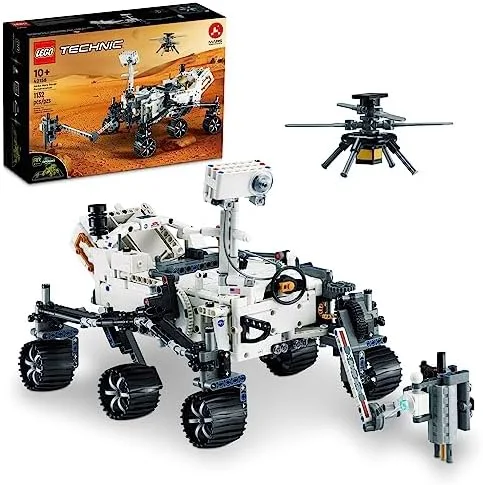
Best for engineering
8. LEGO Technic NASA Mars Rover Perseverance (42158)
A 1,132-piece model of NASA’s Perseverance rover with articulated suspension, 360-degree steering, a movable robotic arm and a small model of the Ingenuity helicopter. An AR app adds information about the real mission.
The suspension is the reason to buy it. Real Mars rovers use a rocker-bogie design: linked arms on each side let the six wheels rise and fall over rocks while the body stays level, with no springs. The LEGO version uses the same linkage, so a child can push one wheel over a book and watch the other wheels stay on the table. Perseverance has been doing that in Jezero Crater since it landed on February 18, 2021.
- LEGO age: 10+
- 1,132 pieces
- Rocker-bogie style suspension, steering, robotic arm, Ingenuity model
Good: a real engineering solution kids can see and test. Not great: Amazon stock comes and goes, so check LEGO.com if the listing is empty.
Check on Amazon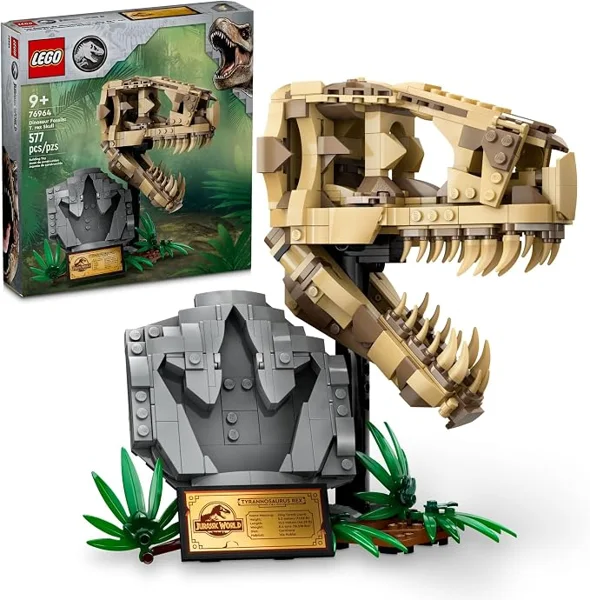
Best for dinosaur kids
9. LEGO Dinosaur Fossils: T. rex Skull (76964)
A 577-piece T. rex skull with an opening jaw, a “fossilized” footprint, a display stand with a plaque and a hidden amber piece. It is the kid-sized version of the full skeleton in the adult section, and it builds like a museum display rather than a toy dinosaur.
That framing matters for a dinosaur-mad child. A skull on a stand invites the questions paleontologists ask: what the teeth say about diet, where the eye sockets point, why the skull has so many openings. Pair it with a trip to see real fossils; our fossils near me map lists places to look by state.
- LEGO age: 9+
- 577 pieces
- Opening jaw, footprint, stand with plaque
Good: a museum-style display a 9-year-old can build alone. Not great: it is a Jurassic World set, so the plaque leans on the movies more than on paleontology.
Check on AmazonTwo more Technic space sets are worth a look for this age. The LEGO Technic NASA Artemis Space Launch System (42221) is a 9+ version of the big Artemis rocket in the adult section, and the LEGO Technic Lunar Outpost Moon Rover (42211) is a 10+ model of a crewed Moon rover designed by the company Lunar Outpost.
Best LEGO sets for adults who love science
LEGO’s 18+ sets are display models, and the science ones are some of the most accurate things the company makes. They also make good gifts for teenagers who are patient builders; the 18+ rating reflects build length and complexity, not safety.
Best for astronomy
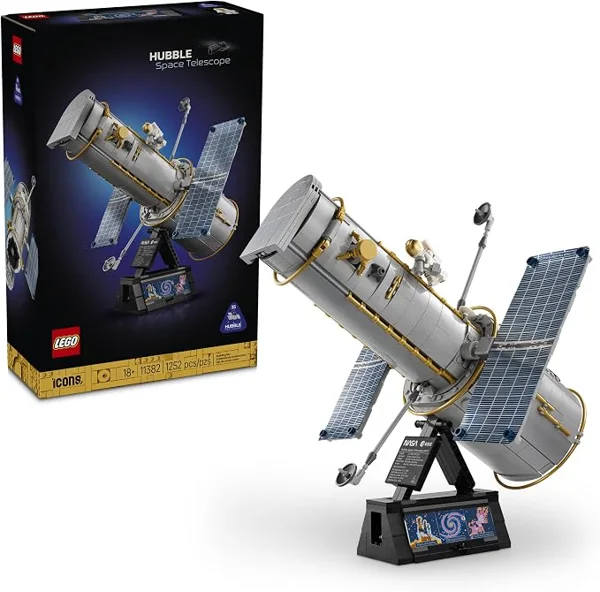
10. LEGO Icons Hubble Space Telescope (11382)
Released on August 1, 2026, this 1,252-piece model has posable solar arrays and antennas, an opening aperture door and removable outer panels that reveal the instrument bay, with gyroscopes and the primary and secondary mirrors inside. An astronaut minifigure shows the scale, and it stands on a display base with an information plaque.
The mirrors are what make it a science set. Hubble is a reflecting telescope: light enters the tube, hits a 2.4-meter primary mirror at the back, bounces forward to a smaller secondary mirror and then passes back through a hole in the primary to the instruments. Building the LEGO version puts that light path in your hands. The astronaut is a nod to the five Space Shuttle servicing missions that repaired and upgraded Hubble in orbit, starting with the 1993 fix for its flawed mirror.
- LEGO age: 18+
- 1,252 pieces
- Removable panels show mirrors and gyroscopes
Good: accurate inside and out; a mid-size build that fits on a desk. Not great: new in 2026, and some Amazon listings are from resellers; check that the seller is Amazon or LEGO.
Check on Amazon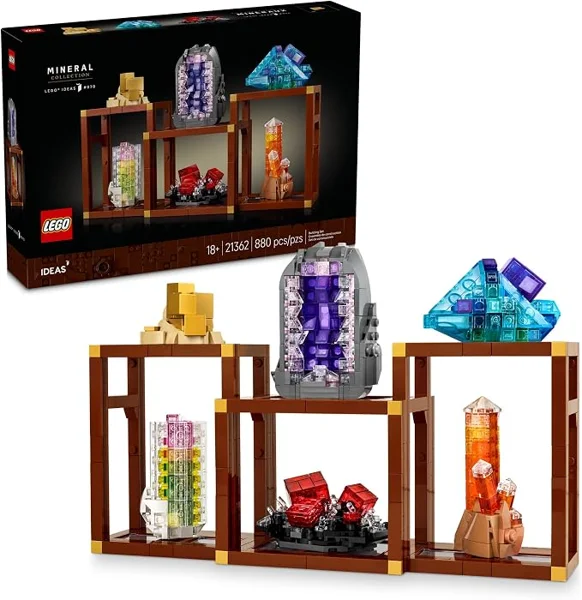
Best for rock and mineral lovers
11. LEGO Ideas Mineral Collection (21362)
This 880-piece set builds six minerals and three display shelves: golden pyrite, purple amethyst, blue fluorite, watermelon tourmaline, reddish-pink rhodochrosite and tangerine quartz. The minerals clip onto any shelf, so the display can be rearranged.
As a geologist, I like the choice of minerals. Each one teaches something different. Pyrite grows in near-perfect cubes, which is why it looks machined. Amethyst is ordinary quartz colored purple by traces of iron. Fluorite gave its name to fluorescence because many specimens glow under ultraviolet light. Watermelon tourmaline changes color from core to rim as the chemistry of the fluid it grew from changed. Rhodochrosite is manganese carbonate and Argentina’s national stone. Tangerine quartz gets its color from a thin coating of iron oxide, not from the quartz itself.
It is also the cheapest of LEGO’s 18+ science sets. Put a real specimen or two next to it and you have the start of a mineral collection; our guide to silicate minerals covers quartz and tourmaline in more depth.
- LEGO age: 18+
- 880 pieces
- 6 minerals, 3 rearrangeable shelves
Good: accurate colors and crystal habits; lowest-cost adult science set. Not great: the brick crystals are stylized, so pair them with real specimens for teaching.
Check on Amazon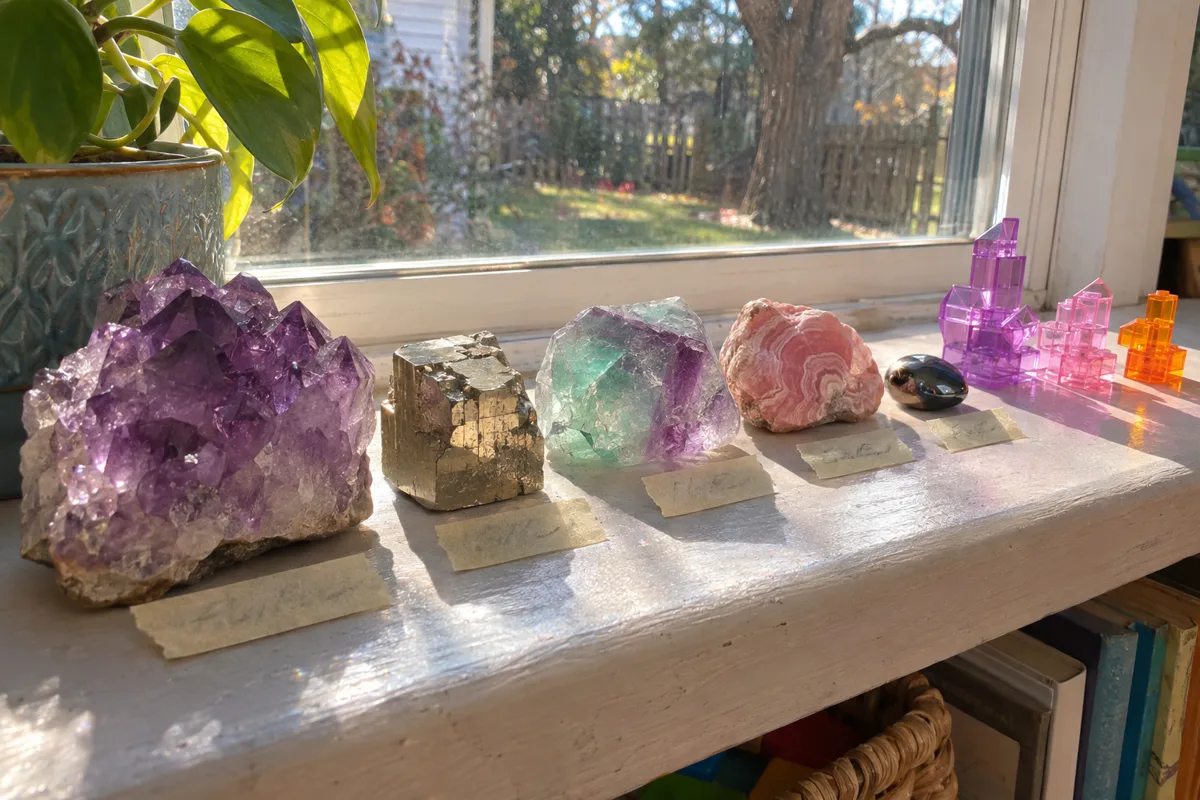
Best for biology
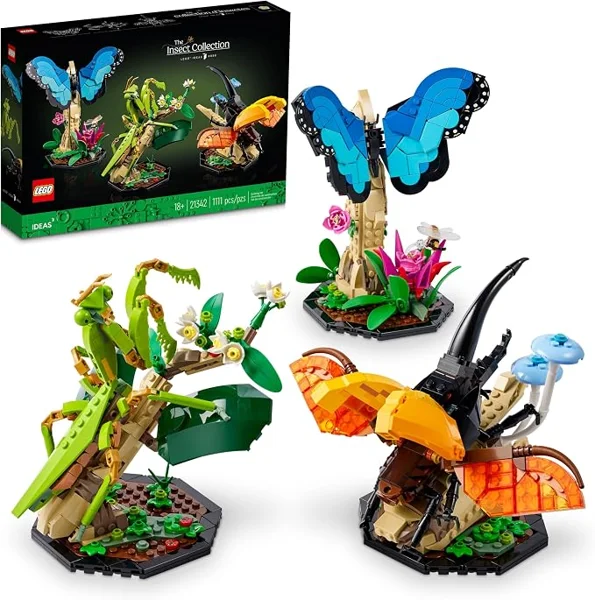
12. LEGO Ideas The Insect Collection (21342)
Three life-size, posable insects on small habitat bases: a blue morpho butterfly (Morpho peleides) with a honeybee and flower, a male Hercules beetle (Dynastes hercules) with attachable wings and its long horns, and a female Chinese mantis (Tenodera sinensis) with a seven-spotted ladybug. The set has 1,111 pieces.
Each insect carries a lesson. The morpho’s blue is structural color: it comes from microscopic ridges on the wing scales that reflect blue light, not from pigment. The Hercules beetle is one of the longest beetles in the world, and only males have the horns. The Chinese mantis is not native to North America; it was introduced near Philadelphia in the 1890s and is now common across the eastern United States. Our guide to insect anatomy covers the body plan all three share.
- LEGO age: 18+
- 1,111 pieces
- 3 insects with Latin names on the build
Good: the most biologically accurate LEGO set; species-level detail. Not great: released in 2023, so Amazon stock is often from third-party sellers.
Check on Amazon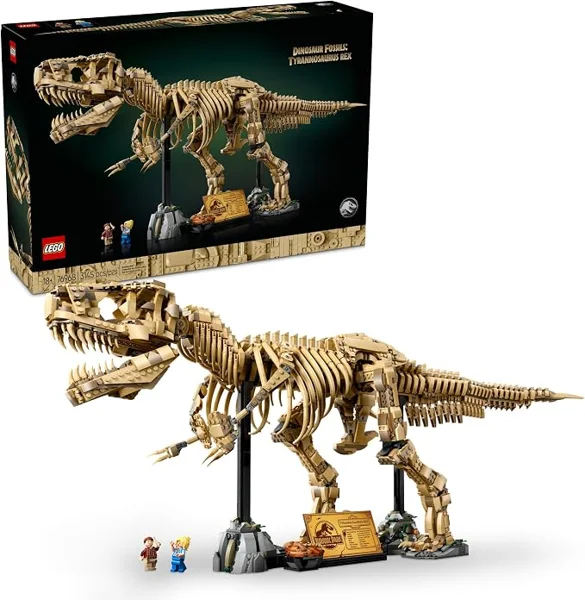
Best for paleontology
13. LEGO Dinosaur Fossils: Tyrannosaurus rex (76968)
A 3,145-piece T. rex skeleton with a movable head, opening jaw, posable arms and tail, a display stand with an information plaque and minifigures of the two paleontologists from Jurassic Park. The instructions are printed in a coffee-table style with dinosaur facts.
Building a skeleton bone by bone is a crash course in anatomy, and the posable joints show how a 2-legged predator balanced its huge head over its hips with a long, stiff tail. The best real reference is Sue at the Field Museum in Chicago, about 12.3 meters long and roughly 90 percent complete, still one of the most complete T. rex skeletons ever found.
- LEGO age: 18+
- 3,145 pieces
- Posable skeleton, stand, 2 minifigures
Good: large, striking anatomy model. Not great: takes a lot of shelf space, and the movie tie-in is stronger than the science on the plaque.
Check on Amazon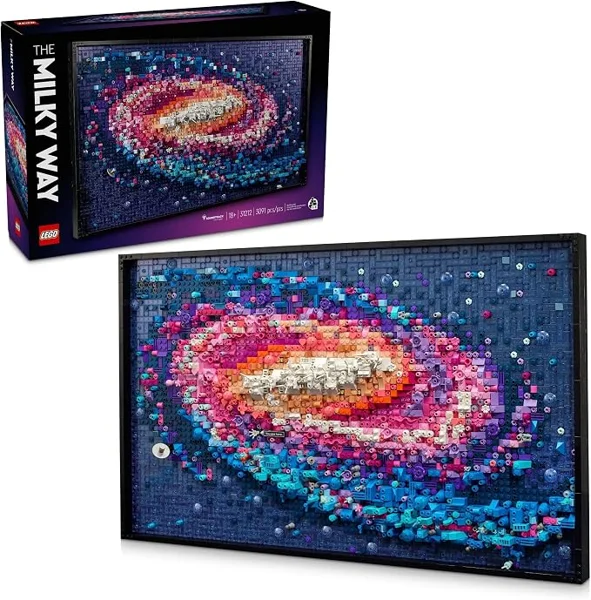
Best wall piece
14. LEGO Art The Milky Way Galaxy (31212)
A 3,091-piece layered wall artwork of the Milky Way, built in 5 panels that each have their own instruction booklet, so several people can build at once. It marks real objects, including the TRAPPIST-1 system, the Pleiades, the Crab Nebula and the Pillars of Creation.
It also raises a good question: nobody has ever photographed the Milky Way from above. We live inside its disk, about 26,000 light-years from the center, so every top-down image is a reconstruction built from star surveys and radio maps of its gas. Finding where the Sun sits on the panel is a good conversation starter.
- LEGO age: 18+
- 3,091 pieces
- 5 panels for group building
Good: a group build with real astronomical objects marked. Not great: a flat artwork with no mechanism; long, repetitive build.
Check on Amazon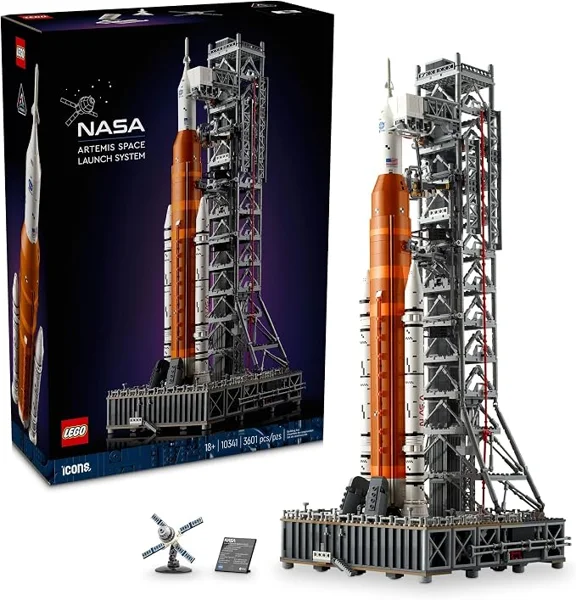
Best big space build
15. LEGO Icons NASA Artemis Space Launch System (10341)
The largest set in this guide: 3,601 pieces for NASA’s Space Launch System with two solid rocket boosters, the Orion capsule and the mobile launch tower. The boosters detach, the stages separate and the tower’s umbilical arms retract.
The separating stages are the science. A rocket drops each stage once its fuel is used, because carrying empty tanks wastes energy. SLS first flew on the uncrewed Artemis I mission on November 16, 2022, sending Orion around the Moon and back.
- LEGO age: 18+
- 3,601 pieces
- Separating stages, detachable boosters, launch tower
Good: shows staging clearly; a long, absorbing build. Not great: the most expensive pick here, and very tall on a shelf.
Check on Amazon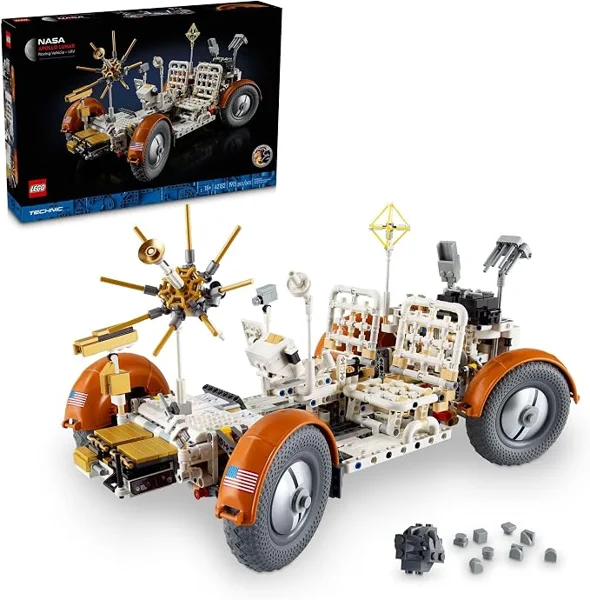
Best adult Technic set
16. LEGO Technic NASA Apollo Lunar Roving Vehicle (42182)
A 1,913-piece Technic model of the Apollo 17 Lunar Roving Vehicle with working steering and suspension, seats, the battery pack, heating and cooling elements, a communications unit and tools for collecting lunar samples. Three equipment attachments each come with their own plaque.
The real LRV folded up to ride to the Moon on the side of the lunar module, and astronauts on Apollo 15, 16 and 17 drove it to collect rock samples far beyond walking distance. All three rovers are still on the Moon. For a geologist, the sample tools are the best part: Apollo 17 was the only mission that included a trained geologist, Harrison Schmitt.
- LEGO age: 18+
- 1,913 pieces
- Working steering and suspension
Good: real Technic mechanisms plus Apollo history. Not great: a single vehicle, so the display is smaller than the piece count suggests.
Check on Amazon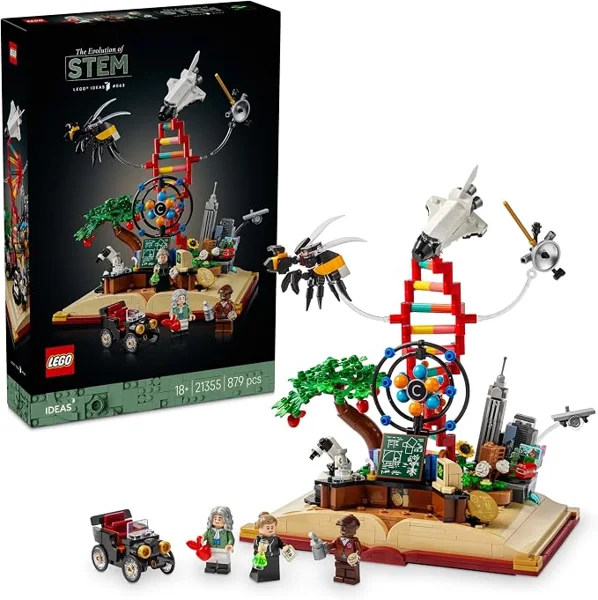
Best for history of science
17. LEGO Ideas The Evolution of STEM (21355)
An 879-piece display with minifigures of Marie Curie, George Washington Carver and Isaac Newton, plus small scenes for each: Newton’s apple tree, Carver’s plant beds, a floating model of a carbon atom and a rotating DNA strand.
It is the only set here about scientists rather than science, and it makes a good desk piece for a teacher or a student. LEGO lists it as retiring soon, and on Amazon it is sold by third-party sellers, so check the price against LEGO.com before buying.
- LEGO age: 18+
- 879 pieces
- 3 scientist minifigures, DNA and atom models
Good: celebrates three very different scientists. Not great: retiring, so stock and sellers vary.
Check on Amazon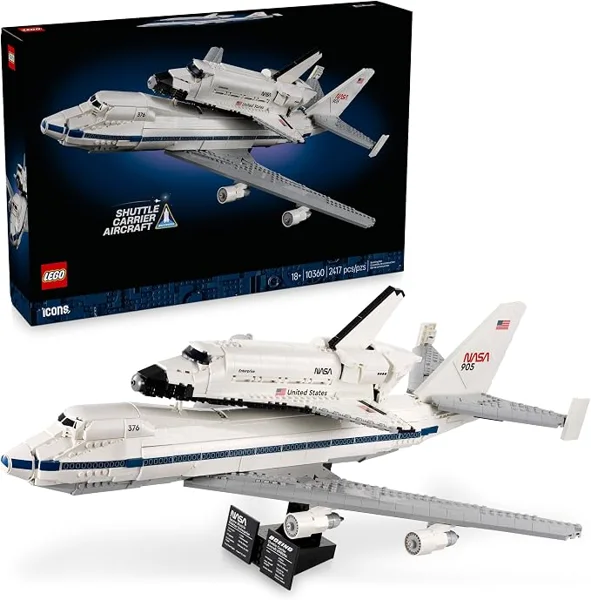
Best for aerospace fans
18. LEGO Icons Shuttle Carrier Aircraft (10360)
A 2,417-piece model of the modified Boeing 747 that ferried the Space Shuttle between landing sites and the launch site, with Space Shuttle Enterprise mounted on top. A dial extends the 18-wheel landing gear, and the shuttle’s tail cone, engines and landing gear can be stowed in its cargo bay.
Enterprise never went to space. It was the test orbiter, carried aloft by this aircraft in 1977 and released for gliding approach and landing tests that proved a shuttle could land like a plane. Those flights are aerodynamics in their purest form.
- LEGO age: 18+
- 2,417 pieces
- Working landing gear, two models in one
Good: two aerospace icons and a working gear mechanism. Not great: more aviation history than science; very wide on a shelf.
Check on AmazonLEGO robotics and coding sets
LEGO ended both Mindstorms and Boost, its consumer robotics lines, at the end of 2022. The robotics sets it still makes are sold by LEGO Education: SPIKE Essential for elementary school, and SPIKE Prime for grades 6 to 8, which can be programmed in Scratch-style blocks or in Python. Both come with motors, sensors and a programmable hub.
They are classroom products, priced and packed for schools. On Amazon, SPIKE listings are mostly from third-party sellers well above LEGO Education’s own price, so buy them from LEGO Education directly. For a child who is not yet sure about coding, the Technic sets above teach the mechanical half of robotics for far less. Our article on robotics engineering covers where those skills lead.
Buying science LEGO on Amazon: check the seller
Popular LEGO sets, especially ones that are retiring or sold out at LEGO, often get resold well above list price. When this guide was checked in November 2026, the Amazon listings for the LEGO Ideas Saturn V (92176), the Apollo 11 Lunar Lander (10266) and the LEGO Ideas Globe (21332) were from resellers well above LEGO’s list price. They are excellent sets, so buy them from LEGO.com when they are in stock there.
Two habits help. Look at “Ships from” and “Sold by” on the Amazon page: Amazon.com as the seller usually means list price or a discount. And compare with the set’s page on LEGO.com, which shows the list price and whether the set is “retiring soon.”
Science LEGO sets by age
| Age | Best picks | Why |
|---|---|---|
| 6 to 7 | Creator Space Shuttle, a bin of loose bricks | Short builds; science comes from testing and asking |
| 8 to 9 | Chain Reactions, Gadgets, Gear Bots, Arctic Science Lab | Builds with a book that explains the physics |
| 10 to 12 | Planet Earth and Moon, Perseverance, T. rex Skull | Technic mechanisms that model real systems |
| 13 and up | Mineral Collection, Hubble, Apollo LRV | 18+ display sets suit patient teen builders |
| Adults | Insect Collection, T. rex, Artemis SLS | Accurate models for display |
How to turn a LEGO set into a science lesson
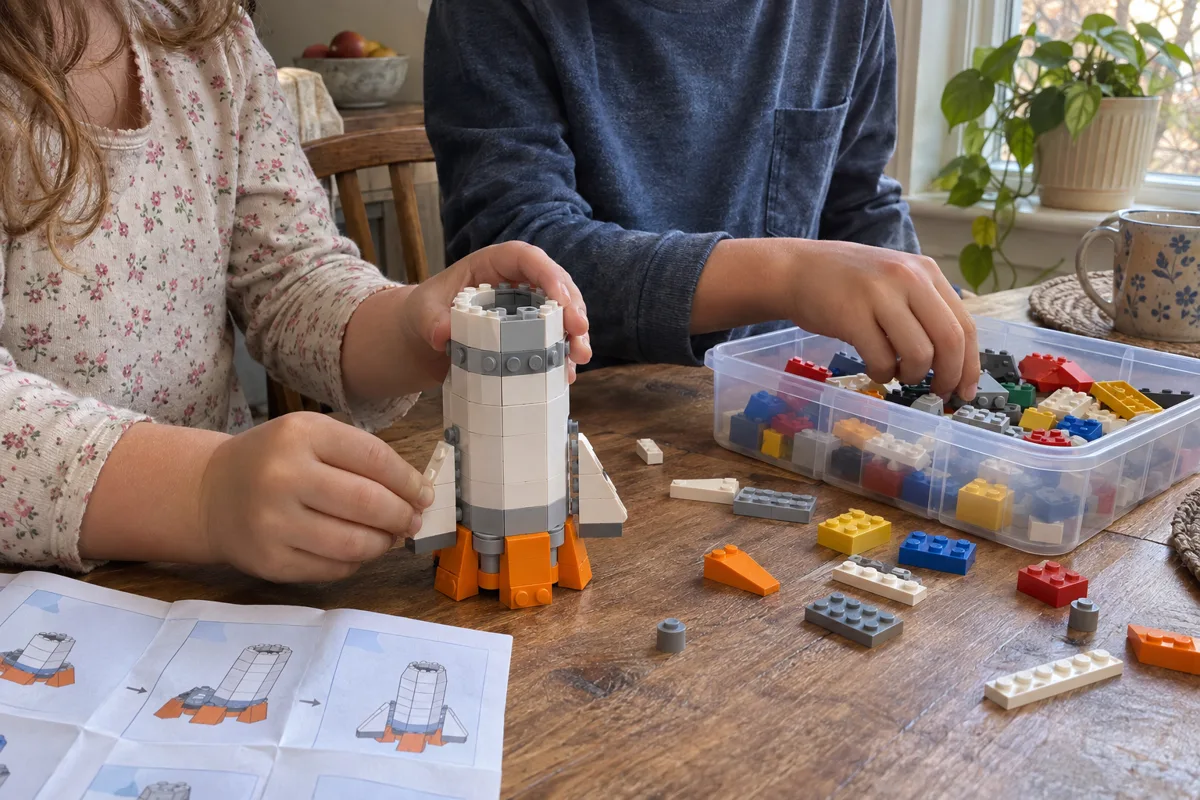
A set teaches the most after it is built. These four activities work with the sets above or with loose bricks.
Drop test (ages 5 and up). Build a small lander and drop it from the same height onto a cushion ten times. Count how many times it lands upright. Then move the heaviest bricks to the bottom and try again. One change, ten drops, a tally on paper: that is a controlled experiment, and it is the same center-of-gravity problem LEGO Education’s Moon Mission kit is built around.
Gear count (ages 8 and up). On any Technic set with gears, count the teeth on two meshing gears and predict how many times the small one turns for one turn of the big one. Then check by turning it. On the Planet Earth and Moon set, count crank turns for one orbit and compare with 365 days.
Mineral match (ages 8 and up). Put a real quartz crystal, a piece of pyrite or any rock from the yard next to the Mineral Collection. Rub the rock across the back of an unglazed white tile and look at the color of the streak. Noor found that a black pebble from our driveway left a red-brown streak, which made it hematite, not the meteorite she hoped for.
Scale model (ages 10 and up). Use the Hubble astronaut minifigure to estimate the real telescope’s length, then look up the real figure (13.2 meters) and see how close you got. For a model with planets, our guide to solar system models shows why no tabletop model can get both planet sizes and distances to scale, and how to make planets for a school project covers a version kids can build themselves.
For more science toys beyond LEGO, see our guide to toys for kids who love science, and for teens and grown-ups, the best science kits for adults.
FAQ
The LEGO Technic Planet Earth and Moon in Orbit (42179) is the best science LEGO set for most people aged 10 and up. Its hand-cranked gears model the Earth’s rotation, its tilted orbit around the Sun and the Moon’s phases, with the year accurate to within 0.2 percent. For adults, the LEGO Icons Hubble Space Telescope (11382) and the LEGO Ideas Mineral Collection (21362) are the most accurate display models.
Yes. LEGO Education sells four science kits for home use, launched in January 2026: Moon Mission (45200), Antarctic Animals (45201), Mars Mission (45202) and Arctic Animals (45203), for ages 7 to 9 and up. Each kit sets small engineering problems for the child to solve. They are sold through LEGO.com and LEGO Stores. LEGO Education also sells K-8 science kits for classrooms.
LEGO Technic sets are the best for STEM learning, because they use real gears, axles and linkages. The Planet Earth and Moon in Orbit (42179) and NASA Mars Rover Perseverance (42158) are the strongest picks for ages 10 and up. For ages 8 to 10, the Klutz LEGO kits (Chain Reactions, Gadgets and Gear Bots) come with books that explain the physics of each build.
Yes. Building with construction toys is linked to stronger spatial reasoning, a skill that predicts later success in science and math. In a large U.S. sample, Jirout and Newcombe (2015) found that children who played more with blocks, puzzles and construction toys scored higher on spatial tests. Sets with working mechanisms add a second benefit: kids can change one part and test the result.
The LEGO Technic Planet Earth and Moon in Orbit (42179) teaches how the Earth, Moon and Sun move, including seasons and Moon phases. It models the Earth’s year closely (364.5 rotations per orbit against the real 365.25) and its axial tilt at 22.5 degrees against the real 23.4, but its Moon cycle runs about 27 days instead of 29.5.
The best science LEGO sets for adults are the Icons Hubble Space Telescope (11382), the Ideas Mineral Collection (21362), the Ideas Insect Collection (21342), the Dinosaur Fossils: Tyrannosaurus rex (76968), the Art Milky Way Galaxy (31212) and the Icons NASA Artemis Space Launch System (10341). All are rated 18+ and built for display.
Yes. LEGO retired Mindstorms, along with LEGO Boost, at the end of 2022. Its robotics sets are now LEGO Education SPIKE Essential for elementary grades and SPIKE Prime for middle school, which can be coded with blocks or Python. Both are sold mainly through LEGO Education.
For a 10-year-old who loves space, the LEGO Technic Planet Earth and Moon in Orbit (42179) or the NASA Mars Rover Perseverance (42158), both rated 10+. For a 10-year-old who loves dinosaurs, the Dinosaur Fossils: T. rex Skull (76964), rated 9+. For one who likes building machines, Klutz LEGO Gear Bots.
Sources
- Amazon product listings, piece counts and LEGO age ratings for every set above, checked November 2026.
- Joseph Shoer, “A Spacecraft Engineer’s Review of Lego #42179 Planet Earth and Moon in Orbit” (2024).
- Brickset, Review: 42179 Planet Earth and Moon in Orbit.
- The LEGO Group, LEGO Education Inspires Hands-On Discovery for Young Builders at Home with New STEM Sets (January 2026).
- New Elementary, Review: LEGO Education at-home sets (February 2026).
- Jamie J. Jirout and Nora S. Newcombe, “Building Blocks for Developing Spatial Skills: Evidence From a Large, Representative U.S. Sample,” Psychological Science 26 (2015).
- NASA, Hubble Space Telescope.
- NASA, Mars 2020 Perseverance Rover and Ingenuity Mars Helicopter mission pages.
- NASA Space Science Data Coordinated Archive, The Apollo Lunar Roving Vehicle.
- Field Museum, SUE the T. rex.
- Mindat.org mineral data for pyrite, quartz, fluorite, elbaite (tourmaline) and rhodochrosite.