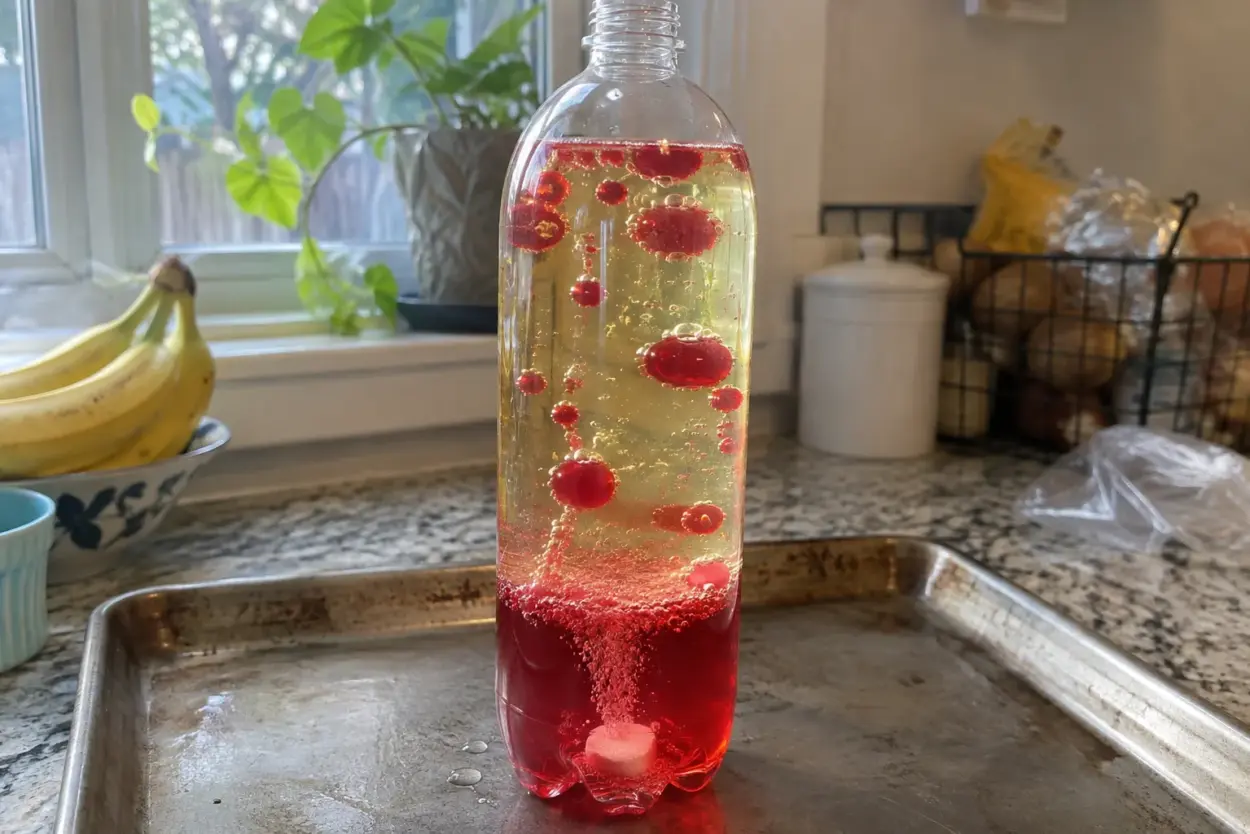
Short answer: fill a clear bottle one quarter with water, add 5 to 10 drops of food coloring, then fill it almost to the top with vegetable oil, leaving about 2 cm of air. Wait a minute for the layers to settle and drop in a quarter of an Alka-Seltzer tablet. Colored blobs rise and fall for about a minute per piece, and a fresh piece restarts it.
I have run this demonstration for kids and adults more times than I can count, and the difference between a dull bottle and a great one comes down to three details: the right oil-to-water ratio, small tablet pieces instead of whole tablets, and a light underneath. This guide covers the classic version, a version without medicine for younger kids, the salt and glow-in-the-dark variations, how a real wax lava lamp works, and the chemistry and physics of every blob.
At a glance
What you need
- 1 clear bottle or tall glass, 12 to 34 oz
- 3 parts vegetable oil or baby oil
- 1 part water
- 5 to 10 drops liquid food coloring
- 1 Alka-Seltzer Original tablet, broken in quarters
- A flashlight (optional, for the glow)
Steps
- Pour water into the bottle to one quarter full.
- Stir in the food coloring.
- Fill with oil, leaving about 2 cm at the top.
- Wait until the layers separate.
- Drop in a quarter tablet and watch the blobs.
Small pieces, slow blobs
Break the tablet into quarters, or even eighths. A whole tablet makes a fast, foamy burst that turns the oil cloudy. Small pieces give slow, separate blobs, which is the lava lamp look.
This guide contains Amazon affiliate links. 33Science earns a commission on qualifying purchases. See our affiliate disclosure.
Materials and tools
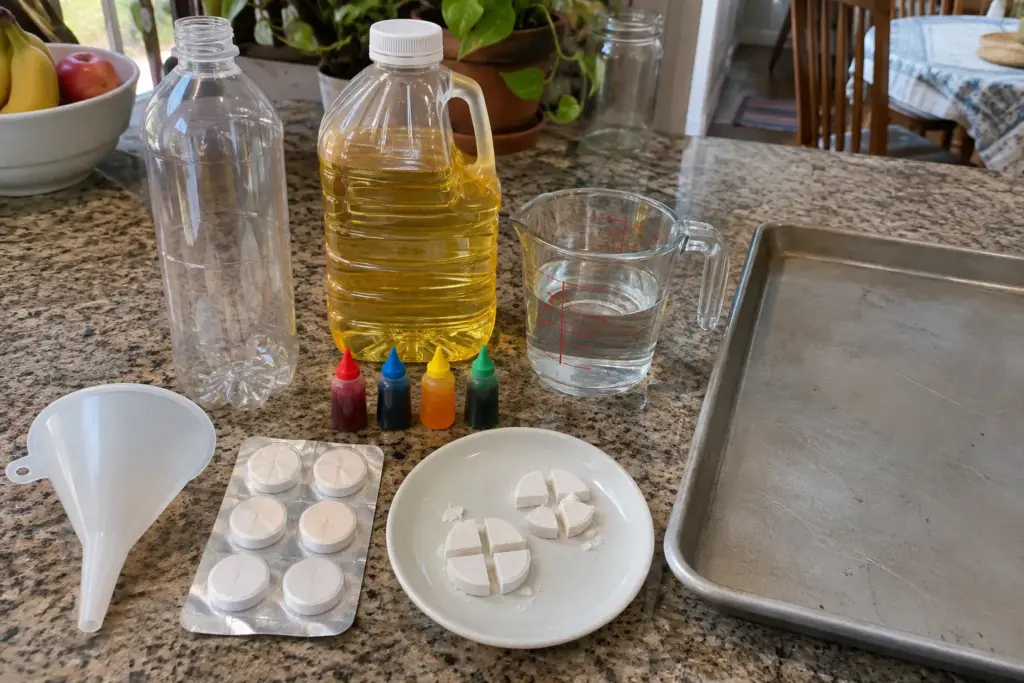
Vegetable oil
Triglycerides, density about 0.92 g/mL
3/4 of the bottleAny clear cooking oil works: canola, sunflower or soybean. Baby oil (mineral oil, about 0.85 g/mL) is clearer and colorless, so the colors look brighter, but it costs more per bottle.
Water
H2O, density 1.00 g/mL
1/4 of the bottleTap water is fine. Warm water (not hot) makes the tablet react faster.
Liquid food coloring
Water-soluble dyes
5 to 10 dropsIt dissolves in the water and not in the oil, so it marks exactly where the water goes. Gel colors work but need stirring.
Alka-Seltzer Original
Citric acid, sodium bicarbonate, aspirin
1 tablet in piecesThe gas source. Any effervescent tablet with citric acid and sodium bicarbonate works the same, including unflavored store brands and fizzing vitamin C tablets.
Tools
- A clear bottle or tall glass. A smooth plastic soda or water bottle is the safest choice with kids; a set of clear plastic bottles lets a group make one each
- A funnel for the oil, or a measuring cup with a spout
- A tray or baking sheet under the bottle to catch drips
- A flashlight or phone light for the glowing version
- Plastic transfer pipettes for the no-tablet version
Why the layers never mix
Oil and water separate because of the water, not the oil. Water molecules hold each other tightly with hydrogen bonds. Oil molecules are nonpolar and cannot form those bonds, so mixing them in would break water-water attractions without replacing them. The system settles in the arrangement with the fewest broken bonds: two layers. Our guide to heterogeneous mixtures lists other pairs that behave the same way.
How to make a lava lamp with Alka-Seltzer
- Set up on a tray. Oil drips are slippery and hard to clean. Put the bottle on a tray or baking sheet before pouring anything.
- Add the water. Fill the bottle about one quarter full with water. Use the amounts table below for a specific bottle size.
- Color the water. Add 5 to 10 drops of food coloring and swirl. Coloring the water before the oil goes in gives an even color; drops added later sink through the oil as beads and take a while to mix.
- Pour in the oil. Use a funnel and pour slowly down the side of the bottle until it is about 2 cm (1 inch) from the top. The oil floats on the water and forms a clear layer.
- Wait for the layers to settle. Pouring pushes some oil into the water and some water into the oil as droplets. Give it one to two minutes until the line between the layers is sharp.
- Drop in a quarter tablet. The piece sinks through the oil without reacting, lands in the water and starts to fizz. Within seconds, colored blobs rise to the top, release their gas and sink back down.
- Keep it going. When the bubbling stops, add another piece. A 500 mL bottle handles four quarter tablets before the water gets cloudy.
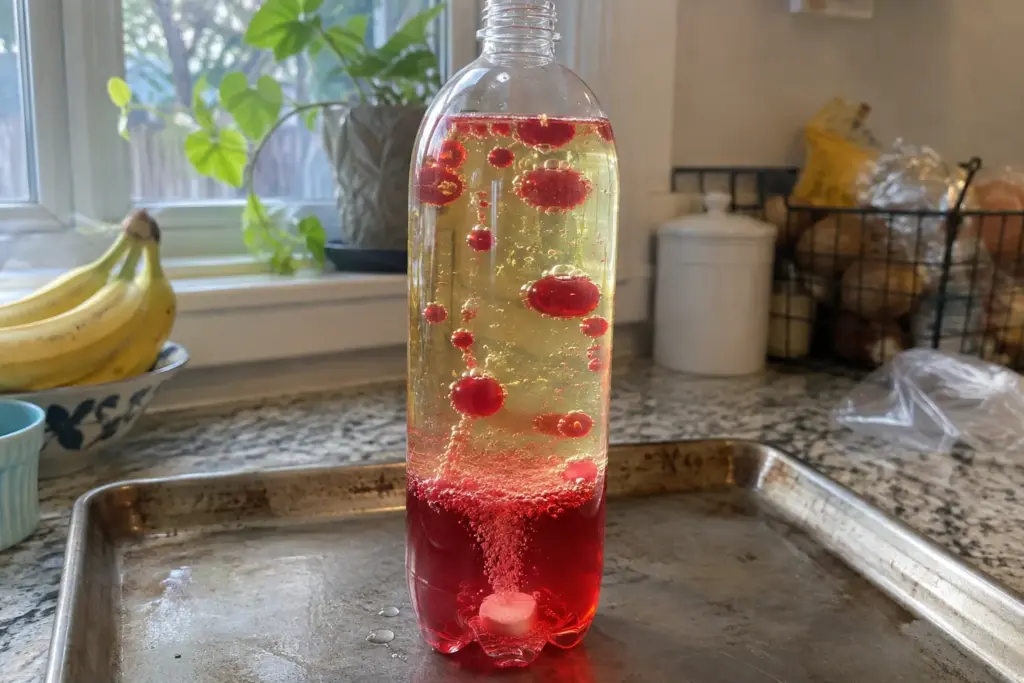
Cap off while it fizzes
Leave the cap off while the tablet reacts. A quarter tablet releases about 100 mL of carbon dioxide, and a sealed bottle builds pressure. Cap it afterwards to store it; the oil and colored water keep for weeks, and new tablet pieces restart it.
How much oil and water for your bottle
A ratio of about 3 parts oil to 1 part water, with a small air gap, gives the blobs the longest trip while leaving enough water for the tablet to react in. These amounts use that ratio:
| Container | Water | Oil | Tablet per round |
|---|---|---|---|
| 12 oz glass (355 mL) | 1/3 cup (80 mL) | 1 cup (240 mL) | 1/8 to 1/4 |
| 16.9 oz bottle (500 mL) | 1/2 cup minus 1 tbsp (100 mL) | 1½ cups (350 mL) | 1/4 |
| 1 liter bottle (34 oz) | 3/4 cup plus 2 tbsp (200 mL) | 3 cups (700 mL) | 1/4 to 1/2 |
| 2 liter bottle (68 oz) | 1⅔ cups (400 mL) | 6 cups (1.4 L) | 1/2 |
More water than this makes a short oil layer and the blobs barely travel. Less water than about 2 cm at the bottom lets the tablet sit half in the oil, where it does not react. A 2 liter bottle uses a lot of oil; for a group, several 500 mL bottles look better and cost less.
How to make a lava lamp without Alka-Seltzer (baking soda and vinegar)
This version uses baking soda and vinegar instead of a tablet. There is no aspirin in the bottle, so it suits younger kids, and they get to control every bubble with a dropper.
- Make the base. Stir 2 tablespoons of baking soda into 1/2 cup of water in a tall glass or 500 mL bottle. Some will stay undissolved on the bottom; that is fine.
- Add the oil. Pour in 1 cup of vegetable oil or baby oil and let the layers settle.
- Color the vinegar. In a small cup, mix 1/4 cup of white vinegar with a few drops of food coloring. The color goes in the vinegar this time, not the water.
- Drip it in. Use a pipette or a spoon to drop colored vinegar onto the oil. The drops sink through the oil as colored beads, hit the baking soda water and fizz, then ride their bubbles back up.
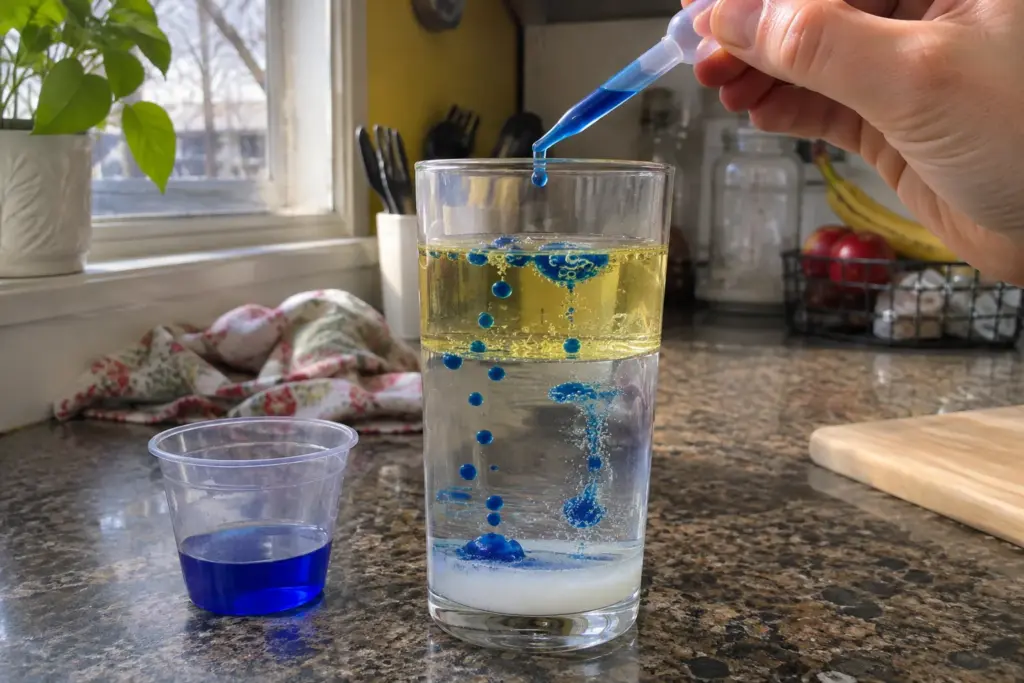
NaHCO3 + CH3COOH → CH3COONa + H2O + CO2
Vinegar is about 5 percent acetic acid and has a density close to water, so it sinks through the oil just like a water drop. Each drop contains only a little acid, which is why the blobs are small and you can run it for as long as the vinegar lasts.
Salt lava lamp
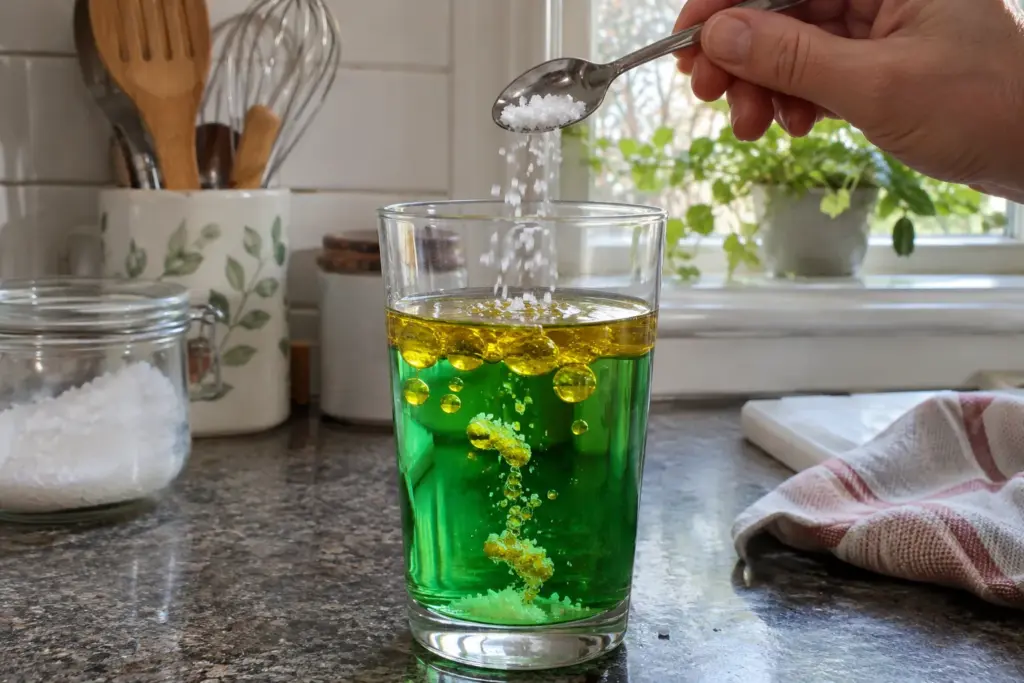
Salt makes a reverse lava lamp: the blobs are oil, and they go down first. Fill a glass about two thirds with colored water, add a layer of oil about 3 cm thick, then sprinkle a teaspoon of salt over the top.
Salt crystals are more than twice as dense as water (2.16 g/cm3). A pile of salt grabs a blob of oil and drags it down into the water. As the salt dissolves, the oil lets go and floats back up. A teaspoon keeps blobs moving for a minute or two, and you can add salt as often as you like because nothing is used up except the salt.
Same physics, opposite direction
The salt version runs on density alone, with no chemical reaction and no gas. It shows that a heavy object can carry a lighter one down, the same way a bubble carries a heavier one up. Compare both bottles side by side and the rule appears: an object rises or sinks according to the average density of everything attached to it.
How to make a glowing lava lamp
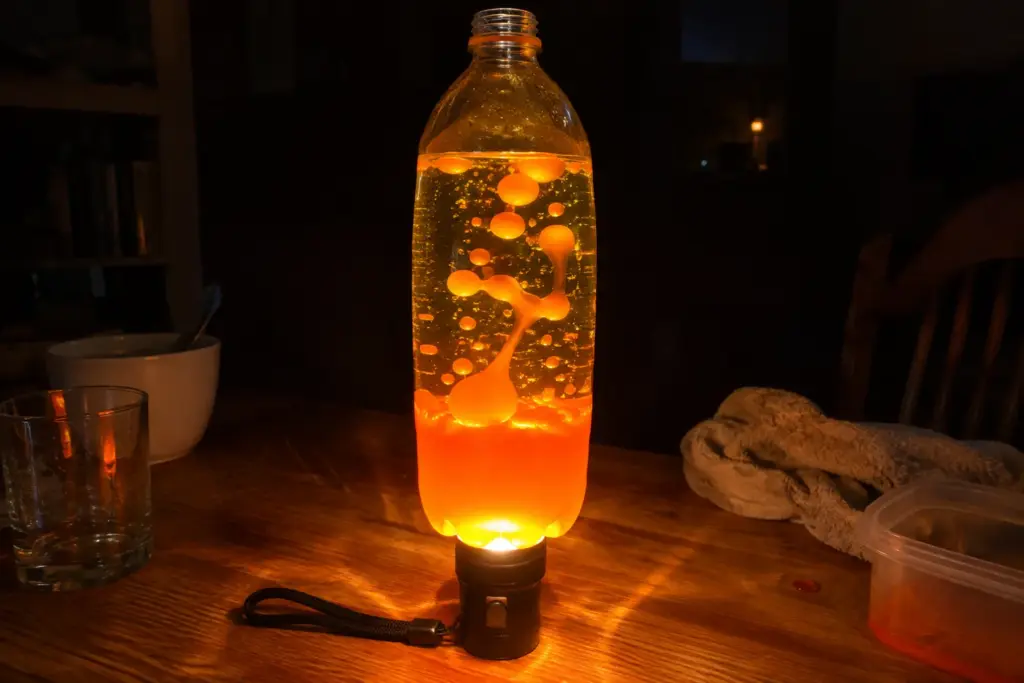
The simplest glow is a flashlight. Turn off the room lights, set the bottle on a phone with the flashlight facing up or on an upturned flashlight, and the colored blobs light up as they pass through the beam. Yellow, orange and red dyes light up best; dark blue and green absorb most of the light.
For a real glow, replace the plain water with tonic water and shine a UV flashlight on the bottle in a dark room. Tonic water contains quinine, which absorbs ultraviolet light and re-emits it as visible blue light. The blobs glow blue-white without any food coloring. Skip the food coloring in this version: dyes absorb the blue glow and make it dimmer.
Skip glow sticks
Do not use glow stick liquid in a lava lamp. Glow sticks contain dibutyl phthalate and hydrogen peroxide, which irritate skin and eyes, and the glass vial inside breaks into sharp fragments. Tonic water under UV gives a glow with nothing harmful in the bottle.
Experiments to try
The lava lamp turns into a real science fair project as soon as you change one thing at a time and time the result. Use two identical bottles, change one variable, and time how long one quarter tablet keeps the blobs moving.
| Change this | What happens | Why |
|---|---|---|
| Warm vs cold water | Warm water fizzes faster and finishes sooner | Reactions and dissolving speed up as temperature rises |
| Whole vs quarter tablet | A whole tablet foams fast and briefly; quarters run longer in total | More surface and acid at once release the gas in a burst |
| Crushed vs whole piece | Crushed powder fizzes in seconds | More surface area exposed to the water |
| Vegetable oil vs baby oil | Blobs in baby oil are smaller and sink faster | Baby oil is less dense, so each blob needs a bigger bubble to float |
| Tall bottle vs short glass | Blobs travel further and slow down near the top | A longer column gives the bubble time to reach steady speed |
| Pour order reversed | The layers end up the same | Density sets the order, not the pouring |
Write down a prediction before each test. A good hypothesis for the oil test: “Blobs in baby oil will be smaller because baby oil is less dense than vegetable oil.” The science section below shows why that prediction holds, with numbers.
The science of a homemade lava lamp
The science
A homemade lava lamp combines three ideas. Oil and water do not mix and stack by density. An acid-base reaction in the tablet makes carbon dioxide gas. A drop of water with a gas bubble attached has a lower average density than oil, so it floats up until the bubble pops at the surface.
Density: why oil sits on top
Density is mass divided by volume. Water is 1.00 g/mL, vegetable oil about 0.92 g/mL and baby oil about 0.85 g/mL. In a container of liquids that do not mix, the densest one goes to the bottom because that arrangement puts the most mass as low as possible, which gives the lowest gravitational potential energy. Pour them in any order and they end up the same way. Density is one of the derived physical quantities, built from mass and length.
The reaction inside the tablet
An Alka-Seltzer Original tablet contains 1,916 mg of sodium bicarbonate, 1,000 mg of citric acid and 325 mg of aspirin. Dry, the powders do nothing. In water they dissolve and react:
3 NaHCO3 + C6H8O7 → Na3C6H5O7 + 3 H2O + 3 CO2
Citric acid has three acidic hydrogens, so each molecule releases three molecules of carbon dioxide. Aspirin is an acid too and adds one more for each of its molecules. Here is the gas from one tablet:
- Citric acid: 1,000 mg ÷ 192.1 g/mol = 5.21 mmol, × 3 = 15.6 mmol of acid
- Aspirin: 325 mg ÷ 180.2 g/mol = 1.80 mmol of acid
- Sodium bicarbonate: 1,916 mg ÷ 84.0 g/mol = 22.8 mmol, more than enough to use up all 17.4 mmol of acid
- Carbon dioxide: 17.4 mmol × 24.5 L/mol (at 25 °C) = about 425 mL of gas
One tablet makes almost enough gas to fill a 500 mL bottle, and a quarter makes about 105 mL. Some of it dissolves in the water and never forms a bubble, but most of it leaves through the open top. That volume is why a whole tablet foams and why a capped bottle is a bad idea.
Why a bubble lifts a drop of water
A drop of colored water on its own sinks in oil, because water is denser. Attach a bubble of gas and the pair acts as one object with an average density. The drop floats once its average density falls below the oil’s. With water at 1.00 g/mL and gas weighing almost nothing, the condition is:
1.00 × Vwater ÷ (Vwater + Vgas) < ρoil
For vegetable oil at 0.92 g/mL, that works out to a bubble of only 9 percent of the drop’s volume. For baby oil at 0.85 g/mL, the bubble must reach 18 percent. That is why baby oil gives smaller blobs: a given bubble can carry only about half as much water. At the surface the bubble breaks into the air above, the drop is pure water again, and it sinks.
Why the bubbles stay stuck to the water at all: the reaction happens in the water, so every bubble forms inside a drop and drags a coat of water with it. Surface tension between oil and water holds that coat together as a round blob, and the attractions involved are the same intermolecular forces that keep the two layers apart.
Why the tablet does nothing in the oil
Citric acid and sodium bicarbonate react only when they are dissolved as ions. Ions need a polar solvent, and oil is nonpolar, so the tablet falls through the oil layer intact and starts fizzing the moment it touches water. Food coloring follows the same rule: its dyes are salts that dissolve in water and stay out of the oil.
Myth: the oil and water mix after a while
Shaking the bottle hard breaks the water into tiny droplets and the bottle goes cloudy. That is a temporary emulsion, not mixing. Leave it for an hour and the droplets merge and settle back into a clean layer. Soap or egg yolk would make the emulsion last, which is how mayonnaise works; our list of examples of emulsions covers the rest.
How a real lava lamp works
The lamp on a desk works by heat instead of gas. British accountant Edward Craven Walker launched the first one, the Astro, in 1963. Inside the sealed glass bottle is a waxy blend based on paraffin, mixed with denser compounds so it is just slightly denser than the surrounding liquid at room temperature. A bulb in the base, usually 25 to 40 watts, heats the wax from below.
- The wax warms and expands. Wax expands more than the liquid around it when heated, so its density drops faster.
- It becomes lighter than the liquid and rises. Once the warm wax is less dense, a blob breaks off and floats upward.
- It cools at the top. The top of the bottle is farthest from the bulb. The blob loses heat, contracts, becomes denser again and sinks.
- The loop repeats. Back at the bottom, the bulb and a metal coil in the base warm it again. This is convection, the same cycle that drives weather and mantle plumes. Our list of thermal energy examples has more.
That is why a new lava lamp takes one to three hours to start flowing: the wax has to melt and reach the temperature where its density crosses the liquid’s. A lamp in a cold room may never get there, and one in a hot sunny window can overheat so the wax stays at the top.
Heat only from the lamp’s own bulb
Never heat a lava lamp on a stove or with any heat source besides its own bulb. The sealed glass builds pressure as the liquid heats. In 2004 a man in Kent, Washington, was killed when a lava lamp he was heating on a stovetop exploded and a glass shard struck him. The same rule applies to a homemade bottle: it is a room-temperature project.
Troubleshooting
| Problem | Cause | Fix |
|---|---|---|
| No blobs, just bubbles | Too little water; the tablet sits in the oil | Keep water at least 2 cm deep, about a quarter of the bottle. |
| Oil turned cloudy | Whole tablet or shaking made an emulsion | Use quarter tablets and wait an hour; the cloudiness settles out. |
| Oil turned colored | Oil-based or gel coloring | Use liquid water-based food coloring and add it to the water first. |
| Foam overflowed | Too much tablet or too little headspace | Use smaller pieces and leave at least 2 cm of air at the top. |
| Blobs stopped after a few rounds | Water saturated with dissolved salts and foam | Pour off the water layer with a baster and add fresh colored water. |
| Reaction too slow | Cold water | Start with warm tap water. |
The mistake that makes a mess
Do not tighten the cap while the tablet is still fizzing. A quarter tablet can still make about 100 mL of gas, and a sealed plastic bottle will bulge and spray oil when opened.
Safety
Before you start
- Alka-Seltzer is a medicine. Each tablet contains 325 mg of aspirin. An adult should hold the tablets and hand out pieces. Aspirin is not given to children or teenagers recovering from flu or chickenpox symptoms because of the risk of Reye’s syndrome. If a child swallows tablets, call Poison Control (1-800-222-1222 in the US).
- Do not drink it. The water contains dissolved medicine, and the oil has been handled. Label shared bottles.
- Spilled oil is slippery. Work on a tray and wipe floor spills with paper towels, then dish soap and water.
- Use plastic with small children. A dropped glass full of oil breaks and is hard to clean up safely.
- Room temperature only. Never heat a homemade or commercial lava lamp on a stove, in a microwave or with a heat gun.
- Eyes. Splashes of tablet solution or vinegar sting. Rinse with water for 15 minutes. Safety goggles are a good habit for any experiment.
To dispose of it, never pour the oil down the sink: it coats pipes and builds clogs with other grease. Pour it into a sealable container and put it in the trash, or take it to a cooking oil drop-off if your town has one. The water layer can go down the drain once the oil is off.
For more hands-on chemistry, our picks for the best chemistry set for kids include kits built around the same acid-base reactions.
More practical science: browse all our everyday science how-tos, from household chemistry to experiments you can build at home.
The same baking soda and vinegar reaction drives our guide on how to make a baking soda volcano, with amounts for any bottle and a balloon test for science fairs.
Frequently asked questions
Fill a clear bottle one quarter with water, add food coloring, fill it almost to the top with vegetable oil and drop in a quarter of an Alka-Seltzer tablet. The gas bubbles carry colored water up through the oil and it sinks again when the bubbles pop.
Oil floats on water because it is less dense. The tablet reacts in the water and makes carbon dioxide bubbles, which lift drops of colored water to the top. At the surface the gas escapes and the heavier water drops sink back down.
Stir baking soda into the water layer, add the oil, then drip in colored vinegar with a pipette. Each vinegar drop sinks, reacts with the baking soda and floats back up on its own carbon dioxide bubbles. Salt sprinkled on top also works and makes oil blobs sink and rise.
Vegetable oil is the cheapest and works well. Baby oil is clearer and colorless, so the colors look brighter, but the blobs are smaller because baby oil is less dense than vegetable oil.
Each quarter tablet keeps the blobs moving for about a minute. The bottle itself keeps for weeks with the cap on, and adding a new tablet piece restarts it. After four or five rounds, replace the water layer for the best effect.
Yes. Let the reaction finish, cap the bottle and store it. To restart it, open the cap and drop in a new tablet piece. Replace the cloudy water layer when the blobs get sluggish.
Too much tablet at once or shaking the bottle breaks the water into tiny droplets in the oil, a temporary emulsion. Leave the bottle still for an hour and it clears.
Yes with an adult handing out the tablet pieces, because Alka-Seltzer contains aspirin. For young children, the baking soda and vinegar version avoids medicine entirely. Use a plastic bottle and never cap it while it is fizzing.
A waxy blend based on paraffin, adjusted with denser compounds, floating in a water-based liquid in a sealed glass bottle. A bulb in the base heats the wax so it expands and rises, then it cools at the top and sinks.
British accountant Edward Craven Walker launched the first lava lamp, called the Astro, in 1963. His company was later renamed Mathmos and still makes them in England.
Sources
- Scientific American and Science Buddies. Make your own lava lamp
- US National Library of Medicine, DailyMed. Alka-Seltzer Original effervescent tablets, drug label
- PubChem. Citric acid
- PubChem. Sodium bicarbonate
- PubChem. Aspirin
- The Engineering ToolBox. Liquids: densities
- McGill University Office for Science and Society. The luminescent chemistry of lava lamps
- Smithsonian Magazine. The history of the lava lamp
- The Seattle Times. Shard of glass kills man as lava lamp explodes (2004)
- American Academy of Pediatrics, HealthyChildren.org. Reye syndrome
- Science Buddies. Tonic water glows