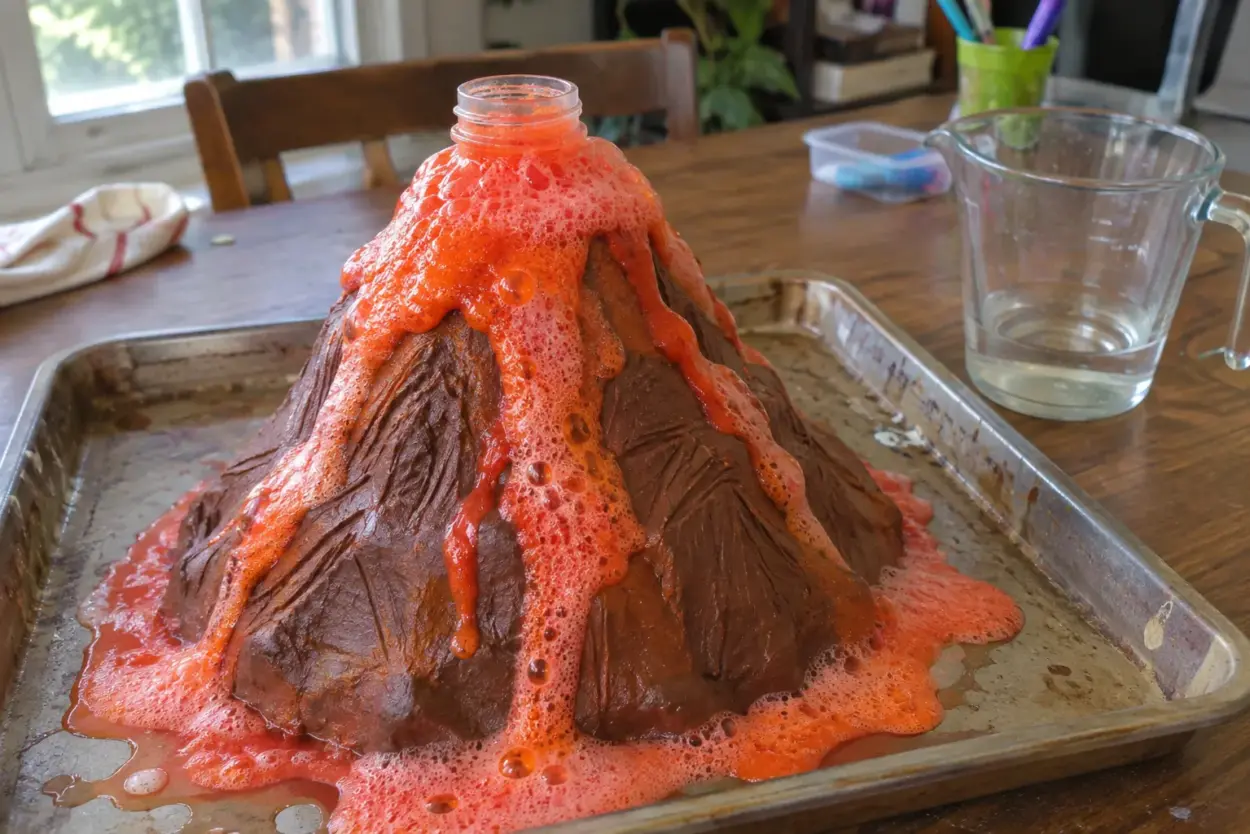
Short answer: stand a small plastic bottle on a tray, mold a cone of salt dough or clay around it and put 2 tablespoons of baking soda, a squirt of dish soap and a few drops of red food coloring inside. Pour in 1/2 cup of white vinegar and red foam pours out of the top for about 30 seconds. The leftover baking soda is enough for two more eruptions: just add more vinegar.
I have built this volcano for kitchen tables, classrooms and science fairs, and the eruptions that impress people all share three details: dish soap in the bottle, warm vinegar and a narrow opening. This guide covers the classic salt dough volcano, a five-minute version with no building, the exact amounts for any bottle, a balloon test that turns the volcano into a real science fair project, and the chemistry behind the foam, including how much gas each tablespoon makes and how a real volcano differs.
At a glance
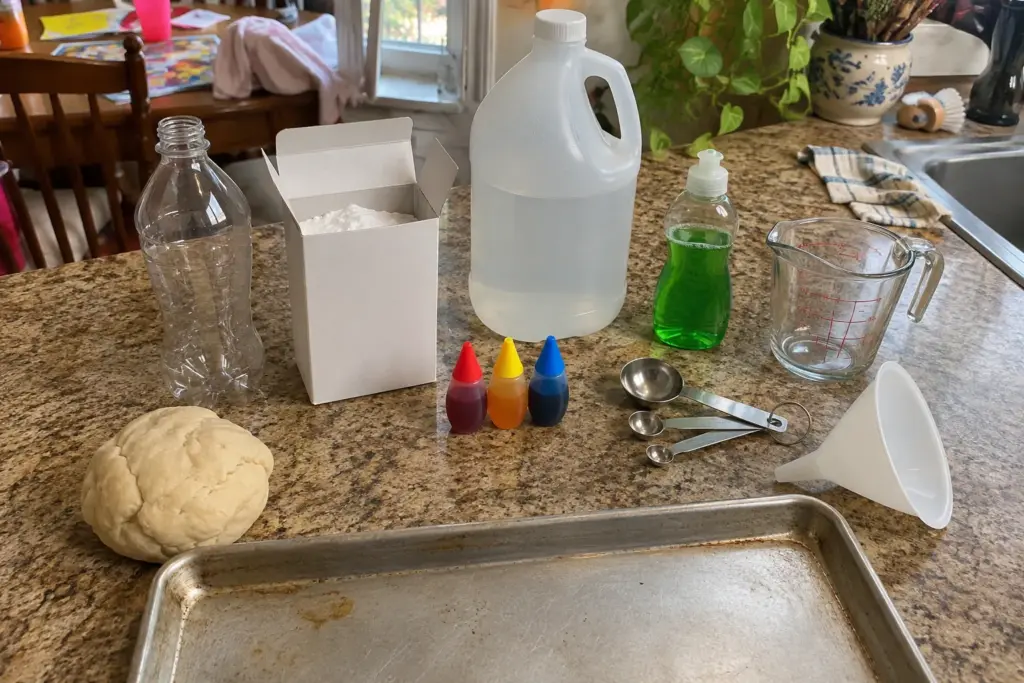
What you need
- 1 small plastic bottle, 8 to 17 oz
- 2 tbsp baking soda
- 1/2 cup white vinegar, warm
- 1 tsp dish soap
- 5 drops red food coloring, plus 2 of yellow
- Salt dough, clay or foil for the cone (optional)
Steps
- Set the bottle on a tray and build a cone around it.
- Add baking soda, dish soap and coloring.
- Pour in the vinegar all at once.
- Step back and watch the foam.
- Add more vinegar for a second eruption.
Do not skip the soap
Dish soap is what turns a quick fizz into flowing lava. Without it the bubbles pop at the top of the bottle in a few seconds. With a teaspoon of soap they hold together as thick foam that rolls down the sides of the cone.
This guide contains Amazon affiliate links. 33Science earns a commission on qualifying purchases. See our affiliate disclosure.
Materials and tools
Baking soda
Sodium bicarbonate, NaHCO3
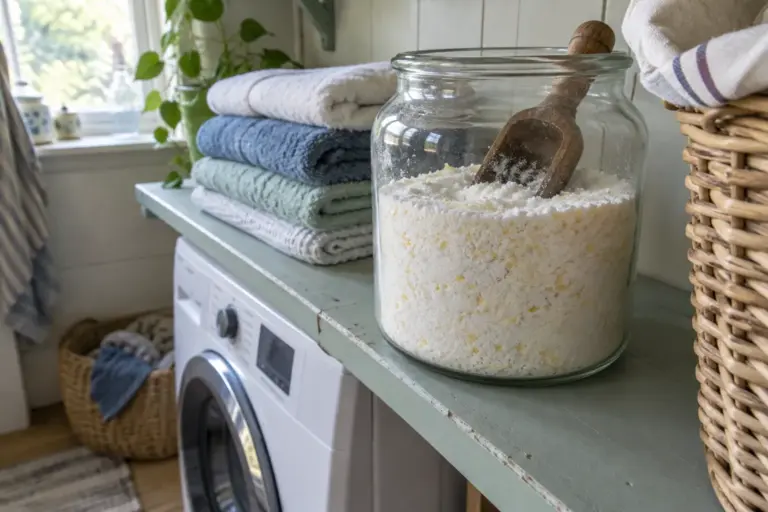
2 tbsp per eruption setThe base. A tablespoon weighs about 14 grams. Use baking soda, not baking powder: baking powder already contains its own dry acid and gives a weak, slow fizz.
White vinegar
Acetic acid, CH3COOH, about 5% in water
1/2 cup per eruptionThe acid. US rules require at least 4 g of acetic acid per 100 mL, and most store vinegar is 5%. Plain distilled white vinegar is the cheapest and the clearest, so the food coloring shows. Cleaning vinegar at 6% acid gives a slightly bigger eruption from the same pour.
Dish soap
Surfactants
1 teaspoonTraps the gas in bubbles that last, so the foam flows like lava instead of fizzing away.
Food coloring
Water-soluble dyes
5 drops red, 2 yellowRed plus a little yellow gives a lava orange. Liquid coloring mixes fastest; gel works if you stir it into the vinegar first.
Tools
- A small plastic bottle with a narrow neck: a 12 oz or 16.9 oz water or soda bottle
- A baking sheet, roasting pan or plastic storage lid to catch the lava
- A funnel for the baking soda (a rolled sheet of paper works)
- Salt dough, modeling clay or aluminum foil for the cone
- Measuring spoons and a measuring cup with a spout
- Optional for the balloon test: a few 12 inch balloons and a tape measure
One reaction does all the work
Baking soda is a base and vinegar is an acid. They react the moment they touch, and the reaction makes a gas, carbon dioxide. Everything else in the volcano, the soap, the color and the cone, only shapes what that gas does on its way out. Our guide to acid-base reactions covers the family this reaction belongs to.
How to build the volcano
The cone is decoration around a bottle; the bottle does the real work. Pick one of three ways to make it.
Salt dough cone (classic, reusable)
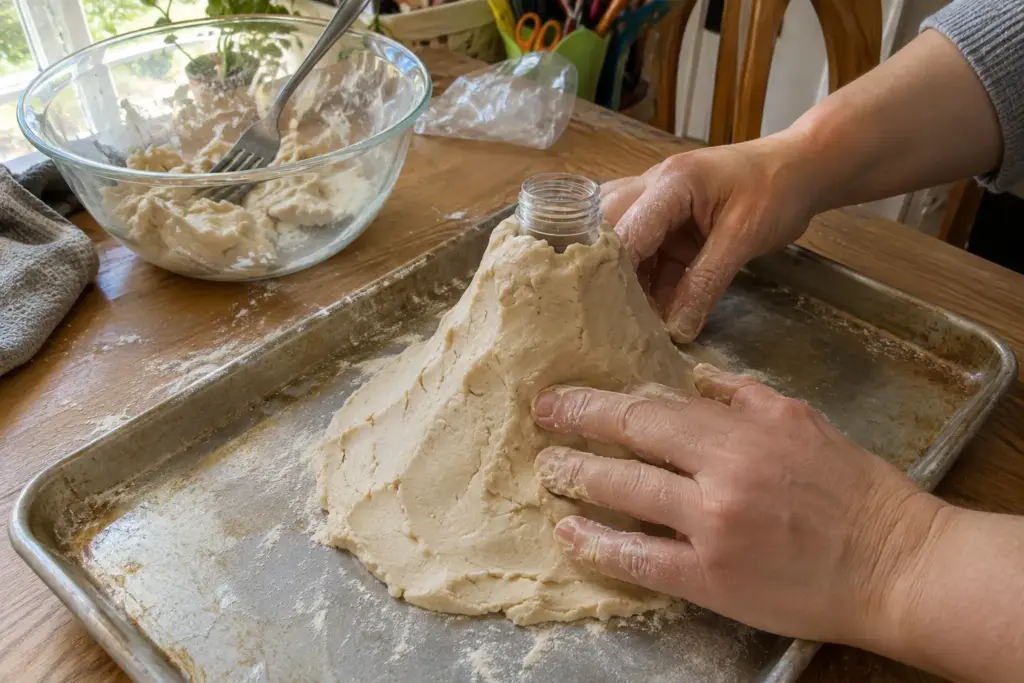
- Mix the dough. Stir 3 cups of flour with 1 cup of salt in a large bowl. Add 2 tablespoons of vegetable oil and 1 cup of warm water and knead until smooth and firm. Too sticky: add flour a spoonful at a time.
- Set up the bottle. Stand the empty bottle in the middle of a baking sheet. Tape it down with a loop of masking tape so it cannot tip.
- Shape the cone. Press the dough around the bottle from the tray up to the neck, wide at the base and narrow at the top. Leave the opening clear and keep dough out of the bottle.
- Add texture. Drag a fork down the sides to make lava channels. They guide the foam into streams, which looks far better than one flat sheet of foam.
- Dry and paint (optional). Air-dry for a day or bake at 250 °F (120 °C) for about an hour with the bottle removed, then put it back. Acrylic paint and a coat of clear sealer keep the vinegar from softening it so the volcano lasts for dozens of eruptions.
Quick cones
- Clay: wrap modeling clay or play dough around the bottle. Ready in five minutes, no drying.
- Foil: crumple aluminum foil into a cone around the bottle. The foam slides off it cleanly and the whole thing rinses in the sink.
- No cone: a bottle or a tall drinking glass on a tray erupts the same way. For toddlers this is often the best version because they get to pour the vinegar again and again.
- Sand or snow: bury a bottle up to the neck in a sandbox or a snowbank. Red foam on snow is the most photogenic eruption of all.
How to make the volcano erupt
- Load the baking soda. Spoon 2 tablespoons of baking soda through a funnel into the bottle.
- Add the soap and color. Add 1 teaspoon of dish soap, 5 drops of red food coloring, 2 drops of yellow and 2 tablespoons of warm water. Swirl gently to make a thin paste. Wet baking soda reacts faster than a dry pile.
- Warm the vinegar. Heat 1/2 cup of white vinegar for about 20 seconds in the microwave until it is warm to the touch, not hot. Warm vinegar reacts faster and gives a taller eruption.
- Pour it in fast. Pour all the vinegar in at once, or use a funnel to get it in within a second or two. A slow trickle gives a slow fizz.
- Step back. Foam rises out of the neck within a second and flows down the cone for 20 to 40 seconds.
- Erupt again. Two tablespoons of baking soda can neutralize about 1⅔ cups of vinegar, so the bottle still holds enough for two more eruptions. Pour in another 1/2 cup of vinegar. Add a fresh squirt of soap if the foam looks thin.
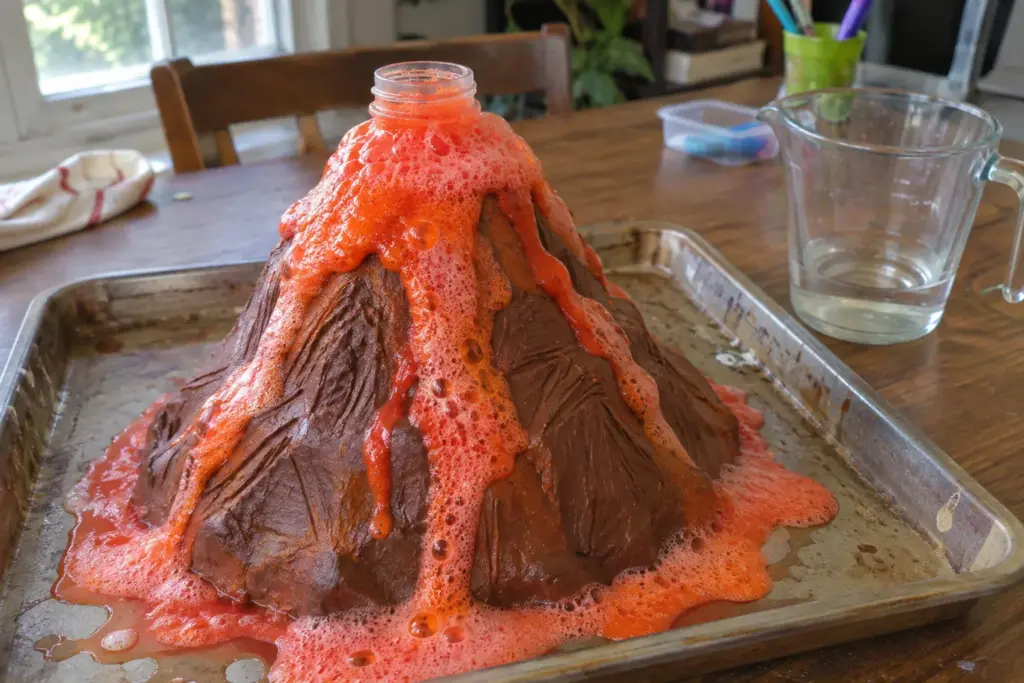
Delayed eruption
For a surprise eruption, wrap the baking soda in a square of toilet paper and drop the packet in. The paper takes a few seconds to soak through, so the eruption starts after you step back. It is the trick for a science fair demonstration in front of a crowd.
How much baking soda and vinegar to use
Vinegar is only about 5 percent acid, so it runs out long before the baking soda does. These amounts use a baking soda excess on purpose: each set gives about three eruptions, one per pour of vinegar.
| Volcano | Baking soda and soap | Vinegar per eruption |
|---|---|---|
| Mini: cup or 8 oz bottle | 1 tbsp baking soda, 1/2 tsp soap | 1/4 cup (60 mL) (about 1.2 L of gas) |
| Classic: 12 to 17 oz bottle | 2 tbsp baking soda, 1 tsp soap | 1/2 cup (120 mL) (about 2.4 L of gas) |
| Large: 1 to 2 liter bottle | 1/4 cup baking soda, 2 tsp soap | 1 cup (240 mL) (about 4.8 L of gas) |
The gas figures assume all the vinegar reacts, at room temperature. To react every last grain of baking soda in one pour, you would need a little over 3/4 cup of vinegar per tablespoon. That is the rule of thumb: 1 teaspoon of baking soda for every 1/4 cup of vinegar. More baking soda than that per pour makes no extra foam; more vinegar does.
How to make a bigger eruption
| Change | Effect | Why |
|---|---|---|
| Add dish soap | Thick, slow, long-lasting lava | Soap stabilizes the bubble walls so the gas stays trapped |
| Warm the vinegar | Faster, taller eruption | Reactions speed up as temperature rises |
| Make a baking soda paste first | Faster start | Dissolved bicarbonate meets the acid at once instead of grain by grain |
| Use a narrow-neck bottle | Taller fountain | The same gas leaves through a smaller opening, so it moves faster |
| Use cleaning vinegar (6%) | About 20% more gas per pour | More acid per cup means more carbon dioxide |
| Pour all the vinegar at once | One big eruption instead of a fizz | All the acid reacts in the same few seconds |
Leave the top open
Never put a cap, cork or stopper on the bottle to build pressure. A classic eruption makes more than 2 liters of gas in a few seconds. A sealed plastic bottle bulges and then the stopper shoots off, or the bottle splits and sprays vinegar into faces. The pressure trick is the one way this experiment injures people.
Science fair version: the balloon test
An eruption is hard to measure. A balloon on the bottle catches the gas instead, and the balloon’s size tells you how much carbon dioxide the reaction made. It also proves one of the central ideas of chemistry, the limiting reactant, with nothing more than a tape measure.
- Fill the balloon. Use a funnel to put 1 teaspoon of baking soda into an empty balloon. Stretch the balloon first so it inflates evenly.
- Fill the bottle. Pour 1/4 cup of vinegar into an empty 16.9 oz bottle.
- Attach it. Stretch the balloon’s mouth over the bottle neck with the balloon hanging to one side so no baking soda falls in yet.
- Start the reaction. Lift the balloon upright so the baking soda drops into the vinegar. Swirl the bottle until the fizzing stops, about a minute.
- Measure. Wrap a tape measure around the widest part of the balloon and write down the circumference.
- Change one thing. Repeat with 2 teaspoons of baking soda and the same 1/4 cup of vinegar, then with 1/2 cup of vinegar. Run each trial three times and average them.
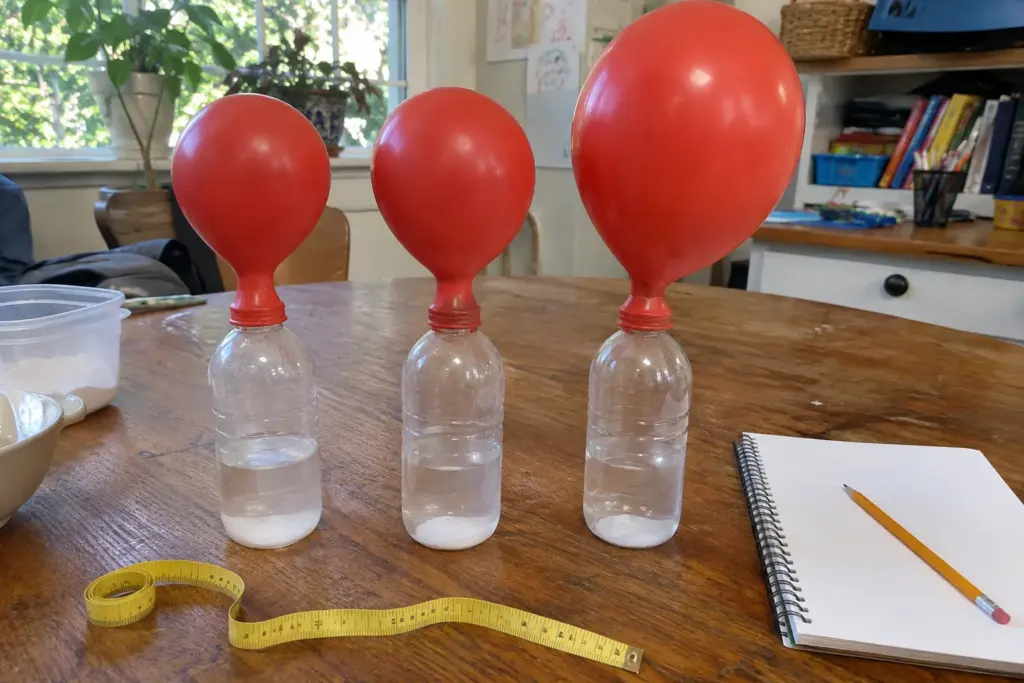
| Trial | Amounts | Prediction |
|---|---|---|
| 1 | 1 tsp baking soda, 1/4 cup vinegar | 1.2 L of gas, balloon about 41 cm (16 in) around |
| 2 | 2 tsp baking soda, 1/4 cup vinegar | 1.2 L, the same balloon as trial 1 |
| 3 | 2 tsp baking soda, 1/2 cup vinegar | 2.4 L, balloon about 52 cm (20 in) around |
Trial 2 is the one that surprises people. Twice the baking soda gives the same balloon, because the acid in 1/4 cup of vinegar was already used up in trial 1 and the extra baking soda just sits at the bottom. Measured balloons come out a little smaller than predicted, because some carbon dioxide stays dissolved in the liquid and the stretched rubber squeezes the gas. The science section shows where the numbers come from.
Other homemade volcanoes
Lemon juice volcano
Swap the vinegar for bottled lemon juice. It contains citric acid instead of acetic acid, about 5 percent (48 to 60 g per liter), and smells better indoors. Each citric acid molecule releases three molecules of carbon dioxide, so a cup of lemon juice makes about as much gas as a cup of vinegar. Yellow lemon juice also tints the lava without extra coloring.
Foaming yeast volcano (elephant toothpaste)
This version runs on a different reaction and makes a warm, dense foam that keeps coming for a minute. Put 1/2 cup of 3% hydrogen peroxide, 1 teaspoon of dish soap and some food coloring in the bottle. In a cup, mix 1 tablespoon of dry yeast with 3 tablespoons of warm water for a minute, then pour it into the bottle. An enzyme in the yeast, catalase, splits the peroxide into water and oxygen:
2 H2O2 → 2 H2O + O2
The reaction releases heat, so the foam feels warm, the opposite of the baking soda volcano. The foam is just soapy water, oxygen and yeast and wipes up easily.
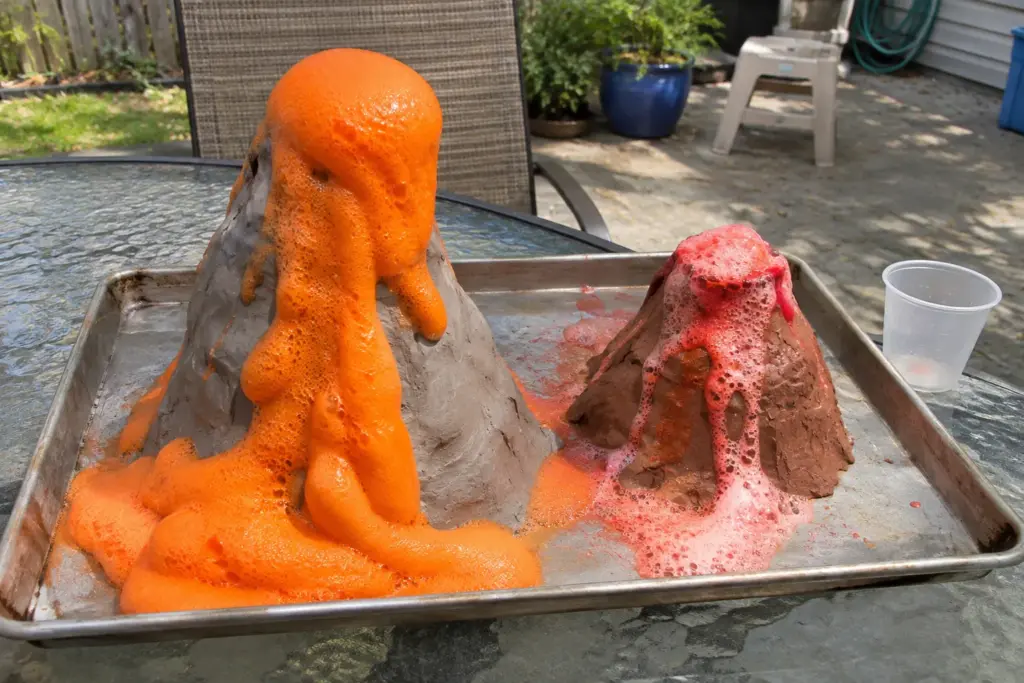
Only 3% peroxide at home
Use only the 3% hydrogen peroxide sold for first aid. The 6% to 12% hair-salon strength and the 30% and higher lab grades burn skin and eyes, and the classroom elephant toothpaste demonstrations that use them are done by teachers with goggles and gloves.
The science of a baking soda volcano
The science
Baking soda and vinegar react in two quick steps: acid meets bicarbonate and forms carbonic acid, which falls apart into water and carbon dioxide gas. The gas takes up hundreds of times more space than the liquids it came from, so it pushes out of the bottle. Dish soap traps it in bubbles, and the result is foam.
The reaction
Written as one equation, the reaction is:
NaHCO3 + CH3COOH → CH3COONa + H2O + CO2
It happens in two steps. First the acid hands a hydrogen ion to the bicarbonate ion and makes carbonic acid. Carbonic acid is unstable and immediately splits:
HCO3− + H+ → H2CO3 → H2O + CO2
The second step is a decomposition reaction. What stays in the bottle afterwards is water and sodium acetate, a mild salt that is also the “salt” in salt and vinegar chips. Baking soda is one of the sodium compounds found in almost every kitchen.
How much gas a classic eruption makes
The amounts work out like this for the classic 2 tablespoons and 1/2 cup:
- Vinegar: 1/2 cup is 120 mL. At 5 percent, that holds 6.0 g of acetic acid. 6.0 g ÷ 60.05 g/mol = 0.10 mol of acid
- Baking soda: 2 tablespoons weigh about 27.6 g. 27.6 g ÷ 84.01 g/mol = 0.33 mol, more than three times what the vinegar can use
- Carbon dioxide: one mole of gas per mole of acid, so 0.10 mol × 24.5 L/mol (at 25 °C) = about 2.4 liters of gas
Two and a half liters of gas from a few spoonfuls of liquid is why the foam keeps coming. The leftover 0.23 mol of baking soda is enough for two more half cups of vinegar, which is why the table above lists three eruptions per set. The molar mass of baking soda used here comes from our molar mass of sodium bicarbonate breakdown.
Why the volcano gets cold
Touch the bottle right after an eruption and it feels cool. The reaction is endothermic: it pulls heat from the liquid around it, so the temperature drops a few degrees. Most chemical reactions that people notice give off heat, like burning or the yeast volcano above. This is one of the few common endothermic reactions you can feel with your hand. A kitchen thermometer in the bottle makes the drop easy to measure for a science fair.
What the dish soap does
Bubbles in plain vinegar burst within a second of reaching the surface, because water’s surface tension pulls thin films apart. Soap molecules have one end that likes water and one end that avoids it. They pack into the bubble walls, lower the surface tension and make the walls elastic, so a stretched spot heals instead of breaking. The gas stays trapped in thousands of small bubbles, and that foam is the lava.
Myth: the volcano is a chemical model of a real eruption
The chemistry has nothing in common with magma. No acid meets a base inside a volcano. What the model does show well is the physics of the last step: gas escaping from a liquid makes foam, and the foam is pushed out through the narrowest opening. A shaken bottle of soda, where dissolved gas comes out all at once when the cap opens, is actually closer to how a real eruption starts.
How real volcanoes erupt
Magma deep underground holds gases dissolved in it under enormous pressure, mostly water vapor with carbon dioxide second and sulfur dioxide third. As magma rises, the pressure drops and the gases come out of solution as bubbles, the same way a soda fizzes when it is opened. The bubbles expand as they rise, and the gas drives the eruption.
- Runny magma lets gas escape. Low-silica basalt magma, like Hawaii’s, lets bubbles rise and leave calmly. The result is flowing lava, the closest match to the foam on a baking soda volcano.
- Sticky magma traps gas. Silica-rich magma is thick enough to hold the bubbles in until the pressure tears it apart. That gives explosive eruptions of ash and pumice, like Mount St. Helens in 1980.
- The cone is the record. Runny lava builds wide, gentle shield volcanoes. Alternating ash and lava builds the steep cone that most people picture, which is the shape of a homemade volcano. Our guide to the types of volcanoes covers each shape.
Pumice is the frozen version of volcano foam: rock so full of gas bubbles that some pieces float on water. To see where real eruptions happen, explore our world volcano map.
Troubleshooting
| Problem | Cause | Fix |
|---|---|---|
| Fizzes but no foam flows | No dish soap | Add 1 tsp of dish soap before the vinegar. |
| Weak eruption | Baking powder instead of baking soda, or old vinegar poured slowly | Use baking soda and pour warm vinegar all at once. |
| Second eruption is weak | Soap used up or the baking soda is gone | Add another squirt of soap; add 1 tbsp of baking soda if no white powder is left. |
| Foam is pink, not red | Too little coloring for the foam volume | Use 8 to 10 drops, or color the vinegar instead. |
| Cone went soggy | Unsealed salt dough absorbs vinegar | Paint and seal the dried cone, or cover it with foil. |
| Foam stays in the bottle | Bottle too big for the amounts | Use a smaller bottle or the large amounts in the table. |
The mistake that wastes a batch
Adding more baking soda to get a bigger eruption does not work once there is already powder left in the bottle. The vinegar is the limit. Add more vinegar, and warm it first.
Safety
Before you start
- Eyes. Vinegar and the foam sting. Kids should not lean over the opening while they pour. If foam gets in an eye, rinse with clean water for 15 minutes. Safety goggles make the experiment feel like a real lab.
- Never seal the bottle. The gas from one pour fills more than 2 liters. A capped or stoppered bottle can burst or launch the stopper.
- Do not drink it. The leftover liquid is soapy sodium acetate solution. It is not toxic in small amounts but causes stomach upset.
- Peroxide version. Use only 3% hydrogen peroxide, and keep it away from eyes.
- Slippery floors. Foam on tile is slippery. Work on a tray, outdoors or on a towel.
- Salt dough. Raw salt dough is very salty and harmful to dogs if eaten in quantity. Keep it away from pets.
Cleanup is simple: the liquid is mostly water with sodium acetate and soap, and it can go down the sink. Rinse the tray with warm water. A sealed salt dough volcano dries out again within a day and is ready for the next eruption.
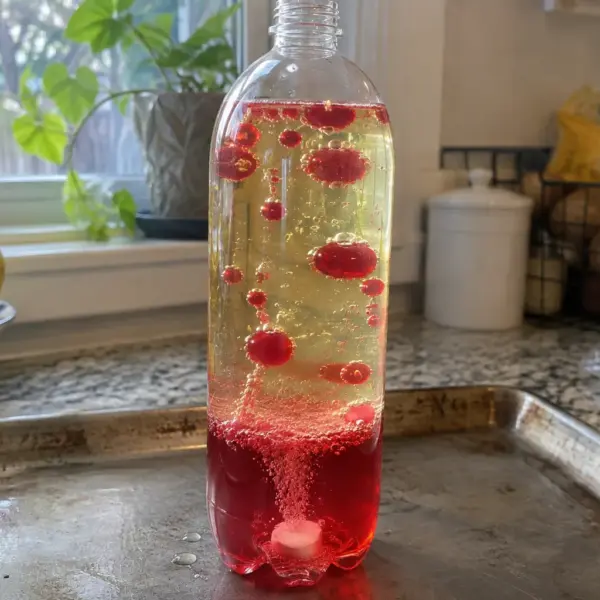
For more kitchen chemistry, our guide on how to make a lava lamp uses the same baking soda and vinegar reaction, and our picks for the best chemistry set for kids include kits built around acid-base reactions.
More practical science: browse all our everyday science how-tos, from household chemistry to experiments you can build at home.
Frequently asked questions
Put 2 tablespoons of baking soda, a teaspoon of dish soap and a few drops of red food coloring in a small plastic bottle, surrounded by a cone of salt dough or clay. Pour in 1/2 cup of white vinegar and red foam erupts out of the top.
Use 2 tablespoons of baking soda and 1/2 cup of vinegar for a 12 to 17 ounce bottle. That much baking soda is enough for three eruptions, one for each 1/2 cup of vinegar you add.
Baking soda is a base and vinegar is an acid. They react to form carbonic acid, which splits into water and carbon dioxide gas. The gas fills more than 2 liters in seconds and pushes foam out of the bottle.
Dish soap traps the carbon dioxide in small, long-lasting bubbles. Without it the gas escapes as a quick fizz; with it the volcano makes thick foam that flows down the sides like lava.
Add dish soap, warm the vinegar, mix the baking soda with a little water first, use a narrow-neck bottle and pour the vinegar in all at once. Cleaning vinegar at 6 percent acid also makes more gas than regular 5 percent vinegar.
Yes. Lemon juice works in place of vinegar because it contains citric acid. A yeast and 3 percent hydrogen peroxide volcano needs no baking soda or vinegar at all and makes a warm foam.
Yes. The reaction absorbs heat from its surroundings, so the liquid gets a few degrees colder. You can feel the bottle cool down after an eruption.
Yes, with an adult nearby. The ingredients are kitchen items, but vinegar stings the eyes, so kids should not lean over the bottle. Never cap or cork the bottle while it reacts.
Build a salt dough cone around a plastic bottle, let it dry, then paint and seal it. For the science part, put the baking soda in a balloon on the bottle, measure the balloon after the reaction and compare different amounts of baking soda and vinegar.
Only in the last step. Both push out foam made by escaping gas, but a real eruption is driven by water vapor and carbon dioxide coming out of magma as it rises and the pressure drops. No acid-base reaction happens inside a real volcano.
Sources
- PubChem. Sodium bicarbonate
- PubChem. Acetic acid
- US FDA. CPG Sec. 525.825 Vinegar, definitions
- USDA FoodData Central. Leavening agents, baking soda
- Science News Explores. Study acid-base chemistry with at-home volcanoes
- Yale-New Haven Teachers Institute. When Earth Fails (salt dough volcano)
- NASA Jet Propulsion Laboratory. Make a volcano
- Frostburg State University, General Chemistry Online. Is the vinegar and baking soda reaction endothermic?
- USGS Volcano Hazards Program. Volcanic gases
- USGS Hawaiian Volcano Observatory. Gases are what drives volcanoes’ spectacular fountains
- USGS Water Science School. Surface tension and water
- Penniston et al., Journal of Endourology (2008). Citric acid in lemon juice, lime juice and juice products