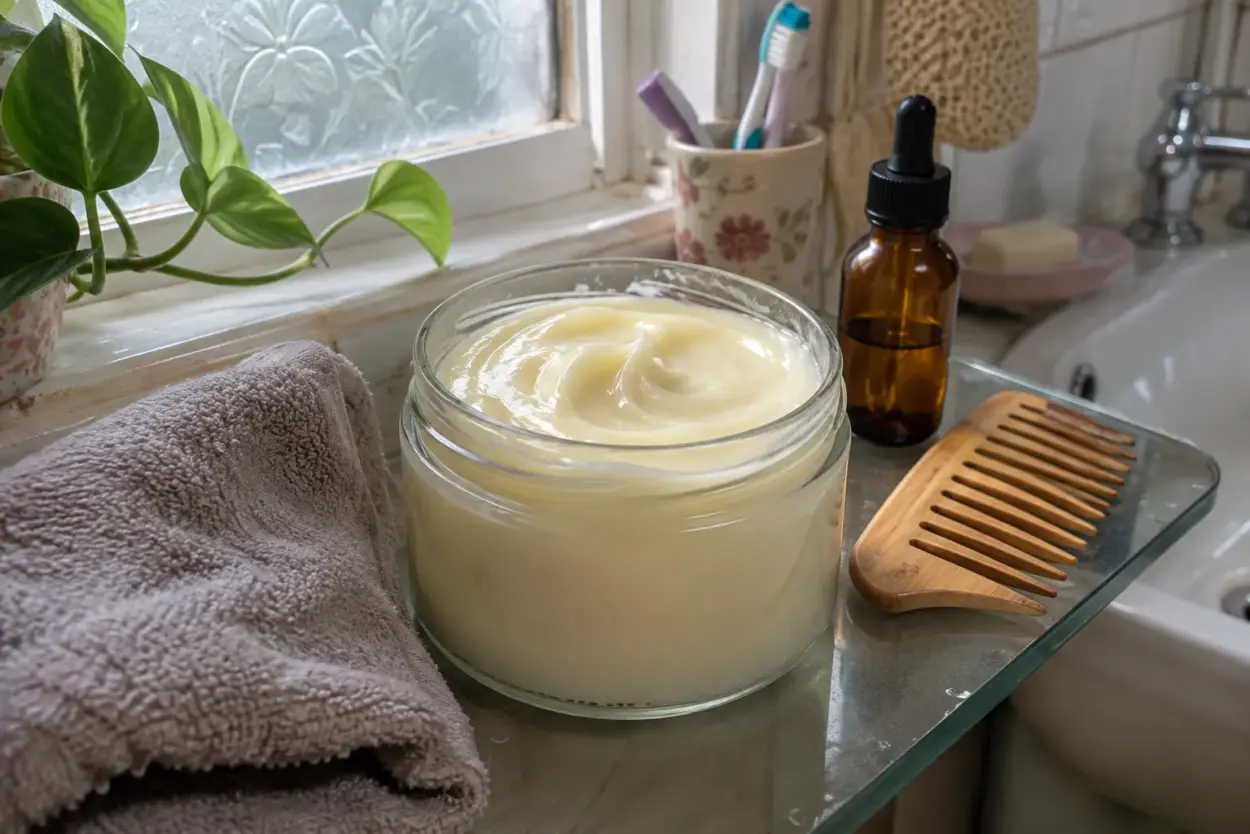
Short answer: melt 12 g of BTMS-50 and 5 g of cetyl alcohol with 2.4 g of oil, heat 211 g of distilled water with 5 g of glycerin to the same 75 to 80 °C, then pour the water into the melted wax and blend. Stir in 2.4 g of preservative once it drops below 45 °C and check that the pH sits between 4.5 and 5.5. That makes an 8 oz jar of rinse-out conditioner in about 40 minutes.
I make my own conditioner because the formula is short and every ingredient does a job you can explain. Real conditioner needs a positively charged ingredient that sticks to hair, and kitchen staples do not carry that charge. This guide covers a rinse-out cream, a leave-in spray and a vinegar rinse, with a calculator that weighs out each batch for your hair, the chemistry behind every step and a straight answer on which kitchen recipes work.
At a glance
What you need
- 12 g BTMS-50 conditioning emulsifier
- 5 g cetyl alcohol
- 2.4 g argan, sweet almond or coconut oil
- 211 g distilled water plus 5 g glycerin
- 2.4 g broad-spectrum preservative (not optional)
Steps
- Weigh everything on a 0.1 g scale.
- Heat the wax and the water separately to 75 to 80 °C.
- Pour the water into the wax and blend for 2 minutes.
- Add the preservative below 45 °C.
- Check the pH, adjust to 4.5 to 5.5 and jar it.
Use a scale
Weigh, do not measure with spoons. BTMS-50 comes as waxy pellets that pack differently in every spoon, and a 1 g error in a small batch shifts the cream from silky to waxy. A jewelry scale that reads to 0.1 g costs little and makes every batch repeatable.
This guide contains Amazon affiliate links. 33Science earns a commission on qualifying purchases. See our affiliate disclosure.
Homemade conditioner calculator
Choose a recipe, a jar size, your hair type and length. The calculator gives every ingredient in grams and ounces, how much to use per wash, and how many conditioner molecules that dose puts on your hair.
Homemade conditioner calculator
Pick a recipe, your jar, your hair type and length. The calculator weighs out every ingredient and works out how much conditioner actually lands on your hair.
The molecule count explains why a little conditioner goes a long way. A shoulder-length head of hair has about 5.5 square meters of surface, roughly the floor of a small bathroom, and two teaspoons of rinse-out conditioner carry more than 20 times the molecules needed to coat all of it once. Fine hair gets a lower dose of conditioner in the formula because it saturates sooner and goes limp.
Ingredients and tools
BTMS-50
Behentrimonium methosulfate (and) cetyl alcohol (and) butylene glycol
4 to 6% rinse-out, 1 to 2% leave-inThe ingredient that makes it conditioner. About 50% of each pellet is a positively charged surfactant that binds to hair; the rest is fatty alcohol that helps build the cream. It also emulsifies the oil, so no other emulsifier is needed.
Cetyl alcohol
Hexadecan-1-ol, C16H34O
1.5 to 3%A waxy fatty alcohol, not a drinking alcohol, and it does not dry hair. It thickens the cream and adds slip as you comb.
Oil
Triglycerides
0 to 3%Optional softness and shine. Coconut oil is the one oil shown to penetrate the hair shaft; argan and sweet almond sit on the surface. Skip it for fine or oily hair.
Vegetable glycerin
Glycerol, C3H8O3
2%A humectant that holds water in the hair. Above 2% it leaves strands sticky in humid weather.
Preservative
For example phenoxyethanol, caprylyl glycol and sorbic acid (Optiphen Plus)
1%Required. Water, oil and glycerin are food for bacteria and mold, and a jar opened with wet hands in a warm bathroom grows them within days.
Why distilled water
Use distilled water. Tap water carries calcium, magnesium and microbes. The minerals do not ruin a cationic conditioner the way they ruin soap, but they add load for the preservative and can leave the cream grainy or off-color.
Tools
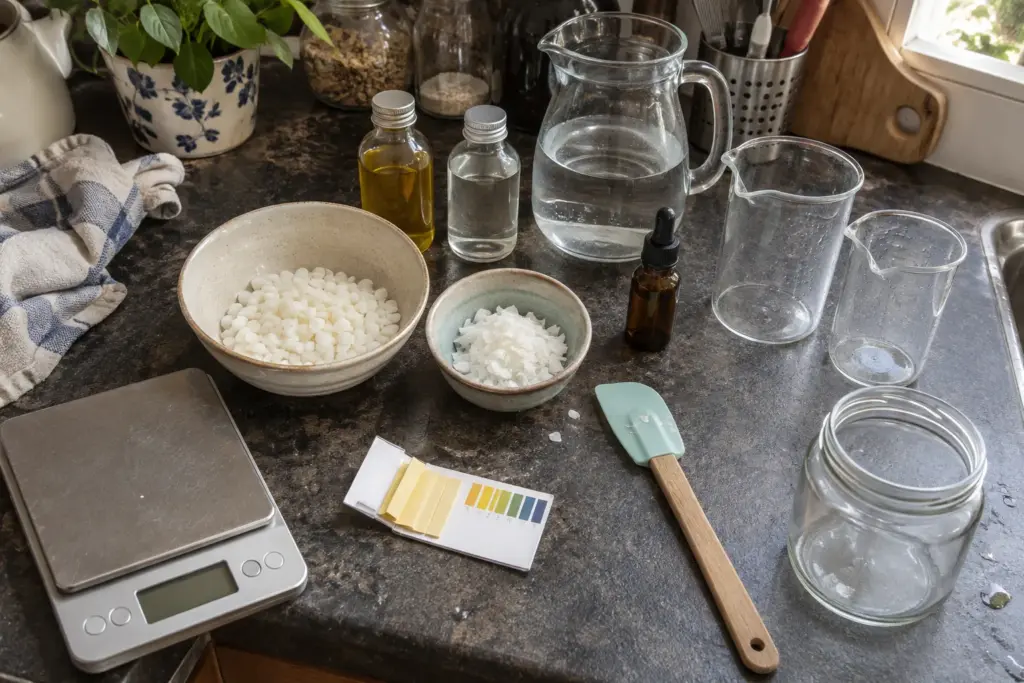
- A digital scale that reads to 0.1 g
- Two heat-proof glass beakers or jars and a saucepan for a water bath
- A probe thermometer
- A small stick blender or a milk frother
- pH test strips or a pH meter, and citric acid for adjusting
- A clean jar or pump bottle, washed and rinsed with rubbing alcohol
How to make rinse-out conditioner
These amounts make 8 oz (237 g) for normal hair. The calculator adjusts them for other jar sizes and hair types.
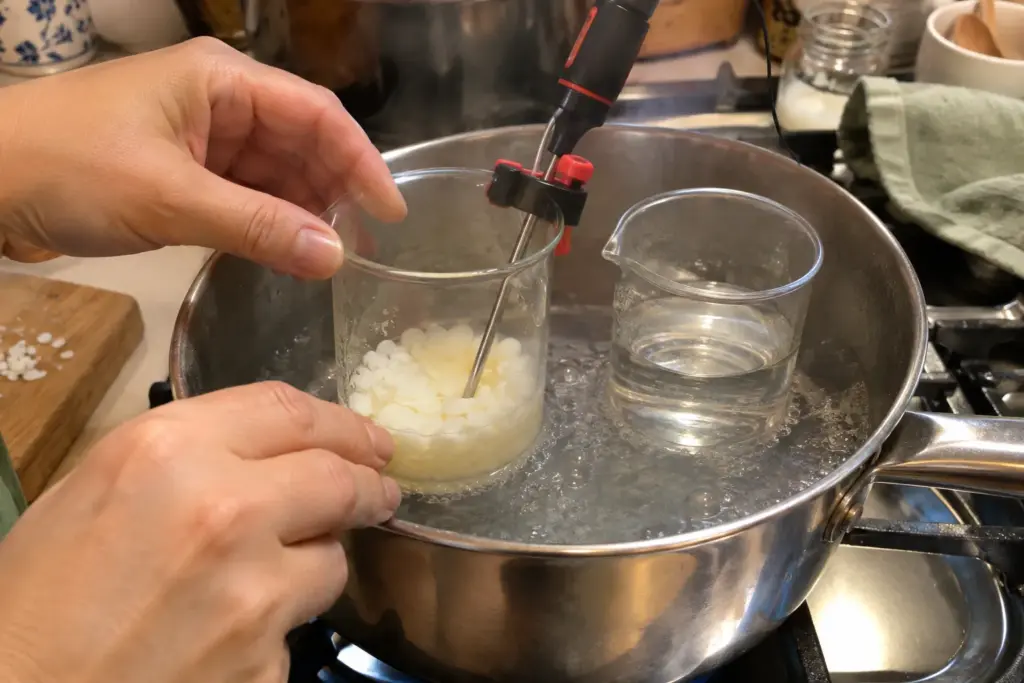
- Sanitize. Wash the beakers, blender head, spatula and jar in hot soapy water, then wipe or spray them with 70% rubbing alcohol and let them air dry.
- Weigh the oil phase. Into the first beaker, weigh 12 g of BTMS-50, 5 g of cetyl alcohol and 2.4 g of oil.
- Weigh the water phase. Into the second beaker, weigh 211 g of distilled water and 5 g of glycerin. Weigh the beaker empty first and write the total down.
- Heat both to 75 to 80 °C. Set both beakers in a pan of simmering water. Stir the wax until every pellet is clear and liquid, and hold both phases at 75 to 80 °C for 10 minutes.
- Combine and blend. Pour the hot water into the melted wax and blend in short bursts for 2 minutes. The mix turns white and opaque at once.
- Top up the water. Weigh the beaker and add hot distilled water to replace what evaporated during heating.
- Cool and stir. Stir every few minutes as it cools. It thickens noticeably between 50 and 40 °C.
- Add the preservative. Below 45 °C, stir in 2.4 g of preservative and any heat-sensitive extras such as panthenol.
- Check the pH and jar it. Test the pH (below), adjust it, then spoon the cream into the jar. It reaches full thickness after 24 hours.
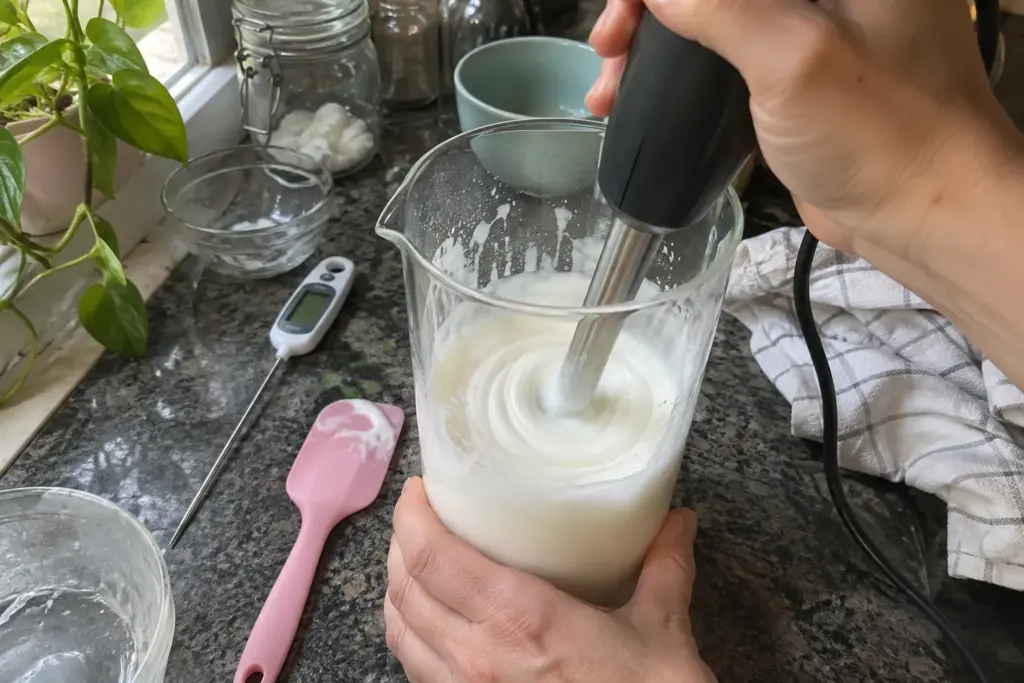
Match the temperatures
Do not pour cold or warm water into the melted wax. Cetyl alcohol melts at 49 °C, and if the water phase is cooler, the wax freezes into gritty specks before it can emulsify. Heat both phases to the same temperature.
How to make leave-in conditioner spray
A leave-in uses the same method with far less BTMS-50, so it stays thin enough to spray. Croda, the maker of BTMS-50, uses 1.5% in its own leave-in formula. For an 8 oz spray bottle:
- Weigh. Oil phase: 3.5 g of BTMS-50 and 1.2 g of oil. Water phase: 225 g of distilled water and 4.7 g of glycerin.
- Heat and combine. Heat both to 75 to 80 °C, pour the water into the wax and blend for 1 minute.
- Cool and preserve. Top up the evaporated water, stir as it cools and add 2.4 g of preservative below 45 °C.
- Bottle. Funnel it into a fine-mist spray bottle once it is cool. It stays pourable, about as thick as milk.
Tune it to your hair
If the leave-in feels heavy, halve the BTMS-50 and drop the oil. If curls frizz, raise BTMS-50 to 2% and add 0.5% cetyl alcohol. The calculator builds both versions.
Apple cider vinegar rinse
A vinegar rinse is the one useful conditioner step you can make from the kitchen. It does not coat hair or soften it the way a cream does. It lowers the pH after shampoo, which reduces the negative charge on the hair surface and with it the static and friction that cause tangles.
- Mix. Stir 2 tablespoons of apple cider vinegar into 1 cup of cool water in a jug or squeeze bottle.
- Apply. After shampoo, pour it over the lengths of your hair and work it through.
- Rinse. Wait 1 minute, then rinse with plain water. The smell leaves as the hair dries.
The rinse works best on hair washed with a true soap shampoo, such as the castile recipe in our guide to making shampoo at home, or a shampoo bar, both of which leave hair alkaline. Use it once or twice a week and keep it out of your eyes.
How much conditioner to use
| Hair length | Rinse-out cream | Leave-in spray | Vinegar rinse |
|---|---|---|---|
| Short (above the ears) | 1 tsp (4 g) | 8 sprays | 1 cup |
| Shoulder length | 2 tsp (8 g) | 15 sprays | 1 cup |
| Long (mid-back) | 1 tbsp (15 g) | 30 sprays | 2 cups |
| Very long (waist) | 1½ tbsp (22 g) | 45 sprays | 3 cups |
Apply rinse-out conditioner from mid-length to the ends, where the cuticle is oldest and most worn, and leave it for 2 minutes. Heavy use near the scalp makes fine hair limp.
pH check: test and adjust your conditioner
BTMS-50 alone gives a pH of 5 to 7 in water, and the target for a conditioner is 4.5 to 5.5. The preservative needs that range too: Optiphen Plus works best below pH 6. Checking takes 2 minutes.
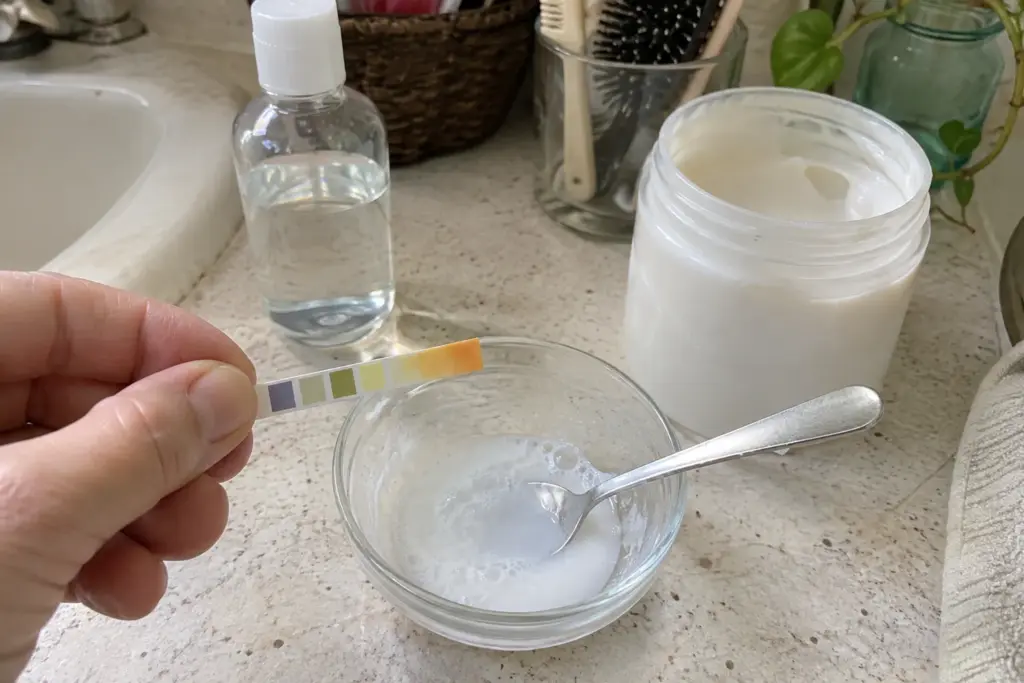
- Dilute a sample. Stir 1 g of cooled conditioner into 9 g of distilled water. Strips cannot read a thick cream.
- Test. Dip a pH strip and compare the color after the time on the pack.
- Adjust. If it reads above 5.5, dissolve 1 teaspoon of citric acid in 1 tablespoon of water, add 2 drops to the batch, stir well and test again. Repeat until it reads 4.5 to 5.5.
Too acidic?
Never use baking soda to fix a conditioner that came out too acidic. It foams and pushes the pH toward 8, where hair carries more negative charge and the preservative fails. Add a little more cream base instead.
The science: how conditioner works
In three sentences
Hair carries a negative charge in water. Conditioner molecules carry a permanent positive charge, so they stick to hair, with their long oily tails pointing out. That thin waxy layer lowers friction, stops static and makes wet hair comb out.
Hair is negatively charged
Hair is made of keratin, a protein with both acidic and basic groups. Its isoelectric point, the pH where the surface charge balances out, is about 3.67. Above that pH, carboxyl groups lose a proton and the surface turns negative:
Keratin–COOH → Keratin–COO− + H+
Shampoo, tap water and most bathroom products sit well above pH 3.67, so washed hair is negative. Each strand repels its neighbors, picks up static and drags against the comb. Bleach makes it worse: it oxidizes the sulfur bonds in keratin into cysteic acid, which carries a sulfonate group (–SO3−) that stays negative even in acid. Bleached hair has a lower isoelectric point and more negative sites.
Healthy hair has a natural oily coat
The outer cuticle of hair is covered with a fatty acid called 18-methyleicosanoic acid, or 18-MEA, bonded to the protein surface. It makes healthy hair water-repellent and slippery. Brushing, sun, heat and bleach strip it away, and the bare protein underneath is hydrophilic and charged. Conditioner replaces that coat.
Quaternary ammonium molecules carry a permanent positive charge
Behentrimonium methosulfate (C26H57NO4S, 479.8 g/mol) is a quaternary ammonium salt, or quat. Its nitrogen atom carries four carbon groups: three methyl groups and one 22-carbon behenyl chain. With four bonds to carbon, the nitrogen holds a positive charge at any pH.
R–N+(CH3)3 + Keratin–COO− → Keratin–COO− +N(CH3)3–R (ion pair on the hair surface)
The charged head pins itself to a negative site and the 22-carbon tail points outward, forming a layer that behaves like the lost 18-MEA. Damaged areas have more negative sites, so they pick up the most conditioner, exactly where it is needed.
Worked numbers: one dose, one layer
Two teaspoons (8 g) of the rinse-out recipe contain 5% BTMS-50, which is 50% active: 0.2 g of behentrimonium methosulfate. Divided by 479.8 g/mol, that is 4.2 × 10⁻⁴ mol, or 2.5 × 10²⁰ molecules.
A shoulder-length head of about 100,000 hairs, each 70 micrometers thick and 25 cm long, has a surface of π × 70 µm × 0.25 m × 100,000 ≈ 5.5 m². If each molecule covers about 0.5 nm², one complete layer takes 1.1 × 10¹⁹ molecules. The dose holds over 20 times that. Most of it rinses down the drain; the fraction that stays is a layer a few nanometers thick.
Fatty alcohol builds the cream
Heated together above the melting point of cetyl alcohol (49 °C), the quat and the fatty alcohol mix into flat double layers of molecules with water trapped between them. As the batch cools, the chains inside those layers freeze into an ordered gel, the lamellar gel network. Stacked sheets of gel and water give the cream its body and its slip. That is why the batch thickens between 50 and 40 °C, and why it keeps firming for a day. More cetyl alcohol makes a thicker cream; formulators often use around three parts fatty alcohol to one part quat.
Why low pH smooths hair
Acetic acid in vinegar is a weak acid with a pKa of 4.76. Store vinegar holds at least 4% acetic acid, and most apple cider vinegar is sold at 5%, about 0.83 mol/L. Two tablespoons in a cup of water dilutes it to 0.093 mol/L:
[H+] ≈ √(Ka × C) = √(1.75 × 10−5 × 0.093) = 1.3 × 10⁻³ mol/L, so pH ≈ 2.9
That is at or below the isoelectric point of hair, where its net charge drops to near zero and strands stop repelling each other. Tap water bicarbonate raises the real pH somewhat. No peer-reviewed study has tested vinegar rinses on hair directly; the benefit follows from the charge chemistry and from studies showing that high-pH products raise friction and frizz.
Why soap and conditioner cannot share a bottle
Soap and most shampoo surfactants are anionic: their heads are negative. Mix them with a cationic quat and the opposite charges pair up into a neutral, insoluble complex that falls out of solution. That is why 2-in-1 shampoos rely on special cationic polymers and silicones that stay dispersed in shampoo, and why a homemade conditioner should never be mixed with soap or castile.
Do kitchen conditioner recipes work?
Most “homemade conditioner” recipes online use food. None of them contain a cationic surfactant, so none of them condition the way a cream does. Some still have a use.
| Recipe | What it does | Verdict |
|---|---|---|
| Coconut oil before washing | Penetrates the hair shaft and reduces protein loss during washing | Works as a pre-wash treatment |
| Apple cider vinegar rinse | Lowers pH and surface charge, reduces tangles | Works, mildly |
| Olive or argan oil on the ends | Coats and adds shine; does not penetrate | Works in small amounts on dry ends |
| Honey | Humectant, holds water; sticky and hard to rinse | Little benefit |
| Egg or mayonnaise | Protein and oil that rinse away; egg cooks in hot water | Little benefit, smells if not rinsed out |
| Avocado or banana mask | Oil and sugars; leaves fibers in hair | Little benefit, hard to rinse |
The coconut oil result comes from a 2003 study in the Journal of Cosmetic Science, which found coconut oil was the only oil tested that markedly reduced protein loss in both undamaged and damaged hair. Mineral oil and sunflower oil did not. Coconut oil is mostly lauric acid triglyceride, a small, straight molecule that fits between the keratin fibers; sunflower oil is bulkier. The study was run by a coconut oil producer, but its method has been widely cited.
Best kitchen add-on
For dry or damaged hair, rub a teaspoon of coconut oil into the lengths 30 minutes before you shampoo, then follow with the cream conditioner. The oil limits swelling damage during washing, and the conditioner handles the surface.
Troubleshooting
| Problem | Cause | Fix |
|---|---|---|
| Gritty or grainy cream | Water phase cooler than the wax, or wax not fully melted | Reheat the batch to 75 °C, blend, cool again. |
| Too thin after 24 hours | Not enough cetyl alcohol or BTMS-50, or too much evaporation top-up | Next batch, raise cetyl alcohol by 1%. |
| Too thick to squeeze | High cetyl alcohol for a pump bottle | Use a jar, or drop cetyl alcohol by 1%. |
| Hair feels coated or limp | Too much product, or oil on fine hair | Use less, keep it off the roots, remove the oil. |
| Hair still tangles | Too little BTMS-50 for the hair type | Raise BTMS-50 to 6% or leave it on 2 minutes. |
| Water separates on top | Not blended long enough, or temperature shock | Reheat and blend 2 minutes; mix both phases hot. |
| Sour or musty smell, spots | Microbial growth | Throw it out. Check the preservative dose and pH. |
| Strong vinegar smell after drying | Rinse too strong or not rinsed out | Use 1 tbsp per cup and rinse with water after. |
Do not skip the preservative
Skipping the preservative is the most common way homemade conditioner goes wrong. Contamination often is not visible until a jar is far gone. A batch without preservative belongs in the fridge and in the trash after 3 days.
Safety
Before you start
- Protect your eyes from BTMS-50. Supplier safety sheets classify it differently, from eye irritant to serious eye damage (H318) and skin irritant (H315). Wear goggles and gloves when handling the pellets and the hot concentrate, and read the sheet from your supplier. If it gets in your eyes, rinse with running water for 15 minutes.
- Hot wax burns. The phases are at 75 to 80 °C. Use a water bath, never a direct flame, and keep children away.
- Citric acid irritates eyes. It is classified H319. Handle the powder and solution with care.
- Patch test. Rub a small amount on the inside of your forearm and wait 24 to 48 hours before the first full use.
- Keep the vinegar rinse out of your eyes. At pH 2.9 it stings; rinse with water if it splashes.
- Label the jar with the date and contents, and keep it away from food.
Store finished conditioner at room temperature out of direct sun, and use it within 3 to 6 months when preserved. Scoop it with a clean spoon or use a pump so wet fingers do not seed the jar with bacteria.
More practical science: browse all our everyday science how-tos, from household chemistry to experiments you can build at home.
Frequently asked questions
Melt BTMS-50 and cetyl alcohol with a little oil, heat distilled water and glycerin to the same 75 to 80 degrees Celsius, pour the water into the wax and blend. Add a preservative once it cools below 45 degrees Celsius and adjust the pH to 4.5 to 5.5.
You can make a conditioner with another cationic emulsifier such as behentrimonium chloride or cetrimonium chloride. Without any cationic ingredient, the product does not bind to hair; oils and vinegar rinses help but do not condition the same way.
Coconut oil before washing reduces protein loss, and an apple cider vinegar rinse lowers the pH and reduces tangles. Neither replaces a cream conditioner for detangling.
Yes. Any product containing water can grow bacteria and mold, especially in a warm bathroom. Without a preservative, keep it in the fridge and use it within 3 days.
With a broad-spectrum preservative and a pH around 5, it lasts 3 to 6 months. Without one, about 3 days in the fridge.
Between 4.5 and 5.5. Hair has its lowest charge near pH 3.7, and slightly acidic products keep the cuticle flat and the preservative effective.
It works as a rinse, not a conditioner. Diluted at 2 tablespoons per cup, it lowers the pH of hair after shampoo and reduces static and tangles, but it does not soften or coat hair.
No. Cetyl alcohol is a waxy fatty alcohol, not a drying alcohol like ethanol. It thickens conditioner and adds slip.
It works best before shampoo, where it penetrates the hair and reduces protein loss during washing. Used after washing, it can leave hair greasy unless applied sparingly to the ends.
Rinse-out conditioner carries more cationic surfactant and is washed off after a few minutes. Leave-in conditioner uses a fraction of the amount so it can stay on hair without weighing it down.
Sources
- Croda. Incroquat Behenyl TMS-50 datasheet
- Lotioncrafter. BTMS-50 specification sheet
- Gavazzoni Dias et al. The shampoo pH can affect the hair: myth or reality? International Journal of Trichology, 2014
- Gavazzoni Dias. Hair cosmetics: an overview. International Journal of Trichology, 2015
- Rele and Mohile. Effect of mineral oil, sunflower oil and coconut oil on prevention of hair damage. Journal of Cosmetic Science, 2003
- PubChem. Behentrimonium methosulfate
- PubChem. Cetyl alcohol
- PubChem. Acetic acid
- Ashland. Optiphen Plus technical data
- US FDA. Microbiological safety and cosmetics
- US FDA. CPG Sec. 525.825 Vinegar, definitions