
Buffer and alkalinity (advanced)
25 C, concentrations (no activity correction). Carbonate stays in the water while you dose (no CO2 loss).
Add 11.0 fl oz (326 mL) of 31.45% muriatic acid
Also 1.38 US cups. 3.26 mol of active ingredient for 37,854 L of water.
- Concentration change2× more acidic[H+] 1.58 × 10⁻⁸ → 3.16 × 10⁻⁸ mol/L (Δ +1.58 × 10⁻⁸). [OH-] 6.31 × 10⁻⁷ → 3.16 × 10⁻⁷.
- Buffer multiplier×261Your water needs 261 times more than a plain-water formula (1.25 mL (about 25 drops)).
- Staged dosingAdd 2/3 first: 7.35 fl ozRun the pump for at least 30 to 60 minutes, then retest. Then add up to 3.68 fl oz more if needed.
Safety Add acid to water, never water to acid. Wear gloves and goggles. Never mix chlorine with acid. Add in stages and retest.
pH curve
How pH moves as you add the product, to 1.5 times the dose
Show the math with your numbers
- Concentration now[H+] = 10^(−pH)= 10^(−7.80)= 1.58 × 10⁻⁸ mol/L
- Concentration at the target[H+] = 10^(−pH)= 10^(−7.50)= 3.16 × 10⁻⁸ mol/L
- Change in concentrationΔ[H+] = [H+]target − [H+]now= 3.16 × 10⁻⁸ − 1.58 × 10⁻⁸= +1.58 × 10⁻⁸ mol/L, 2× more acidic (10^0.30)
- Carbonate in your watercarbonate alkalinity = TA − cyanurate − borate; C_T = (CA − [OH-] + [H+]) / (α1 + 2α2)= TA 100 ppm CaCO3, cyanurate 13.8 ppm= CA 86.2 ppm, C_T 1.78 × 10⁻³ mol/L
- Equivalents if the water had no buffer|Δ[H+] − Δ[OH-]| × V= 3.31 × 10⁻⁷ mol/L × 37,854 L= 0.0125 eq
- Extra equivalents to move the bufferbuffer term = Σ C × |Δn_avg| × V (carbonate, cyanurate, borate, lab buffer)= 3.25 eq
- Total equivalents and moles of adjustermoles = (plain + buffer) / eq per mole at the target pH= 3.26 eq / 1 eq per mol= 3.26 mol
- Stock volumevolume = moles / molarity of the stock= 3.26 mol / 10.01 mol/L= 11.0 fl oz (326 mL)
Short answer: pH is a log scale, so every 1-unit change means a 10-fold change in hydrogen ion concentration. In pure water that takes very little acid or base. Real water is buffered by alkalinity, stabilizer or a lab buffer, so it usually needs hundreds of times more. Enter your current pH, target pH and volume above and the calculator gives you the amount to add. It includes the buffering.
How to use the pH adjustment calculator
- Pick what you are adjusting: a lab solution, a pool or spa, a hydroponic reservoir or an aquarium. Each choice loads typical values for that water.
- Enter the current pH and the target pH. Measure the current pH with a meter, strips or a test kit just before you dose.
- Enter the volume in gallons, liters, milliliters or cubic meters.
- Choose the product you will add. This can be muriatic acid, dry acid, soda ash, phosphoric acid, citric acid, NaOH, HCl or your own concentration.
- Check the buffer fields. Total alkalinity (TA) matters most. For pools, also enter cyanuric acid (CYA). For lab work, pick the buffer and its concentration.
The result shows how much to add, how much the hydrogen ion concentration changes, and how many times more product your water needs than pure water would. The Test-dose tab works out the dose for a product with no stated strength, such as a bottle of pH Down. The Dilute tab tells you how much water to add instead.
How to calculate pH adjustment
pH is the negative logarithm of the hydrogen ion concentration:
pH = −log10[H+] and [H+] = 10−pH
For unbuffered water, the amount of acid to add follows in three steps:
- Find the concentration at each pH. At pH 7, [H+] = 10−7 mol/L. At pH 3, it is 10−3 mol/L.
- Subtract to get the change in concentration: 10−3 − 10−7 ≈ 0.001 mol/L.
- Multiply by the volume and divide by the strength of your acid: 0.001 mol/L × 1 L ÷ 1 mol/L = 1.00 mL of 1 M hydrochloric acid.
| Change in 1 L of pure water | 1 M HCl needed |
|---|---|
| pH 7 to 4 | 0.10 mL |
| pH 7 to 3 | 1.00 mL |
This math only holds for pure water with a strong acid or base, such as HCl, HNO3 or H2SO4 and NaOH or KOH. Almost no water you will want to adjust is pure. The next sections explain why the real dose is larger.
Why one pH unit is a 10-fold change
Because the scale is logarithmic, small pH changes add up fast. Lowering a pool from 7.8 to 7.5 doubles its hydrogen ion concentration. Moving a solution from pH 6 to pH 4 makes it 100 times more acidic.
| pH change | [H+] changes by |
|---|---|
| 0.1 | 1.26x |
| 0.2 | 1.58x |
| 0.3 | 2.00x |
| 0.5 | 3.16x |
| 1 | 10x |
| 2 | 100x |
| 3 | 1,000x |
Why buffered water needs more acid or base
A buffer is a weak acid paired with its conjugate base. When you add acid, the buffer absorbs most of the hydrogen ions before the pH can move. The calculator handles four buffers:
- Carbonate alkalinity (bicarbonate) in tap water, pools, reservoirs and aquariums. This is the TA or KH number on a test kit.
- Cyanurate from cyanuric acid (CYA), the pool stabilizer.
- Borates, added to some pools.
- Lab buffers such as acetate, citrate, phosphate, Tris, HEPES and ammonia. See examples of buffer solutions.
The difference is large. Raising 1 L of 0.1 M acetate buffer from pH 4.76 to 5.50 takes 34.6 mL of 1 M NaOH. Pure water would need 0.0142 mL for the same change, about 2,435 times less. A 10,000-gallon pool with TA 100 ppm and CYA 40 ppm needs 314 times the plain-water amount of acid to go from pH 7.8 to 7.4.
For buffered water the calculator solves the full charge balance: every acid, base and buffer species in the water at once. It then searches for the dose that lands on your target pH. With a single buffer near its pKa, the result matches the Henderson–Hasselbalch equation.
How much muriatic acid to lower pH in a pool
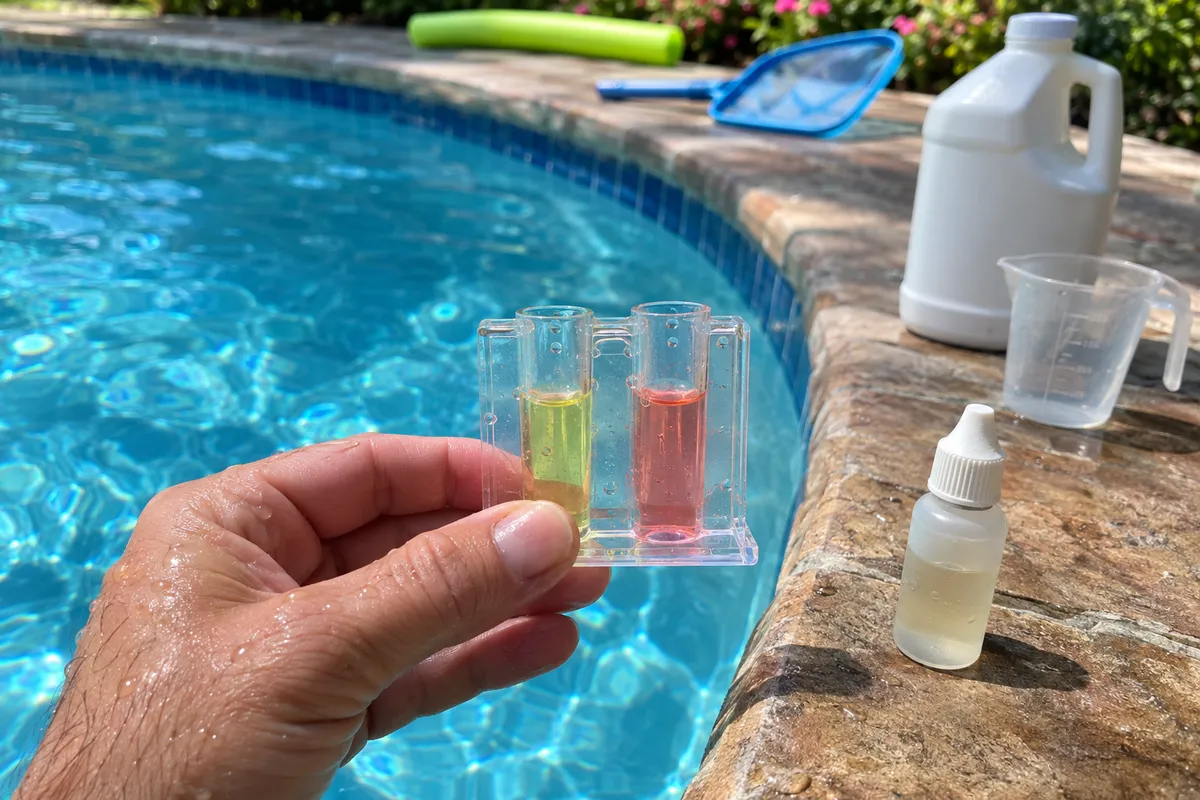
The CDC recommends keeping pool water between pH 7.0 and 7.8. Most pool owners aim for about 7.4 to 7.6. Chlorine works more slowly as pH climbs, especially above 8.0. Muriatic acid (hydrochloric acid, usually 31.45%) is the standard way to bring pH down. The table shows doses to reach pH 7.4 with TA 100 ppm and CYA 40 ppm.
| Pool size | From pH 7.8 to 7.4 | From pH 8.0 to 7.4 |
|---|---|---|
| 10,000 gal | 16.2 fl oz (479 mL) | 20.6 fl oz (610 mL) |
| 15,000 gal | 24.3 fl oz (719 mL) | 30.9 fl oz (914 mL) |
| 20,000 gal | 32.4 fl oz (959 mL) | 41.2 fl oz (1,219 mL) |
Three numbers change the dose more than anything else:
- Total alkalinity. At TA 80 ppm the dose drops by about a sixth. At TA 120 ppm it rises by about a sixth.
- CYA. Stabilizer is a second buffer. In a 10,000-gallon pool going from 7.8 to 7.4, the dose is 13.1 fl oz at CYA 0, 16.2 fl oz at CYA 40 and 19.3 fl oz at CYA 80.
- Acid strength. “Low-fume” or half-strength muriatic acid (14.5%) needs 38.1 fl oz for the same 10,000-gallon job. Dry acid (sodium bisulfate) needs 1.36 lb.
How to add it:
- Run the pump.
- Add about two thirds of the dose by pouring it slowly in front of a return jet in the deep end.
- Let the water circulate for at least 30 minutes. Retest, then add the rest if you still need it.
Acid lowers total alkalinity along with pH, so retest TA every few doses.
How to raise pH in a pool
Soda ash (sodium carbonate) raises pH. Baking soda (sodium bicarbonate) mainly raises total alkalinity and barely moves pH. Moving a 10,000-gallon pool from 7.0 to 7.4 would take about 25 lb of baking soda, compared with about 2.4 lb of soda ash.
| Pool size | Soda ash, pH 7.0 to 7.4 (upper limit) |
|---|---|
| 10,000 gal | 37.8 oz (2.4 lb) |
| 15,000 gal | 56.8 oz (3.5 lb) |
| 20,000 gal | 75.7 oz (4.7 lb) |
Treat these soda ash figures as a ceiling. The calculator assumes the carbon dioxide stays in the water. A real pool slowly releases CO2, and that release raises pH by itself, so most pools need less. Add half the dose, wait a few hours, then retest.
To raise pH without adding chemicals, aerate the water. Point the return jets up at the surface, or run a waterfall or fountain. This drives off CO2, which raises pH without changing alkalinity.
Hydroponics: adjusting nutrient solution pH
Most hydroponic crops grow best in a nutrient solution between pH 5.5 and 6.5, and many growers target 5.8 to 6.2. Above that range, iron, manganese and phosphorus become harder for roots to absorb. Below it, calcium and magnesium do. Tap water usually comes in with some alkalinity and a pH above 7, so the usual job is bringing it down.
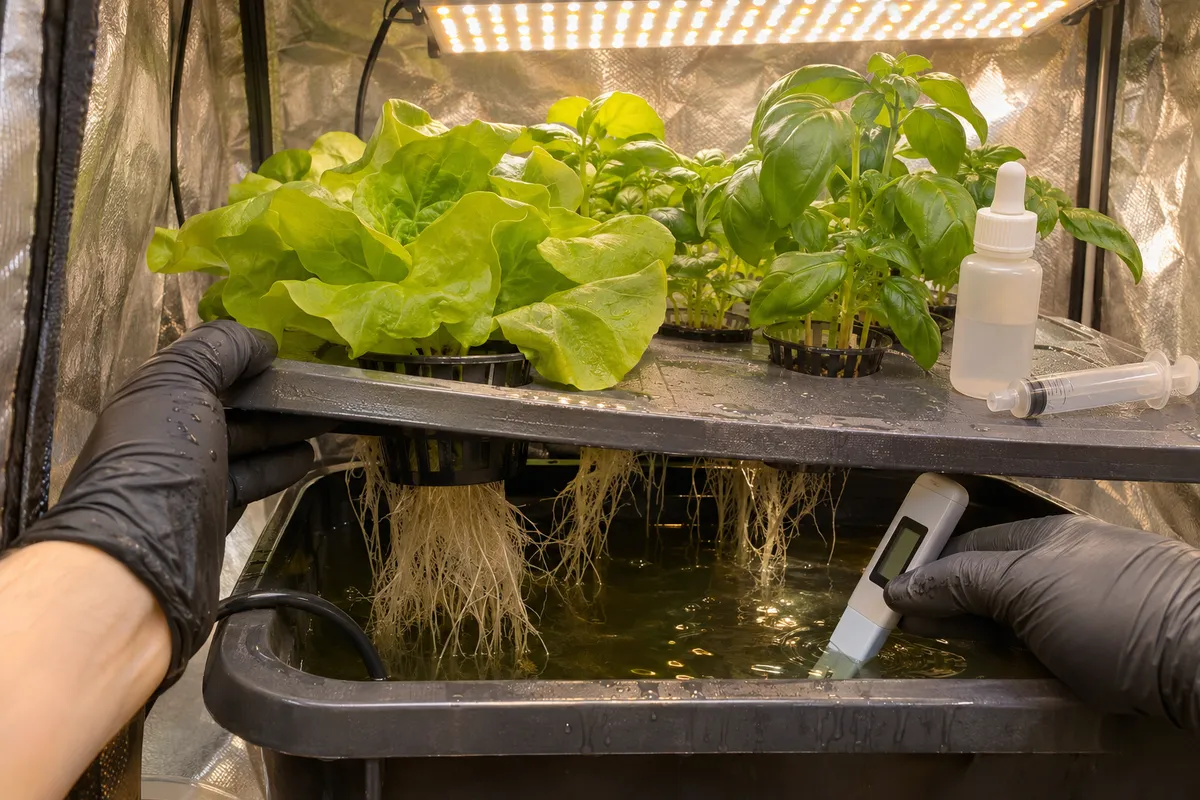
A 20-gallon reservoir with TA 60 ppm needs 4.21 mL of 85% phosphoric acid to drop from pH 6.8 to 5.8. The tap water’s alkalinity sets the dose:
| Tap-water TA | 85% phosphoric acid for 20 gal, pH 6.8 to 5.8 |
|---|---|
| 0 ppm | 0.01 mL |
| 30 ppm | 2.11 mL |
| 60 ppm | 4.21 mL |
| 120 ppm | 8.41 mL |
| 180 ppm | 12.61 mL |
Most bottled pH Down products are diluted phosphoric or nitric acid, and labels rarely state the strength. Use the Test-dose tab:
- Add a small measured amount, such as 1 mL.
- Stir and measure the new pH.
- Enter both readings. The calculator works out the product’s strength and gives the dose to reach your target.
Adjust pH after you add nutrients, because the nutrients themselves shift it. Read more about growing with hydroponics.
Aquarium pH adjustment
In an aquarium, carbonate hardness (KH, measured in dKH) is the buffer. One dKH equals 17.9 ppm of alkalinity. Lowering a 20-gallon tank at 4 dKH from pH 7.8 to 7.2 takes 0.69 g of citric acid in a closed system. The table shows how KH changes the amount.
| Carbonate hardness | Citric acid for 20 gal, pH 7.8 to 7.2 |
|---|---|
| 1 dKH | 0.17 g |
| 2 dKH | 0.35 g |
| 4 dKH | 0.69 g |
| 6 dKH | 1.03 g |
| 8 dKH | 1.38 g |
| 12 dKH | 2.06 g |
Fish handle a stable pH better than a fast change. Change aquarium pH gradually, through water changes, driftwood or peat for lower pH, or crushed coral for higher pH, rather than in one dose with fish in the tank. Use the calculator to size the change in new water before it goes in. Aquarium CO2 levels also swing between day and night, so take pH readings at the same time each day.
Can you change pH by adding water?
Yes, but only toward 7. For a strong acid or base with no buffer, each 1-unit pH change takes 10 times the volume. Taking 1 L from pH 2 to pH 3 takes 9 L of water.
| pH change | Volume factor | Water to add per litre |
|---|---|---|
| 2 to 3 | 10.0x | 9.0 L |
| 3 to 4 | 10.0x | 9.0 L |
| 4 to 5 | 10.0x | 9.0 L |
| 5 to 6 | 10.1x | 9.1 L |
| 11 to 10 | 10.0x | 9.0 L |
Dilution cannot cross neutral. Pure water moves any solution toward pH 7 and never past it. Buffered water barely responds to dilution. Taking pool water at TA 100 ppm from pH 8.2 to 7.8 by adding pure water would take about 83 times the volume, compared with 2.5 times for unbuffered water. For buffered water, use acid.
pH adjustment in the lab
For lab solutions, select the buffer, its concentration and its pKa, then pick a titrant such as 1 M or 0.1 M HCl or NaOH. The calculator gives the volume to add, the change in [H+], and a pH curve showing how the pH moves as you add titrant. The curve is steepest far from the buffer’s pKa. This is why the last few tenths of a pH unit can move fast when you adjust by hand.
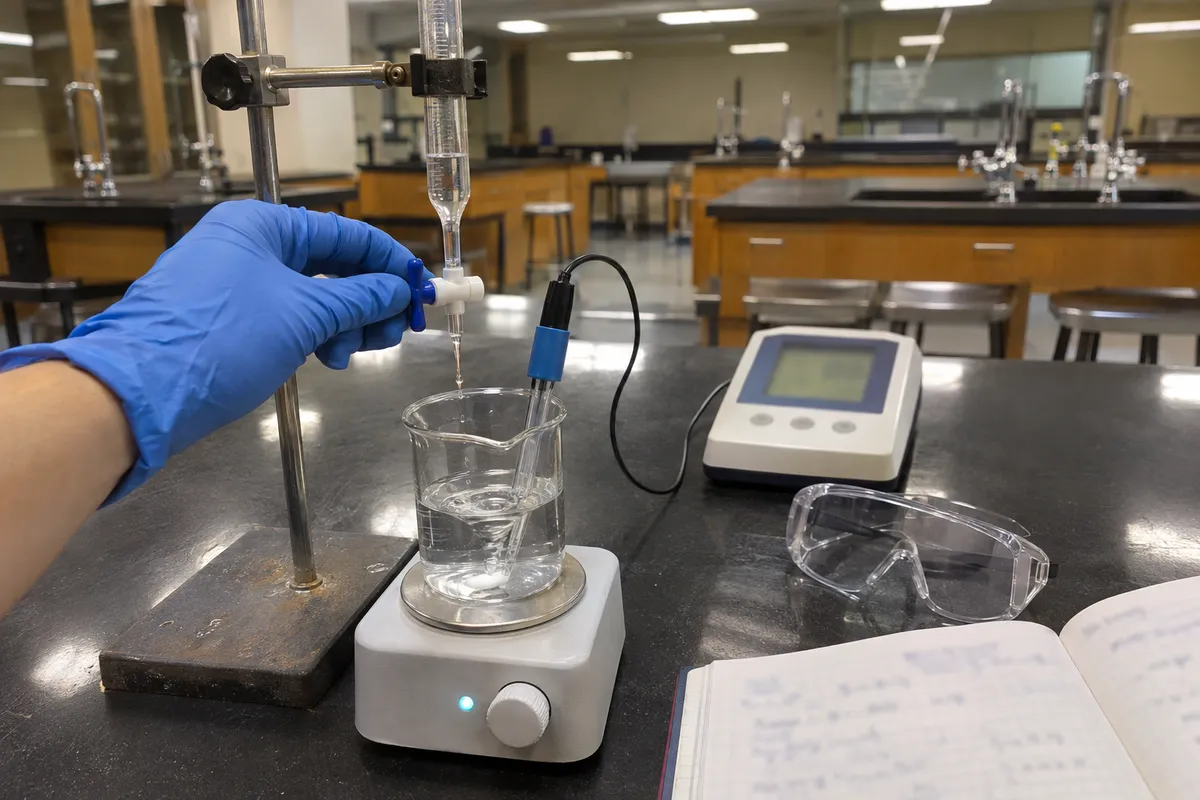
For accurate work, add titrant from a burette or pipette while stirring, with a calibrated meter in the solution. Slow down as you approach the target. The calculator works at 25 °C and uses concentrations rather than activities. For dilute solutions that matches textbook values. In concentrated or high-salt solutions, the measured pH can differ by a tenth of a unit or more. The titration guide covers the method in more detail.
Safety when adjusting pH
- Add acid to water, never water to acid. Concentrated acids release heat when diluted and can spatter.
- Wear gloves and eye protection. Concentrated muriatic, sulfuric and phosphoric acid and NaOH all burn skin and eyes.
- Never mix chlorine products with acid. Together they release chlorine gas. Add them to a pool separately, hours apart.
- Dose in stages. Add about two thirds, mix, then retest. It is easy to add more and hard to take it back.
- Store acids and bases apart, in their original containers and away from children.
What you need to measure pH
The calculator is only as good as the pH reading you enter. Here is what each tool suits:
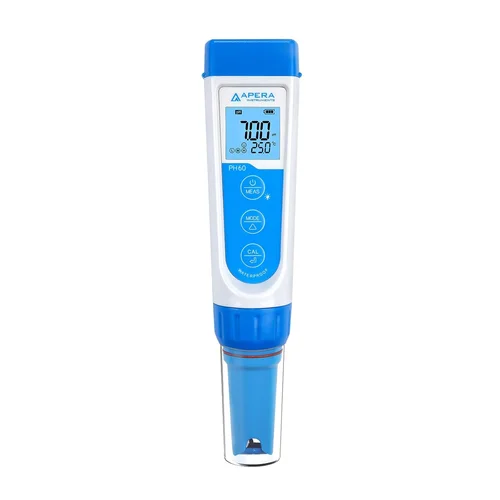
- A digital pH meter reads to 0.01 and suits hydroponics, aquariums and lab work. Calibrate it with buffer solutions before you use it.
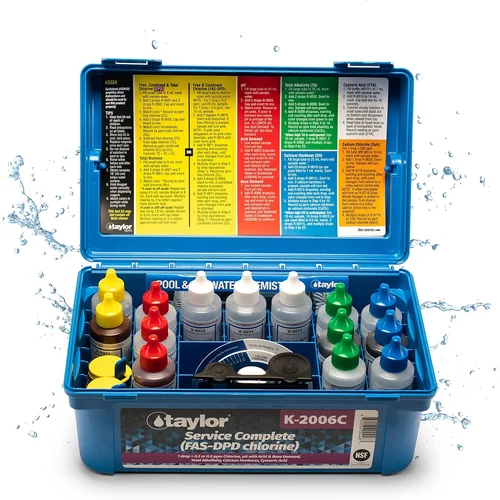
- A drop-based pool kit also measures TA and CYA, the two numbers that set your pool dose.
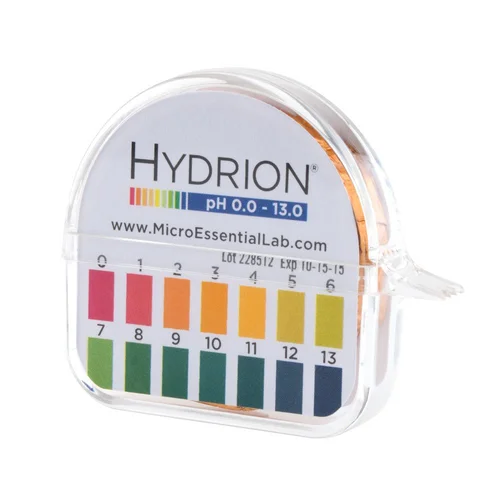
- Universal pH strips are cheap and fine for quick checks to about 0.5 units.
As an Amazon Associate 33Science earns from qualifying purchases.
Sources
- Centers for Disease Control and Prevention, Home pool and hot tub water treatment and testing.
- The Ohio State University Extension, hydroponic nutrient solution pH (HYG-1437).
- Michigan State University Extension, pHix it! Getting substrate pH just right.
- Aqua Magazine, Adjusting pH and alkalinity may not be as simple as you think.
- Acid dissociation constants: CRC Handbook of Chemistry and Physics (carbonic acid 6.35 and 10.33, acetic acid 4.76, phosphoric acid 2.15, 7.20 and 12.35, boric acid 9.24, cyanuric acid 6.88).
Frequently asked questions
How do you calculate how much acid to add to lower pH?
For unbuffered water, convert both pH values to hydrogen ion concentration with [H+] = 10−pH. Subtract, multiply by the volume in liters, and divide by your acid’s molarity. Lowering 1 L of pure water from pH 7 to 3 takes 1.00 mL of 1 M HCl. Buffered water such as pool, tap or nutrient water needs far more, so enter its alkalinity in the calculator.
What is the formula for pH?
pH = −log10[H+], where [H+] is the hydrogen ion concentration in moles per liter. Rearranged, [H+] = 10−pH. At 25 °C, pH + pOH = 14.
How much muriatic acid do I need to lower pool pH?
In a 10,000-gallon pool with TA 100 ppm and CYA 40 ppm, lowering pH from 7.8 to 7.4 takes about 16.2 fl oz of 31.45% muriatic acid. From pH 8.0 it takes about 20.6 fl oz. Higher alkalinity or stabilizer raises the dose. Add about two thirds, circulate, then retest.
How many times more acidic is a change of one pH unit?
Ten times. A drop of 2 units is 100 times more acidic and 3 units is 1,000 times. Even 0.3 units roughly doubles the hydrogen ion concentration.
Why does my pH keep bouncing back after I adjust it?
A buffer is pulling it back. In pools and aquariums, carbon dioxide leaving the water slowly raises pH. High alkalinity makes that rise stronger. In hydroponics, plants change the pH as they take up nutrients. Lowering the alkalinity, or using water with less of it, makes pH easier to hold.
What is the difference between pH Up and pH Down?
pH Down is an acid, usually phosphoric, nitric, citric or sodium bisulfate. pH Up is a base, usually potassium hydroxide, potassium carbonate or sodium carbonate. Most labels do not state the concentration. Use the Test-dose tab to work out how much your bottle needs.
Can you lower pH by adding water?
Only if the solution is acidic and only toward 7. Adding water to a pH 2 strong acid takes 10 times the volume to reach pH 3. Water cannot take a solution past neutral, and buffered water barely changes, so for most real adjustments you need an acid or a base.
Does baking soda raise pH?
Only slightly. Baking soda (sodium bicarbonate) raises total alkalinity, but its own pH is about 8.3, so it moves pH little. Use soda ash (sodium carbonate) when the goal is a higher pH.
How accurate is this pH adjustment calculator?
It solves the full chemical balance at 25 °C. For dilute lab solutions it reproduces textbook values, such as pH 2.00 for 0.01 M HCl and 2.88 for 0.1 M acetic acid. For pools, ponds and reservoirs it is a planning number, because CO2 exchange, temperature and other dissolved chemicals shift the real result. Always dose in stages and retest.