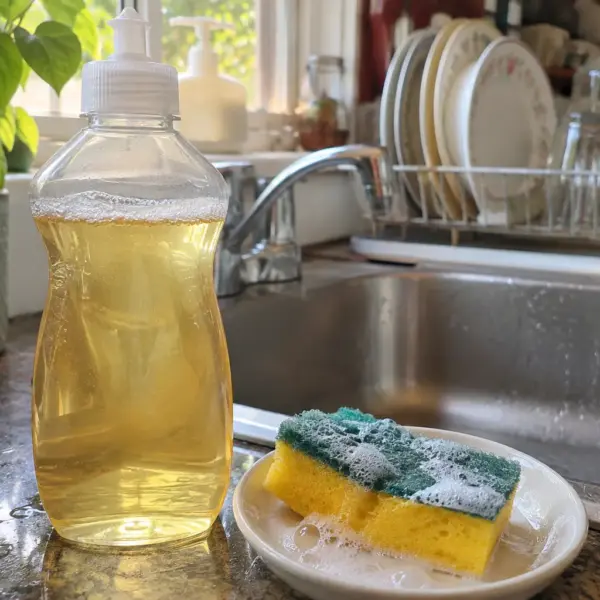
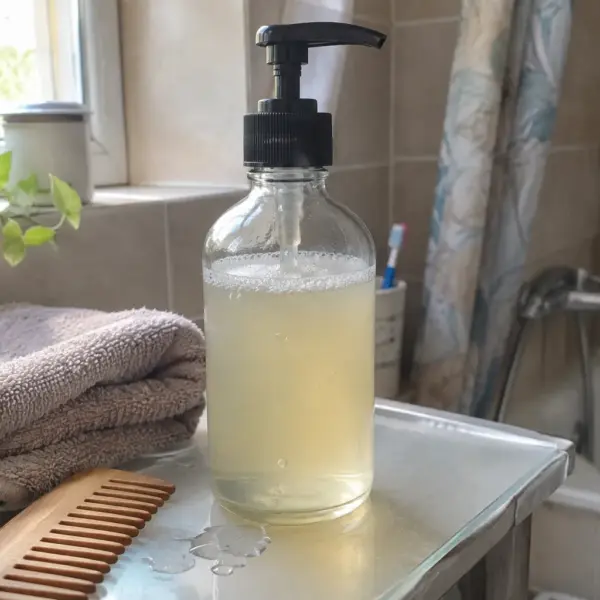
Short answer: mix 1 part liquid castile soap with 3 parts distilled water in a foaming pump bottle: ¼ cup of soap and ¾ cup of water fill an 8 oz bottle. Add 1 teaspoon of glycerin if your hands dry out. It takes 5 minutes, gives about 300 washes and keeps for 3 weeks.
I make hand soap in small batches, one bottle at a time, because a diluted soap has no preservative and a big jug spoils before a household uses it. The foaming version is the one that works best: castile soap is too thin for an ordinary pump, and a foaming pump turns that thinness into an advantage. This guide covers the foaming recipe, a thicker pump soap made from a leftover bar, a calculator that sizes the batch to your household and the chemistry of how soap cleans hands.
At a glance
What you need
- ¾ cup distilled or boiled water, cooled
- ¼ cup liquid castile soap, unscented
- 1 tsp vegetable glycerin (optional)
- 24 drops essential oil (optional)
- An 8 oz foaming pump bottle
Steps
- Pour the water into the bottle first.
- Add the castile soap.
- Add glycerin and essential oil.
- Screw on the pump and tip the bottle gently to mix.
- Use one pump per wash and lather for 20 seconds.
Which bottle?
Castile soap in a regular lotion pump drips and clogs. Use a foaming pump for castile, or make the bar soap gel for a standard pump.
This guide contains Amazon affiliate links. 33Science earns a commission on qualifying purchases. See our affiliate disclosure.
Homemade hand soap calculator
Choose a recipe, a bottle and a scent strength, then enter how many people use the sink. The calculator gives the amounts in US and metric units, the number of washes per bottle and whether the batch runs out before it spoils.
Homemade hand soap calculator
Pick a recipe and a bottle, then tell it how many people wash at your sink. It scales the recipe, counts the essential oil drops and checks whether the bottle runs out before the batch spoils.
Assumptions: liquid castile soap is 39% soap; a loosely packed cup of grated bar soap weighs 70 g; a foaming pump dispenses 0.8 mL of liquid per stroke and a lotion pump about 1.5 mL; one stroke per wash; 20 drops of essential oil per mL; average soap molecule 280 g/mol. Shelf life: 3 weeks for the foaming mix, 4 weeks for the bar soap gel.
The shelf life check matters more than the recipe. A 32 oz refill jug of foaming mix lasts a family of three about two months, almost three times as long as the mix stays fresh. Make one bottle at a time and keep the concentrate undiluted.
Ingredients and tools

Liquid castile soap
Potassium salts of plant oil fatty acids
¼ cup per 8 ozThe cleaner in the foaming recipe. True soap made from oil and potassium hydroxide, about 39% soap and the rest water. Buy it unscented so you choose the scent.
Bar soap
Sodium salts of fatty acids
⅓ cup grated per 2 cups waterThe cleaner in the gel recipe. It must be true soap: castile, coconut oil or a plain bar such as Ivory. Many “beauty bars” are synthetic detergent and do not gel.
Vegetable glycerin
Glycerol, C3H8O3
1 tsp per cupOptional. A humectant that holds water in the outer layer of your skin, so frequent washing dries hands less. More than 1 teaspoon per cup makes the soap feel sticky.
Distilled water
H2O without dissolved minerals
¾ cup per 8 ozTap water carries calcium and microbes. Distilled water, or tap water boiled for a minute and cooled, keeps the mix clear and lasting longer.
Why glycerin helps
Glycerin is already in soap: it is the byproduct of saponification, and handmade bars keep it. Each glycerol molecule carries three hydroxyl (OH) groups that hydrogen bond with water, which is why a thin film of it left on skin pulls in moisture instead of letting it evaporate.
Tools
- A foaming soap dispenser for the castile recipe. An empty store foaming bottle, washed out, works as well.
- A glass pump bottle or a jar for the bar soap gel
- A small funnel and a measuring cup
- A saucepan, a whisk and a box grater for the bar soap recipe
How to make foaming hand soap

- Clean the bottle. Wash the bottle and pump with hot soapy water, rinse and let them dry. Old soap residue seeds bacteria into the new batch.
- Add the water. Pour ¾ cup (175 mL) of distilled or cooled boiled water into an 8 oz foaming bottle.
- Add the soap. Pour in ¼ cup (60 mL) of liquid castile soap. Leave about an inch of space below the neck; the pump mechanism needs it.
- Add glycerin and scent. Add 1 teaspoon of glycerin and up to 24 drops of essential oil, if you use them.
- Mix gently. Screw the pump on and tip the bottle end over end a few times. Shaking whips the soap into foam inside the bottle.
- Prime and use. Pump four or five times until foam comes out. One pump per wash is enough.
The ratio is Dr. Bronner’s own recommendation for foaming dispensers: 1 part soap to 3 parts water. At that strength the mix is about 10% soap, thin enough to pass through the pump’s mesh and strong enough to hold its foam. Essential oil floats on the mix, so tip the bottle once before use if you add a lot.
Never top off
Do not top off a half-empty bottle with a new batch. Bacteria growing in the old mix contaminate the fresh one, and studies of refillable soap dispensers found hands carried more bacteria after washing with contaminated soap than before. Empty, wash, dry, then refill.
How to make liquid hand soap from a bar
This version turns a bar into a soft gel that works in an ordinary lotion pump. It is a good use for the last slivers of old bars. The ratio depends on the bar, so start with this and adjust. For a 16 oz bottle:
- Grate the soap. Grate a true soap bar on the fine side until you have ⅓ cup, loosely packed (about 23 g, a fifth of a 4 oz bar).
- Heat the water. Bring 2 cups of water to a simmer in a saucepan, then turn the heat to low.
- Dissolve the soap. Whisk in the grated soap until no flakes remain, 3 to 5 minutes. Keep it below a boil or it foams over.
- Add glycerin. Take the pan off the heat and stir in 2 teaspoons of glycerin.
- Rest overnight. Leave it uncovered to cool, then for 12 to 24 hours. It thickens into a soft gel.
- Blend and bottle. Whisk or use a stick blender until smooth, add essential oil and funnel it into a pump bottle.

Adjust the texture
If the gel sets too stiff to pump, whisk in hot water a tablespoon at a time. If it stays watery after a day, warm it again and whisk in another tablespoon of grated soap.
How much bar soap per cup of water
| Bar type | Grated soap per cup of water | Result |
|---|---|---|
| Coconut oil or Ivory-type bar | 2 to 2½ tbsp | Firm gel; may need more water |
| Castile (olive oil) bar | 2½ to 3 tbsp | Soft, smooth gel |
| Handmade bar with shea or cocoa butter | 2½ tbsp | Creamy, can separate; whisk before bottling |
| “Beauty bar” or syndet bar | Not recommended | Stays runny or turns lumpy |
Add-ins: what helps and what spoils the soap
Most “moisturizing” additions in online recipes make hand soap worse. Oils use up soap that should be lifting dirt, and food-based ingredients feed bacteria in a mix that has no preservative.
| Add-in | Amount per cup | Verdict |
|---|---|---|
| Vegetable glycerin | 1 tsp | Helps. Draws water into skin, does not cut lather. |
| Essential oil | Up to 48 drops (1%) | Fine for scent. No proven germ-killing effect at this dose. |
| Olive, almond or coconut oil | Any | Skip. Oil sits in the soap and cuts its cleaning power. |
| Vitamin E oil | Any | Skip. It does not preserve a water-based mix. |
| Aloe vera gel | Any | Skip. Sugars and water feed bacteria; the mix spoils in days. |
| Honey | Any | Skip. Same problem as aloe. |
| Vinegar or lemon juice | Any | Never. Acid curdles soap into fatty acid. |
| Salt | Any | Never in castile. It pushes soap out of solution instead of thickening it. |
Citrus oils and sunlight
Citrus oils such as cold-pressed lemon, lime and bergamot can cause sun burns on skin that is exposed to light after a leave-on product. Essential oil safety guidance treats wash-off products such as soap as free of that risk, so citrus oils are safe in hand soap at these doses.
Foam test: find the right ratio for your pump
Foaming pumps differ in mesh and air chamber size, and castile brands differ in strength. This two-minute test finds the ratio that gives your pump the best foam.
- Mix three ratios. In three cups, mix 1 tablespoon of castile soap with 2, 3 and 5 tablespoons of distilled water. Label them 1:2, 1:3 and 1:5.
- Pump each one. Pour the first into the foaming bottle, pump three times onto a dark plate and rinse the pump with water between ratios.
- Watch for one minute. Good foam is white, fine and holds its shape. Weak foam is wet, has large bubbles and collapses into a puddle.
- Pick the weakest mix that holds. Use the most dilute ratio whose foam still stands after a minute. More soap than that only runs out faster.
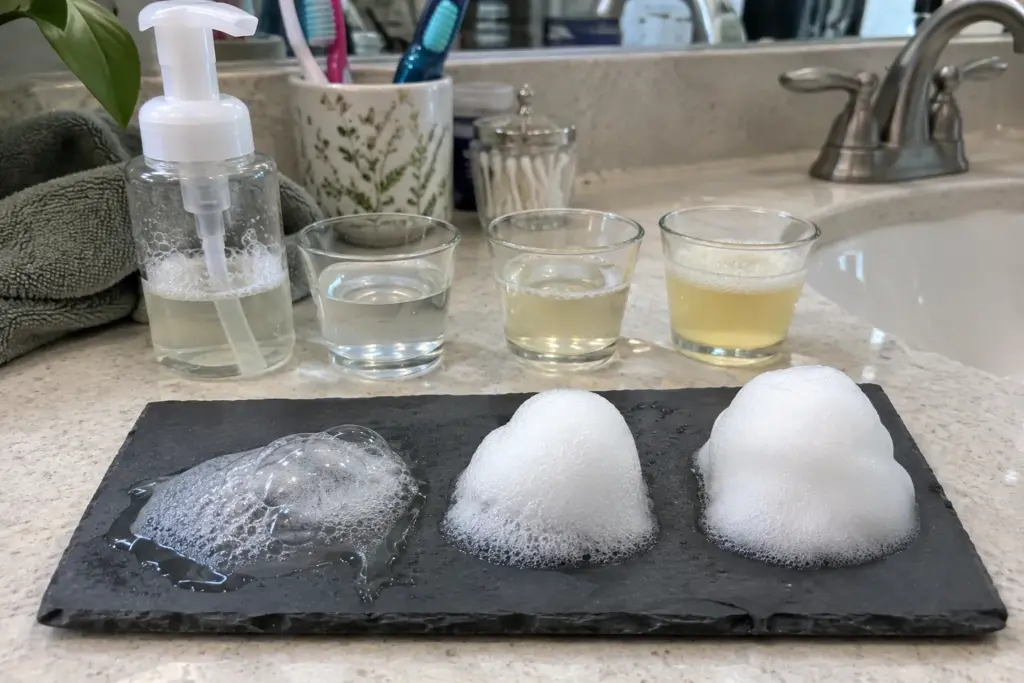
In soft water, 1:4 often works. In hard tap water the calcium consumes part of the soap, which is another reason to mix with distilled water.
The science: how soap cleans your hands
In three sentences
Soap does not need to kill germs. Its molecules grip oil and water at once, so they lift the oily film that holds dirt and microbes on skin and let the rinse carry it away. Viruses with a fatty outer envelope are also pulled apart by the same molecules.
Soap is made from oil and lye
All soap comes from saponification: heating a fat or oil with a strong base. The base splits each fat molecule (a triglyceride) into glycerol and three fatty acid salts:
Triglyceride + 3 KOH → glycerol + 3 RCOO−K+ (potassium soap)
Potassium hydroxide gives a soft, water-soluble soap: liquid castile. Sodium hydroxide gives a hard one: bar soap. That difference explains both recipes. Potassium soap simply dilutes. Sodium soap needs heat to dissolve, and as the solution cools its molecules stack into layered crystals that trap water, which is the gel you see the next morning.
How soap lifts germs off skin
Skin is coated with sebum, a mix of oils and waxes, and microbes and dirt stick in it. Water alone slides over that film because water molecules bond to each other and push oil away. A soap molecule bridges the two: its hydrocarbon tail, 12 to 18 carbons long, dissolves in oil, and its charged carboxylate head (COO−) dissolves in water.
As you lather, the tails bury into the oil film and the heads face the water. Rubbing breaks the film into droplets coated with soap heads, and soap molecules also cluster into micelles, balls with the tails hidden inside, that hold oil in their cores. The rinse washes the droplets, the micelles and everything trapped in them down the drain. The CDC notes that people also scrub harder with soap than with water alone, and that friction does part of the work.
Why soap breaks enveloped viruses
Flu viruses and coronaviruses wrap their genetic material in a lipid membrane, a fatty layer similar to the membrane of a cell. The particle holds together through weak attractions between lipids and proteins rather than strong chemical bonds. Soap tails wedge into that membrane like crowbars, and the envelope comes apart. Viruses without an envelope, such as norovirus, are not broken this way, but they are still lifted off and rinsed away.
Why 20 seconds
The CDC recommends 20 seconds of scrubbing and cites evidence that washing for 15 to 30 seconds removes more germs than shorter washes. That time lets soap reach the backs of the hands, between the fingers and under the nails, where most people miss. Water temperature makes little difference: warm and cold water remove the same amount of germs when used with soap. Warm water is simply more comfortable, so people wash longer.
Soap pH and skin
Soap is alkaline because a little of it reacts with water and releases hydroxide ions:
RCOO− + H2O ⇌ RCOOH + OH−
Dr. Bronner’s gives the pH of its liquid castile soap as 8.7 to 9.9. Diluting it barely changes that. For a weak base, the hydroxide concentration scales with the square root of the soap concentration, so a fourfold dilution halves it: ΔpH = log10(√4) = 0.3. Your foaming mix sits near pH 9.
The skin surface is acidic. A study of 330 volunteers put its natural pH at about 4.7, and skin below pH 5 showed better barrier function. A 20 second wash with alkaline soap raises the surface pH briefly, and skin re-acidifies on its own after rinsing. People who wash dozens of times a day, or whose skin cracks in winter, feel the difference most. Glycerin and a moisturizer after washing help more than any change to the soap.
Why a foaming pump works with thin soap
A foaming pump has two chambers. On each stroke one pushes a small dose of liquid, about 0.8 mL, and the other pushes air; both meet in a mixing chamber and are forced through fine mesh screens. The screens split the air into tiny bubbles, each wrapped in a film of soap solution. Pump designs mix roughly ten parts air to one part liquid, so a spoonful of soap becomes a handful of foam.
The mesh needs a thin liquid. A thick commercial hand soap would clog it, which is why store foaming soaps are sold already diluted. Castile soap at 1:3 has the right flow, and its soap molecules line each bubble wall with the tails pointing into the air, which stabilizes the film.
Why homemade soap spoils
Undiluted castile soap keeps for years: it has little free water, and its high soap content and pH hold microbes back. Diluting it with three parts water removes that protection, and Dr. Bronner’s puts the shelf life of a diluted foaming mix at 2 to 3 weeks. Store soaps survive months because they contain preservatives. A musty or sour smell, cloudiness or slime in the pump tube means the batch has spoiled.
Homemade vs store-bought hand soap
Most store liquid hand soaps contain no true soap. They use synthetic surfactants such as sodium laureth sulfate and cocamidopropyl betaine, thickened with salt, adjusted to a skin-friendly pH with citric acid and protected by preservatives.
| Feature | Foaming castile | Bar soap gel | Store liquid hand soap |
|---|---|---|---|
| Main cleaner | Potassium soap | Sodium soap | Synthetic surfactants |
| pH | About 9 | Alkaline, similar to castile | Usually near neutral or slightly acidic |
| Preservative | None | None | Yes |
| Shelf life once mixed | 3 weeks | 4 weeks | Months to years |
| Hard water | Leaves some scum | Leaves some scum | Unaffected |
| Fragrance and dye | Only what you add | Only what you add | Common |
| Cost per wash | Low | Lowest | Higher |
Plain soap and water remove germs as well as antibacterial soap for everyday use. In 2016 the FDA banned triclosan and 18 other antibacterial ingredients from consumer hand washes because manufacturers had not shown they work better than plain soap or that they are safe for daily long-term use. Homemade soap gives up shelf life and a lower pH, not cleaning power.
One bottle, three cleaners
The same castile soap cleans dishes and laundry. See how to make dish soap and how to make laundry detergent for the recipes and their hard water fixes.
Troubleshooting
| Problem | Cause | Fix |
|---|---|---|
| Foam is wet and collapses | Mix too dilute for your pump | Add castile soap a tablespoon at a time, or run the foam test. |
| Pump sputters or clogs | Mix too strong, or dried soap in the nozzle | Dilute to 1:3 or 1:4; pump hot water through it. |
| Liquid squirts instead of foam | Bottle overfilled; no room for air | Pour off some liquid to leave an inch below the neck. |
| Cloudy mix or white flecks | Hard tap water reacted with the soap | Remake it with distilled or boiled water. |
| Oily layer on top | Essential oil or added carrier oil separating | Tip the bottle before use; skip carrier oils. |
| Musty or sour smell | Bacteria growing in the mix | Throw it out, wash and dry the bottle, make a smaller batch. |
| Bar soap gel stays runny | Too little soap, or a syndet bar | Reheat and whisk in more grated true soap. |
| Gel lumpy or too stiff | High coconut or tallow content | Whisk in hot water a tablespoon at a time, then blend. |
| Hands feel dry or tight | Alkaline soap strips skin oils | Add glycerin; use moisturizer after washing. |
Do not fix dryness with oil
Adding oil, aloe or honey to fix dry hands creates a different problem. Oil cuts the soap’s cleaning power, and aloe and honey feed bacteria in a mix with no preservative. Use glycerin in the soap and put lotion on after.
Safety
Before you start
- Keep it out of eyes. Soap solutions are alkaline and sting. Rinse with running water for several minutes; see a doctor if irritation continues.
- Use a pump bottle, not a drink bottle. A soap mix in a reused juice or water bottle looks drinkable to a child. Label it.
- Keep essential oils at 1% or less. Higher doses irritate skin with repeated washing. Leave them out of soap for babies and anyone with eczema.
- Know your pets. Tea tree, citrus and several other essential oils are toxic to cats. Skip them where a cat licks wet hands or drinks from the sink.
- Hot liquid in the gel recipe. Simmering soap boils over fast. Keep the heat low and let it cool before handling.
- Make it fresh. Discard any batch that smells off, turns slimy or grows spots.
Both recipes are safe for septic systems. Soap made from plant oils biodegrades quickly, and the amount per wash is under a tenth of a gram.
More practical science: browse all our everyday science how-tos, from household chemistry to experiments you can build at home.
Frequently asked questions
Mix 1 part liquid castile soap with 3 parts distilled water in a foaming pump bottle, for example 1/4 cup of soap and 3/4 cup of water. Add water first, tip gently to mix and use one pump per wash.
Use 1 part castile soap to 3 parts water for a foaming dispenser. In soft water 1 to 4 often foams well. Castile soap is too thin for a regular lotion pump at any dilution.
Yes, if you dilute it. Mix about 1 part store liquid soap with 3 to 4 parts water. Undiluted liquid soap is too thick for the pump mesh and clogs it.
Grate about 1/3 cup of true bar soap, dissolve it in 2 cups of simmering water, stir in 2 teaspoons of glycerin and let it rest overnight. Whisk the gel smooth and pour it into a pump bottle.
A diluted castile foaming soap lasts about 2 to 3 weeks and a bar soap gel about a month. Neither has a preservative, so make small batches and throw out any that smells off.
Soap removes germs rather than killing most of them. It lifts the oily film that holds microbes on skin so the rinse carries them away, and it breaks apart viruses with a fatty envelope, such as flu.
No. The FDA found that antibacterial consumer hand washes were not shown to work better than plain soap and water for everyday use and banned triclosan and 18 other ingredients in 2016.
The mix is usually too dilute or the bottle is too full to draw in air. Add a little more castile soap and leave about an inch of space below the neck.
It is better not to. Free oil uses up the soap that should be lifting dirt and reduces lather. Glycerin moisturizes without that problem.
Yes. It is a true soap that removes oil, dirt and germs well. It is alkaline, so people with dry skin do better with glycerin added and a moisturizer after washing.
Sources
- Lisa Bronner. Dilutions cheat sheet for Dr. Bronner’s castile soap
- Lisa Bronner. Skin health, pH and Dr. Bronner’s soap
- Centers for Disease Control and Prevention. Show me the science: how to wash your hands
- US Food and Drug Administration. Antibacterial soap? You can skip it, use plain soap and water
- Zapka CA et al. (2011). Bacterial hand contamination and transfer after use of contaminated bulk-soap-refillable dispensers. Applied and Environmental Microbiology 77(9)
- Lambers H et al. (2006). Natural skin surface pH is on average below 5, which is beneficial for its resident flora. International Journal of Cosmetic Science 28(5)
- Tisserand Institute. Phototoxicity: essential oils, sun and safety
- PubChem. Glycerol
- American Cleaning Institute. An introduction to the science of how things get clean