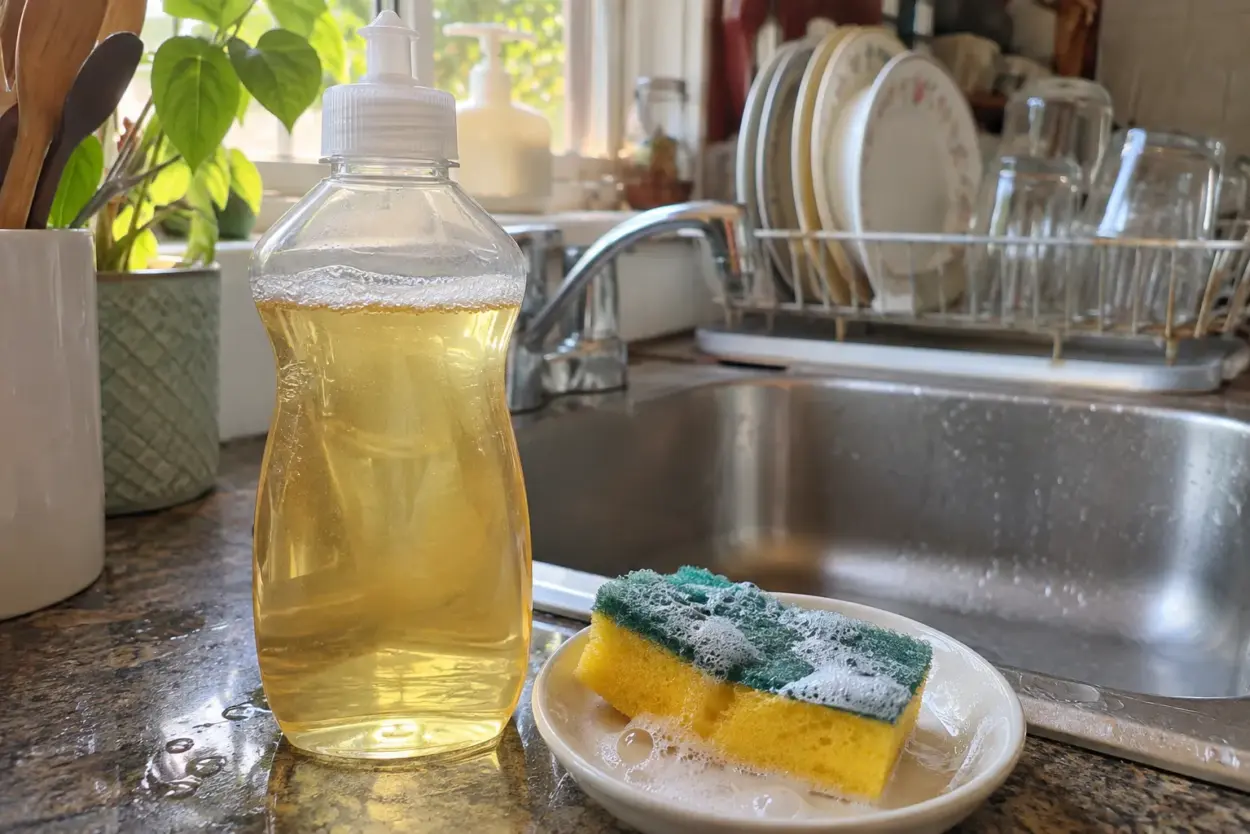
Short answer: mix ½ cup of liquid castile soap with 1½ cups of distilled water and 2 teaspoons of glycerin in a squeeze bottle. Put 1 teaspoon on a wet sponge for each round of dishes. It takes 5 minutes, and it only works on the sponge: in a filled sink, hard water turns the soap into scum.
I keep two homemade dish soaps by my sink, and the one I reach for depends on the water. Real soap, the kind made from oil and lye, cleans grease well but reacts with the calcium in tap water. Store dish liquid is not soap at all; it is a synthetic detergent built to ignore that calcium. This guide gives three recipes, a calculator that scales them and checks them against your water hardness, and the chemistry behind each step.
At a glance
What you need
- ½ cup liquid castile soap, unscented
- 1½ cups distilled or boiled water
- 2 tsp vegetable glycerin (optional)
- 10 drops lemon or orange essential oil (optional)
- A 16 oz squeeze or pump bottle and a funnel
Steps
- Pour the water into the bottle first.
- Add the castile soap and glycerin.
- Tip the bottle gently to mix. Do not shake.
- Use 1 teaspoon on a wet sponge.
- Never add vinegar or lemon juice.
Washing in a filled sink?
Fill the sink to wash and the castile recipe fails in all but soft water. Use the gel recipe, which carries its own washing soda, or the detergent concentrate.
This guide contains Amazon affiliate links. 33Science earns a commission on qualifying purchases. See our affiliate disclosure.
Homemade dish soap calculator
Choose a recipe, a bottle size, your water hardness and how you wash. The calculator gives the amounts in US and metric units and works out how much of each dose your water turns into soap scum.
Homemade dish soap calculator
Pick a recipe, your bottle, your water and how you wash. The calculator scales the recipe and checks whether your water hardness will eat the soap.
Liquid castile soap is taken as 39% soap, a loosely packed cup of grated bar soap as 70 g, washing soda as 4.6 g per teaspoon and the average soap molecule as 280 g/mol. Each calcium or magnesium ion binds two soap molecules, so 1 mg of hardness (as CaCO3) ties up 5.6 mg of soap.
The numbers explain the most common complaint about homemade dish soap. Two gallons of moderately hard water carry enough calcium to destroy a full 2 tablespoon dose of diluted castile soap. The same dose on a sponge meets only the water the sponge holds, so almost all of it survives.
Ingredients and tools
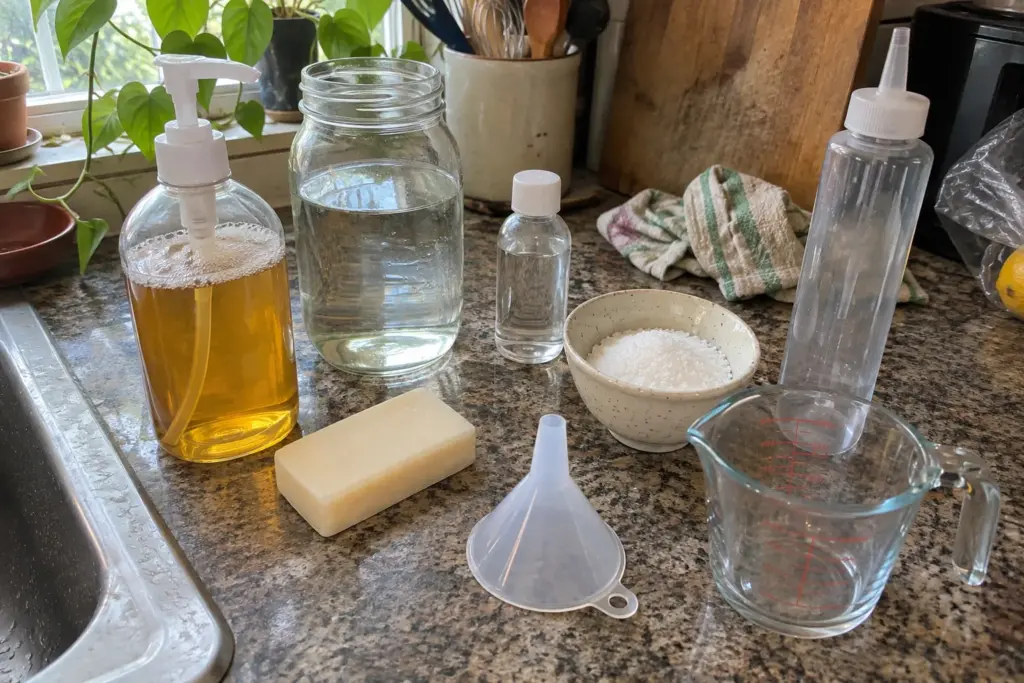
Liquid castile soap
Potassium salts of coconut and olive oil fatty acids
½ cup per 16 ozThe cleaner in the main recipe. True soap, about 39% soap and 61% water. Buy it unscented so you control the smell.
Vegetable glycerin
Glycerol, C3H8O3
1 tsp per cupOptional. A humectant that holds water against your skin, so hands dry out less. It also thickens the mix slightly.
Washing soda
Sodium carbonate, Na2CO3
1½ tsp per cup (gel only)Softens the water by pulling calcium out as chalk. It turns the bar soap recipe into a gel and keeps it working in a filled sink.
Sal Suds
Sodium lauryl sulfate with coco-betaine
¼ cup per 16 ozA plant-derived detergent concentrate, not a soap. Use it for the detergent recipe if your water is hard or you wash in a filled sink.
Why distilled water
Tap water carries calcium and magnesium, the same ions that wreck soap in the sink. A 16 oz bottle of castile mix made with water at 150 ppm holds about 50 mg of hardness, enough to turn 0.3 g of soap into flecks and haze in the bottle. Distilled water, or tap water boiled and cooled, avoids it.
Tools
- A 16 oz squeeze bottle or glass pump bottle. Use a foaming pump for the castile recipe; thin soap leaks from a standard pump.
- A small funnel and a measuring cup
- A saucepan and a whisk for the gel recipe
- A box grater for the bar soap
How to make liquid castile dish soap
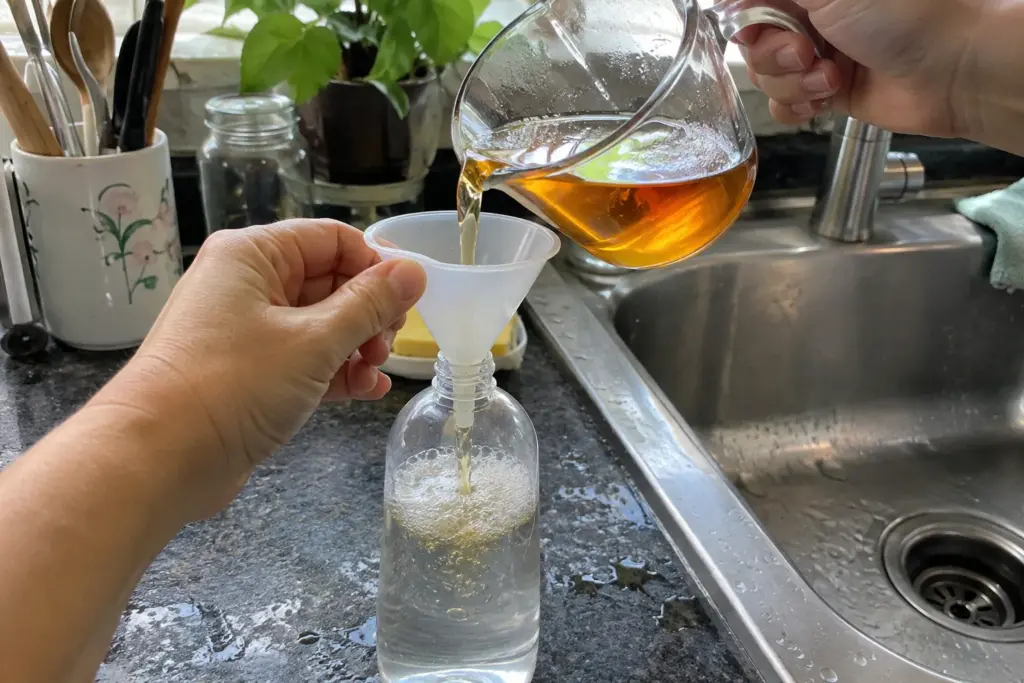
- Add the water first. Pour 1½ cups of distilled or cooled boiled water into a clean 16 oz bottle with a funnel.
- Add the soap. Pour in ½ cup of liquid castile soap. Adding soap to water keeps the foam down.
- Add glycerin and scent. Add 2 teaspoons of glycerin and, if you like, 10 drops of lemon or orange essential oil.
- Mix gently. Cap the bottle and tip it end over end five or six times. Shaking whips it into foam that takes an hour to settle.
- Label and date it. The mix has no preservative. Use it within a month.
The finished soap is thin, like milk, and much thinner than store dish liquid. That is normal. Commercial dish liquid is thickened with salt, which works on synthetic detergents and fails on soap.
Never mix soap with vinegar
Many recipes online add vinegar or lemon juice to castile soap for “grease cutting”. Acid turns soap back into fatty acid, an oily, insoluble film. The bottle separates into curds and the soap stops working. Use vinegar on its own, as a rinse, never in the bottle.
How to make gel dish soap from a bar
This version starts with a bar of soap and adds washing soda. It sets into a thick gel overnight, and the washing soda in every squirt softens the sink water, so it keeps working where castile liquid fails. For a 16 oz batch:
- Grate the soap. Grate a bar of castile or coconut oil bar soap on the fine side until you have ½ cup, loosely packed (about 35 g).
- Heat the water. Bring 2 cups of water to a simmer in a saucepan, then lower the heat.
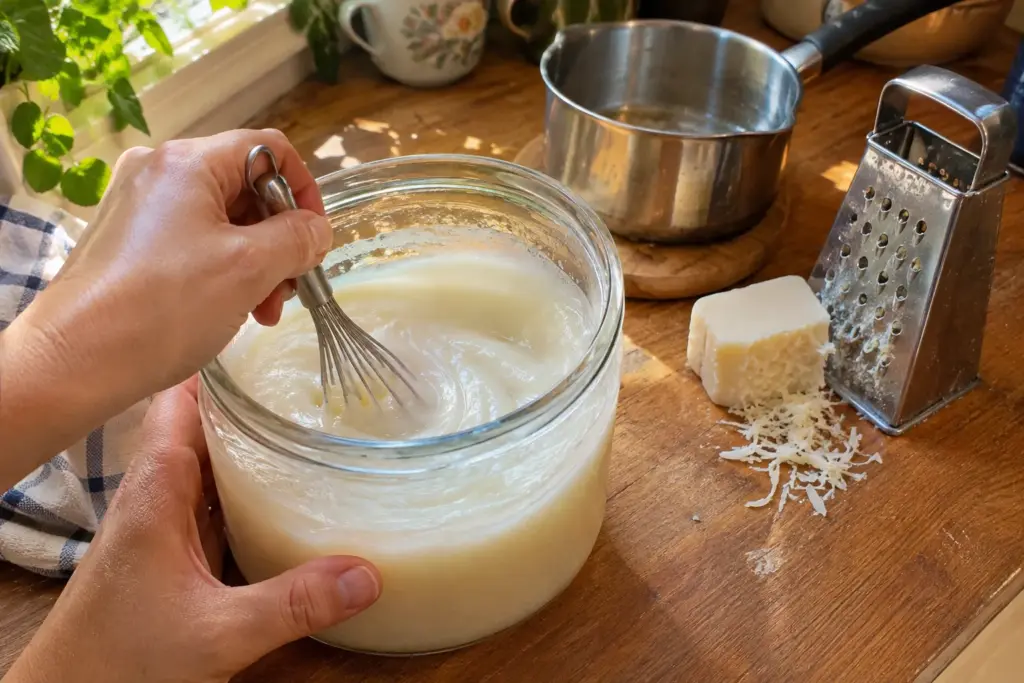
- Dissolve the soap. Whisk in the grated soap until no flakes remain, about 5 minutes. Keep it below a boil or it foams over.
- Add washing soda. Wear gloves. Whisk in 1 tablespoon of washing soda and 2 teaspoons of glycerin until dissolved.
- Cool and set. Let it cool, uncovered, then leave it overnight. It thickens into a soft gel.
- Blend and bottle. Whisk or use a stick blender to smooth it, then pour it into a squeeze bottle or a jar.
Adjust the texture
If the gel is too stiff to squeeze, whisk in hot water a tablespoon at a time. If it stays runny, your bar had a high olive oil content; it still cleans, so use it from a jar with a brush.
Detergent concentrate for hard water
Sal Suds is a detergent: its main cleaner is sodium lauryl sulfate, not soap. Its maker recommends ½ cup in a quart of water for a bottle by the sink, or ½ to 1½ teaspoons of the concentrate straight into a large sink of water. For a 16 oz bottle:
- Measure. Pour 1¾ cups of water into the bottle, then ¼ cup of Sal Suds.
- Mix and use. Tip the bottle gently to mix. Use 1 teaspoon on a sponge or 2 tablespoons in a 2 gallon sink.
Salt thickens detergent, not soap
Want it thicker? Dissolve ¼ teaspoon of table salt in a spoon of warm water and stir it in, then repeat until the texture suits you. The sodium ions crowd the sulfate head groups together so the micelles grow from small spheres into long, tangled worms, which thicken the liquid. Too much salt breaks the worms apart and it thins again.
How much dish soap to use
| Method | Castile liquid | Bar soap gel | Detergent concentrate |
|---|---|---|---|
| Sponge or brush | 1 tsp, recharge as suds fade | 1 tsp | 1 tsp |
| 2 gallon sink, soft water | 2 tbsp plus ⅛ tsp washing soda | 2 tbsp | 2 tbsp |
| 2 gallon sink, hard water | Not recommended | 2 tbsp plus ⅛ to ⅜ tsp washing soda | 2 tbsp |
| One greasy pan | A few drops on the pan, scrub, then add water | Same | Same |
Wash in water as hot as your hands tolerate, ideally around 110 °F (43 °C), and use gloves for hotter water. Heat melts solid fats such as bacon grease and butter, and liquid oil is far easier for soap to lift.
Not for the dishwasher
Do not use any of these recipes in a dishwasher. Soap and hand dish detergents foam, and the suds leak from the door and can trip the machine’s sensors. Dishwashers need low-foam detergent.
Grease test: check your soap at home
This test shows in two minutes whether a soap works in your water, and it is a good way to see emulsification. You need three clear jars with lids, tap water and cooking oil.
- Fill the jars. Fill each jar halfway with warm tap water and add 1 tablespoon of cooking oil. The oil floats.
- Add soap. Leave the first jar plain. Add 1 teaspoon of your castile mix to the second and 1 teaspoon of the detergent or gel recipe to the third.
- Shake. Close the lids and shake each jar hard for 15 seconds.
- Watch for 2 minutes. In the plain jar, the oil separates into a layer within seconds. Where the soap works, the water stays milky and the oil stays spread through it as tiny droplets.
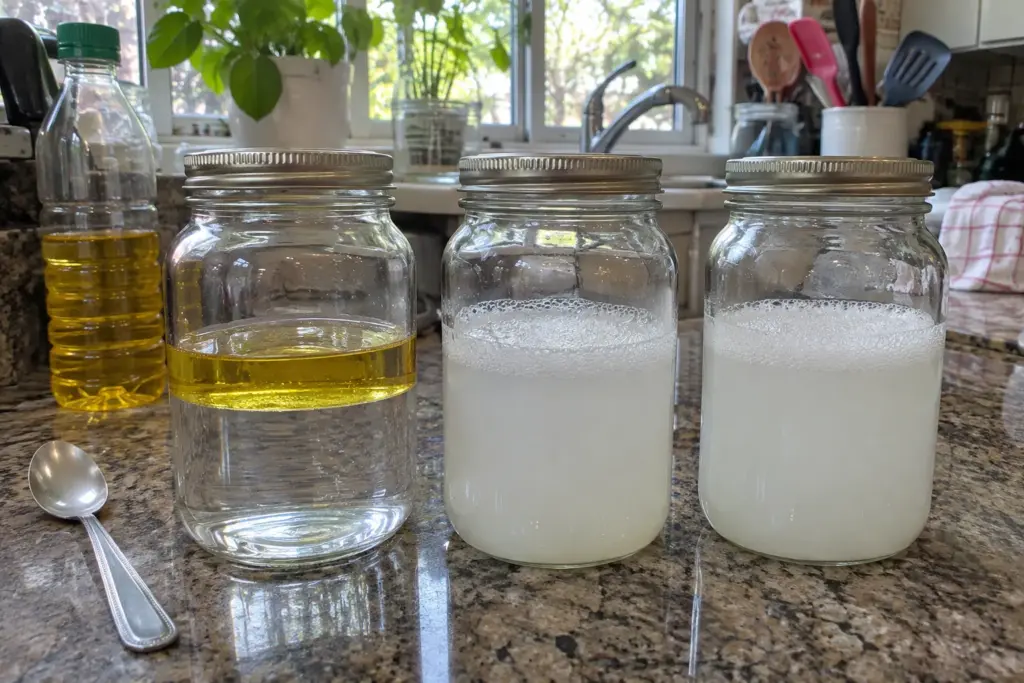
If the castile jar separates almost as fast as the plain one and the water looks gray with flecks, your tap water is hard enough to consume the soap. Repeat the test with distilled water to confirm, then switch to the gel or detergent recipe.
The science: how dish soap removes grease
In three sentences
Soap and detergent molecules have an oil-loving tail and a water-loving head. They wrap grease into tiny droplets that rinse away. Calcium in hard water binds soap heads into scum, but barely touches synthetic detergents.
Surfactants grab oil and water at the same time
Oil and water do not mix because water molecules attract each other through hydrogen bonds and push the nonpolar oil out. A surfactant bridges the two. Each molecule has a hydrocarbon tail, 12 to 18 carbons long, that dissolves in grease, and a charged head that dissolves in water. In soap the head is a carboxylate (COO−); in sodium lauryl sulfate it is a sulfate (OSO3−).
On a greasy plate, the tails sink into the fat and the heads stay in the water. Scrubbing tears the film into droplets, each coated with surfactant heads facing out. Above a threshold called the critical micelle concentration, surfactant molecules also cluster on their own into balls called micelles, with their tails hidden inside, and grease dissolves into those cores. For sodium lauryl sulfate in pure water at 25 °C the threshold is about 8 millimoles per liter, roughly 2.3 grams per liter.
Soap is made from fat and lye
Soap is made by heating fats or oils with a strong base, a reaction called saponification. The base splits each fat molecule into glycerol and three fatty acid salts:
Fat + 3 KOH → glycerol + 3 RCOO−K+ (potassium soap)
Liquid castile soap uses potassium hydroxide, which gives a soft, water-soluble soap. Bar soap uses sodium hydroxide, which gives a hard one. That is why the gel recipe needs heat to dissolve a bar, and why it sets into a gel as it cools: sodium soap molecules stack into layered crystals that trap the water.
Hard water turns soap into scum
Calcium and magnesium ions carry a charge of +2, so each one pairs with two soap molecules and forms an insoluble salt:
2 RCOO− + Ca2+ → (RCOO)2Ca (calcium soap, the gray film on dishes)
The numbers are harsh. One gram of hardness, counted as calcium carbonate (100 g/mol), is 0.01 mol of calcium. It binds 0.02 mol of soap, about 5.6 g for an average soap of 280 g/mol. A 2 gallon sink of water at 90 ppm holds 0.68 g of hardness and can destroy 3.8 g of soap. Two tablespoons of the castile mix carry about 2.9 g. All of it turns to scum, which is exactly what people see when they say homemade dish soap leaves a film.
Washing soda removes calcium first
Sodium carbonate reacts with calcium faster than soap does, and the product is chalk, which rinses away as a fine powder:
Ca2+ + CO32− → CaCO3
By mass, 1.06 g of washing soda removes 1 g of hardness. The 0.68 g in that sink takes 0.72 g of washing soda, about ¼ teaspoon. The gel recipe carries 0.78 g in every 2 tablespoon squirt, which is why it survives a filled sink of moderately hard water. Washing soda also raises the pH above 10, where grease from food starts turning into soap itself.
Why acid ruins soap
Soap only works as a salt. Add an acid such as vinegar (acetic acid) or lemon juice (citric acid) and the carboxylate heads pick up hydrogen ions:
RCOO− + H+ → RCOOH (free fatty acid)
The free fatty acid has no charge, so it no longer dissolves in water. It floats as an oily layer, which is the curdled mess in a bottle of castile soap and vinegar. Sulfate detergents do not have this problem: sulfuric acid is so strong that the sulfate head stays charged even in acidic water.
Why salt thickens detergent and curdles soap
Store dish liquid gets its thick body from salt. Sodium ions screen the repulsion between the negative heads, the micelles stretch into long worm-like chains and the chains tangle like cooked spaghetti. Potassium soap reacts differently: salt pulls water away from it and pushes it out of solution, the same “salting out” step soap makers use to separate soap from glycerin. So castile soap stays thin. Add glycerin for body instead.
Homemade vs store-bought dish soap
Commercial hand dish liquid is mostly water with roughly 15 to 35% surfactant, usually an alkyl ethoxy sulfate paired with an amine oxide that boosts foam and grease cutting. It contains no true soap.
| Feature | Castile liquid | Bar soap gel | Detergent concentrate | Store dish liquid |
|---|---|---|---|---|
| Main cleaner | Potassium soap | Sodium soap + washing soda | Sodium lauryl sulfate | Alkyl ethoxy sulfate + amine oxide |
| Hard water | Sponge only | Works | Works | Works |
| Filled sink | Soft water only | Yes | Yes | Yes |
| Thickness | Thin | Thick gel | Thin, salt thickens it | Thick |
| Lasting suds | Short | Short | Good | Long |
| Fragrance and dye | Only what you add | Only what you add | Fir and spruce oil | Common |
Homemade soap cleans greasy plates, pots and cutting boards well. Its limits are hard water in a filled sink, suds that collapse sooner and a shelf life of weeks. Suds are not a measure of cleaning power, but they are a useful signal: when they disappear in a sink, the surfactant is used up and it is time to add more.
Stuck-on food
For baked-on grease, sprinkle a teaspoon of baking soda on the pan with a few drops of your soap and scrub. The fine crystals scour without scratching stainless steel or enamel.
Troubleshooting
| Problem | Cause | Fix |
|---|---|---|
| White film or haze on glasses | Calcium soap from hard water | Switch to the gel or detergent recipe. Rinse with water and a splash of vinegar. |
| No suds in the sink | Hardness used up the soap | Add washing soda to the water first or wash with the sponge method. |
| Soap separated into curds | Acid (vinegar, lemon juice) or salt in the bottle | Discard it and make a new batch without them. |
| Flecks or cloudiness in the bottle | Tap water hardness reacted with the soap | Use distilled or boiled water. |
| Leaks from the pump | Castile mix is too thin for a standard pump | Use a squeeze bottle or a foaming pump. |
| Gel too thick to squeeze | Bar soap high in coconut or tallow | Whisk in hot water a tablespoon at a time. |
| Musty smell after a few weeks | Bacteria growing in the diluted mix | Discard it, wash the bottle and make smaller batches. |
| Hands dry and tight | Alkaline soap and washing soda strip skin oils | Add glycerin, wear gloves for long sessions. |
More soap is not the fix
Do not fix a weak castile mix by pouring in more and more soap. In hard water, extra soap only makes more scum and a thicker film on your glasses. Soften the water or change recipes.
Safety
Before you mix
- Keep soap out of your eyes. Soap and washing soda solutions are alkaline and cause serious eye irritation. Rinse with running water for 15 minutes if splashed.
- Wear gloves with washing soda. Sodium carbonate is an eye irritant and dries out skin. Add it to warm, not boiling, water to avoid spatter.
- Undiluted Sal Suds is an irritant. Concentrated sodium lauryl sulfate irritates skin and can damage eyes. Dilute it before use.
- Label the bottle. A homemade soap in a reused drink bottle looks like juice to a child.
- Go easy on essential oils. Use 10 drops or fewer per 16 oz. Tea tree and citrus oils are toxic to cats.
- Never mix with bleach. Bleach and acids release chlorine gas; keep bleach out of homemade cleaners.
All three recipes are safe for septic systems at normal doses. Soap biodegrades quickly, and the sodium lauryl sulfate in Sal Suds is readily biodegradable as well.
More practical science: browse all our everyday science how-tos, from household chemistry to experiments you can build at home.
Frequently asked questions
Yes, on a sponge. Castile soap removes grease well, but in a filled sink of hard water the calcium turns most of it into scum. The bar soap gel with washing soda or a diluted detergent concentrate works in a sink.
Mix 1/2 cup of liquid castile soap with 1 1/2 cups of distilled water and 2 teaspoons of glycerin in a squeeze bottle. Use 1 teaspoon on a wet sponge.
Calcium and magnesium in hard water bind soap into insoluble calcium soap, which dries as a white film. Add washing soda to the wash water, use the sponge method or switch to a detergent such as Sal Suds.
No. Acid converts soap into free fatty acid, which separates into an oily, curdled layer and stops cleaning. Use vinegar only as a separate rinse.
Add glycerin to castile soap, or use the bar soap recipe with washing soda, which sets into a gel. Salt thickens detergent-based recipes such as diluted Sal Suds but curdles castile soap.
No. Soap and hand dish detergents make too much foam, which leaks from the dishwasher door. Use a low-foam dishwasher detergent instead.
Use a diluted mix within about a month. It has no preservative, so bacteria can grow once water is added. Distilled or boiled water and a clean bottle help it last.
It cleans grease well in soft water or applied on a sponge. In hard water it reacts with calcium and leaves a film, so a detergent or washing soda works better there.
Plain liquid hand soap works in small amounts if it is unscented and rinses clean. Laundry detergent often contains enzymes, brighteners and fragrance that are not meant for food surfaces, so avoid it.
Yes. Soap and sodium lauryl sulfate are readily biodegradable, and the small amounts of washing soda used per wash do not harm septic bacteria.
Sources
- Lisa Bronner. Liquid vs. bar in Dr. Bronner’s Pure-Castile Soap
- Lisa Bronner. Sal Suds dilutions cheat sheet
- Lisa Bronner. Dilutions cheat sheet for Dr. Bronner’s castile soap
- US Geological Survey. Hardness of water
- American Cleaning Institute. An introduction to the science of how things get clean
- PubChem. Sodium carbonate
- PubChem. Sodium dodecyl sulfate
- TA Instruments. Determination of the critical micelle concentration of SDS by ITC
- US Patent 9,969,956. Liquid detergent composition (hand dishwashing)