
An oxide is a compound made of oxygen and one other element, where oxygen sits in the −2 oxidation state. That’s the whole definition. The useful part is sorting oxides into four types, because the type tells you how a given oxide reacts with water, acids and bases.
Below are 20 examples, grouped by type, each with the reason it behaves the way it does. Then comes a quick way to predict the type from the periodic table, the mistakes students make most often, and where oxides turn up outside the classroom.
TLDR
- Basic oxides (mostly metals on the left of the table): CaO, MgO, Na2O, CuO. They react with acids, and the soluble ones make alkalis in water.
- Acidic oxides (non-metals): CO2, SO2, SO3, P4O10, SiO2. They react with bases, and most make acids in water.
- Amphoteric oxides (metals and metalloids near the staircase): Al2O3, ZnO, BeO, PbO. They react with both acids and bases.
- Neutral oxides: CO, NO, N2O, H2O. They react with neither under normal conditions.
- Peroxides and superoxides (H2O2, BaO2, KO2) aren’t plain oxides, because their oxygen isn’t in the −2 state.
Contents
- Quick reference table
- Basic oxide examples
- Acidic oxide examples
- Amphoteric oxide examples
- Neutral oxide examples
- Peroxides and superoxides
- How to predict the type of an oxide
- Common mistakes
- Everyday and industrial oxides
- FAQ
Quick reference table
| Formula | Name | Type | State at room temp | Where you meet it |
|---|---|---|---|---|
| CaO | Calcium oxide (quicklime) | Basic | Solid | Cement, steelmaking |
| MgO | Magnesium oxide (periclase) | Basic | Solid | Furnace linings, antacids |
| Na2O | Sodium oxide | Basic | Solid | Glass chemistry |
| CuO | Copper(II) oxide (tenorite) | Basic | Solid | Black coating on heated copper |
| CO2 | Carbon dioxide | Acidic | Gas | Fizzy drinks, exhaled breath |
| SO2 | Sulfur dioxide | Acidic | Gas | Volcanoes, coal burning |
| SO3 | Sulfur trioxide | Acidic | Liquid or solid (melts at 17 °C) | Sulfuric acid production |
| P4O10 | Phosphorus(V) oxide | Acidic | Solid | Drying agent |
| SiO2 | Silicon dioxide (silica) | Acidic | Solid | Sand, quartz, glass |
| Al2O3 | Aluminium oxide | Amphoteric | Solid | Foil coating, sapphire, abrasives |
| ZnO | Zinc oxide | Amphoteric | Solid | Sunscreen, rubber |
| BeO | Beryllium oxide | Amphoteric | Solid | Electronics ceramics |
| PbO | Lead(II) oxide (litharge) | Amphoteric | Solid | Old lead-acid battery plates, glass |
| CO | Carbon monoxide | Neutral | Gas | Incomplete combustion |
| NO | Nitric oxide | Neutral | Gas | Engines, lightning |
| N2O | Dinitrogen monoxide | Neutral | Gas | Dental anaesthetic, whipped cream chargers |
| H2O | Water | Neutral | Liquid | Everything |
| H2O2 | Hydrogen peroxide | Peroxide | Liquid | Bleach, disinfectant |
| BaO2 | Barium peroxide | Peroxide | Solid | Pyrotechnics, bleaching |
| KO2 | Potassium superoxide | Superoxide | Solid | Emergency breathing gear |
Basic oxide examples
Basic oxides come from metals, mostly the ones on the far left of the periodic table. The oxide ion, O²⁻, is a strong proton acceptor, so these compounds take part in acid-base reactions and neutralise acids, making salt and water.
Calcium oxide (CaO). Heat limestone hard enough and it loses CO2, leaving quicklime. Add water and you get slaked lime, with enough heat released to scald skin:
CaO + H2O → Ca(OH)2
Magnesium oxide (MgO). The white ash left when magnesium ribbon burns in a school lab. It’s barely soluble in water but dissolves in acid, which is why it works in some antacids:
MgO + 2HCl → MgCl2 + H2O
Sodium oxide (Na2O). It reacts violently with water and forms sodium hydroxide. Because that reaction is so complete, textbooks use it as the standard example of a soluble basic oxide:
Na2O + H2O → 2NaOH
Copper(II) oxide (CuO). The black crust on a copper pipe that’s been heated in air. It’s insoluble in water, so it won’t make an alkali, but it dissolves in sulfuric acid to give blue copper(II) sulfate. A basic oxide doesn’t have to dissolve in water to count as basic; it only has to react with acids.
Acidic oxide examples
Acidic oxides come from non-metals. Most react with water to form an acid, and all of them react with bases to form salts.
Carbon dioxide (CO2). It dissolves in water to form weak carbonic acid, the reason soda fizzes and rainwater is slightly acidic even in clean air:
CO2 + H2O ⇌ H2CO3
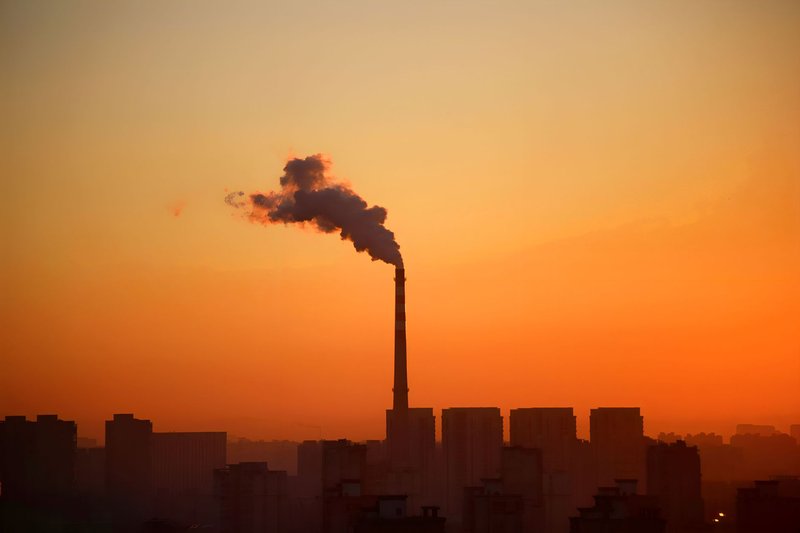
Sulfur dioxide (SO2). A choking gas from volcanoes and from burning sulfur-bearing coal and oil. In water it forms sulfurous acid, and in the atmosphere it ends up as acid rain. The US EPA tracks it as a regulated air pollutant because it irritates the lungs and forms fine particles.
SO2 + H2O → H2SO3
Sulfur trioxide (SO3). The industrial middle step in making sulfuric acid, the most-produced chemical in the world by tonnage. It reacts with water so violently that factories absorb it into concentrated acid instead:
SO3 + H2O → H2SO4
Phosphorus(V) oxide (P4O10). Written as P2O5 in older books, but the real molecule is a cage of four phosphorus atoms. It grabs water so hungrily that it’s used to dry other chemicals:
P4O10 + 6H2O → 4H3PO4
Silicon dioxide (SiO2). The odd one. It’s acidic, but it’s a giant network solid that doesn’t dissolve in water, so you won’t see it make an acid. It reacts with hot, concentrated alkali or molten carbonates instead, which is how glass gets made:
SiO2 + 2NaOH → Na2SiO3 + H2O
Amphoteric oxide examples
Amphoteric oxides play both roles. They behave as a base when they meet an acid and as an acid when they meet a strong alkali. The elements involved sit along the diagonal between metals and non-metals, with a few heavier metals mixed in.
Aluminium oxide (Al2O3). Dissolves in hydrochloric acid and in sodium hydroxide solution, the second reaction giving a soluble aluminate:
Al2O3 + 6HCl → 2AlCl3 + 3H2O
Al2O3 + 2NaOH + 3H2O → 2Na[Al(OH)4]
Zinc oxide (ZnO). A white powder that does the same trick, forming zinc chloride with acid and a zincate with alkali:
ZnO + 2HCl → ZnCl2 + H2O
ZnO + 2NaOH + H2O → Na2[Zn(OH)4]
Beryllium oxide (BeO). Beryllium sits at the top of the group 2 column but acts like its diagonal neighbour aluminium. It’s an electrical insulator that also conducts heat well, which is why it appears in specialised electronics. It is toxic as a dust, so it doesn’t turn up in classrooms.
Lead(II) oxide (PbO). Known as litharge. It dissolves in nitric acid and in hot concentrated alkali. Tin(II) oxide, SnO, is the usual companion example.
Neutral oxide examples
Neutral oxides don’t react with water to form an acid or a base, and they don’t react with acids or alkalis in the usual way. They’re all small molecules built from non-metals.
Carbon monoxide (CO). A colourless, odourless gas from incomplete burning of carbon fuels. It’s neutral in water, but it’s far from harmless: it binds to haemoglobin much more tightly than oxygen does. The CDC has guidance on carbon monoxide poisoning and how to prevent it at home.
Nitric oxide (NO). Forms wherever air is heated enough to split nitrogen, in car engines and in lightning. In open air it quickly turns into NO2, which is acidic, so the neutral label applies only to NO itself. NO2 is one of the air pollutants behind city smog.
Dinitrogen monoxide (N2O). Laughing gas. Dentists use it as a mild anaesthetic, and it’s also a greenhouse gas that lingers in the atmosphere for over a century.
Water (H2O). It is an oxide of hydrogen, and a neutral one. If your syllabus lists oxides, water belongs here, not under “other”.
Peroxides and superoxides
These two families contain more oxygen than the formula suggests, and the oxygen is not in the −2 state.
A peroxide contains the O2²⁻ ion (or an O–O bond), where each oxygen is at −1. Examples are hydrogen peroxide (H2O2), sodium peroxide (Na2O2) and barium peroxide (BaO2). They behave as oxidising agents and release hydrogen peroxide with water or dilute acid:
Na2O2 + 2H2O → 2NaOH + H2O2
A superoxide contains the O2⁻ ion, with oxygen at an average of −½. Potassium superoxide (KO2) is the standard example. It reacts with water and with CO2 to release oxygen, which is why it has been used in emergency breathing apparatus and submarine air systems:
4KO2 + 2H2O → 4KOH + 3O2
4KO2 + 2CO2 → 2K2CO3 + 3O2
Strictly, neither group is a “simple oxide”, so exam boards that ask for oxides usually mean the O²⁻ type.
How to predict the type of an oxide
You don’t have to memorise every case. Three rules from the periodic table cover most of them.
- Metal oxides are usually basic. Group 1 and 2 metals and most transition metals fall here.
- Non-metal oxides are usually acidic. Carbon, sulfur, phosphorus and nitrogen in its higher oxidation states.
- Elements near the metal/non-metal staircase give amphoteric oxides. Aluminium, zinc, beryllium, tin, lead.
Period 3 shows the pattern in a single row: Na2O and MgO are basic, Al2O3 is amphoteric, and SiO2, P4O10 and SO3 are acidic.
One more rule helps with transition metals. The higher the oxidation state of the metal, the more acidic its oxide. Chromium shows it neatly: CrO is basic, Cr2O3 is amphoteric and CrO3 is acidic. Manganese does the same, with MnO basic and Mn2O7 strongly acidic.
The exceptions are the neutral oxides. CO, NO, N2O and H2O are non-metal oxides that don’t follow rule 2, so learn those four by name.
Common mistakes
- Putting CO and H2O in the acidic group. They’re non-metal oxides, so the pattern suggests “acidic”, but both are neutral. CO2 is the acidic carbon oxide.
- Treating KO2 as a plain oxide. Its oxygen is a superoxide ion. Writing “K2O” for it, or balancing it as if oxygen were −2, gives wrong equations.
- Calling SiO2 neutral because it doesn’t dissolve. Solubility isn’t the test. SiO2 reacts with alkalis, so it’s acidic.
- Assuming “dioxide” means acidic. MnO2 is a dioxide, and it’s amphoteric at best. The name only counts oxygen atoms.
- Mixing up NO, NO2 and N2O. The first and last are neutral. NO2 is acidic and reacts with water to give nitric and nitrous acids.
Everyday and industrial oxides

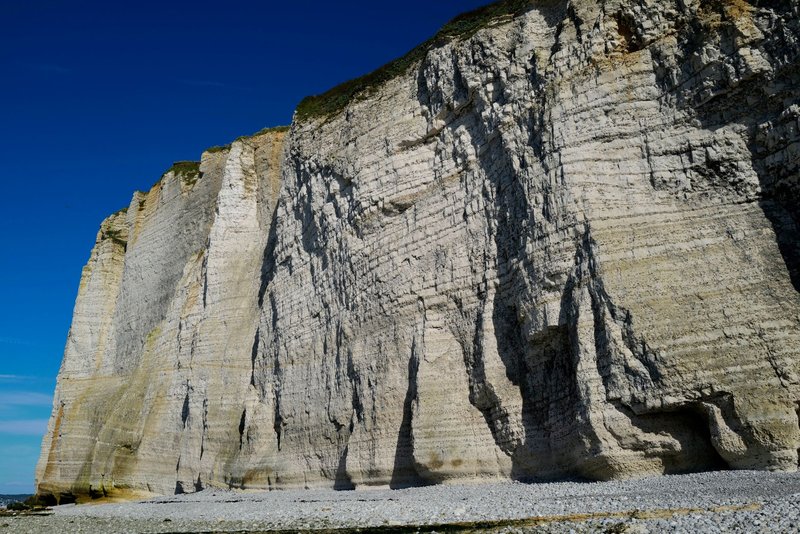
Most of the solid ground you stand on is oxide. Silicon dioxide alone makes up quartz, most sand, and a large share of the Earth’s crust.
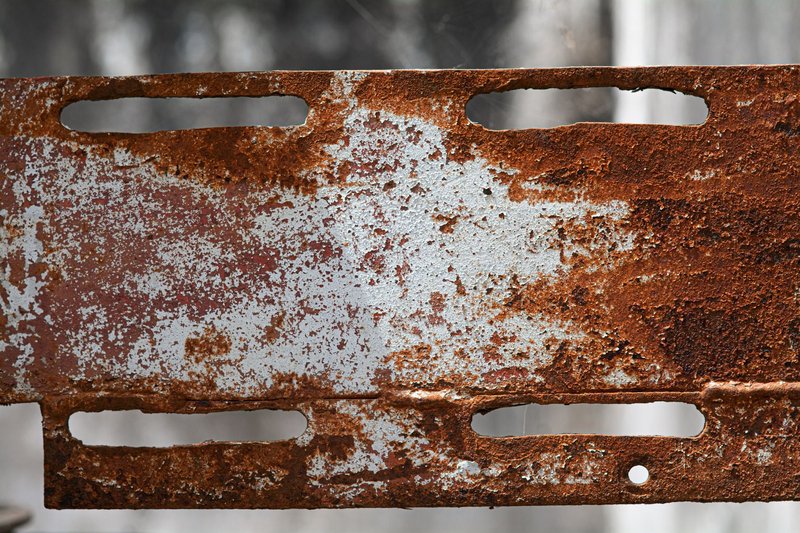
- Rust. Iron’s oxide is mostly Fe2O3 with water in the structure, written Fe2O3·nH2O. It flakes off, which exposes fresh iron underneath, so rust keeps spreading. Hematite (Fe2O3) and magnetite (Fe3O4) are the same iron oxides found as ores. The wider family is covered in iron compounds: types, colours and uses.
- Aluminium foil. Aluminium is reactive, but the surface seals itself with a layer of Al2O3 only a few nanometres thick. That film is what stops the metal underneath from corroding. Aluminium is made from the ore bauxite, which is refined into alumina (Al2O3) before smelting.
- Quicklime. CaO is heated in kilns and goes into cement, mortar and steel production, where it binds impurities into slag.
- Silica. Melt sand with soda and lime and you get glass. Sand is also the raw material for silicon chips, after the oxide is reduced to the element.
- Zinc oxide and titanium dioxide. Both are white and both block ultraviolet light, so they are the two mineral filters in sunscreen. The FDA covers them in its sunscreen guidance. TiO2 is also the main white pigment in paint, paper and toothpaste.
- Nitrogen oxides, carbon monoxide and sulfur dioxide. These are the oxides that matter for air quality. The EPA lists nitrogen dioxide among its criteria pollutants. Vehicle engines and power plants are the main sources, and the gas contributes to smog and acid rain.
FAQ
What are the four types of oxides? Basic, acidic, amphoteric and neutral. Peroxides and superoxides are usually listed separately, and some textbooks add “mixed oxides” such as Fe3O4 and Pb3O4.
Is water an oxide? Yes. H2O is hydrogen oxide, and it’s neutral.
What’s the difference between a metal oxide and a non-metal oxide? Metal oxides are generally basic, ionic solids. Non-metal oxides are generally acidic, covalent, and often gases or low-melting solids. The amphoteric ones sit in between.
Is CO2 an acidic oxide? Yes. It reacts with water to form carbonic acid and with bases to form carbonates, though carbonic acid is weak.
Is rust an oxide? Yes, it’s hydrated iron(III) oxide, Fe2O3·nH2O.
Which oxides are amphoteric? The common ones are Al2O3, ZnO, BeO, PbO and SnO. Cr2O3 is another.