Iron compounds are substances in which iron is chemically bonded to one or more other elements, and nearly all of them come down to one question: did the iron lose two electrons or three? Iron(II) compounds, called ferrous, are usually pale green. Iron(III) compounds, called ferric, are usually yellow, brown or red. Learn that split and most of the rest of iron chemistry sorts itself out.
That includes rust, the red dust on Mars, the blue in old blueprints, the pill your doctor prescribes for anemia, and the ore that becomes steel.
Table of Contents
- Ferrous vs. ferric: the one distinction that matters
- Iron compounds at a glance
- Iron oxides: FeO, Fe2O3 and Fe3O4
- Chlorides and sulfates: the iron salts
- Sulfides: pyrite and its relatives
- Complexes: Prussian blue, ferrocene and iron pentacarbonyl
- Batteries and fertilizers
- Iron compounds in your body and your supplements
- The short version
Ferrous vs. ferric: the one distinction that matters
An iron atom can give up electrons in several ways, but two oxidation states cover almost everything you’ll meet outside a research lab.
- Iron(II), or ferrous (Fe²⁺): the atom has lost two electrons. Solutions are pale green.
- Iron(III), or ferric (Fe³⁺): the atom has lost three. Solutions are yellow to brown.
Rarer states exist. Iron(VI) shows up in ferrate salts such as potassium ferrate, K₂FeO₄, which are deep purple and powerful oxidizers. Iron(0), the state in the pure metal, appears in a few compounds like iron pentacarbonyl. But +2 and +3 are the working pair.
The two states convert into each other easily. Leave a ferrous sulfate solution in an open glass and oxygen slowly turns it from green to brown as Fe²⁺ becomes Fe³⁺.
Three quick lab tests tell them apart:
- Add sodium hydroxide. Fe²⁺ gives a pale green precipitate, Fe(OH)₂. Fe³⁺ gives a rust-brown one, Fe(OH)₃.
- Add potassium thiocyanate. Fe³⁺ turns the solution blood red. Fe²⁺ does nothing.
- Add potassium ferricyanide. Fe²⁺ gives a deep blue precipitate. Fe³⁺ gives a brownish solution.
The difference also matters in biology. Ferric iron barely dissolves at neutral pH, so it clumps into solid particles. Ferrous iron stays dissolved. Your gut prefers the ferrous form, which is why vitamin C, a reducing agent, helps you absorb iron from plant foods.
Iron compounds at a glance
| Compound | Formula | Iron oxidation state | Color | Main use |
|---|---|---|---|---|
| Iron(II) oxide (wüstite) | FeO | +2 | Black | Minor ore, intermediate in steelmaking |
| Iron(III) oxide (hematite) | Fe₂O₃ | +3 | Red-brown | Main iron ore, red pigment |
| Magnetite | Fe₃O₄ | +2 and +3 | Black | Ore, magnets, toner |
| Iron(II) sulfate | FeSO₄ | +2 | Pale green (blue-green as a hydrate) | Supplements, water treatment, food fortification |
| Iron(III) chloride | FeCl₃ | +3 | Dark green-brown solid, yellow-brown solution | Water treatment, circuit board etching |
| Pyrite | FeS₂ | +2 | Brassy yellow | Mineral specimens, sulfur source |
| Prussian blue | Fe₄[Fe(CN)₆]₃ | +3 and +2 | Deep blue | Pigment, blueprints, poison antidote |
| Ferrocene | Fe(C₅H₅)₂ | +2 | Orange | Catalysts, research |
| Iron pentacarbonyl | Fe(CO)₅ | 0 | Pale yellow liquid | Making carbonyl iron powder |
| Lithium iron phosphate | LiFePO₄ | +2 | Grey to black | Battery cathodes |
Iron oxides: FeO, Fe2O3 and Fe3O4
Oxides are the most important iron compounds by tonnage. Iron and oxygen are both abundant in Earth’s crust, so they’ve been combining for billions of years.
Iron(II) oxide, FeO, is a black powder that the mineral wüstite approximates. Real wüstite is never perfectly FeO. It’s short on iron, closer to Fe₀.₉₅O, which is a good reminder that textbook formulas are tidy and minerals aren’t. It matters mostly as a stage inside blast furnaces and as a starting material for other iron chemistry.
Iron(III) oxide, Fe₂O₃, is the red one. As the mineral hematite it’s the world’s main iron ore, and it’s about 70% iron by mass. Ground up, it’s also the pigment behind red ochre, which people were smearing on cave walls and each other long before anyone smelted metal. Hematite and its hydrated relatives are why Mars looks rust-colored: the surface dust is full of iron(III) oxides.
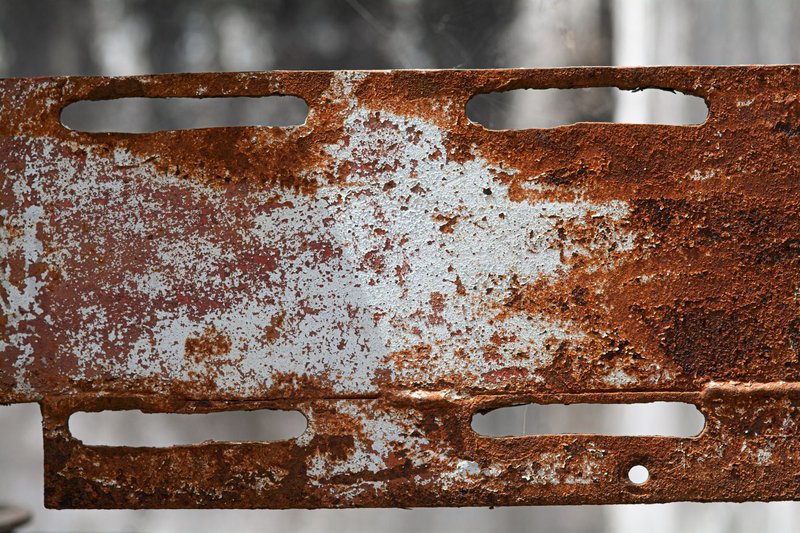
Everyday rust is a close cousin, a hydrated iron(III) oxide-hydroxide. It’s one of many metallic compounds that form when metal meets oxygen. Rust forms when iron meets oxygen and water together, and it’s a bad coat of armor. Rust is bulkier than the metal it came from, so it flakes off and exposes fresh iron underneath. Aluminum oxide, by contrast, sticks and seals the surface, which is why aluminum doesn’t rust away.
Iron(II,III) oxide, Fe₃O₄, is magnetite, and it’s the one that sticks to a magnet. It’s often written as FeO·Fe₂O₃ because it holds Fe²⁺ and Fe³⁺ in a fixed 1:2 ratio. No Fe(IV) is involved, a mistake that circulates in some study notes. Magnetite is slightly richer in iron than hematite, at about 72%. Natural lumps of it, called lodestone, were the first compasses. Today it goes into toner, magnetic recording media, and ferrofluids.
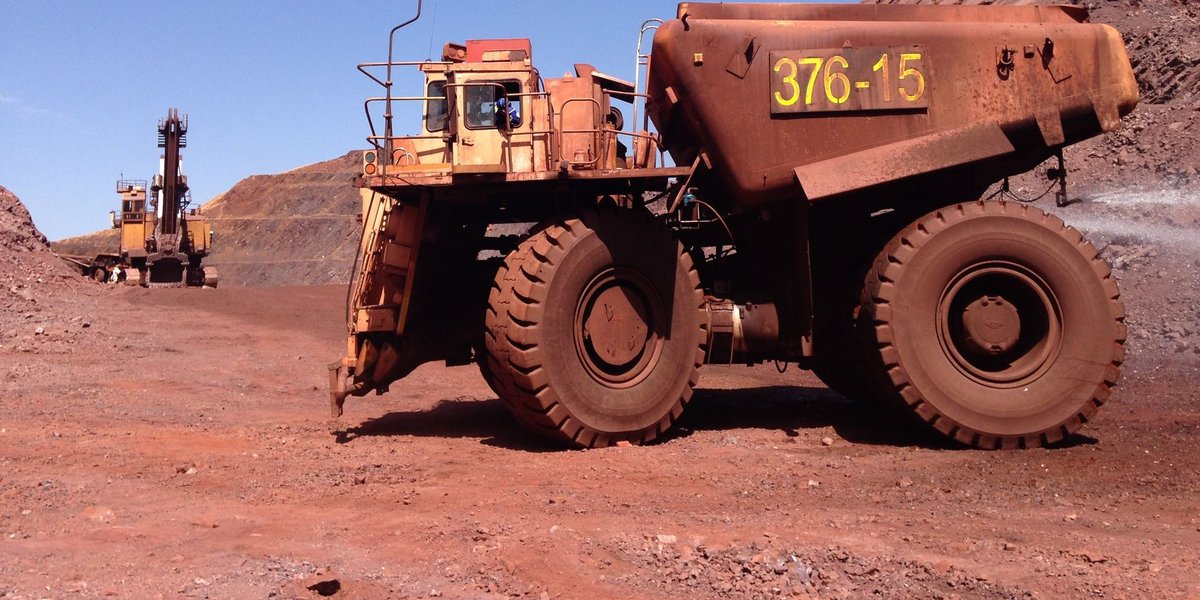
Most of what’s dug up as iron oxide ends up as steel. In a blast furnace, carbon monoxide strips the oxygen off the ore and leaves molten iron. The U.S. Geological Survey tracks world iron ore output at over two billion tonnes a year, and the vast majority is smelted.
Iron oxide has a more dramatic job in the thermite reaction. Aluminum powder pulls oxygen away from Fe₂O₃, releasing so much heat that the iron comes out molten at temperatures around 2,500 °C. Railway crews have used it to weld rails in the field.
Chlorides and sulfates: the iron salts
Dissolve iron in acid and you get iron salts. The two families you’ll hear about most are chlorides and sulfates, each in ferrous and ferric versions.
Iron(II) sulfate, FeSO₄, is the workhorse. The crystals most people see are the heptahydrate, FeSO₄·7H₂O, once called green vitriol, a blue-green solid that picks up a brown crust as it oxidizes. It’s used to:
- treat drinking water and wastewater, where it helps remove phosphate and other contaminants
- fortify flour and other foods with iron
- supply iron in tablets and drops
- fix iron-deficient soil and kill moss on lawns
- make iron gall ink, the standard European writing ink for centuries, which combined iron sulfate with tannins from oak galls
Iron(III) chloride, FeCl₃, is the stronger acid and the more aggressive reagent. The anhydrous solid is dark and shiny, and solutions are yellow-brown. Water treatment plants use it as a coagulant: dissolved Fe³⁺ forms sticky iron hydroxide flakes that trap suspended particles and settle out. Electronics hobbyists know it differently, as the etchant that eats unwanted copper off printed circuit boards.
Iron(II) chloride, FeCl₂, is the milder sibling, used in some water treatment and chemical manufacturing. Iron(III) sulfate, Fe₂(SO₄)₃, shows up as a coagulant and a pickling agent for metal.
Sulfides: pyrite and its relatives
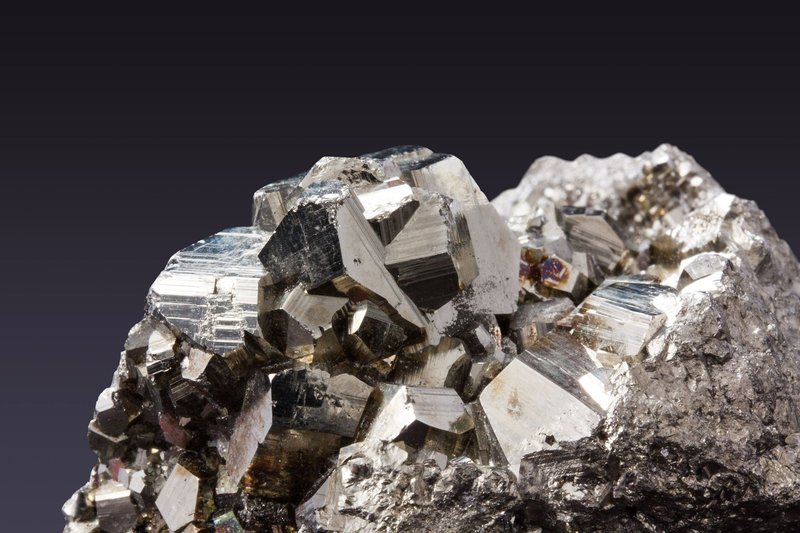
Pyrite is the famous one, and it isn’t FeS. Its formula is FeS₂, an iron(II) ion paired with a disulfide unit (S₂²⁻). Its brassy yellow crystals, often in near-perfect cubes, earned the name fool’s gold. The name pyrite comes from the Greek word for fire, because struck against steel it throws sparks. Early firearms used it that way.
A true FeS exists too, as the mineral troilite, which turns up in meteorites. A related mineral, pyrrhotite, is slightly short on iron and mildly magnetic.
Sulfides are worth knowing for what they do when they get wet. Pyrite exposed to air and water produces sulfuric acid and dissolved iron, which is the root cause of acid mine drainage. The orange-stained streams below abandoned coal and metal mines are iron(III) hydroxide sitting in acidic water. Historically, pyrite was also roasted to make sulfuric acid.
Complexes: Prussian blue, ferrocene and iron pentacarbonyl
In coordination compounds, iron sits at the center and other molecules, called ligands, attach around it. These are where iron chemistry gets strange.
Prussian blue, Fe₄[Fe(CN)₆]₃, was an accident. A Berlin color maker named Diesbach produced it around 1706 while making a red pigment with contaminated chemicals. It became the first widely available synthetic blue pigment, and a version of it drives the cyanotype process behind blueprints. The ligand is cyanide, yet Prussian blue is not a cyanide hazard in practice: the cyanide groups are locked tightly onto the iron. Medicine takes advantage of that grip. Doctors give Prussian blue by mouth to people exposed to radioactive cesium-137 or to thallium, because it binds those ions in the gut and carries them out in stool.
Ferrocene, Fe(C₅H₅)₂, is an orange solid in which an iron(II) ion sits between two flat five-carbon rings, like a metal sandwich. Chemists first made it in 1951, and working out its structure helped open up the field of organometallic chemistry. Geoffrey Wilkinson and Ernst Otto Fischer shared the 1973 Nobel Prize in Chemistry for their work on these sandwich compounds. Ferrocene and its derivatives still turn up in catalysts and electrochemistry research.
Iron pentacarbonyl, Fe(CO)₅, is a pale yellow, toxic liquid with iron in the zero oxidation state, surrounded by five carbon monoxide molecules. Heat it and it breaks down into very fine, pure iron powder, called carbonyl iron, used in electronics components and some supplements.
Batteries and fertilizers
Two uses don’t fit neatly into a compound family.
Batteries. Lithium iron phosphate, LiFePO₄, is a cathode material in lithium-ion batteries. It uses no cobalt or nickel, tolerates many charge cycles, and resists overheating better than some alternatives, so it has spread through electric vehicles and home energy storage.
Fertilizers. Plants need iron to make chlorophyll. In alkaline soils, iron locks up as insoluble ferric compounds and leaves leaves yellow between the veins, a condition called chlorosis. Gardeners fix it with ferrous sulfate or with iron chelates such as Fe-EDDHA, where an organic molecule wraps around the Fe³⁺ and keeps it dissolved and available to roots.
Iron compounds in your body and your supplements
Your blood is red because of an iron compound. Hemoglobin carries oxygen using heme, a ring-shaped molecule with an Fe²⁺ ion at the center. The oxygen binds to the iron. If that iron oxidizes to Fe³⁺, you get methemoglobin, which can’t carry oxygen. Your red blood cells run constant repair crews to prevent that.
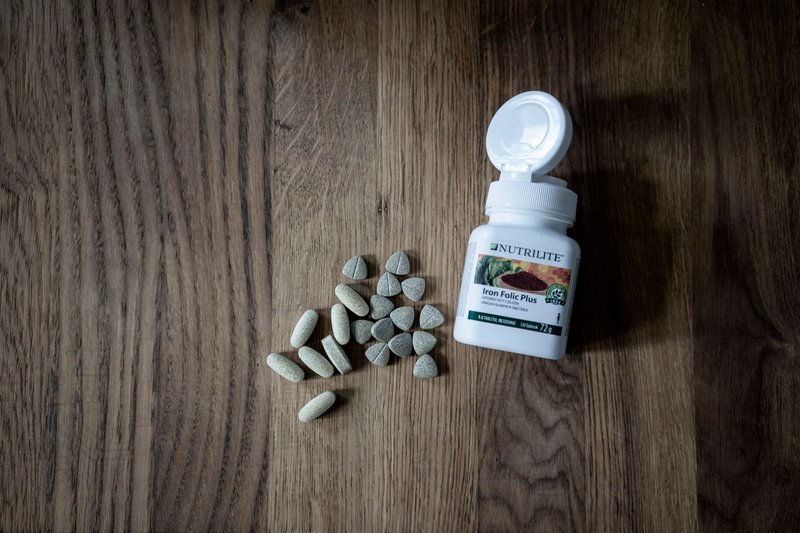
Humans need more iron than the diet sometimes supplies. The NIH Office of Dietary Supplements lists the recommended daily intake as 8 mg for adult men, 18 mg for women aged 19 to 50, and 27 mg during pregnancy. Heme iron from meat and fish absorbs better than the non-heme iron in plants and fortified foods.
When diet isn’t enough, supplements usually contain one of a few iron salts:
| Compound | Type | Approx. elemental iron | Notes |
|---|---|---|---|
| Ferrous sulfate | Ferrous | 20% | Cheapest and most studied, most likely to upset the stomach |
| Ferrous fumarate | Ferrous | 33% | Most iron per milligram of salt |
| Ferrous gluconate | Ferrous | 12% | Often described as gentler, but supplies less iron per pill |
| Ferric citrate | Ferric | Varies | Used mainly as a phosphate binder in kidney disease, and also for iron deficiency |
| Iron sucrose, ferric carboxymaltose | Ferric | Varies | Given by IV when pills fail or can’t be absorbed |
Labels list the weight of the salt, not the iron inside it, so read the “elemental iron” figure.
Iron needs respect. The body has no efficient way to excrete extra iron, and the same chemistry that makes it useful, handing electrons back and forth, can damage cells in excess. The adult upper limit is 45 mg a day from all sources. Accidental overdose of iron supplements is a well-documented cause of poisoning in young children, as the NIH fact sheet for consumers notes, so keep tablets locked away. Don’t start high-dose iron without a blood test confirming you need it.
The short version
Iron compounds sort into a handful of families. Oxides are the ores and pigments. Sulfates and chlorides are the soluble salts used in water treatment, fortification and etching. Sulfides like pyrite are the minerals that sour mine water. Complexes such as Prussian blue and ferrocene are the strange, valuable specialists. Running through all of them is the ferrous (+2) and ferric (+3) pair, which decides color, solubility and how the body handles each one.
Want a quick check for a compound you’re staring at? Green and dissolved usually means ferrous. Brown, yellow or red usually means ferric.