As an Amazon Associate we earn from qualifying purchases. Disclosure
When my son Sami was six he spent most of one rainy February sending marbles down our staircase. He started with the bare steps, then lined them with cereal boxes, then propped a cookie sheet against the bottom step to see how far a marble would roll across the kitchen floor. He kept a tally on the back of an envelope: cookie sheet flat, cookie sheet tilted, cookie sheet with a dish towel on it. Nobody had told him he was running an experiment. He was changing one thing at a time and watching what happened, which is the whole method.
The best toys for kids who love science work the same way. They let a child set something up, run it, change one thing and run it again, and they stay interesting on the fiftieth try. For most kids aged 8 and up, the best single pick is the GraviTrax Starter Set, a modular marble run built around gravity and magnetism. For kids under 8, start with the Stomp Rocket Ultra or the Learning Resources Super Magnet Lab. For a child who is curious about how things work inside, Snap Circuits SC-100 is the best first electronics toy.
I trained as a geoscientist and spent my lab years on ice cores and volcanic gases. At home I have two kids who love science in different ways: Noor, 11, wants to know what things are made of, and Sami, now 7, wants to know what happens if he drops them. The 21 science toys below are sorted by the kind of science a child loves, with the maker’s age rating on every pick, so you can match the toy to the kid rather than to a “STEM” label on the box.
Quick picks
| Pick | Best for | Maker age |
|---|---|---|
| GraviTrax Starter Set | Best overall, builders | 8+ |
| Snap Circuits SC-100 | Electricity | 8+ |
| Stomp Rocket Ultra | Forces and motion, outdoors | 5+ |
| Super Magnet Lab | Ages 5 to 7, magnets | 5 to 10 |
| ThinkFun Laser Maze | Light and logic | 8+ |
| Uncle Milton Giant Ant Farm | Kids who love animals and bugs | 6 to 15 |
| National Geographic Rock Collection | Rocks and minerals | 8+ |
| Kids First Coding & Robotics | Coding without a screen | 4+ |
| Teach Tech Hydrobot Arm | Older kids and teens | 12+ |
What makes a good science toy
A science kit and a science toy are different purchases. A kit is a sequence of experiments: the child works through the manual, uses up the materials and is done. Our guide to the best science kits for kids covers those. A science toy has no last page. A marble run, a magnet set or a gyroscope can be set up a different way every afternoon, and each new setup is a new question.
I use one test before I buy anything for my kids: can the child change one thing and get a different result? A marble run passes, because moving one curve changes the marble’s path and speed. A circuit board passes, because swapping a lamp for a motor changes what the circuit does. A toy that does the same thing every time you press its button fails, however many science words are printed on the box.
“STEM” on a toy box is a marketing term. No regulator checks it. What every toy sold in the United States does have to meet is the ASTM F963 toy safety standard, which covers small parts, sharp edges, magnets and batteries, and the maker’s age rating follows from that testing. Treat the age on the box as the minimum and the topic as the thing to match.
There is good evidence for the kind of play these toys encourage. In a large sample of U.S. children, Jirout and Newcombe (2015) found that kids who played more often with blocks, puzzles and construction toys scored higher on spatial reasoning, a skill that predicts success in science and math later on. The American Academy of Pediatrics’ 2018 report on play makes a similar case for open-ended toys over electronic ones that do the playing for the child.
Toys for kids who love building and engineering
Builders want to make something work and then make it work better. The best toys for them give real feedback: the marble falls off the track, the bridge sags, the arm drops what it picked up. Each failure tells the child what to change.
Best overall
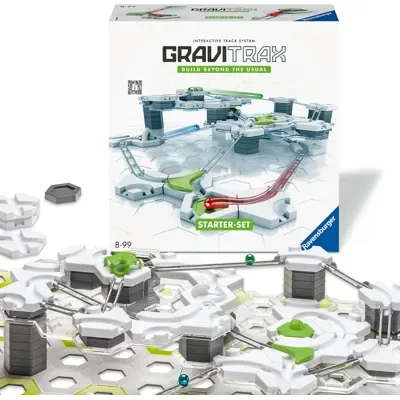
1. Ravensburger GraviTrax Starter Set
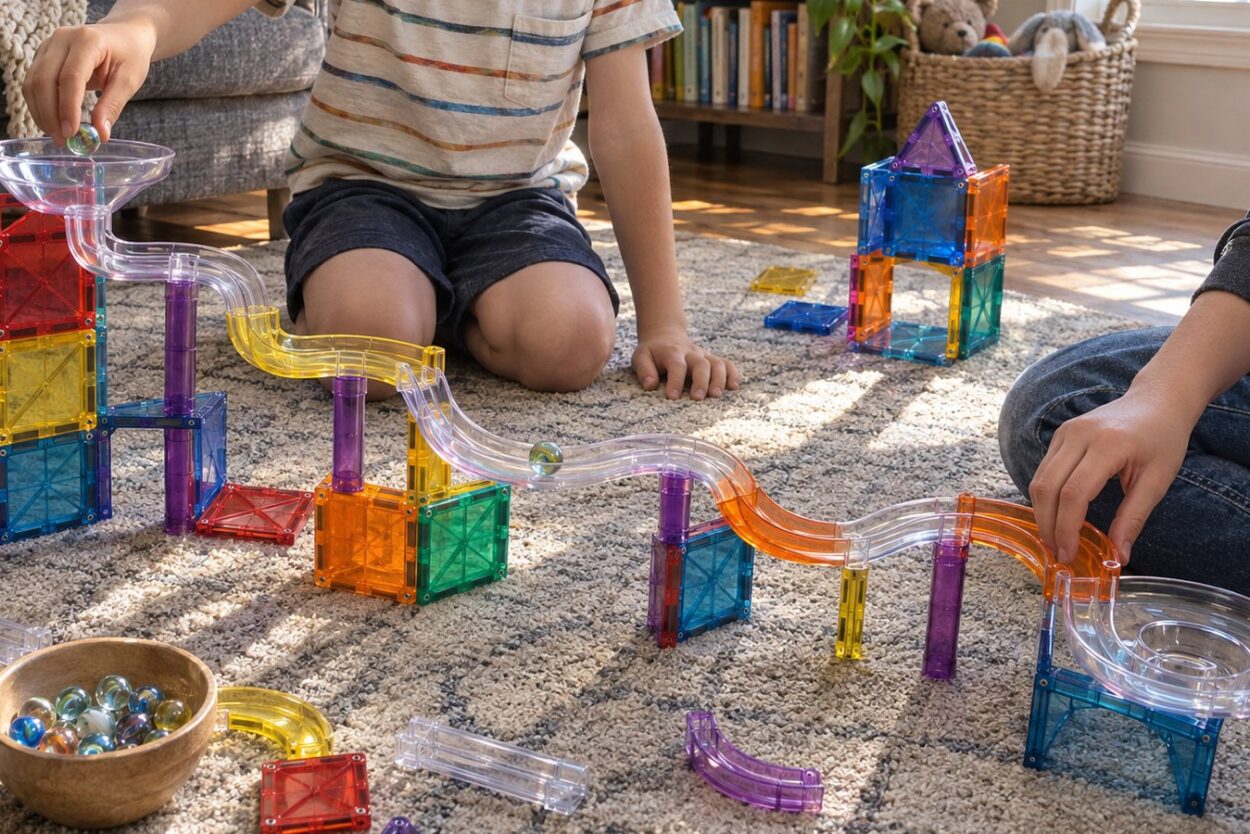
GraviTrax is a marble run built on a grid of hexagonal base tiles. Kids stack height tiles, lay track between them and add action pieces that use gravity, magnetism and momentum to move the marble along. The starter set has 122 components, which is enough for a run that covers a kitchen table and takes a whole afternoon to tune.
It is the best toy for a kid who loves science because it rewards the method Sami used on the stairs. If the marble flies off a curve, the child has to work out whether it is going too fast, whether the curve is too tight or whether the track before it drops too steeply, then change one of those. The system is also open: Ravensburger sells add-on sets with new tricks, so the toy grows with the child.
- Maker age 8+
- 122 components
- Expandable with GraviTrax add-on sets
Good: deep, repeatable play about speed, energy and gravity; expansions keep it new for years. Not great: younger kids need an adult for the first few builds, and the pieces take up a big box.
Check on Amazon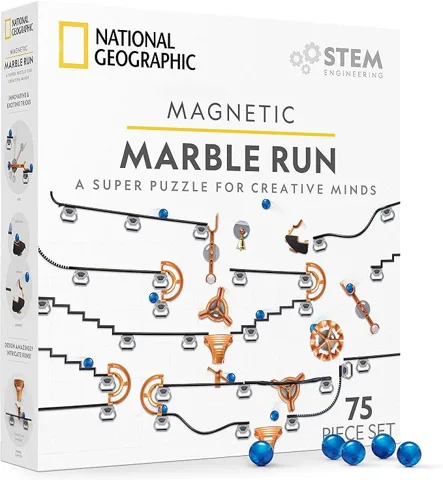
Marble run for a fridge or whiteboard
2. National Geographic Magnetic Marble Run
This marble run builds on any vertical magnetic surface: the fridge, a whiteboard, a metal door. The set has 42 tracks and connectors, 17 trick pieces and 15 marbles, with a learning guide on the physics and engineering behind the tricks. Because it lives on a wall, the run can stay up for days and get rebuilt a piece at a time without anyone stepping on it.
It is a good second marble run, or a first one for a home with no floor space. The vertical build changes the problem: every piece has to catch a falling marble rather than guide a rolling one.
- Maker age 10+
- 42 tracks and connectors, 17 trick pieces, 15 marbles
- Needs a magnetic surface
Good: builds on the fridge, so it stays out and gets played with. Not great: rated 10+, and a stainless steel fridge door often is not magnetic.
Check on Amazon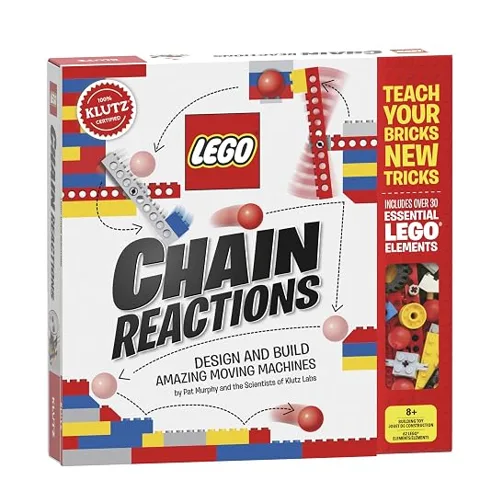
Best for LEGO kids
3. Klutz LEGO Chain Reactions
Written by Pat Murphy and the scientists of Klutz Labs, this is a book with LEGO elements and printed paper parts for building Rube Goldberg machines: a ball rolls down a ramp, knocks a lever, swings a hammer and sets off the next step. Each machine in the book teaches one mechanism, and then the child chains them together.
For a child who already has a bin of LEGO bricks, this is the toy that turns those bricks into an engineering lab. A chain reaction fails at its weakest link, so kids learn to test each step on its own before running the whole machine.
- Maker age 8+
- Paperback book with LEGO elements and paper parts
- Works best alongside a LEGO collection the child already owns
Good: teaches levers, ramps and energy transfer with bricks most families already have. Not great: the paper parts wear out with heavy use.
Check on Amazon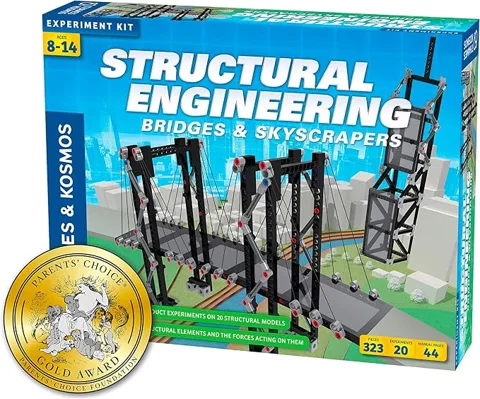
Best for future engineers
4. Thames & Kosmos Structural Engineering: Bridges & Skyscrapers
This set has more than 285 building pieces and a 36-page illustrated manual for 20 models, from beam and truss bridges to towers. Each model is built to show one idea: load, force, compression or tension. The manual has kids test their bridges with weight and compare designs, which is how civil engineers learned the same lessons.
It suits the child who builds towers just to see how tall they can go before they fall. After a few models they start to see why a triangle holds its shape and a square folds.
- Maker age 8 to 14
- 285+ pieces, 20 models
- 36-page experiment manual
Good: real structural engineering concepts, explained clearly. Not great: once the 20 models are built, it depends on the child to invent new ones.
Check on Amazon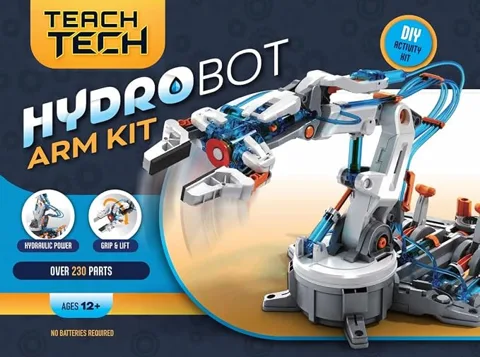
Best for teens
5. Teach Tech Hydrobot Arm
The Hydrobot is a robotic arm that runs on water. Kids build it from parts, then fill syringes and tubes with water and use levers to drive six axes of movement. The arm rotates 270 degrees and has a gripper that can be swapped for a suction cup. There are no batteries and no motors: every movement comes from pressure pushed through a tube, which is how the hydraulics in a digger or an aircraft work.
Expect several hours of build time. That is the point for a 12-year-old: the build is the engineering lesson, and a leaking joint teaches more about seals and pressure than a diagram does.
- Maker age 12+
- Water-powered hydraulics, no batteries
- 6 axes, 270-degree rotation, gripper and suction attachments
Good: a long, real build with a working machine at the end. Not great: too fiddly for most kids under 12, and the syringes need careful filling to avoid air bubbles.
Check on AmazonElectricity and circuit toys
Electricity is hard to teach from a book because you cannot see it. Circuit toys solve that by making the result visible: the light turns on, the fan spins or the buzzer sounds. When it does not, the child has found an open circuit, and fixing it is the lesson.
Best electronics toy
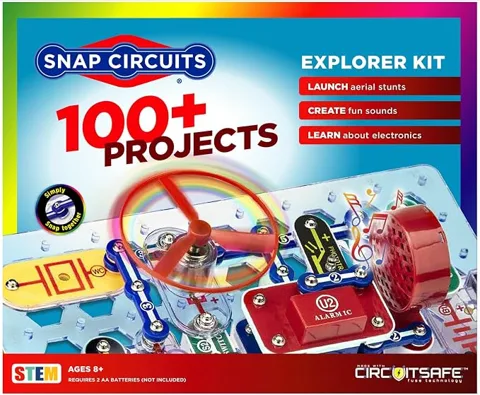
6. Snap Circuits Explorer SC-100
Snap Circuits replace wires and solder with color-coded parts that snap onto a plastic grid. The SC-100 has 29 parts, including a motor, a fan blade that flies off as a “flying saucer,” a lamp, a switch and an alarm module, and a manual with more than 100 projects. Each part is printed with its circuit symbol, so kids learn to read a schematic without noticing.
It is the toy I recommend most for kids who take things apart. Once they have built the projects in the book, they start building their own circuits, and the grid makes it easy to see where a connection is missing. Bigger Snap Circuits sets use the same parts, so it can be expanded later.
- Maker age 8+
- 29 parts, 100+ projects
- No soldering or tools; needs batteries
Good: the clearest way for a child to learn series and parallel circuits by building them. Not great: the projects in the manual get repetitive toward the end.
Check on Amazon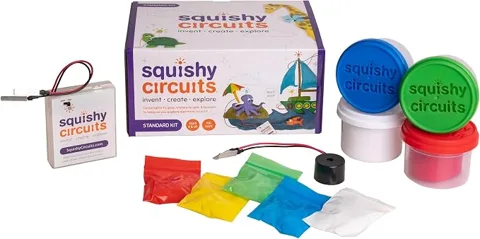
Best for kids who like to sculpt
7. Squishy Circuits Standard Kit
Squishy Circuits started in an engineering lab at the University of St. Thomas in 2011. The kit uses play dough as wire. Three tubs of conductive dough carry current and one tub of insulating dough blocks it, so a child can sculpt a caterpillar, press in LEDs and a buzzer, and watch it light up. The kit has a battery holder, a piezo buzzer and 25 LEDs in five colors.
It teaches a lesson Snap Circuits cannot: what a short circuit is. If the two halves of conductive dough touch, the current takes the short path and the LEDs go dark. Kids work out the role of the insulating dough on their own.
- Maker age 8 to 12 (younger kids with an adult)
- 4 tubs of dough, 25 LEDs, buzzer, battery holder
- Needs 4 AA batteries, not included
Good: the most hands-on way to learn circuits; tested to ASTM F963. Not great: the dough dries out unless the lids go back on.
Check on Amazon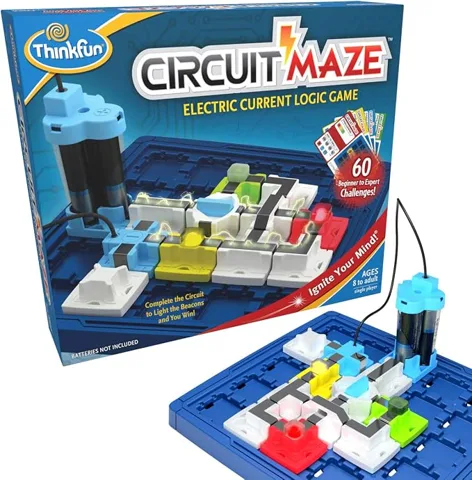
Best circuit puzzle
8. ThinkFun Circuit Maze
Circuit Maze is a logic puzzle with a real circuit inside. Each of the 60 challenge cards shows which lights must turn on, and the player places conducting tiles on the grid to complete that circuit. Challenges run from beginner to expert, and the later ones need switches and parallel paths.
It suits the child who likes puzzles more than building. It also travels well and plays solo, which a lot of science toys do not.
- Maker age 8+
- 60 challenges
- Needs 3 AAA batteries, not included
Good: real circuits in a self-contained puzzle. Not great: once all 60 cards are solved, there is little left to do.
Check on AmazonForces, motion and magnet toys
Kids who love physics are usually the ones who throw, spin and drop things. These toys give them something better to throw and a reason to measure it.
Best for ages 5 and up
9. Stomp Rocket Ultra
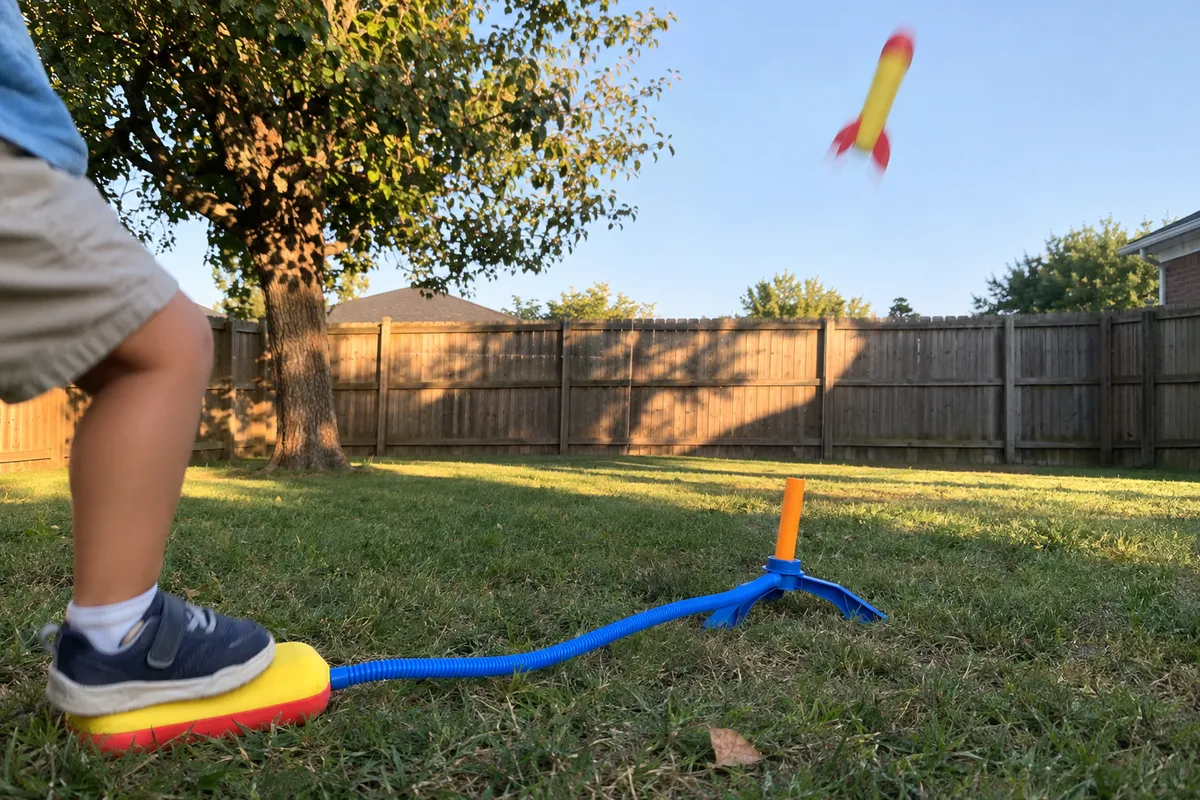
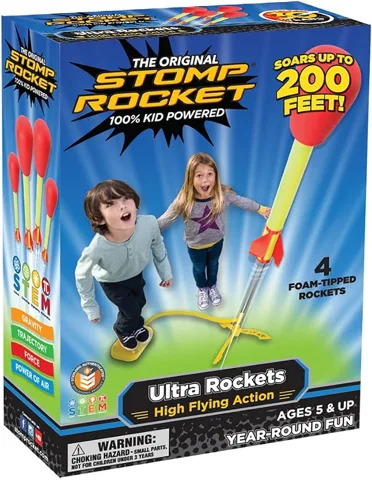
The child stomps on an air bladder, the air shoots up a tube and launches a foam-tipped rocket up to 200 feet. The launch stand angles, so kids can aim straight up or across the yard. It comes with four rockets and needs no batteries.
It is the best science toy for a five-year-old because the cause and effect are immediate and physical: a harder stomp means a higher flight. Older kids can turn it into a real experiment by marking launch angles and pacing out where each rocket lands. In a vacuum the farthest launch angle is 45 degrees; a light foam rocket does best a little lower because of air drag, and finding that out in your own yard is more convincing than reading it.
- Maker age 5+
- 4 rockets, adjustable launcher
- No batteries; outdoor toy
Good: gets kids outside and running, with real physics behind every launch. Not great: rockets end up on roofs and in trees.
Check on Amazon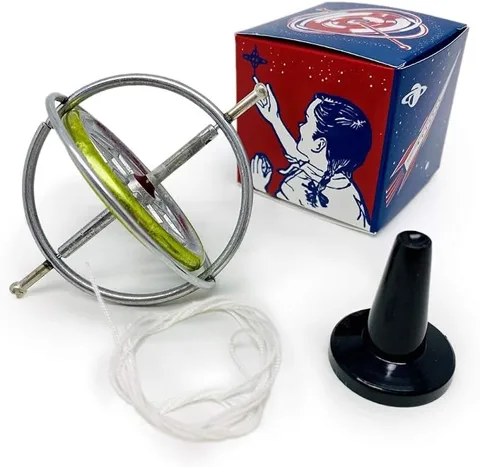
Best physics toy under the radar
10. TEDCO Classic Gyroscope
TEDCO has made this all-metal gyroscope since 1917. Pull the string to spin the flywheel and the gyroscope balances on a fingertip, on the edge of its box or on the tip of the included pedestal. Tilt it and it refuses to fall, then traces a slow circle instead. That motion is called precession, and it is the same physics that keeps a spinning top upright and lets spacecraft hold their orientation.
It is small enough for a stocking and teaches a concept most adults never quite understood. Spinning it well takes a few tries, so it suits kids with some patience.
- Maker age 8+
- All-metal, with string, pedestal and trick sheet
- No batteries
Good: a century-old toy that still shows angular momentum better than any screen. Not great: the string-pull takes practice, and younger kids get frustrated.
Check on Amazon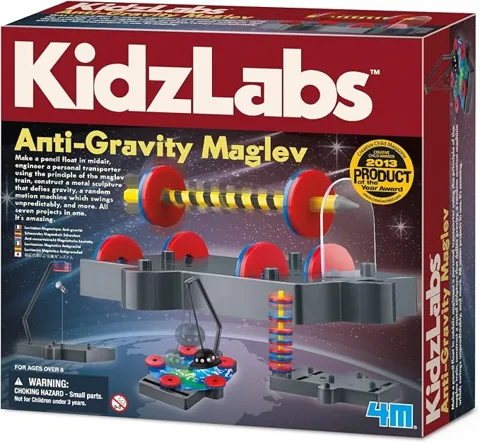
Best magnet toy for older kids
11. 4M Kidzlabs Anti-Gravity Magnetic Levitation
This kit uses ring magnets to float things: a pencil that hovers above its base, a levitating screw and a small maglev track. The child sets up the magnets so like poles face each other and the repulsion holds the object up. It is the same principle behind maglev trains, scaled down to a desk.
It works best for a child who already knows that magnets attract and wants to see what repulsion can do.
- Maker age 8 to 15
- Floating pencil, levitating screw and maglev experiments
- All materials in the box
Good: a striking demonstration of magnetic repulsion. Not great: a short list of experiments, so it is more desk toy than long project.
Check on Amazon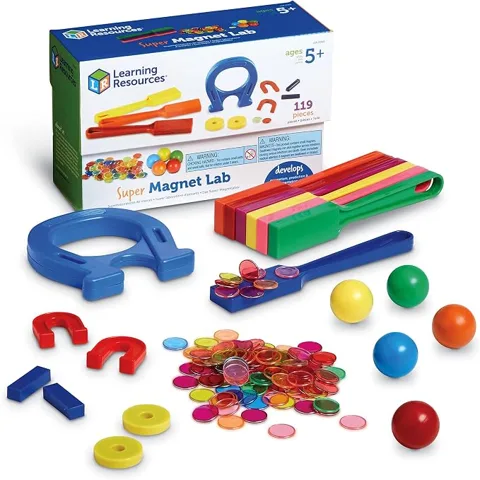
Best for ages 5 to 7
12. Learning Resources Super Magnet Lab Kit
This 119-piece set is a classroom magnet kit sold for home use: 7 magnet wands, 100 magnetic chips, 2 bar magnets, 2 ring magnets, 2 horseshoe magnets, a large horseshoe magnet and 5 magnetic marbles, with an activity guide. Kids test what sticks and what does not, feel attraction and repulsion and find out that a magnet works through paper and water.
For a five-year-old, this is the right first science toy. Every piece is big enough to be safe, and the wands make cleanup a game. Once they ask why a nail sticks and a coin does not, our list of magnetic materials has the answer.
- Maker age 5 to 10
- 119 pieces with activity guide
- Sturdy storage box
Good: classroom-grade pieces sized for small hands. Not great: older kids will outgrow it in a few weeks.
Check on AmazonLight, color and pattern toys
Some kids love science because it is beautiful. These toys are for the child who stops to look at a rainbow on the wall or the pattern on a shell.
Best optics toy
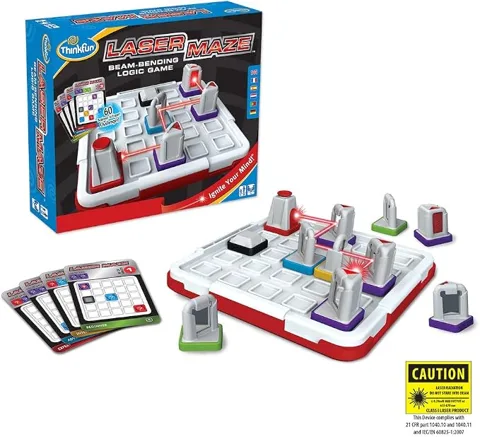
13. ThinkFun Laser Maze
Laser Maze is a puzzle game with a real Class 1 laser. Each of the 60 challenge cards sets up a grid with some pieces fixed, and the player places mirrors and beam splitters to steer the beam to its target. The batteries for the laser are included.
It teaches reflection the way physics teachers wish they could: the child predicts where the beam will go, places a mirror and sees if they were right. Class 1 is the lowest laser class and is safe under normal use, but kids should still never aim it at anyone’s eyes.
- Maker age 8+
- Class 1 laser, 60 challenges
- Batteries included
Good: real optics in a puzzle that adults enjoy too. Not great: the small mirror pieces are easy to lose.
Check on Amazon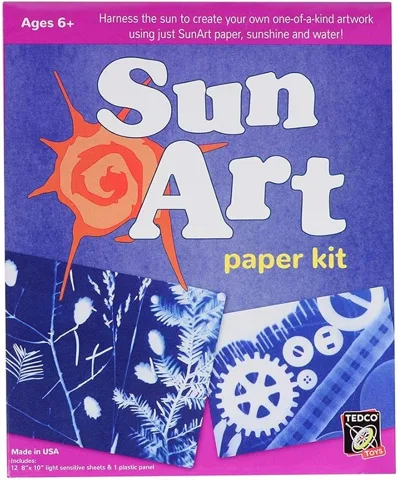
Best for nature lovers
14. TEDCO Sun Art Paper Kit
Sun Art paper is cyanotype paper, coated with light-sensitive iron salts. Kids lay leaves, flowers or keys on a sheet, hold them flat under the acrylic panel and leave it in the sun for a few minutes. A rinse in water fixes the print: white silhouettes on deep blue. The blue is Prussian blue, formed where sunlight reduced the iron in the coating.
This is the same process Anna Atkins used in 1843 to make the first book illustrated with photographs, a guide to British algae. My niece Leila made a row of fern prints at summer camp, and they still hang above her desk. The kit has 12 sheets at 8 by 10 inches, large enough to frame.
- Maker age 6+
- 12 sheets, 8 x 10 inches, acrylic panel
- Needs sunshine and water
Good: real photochemistry, and the results are worth keeping. Not great: 12 sheets go fast; a cloudy week means waiting.
Check on Amazon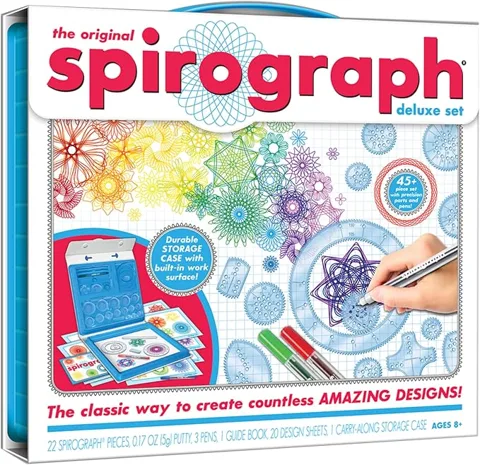
Best for kids who love math
15. Spirograph Deluxe Set
Spirograph is a geometry toy disguised as an art set. A toothed wheel rolls inside or around a toothed ring, and a pen in one of its holes traces a looping curve called a hypotrochoid. The deluxe set comes in a carrying case with a built-in drawing surface, gears, pens, markers, pencils, paper and putty to hold the ring in place.
The math is right there for a curious kid. The number of loops in the finished pattern depends on the tooth counts of the wheel and the ring, so a child who writes those numbers down can learn to predict the drawing before it is done.
- Maker age 8+
- Carrying case with drawing surface
- Gears, pens, markers, pencils, paper and putty
Good: teaches ratios and patterns through drawing. Not great: the pen slips if the child presses too hard, which takes practice to avoid.
Check on Amazon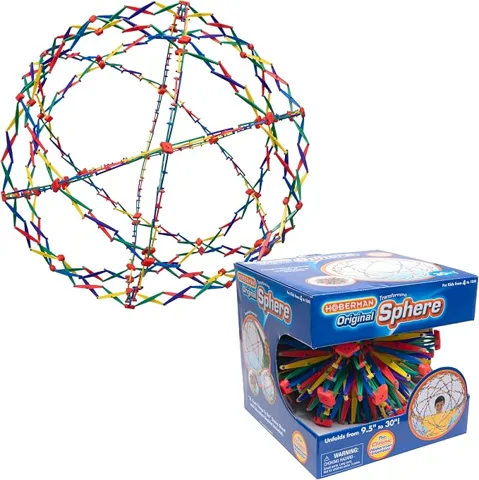
Best for little kids
16. Hoberman Sphere
Chuck Hoberman designed this sphere from a network of scissor-like hinges. Pull on two sides and the whole ball expands; push and it folds back into a small knot. The toy comes with a pulley and hardware to hang it as a mobile and a sheet of 21 activities.
For a four-year-old it is a toy to play with. For a ten-year-old it is a question: how do all the joints move together? Hoberman uses the same kind of linkage in retractable roofs and deployable structures.
- Maker age 4+
- Includes pulley for hanging and activity sheet
- No batteries
Good: a geometry and engineering toy that works for a wide age range. Not great: rough handling can snap a hinge.
Check on AmazonToys for kids who love animals and bugs
A living toy teaches something no plastic set can: animals do not follow the manual. Kids learn to observe, keep notes and take care of something that depends on them.
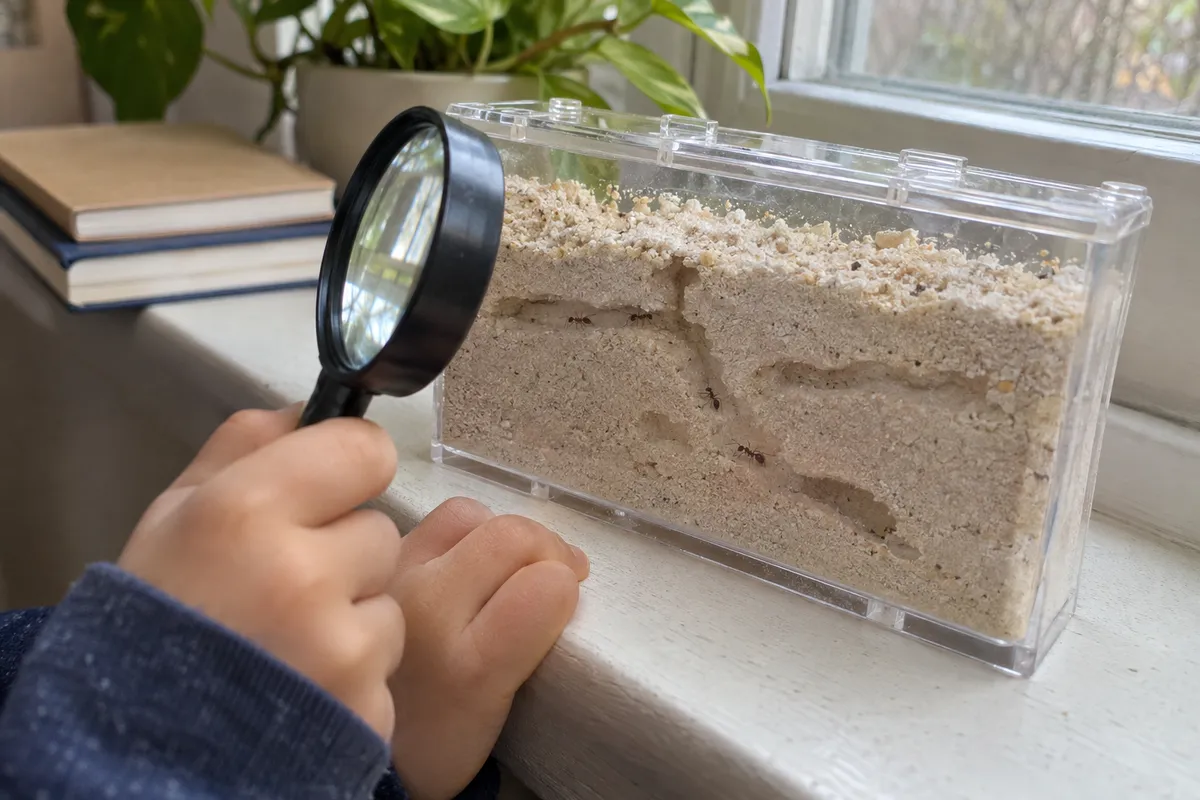
Last spring Sami dropped a cracker crumb on the sidewalk outside our house and timed how long it took the first ant to find it. It took about four minutes. Within half an hour there was a line of ants from the crumb to a crack by the curb, and he wanted to know how the others knew where to go. The answer is a scent trail: each ant that finds food lays down pheromones on the way home, and the trail gets stronger as more ants use it. An ant farm lets a child watch that behavior up close.
Best living science toy
17. Uncle Milton Giant Ant Farm
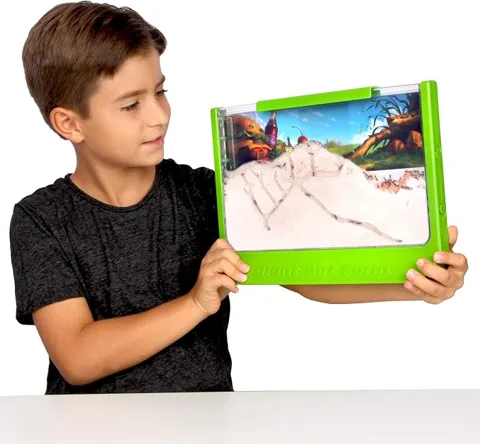
Uncle Milton sold the first ant farm in 1956, and the Giant Ant Farm is the large version of that design: a thin, clear habitat with a removable lid for feeding, side vents and a tip-proof stand. The farm is modular, with connectors and tubing for joining more than one together.
Before you buy it as a gift, read how the ants arrive. Most ant farms ship without ants and include a way to order them separately, and live ants cannot be shipped to every state. Harvester ants live for weeks to a few months in a farm without a queen, so a notebook with dates and tunnel sketches gives the project a beginning and an end. Our article on insect anatomy helps kids name what they see.
- Maker age 6 to 15
- Large viewing area, removable lid, tip-proof stand
- Modular: connects to other Uncle Milton farms
Good: real animal behavior, every day. Not great: getting the ants is a separate step, and reviews show it is the part that most often goes wrong.
Check on Amazon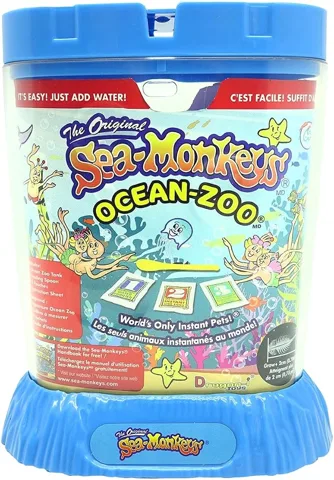
Best first pet experiment
18. Sea-Monkeys Ocean Zoo
Sea-Monkeys are a hybrid brine shrimp, a crustacean in the genus Artemia. Their eggs survive dry for years in a dormant state, and they hatch within days of going into salt water. The Ocean Zoo has a small tank, three pouches (water conditioner, eggs and food) and a feeding spoon.
The rating on Amazon is lower than the other picks here, and the reason is usually care, not the eggs. The shrimp need room temperature, a dim spot out of direct sun and very little food: overfeeding fouls the water and kills them. Kids who follow the instructions closely get a tank that lives for months. If your child wants something bigger and stranger, triops kits work the same way. Triops are tadpole shrimp whose body plan has changed little in over 200 million years, though their kits hatch less reliably.
- Maker age 3+ (with an adult)
- Tank, 3 pouches, feeding spoon
- Tank color varies
Good: a cheap, quick introduction to dormancy, hatching and life cycles. Not great: tanks often fail when the care steps are skipped.
Check on AmazonRocks, space and sky toys
Noor’s science started with a black rock from our driveway that turned out to be hematite. Collectors and sky watchers want things to sort, label and compare, and these two toys give them that.
Best for rock collectors
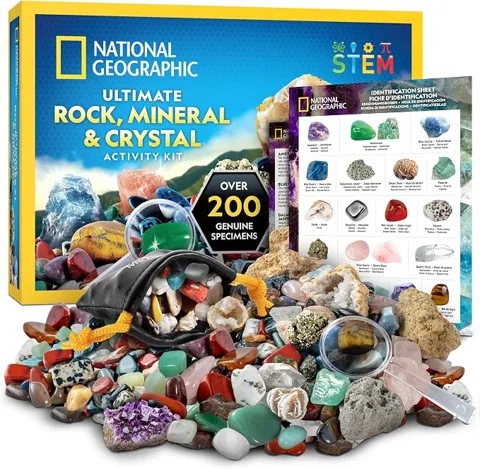
19. National Geographic Rock Collection (200 Specimens)
This box has 200 genuine rock, mineral and crystal specimens, including amethyst, pyrite, rose quartz, fluorite, hematite, pumice and snowflake obsidian, plus two whole geodes to crack open and one broken geode. A color learning guide and a magnifying glass help kids identify each piece.
The specimens are small and tumbled, so this is a sorting and identifying toy rather than a museum collection. For a young collector, that is the right start. Have them sort by color, then by hardness with a steel nail, then by streak on the back of a bathroom tile. Our fossils near me map shows where to collect real specimens nearby, and our list of the best geology books for beginners has the field guides.
- Maker age 8+
- 200 specimens, 2 geodes, magnifying glass, learning guide
- Storage bag included
Good: a lot of real minerals for a first collection. Not great: pieces are small and not individually labeled; kids identify them from the guide.
Check on Amazon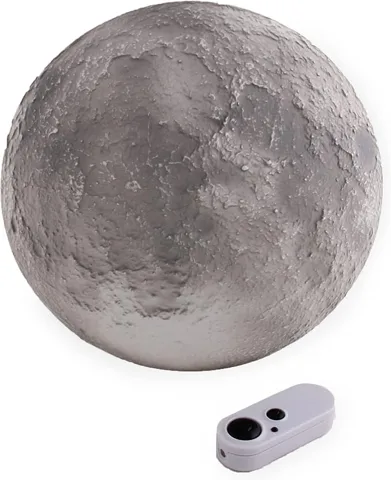
Best space toy for a bedroom
20. Uncle Milton Moon in My Room
This wall light is a detailed model of the Moon’s near side that lights up in 12 phases, from thin crescent to full. A remote steps through the phases, or the automatic mode cycles through them on its own. It shuts off by itself and comes with a poster on the lunar cycle, orbits and eclipses.
When Noor was nine she drew the Moon from her window every clear night for a month and was surprised that it rose later each evening. A Moon on the bedroom wall lets a child connect those drawings to the model: the lit side always faces the Sun, and the phase is just how much of it we see. NASA’s guide to moon phases, linked in the sources, explains the geometry.
- Maker age 6 to 15
- 12 phases, remote or automatic mode, auto shut-off
- Learning poster included; needs batteries
Good: makes the lunar cycle concrete and doubles as a night light. Not great: it is a display, so play is limited once the phases are learned.
Check on AmazonRobot and coding toys
Coding is the science of giving exact instructions. The best coding toys for young kids make the instructions physical, so a child sees the bug when the robot turns the wrong way.
Best coding toy for ages 4 to 8
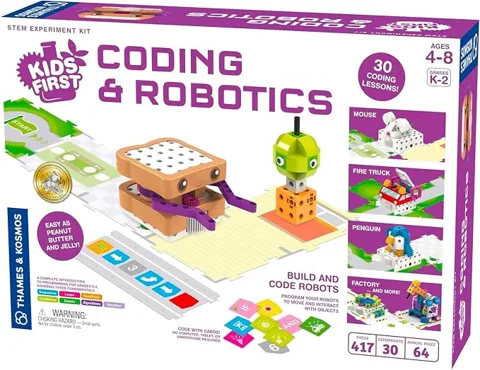
21. Thames & Kosmos Kids First Coding & Robotics
This set teaches coding with no app, tablet or screen. Kids build a robot, then program it with physical cards that it reads in order. The 64-page manual tells six stories, such as a mouse finding cheese in a maze, and each one introduces a concept: sequences, loops, functions, conditions and events. It won a Parents’ Choice Gold Award.
For a kindergartner, the lack of a screen is the advantage. The program is a row of cards on the floor, and when the robot goes wrong, the child can point at the card that caused it.
- Maker age 4+ (grades K to 2)
- Screen-free, card-based programming
- 64-page story manual
Good: real programming concepts with no screen time. Not great: kids who can read well will move on to a screen-based robot within a year or two.
Check on AmazonFor kids 10 and up who like to build more than code, the Sillbird 12-in-1 Solar Robot Kit is a popular choice: 190 parts that build 12 different solar-powered robots and vehicles, with a solar panel that also runs under a strong flashlight. It is a build-and-display kit more than a toy, but it is a good first look at how a solar cell turns light into motion.
Science toys by age
Every age in this list is the maker’s minimum. A careful six-year-old can do a lot with an adult beside them; a ten-year-old who has never built anything may want to start a step lower.
| Age | Best science toys | Why |
|---|---|---|
| 3 to 5 | Hoberman Sphere, Kids First Coding & Robotics (4+), Stomp Rocket (5+), Super Magnet Lab (5+) | Big pieces, instant results, no reading needed |
| 6 and 7 | Ant farm, Sun Art paper, Moon in My Room, Sea-Monkeys | Observing over days; simple care routines |
| 8 and 9 | GraviTrax, Snap Circuits, Laser Maze, LEGO Chain Reactions, rock collection | Reads instructions alone; ready for systems and puzzles |
| 10 to 12 | Magnetic Marble Run, Bridges & Skyscrapers, magnetic levitation, gyroscope | Can test ideas and explain why something failed |
| 12 and up | Hydrobot Arm, Squishy Circuits projects of their own design | Long builds and open-ended design |
For an 8-year-old who loves science, my first choice is GraviTrax, and my second is Snap Circuits. For a 10-year-old, add the Bridges & Skyscrapers set or a first real microscope. For a teenager ready for real chemicals, the best chemistry sets for kids are rated from 10 and 12.
How to choose a toy for a kid who loves science
Match the science they already love. Watch what your child does when nobody is directing them. A kid who stacks and knocks down is a builder. A kid who turns over rocks is a naturalist. A kid who asks why the light switch works is ready for circuits. Buy for that, not for a general “science” label.
Pick toys that can be run again with a change. This is the test from the top of this guide, and it is the best predictor of whether a toy stays out of the closet. Marble runs, circuit sets, magnets and rockets all pass. A toy that performs the same trick every time does not.
Count the adult time. Some toys on this list need an adult for the first session (the ant farm, Sea-Monkeys, the Hydrobot) and some need none (Stomp Rocket, Circuit Maze). Be honest about which one your week has room for.
Check batteries and consumables. Snap Circuits, Squishy Circuits, Circuit Maze and Moon in My Room all need batteries. Sun Art paper runs out. Live animals need to be ordered. None of that is a reason to skip them, but it is a reason not to hand them over on a birthday morning with nothing in the drawer.
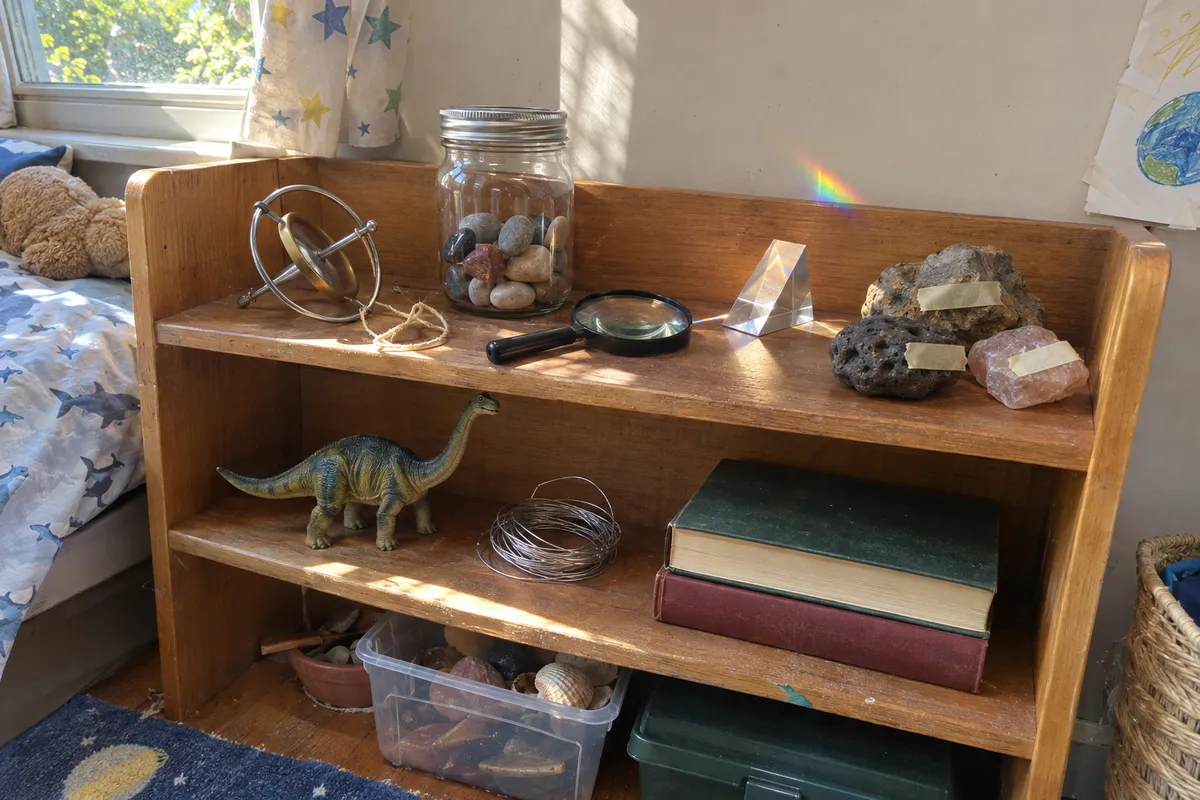
Give it a place. A toy on a shelf the child can reach gets used. A toy in its box in a closet does not. Ours live on a low bookshelf in Sami’s room next to his rocks.
Science toy safety
Magnets. Small, strong magnets are among the most dangerous things a young child can swallow. If two magnets are swallowed, they can attract each other through the walls of the intestine and cause serious injury. The U.S. Consumer Product Safety Commission has warned parents about this for years. Keep sets with small magnets away from toddlers and younger siblings, and count loose magnets when you put them away. The Super Magnet Lab on this list is built with large pieces for young kids for this reason.
Small parts. Anything rated 3+ or higher can contain pieces small enough to choke a child under three. In a house with a baby, marble runs and rock collections need a shelf the baby cannot reach.
Lasers. Laser Maze uses a Class 1 laser, the safest class. Teach kids that no laser, toy or not, ever points at an eye.
Live animals. Wash hands after feeding, keep habitats out of direct sun and do not release ants or shrimp outside. Store-bought animals should not end up in local ecosystems.
FAQ
Good toys for kids who love science are open-ended toys that let a child set something up, test it and change it: marble runs such as GraviTrax, circuit sets such as Snap Circuits, magnet sets, air rockets, ant farms and rock collections. Match the toy to the kind of science the child already enjoys, such as building, electricity, animals or space.
The GraviTrax Starter Set is the best STEM toy for most 8-year-olds. It is rated 8+, has 122 pieces and teaches gravity, speed and energy through marble runs the child designs. Snap Circuits SC-100, also rated 8+, is the best choice for an 8-year-old who is more interested in how electronics work.
For a 5-year-old, the best science toys give an instant, physical result: the Stomp Rocket Ultra (5+), the Learning Resources Super Magnet Lab Kit (5 to 10), the Hoberman Sphere (4+) and Thames & Kosmos Kids First Coding & Robotics (4+). Avoid sets with small, strong magnets if there are younger siblings in the house.
A science kit is a set of experiments that the child works through and uses up, like a chemistry set or a crystal-growing kit. A science toy can be played with again and again in different ways, like a marble run, a circuit set or a gyroscope. Kits teach a topic in order; toys let a child keep experimenting on their own.
Open-ended building and puzzle toys are linked to stronger spatial reasoning, a skill that predicts later success in science and math. A 2015 study of a large U.S. sample by Jirout and Newcombe found that children who played more with blocks, puzzles and construction toys scored higher on spatial tests. A “STEM” label alone means nothing; the type of play matters.
Magnet toys made for young children, with large magnets sealed inside plastic, are safe when used as intended. Small, loose, strong magnets are dangerous: if a child swallows two or more, they can pull together through the intestines and cause serious injury. Keep small magnets away from children under the maker’s age and count them after play.
Snap Circuits SC-100 (8+) is the best toy for teaching electricity, with 29 snap-together parts and more than 100 projects. Squishy Circuits uses conductive play dough to teach circuits and short circuits, and ThinkFun Circuit Maze turns real circuits into 60 logic puzzles.
Teenagers who love science do best with long builds and open-ended projects: the Teach Tech Hydrobot Arm (12+), a real chemistry set such as the Thames & Kosmos Chem C3000, a compound microscope, or a microcontroller kit such as Arduino. Toys rated for younger kids rarely hold a teenager’s attention for long.
Sources
- Amazon product listings and maker age ratings for every product above, checked November 2026.
- Jamie J. Jirout and Nora S. Newcombe, “Building Blocks for Developing Spatial Skills: Evidence From a Large, Representative U.S. Sample,” Psychological Science 26 (2015).
- Michael Yogman and colleagues, “The Power of Play: A Pediatric Role in Enhancing Development in Young Children,” Pediatrics 142 (2018), American Academy of Pediatrics.
- ASTM International, ASTM F963 Standard Consumer Safety Specification for Toy Safety.
- U.S. Consumer Product Safety Commission, Magnets Information Center.
- NASA Science, Moon Phases.
- Squishy Circuits, squishycircuits.com (origin at the University of St. Thomas).
- The Metropolitan Museum of Art, Anna Atkins, Photographs of British Algae: Cyanotype Impressions.