As an Amazon Associate we earn from qualifying purchases. Disclosure
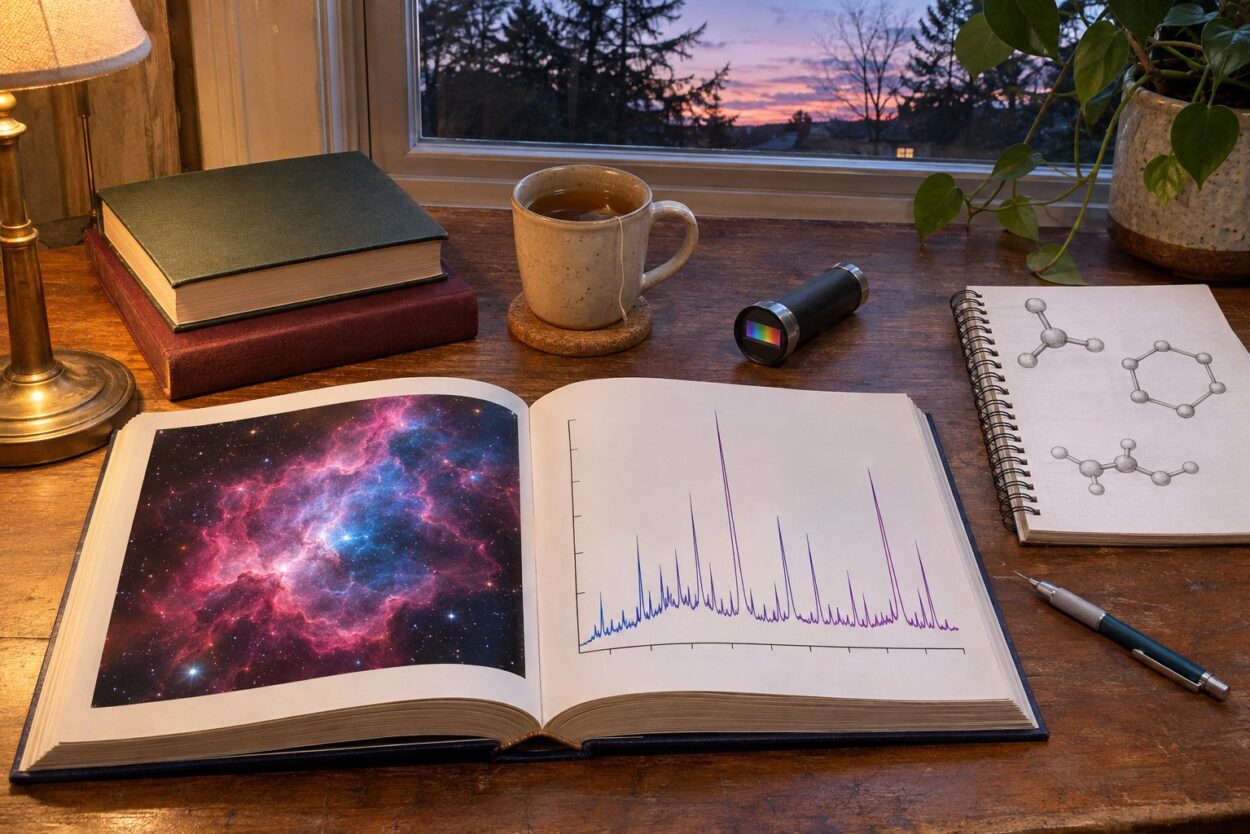
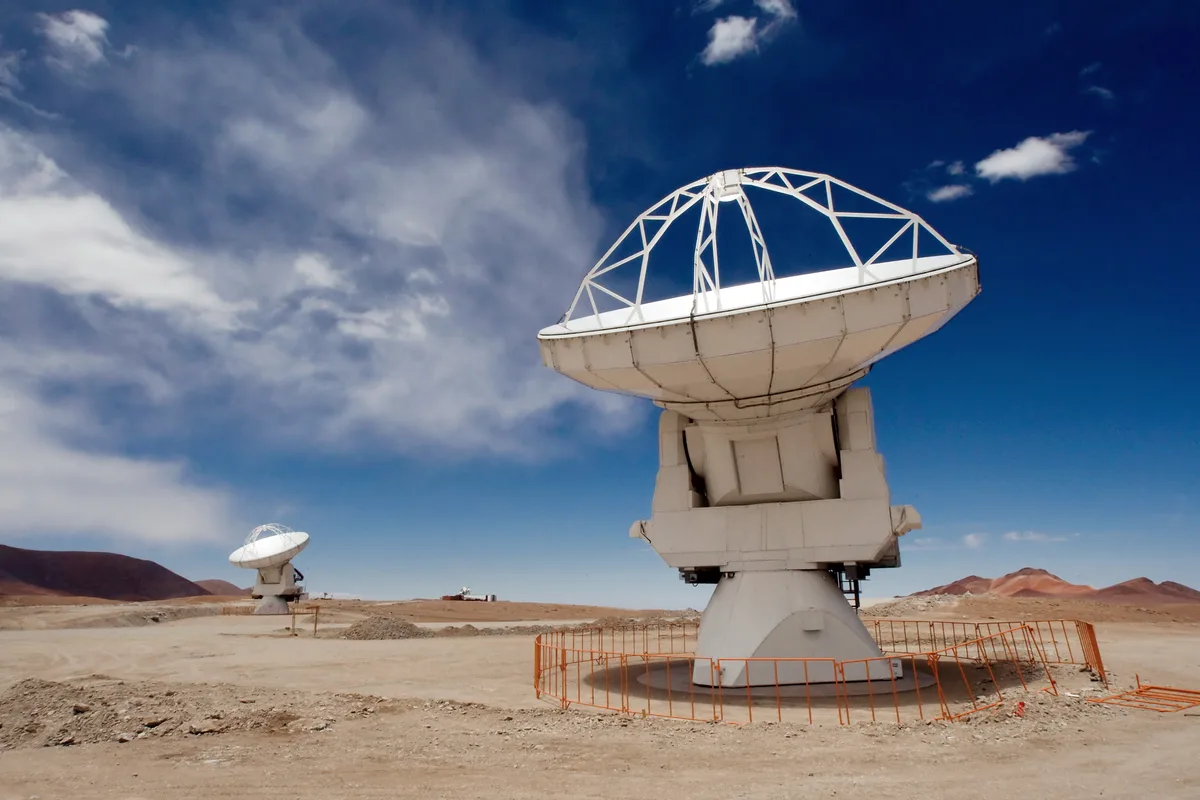
On a reporting trip to the ALMA observatory in Chile, a postdoc at the operations base, 2,900 meters up in the Atacama Desert, turned his laptop toward me and showed me a spectrum of a young star still wrapped in its birth cloud. It looked like a barcode drawn by an earthquake: hundreds of sharp spikes, each one a molecule spinning in gas colder than anything in a freezer. Methanol, formaldehyde, methyl formate, a sugar called glycolaldehyde. A good share of the spikes had no name yet. I asked him what a curious outsider should read to understand what he was looking at. He laughed and said it depended on whether I had come to it from chemistry or from physics, because the books are written for one or the other.
He was right, and it is the main thing to know before you buy astrochemistry books. The field sits between chemistry, astronomy and physics, so there is no single standard text. Popular books tell the story of how we learned we are made of stardust. Undergraduate textbooks assume you know either spectroscopy or stellar physics. Graduate texts assume both.
The best astrochemistry book for most readers is The Stardust Revolution by Jacob Berkowitz, a no-math history of how astronomers found the chemistry of life in stars and interstellar clouds. If you want a real astrochemistry textbook, the best one is Satoshi Yamamoto’s Introduction to Astrochemistry, which teaches the chemistry of interstellar clouds, star formation and planet-forming disks with the spectroscopy you need. For graduate study, the standard book is Xander Tielens’ The Physics and Chemistry of the Interstellar Medium.
I have a PhD in particle physics from Imperial College London, spent five years at CERN calibrating detectors and have since reported from telescope arrays and chemistry labs on four continents. The 27 books below are sorted by level: popular science, undergraduate textbooks, astrobiology texts, graduate references and books for kids. Each entry says who it suits, what it covers, where it falls short and which edition to buy. After the list you will find what working astrochemists on Reddit recommend, the background you need, free resources, a spectroscope you can build from a CD and a reading order.
Quick picks
| Pick | Best for | Level |
|---|---|---|
| The Stardust Revolution | Best first astrochemistry book | No math |
| Atom (Krauss) | The life story of one oxygen atom | No math |
| Stardust: The Cosmic Seeds of Life | Popular book by a working astrochemist | No math |
| Introduction to Astrochemistry (Yamamoto) | Best astrochemistry textbook | Upper undergraduate |
| Astrochemistry (Shaw) | Gentlest textbook | Undergraduate |
| Chemistry in Space (Rehder) | Chemists new to astronomy | Undergraduate |
| Introduction to the Interstellar Medium | Physics students new to chemistry | Upper undergraduate |
| Astrobiology: An Introduction | Chemistry of life beyond Earth | Undergraduate |
| Tielens, Physics and Chemistry of the ISM | Graduate standard | Graduate |
| Older Than the Stars | Young children | Ages 4 to 8 |
What astrochemistry is
Astrochemistry is the study of atoms and molecules in space: which ones exist, how they form, how they survive and how they end up in stars, planets, comets and living things. Most of it happens in the gas and dust between the stars, the interstellar medium, where a dense cloud holds perhaps ten thousand molecules per cubic centimeter at about 10 degrees above absolute zero. That is emptier than the best vacuum chambers on Earth and colder than liquid helium, yet chemistry still runs there, through reactions between ions and molecules in the gas and on icy dust grains.
Astrochemists find molecules by their spectra. Every molecule absorbs and emits light at its own set of frequencies, so a line at exactly the right frequency is a fingerprint. The first interstellar molecules, CH, CN and CH+, were identified from optical absorption lines between 1937 and 1941. Radio astronomy then found the hydroxyl radical in 1963, ammonia in 1968 and water and formaldehyde in 1969. The Cologne Database for Molecular Spectroscopy listed 346 molecules detected in interstellar or circumstellar space as of April 2026, up from 309 two years earlier. Recent ones include benzonitrile (2018), the first specific aromatic ring found by radio, and the methyl cation CH3+, which the James Webb Space Telescope detected in a planet-forming disk in Orion in 2023.
The field also reaches into our own solar system. In January 2025, NASA reported that samples returned from the asteroid Bennu contain 14 of the 20 amino acids used by life on Earth and all five nucleobases of DNA and RNA. Astrochemistry is one of the branches of chemistry and of astronomy at once, and its methods come from physical chemistry, mainly spectroscopy and kinetics.
Which astrochemistry book to start with
Choose by what you already know, not by the title. Several books called “astrochemistry” are graduate monographs, and some of the best introductions never use the word on the cover.
- You have no science background and want the story. Start with The Stardust Revolution or Krauss’s Atom. Neither needs any math.
- You studied chemistry and want the astronomy. Read Rehder’s Chemistry in Space, then Yamamoto. Both assume you know what an orbital and a rate constant are and teach the astronomy as they go.
- You studied physics or astronomy and want the chemistry. Read Williams’ Introduction to the Interstellar Medium, then Yamamoto. Tennyson’s Astronomical Spectroscopy fills in the molecular physics.
- You are a high school student or first-year undergraduate. Shaw’s Astrochemistry is the only textbook written for you. Pair it with a popular book so you know why each chapter matters.
- You care most about the origin of life. Read the astrobiology textbooks: Plaxco and Gross is the most chemical, Rothery and colleagues the best for self-study.
- You are starting a PhD. Tielens is the standard, Draine covers the physics and McSween and Huss covers meteorites and isotopes.
Check the year as well. ALMA began full operations in 2013 and the James Webb Space Telescope in 2022, and both changed what astrochemists can see. A book from 2006 still teaches the principles well, but it will not describe complex organic molecules in planet-forming disks or ices measured by Webb.
Popular astrochemistry books (no math)
These books explain where the elements came from, how molecules form in space and what that means for life. They suit adults with no chemistry beyond school, and several are written by working scientists.
Best first astrochemistry book
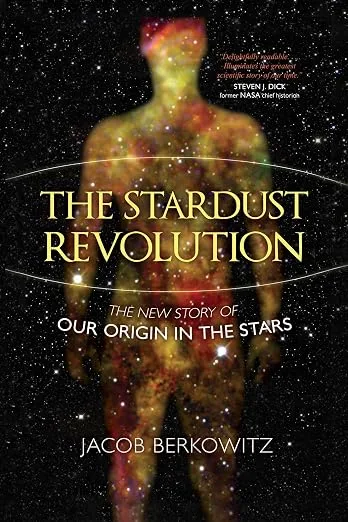
1. The Stardust Revolution: The New Story of Our Origin in the Stars
Jacob Berkowitz is a Canadian science writer, and this is the only popular book built entirely around astrochemistry and the people who created it. It runs in three parts. The first follows how astronomers learned to read the chemistry of stars from their light. The second covers the discovery of molecules in interstellar clouds and of presolar grains, specks of stardust older than the Sun found inside meteorites. The third turns to astrobiology and the search for life’s ingredients on other worlds.
Berkowitz keeps the chemistry light and the people central, so you meet the radio astronomers who first found ammonia and water in space and the meteorite scientists who found stardust in a lab. Reviewers note he sometimes overstates how revolutionary each step was. The 2022 revised paperback is the edition to buy.
- Jacob Berkowitz
- Prometheus, revised paperback (2022), 384 pages
- No math; history of astrochemistry and astrobiology
Good: the clearest no-math account of what astrochemistry is and how it began. Not great: light on the actual chemical reactions, and enthusiastic to a fault.
Check on Amazon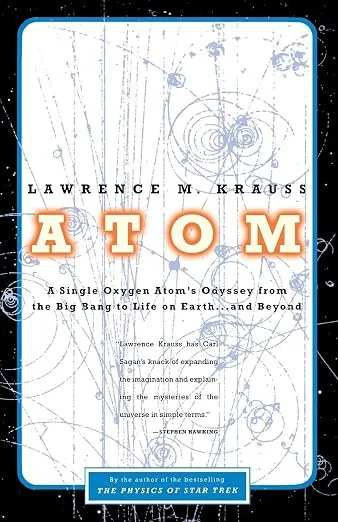
Best story of where atoms come from
2. Atom: A Single Oxygen Atom’s Journey from the Big Bang to Life on Earth
Lawrence Krauss, a theoretical physicist, follows one oxygen atom from the quarks that formed its nucleus after the Big Bang, through the star that fused it and the supernova that scattered it, into the cloud that collapsed to form the Sun, onto the young Earth, through oceans and living things and finally forward to the end of the universe. Each stage of the journey is an excuse to explain a piece of physics or chemistry.
It is strongest on nucleosynthesis, how stars build the elements, which is the foundation every astrochemistry textbook takes for granted. It is weaker on the molecular side and dates from 2001, before the explosion in known interstellar molecules.
- Lawrence M. Krauss
- Little, Brown, paperback (2002), 320 pages
- No math; element formation and cosmic history
Good: a memorable single thread through the whole of cosmic chemistry. Not great: more physics than chemistry, and 25 years old.
Check on Amazon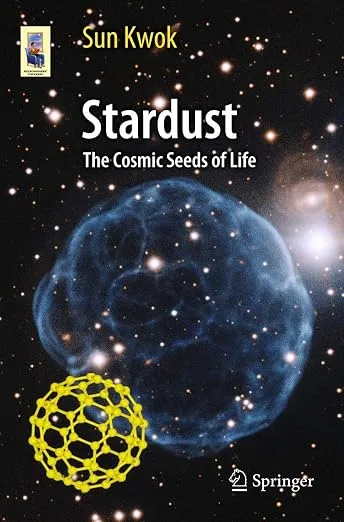
Best popular book by an astrochemist
3. Stardust: The Cosmic Seeds of Life
Sun Kwok is an astronomer who has spent his career studying the dust that dying stars throw off, and he is known for arguing that these stars make complex organic solids, not only simple molecules. Here he explains that work for general readers: how infrared telescopes revealed organic matter around old stars, how that material spreads through the galaxy and how some of it may have reached the early Earth in comets and meteorites.
It is the closest a popular book gets to current astrochemistry research, with real spectra and telescope images. Kwok’s view on the nature of the organic dust is one side of an active debate, which he says openly. It is part of Springer’s Astronomers’ Universe series, aimed at educated readers.
- Sun Kwok
- Springer, paperback (2013), 289 pages
- Little math; organic molecules and dust around stars
Good: written by someone who does the research, with the evidence shown. Not great: denser than most popular science, and argues for the author’s own model.
Check on Amazon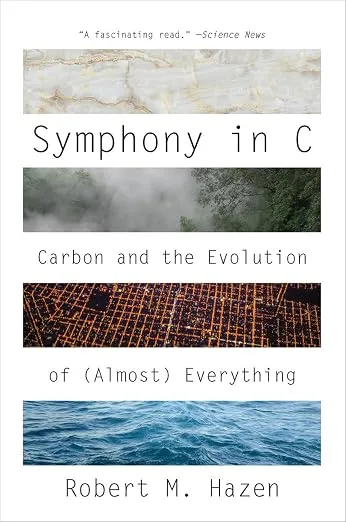
Best book on carbon from stars to life
4. Symphony in C: Carbon and the Evolution of (Almost) Everything
Robert Hazen is a mineralogist at the Carnegie Institution for Science who led the Deep Carbon Observatory, a ten-year study of carbon inside the Earth. The book follows one element in four movements named Earth, Air, Fire and Water: how carbon is made in stars, how it forms minerals, how it built the molecules of life and how it cycles through the planet today.
The first movement covers stellar nucleosynthesis and carbon in space, which is the astrochemistry part. The rest moves to Earth, which makes it a good second book once you know how carbon got here and want to know what it did next.
- Robert M. Hazen
- W. W. Norton, paperback (2020), 320 pages
- No math; carbon in space, minerals and life
Good: elegant and current, by a scientist at the center of carbon research. Not great: only about a quarter of it is set in space.
Check on Amazon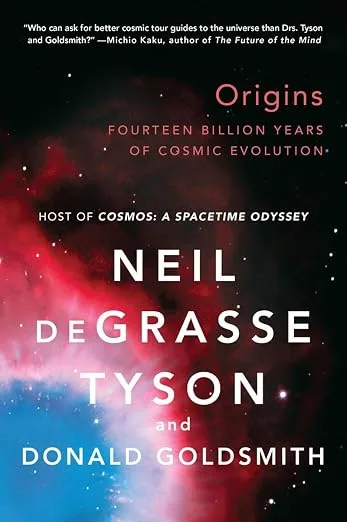
Best overview of cosmic evolution
5. Origins: Fourteen Billion Years of Cosmic Evolution
Written as a companion to the PBS NOVA series, Origins moves from the Big Bang to galaxies, stars, planets and the search for life. Neil deGrasse Tyson and Donald Goldsmith give whole chapters to how elements formed and to the question of where life’s chemistry could start. It is the broadest book here, so it places astrochemistry inside the rest of astronomy.
It is the most popular title on this list by far on Amazon, with more than 1,400 ratings. The chemistry is a thread rather than the subject, so treat it as background reading rather than an astrochemistry book in the strict sense.
- Neil deGrasse Tyson and Donald Goldsmith
- W. W. Norton, paperback reissue (2014), 352 pages
- No math; cosmology to astrobiology
Good: the easiest way to get the big picture astrochemistry fits into. Not great: chemistry is one theme among many.
Check on Amazon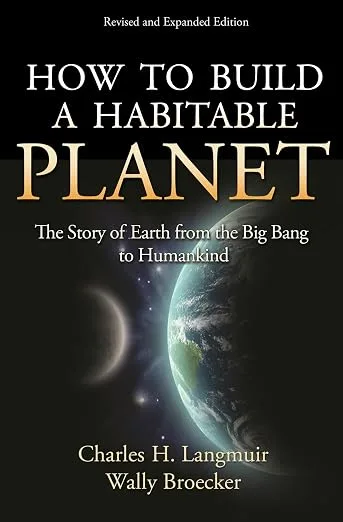
Best bridge from stars to Earth’s chemistry
6. How to Build a Habitable Planet
Charles Langmuir of Harvard and the late Wallace Broecker of Columbia were geochemists, and this book grew out of a university course. It starts with Big Bang nucleosynthesis and element formation in stars, moves through the formation of the solar system and the separation of the Earth into core, mantle and crust, then covers the oceans, atmosphere, the origin of life and climate.
It uses more chemistry than the other popular books, with graphs and the occasional equation, which makes it a good step toward a textbook. At 736 pages it is long, and the second half is about Earth rather than space.
- Charles H. Langmuir and Wallace Broecker
- Princeton University Press, revised hardcover (2012), 736 pages
- Light math; nucleosynthesis, cosmochemistry, Earth
Good: the most scientific popular book here, written by working geochemists. Not great: long, and more Earth science than astrochemistry.
Check on Amazon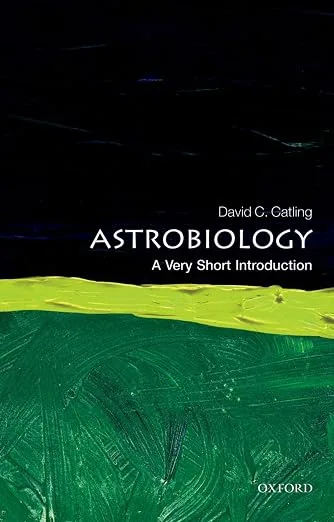
Shortest introduction to astrobiology
7. Astrobiology: A Very Short Introduction
David Catling is a planetary scientist at the University of Washington. In 160 pages he covers what life is, how it might have started, where the elements and organic molecules came from, how Earth stayed habitable and where else to look: Mars, Europa, Enceladus and planets around other stars.
It came up in three separate Reddit threads asking for astrobiology books, more than any other popular title. It is the right book if you want the origin-of-life side of astrochemistry in an afternoon.
- David C. Catling
- Oxford University Press, paperback (2014), 160 pages
- No math; origin of life and habitability
Good: accurate, compact and written by a researcher. Not great: too brief to cover interstellar chemistry in any depth.
Check on Amazon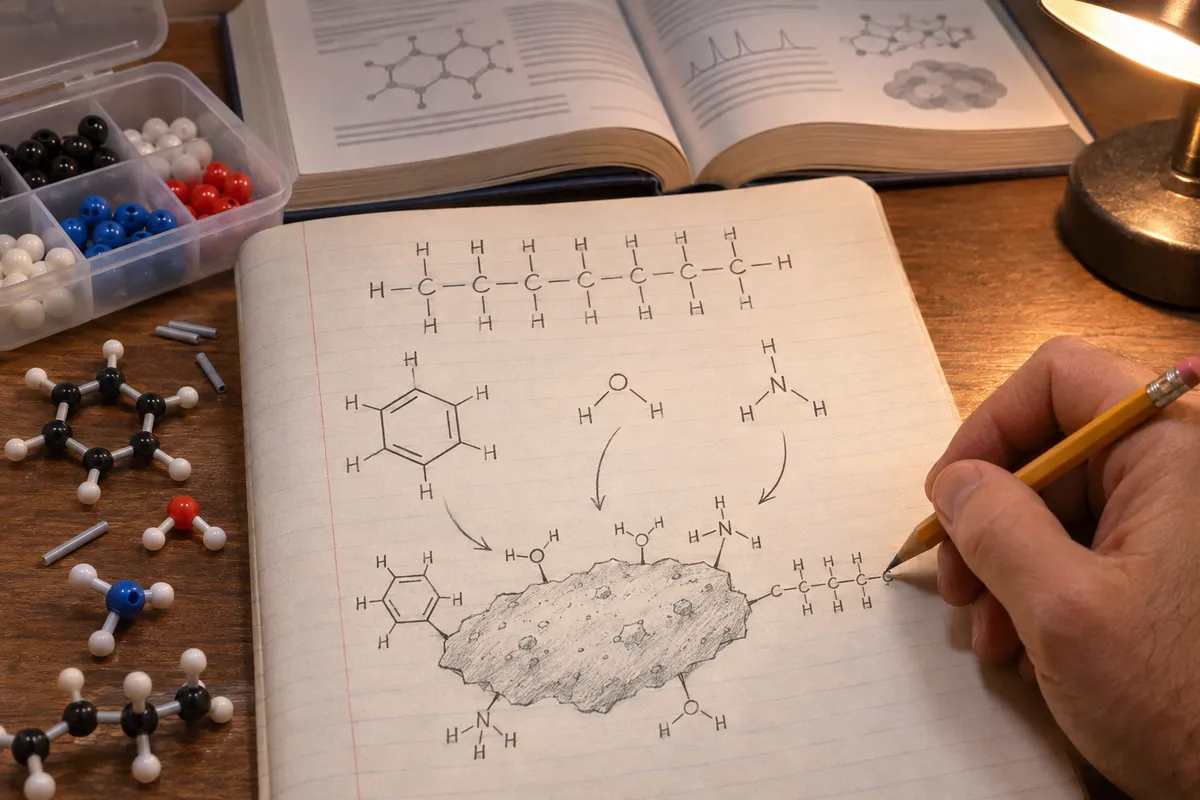
Astrochemistry textbooks for undergraduates
These books teach the subject properly, with equations, spectra and problems. Most assume a first university course in chemistry or physics. Several are expensive academic titles, so check your library or a used copy first.
Best astrochemistry textbook
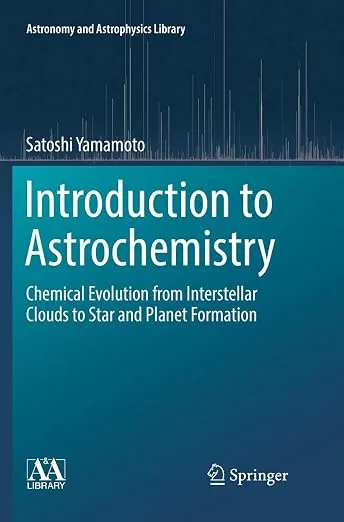
8. Introduction to Astrochemistry: Chemical Evolution from Interstellar Clouds to Star and Planet Formation
Satoshi Yamamoto is a professor at the University of Tokyo who works on radio observations of interstellar molecules, and this is the most complete modern introduction to the field. It explains the conditions in interstellar clouds, the gas-phase reactions that work at 10 kelvin, chemistry on grain surfaces, how molecular abundances change as a cloud collapses into a star and what happens in the disk that forms planets. It also teaches the rotational spectroscopy you need to read radio observations.
It is pitched at advanced undergraduates and new graduate students, and it is written by a chemist who understands what physicists find hard and the other way around. If you buy one textbook, buy this one. The paperback is a softcover reprint of the 2017 hardcover with the same content.
- Satoshi Yamamoto
- Springer, paperback (2018), 296 pages
- Calculus, basic quantum chemistry; molecular clouds to planet formation
Good: modern, focused on astrochemistry itself and balanced between chemistry and astronomy. Not great: expensive, and predates most Webb results.
Check on Amazon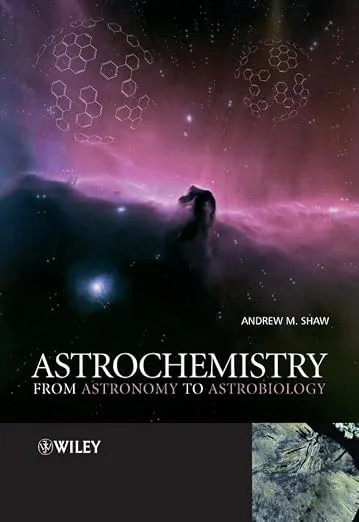
Gentlest astrochemistry textbook
9. Astrochemistry: From Astronomy to Astrobiology
Andrew Shaw is a chemist at the University of Exeter, and he wrote this for undergraduate chemists taking a first course in the subject. It starts from basic astronomy, introduces the spectroscopy of atoms and molecules, then covers the interstellar medium, star formation, planets, comets and the origin of life. Each chapter has worked examples and problems.
It is the only textbook here that a strong first-year student could read alone. It is also the oldest, from 2006, so it predates ALMA, the Herschel space telescope’s results and Webb, and its 3.8-star Amazon rating reflects some readers finding it uneven. Use it for the foundations and a newer book for the current picture.
- Andrew M. Shaw
- Wiley, paperback (2006), 352 pages
- Algebra and some calculus; broad survey with problems
Good: written for beginners, with problems and a broad scope. Not great: 20 years old, and some chapters are thin.
Check on Amazon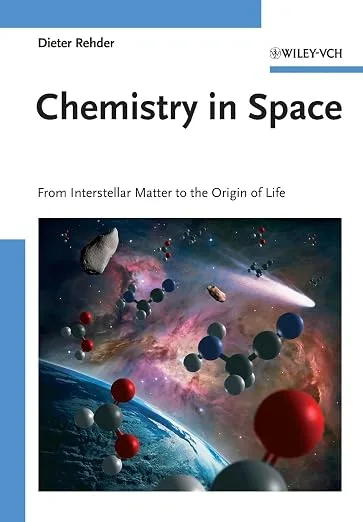
Best for chemists
10. Chemistry in Space: From Interstellar Matter to the Origin of Life
Dieter Rehder is an inorganic chemist at the University of Hamburg, and this is astrochemistry written for people who think in molecules. It covers how elements form, the molecules of the interstellar medium, the chemistry of the planets, moons, comets and meteorites of our solar system, and theories of how life began. Inorganic and metal-containing compounds get more space here than in any other book on the list.
It came up in two Reddit threads asking for astrochemistry books. It assumes general and some inorganic chemistry and explains the astronomy as it goes.
- Dieter Rehder
- Wiley-VCH, paperback (2010), 302 pages
- Undergraduate chemistry; interstellar and solar system chemistry
Good: the most chemical astrochemistry textbook, wide in scope. Not great: 2010, and lighter on the astronomy and spectroscopy.
Check on Amazon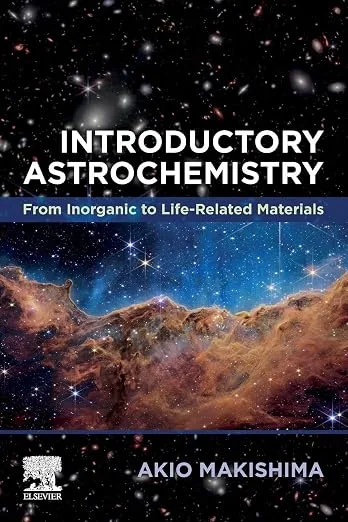
Newest textbook, solar system focus
11. Introductory Astrochemistry: From Inorganic to Life-Related Materials
Akio Makishima is a geochemist at Okayama University’s Institute for Planetary Materials, and his 2024 book approaches astrochemistry from the rocks up. Its ten chapters cover astronomy basics, the origin of the elements, the materials of the Moon, Earth, Venus and Mars, life-related molecules, comet and asteroid samples including Japan’s Hayabusa2 material from the asteroid Ryugu, the ocean moons of Jupiter and Saturn and exoplanets.
It is the most up to date textbook here and the best on sample-return missions. It says little about interstellar clouds, so read it alongside Yamamoto rather than instead of it.
- Akio Makishima
- Elsevier, paperback (2024), about 300 pages
- Undergraduate chemistry; planets, meteorites, sample returns
Good: current, covers Ryugu and the planets in detail. Not great: little on the interstellar medium, and few reviews yet.
Check on Amazon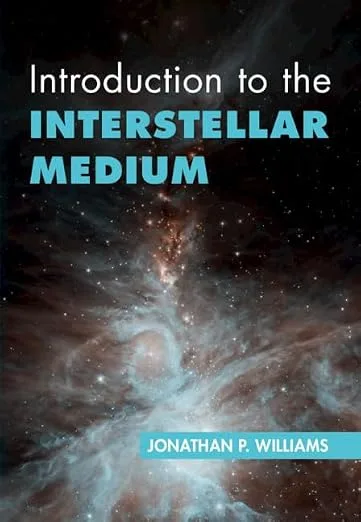
Best for physics and astronomy students
12. Introduction to the Interstellar Medium
Jonathan Williams teaches at the University of Hawaii’s Institute for Astronomy, and he wrote this as a one-semester course for advanced undergraduates and new graduate students. It covers how radiation and matter interact, atomic, molecular and ionized gas, dust, star formation and the structure of the galaxy, and it uses public telescope data so readers can run their own analyses.
It is not an astrochemistry book in name, but you cannot understand where molecules form without understanding the gas they form in. At 218 pages it is the shortest serious route into the subject.
- Jonathan P. Williams
- Cambridge University Press, hardcover (2021), 218 pages
- Calculus, undergraduate physics; the interstellar medium
Good: short, modern and built around real data. Not great: chemistry is one chapter among many.
Check on Amazon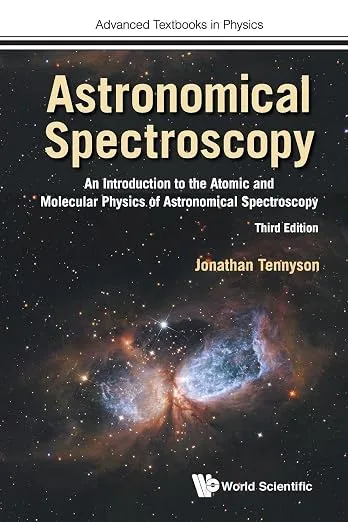
Best book on spectroscopy for astronomy
13. Astronomical Spectroscopy: An Introduction to the Atomic and Molecular Physics of Astronomical Spectra
Jonathan Tennyson is a professor at University College London who computes molecular spectra for astronomy. His book teaches how atoms and molecules produce spectral lines, starting with hydrogen, then many-electron atoms, then diatomic and polyatomic molecules, always tied to what telescopes see. It grew out of his lecture course and keeps the quantum mechanics to what you need.
Spectroscopy is how every molecule in space is found, and Reddit’s astrochemists say again and again that it is the skill to learn first. This is the readable way to learn it. Buy the third edition.
- Jonathan Tennyson
- World Scientific, 3rd edition paperback (2019), 282 pages
- Calculus, some quantum mechanics; atomic and molecular spectra
Good: short, clear and focused on astronomical applications. Not great: no chemistry of how molecules form.
Check on Amazon
Best on organic molecules in space
14. Organic Matter in the Universe
Sun Kwok’s technical book covers the evidence for organic compounds across the universe: in interstellar clouds, around dying stars, in other galaxies, in comets and in meteorites. It explains the infrared spectroscopy used to detect organic solids and the debate over what carries the unidentified infrared bands seen everywhere in the galaxy.
It is the natural next step after Kwok’s popular Stardust if you want the evidence in full. It assumes undergraduate chemistry and some astronomy.
- Sun Kwok
- Wiley-VCH, hardcover (2011), 277 pages
- Undergraduate chemistry; organics, infrared spectroscopy
Good: the most focused book on organic astrochemistry. Not great: expensive and written from one side of an open debate.
Check on AmazonOne more title appears in several Reddit lists: Astrochemistry and Astrobiology, edited by Ian W. M. Smith, Charles Cockell and Sydney Leach (Springer, 2013). It is a set of review chapters by specialists, good for a student writing a paper, and a costly academic volume best borrowed from a library.
Astrobiology textbooks with strong chemistry
Astrobiology asks whether life exists elsewhere, and much of the answer depends on chemistry: which molecules reach young planets and what they can become. These three textbooks cover that chemistry better than most astrochemistry books cover biology.
Best astrobiology textbook for chemistry
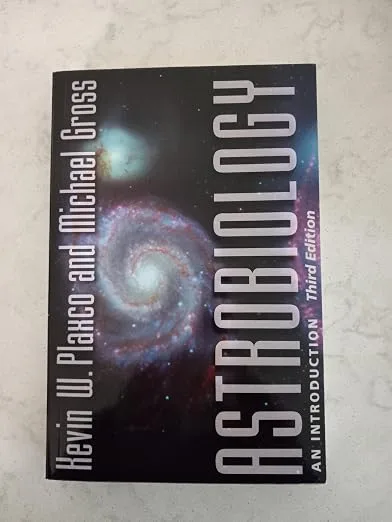
15. Astrobiology: An Introduction
Kevin Plaxco is a biochemist at the University of California, Santa Barbara, and Michael Gross is a chemist turned science writer. Their book starts with the Big Bang and the formation of the elements, then the chemistry of the interstellar medium, the formation of planets, the origin of life on Earth, life in extreme environments and the search for life elsewhere. It explains each chemical step without assuming much background.
It is the most chemistry-focused astrobiology text and the best written of the three. The third edition from 2021 is the one to buy; the older 2011 edition is often sold as A Brief Introduction.
- Kevin W. Plaxco and Michael Gross
- Johns Hopkins University Press, 3rd edition paperback (2021), 416 pages
- High school chemistry; elements to origin of life
Good: chemistry-first, current and readable without a course. Not great: few problems, so less useful as a course text.
Check on Amazon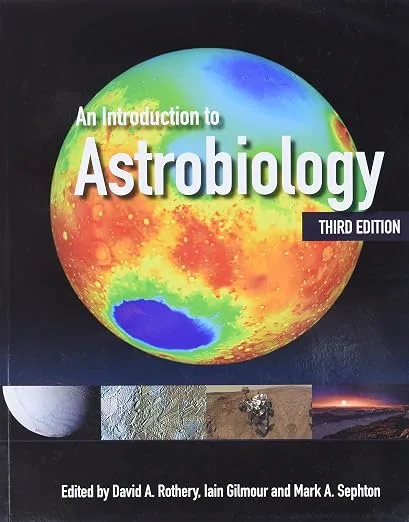
Best for self-study
16. An Introduction to Astrobiology
This textbook comes from the Open University, the UK’s distance-learning university, so it was written for students studying alone. David Rothery, Iain Gilmour and Mark Sephton edit chapters on the origin of the elements and organic molecules, the early Earth, the origin of life, Mars, the icy moons and exoplanets. Questions with full answers run through every chapter.
Gilmour and Sephton are organic geochemists who study meteorites, so the chemistry is solid. Buy the 2018 third edition.
- David A. Rothery, Iain Gilmour and Mark A. Sephton (editors)
- Cambridge University Press, 3rd edition paperback (2018), 398 pages
- High school science; built-in questions and answers
Good: designed for self-study, with checks on every page. Not great: the UK course format feels dry to some readers.
Check on Amazon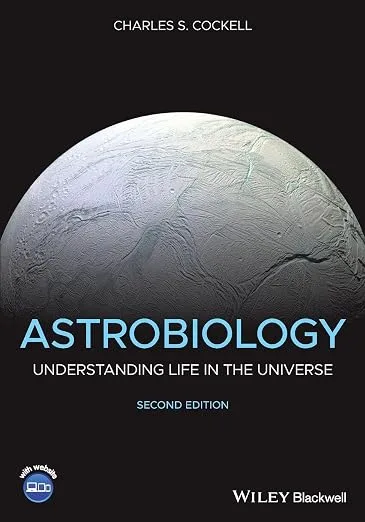
Most complete astrobiology textbook
17. Astrobiology: Understanding Life in the Universe
Charles Cockell is a professor of astrobiology at the University of Edinburgh, and this is the most comprehensive textbook in the field: 632 pages covering the physics and chemistry of life, the origin of life, extremophiles, the evolution of Earth, the planets and moons of the solar system, exoplanets and the search for intelligence. Cockell’s books came up in four Reddit astrobiology threads, the most of any author.
The chemistry is good but spread across a much larger subject. Buy the second edition from 2020.
- Charles S. Cockell
- Wiley-Blackwell, 2nd edition paperback (2020), 632 pages
- Undergraduate science; the whole field of astrobiology
Good: the broadest and most up to date astrobiology text. Not great: long and expensive if chemistry is all you want.
Check on AmazonGraduate books and references
These are the books astrochemistry PhD students and researchers keep on their desks. They assume physical chemistry, quantum mechanics and undergraduate astrophysics.
Graduate standard
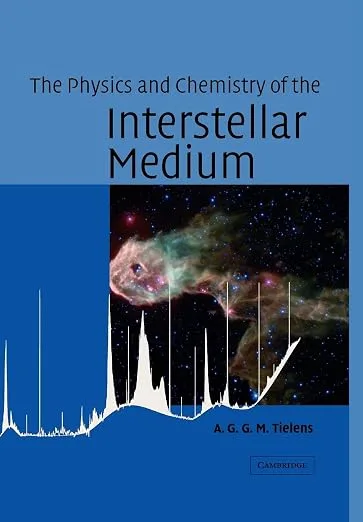
18. The Physics and Chemistry of the Interstellar Medium
Xander Tielens, of Leiden University and formerly NASA Ames, wrote the book most astrochemistry graduate courses use. It covers interstellar dust, polycyclic aromatic hydrocarbons, photodissociation regions where starlight breaks molecules apart, molecular clouds, gas-phase and grain-surface chemistry, shocks and the chemistry of star formation, with the physics derived in full.
A Reddit commenter who studied astrochemistry in graduate school wrote that it “goes through both the math and chemistry” and worked best paired with an astronomy book. It is from 2005, so for recent results read it alongside Tielens’ own Molecular Astrophysics.
- A. G. G. M. Tielens
- Cambridge University Press, paperback (2006), 510 pages
- Graduate level; full treatment of interstellar physics and chemistry
Good: the reference the field is built on. Not great: 20 years old, and hard going without a physical chemistry background.
Check on Amazon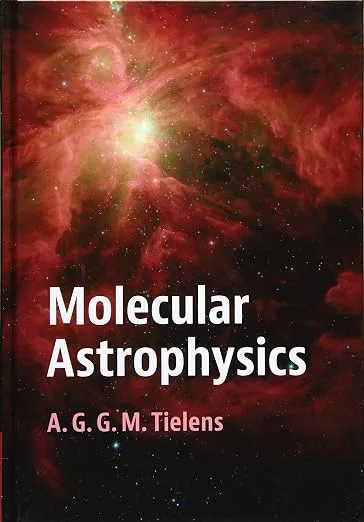
Best modern graduate text
19. Molecular Astrophysics
Tielens’ 2021 book is a newer, molecule-centered companion to his first. It covers the spectroscopy and chemistry of interstellar molecules, large aromatic molecules and fullerenes, interstellar ices, the chemistry of planet-forming disks and what ALMA and space infrared telescopes have shown since 2005.
If you are starting a PhD in astrochemistry today, this is the book to read first, with the 2005 book for the background physics.
- A. G. G. M. Tielens
- Cambridge University Press, hardcover (2021), 664 pages
- Graduate level; molecules, PAHs, ices, disks
Good: the most current graduate treatment, by the field’s leading textbook author. Not great: long, expensive and hardcover only.
Check on Amazon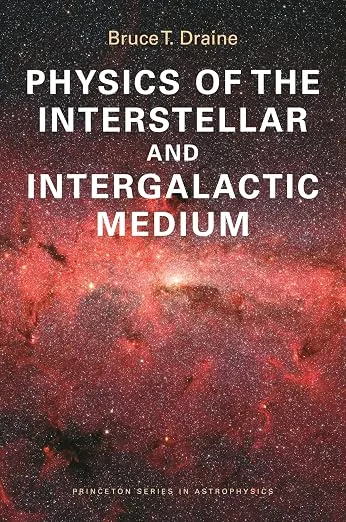
Best for the physics
20. Physics of the Interstellar and Intergalactic Medium
Bruce Draine of Princeton wrote the standard graduate text on the physics of interstellar gas and dust: radiative transfer, atomic and molecular excitation, heating and cooling, ionization, dust grains and their optics, shocks and star formation. Chemistry gets its own chapters, including the formation of molecular hydrogen on grains.
Draine is the book physicists in the field cite most. Chemists usually find Tielens friendlier and come to Draine for specific derivations.
- Bruce T. Draine
- Princeton University Press, paperback (2011), 576 pages
- Graduate physics; complete physical treatment
Good: rigorous, complete and still current on the physics. Not great: chemistry is a minor part.
Check on Amazon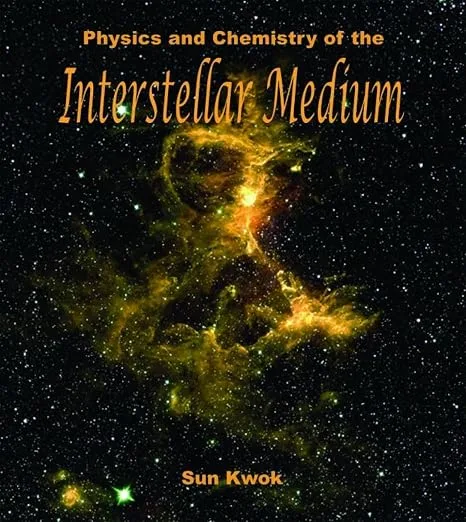
Alternative graduate text
21. Physics and Chemistry of the Interstellar Medium
Sun Kwok’s graduate textbook covers the same ground as Tielens with more emphasis on observations: spectroscopy across radio, infrared and optical bands, interstellar molecules, dust, circumstellar envelopes around old stars and star formation. Kwok’s specialty in dying stars shows in the strong chapters on circumstellar chemistry.
It is a good second graduate text, or a first one if your interest is the chemistry around evolved stars.
- Sun Kwok
- University Science Books, hardcover (2007), 584 pages
- Graduate level; observation-led
Good: strong on observations and circumstellar chemistry. Not great: less widely used than Tielens, so fewer course notes pair with it.
Check on Amazon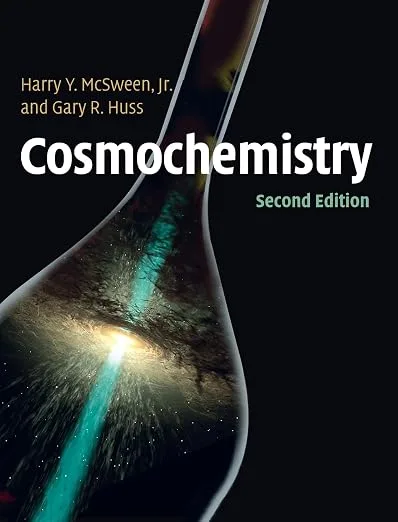
Best on meteorites and isotopes
22. Cosmochemistry
Cosmochemistry is the sister field that studies the chemistry of the solar system through meteorites, returned samples and isotopes. Harry McSween of the University of Tennessee and Gary Huss of the University of Hawaii cover nucleosynthesis, presolar grains, the formation and dating of the first solids, chondrites, the chemistry of planets and sample-return results.
It is the standard text for this side of the subject. The 2022 second edition adds newer mission results and is the one to buy.
- Harry McSween Jr. and Gary Huss
- Cambridge University Press, 2nd edition hardcover (2022), 452 pages
- Upper undergraduate to graduate; meteorites, isotopes, solar system
Good: the authoritative cosmochemistry text, recently updated. Not great: little on interstellar molecules.
Check on AmazonTwo more references for researchers. The Handbook of Astrochemistry, edited by Wendy Brown, Martin McCoustra and Serena Viti, is an 872-page reference from Elsevier listed for release on November 29, 2026. For the origin of the elements in depth, Bernard Pagel’s Nucleosynthesis and Chemical Evolution of Galaxies (1997) remains the classic graduate treatment. Read about the isotopes that cosmochemists use as clocks if the vocabulary is new.
Astrochemistry books for kids and teens
Children can grasp the central idea of astrochemistry, that the atoms in their bodies were made in stars, years before they can follow any of the chemistry. These books teach it well.
Best for young children
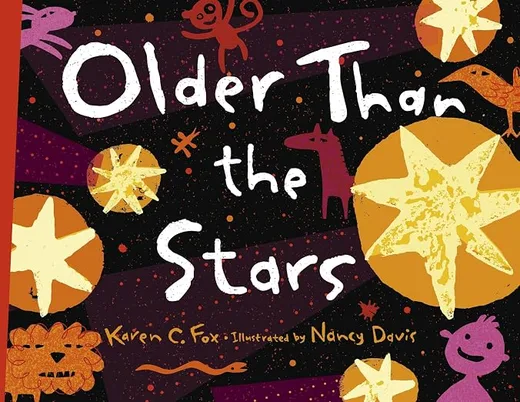
23. Older Than the Stars
Karen Fox, a NASA science writer, tells the story from the Big Bang to a child’s own body in the cumulative style of “The House That Jack Built”: the particles that made the atoms that made the stars that made the elements that made you. Each spread has a short rhyming line for small children and a paragraph of real science for older ones or the adult reading aloud.
- Karen C. Fox, illustrated by Nancy Davis
- Charlesbridge, paperback (2011), 32 pages
- Ages 4 to 8
Good: works on two levels, accurate and over 370 Amazon ratings at 4.8 stars. Not great: the collage illustrations are simple.
Check on Amazon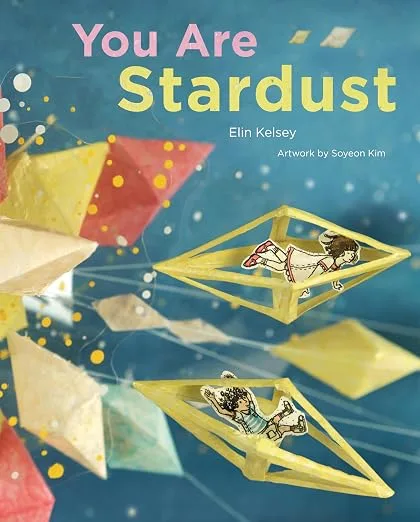
Best picture book
24. You Are Stardust
Elin Kelsey connects children to the natural world through facts: every atom in your body came from a star, the water you drink was once drunk by dinosaurs, your body has as many electrical sparks as a thunderstorm. Soyeon Kim’s illustrations are photographed dioramas, and they are the reason this book has over 500 ratings at 4.8 stars.
- Elin Kelsey, illustrated by Soyeon Kim
- Owlkids, hardcover (2012), 32 pages
- Ages 3 to 8
Good: beautiful, gentle and scientifically sound. Not great: stardust is one page, the rest is wider nature.
Check on Amazon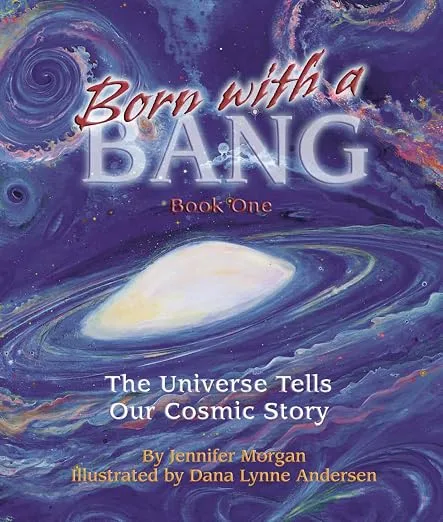
Best for ages 7 to 11
25. Born With a Bang: The Universe Tells Our Cosmic Story
The universe narrates its own life story in letters to a child, from the Big Bang through the first stars, the supernovae that made heavier elements and the formation of the Sun and Earth. It is the first of Jennifer Morgan’s three-book series, which continues through the origin of life and human evolution. A timeline and notes at the back give parents the details.
- Jennifer Morgan, illustrated by Dana Lynne Andersen
- Dawn Publications, paperback, 48 pages (first published 2002)
- Ages 7 to 11
Good: fuller science than most picture books, told as a story. Not great: the spiritual tone of the narration does not suit every family.
Check on Amazon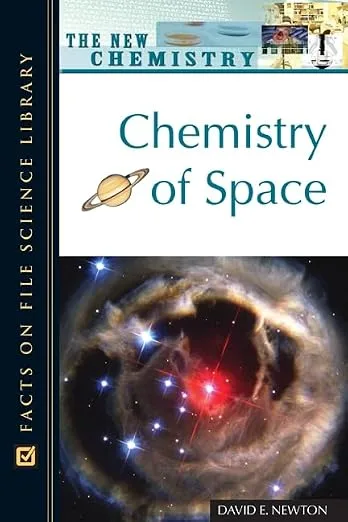
Best for teens
26. Chemistry of Space
David Newton wrote this for high school students as part of Facts on File’s New Chemistry series. It covers how elements form, the chemistry of stars, the interstellar medium, the planets and moons, comets and meteorites and the search for life, with diagrams and short profiles of the scientists involved. It is one of very few astrochemistry books written for teenagers.
- David E. Newton
- Facts on File, hardcover (2007), 246 pages
- Grades 7 to 12
Good: pitched right for a school project or a curious teenager. Not great: dated, and priced as a library book.
Check on AmazonFor teenagers who like the element side, our interactive periodic table shows where each element was made, and the list of neutron stars explains the objects whose collisions forge gold and platinum.
What Reddit recommends
I read 20 Reddit threads where people asked for astrochemistry or astrobiology books or how to enter the field, in r/chemistry, r/Astrobiology, r/astrophysics, r/Astronomy and r/astrosciences, from 2015 to 2024. Astrochemistry threads are few, because the field is small. These are the patterns.
- The same four textbooks come up. Shaw’s Astrochemistry and the Smith, Cockell and Leach collection appear in book lists in two r/chemistry threads each, alongside Rehder’s Chemistry in Space and Tielens. A commenter who studied astrochemistry in graduate school recommended Tielens and said it “gave a pretty good review of the topic.”
- Learn spectroscopy. Every thread about entering the field comes back to it: “You would need to get familiar with spectroscopy since by looking for certain absorption or emission lines is how we can ID what molecules or molecular ions are up there.” One self-described gas-phase spectroscopist wrote that astrochemistry “is a subset of physical chemistry/chemical physics,” using the same techniques as atmospheric and combustion chemistry.
- Use the Cologne database. Two separate threads point beginners to the CDMS list of molecules in space, with papers for each detection, as the best free starting point.
- A PhD is required. In a 2023 thread from a chemistry graduate asking how to get in, the top answer (30 upvotes, from an astrochemistry grad student) said to apply to PhD programs with astrochemistry groups, and others agreed: “You will never work in astrochemistry with a bachelors.” Astrochemists work in chemistry, physics and astronomy departments, split between lab spectroscopy, telescope observations and theory.
- For astrobiology, Catling and Cockell lead. Catling’s Very Short Introduction came up in three threads and Cockell’s books in four. Plaxco and Gross, Rothery and Gilmour, Peter Ward’s books and David Darling’s Life Everywhere also appear.
The background you need
Popular books need nothing. For the textbooks, the requirements depend on the book, but the core is the same:
- General chemistry, to the level of bonding, reaction rates and equilibrium. Our guide to the best chemistry books for self-study covers the books for this.
- Physical chemistry, especially spectroscopy, kinetics and a little statistical mechanics. This is the subject astrochemistry is built on; the physical chemistry topics explainer lists what each part covers.
- Introductory astronomy: stellar evolution, the interstellar medium, how telescopes work. See the branches of astrophysics and the instruments used in astronomy.
- Math: calculus and differential equations for kinetics and radiative transfer, and enough linear algebra for quantum mechanics. For the quantum side, start with our list of quantum physics books for beginners.
Free astrochemistry resources
- CDMS Molecules in Space: the running list of every molecule detected in space, with the discovery paper for each. Reddit’s top recommendation.
- The Astrochymist: David Woon’s site, with a timeline of molecule discoveries and a long list of astrochemistry texts.
- Brett McGuire’s 2021 census of interstellar molecules: a free review paper that explains how each class of molecule was found, with charts of detections by year and telescope.
- The UMIST Database for Astrochemistry and KIDA: the reaction networks astrochemists use to model clouds, free to browse.
- The Astrobiology Primer 3.0 (2024): a free textbook-length review written by early-career scientists for students entering astrobiology.
- ALMA Observatory: press releases on new molecule detections, with plain-language explanations.
Build a CD spectroscope
Every molecule in the books above was found by splitting light into its colors and looking for lines. You can see the same thing at home in ten minutes with an old CD, the way I did with my nephew Arjun on a winter evening.
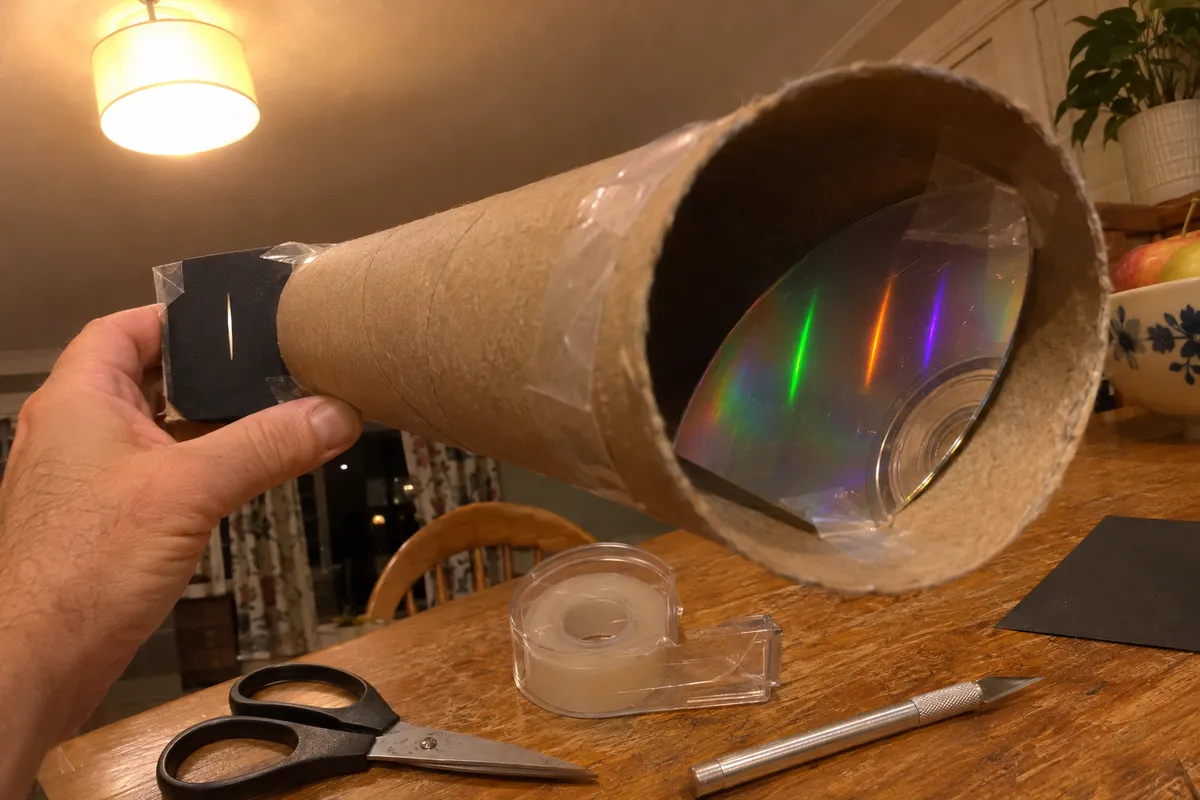
- Cut a narrow slit, about a millimeter wide, in a piece of black card and tape it over one end of a paper towel tube.
- At the other end, cut a slot at about 45 degrees and slide in a piece of CD, shiny side facing the slit, or tape a whole CD across the end at an angle.
- Cut a small viewing hole in the side of the tube above the CD.
- Point the slit at a light and look at the CD through the hole. Never point it at the Sun.
An old incandescent bulb gives a smooth rainbow. A compact fluorescent bulb gives separate bright lines, green and violet from mercury and orange-red from the phosphor coating. A white LED gives a smooth band with a blue peak. Those lines are the visible-light version of what ALMA records at radio wavelengths: each one belongs to a specific atom or molecule, at a frequency that never changes.
If the CD spectroscope gets you hooked, amateur astronomers record real stellar spectra with a small diffraction grating on a telescope, and Ken Harrison’s book shows how.
Best hands-on spectroscopy book
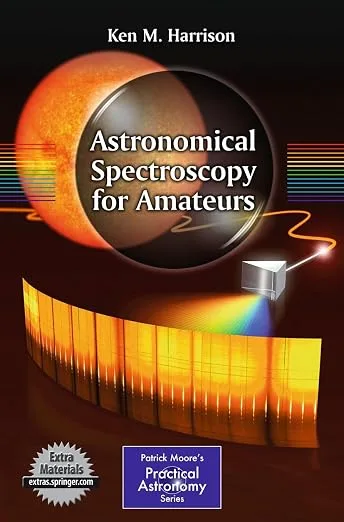
27. Astronomical Spectroscopy for Amateurs
Ken Harrison explains how spectroscopes work, how to choose or build one for a backyard telescope, how to record and calibrate spectra with a camera and how to identify the lines in stars, planetary nebulae and comets. It is part of Springer’s Patrick Moore Practical Astronomy series and assumes you already know your way around a telescope.
- Ken M. Harrison
- Springer, paperback (2011), 256 pages
- Practical; telescope and camera needed
Good: the most complete guide to doing spectroscopy yourself. Not great: some equipment advice has aged.
Check on AmazonA reading order
If you are curious and have no science background:
- The Stardust Revolution, for the story and the people.
- Atom, for how stars make the elements.
- Astrobiology: A Very Short Introduction, for what this means for life.
- Kwok’s Stardust, for a taste of real research.
If you have studied chemistry:
- Rehder’s Chemistry in Space, to learn the astronomy in chemical terms.
- Tennyson’s Astronomical Spectroscopy, for how molecules are detected.
- Yamamoto’s Introduction to Astrochemistry, for the full picture.
- Tielens’ Molecular Astrophysics, if you are heading to graduate school.
If you have studied physics or astronomy:
- Williams’ Introduction to the Interstellar Medium, for the environment.
- Yamamoto, for the chemistry.
- Tielens’ Physics and Chemistry of the Interstellar Medium, with Draine for derivations.
For more reading lists across the sciences, see our best science books for non-scientists and the full set of science buying guides.
FAQ
For a textbook, Satoshi Yamamoto’s Introduction to Astrochemistry is the best single book: modern, focused on astrochemistry itself and written for advanced undergraduates and new graduate students. For a no-math introduction, read Jacob Berkowitz’s The Stardust Revolution. For graduate study, the standard is Tielens’ The Physics and Chemistry of the Interstellar Medium.
Yes. The Stardust Revolution by Jacob Berkowitz and Atom by Lawrence Krauss need no math or chemistry. Sun Kwok’s Stardust: The Cosmic Seeds of Life is a step up and is written by a working astrochemist. The first true textbook a beginner can manage is Andrew Shaw’s Astrochemistry, written for first-year undergraduates.
Astrochemistry is the study of atoms and molecules in space: how they form, survive and react in interstellar clouds, around stars, in planet-forming disks, on comets and asteroids and in planetary atmospheres. Astrochemists identify molecules from their spectra using radio and infrared telescopes, measure those spectra in laboratories and build computer models of the chemistry.
About 350. The Cologne Database for Molecular Spectroscopy listed 346 molecules detected in interstellar or circumstellar space as of April 2026, and 74 in other galaxies. The count grows by more than a dozen a year, largely from radio telescopes such as ALMA and the Green Bank Telescope.
Astrochemistry studies molecules in space, mainly in interstellar clouds and around stars, using telescopes. Cosmochemistry studies the chemical and isotopic makeup of solar system material, mainly meteorites and returned samples, in laboratories. Astrobiology asks whether life exists beyond Earth and how it began, drawing on both.
General chemistry, physical chemistry (especially spectroscopy and kinetics) and an introductory astronomy course, plus calculus. Chemists usually need to add astronomy, and physicists usually need to add chemical kinetics and molecular spectroscopy. Tennyson’s Astronomical Spectroscopy is the best bridge for both.
Yes. The CDMS Molecules in Space list, The Astrochymist website, Brett McGuire’s free 2021 census of interstellar molecules on arXiv and the Astrobiology Primer 3.0 are all free. University libraries usually hold the Springer and Cambridge textbooks as e-books.
Yes, for research. Astrochemists work in university chemistry, physics and astronomy departments and at observatories and space agencies, and nearly all of those positions require a PhD. The usual route is a chemistry or physics degree followed by a PhD in a group that does lab spectroscopy, telescope observations or chemical modeling.
The principles in books from the 2000s still hold, but the observations have moved on. ALMA, which began full operations in 2013, and the James Webb Space Telescope, launched in 2021, have found many new molecules and measured the chemistry of planet-forming disks directly. Pair an older text such as Shaw or Tielens (2005) with a newer one such as Tielens’ Molecular Astrophysics (2021).
For ages 4 to 8, Older Than the Stars by Karen Fox explains how a child’s atoms were made in stars. You Are Stardust by Elin Kelsey suits ages 3 to 8, Born With a Bang by Jennifer Morgan ages 7 to 11 and Chemistry of Space by David Newton teenagers.
Sources
- Amazon product pages for each book, checked November 2026 (editions, page counts, publishers and ratings).
- Reddit threads in r/chemistry, r/Astrobiology, r/astrophysics, r/Astronomy and r/astrosciences asking for astrochemistry and astrobiology books, 2015 to 2024, summarized in the What Reddit recommends section.
- Cologne Database for Molecular Spectroscopy, Molecules in Space, University of Cologne, April 2026.
- Brett A. McGuire, 2021 Census of Interstellar, Circumstellar, Extragalactic, Protoplanetary Disk, and Exoplanetary Molecules, The Astrophysical Journal Supplement Series, 2022.
- NASA, NASA’s Asteroid Bennu Sample Reveals Mix of Life’s Ingredients, January 29, 2025.
- Olivier Berné and colleagues, Formation of the methyl cation by photochemistry in a protoplanetary disk, Nature, 2023.
- David E. Woon, The Astrochymist.
- Mix and colleagues, The Astrobiology Primer 3.0, Astrobiology, 2024.
- ALMA Observatory, almaobservatory.org.
- Elsevier, Introductory Astrochemistry (Makishima, 2024) catalog description; Cambridge University Press, Introduction to the Interstellar Medium (Williams, 2021) catalog description.