One compound goes in. Two or more substances come out. That’s the whole idea behind a decomposition reaction, and it’s the exact opposite of what happens when atoms combine to build something bigger.
The catch is that nothing breaks apart on its own. A stable molecule sits there perfectly happy until you give it a reason to fall apart, and that reason is almost always energy in one of three flavors: heat, electricity, or light. Get a handle on which energy source drives which reaction and the whole topic clicks into place.
This guide covers the general formula, the four types you’ll be tested on, a stack of balanced equations to work through, a side-by-side comparison table, and the everyday products that run on exactly these reactions. There’s also a short walkthrough on how to spot and balance one yourself.
Table of Contents
- The Short Version
- What Is a Decomposition Reaction?
- The Four Types of Decomposition Reactions
- Comparison Table: Type vs. Energy vs. Example
- Worked Examples: 10 Balanced Equations
- Decomposition vs. Synthesis Reactions
- How to Identify and Balance a Decomposition Reaction
- Decomposition Reactions in Everyday Life
- Frequently Asked Questions
The Short Version
A decomposition reaction breaks a single compound into two or more simpler substances. The general form is AB → A + B.
There are four types, sorted by the energy that drives them:
- Thermal — heat breaks the bond (thermolysis)
- Electrolytic — electric current breaks the bond (electrolysis)
- Photolytic — light breaks the bond (photolysis)
- Double decomposition — two compounds swap partners (a metathesis reaction)
Most decomposition reactions are endothermic, meaning they need a constant supply of energy to keep going. Stop the heat, the current, or the light, and the reaction stops too.
What Is a Decomposition Reaction?
A decomposition reaction is a chemical change where one reactant splits into two or more products. You start with a single compound and end up with simpler compounds, individual elements, or a mix of both.
The general formula is clean and worth memorizing:
AB → A + B
Here AB is the compound that falls apart, and A and B are the pieces left behind. Compare that to a combination (synthesis) reaction, which runs the other direction: A + B → AB. That mirror-image relationship is the single most useful thing to remember, and it’s the exact source of confusion that trips students up, something LibreTexts flags directly in its lesson on the topic.
Two features show up in almost every decomposition reaction:
- One reactant, multiple products. If you see two or more things on the left side of the arrow, it isn’t decomposition. One thing in, several things out.
- An energy input. Stable compounds don’t spontaneously self-destruct. You have to supply heat, electricity, or light to pull the atoms apart, which is why most of these reactions are endothermic.
The clearest classroom example is calcium carbonate, the main component of limestone. Heat it hard enough and it splits into calcium oxide (quicklime) and carbon dioxide gas:
CaCO₃ → CaO + CO₂↑
One compound, two products, driven by heat. That’s the template every other example follows.
The Four Types of Decomposition Reactions
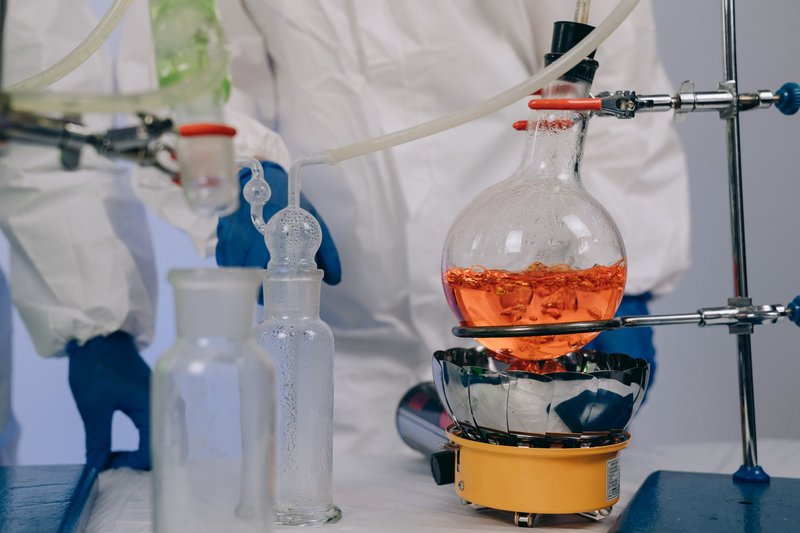
The types aren’t defined by what comes out. They’re defined by what energy goes in. Sort them that way and you’ll never mix them up.
1. Thermal Decomposition (Thermolysis)
Heat is the trigger. Raise the temperature high enough and the chemical bonds vibrate apart. This is by far the most common type you’ll meet, and it’s the one behind most industrial and kitchen chemistry.
The limestone reaction above is a textbook case. Another classic is the breakdown of potassium chlorate, the lab method for producing oxygen, usually sped up with a manganese dioxide catalyst:
2KClO₃ → 2KCl + 3O₂↑
And the one you’ve literally tasted: sodium bicarbonate (baking soda) decomposing when it hits oven heat, releasing the carbon dioxide that makes baked goods rise:
2NaHCO₃ → Na₂CO₃ + H₂O + CO₂↑
The energy source is heat. The tell is a Bunsen burner, a kiln, or an oven.
2. Electrolytic Decomposition (Electrolysis)
Here the energy is an electric current. Pass electricity through a compound, usually melted or dissolved in water, and it breaks into its elements. This is how we get pure metals and gases that are too reactive to find lying around in nature.
The most famous example is splitting water into hydrogen and oxygen:
2H₂O → 2H₂↑ + O₂↑
Run a current through molten sodium chloride and you peel it apart into pure sodium metal and chlorine gas:
2NaCl → 2Na + Cl₂↑
Industry leans hard on this. The U.S. Department of Energy notes that electrolysis is a primary route to producing clean hydrogen, the same reaction you’d run in a school lab, just scaled up enormously. The energy source is electricity. The tell is electrodes and a power supply.
3. Photolytic Decomposition (Photolysis)
Light does the work. Photons carry energy, and certain compounds absorb enough of it to break apart, no heat or current required.
Silver chloride is the schoolbook example. Sunlight breaks it down into silver metal and chlorine gas, which is exactly the chemistry that made old photographic film work:
2AgCl → 2Ag + Cl₂↑
Silver bromide behaves the same way, which is why darkrooms used red safelights, the bromide absorbs blue light and decomposes, but is far less sensitive to red.
The most consequential photolytic reaction on Earth happens overhead. In the stratosphere, ultraviolet light splits ozone, part of the constant cycle that filters UV radiation before it reaches the ground:
O₃ → O₂ + O
The energy source is light, often ultraviolet. The tell is a reaction that runs in sunlight and stalls in the dark.
4. Double Decomposition (Metathesis)
This one’s the odd member of the family. Instead of a single compound breaking apart, two compounds in solution swap their ion partners. Strictly speaking it’s a double-displacement reaction, but it earns the “decomposition” label because each original compound comes apart and recombines into something new.
Mix solutions of barium chloride and sodium sulfate, and you get a white precipitate of barium sulfate:
BaCl₂ + Na₂SO₄ → BaSO₄↓ + 2NaCl
The partners switch: barium pairs with sulfate, sodium pairs with chloride. The driving force here isn’t external energy but the formation of a stable product, usually an insoluble precipitate, a gas, or water.
Comparison Table: Type vs. Energy vs. Example
| Type | Energy Input | What Triggers It | Example Equation |
|---|---|---|---|
| Thermal | Heat | Burner, kiln, oven | 2NaHCO₃ → Na₂CO₃ + H₂O + CO₂ |
| Electrolytic | Electricity | Current through molten/dissolved compound | 2H₂O → 2H₂ + O₂ |
| Photolytic | Light | Sunlight or UV exposure | 2AgCl → 2Ag + Cl₂ |
| Double | None external | Formation of precipitate, gas, or water | BaCl₂ + Na₂SO₄ → BaSO₄ + 2NaCl |
Read the table by the second column. Identify the energy source and the type names itself.
Worked Examples: 10 Balanced Equations
Work through these until the pattern feels automatic. Each one is balanced, with the type noted.
- 2H₂O → 2H₂ + O₂ (electrolytic) — water into hydrogen and oxygen
- CaCO₃ → CaO + CO₂ (thermal) — limestone into quicklime and carbon dioxide
- 2KClO₃ → 2KCl + 3O₂ (thermal) — potassium chlorate, the classic oxygen prep
- 2NaHCO₃ → Na₂CO₃ + H₂O + CO₂ (thermal) — baking soda in the oven
- 2H₂O₂ → 2H₂O + O₂ (thermal/catalytic) — hydrogen peroxide into water and oxygen
- 2AgCl → 2Ag + Cl₂ (photolytic) — silver chloride in sunlight
- 2NaCl → 2Na + Cl₂ (electrolytic) — molten salt into sodium and chlorine
- NH₄NO₃ → N₂O + 2H₂O (thermal) — ammonium nitrate into nitrous oxide and water
- 2HgO → 2Hg + O₂ (thermal) — mercuric oxide into mercury and oxygen, Priestley’s historic experiment
- 2Pb(NO₃)₂ → 2PbO + 4NO₂ + O₂ (thermal) — lead nitrate, which crackles audibly as it breaks down
A quick note on number 10: it produces three products and needs a coefficient of 2 on lead nitrate to balance the nitrogen and oxygen. If your first attempt leaves an odd oxygen count, that’s usually the equation to double-check.
Decomposition vs. Synthesis Reactions
These two are mirror images, and confusing them is the most common mistake on chemistry exams. Hold them side by side:
| Decomposition | Synthesis (Combination) | |
|---|---|---|
| General form | AB → A + B | A + B → AB |
| Reactants | One compound | Two or more substances |
| Products | Two or more substances | One compound |
| Energy | Usually absorbs energy (endothermic) | Usually releases energy (exothermic) |
| Example | 2H₂O → 2H₂ + O₂ | 2H₂ + O₂ → 2H₂O |
Notice the example row uses the same chemicals running in opposite directions. Water decomposing into hydrogen and oxygen is the reverse of hydrogen and oxygen combining into water.
The fastest gut check: count the reactants. One reactant pointing to several products is decomposition. Several reactants pointing to one product is synthesis. That single rule resolves the confusion almost every time.
How to Identify and Balance a Decomposition Reaction
Step 1: Confirm it’s actually decomposition
Look at the left side of the arrow. One compound? It’s a decomposition candidate. Two or more reactants and you’re looking at synthesis, displacement, or something else (double decomposition is the exception, with two reactants swapping partners).
Step 2: Predict the products
Break the compound into simpler pieces. Binary compounds (two elements) tend to split into their elements: 2HgO → 2Hg + O₂. Compounds with polyatomic ions, like carbonates and chlorates, often release a gas, carbonates give off CO₂, chlorates give off O₂.
Step 3: Balance the atoms
Count each element on both sides and adjust coefficients, never subscripts, until they match. Work through potassium chlorate:
- Start: KClO₃ → KCl + O₂
- Oxygen is the problem: 3 on the left, 2 on the right. The lowest common multiple is 6.
- Put a 2 in front of KClO₃ (giving 6 O) and a 3 in front of O₂ (giving 6 O).
- Now rebalance K and Cl: 2 in front of KCl.
- Final: 2KClO₃ → 2KCl + 3O₂ ✓
Step 4: Check your work
Tally every element on both sides one last time. Left: 2 K, 2 Cl, 6 O. Right: 2 K, 2 Cl, 6 O. Balanced. If a count doesn’t match, the oxygen or hydrogen coefficient is almost always where the error hides.
Decomposition Reactions in Everyday Life
This is where the textbook chemistry stops feeling abstract. Like so many of the chemical reactions you run into every day, decomposition is constantly at work around you, usually without announcing itself.
Baking. Baking soda and baking powder work because sodium bicarbonate decomposes under heat, releasing carbon dioxide that puffs up dough and batter. No decomposition, no rise.
Car airbags. An airbag inflates in roughly 30 milliseconds because sodium azide decomposes explosively into nitrogen gas: 2NaN₃ → 2Na + 3N₂. The nitrogen fills the bag almost instantly. It’s a controlled decomposition reaction with your face on the line.
Glow sticks. Crack one and you trigger a reaction where hydrogen peroxide decomposes and drives a chemiluminescent process, releasing energy as light instead of heat. The same peroxide breakdown, 2H₂O₂ → 2H₂O + O₂, also explains why a bottle of hydrogen peroxide in your medicine cabinet slowly loses strength and why it foams on a cut: the enzyme catalase speeds up the decomposition.
Metal extraction. Smelting and refining lean on decomposition. Limestone decomposes to quicklime in steelmaking, and electrolysis decomposes molten compounds to extract reactive metals like aluminum and sodium that you can’t get any other way.
Antacids and digestion. Some antacids neutralize stomach acid through reactions that release carbon dioxide via carbonate decomposition, the fizz when the tablet hits water.
Photography (the old kind). Before digital, every photo depended on photolytic decomposition. Silver halides on the film broke down where light struck them, and the pattern of deposited silver became the image. The whole craft of the darkroom was managing one decomposition reaction.
The common thread: feed a stable compound enough of the right energy, heat, electricity, or light, and it comes apart in a way you can put to work.
Frequently Asked Questions
Are decomposition reactions endothermic or exothermic? Most are endothermic, they absorb energy, which is why they need a constant supply of heat, current, or light to keep running. A few are exothermic and self-sustaining once triggered, like the sodium azide reaction in an airbag.
What’s the difference between thermal, electrolytic, and photolytic decomposition? Only the energy source. Thermal uses heat, electrolytic uses electric current, and photolytic uses light. The reaction type is named after whatever breaks the bonds.
Is rusting a decomposition reaction? No. Rusting is iron combining with oxygen to form iron oxide, that’s a combination (synthesis) reaction, not decomposition. The atoms are building up, not breaking apart.
What is the general formula for a decomposition reaction? AB → A + B. One compound splits into two or more simpler substances.
Why is digestion sometimes called a decomposition reaction? Because enzymes break large food molecules into smaller absorbable ones, large carbohydrates into simple sugars, for example. It follows the same one-into-many pattern, though biologists usually call it catabolism.