A rusting nail, a slice of bread turning to toast, the fizz when you drop an antacid tablet in water. Those are all chemical reactions, and they share one thing: the stuff you started with is gone, and something genuinely new has taken its place.
That’s the whole idea. A chemical reaction is any process where substances (the reactants) rearrange their atoms into different substances (the products). The atoms themselves don’t vanish or appear from nowhere — they just get shuffled into new combinations, breaking old chemical bonds and forming new ones.
This guide walks through how to tell a chemical change from a physical one, the main types of reactions you’ll actually run into, the telltale signs a reaction happened, and how to read and balance an equation without your eyes glazing over.
Table of Contents
- Chemical vs. Physical Change
- The Main Types of Chemical Reactions
- Signs a Chemical Reaction Happened
- How to Read a Chemical Equation
- How to Balance a Chemical Equation
- Where the Energy Goes: Exothermic vs. Endothermic
- Chemical Reactions in Everyday Life
Chemical vs. Physical Change
This is the distinction that trips people up, so let’s nail it down first.
A physical change alters how a substance looks or what state it’s in, but not what it actually is. Ice melting into water is still H₂O — same molecule, different arrangement. Tearing paper, dissolving sugar in tea, boiling water into steam: all physical. Reverse the conditions and you usually get the original back.
A chemical change produces a new substance with new properties. Burn that paper and you can’t un-burn it. The ash, smoke, and gas that come off are not paper anymore, and no amount of cooling brings the page back.
The test: did you make something new? If the molecules themselves changed, it’s chemical. If only the form changed, it’s physical.
| Physical change | Chemical change | |
|---|---|---|
| What changes | Form, state, appearance | The substance itself |
| New substance? | No | Yes |
| Usually reversible? | Often | Rarely |
| Example | Ice → water | Iron → rust |
One useful gut-check: the U.S. Geological Survey notes that water can exist as solid, liquid, or gas without ever stopping being water. State changes are the classic physical change. The deeper question of why substances behave this way — why ice melts at exactly 0°C, for instance — is the territory of physical chemistry, which studies the rules behind matter and energy.
The Main Types of Chemical Reactions
Almost every reaction you’ll meet in an intro chemistry class fits into one of these buckets. Here’s the cheat sheet, then a quick word on each.
| Type | General formula | Real example |
|---|---|---|
| Synthesis (combination) | A + B → AB | 2H₂ + O₂ → 2H₂O |
| Decomposition | AB → A + B | 2H₂O₂ → 2H₂O + O₂ |
| Combustion | fuel + O₂ → CO₂ + H₂O | CH₄ + 2O₂ → CO₂ + 2H₂O |
| Single replacement | A + BC → AC + B | Zn + 2HCl → ZnCl₂ + H₂ |
| Double replacement | AB + CD → AD + CB | AgNO₃ + NaCl → AgCl + NaNO₃ |
| Acid-base (neutralization) | acid + base → salt + water | HCl + NaOH → NaCl + H₂O |
Synthesis glues two or more things into one bigger thing. Hydrogen and oxygen combining into water is the textbook case.
Decomposition is the reverse — one compound splits apart. Hydrogen peroxide breaking down into water and oxygen is why that bottle in your medicine cabinet eventually goes flat.
Combustion is fuel meeting oxygen and releasing energy as heat and light. Burning natural gas (methane) on your stove is exactly this.
Single replacement is one element kicking another out of a compound. Drop zinc into hydrochloric acid and the zinc takes chlorine’s partner, freeing hydrogen gas — those are the bubbles.
Double replacement is two compounds swapping partners. Mix silver nitrate and table salt and you get a cloudy solid (silver chloride) that drops out of solution.
Acid-base reactions are a famous flavor of double replacement: an acid and a base cancel each other out into a salt and water. It’s why antacids settle a sour stomach. The acids involved aren’t always the harsh lab kind, either — many are gentle organic acids like citric and acetic acid that show up in food and the body.
A heads-up: these categories overlap. A combustion reaction is also a redox (electron-transfer) reaction, and neutralization is a kind of double replacement. The labels are tools for spotting patterns, not rigid boxes.
Signs a Chemical Reaction Happened
You can’t always see atoms rearranging, but you can usually see the evidence. Watch for any of these five:
- Color change — a clear liquid turning blue, a shiny apple slice browning.
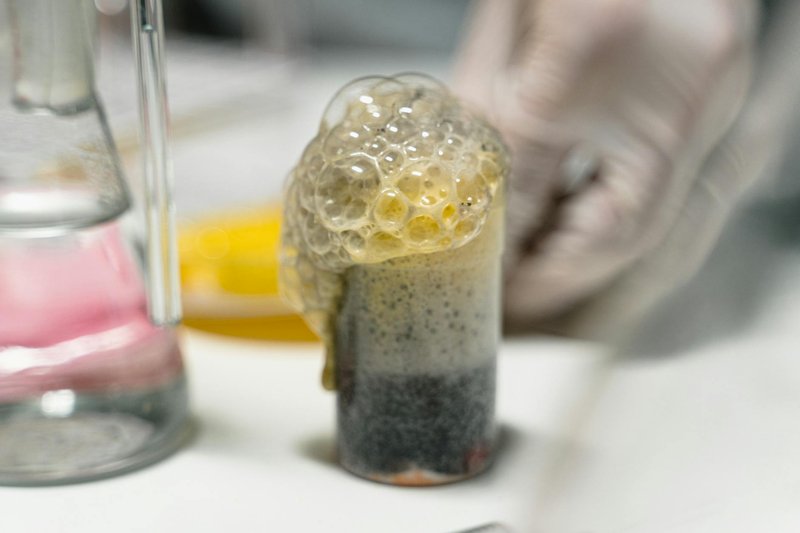
- Gas produced — bubbling or fizzing that isn’t just boiling, like vinegar hitting baking soda.
- Temperature change — the container getting noticeably warmer or colder on its own.
- A precipitate forms — a solid suddenly appearing out of two clear liquids and settling at the bottom.
- Light or odor — a glow, a flame, or a brand-new smell.
One sign on its own isn’t proof — boiling water makes bubbles without any chemical change. But two or more together, especially a color shift plus heat or a new solid, and you’re almost certainly looking at a reaction.
How to Read a Chemical Equation
A chemical equation is just a sentence written in chemistry shorthand. Take the formation of water:
2H₂ + O₂ → 2H₂O
Reading left to right:
- Reactants sit on the left of the arrow — what you start with.
- The arrow means “reacts to form” or “yields.”
- Products sit on the right — what you end up with.
- The big number in front (the coefficient) tells you how many of each molecule. The “2” in front of H₂ means two hydrogen molecules.
- The little number below (the subscript) tells you how many atoms are in a single molecule. The “2” in H₂ means each molecule has two hydrogen atoms.
So that equation reads: two molecules of hydrogen gas react with one molecule of oxygen gas to yield two molecules of water.
How to Balance a Chemical Equation
Here’s the rule that makes balancing necessary: atoms are never created or destroyed in a reaction. Whatever atoms go in must come out. This is the law of conservation of mass, and it means both sides of the equation need the same count of every element.
Take the burning of methane. Start with the unbalanced skeleton:
CH₄ + O₂ → CO₂ + H₂O
Count the atoms on each side:
- Left: 1 C, 4 H, 2 O
- Right: 1 C, 2 H, 3 O
Carbon’s already even. Hydrogen isn’t — 4 on the left, 2 on the right. Put a 2 in front of H₂O:
CH₄ + O₂ → CO₂ + 2H₂O
Now hydrogen balances (4 and 4), but oxygen is off: 2 on the left, 4 on the right (2 from CO₂, 2 from the two waters). Put a 2 in front of O₂:
CH₄ + 2O₂ → CO₂ + 2H₂O
Recount: left has 1 C, 4 H, 4 O. Right has 1 C, 4 H, 4 O. Balanced.
The practical workflow:
- Count atoms of each element on both sides.
- Adjust coefficients (the big front numbers) to even things out — never touch the subscripts, since changing those changes what the substance actually is.
- Save lone elements like O₂ and H₂ for last; balance compounds first.
- Recount everything to confirm.
Where the Energy Goes: Exothermic vs. Endothermic
Every reaction either releases energy or soaks it up.
Exothermic reactions give off energy, usually as heat. Combustion is the obvious one — a fire warms the room. So is the hand warmer in your ski jacket, and the heat your body generates digesting food.
Endothermic reactions absorb energy from their surroundings, which is why the container often feels cold. An instant cold pack works this way: snap it, and the reaction inside pulls heat out so fast the pack turns icy. Photosynthesis is endothermic too — plants store the sun’s energy in sugar.
Quick way to remember it: exothermic energy exits; endothermic energy enters.
Chemical Reactions in Everyday Life
Strip away the lab coat and reactions are running constantly all around you:
- Rusting — iron plus oxygen and water, slowly forming flaky iron oxide. A single replacement-style oxidation that eats cars and railings.
- Baking — heat triggers the Maillard reaction (browning) and makes baking soda release CO₂, the gas that makes bread rise.
- Digestion — enzymes break the food you eat into smaller molecules your body can absorb, one of the many ways biochemistry quietly runs the machinery of life.
- Photosynthesis — plants combine CO₂ and water using sunlight to build glucose and release the oxygen you’re breathing right now.
- Batteries — controlled redox reactions push electrons through a circuit to power your phone.
Once you start spotting the signs — the color shift, the fizz, the heat — you’ll notice them everywhere. That’s the real payoff of understanding reactions: the world stops being a set of static objects and starts looking like the constant, low-key chemistry experiment it actually is.