Short answer: molarity (M) is moles of solute divided by liters of solution. Convert the mass of solute to moles by dividing by its molar mass, convert the volume to liters, then divide. For example, 5.85 g of sodium chloride (58.44 g/mol) is 0.100 mol, and dissolved to make 250 mL of solution it gives 0.100 ÷ 0.250 = 0.400 M.
I have taught this calculation to first-year chemistry students for years, and almost every wrong answer comes from units, not from the formula. This guide covers the formula, the four situations you will meet (grams of solute, preparing a solution, diluting a stock and converting from percent or a titration) and the mistakes that give the wrong number.
At a glance
What you need
- Mass of solute in grams
- Molar mass of the solute in g/mol
- Volume of solution in liters
Steps
- Find the molar mass from the formula.
- Divide grams by molar mass to get moles.
- Convert mL to L (divide by 1,000).
- Divide moles by liters.
This guide contains Amazon affiliate links. 33Science earns a commission on qualifying purchases. See our affiliate disclosure.
The molarity formula
Molarity (M) = moles of solute (mol) ÷ volume of solution (L)
Molarity is the amount concentration of a solution: how many moles of a dissolved substance each liter of the finished solution holds. Its unit is mol/L, written M and read “molar”. A 1 M solution holds 1 mole of solute per liter, and 1 millimolar (mM) is 0.001 M.
The formula rearranges to find any of the three values:
| To find | Use | Example |
|---|---|---|
| Molarity | M = n ÷ V | 0.50 mol ÷ 2.0 L = 0.25 M |
| Moles | n = M × V | 0.25 M × 0.40 L = 0.10 mol |
| Volume | V = n ÷ M | 0.10 mol ÷ 0.25 M = 0.40 L |
Solution, not solvent
The volume is the volume of the solution, not of the water you added. Dissolving 58.44 g of NaCl in 1.000 L of water gives slightly more than 1 L of solution, so it is not exactly 1 M.
How to calculate molarity from grams
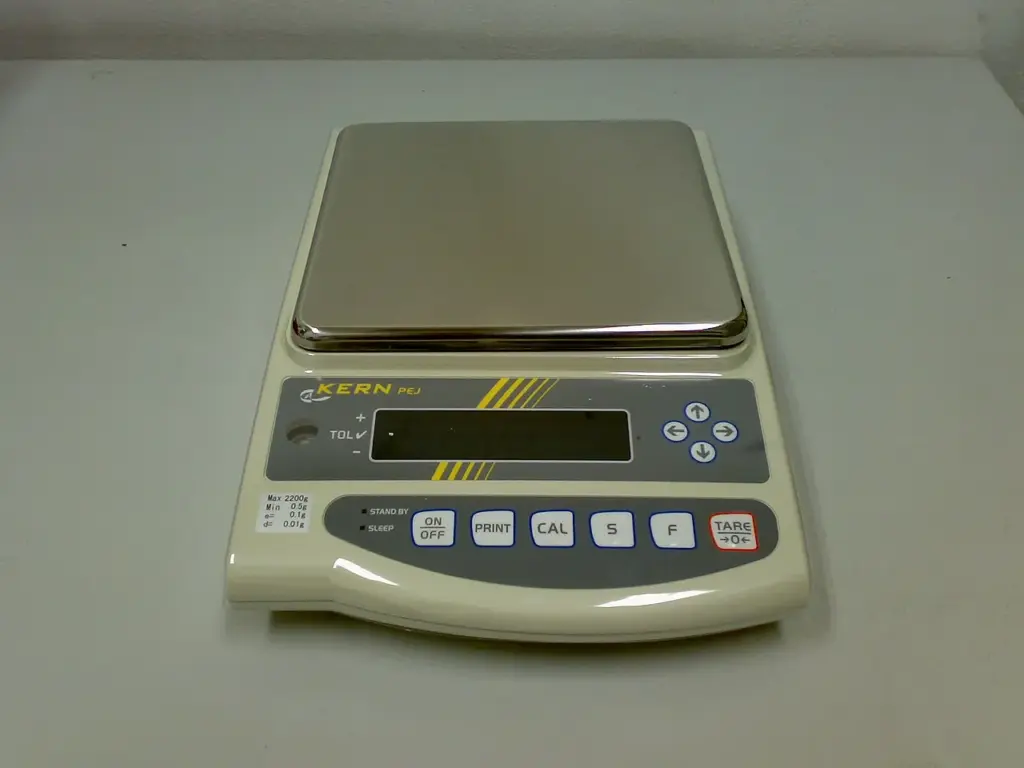
Example: 5.85 g of sodium chloride dissolved in water to make 250 mL of solution.
- Find the molar mass. NaCl = 22.99 + 35.45 = 58.44 g/mol. Our molar mass calculator works it out for any formula.
- Convert grams to moles. 5.85 g ÷ 58.44 g/mol = 0.1001 mol.
- Convert the volume to liters. 250 mL ÷ 1,000 = 0.250 L.
- Divide moles by liters. 0.1001 mol ÷ 0.250 L = 0.400 M.
In one line: M = mass ÷ (molar mass × volume in L) = 5.85 ÷ (58.44 × 0.250) = 0.400 M.
Molarity of the ions
Ionic compounds split into ions when they dissolve. A 0.10 M CaCl2 solution holds 0.10 M Ca2+ and 0.20 M Cl−, for 0.30 M of particles in total. That total is what matters for boiling point, freezing point and osmotic pressure.
How to make a solution of a given molarity
Mass of solute (g) = M × V (L) × molar mass (g/mol)
Example: 500 mL of 0.100 M copper(II) sulfate from the blue pentahydrate crystals, CuSO4·5H2O (249.68 g/mol): 0.100 × 0.500 × 249.68 = 12.48 g.
- Weigh the solute. Weigh 12.48 g on a balance that reads to 0.01 g or better.
- Dissolve it in less water. Dissolve the solid in about 300 mL of distilled water in a beaker.
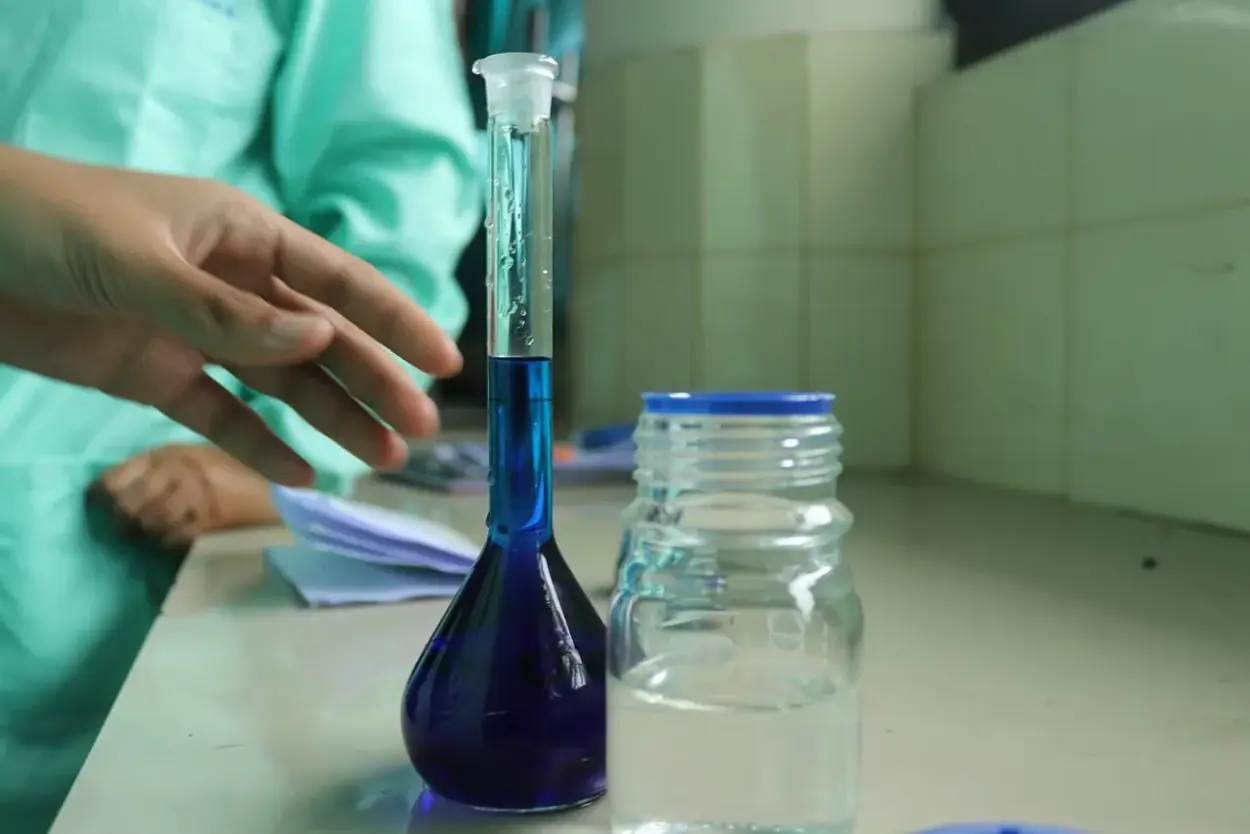
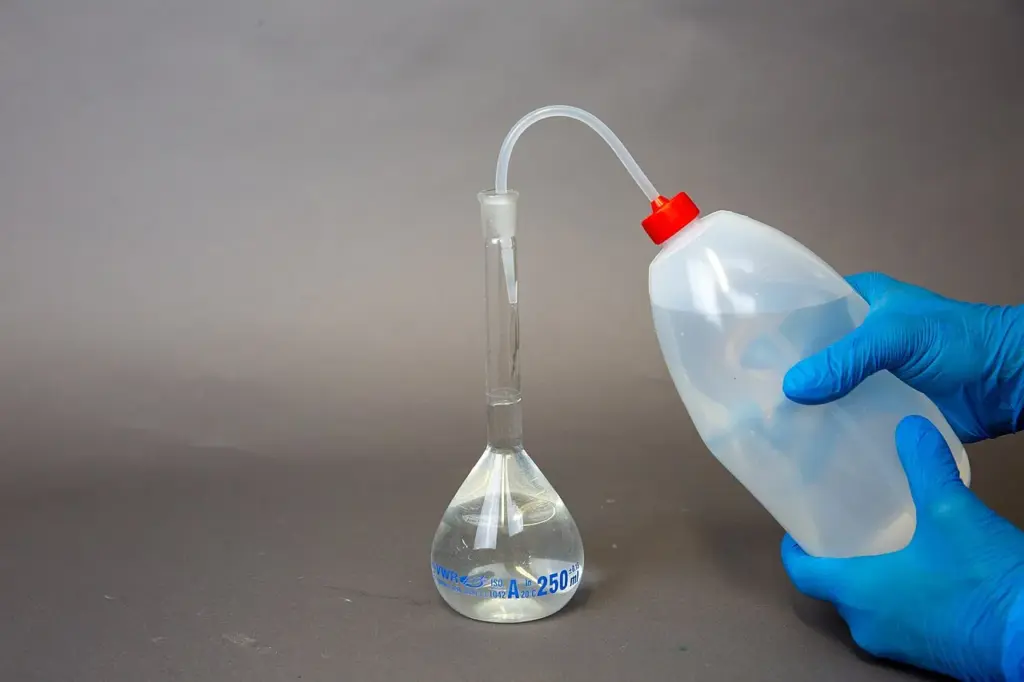
- Transfer it. Pour it into a 500 mL volumetric flask and rinse the beaker into the flask two or three times.
- Fill to the mark. Add water until the bottom of the meniscus sits on the line, cap the flask and invert it 10 to 15 times to mix.
Hydrates change the mass
Check whether your chemical is a hydrate. Anhydrous CuSO4 is 159.60 g/mol, so weighing 12.48 g of the anhydrous powder gives 0.156 M instead of 0.100 M.
Molarity after a dilution
M1V1 = M2V2
Adding water changes the volume but not the moles of solute, so the product of molarity and volume stays the same. M1 and V1 are the stock, M2 and V2 the diluted solution. Both volumes can be in mL as long as they match.
Example: 1.00 L of 1.00 M HCl from 12.0 M stock. V1 = (1.00 × 1,000 mL) ÷ 12.0 = 83.3 mL of stock, made up to 1.00 L with water.
Acid into water
Add concentrated acid to water, never water to acid. Dilution releases heat, and a small amount of water poured onto acid can boil and spatter.
Molarity from percent concentration and density
Concentrated reagents are sold by mass percent. Combine the percent with the density to get molarity:
M = (10 × mass % × density in g/mL) ÷ molar mass
Example: 37% hydrochloric acid with a density of 1.19 g/mL and a molar mass of 36.46 g/mol: (10 × 37 × 1.19) ÷ 36.46 = 12.1 M. The factor of 10 turns grams per mL and percent into grams of solute per liter.
Molarity from a titration
A titration measures how much of a solution of known molarity reacts with a sample. Moles of titrant (M × V) times the mole ratio from the balanced equation gives the moles in the sample.
Example: 25.00 mL of HCl is neutralized by 18.40 mL of 0.1000 M NaOH. HCl and NaOH react 1:1, so moles of HCl = 0.1000 × 0.01840 = 0.001840 mol, and the molarity is 0.001840 ÷ 0.02500 = 0.07360 M.
For sulfuric acid, H2SO4 + 2NaOH → Na2SO4 + 2H2O, so the moles of acid are half the moles of NaOH. Once you know an acid’s molarity, the molarity to pH calculator gives its pH.
Common mistakes
| Mistake | Effect | Fix |
|---|---|---|
| Using mL instead of L | Result 1,000 times too low | Divide mL by 1,000 |
| Using the volume of water added | Result slightly off | Use the final volume of solution |
| Ignoring water of hydration | Solution stronger than labeled | Use the molar mass of the hydrate |
| Using grams instead of moles | Wrong by the molar mass | Divide grams by molar mass first |
| Confusing molarity with molality | Small error in dilute water, large in other solvents | Molality is mol per kg of solvent |
Molarity shifts slightly with temperature because liquids expand when warmed: water expands about 0.1% from 20 to 25 °C. Molality uses mass, which does not change, so it is the unit of choice for boiling and freezing point calculations.
More practical science: browse all our everyday science how-tos, from household chemistry to experiments you can build at home.
Frequently asked questions
Molarity equals moles of solute divided by liters of solution, M = n / V. Its unit is mol/L, written M.
Divide the grams of solute by its molar mass to get moles, then divide by the volume of solution in liters. For 5.85 g of NaCl in 0.250 L, that is 5.85 / 58.44 / 0.250 = 0.400 M.
Convert mL to liters by dividing by 1,000 before you divide the moles by the volume. 0.050 mol in 200 mL is 0.050 / 0.200 = 0.25 M.
Use one molar mass in grams per liter of solution. For 1 L of 1 M NaCl, dissolve 58.44 g and add water up to 1 L of total volume.
Molarity is moles of solute per liter of solution. Molality is moles of solute per kilogram of solvent and does not change with temperature.
Use M1V1 = M2V2. Diluting 50 mL of 2.0 M solution to 200 mL gives 2.0 x 50 / 200 = 0.50 M.
Multiply 10 by the mass percent and the density in g/mL, then divide by the molar mass. 37% HCl at 1.19 g/mL is about 12.1 M.
A 0.1 M solution contains 0.1 mole of solute in every liter of solution, or 0.1 millimole in every milliliter.