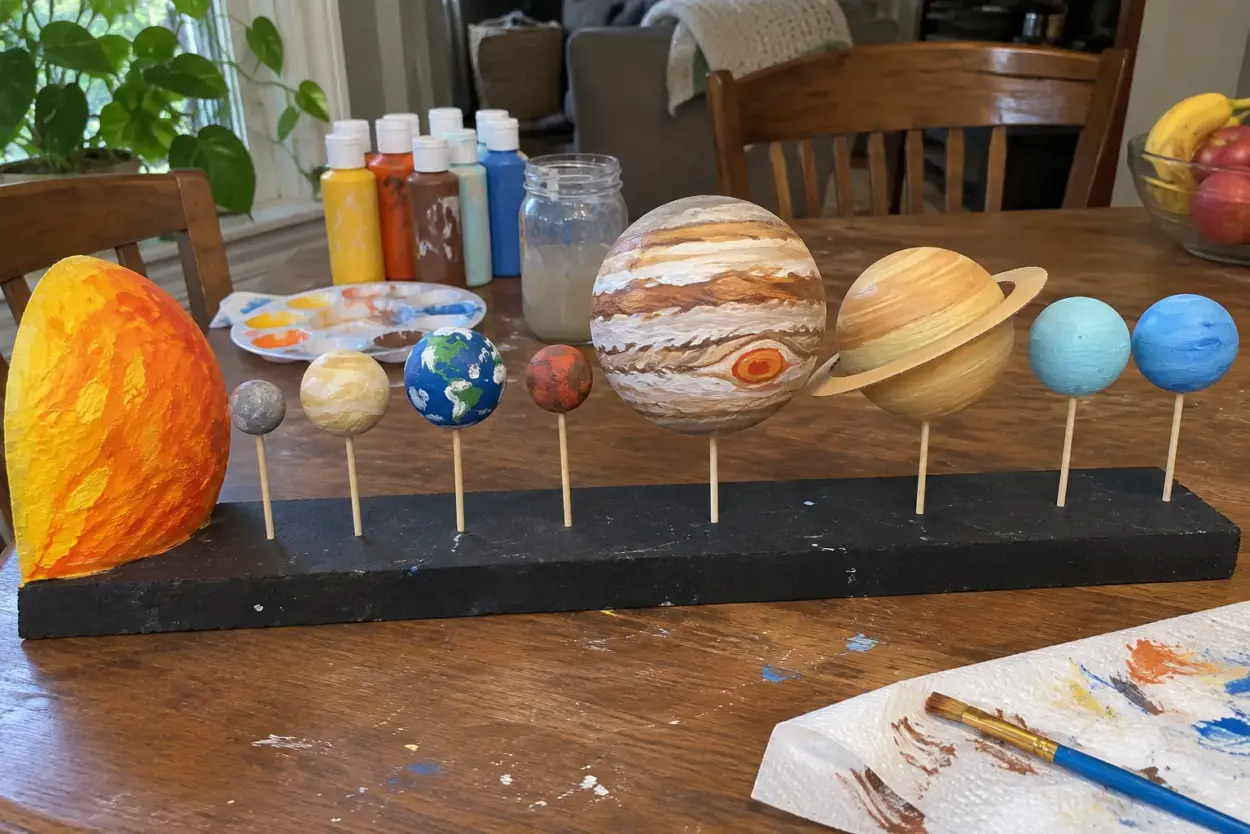
Short answer: paint craft foam balls with water-based acrylic paint, one ball per planet, sized so Jupiter is about 11 times wider than Earth. A 12 inch Jupiter gives a 10 inch Saturn, 4 inch Uranus and Neptune, 1 inch Earth and Venus, a half inch Mars and a pea-sized Mercury. Plan on 3 hours of work plus an overnight dry.
I have helped with a lot of planet projects, and the ones that get top marks share two things: the sizes are right relative to each other, and every color has a reason the student can explain. Jupiter is striped because of ammonia clouds. Mars is red because of rust. This guide gives you a size chart for any budget, the paint recipe for each planet, a template for Saturn’s rings, and the physics and chemistry behind each choice so the oral presentation writes itself.
At a glance
What you need
- 8 to 9 craft foam balls in graduated sizes
- 1 set acrylic craft paints
- 1 sheet card stock or a cereal box for Saturn’s rings
- Wooden skewers, a sponge and a few brushes
- Low-temperature glue gun or white glue
Steps
- Pick a scale and match each planet to a ball size.
- Push each ball onto a skewer and base-coat it.
- Add bands, spots, ice caps and craters.
- Cut Saturn’s ring 2.3 times wider than the planet.
- Dry overnight, then mount or hang the set.
The one rule for foam
Never use spray paint on craft foam. Its solvents dissolve polystyrene and the ball pits and shrinks in seconds. Water-based acrylic is safe.
This guide contains Amazon affiliate links. 33Science earns a commission on qualifying purchases. See our affiliate disclosure.
Planet size chart: what size ball for each planet
Most planet projects get one thing wrong: the balls are picked by what was in the craft bag, so Jupiter ends up three times wider than Earth instead of eleven. The real diameters from NASA set the ratios. Divide each planet by Earth and you get its size in “Earths”:
| Planet | Real diameter | Times Earth |
|---|---|---|
| Mercury | 4,879 km (3,032 mi) | 0.38 |
| Venus | 12,104 km (7,521 mi) | 0.95 |
| Earth | 12,756 km (7,926 mi) | 1.00 |
| Mars | 6,792 km (4,220 mi) | 0.53 |
| Jupiter | 142,984 km (88,846 mi) | 11.21 |
| Saturn | 120,536 km (74,898 mi) | 9.45 |
| Uranus | 51,118 km (31,763 mi) | 4.01 |
| Neptune | 49,528 km (30,775 mi) | 3.88 |
| Sun | 1,392,700 km (865,370 mi) | 109 |
Those ratios turn into two practical ball sets:
| Planet | True scale (12 in Jupiter) | Easy craft set |
|---|---|---|
| Mercury | 0.4 in (clay or bead) | ¾ in |
| Venus | 1 in | 1½ in |
| Earth | 1 in | 1½ in |
| Mars | 0.6 in (clay or bead) | 1 in |
| Jupiter | 12 in | 5 in |
| Saturn | 10 in | 4 in |
| Uranus | 4 in | 2½ in |
| Neptune | 4 in | 2½ in |
| Sun | 9 ft 9 in (an arc on the wall) | 8 in half ball |
The true scale column is exact to the nearest common ball size. It looks dramatic on a table and makes the point every teacher wants: the gas giants dwarf the rocky planets. The easy craft set uses the sizes sold in most assortment packs and fits on a poster board or in a shoebox. It keeps the order of sizes correct (Jupiter, Saturn, Uranus, Neptune, Earth, Venus, Mars, Mercury) but shrinks the gap between the giants and the rocky planets.
Why the distances never fit
At the true scale above, 1 inch stands for about 12,000 km. Earth would sit 1,046 feet from the Sun and Neptune more than 5 miles away. No school model can show sizes and distances at the same scale, which is worth one sentence in the presentation. Our guide to solar system models shows how to build a walking distance model instead.
Want to check a set you already bought? Measure each ball, divide by the Earth ball, and compare with the “Times Earth” column. Anything within 20 percent reads as correct to the eye.
Materials and tools
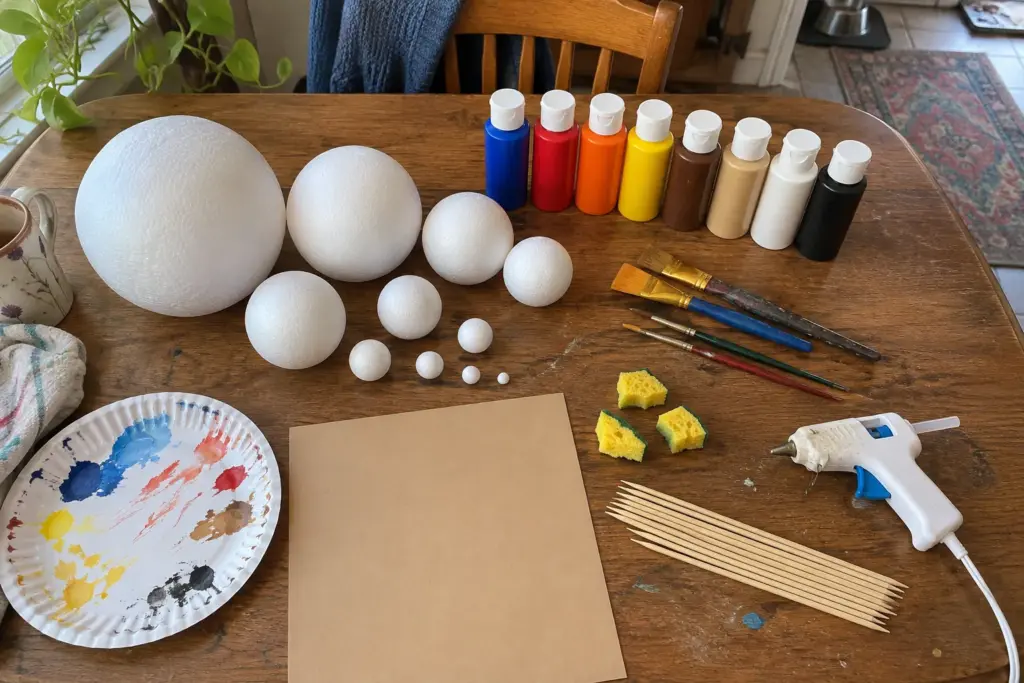
Craft foam balls
Expanded polystyrene, (C8H8)n
8 to 9 balls, 1 to 12 inLight, cheap and easy to paint. Smooth-surface foam takes paint better than the beaded kind, which shows little bumps through the color.
Acrylic craft paint
Water-based acrylic polymer emulsion
10 to 12 colorsNeeds white, black, blue, green, red, orange, yellow, brown, tan and gray. You mix the rest. Dries in 20 to 30 minutes and does not attack the foam.
Polymer or air-dry clay
PVC clay or clay with a binder
A walnut-sized pieceFor true-scale Mercury and Mars, which are smaller than most foam balls. Roll, texture with a toothpick, dry, then paint.
Card stock or thin cardboard
1 sheetFor Saturn’s rings. A cereal box works. An old CD makes a shiny ring for a 4 to 5 inch Saturn.
Tools
- Wooden skewers, one per planet, to hold each ball while you paint and as a mounting post later
- A block of foam or a cup of rice to stand the skewers in while they dry
- Two flat brushes, one fine detail brush and a kitchen sponge cut into small pieces
- A low-temperature glue gun or white school glue
- Fishing line and a large embroidery hoop if you plan a hanging mobile
- A protractor, a compass (or a cup to trace) and scissors
How to make foam ball planets
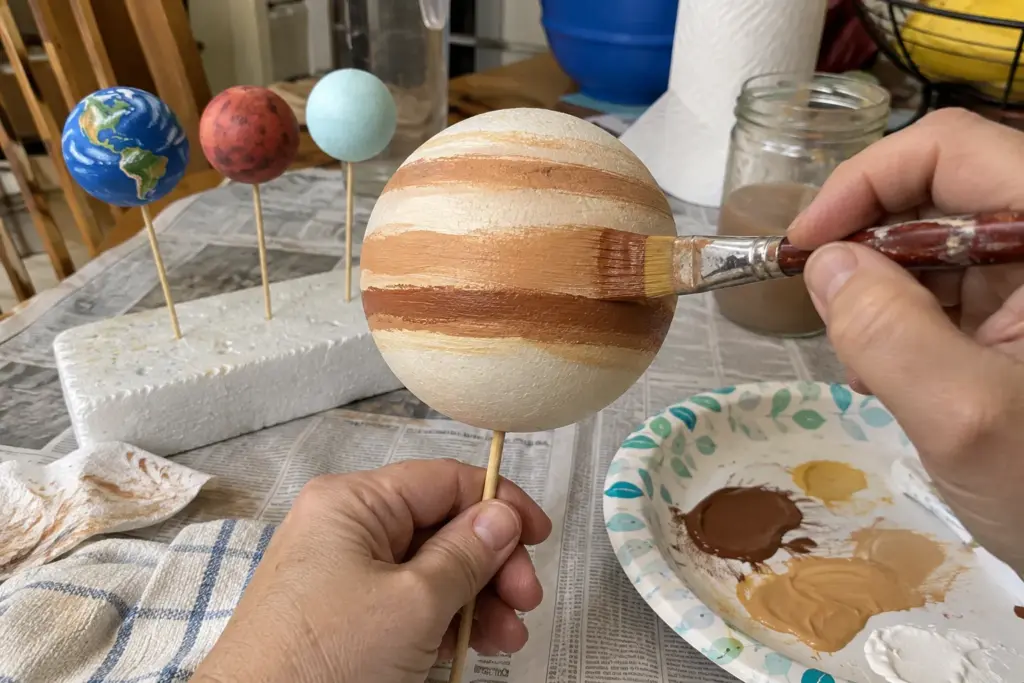
- Sort the balls by planet. Lay them out in order from the Sun and check them against the size chart. Mark the bottom of each one with a pencil letter so they do not get mixed up after painting.
- Skewer each ball. Push a skewer about halfway into the ball. For Uranus, angle it to match the planet’s tilt (see the tip below). The skewer becomes your handle now and the mounting post later.
- Seal the surface. Brush on a thin coat of white paint mixed with a few drops of white glue. It fills the foam pores so the color coat covers in one pass. Let it dry 30 minutes.
- Base-coat each planet. Paint the main color of each planet (see the next section). Work from light colors to dark. Stand each skewer in the foam block to dry.
- Add details. Bands, storms, polar caps, continents and craters go on once the base is dry to the touch. Dab with a damp sponge for clouds and texture; drag a dry brush for bands.
- Dry overnight and seal. Acrylic is touch-dry in half an hour but stays soft for hours. A coat of clear matte Mod Podge the next day protects the paint during transport to school.
Tilt the skewers
Planets spin on tilted axes, and a skewer shows it. Earth tilts 23.4°, Mars 25.2°, Saturn 26.7° and Uranus 97.8°, so Uranus spins on its side. Set the protractor against the skewer before you push it in. Most models skip this, and it is an easy thing to point out to the class.
How to paint each planet (and why it is that color)
Every color on a planet comes from something physical: a mineral, a gas that absorbs some wavelengths of light, or a cloud of ice crystals. Paint the cause and you can explain it.
| Planet | Paint it | Why it looks that way |
|---|---|---|
| Mercury | Medium gray; dab darker gray craters with a pencil eraser | Bare silicate rock with no air to erode its craters |
| Venus | Pale yellow-cream with soft tan swirls | A complete cover of sulfuric acid clouds hides the surface |
| Earth | Blue, then green and brown continents, white sponge clouds | Liquid water covers about 71% of the surface |
| Mars | Rusty orange-red, darker patches, white polar caps | Iron in the rocks and dust has oxidized (rusted) |
| Jupiter | Cream base, alternating tan, brown and white bands, a red-orange oval below the equator | Light zones and dark belts of ammonia clouds; the Great Red Spot is a storm |
| Saturn | Butterscotch yellow with faint pale bands | Similar clouds to Jupiter under a thicker haze |
| Uranus | Pale cyan, no features | Methane gas absorbs red light |
| Neptune | Cyan with a touch more blue than Uranus, a few white streaks | Methane again, with a thinner haze layer |
| Sun | Yellow-orange, with red and orange sponge dabs | From space the Sun looks white; yellow is the classroom convention |
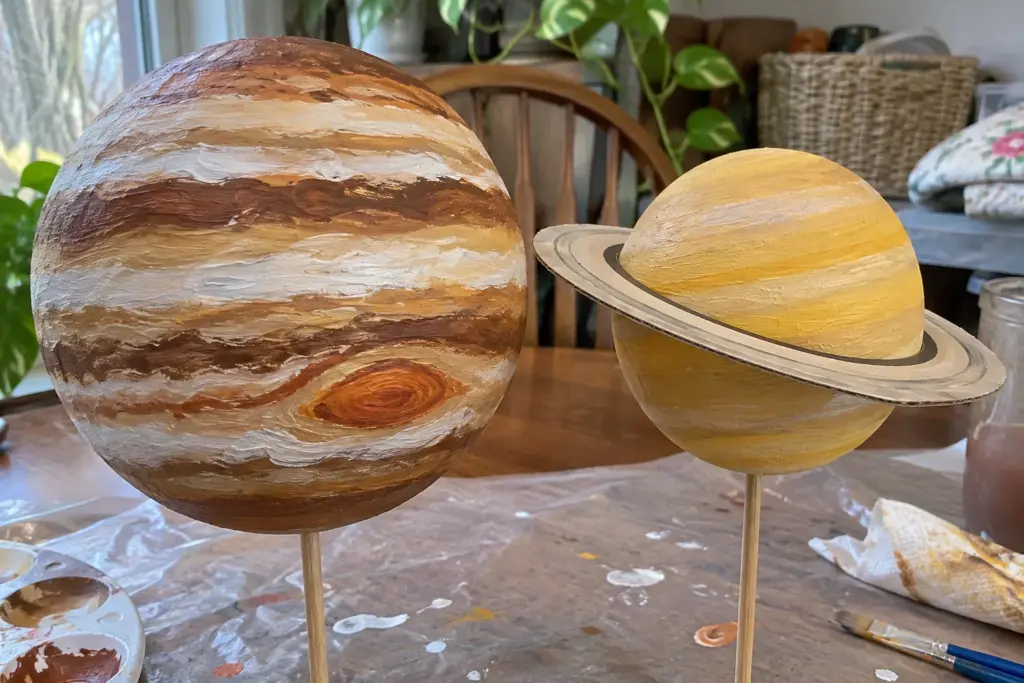
How to paint Jupiter’s bands
Hold the skewer horizontally and turn it slowly while you rest a loaded flat brush against the ball. The ball spins under the brush like a pottery wheel and the band comes out straight. Paint wide cream zones first, then narrower tan and brown belts. The Great Red Spot is about twice as wide as Earth, so on a 12 inch Jupiter make it about 2 inches long; on a 5 inch Jupiter, about 1 inch.
How to paint Earth
Paint the whole ball ocean blue. Sketch the continents with a pencil, using a globe or a printed map as a guide, and fill them in green and brown. Add white at both poles. Finish with a barely damp sponge dipped in white for cloud swirls, keeping them thin so the continents still show.
Neptune is not royal blue
A 2024 University of Oxford study rebalanced the Voyager 2 and Hubble images of Uranus and Neptune and found the two planets are almost the same greenish blue. The deep royal blue Neptune in older pictures came from contrast stretching. Paint Neptune only slightly bluer than Uranus.
For the rocky planets, our explainer on the terrestrial planets has more detail on Mercury, Venus, Earth and Mars to add to the labels.
How to make Saturn’s rings
Saturn’s main rings reach out to about 2.27 times the planet’s radius, so the ring disk is about 2.3 times wider than the planet. Use that ratio and your Saturn will look right.
- Measure the ball. Wrap a strip of paper around Saturn’s equator, mark the overlap, and divide that length by 3.14 to get the diameter. Or read it off the ball’s label.
- Draw three circles. With a compass centered on the card, draw the outer edge at 2.3 times the ball diameter, a thin dark line at 1.95 times (the Cassini Division), and the inner hole at exactly the ball diameter.
- Cut and paint. Cut out the ring and the hole. Paint it pale tan and gray with darker thin circles, leaving the Cassini Division as a dark gap.
- Fit the ring. Cut the ball in half at the equator with a serrated bread knife, sandwich the ring, and glue the halves back together with low-temperature glue. Or slit the ring once and slide it on, taping the slit underneath.
- Tilt it. Saturn tilts 26.7°. Mount the skewer straight up and the ring tilted, or tilt the skewer and keep the ring perpendicular to it.
| Saturn | Ring width | Cassini gap | Hole |
|---|---|---|---|
| 3 in | 6.9 in | 5.9 in | 3 in |
| 4 in | 9.2 in | 7.8 in | 4 in |
| 5 in | 11.5 in | 9.8 in | 5 in |
| 10 in | 23 in | 19.5 in | 10 in |
Thin, not chunky
Make the ring thin. The real main rings are about 10 meters thick, and the full ring system reaches 282,000 km from the planet. A thick foam-board ring is the most common accuracy mistake a teacher will spot.
Jupiter, Uranus and Neptune have rings too, faint and dark. A loop of thin black thread around Uranus, tilted with the planet, is a detail most projects miss.
Papier-mâché planets for Jupiter, Saturn and the Sun
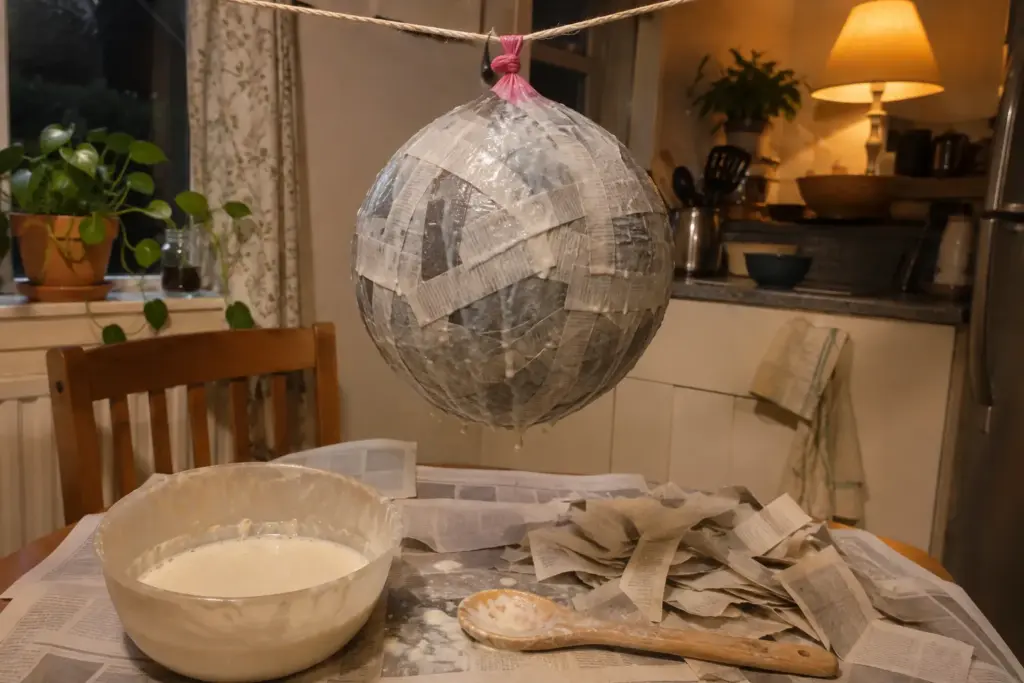
Foam balls over 8 inches are expensive and hard to find. For a true-scale Jupiter or a big Sun, papier-mâché over a balloon is cheaper and lighter. It takes 2 to 3 days because of drying time.
- Make the paste. Whisk 1 cup of flour into 1 cup of cold water, then stir it into 4 cups of boiling water and simmer 3 minutes until it thickens and turns translucent. Cool it. A pinch of salt slows mold.
- Blow up the balloon. Inflate it to the planet’s diameter: measure around the middle and stop at 3.14 times the diameter you want. A 12 inch Jupiter needs about 38 inches around.
- Layer the paper. Dip newspaper strips about 1 inch wide, wipe off the extra paste between two fingers, and lay them crisscross. Three layers make a firm shell.
- Dry fully. Hang it by the knot for 24 hours, add two more layers, and dry again. The shell is ready when it sounds hollow and feels cool only from the room, not damp.
- Pop and paint. Pop the balloon, pull it out through the knot hole, cover the hole with one more strip, then base-coat with white acrylic before the planet colors.
Why cooked paste is stronger
Heating flour in water gelatinizes its starch: the granules absorb water, swell and burst, and the released starch chains tangle into a sticky gel. As the water evaporates, that gel dries into a film that binds the paper fibers. Uncooked flour paste works, but the cooked version dries harder and smoother.
How to display your planets
| Display | Best for | How |
|---|---|---|
| Skewers in a base | Desk projects, science fairs | Push skewers into a foam board base in a row, heights varied so the planets do not touch. |
| Hanging mobile | Classrooms, bedrooms | Tie fishing line to a pin pushed into the top of each planet and hang it from a hoop or two crossed dowels. |
| Shoebox diorama | Younger students | Paint the inside black, add white paint dots for stars, and hang the planets from the lid. |
| Poster board | Flat projects | Glue foam half-balls to the board and draw orbit lines with a compass and a string. |
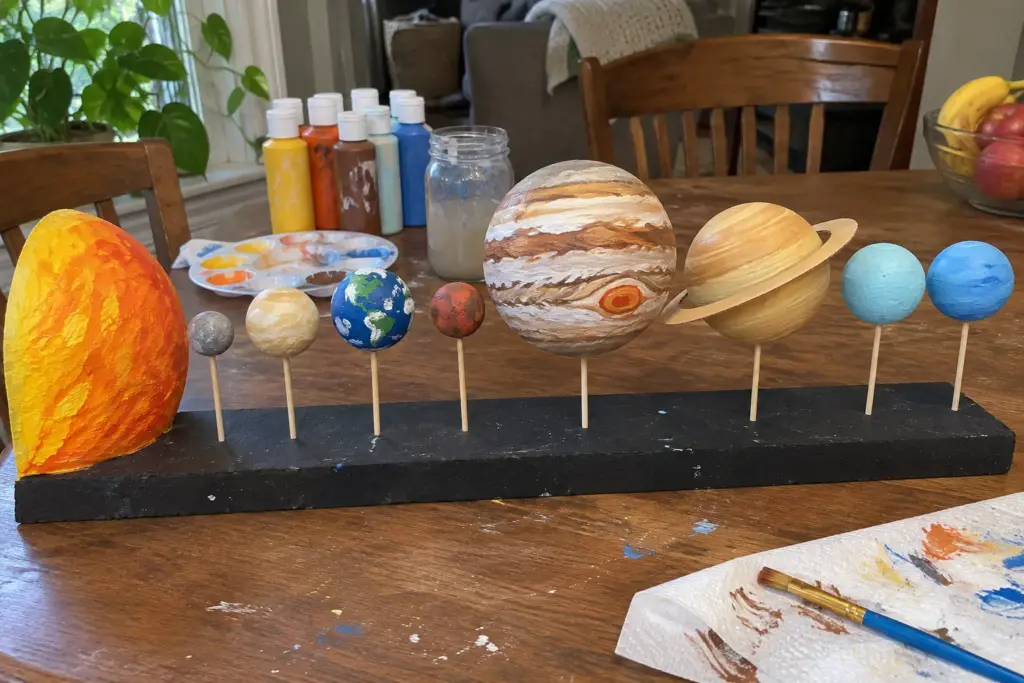
Label each planet with a small flag on its skewer. One fact per flag is enough: the planet’s size in Earths from the chart works well. For the facts, our guide to the 8 planets has one paragraph per planet, and the planets word search makes a good handout for classmates.
Bonus object
Add Pluto as a tiny clay ball on a separate skewer with a flag that says “dwarf planet since 2006”. It gives the presentation a good question to answer. The differences between a dwarf planet and a planet explain the reclassification.
The science behind the project
The science
The model teaches two kinds of science. The astronomy: planets differ in size by a factor of 29 (Jupiter to Mercury), and their colors come from what they are made of. The materials chemistry: foam, paint, glue and paste each behave the way they do because of how their molecules respond to solvents, heat and water.
Why the gas giants are so much bigger
The four inner planets formed close to the young Sun, where it was too warm for water and other ices to freeze. Only rock and metal could condense, and there was little of it. Beyond the frost line, between Mars and Jupiter, ices froze too, so the growing cores got large enough to pull in hydrogen and helium from the surrounding gas. That is why the size jump between Mars and Jupiter is so steep: Jupiter’s diameter is 21 times that of Mars.
How a planet gets its color
A planet reflects sunlight, which contains every visible color. Whatever the surface or atmosphere absorbs is removed, and the rest bounces back to us. On Uranus and Neptune, methane absorbs red and orange light, so the reflected light is blue-green. On Mars, iron oxide absorbs blue and green light and reflects red. The same rusting reaction happens to a nail left outside:
4Fe + 3O2 → 2Fe2O3
Why spray paint melts foam
Craft foam is expanded polystyrene: beads of polystyrene puffed up with gas. A typical craft foam weighs 20 to 50 kg per cubic meter, while solid polystyrene weighs about 1,050 kg. Divide one by the other and the foam is only 2 to 5 percent plastic; the rest is air. The plastic walls between the bubbles are very thin.
Polystyrene dissolves in many organic solvents, including acetone, toluene and xylene, the same solvents that carry the pigment in most spray paints. The solvent dissolves the thin walls, the bubbles collapse and the foam shrinks into hard, pitted plastic. Acrylic craft paint is pigment and acrylic polymer suspended in water, which does not dissolve polystyrene, so it dries on the surface instead.
Why high-temperature glue guns dent the foam
Polystyrene softens at its glass transition temperature, about 100 °C (212 °F). A standard hot glue gun runs near 193 °C (380 °F) and melts a crater where the glue lands. A low-temperature gun runs near 121 °C (250 °F). That is still above the softening point, but the glue cools quickly enough on contact that it only slightly softens the surface and bonds instead of melting a hole. White school glue avoids heat entirely but needs an hour to set.
Troubleshooting
| Problem | Cause | Fix |
|---|---|---|
| Foam pitted, shrank or went sticky | Solvent-based spray paint or marker | Start that planet over with a new ball and use acrylic only. |
| Paint looks patchy and foam beads show | Foam soaks up the first coat | Seal with white paint plus glue first, then a second color coat. |
| Hole melted where the glue went | High-temperature glue gun | Use a low-temperature gun or white glue; fill the dent with a dab of clay. |
| Ball keeps spinning on the skewer | Hole worn too wide | Pull out the skewer, dip the tip in glue and push it back in a new spot. |
| Papier-mache shell is soft or moldy | Layers too thick or not dried between rounds | Dry each round 24 hours near a fan; use thinner paste. |
| Saturn ring droops | Card too thin for the ring width | Glue two layers of card together, or use foam board for rings over 10 inches. |
Leave drying time
Do not assemble the display the night before it is due. Acrylic needs hours to harden, and papier-mache needs days. Finish painting at least one full day ahead.
Safety
Before you start
- Hot glue burns. Even low-temperature glue is hotter than boiling water. An adult should run the glue gun for younger children. Cool a burn under running water for 20 minutes.
- Cutting foam is an adult job. Cut balls in half with a serrated knife on a cutting board, the blade moving away from your hand.
- Skewer points are sharp. Snip the points off skewers that stick out of the display.
- Small parts are a choking hazard. Clay Mercury, beads and small foam balls stay away from children under 3.
- Latex allergies. Use foil or plastic balloons for papier-mache if anyone in the class is allergic to latex.
Acrylic paint washes off hands and brushes with soap and water while it is wet. Rinse brushes in a cup first and wipe the cup out with a paper towel instead of pouring large amounts of paint down the drain.
More practical science: browse all our everyday science how-tos, from household chemistry to experiments you can build at home.
Frequently asked questions
For a true-scale set, use a 12 inch ball for Jupiter, 10 inch for Saturn, 4 inch for Uranus and Neptune, 1 inch for Earth and Venus, and clay balls of about half an inch for Mars and 0.4 inch for Mercury. For a smaller set, use 5, 4, 2.5, 2.5, 1.5, 1.5, 1 and 3/4 inch.
Use water-based acrylic craft paint. Spray paint and most paint markers contain solvents that dissolve polystyrene foam and leave it pitted and shrunken.
Cut a ring from card stock with an outer diameter 2.3 times the width of the Saturn ball and a hole the same size as the ball. Paint it tan and gray, then slide it onto the ball or sandwich it between two halves of the ball and tilt it about 27 degrees.
Use papier-mache over balloons for the big planets and air-dry clay or polymer clay for the small ones. Paper balls wrapped in masking tape also work and are cheap.
Mercury gray, Venus pale yellow-cream, Earth blue with green and brown land, Mars rusty red, Jupiter cream with tan and brown bands, Saturn butterscotch, Uranus pale cyan and Neptune a slightly bluer cyan.
About 3 hours of hands-on work for a foam set, plus an overnight dry. A papier-mache set takes 2 to 3 days because each round of layers needs 24 hours to dry.
Jupiter. It is about 11 times wider than Earth, and Saturn is about 9.5 times wider. The Sun is 109 times wider than Earth, so in a scale model it is usually shown as a half ball or an arc.
Include it as a bonus object labeled dwarf planet. The International Astronomical Union reclassified Pluto in 2006, and it is smaller than Earth’s Moon.
Push a sewing pin with a small loop of fishing line into the top of each planet, add a drop of glue, and tie the lines to an embroidery hoop or two crossed dowels. Hang the heaviest planets opposite each other to balance it.
Not in the same model on a desk. If Earth is a 1 inch ball, it sits about 1,046 feet from the Sun and Neptune more than 5 miles away. Scale the sizes for the desk model and do the distances as a separate walking model.
Sources
- NASA Goddard Space Flight Center. Planetary Fact Sheet
- NASA Science. Jupiter facts
- NASA Science. Saturn facts
- NASA Science. Mars facts
- NASA Science. Venus facts
- NASA Science. Uranus facts
- University of Oxford, Department of Physics. The true colours of Neptune and Uranus (2024)
- NASA. What color is the Sun?
- GlueGun.com. Guide to low temperature glue guns and glue sticks
- NETZSCH Analyzing & Testing. PS: Polystyrene (glass transition and properties)