A hadron is any particle built from quarks and held together by the strong force. Protons and neutrons are the famous ones, but physicists have catalogued well over a hundred more.
Every example below falls into one of three groups: baryons (three quarks), mesons (a quark and an antiquark), and exotic hadrons (four or five quarks). Here’s the full tour, a table you can screenshot for revision, and a list of particles that look like they belong but don’t.
Contents
- What makes a particle a hadron
- Baryon examples
- Meson examples
- Exotic hadrons: tetraquarks and pentaquarks
- Hadron examples at a glance
- Particles that are not hadrons
- Why the Large Hadron Collider has the word in its name
- FAQ
- Quick quiz
What makes a particle a hadron
Quarks never show up alone. The strong force, carried by gluons, locks them into groups, and any group of quarks that feels the strong force is a hadron. The word comes from the Greek hadros, meaning thick or bulky, which is how early physicists described these heavy, interacting particles compared with light ones like the electron.
Quarks come in six flavors: up (u), down (d), strange (s), charm (c), bottom (b) and top (t). Up carries a charge of +2/3, down carries -1/3, and adding them up gives the charge of the hadron. A proton is two ups and a down: 2/3 + 2/3 – 1/3 = +1. That arithmetic works for every example below.
The top quark is the odd one out. It decays so fast that it vanishes before it can bind into anything, so no top-containing hadron exists.
Baryon examples
Baryons are made of three quarks. They’re the heavyweights, and every one of them carries a property called baryon number that the universe never seems to lose track of.

Proton (uud). The only truly stable hadron as far as anyone has measured. Experiments such as Super-Kamiokande in Japan have watched huge tanks of water for years and found no proton decay, setting a lifetime of more than 10^34 years. Every hydrogen nucleus in the universe is a single proton.
Neutron (udd). Electrically neutral, slightly heavier than the proton. Locked inside an atomic nucleus it can last forever. Free in space, it decays in about 15 minutes into a proton, an electron and an antineutrino. Protons and neutrons together build every nucleus, which makes them the hadrons responsible for nearly all the mass you can touch.
Lambda (uds). The first baryon with a strange quark, and the first sign that “strangeness” was a real property. It lives roughly a quarter of a nanosecond, a long time by particle standards, which is exactly why it was labeled strange.
Sigma (Σ+, Σ0, Σ-). Siblings of the lambda with the same heavy strange quark: Σ+ is uus, Σ0 is uds, and Σ- is dds.
Xi (Ξ0, Ξ-). Two strange quarks each: Ξ0 is uss and Ξ- is dss. Physicists nicknamed them “cascades” because they decay in two steps.
Omega-minus (sss). Three strange quarks and nothing else. Murray Gell-Mann predicted it in 1962, using a pattern he called the Eightfold Way, including its mass. Brookhaven found it in 1964, and the discovery helped win him the 1969 Nobel Prize in Physics.
Delta (Δ++, Δ+, Δ0, Δ-). Excited, short-lived relatives of the proton and neutron. Δ++ is uuu, three up quarks with a charge of +2, and it decays in about 10^-23 seconds. That’s so brief that light barely crosses a proton’s width in that time.
Meson examples
Mesons pair one quark with one antiquark. Because they contain an antimatter partner, they’re unstable: sooner or later quark and antiquark meet and annihilate, or one of them changes flavor.
Pions (π+, π-, π0). The lightest mesons. π+ is an up quark with an anti-down (ud̄), and π- is the reverse (dū). π0 is a quantum blend of uū and dd̄. Hideki Yukawa predicted the pion in 1935 as the carrier of the force between nucleons, work that earned him the 1949 Nobel Prize in Physics. Today we know the deeper story involves quarks and gluons, but pions still dominate the residual force that holds nuclei together.
Kaons (K+, K0). K+ is us̄, K0 is ds̄. They’re the reason strangeness exists as a concept: kaons were produced quickly but decayed slowly, a mismatch that only made sense if they carried a new quantum number. Neutral kaons also provided the first evidence that nature treats matter and antimatter slightly differently.
J/psi (cc̄). A charm quark bound to its own antiquark. Two teams, led by Burton Richter at SLAC and Samuel Ting at Brookhaven, found it independently in 1974. The simultaneous discovery proved charm quarks were real, and physicists called it the November Revolution.
D mesons (D0 = cū, D+ = cd̄). The lightest hadrons that contain a charm quark alongside a lighter one.
B mesons (B+ = ub̄, B0 = db̄). Contain a bottom antiquark. They’re studied heavily because their decays are a testing ground for why the universe contains more matter than antimatter.
Upsilon (bb̄). The bottom-quark version of the J/psi, discovered at Fermilab in 1977. It confirmed that a fifth quark flavor existed.
Exotic hadrons: tetraquarks and pentaquarks
Nothing in the rules says a hadron must have two or three quarks. The only requirement is that the colour charges of the quarks cancel out into a neutral package. Four-quark and five-quark combinations meet that requirement, and several now have experimental evidence behind them.
Tetraquarks (four quarks). The X(3872), found by the Belle experiment in Japan in 2003, was the first strong candidate, and it contains a charm quark and anticharm quark plus a light quark pair. In 2014 LHCb confirmed another, Z(4430), and showed it has a charge, which a plain charm-anticharm meson can’t. In 2021 LHCb reported Tcc+, a tetraquark with two charm quarks.
Pentaquarks (five quarks). In 2015 the LHCb experiment reported two pentaquark states, Pc(4380)+ and Pc(4450)+, each made of uud plus a charm and anticharm pair. CERN announced the discovery after searching for such a state for decades. Later data revealed a third, Pc(4312)+, plus a finer structure in the original signal.
Some older reference pages still describe tetraquarks and pentaquarks as hypothetical. They’re not. Whether each one is a tightly bound cluster or two ordinary hadrons loosely stuck together, a molecule of sorts, is still being argued.
Hadron examples at a glance
| Particle | Type | Quark content | Charge | Stable? |
|---|---|---|---|---|
| Proton | Baryon | uud | +1 | Yes (no decay ever seen) |
| Neutron | Baryon | udd | 0 | Only inside nuclei; free lifetime about 15 min |
| Lambda (Λ0) | Baryon | uds | 0 | No (about 0.26 ns) |
| Sigma-plus (Σ+) | Baryon | uus | +1 | No |
| Xi-minus (Ξ-) | Baryon | dss | -1 | No |
| Omega-minus (Ω-) | Baryon | sss | -1 | No |
| Delta-plus-plus (Δ++) | Baryon | uuu | +2 | No (about 10^-23 s) |
| Pion (π+) | Meson | ud̄ | +1 | No (about 26 ns) |
| Kaon (K+) | Meson | us̄ | +1 | No (about 12 ns) |
| J/psi | Meson | cc̄ | 0 | No |
| B meson (B0) | Meson | db̄ | 0 | No |
| Upsilon (Υ) | Meson | bb̄ | 0 | No |
| Pentaquark Pc(4312)+ | Exotic | uudcc̄ | +1 | No |
Particles that are not hadrons
The most common mix-up is between hadrons and leptons. A lepton has no quarks inside and ignores the strong force entirely. If a particle doesn’t contain quarks, it’s not a hadron. These are the ones that get confused:
- Electron. A lepton. It orbits the nucleus without ever feeling the strong force.
- Muon. A heavier cousin of the electron, around 200 times its mass. Still a lepton, despite the weight.
- Tau. The heaviest charged lepton.
- Neutrinos. Three flavors, all leptons, almost no interaction with anything.
- Photon. A force carrier for electromagnetism, with no quarks involved.
- Gluon. It carries the strong force between quarks. It binds hadrons together but isn’t one itself.
- W and Z bosons, Higgs boson. Fundamental particles, none containing quarks.
The shortcut: hadrons are built from quarks, leptons are not. Heavy does not mean hadron, and charged does not mean hadron.
Why the Large Hadron Collider has the word in its name
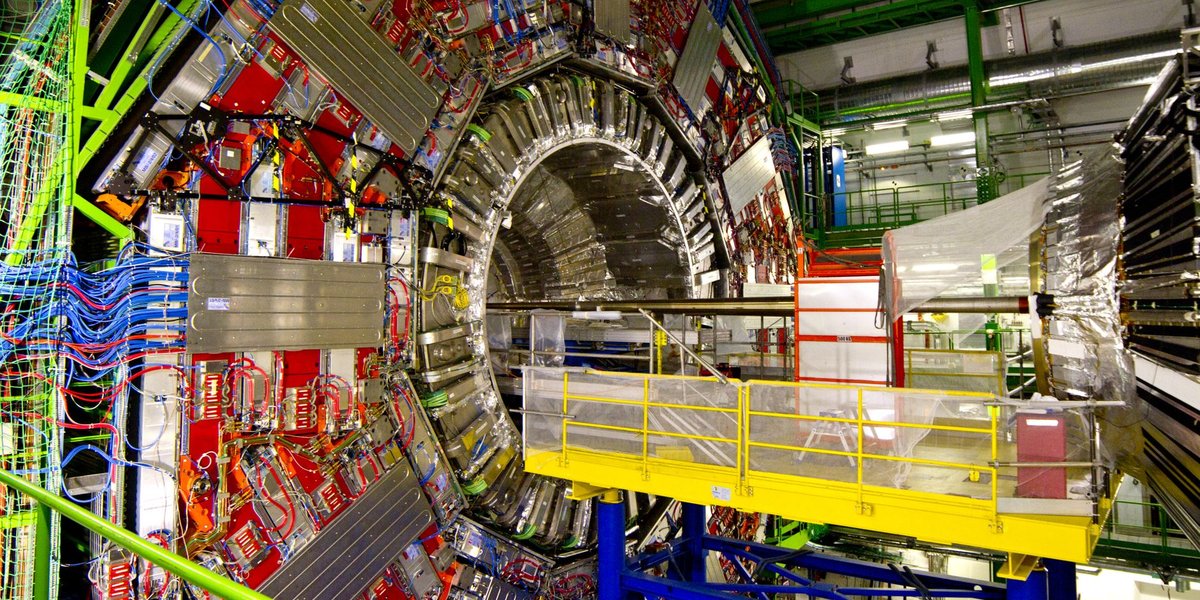
The Large Hadron Collider at CERN smashes beams of protons together, and protons are hadrons. Most of what comes out of those collisions is also hadrons: pions, kaons and a spray of heavier relatives, produced when the colliding energy turns into new quark-antiquark pairs.
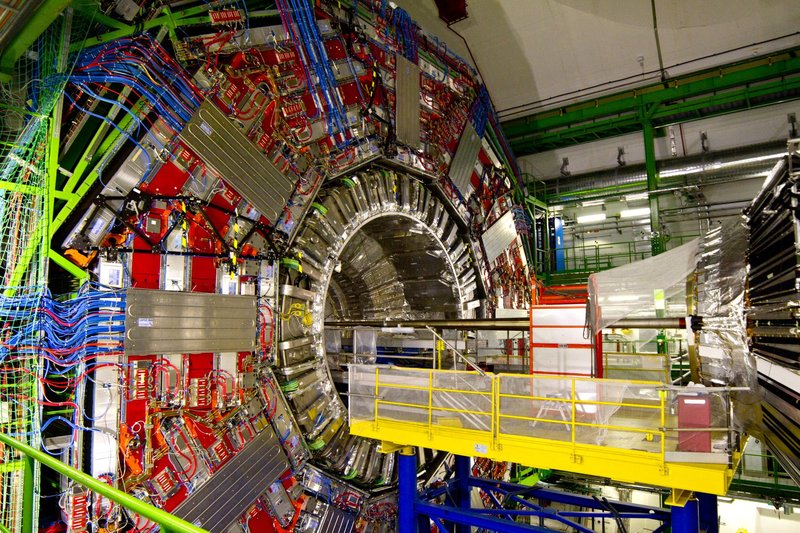
The LHCb detector is built specifically to study hadrons that contain bottom and charm quarks. Its collaboration has found more than 70 new hadrons, including the pentaquarks and several tetraquarks above. Each one is a data point for understanding how the strong force assembles matter.
FAQ
What is the most common example of a hadron? The proton. Every atom of hydrogen contains one, and every atom heavier than hydrogen contains at least one more, along with neutrons in most cases.
Are baryons and mesons both hadrons? Yes. Baryons (three quarks) and mesons (a quark and an antiquark) are the two main families, with exotic hadrons as a smaller third group.
Is an electron a hadron? No. It’s a lepton with no quark content and no strong-force interaction.
Are there any stable hadrons? Only the proton, as far as experiments can tell. The neutron is stable inside nuclei but decays when free.
How many hadrons exist? Hundreds of hadrons have been identified, mostly short-lived resonances, and new ones keep turning up at the LHC.
Quick quiz
- Which quarks make up a neutron?
- A pion contains how many quarks in total?
- Is a muon a hadron?
- What is the quark content of the omega-minus?
- Why does a pentaquark count as a hadron?
Answers: (1) one up and two down (udd); (2) two, a quark and an antiquark; (3) no, it’s a lepton; (4) three strange quarks (sss); (5) it’s built from quarks (four quarks and one antiquark) and held together by the strong force.