TLDR
- A meson is a hadron made of one quark and one antiquark, bound by the strong force.
- Mesons have integer spin, so they’re bosons. Baryons (protons, neutrons) have three quarks and half-integer spin, so they’re fermions.
- Every meson is unstable. The longest-lived, the charged pion, survives about 26 billionths of a second.
- Yukawa predicted mesons in 1935 to explain what holds the nucleus together. The pion turned up in 1947.
- Mesons are made in cosmic-ray collisions and in particle accelerators, and they’re how physicists tested ideas like charm and CP violation.
Table of contents
- What is a meson?
- Mesons vs baryons
- Yukawa’s prediction and the muon mix-up
- The main mesons at a glance
- Why mesons matter
- How mesons are made and detected
- Exotic mesons: tetraquarks and glueballs
- FAQ
What is a meson?
A meson is a particle made of exactly one quark and one antiquark, held together by the strong force. That’s the whole definition. Everything else is consequences.
Quarks come in six flavors: up, down, strange, charm, bottom, and top. An antiquark is the antimatter twin of one of them. Pair a quark with an antiquark and you get a meson. A positive pion, for example, is an up quark plus an anti-down quark.
The word comes from the Greek mesos, “middle.” The first mesons had masses between the electron and the proton, and the name stuck even after much heavier ones showed up. The upsilon meson weighs about ten times a proton.
There’s one thing you can’t do with a meson: pull the quark out. The strong force doesn’t weaken with distance the way electric force does. Stretch a meson and the energy stored in the gap grows until it’s cheaper to create a new quark-antiquark pair from nothing. You don’t get a free quark. You get two mesons.
Mesons vs baryons
Mesons and baryons are the two families of hadrons, the particles built from quarks. The split comes down to counting.
| Mesons | Baryons | |
|---|---|---|
| Quark content | 1 quark + 1 antiquark | 3 quarks |
| Spin | Integer (0, 1, 2…) | Half-integer (1/2, 3/2…) |
| Particle type | Boson | Fermion |
| Examples | Pion, kaon, J/psi | Proton, neutron, lambda |
| Stability | All unstable | Proton stable (as far as we know) |
Quarks each carry spin 1/2. Two of them combine to total spin 0 or 1. Three of them give 1/2 or 3/2. That arithmetic is why mesons are bosons and baryons are fermions, and it matters: fermions obey the Pauli exclusion principle, so matter is built out of them. Bosons can pile into the same state, which is why mesons don’t make up atoms.
Baryons also carry a conserved “baryon number,” so the lightest one, the proton, has nothing to decay into. Mesons have baryon number zero, so they can always decay into lighter particles. Every meson does, eventually.
Yukawa’s prediction and the muon mix-up
In 1935, Japanese physicist Hideki Yukawa asked what glues protons and neutrons together inside a nucleus. Electromagnetism would push the protons apart. He proposed a new force carried by a new particle, and because the nuclear force has a very short range, about the size of a nucleus, the particle had to be heavy. His estimate was roughly 200 times the electron’s mass. Yukawa won the 1949 Nobel Prize in Physics for the prediction.
Then came a false alarm. In 1936, Carl Anderson and Seth Neddermeyer found a particle in cosmic rays with almost exactly the mass Yukawa wanted, about 207 electron masses. It was called the “mu meson” and treated as the nuclear glue. It was a different particle entirely.
In 1947, Marcello Conversi, Ettore Pancini, and Oreste Piccioni showed that these particles barely interacted with atomic nuclei. A particle carrying the strong force wouldn’t do that. The mu meson was a heavy cousin of the electron, now just called the muon.
The real thing arrived the same year. Cecil Powell, César Lattes, and Giuseppe Occhialini exposed photographic plates on mountaintops, including the Chacaltaya observatory in the Bolivian Andes, and found tracks of a second particle that decayed into a muon. That was the pion, about 273 electron masses. Powell received the 1950 Nobel Prize for the method and the discovery.
The main mesons at a glance
Hundreds of mesons exist, but a handful carry most of the story. The lightest ones, built from up, down, and strange quarks, sort into a neat nine-member family called the pseudoscalar nonet: three pions, four kaons, the eta, and the eta prime. Heavier relatives come from charm and bottom quarks.
| Meson | Quark content | Mass (MeV/c²) | Typical lifetime |
|---|---|---|---|
| Charged pion (π⁺) | up, anti-down | 139.6 | 2.6 × 10⁻⁸ s |
| Neutral pion (π⁰) | mix of up/anti-up and down/anti-down | 135.0 | 8.5 × 10⁻¹⁷ s |
| Charged kaon (K⁺) | up, anti-strange | 493.7 | 1.2 × 10⁻⁸ s |
| Eta (η) | mix of up, down, strange pairs | 547.9 | about 5 × 10⁻¹⁹ s |
| J/psi (J/ψ) | charm, anti-charm | 3,097 | about 7 × 10⁻²¹ s |
| B meson (B⁺) | up, anti-bottom | 5,279 | 1.6 × 10⁻¹² s |
| Upsilon (Υ) | bottom, anti-bottom | 9,460 | about 1 × 10⁻²⁰ s |
Values are rounded from the Particle Data Group, the standard reference maintained by Lawrence Berkeley National Laboratory. For scale, a proton is 938 MeV/c².
Two things stand out. First, a neutral pion decays a billion times faster than a charged one, because it falls apart through the electromagnetic force (into two photons), while the charged pion has to wait for the much weaker weak force. Second, the heavier the meson, the shorter it usually lives, but the J/psi breaks the pattern, and that oddity is part of its story below.
Kaons earned the name “strange” particles. Rochester and Butler spotted them in 1947 as V-shaped tracks in a cloud chamber. They were produced quickly but decayed slowly, which implied a new conserved property. That property is strangeness, and it led directly to the strange quark.
Why mesons matter
They carry the force between nucleons. Protons and neutrons are color-neutral, so you’d expect the strong force to cancel out between them. It doesn’t fully, in the same way that neutral atoms still attract through van der Waals forces. Part of that leftover “residual” strong force can be described as nucleons swapping pions, and Yukawa’s picture still works as a good approximation at nuclear distances.
Kaons showed that nature breaks a symmetry. In 1964, James Cronin and Val Fitch found that long-lived neutral kaons sometimes decay into two pions, something that would be forbidden if matter and antimatter obeyed identical rules combined with mirror reflection. It happened in roughly one decay in 500. That’s CP violation, and it’s one of the ingredients needed to explain why the universe contains matter rather than an equal amount of antimatter. They shared the 1980 Nobel Prize for it.
The J/psi confirmed charm. In November 1974, two teams, Burton Richter’s at SLAC and Samuel Ting’s at Brookhaven, found the same sharp resonance at 3.1 GeV within days of each other. Richter’s team called it psi, Ting’s called it J, and the compromise name stuck. The particle was far too long-lived for its mass. The explanation was a fourth quark, charm, bound to its own antiquark, with no lighter route to decay. Theory had predicted charm, and the J/psi made it real.
B mesons keep probing CP violation. Experiments such as Belle and BaBar, built to make huge numbers of B mesons, measured CP violation there at a much larger scale than in kaons, and LHCb at CERN continues the work.
How mesons are made and detected
Mesons are rare in everyday matter because they decay so fast. Two sources make them reliably.
Cosmic rays. High-energy protons from space slam into nuclei in the upper atmosphere and produce showers of pions. Charged pions decay into muons, and those muons are what reach the ground: roughly one passes through your hand every second. Powell’s mountaintop plates were catching the early stages of this process.
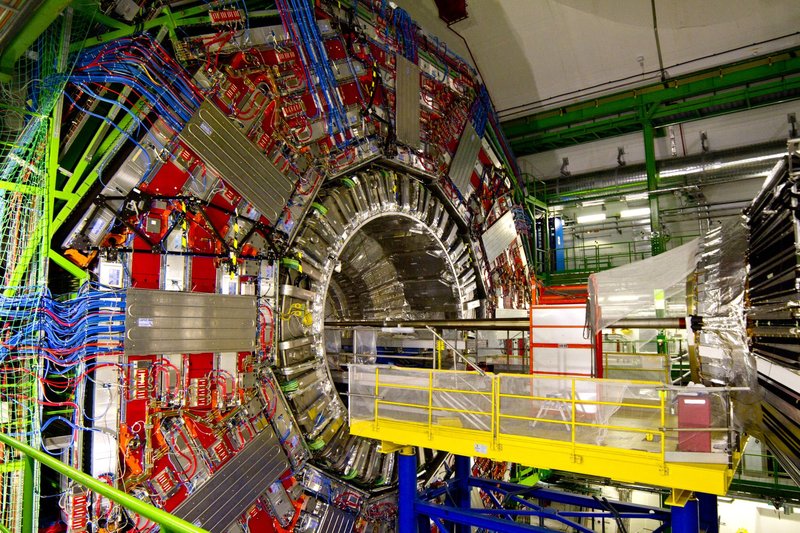
Accelerators. Collide protons or electrons at high enough energy and the collision energy converts into mass (E = mc²), producing quark-antiquark pairs that bind into mesons. The Large Hadron Collider makes billions of them per second. B factories took a more targeted route: they tuned electron-positron collisions to the energy of the Υ(4S), a bottom-antibottom state that decays almost entirely into a pair of B mesons, giving a clean supply.
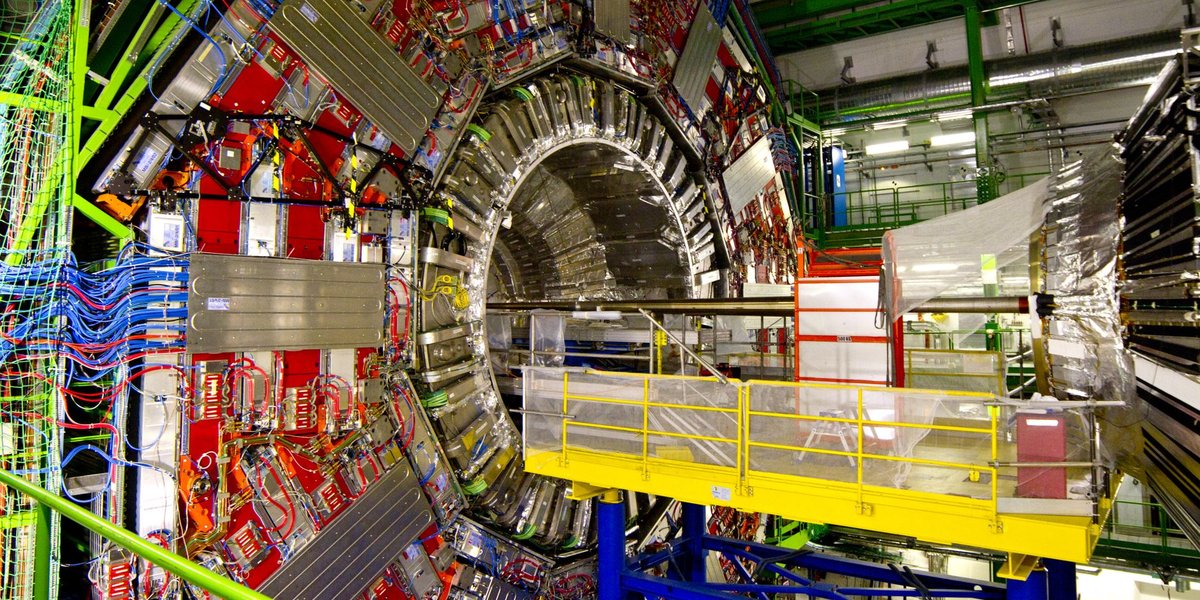
Detection. Nobody sees a meson directly. Most decay before they travel a millimeter. Detectors catch the decay products instead. Early experiments used photographic emulsions and cloud chambers; modern ones use layers of silicon trackers to reconstruct the path of charged particles in a magnetic field, plus calorimeters to measure energy. The curvature of a track gives momentum, and the combination of tracks pointing back to a common spot gives the parent particle’s mass. A bump in that mass distribution is how a new meson announces itself. CERN’s overview of the Standard Model covers where quarks and hadrons fit in the bigger picture.
Exotic mesons: tetraquarks and glueballs
The quark-antiquark rule describes almost every meson. A few candidates break it.
Tetraquarks contain two quarks and two antiquarks. The first strong candidate, X(3872), was spotted by the Belle experiment in 2003 and behaves like nothing a simple charm-anticharm pair should. Since then, experiments including LHCb have reported more, including a doubly charmed tetraquark in 2021 that lives unusually long by exotic standards. Physicists still argue over whether these are tightly bound four-quark states or two ordinary mesons loosely stuck together like a molecule.
Glueballs are a different idea: bound states made only of gluons, the carriers of the strong force, with no quarks at all. The theory of the strong force allows them. Several candidates have been proposed, but none is confirmed, because they mix with ordinary mesons of similar mass and are hard to tell apart.
Pentaquarks, found by LHCb in 2015, are five-quark states. They’re baryons, not mesons, but they come from the same line of research.
FAQ
What is the difference between a meson and a baryon?
A meson has one quark and one antiquark and an integer spin, so it’s a boson. A baryon has three quarks and a half-integer spin, so it’s a fermion. Protons and neutrons are baryons.
Are mesons stable?
No. Every meson decays. The charged pion, one of the longest-lived, lasts about 26 nanoseconds on average, and the heaviest mesons last on the order of 10⁻²⁰ seconds.
Is a pion a meson?
Yes. Pions are the lightest mesons and the first to be discovered, in 1947. They come in three types: positive, negative, and neutral.
What is the difference between a pion and a kaon?
Pions are made only of up and down quarks and antiquarks. Kaons contain one strange quark or antiquark. Kaons are about 3.5 times heavier than pions and decay through paths that revealed new physics, including CP violation.
Are mesons found in normal matter?
Not as lasting constituents. Atoms are built from protons, neutrons, and electrons. Mesons appear briefly in nuclear interactions, cosmic-ray showers, and collider collisions.
Why can’t we isolate a single quark?
The strong force grows with distance. Pulling a quark away from its partner stores energy until a new quark-antiquark pair forms, and you end up with two mesons instead of a free quark. Physicists call this confinement.
Who discovered the first meson?
Yukawa predicted it in 1935. The muon was mistaken for it in 1936. The pion, the actual Yukawa particle, was found in 1947 by Lattes, Occhialini, and Powell.