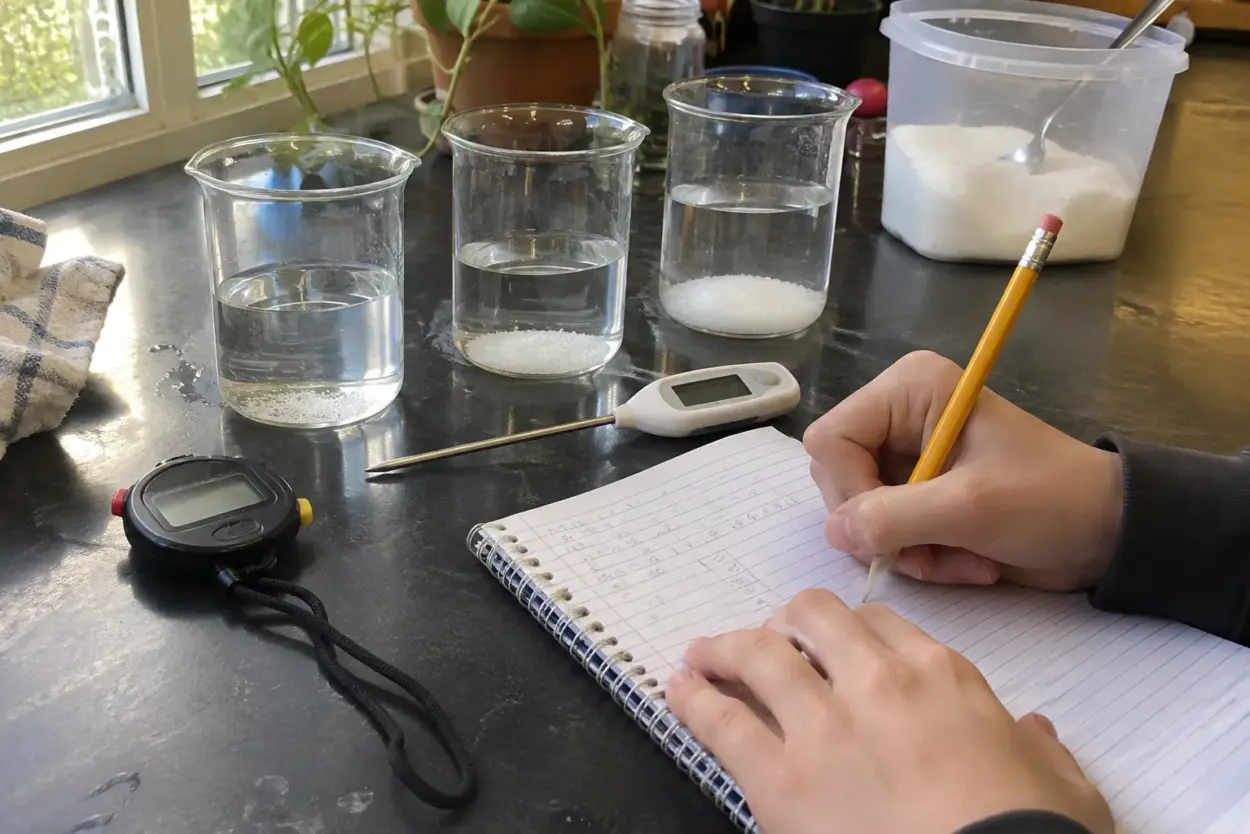
Short answer: The 7 steps of the scientific method are: 1. ask a question, 2. do background research, 3. construct a hypothesis, 4. test it with an experiment, 5. analyze the data, 6. draw a conclusion and 7. communicate the results. If the data reject the hypothesis, you revise it and test again.
Most students memorize the list and then get stuck at step 3 or step 4, because a hypothesis has to be testable and an experiment has to change only one thing at a time. This page gives each step with a plain definition, carries one simple experiment through all seven, and includes three free PDFs: a one-page steps poster, a steps and definitions sheet, and a worksheet with an answer key.
The 7 steps of the scientific method
Each step answers one question: what do I want to know, what is already known, what do I predict, how do I test it, what did I find, what does it mean, and who needs to know. The order below is the one most science classes and science fair guides use.
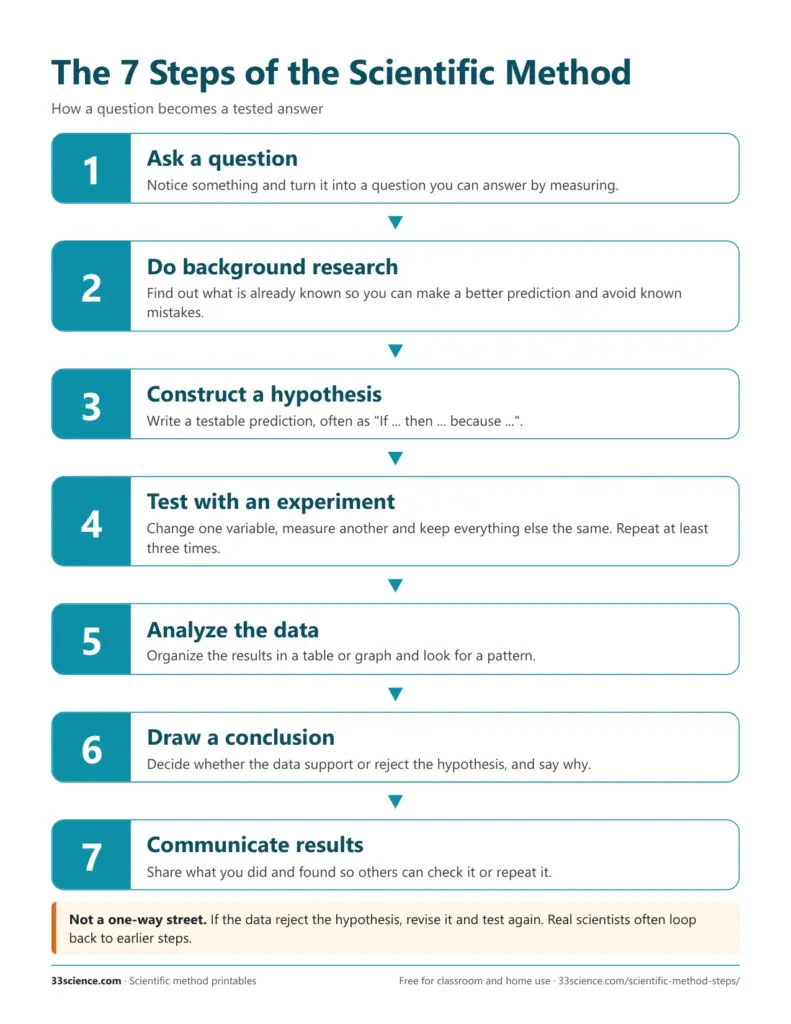
Scientific method steps and definitions
The table defines each step in one line and shows what it looks like in a real experiment. It matches the first page of the steps and definitions PDF.
| Step | Definition | Example |
|---|---|---|
| 1. Ask a question | Notice something and turn it into a question you can answer by measuring. | Does sugar dissolve faster in hot water than in cold water? |
| 2. Do background research | Find out what is already known so you can make a better prediction and avoid known mistakes. | Read that warmer water molecules move faster and hit the sugar crystals more often. |
| 3. Construct a hypothesis | Write a testable prediction, often as “If … then … because …”. | If the water is hotter, then the sugar will dissolve faster, because faster molecules break the crystals apart sooner. |
| 4. Test with an experiment | Change one variable, measure another and keep everything else the same. Repeat at least three times. | Time one teaspoon of sugar in cold, room-temperature and hot water, same cup, same amount, three trials each. |
| 5. Analyze the data | Organize the results in a table or graph and look for a pattern. | Average the three times for each temperature and plot them on a bar graph. |
| 6. Draw a conclusion | Decide whether the data support or reject the hypothesis, and say why. | Hot water dissolved the sugar fastest in every trial, so the data support the hypothesis. |
| 7. Communicate results | Share what you did and found so others can check it or repeat it. | Present a poster or lab report with the question, method, data table, graph and conclusion. |
Example: the scientific method in a kitchen experiment
Testing whether sugar dissolves faster in hot water shows all seven steps with three glasses, a spoon and a timer. It takes about 20 minutes and works as a first science project.
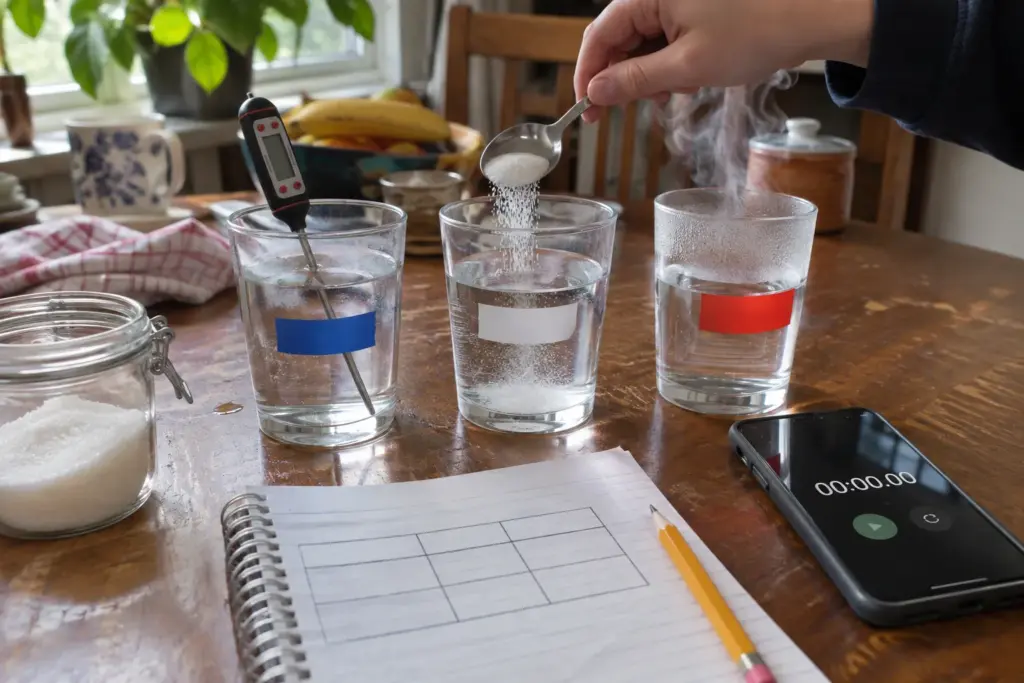
In this experiment the water temperature is the independent variable, the time to dissolve is the dependent variable, and the amount of water, the amount of sugar, the glass and the stirring are the controlled variables. Room-temperature water acts as the comparison group. Use hot tap water rather than boiling water.
Key scientific method terms
These words show up on every worksheet and lab report. The second page of the definitions PDF lists all of them on one sheet.
| Term | Definition |
|---|---|
| Observation | Information gathered with the senses or instruments, such as noticing, measuring or counting. |
| Hypothesis | A testable prediction that answers the question and could be proven wrong by an experiment. |
| Prediction | The specific result you expect to see if the hypothesis is true. |
| Independent variable | The one factor you change on purpose (water temperature). |
| Dependent variable | The factor you measure to see if it responds (time for the sugar to dissolve). |
| Controlled variables | Everything you keep the same so it cannot affect the result (amount of sugar, cup, stirring). |
| Control group | The group that gets no change, used as the baseline for comparison. |
| Experimental group | The group that receives the change being tested. |
| Trial | One run of the experiment. Repeating trials shows whether a result is consistent. |
| Data | The recorded results: numbers (quantitative) or descriptions (qualitative). |
| Conclusion | A statement of whether the data support the hypothesis, based only on the results. |
| Peer review | Other scientists checking a study before it is published. |
| Scientific theory | A well-tested explanation that ties together many facts, laws and supported hypotheses. |
| Scientific law | A description of what always happens under stated conditions, often as an equation. |
A hypothesis, a theory and a law are three different things. A hypothesis is one testable prediction. A theory is a well-tested explanation that ties together many facts and supported hypotheses, such as the theory of evolution. A law describes what happens, often as an equation, without explaining why, such as Newton’s law of gravitation. A theory never “graduates” into a law.
Why some lists have 5, 6 or 8 steps
There is no official number of steps. Textbooks split or merge the same actions, so a 5-step list and a 7-step list describe the same process. The most common versions:
| Version | Steps | What changes |
|---|---|---|
| 7 steps (Science Buddies) | Question, research, hypothesis, experiment, analyze, conclude, communicate | The version on this page |
| 7 steps (NOAA SciJinks) | Wonder, define, review, design, experiment, analyze, conclude | Splits planning into “define” and “design”, drops “communicate” |
| 6 steps | Observe, question, hypothesis, experiment, analyze, conclude | Starts with observation, drops research and communicate |
| 5 steps | Question, hypothesis, experiment, analyze, conclude | Folds research into the question |
| 8 steps | Observe, question, research, hypothesis, experiment, analyze, conclude, communicate | Splits “observe” from “ask a question” |
Real research is also less tidy than any list. The Understanding Science project at UC Berkeley points out that scientists loop back, run steps in a different order and revise ideas as data come in; the neat sequence mostly describes how results are written up afterward. Learn the 7 steps as a checklist, not as a rule that each one happens exactly once.
Scientific method worksheet (PDF with answer key)
The worksheet checks whether students can use the steps, not only list them. It has two student pages and two answer key pages, so print pages 1 and 2 for the class and keep pages 3 and 4.
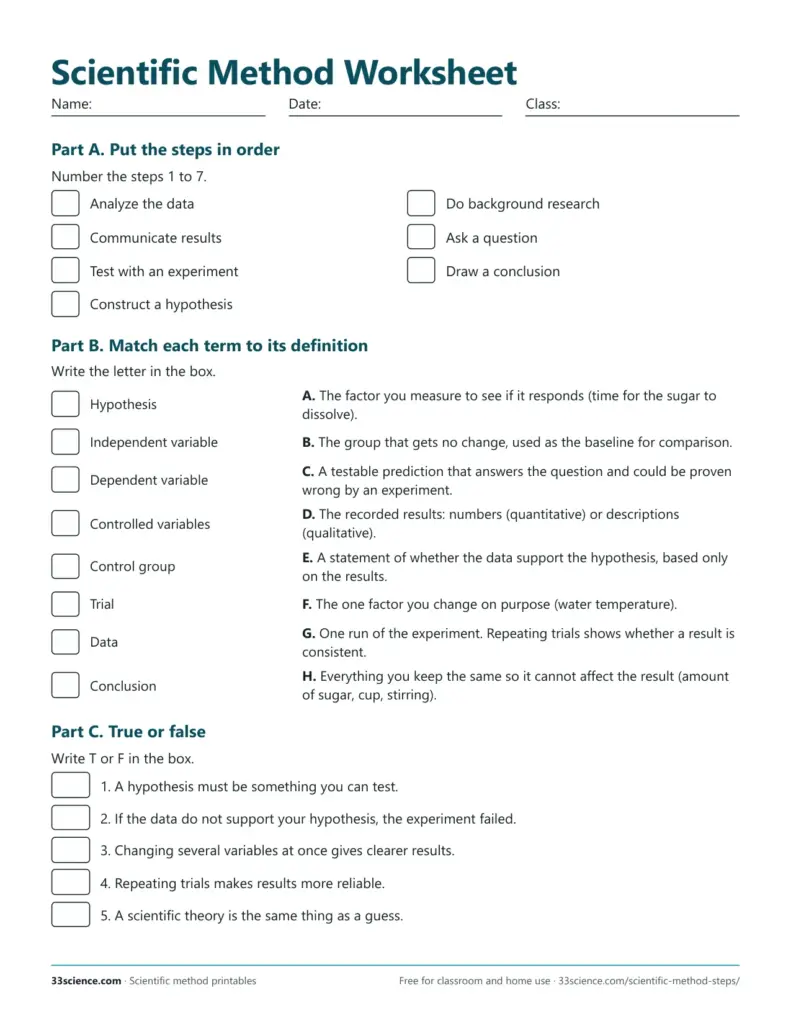
For a vocabulary warm-up before the worksheet, the scientific method word search uses the same terms. More free sheets are on the 33science printables page.
Common mistakes with the scientific method
Most lost points on lab reports and science fair rubrics come from the same few slips.
Frequently asked questions
Ask a question, do background research, construct a hypothesis, test it with an experiment, analyze the data, draw a conclusion and communicate the results.
The first step is asking a question, usually after noticing something. Some lists call this step making an observation and put the question second.
Testing the hypothesis with a fair experiment is the core of the method, because it is the step that lets evidence decide whether an idea holds up.
The experiment still succeeded. You report that the data do not support the hypothesis, revise the prediction and test again, which is how most scientific progress happens.
No. Different textbooks list between 5 and 8 steps by splitting or merging the same actions, and working scientists often repeat or reorder steps.
A hypothesis is a testable explanation or claim, while a prediction is the specific result you expect to measure if that hypothesis is true.
A control is the group or trial that does not receive the change being tested. It gives a baseline so you can tell whether the change caused the result.
No single person invented it. It developed over centuries, with thinkers such as Ibn al-Haytham, Francis Bacon and Galileo shaping the idea of testing claims with observation and experiment.
Sources
- Science Buddies. Steps of the Scientific Method
- Science Buddies. Conducting a Science Experiment
- NOAA and NASA SciJinks. What is the scientific method?
- UC Museum of Paleontology, Understanding Science. The real process of science
- Encyclopaedia Britannica. Scientific hypothesis
- Encyclopaedia Britannica. Scientific method
- National Park Service. Nature of science definitions, after the National Academy of Sciences