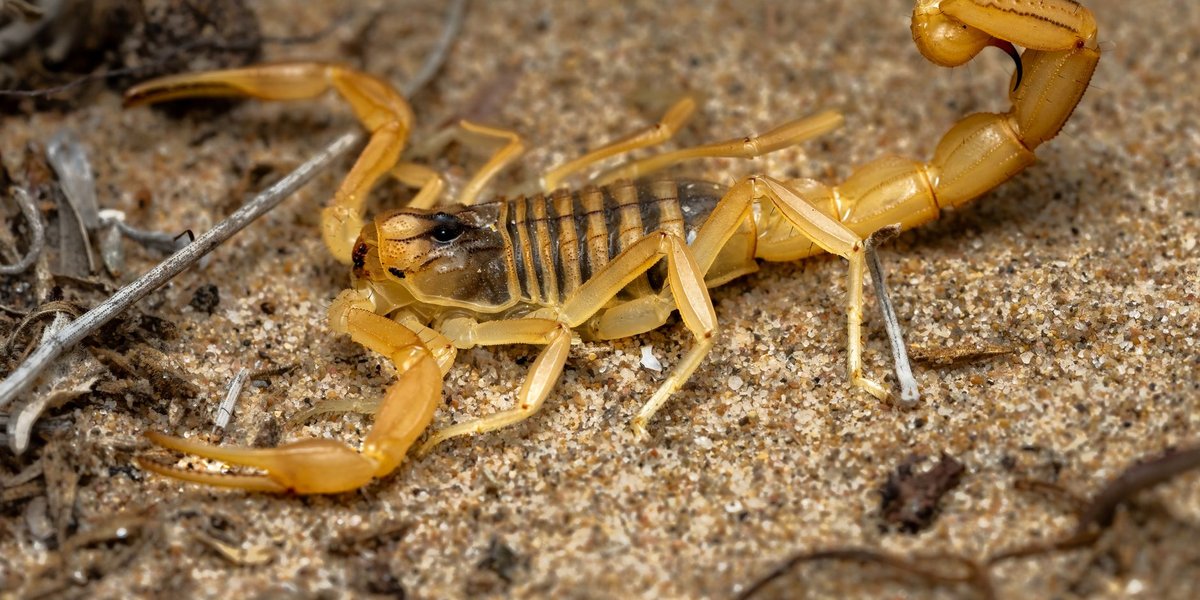
Scorpions have been around for more than 400 million years, and the basic design has barely changed: eight legs, two claws, a segmented tail with a stinger. Most of the roughly 2,000-plus species are harmless to people. A few are not. This guide covers what scorpions are, why they glow, which ones you should worry about, and what to do if one stings you. (Looking for the German rock band? Different article.)
Table of Contents
- Quick Facts
- How Many Scorpion Species Are There?
- Anatomy and Senses
- Why Scorpions Glow Under UV Light
- Scorpion Venom: What It Does
- Three Scorpions Compared
- Diet and Survival
- Reproduction and Live Birth
- Where Scorpions Live
- Scorpion Sting First Aid
- Scorpion Myths
Quick Facts
- Group: Order Scorpiones, class Arachnida (related to spiders, ticks and mites)
- Species: about 2,000 to 2,800, depending on the checklist and the year
- Range: every continent except Antarctica
- Dangerous to humans: roughly 25 to 40 species, nearly all in the family Buthidae
- Size: from under 1.5 cm to about 20 cm
- Activity: nocturnal
- Glow: the cuticle fluoresces blue-green under UV light
- Young: born alive, carried on the mother’s back
How Many Scorpion Species Are There?
Sources disagree, and the reason is boring: taxonomists keep describing new ones. Older references and popular pages give about 1,300 to 1,500. Current specialist checklists run well past 2,000, and the count rises by a handful of species most years as researchers survey caves, leaf litter and remote mountains.
Treat any single number as a snapshot. “About 2,000 or more” is the safe answer.
The “dangerous” count is just as fuzzy. The figure you’ll see most is 25 to 40 species with venom capable of killing a healthy adult or, more often, a child. The spread exists because there’s no agreed threshold. Some species have caused a handful of documented deaths, others only severe illness. Nearly all sit in the Buthidae family, which is also the largest scorpion family.
Anatomy and Senses
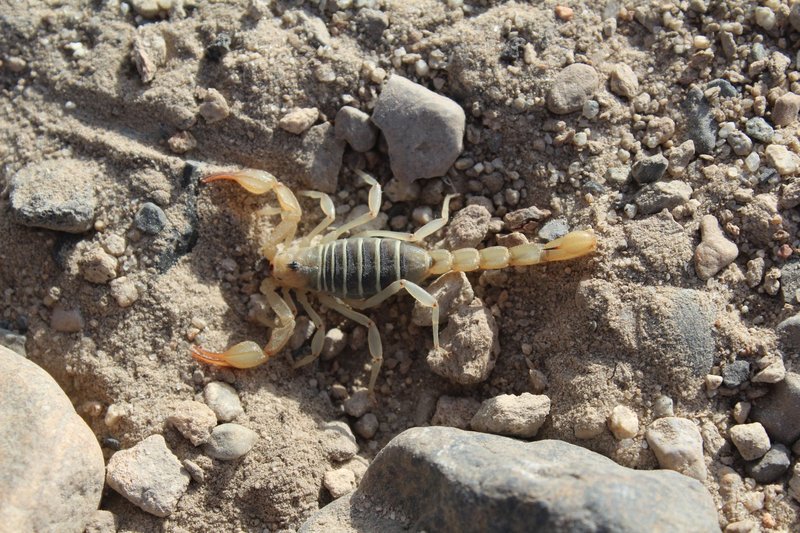
A scorpion’s body has two main parts. The front section, the cephalothorax, carries the eyes, the mouth, four pairs of legs and a pair of pedipalps, the claws. The back section is the abdomen, which ends in the narrow, flexible segments people call the tail. Strictly speaking it’s the metasoma, and the stinger (the telson) sits at its tip.
Scorpions see poorly despite having up to 12 eyes: one pair on top of the head and up to five pairs along the front edges. They barely need them. Their real tools are:
- Trichobothria: fine hairs on the pedipalps that pick up tiny air movements, enough to detect a flying insect’s wingbeat.
- Slit sensilla: vibration sensors in the legs. Desert sand scorpions can locate burrowing prey several centimeters away by vibrations traveling through the ground.
- Pectines: comb-shaped organs on the underside, found only in scorpions. They drag across the ground and sample texture and chemicals, which helps with finding mates and prey.
Scorpions also breathe through book lungs, stacked plates in the abdomen that work like the pages of a book. That’s one more trait they share with spiders.
Why Scorpions Glow Under UV Light
Shine a blacklight on a scorpion in the dark and it lights up blue-green. The glow comes from compounds in the thin, outermost layer of the cuticle, including beta-carboline and a coumarin derivative. They absorb ultraviolet light and re-emit it at a longer, visible wavelength.
The glow is so durable that it survives molting: shed skins glow, and so do fossil scorpions hundreds of millions of years old. It also fades in a freshly molted animal and strengthens as the new cuticle hardens.
Why they do it is still unsettled. Proposed explanations include acting as a sunscreen that converts harmful UV into harmless light, helping the animal sense ambient light and retreat to shelter, and a side effect of the cuticle chemistry with no function at all. None has been settled.
For people, it’s the easiest way to find them. A cheap UV flashlight and a walk through a desert yard at night will turn up scorpions you’d never see by daylight, which is how pest control crews and field biologists survey them.
Scorpion Venom: What It Does
Scorpion venom is a cocktail of proteins, peptides and salts. In the dangerous species, the key ingredients are neurotoxins that interfere with sodium and potassium channels in nerve cells. The result is a flood of uncontrolled nerve signals.
In most species the sting hurts and little else happens. Think wasp or bee sting: sharp pain, a burning or tingling sensation, some swelling, sometimes numbness around the site.
In the medically significant species, symptoms can spread beyond the sting:
- Intense pain that feels out of proportion to the small mark on the skin
- Numbness or tingling that moves up a limb
- Muscle twitching, jerky movements, or trouble swallowing
- Sweating, drooling, a racing heart, or blood pressure swings
- Restlessness and abnormal eye movements, especially in small children
Children, older adults and people with heart conditions face the highest risk. Deaths are rare where medical care and antivenom are accessible, but they still occur in parts of North Africa, the Middle East, Mexico, Brazil and India, where the dangerous species live near homes and clinics can be far away.
Venom also has a medical upside. A peptide from the deathstalker’s venom, chlorotoxin, binds to certain brain tumor cells, and researchers have used it as a tracer to help surgeons see tumor edges.
Three Scorpions Compared
| Emperor scorpion | Deathstalker | Arizona bark scorpion | |
|---|---|---|---|
| Scientific name | Pandinus imperator | Leiurus quinquestriatus | Centruroides sculpturatus |
| Size | up to about 20 cm | 8 to 10 cm | 6 to 8 cm |
| Range | West African rainforests and savannas | North Africa and the Middle East | Sonoran Desert (Arizona, nearby states, northern Mexico) |
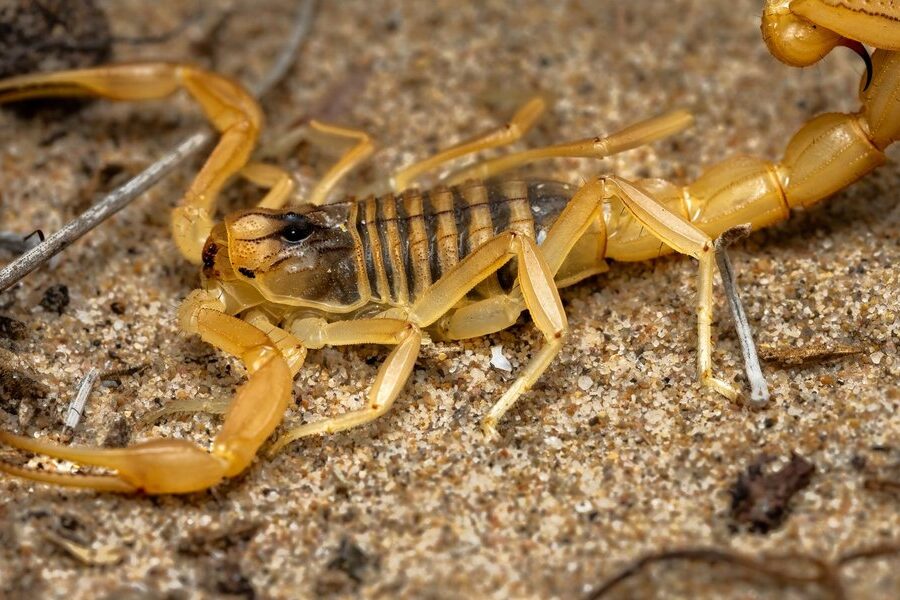
| Appearance | Large, black, heavy claws | Pale yellow, thin claws, slender tail | Small, tan, slim |
| Venom danger | Low (comparable to a bee sting for most people) | High | Highest in North America, rarely fatal with care |
| Behavior | Slow, relies on its big claws | Fast, quick to sting | Climbs walls and trees, often indoors |
The pattern is worth remembering: big claws and a bulky body usually mean weak venom, because the animal can overpower prey by force. Thin claws and a slender tail usually mean the scorpion relies on venom. It’s a useful rule of thumb, not a guarantee.
Diet and Survival
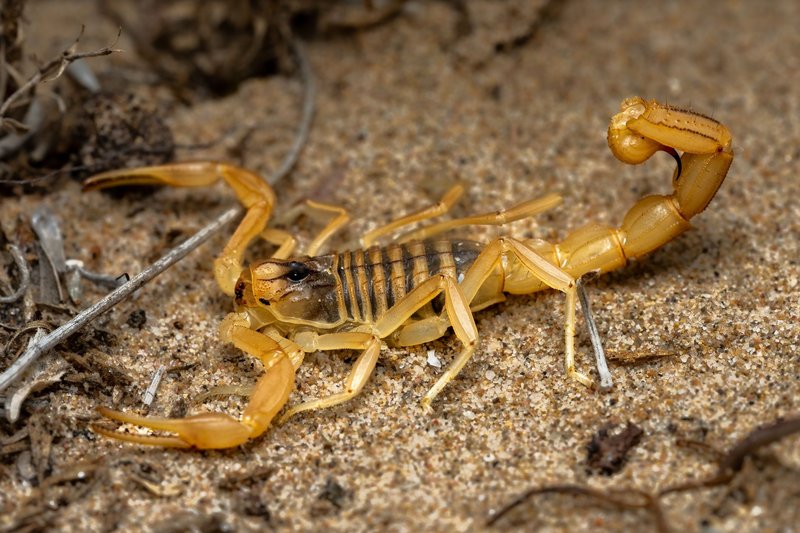
Scorpions are ambush predators. They sit near a burrow or under a rock, grab prey with the pedipalps and pull it apart with their chelicerae, the small pincer-like mouthparts. Insects, spiders and other scorpions are the main menu. Larger species occasionally take small lizards and mice.
Most use venom only on prey that’s large or fights back. Smaller prey gets crushed. The scorpion then liquefies the meal with digestive fluid and sucks it up, because it can’t chew.
What sets scorpions apart is how little they need. Their metabolic rate is among the lowest of any terrestrial arthropod. Some species survive for months, in some reports up to a year, without a meal. That’s how they live in deserts where prey is scarce and temperatures swing by dozens of degrees in a day. They spend most of their time hidden in burrows or crevices and come out at night.
Reproduction and Live Birth
Scorpion courtship is a slow dance. The male grasps the female’s pedipalps and leads her back and forth in the “promenade à deux,” which can last minutes or hours. He deposits a spermatophore on the ground and maneuvers her over it so she can take it up.
The young develop inside the mother and are born alive. Gestation takes anywhere from a couple of months to more than a year, depending on the species and temperature. A litter can have a few to a few dozen scorplings, and the numbers can pass 100 in some species.
Newborns are pale and soft. They climb onto the mother’s back and stay there until their first molt, usually within a couple of weeks, after which they harden and disperse. Young scorplings molt several times before reaching adulthood, which can take months to years.
Where Scorpions Live
Scorpions occupy deserts, grasslands, savannas, tropical rainforests, mountains up to several thousand meters, and caves. They’re absent from Antarctica and from the coldest regions. Deserts get the attention, but a large share of species live in forests and under leaf litter.
The medically important species cluster in a few regions:
- North Africa and the Middle East: deathstalker and Androctonus species (fat-tailed scorpions)
- Mexico and the southwestern US: Centruroides, including the Arizona bark scorpion
- Brazil and northern South America: Tityus species, with Tityus serrulatus causing most severe cases in Brazil
- India: the Indian red scorpion, Hottentotta tamulus
- South Africa: thick-tailed scorpions of the genus Parabuthus
For a general overview of scorpion biology and range, see National Geographic’s scorpion profile.
Scorpion Sting First Aid
Most stings can be handled at home. The goal is to ease pain and watch for signs that the sting is more than local.
- Wash the area with soap and water.
- Apply a cool compress or cold pack wrapped in cloth for about 10 minutes at a time. Don’t put ice directly on skin.
- Keep the limb still and, if possible, at about heart level.
- Take over-the-counter pain relief if you need it, following the label directions.
- Remove rings and tight clothing near the sting in case of swelling.
- Call a poison control center. In the US, the Poison Help line is 1-800-222-1222, and the American Association of Poison Control Centers runs the national network. Elsewhere, use your local emergency number or poison service.
Don’t cut the wound, try to suck out venom, apply a tourniquet, or use electric shock. None of these help, and some cause harm.
Get medical help right away if:
- The person is a young child, an older adult, or has a heart condition
- Symptoms spread beyond the sting site (numbness, twitching, trouble breathing or swallowing, drooling, unusual eye movements)
- A child is inconsolable, restless or thrashing
- You were stung by a species you know or suspect is dangerous
- Pain is severe and getting worse
Antivenom exists for several dangerous species. In the US, an antivenom for Arizona bark scorpion stings has been available since the FDA approved Anascorp in 2011, and it’s used for severe symptoms in children in particular.
If you can safely do it, take a photo of the scorpion or note its color and size. It helps clinicians, but don’t risk a second sting to catch it.
To keep scorpions out of your home in scorpion country, shake out shoes and clothing, seal gaps under doors, keep woodpiles and debris away from walls, and check bedding. Bark scorpions are climbers, so trim branches touching the house.
Scorpion Myths
“Scorpions sting themselves to death when surrounded by fire.” No. Scorpions are largely resistant to their own venom. Footage of a “suicide” is typically a scorpion dying from heat and thrashing in response to it, not stinging itself.
“The smaller the scorpion, the more dangerous it is.” Partly true as a rule of thumb (see the table above), but it fails often enough that you shouldn’t rely on it. Some small species are harmless, and some large ones are not.
“All scorpions can kill you.” No. Only a few dozen of the 2,000-plus species pose a real threat, and most stings produce symptoms like a bee sting.
“Scorpions are insects.” They’re arachnids, closer to spiders than to beetles or ants.
“Scorpions live only in deserts.” Many live in forests, caves and mountains, and a few species reach temperate regions as far north as southern Europe and the northern US.
For a broader look at the animal’s classification and natural history, see Britannica’s scorpion entry.