There are around 50,000 named spider species crawling, jumping, and ballooning across every continent except Antarctica. Of those, the number that can do a healthy adult serious harm in North America is two. Maybe three if you’re generous. That ratio — tens of thousands of species, a literal handful worth worrying about — is the single most useful fact about spiders, and it’s the one most people get backwards.
So let’s fix that. This is a practical guide to the spiders you’ll actually meet: how to tell them apart, which ones earn a careful response, what a real bite looks like versus the “spider bite” your doctor diagnosed without seeing a spider, and why the eight-legged tenant in your basement is doing you a favor.
Table of Contents
- What a spider actually is
- How to identify a spider
- Common house spiders (and what they’re doing in your house)
- The spiders that are actually dangerous
- Spider bite symptoms and first aid
- How to keep spiders out
- Why spiders are worth keeping around
- Quick answers
What a spider actually is {#what-a-spider-actually-is}
A spider is not an insect. This matters more than it sounds. Insects have six legs, three body segments, and usually antennae and wings. Spiders have eight legs, two body segments (a fused head-and-thorax called the cephalothorax, plus an abdomen), no antennae, and no wings. They’re arachnids — same class as scorpions, ticks, and mites. If you want to keep the two groups straight at a glance, the differences between insects and arachnids come down to a few reliable tells like these.
Every spider makes silk. Not every spider builds a web. That’s a distinction worth holding onto, because the orb-weaver spinning a wheel between your porch railings and the wolf spider sprinting across your garage floor are using silk in completely different ways. The web-builders trap food in silk. The hunters use silk for egg sacs, draglines, and the occasional ambush, but they run their prey down on foot.
Nearly all spiders are venomous, in the technical sense that they inject venom to subdue prey. That word — venomous — does a lot of unfair work scaring people. The vast majority have fangs too small or too weak to break human skin, and venom calibrated for a fly, not a mammal. (Also, the word people reach for is usually “poisonous,” which is wrong. Poison is something you eat or touch that hurts you. Venom is injected. Spiders are venomous, not poisonous. You can eat one, if you must.)
Spiders breathe through book lungs — stacked, page-like tissue layers in the abdomen. They have a heart that pumps blue-green blood (hemolymph, colored by copper instead of iron). And most have eight eyes arranged in patterns so specific that arachnologists use the eye layout alone to sort spiders into families.
How to identify a spider {#how-to-identify-a-spider}
You don’t need a microscope to narrow down what you’re looking at. Four features get you most of the way:
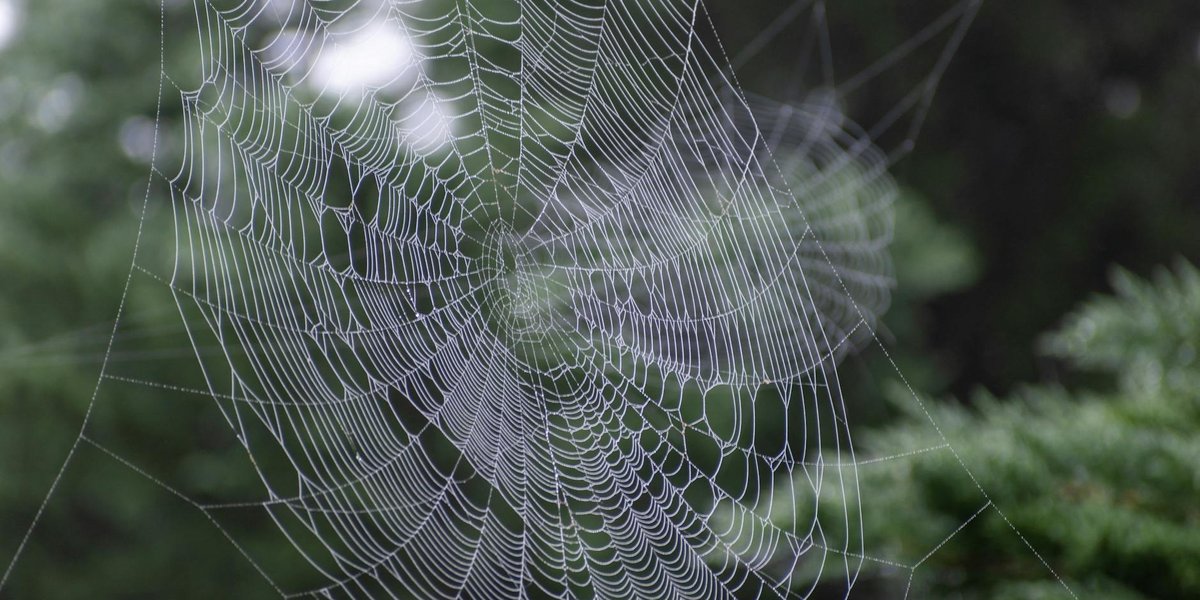
The web. A flat, wheel-shaped web in the open is an orb-weaver. A messy, three-dimensional tangle in a corner is a cobweb spider (the family that includes house spiders and widows). A flat sheet with a funnel retreat at one edge is a funnel weaver or grass spider. No web at all, just a spider out in the open? It’s a hunter — wolf, jumping, or sac spider.
The body shape. A fat, round abdomen usually means a web-builder sitting and waiting. A flatter, more muscular build means an active hunter.
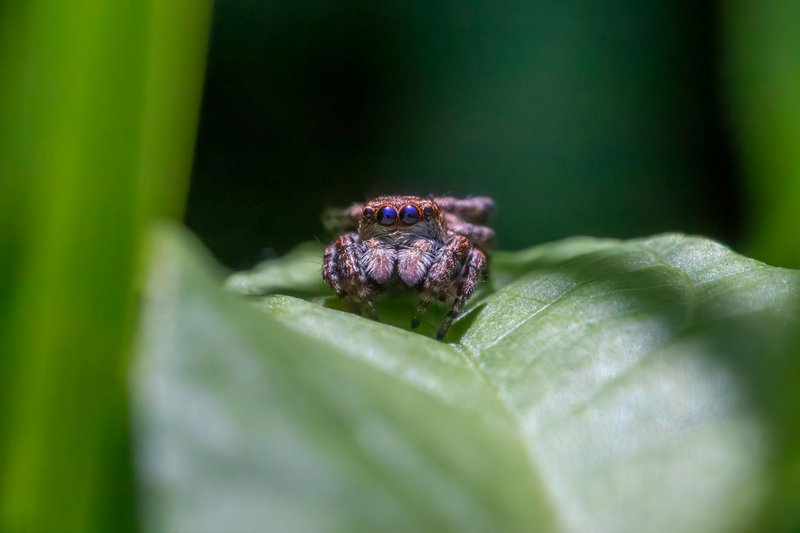
The eyes. If you can get close (a phone camera with macro mode helps), count and arrange the eyes. Jumping spiders have two enormous front-facing eyes like binoculars. Wolf spiders have a row of four small eyes below two big ones. Recluses are the oddball with six eyes in three pairs — more on that below, because it’s diagnostic.
The legs. Long, thin, splayed legs holding the body close to a surface suggest a hunter or a cellar spider. Legs angled forward in a crab-like stance? Probably a crab spider, waiting on a flower.
One more honest note: leg span makes spiders look bigger and scarier than their bodies are. A wolf spider with a body the size of a pea can span four inches leg-tip to leg-tip. Judge by the body, not the sprawl.
Common house spiders (and what they’re doing in your house) {#common-house-spiders}
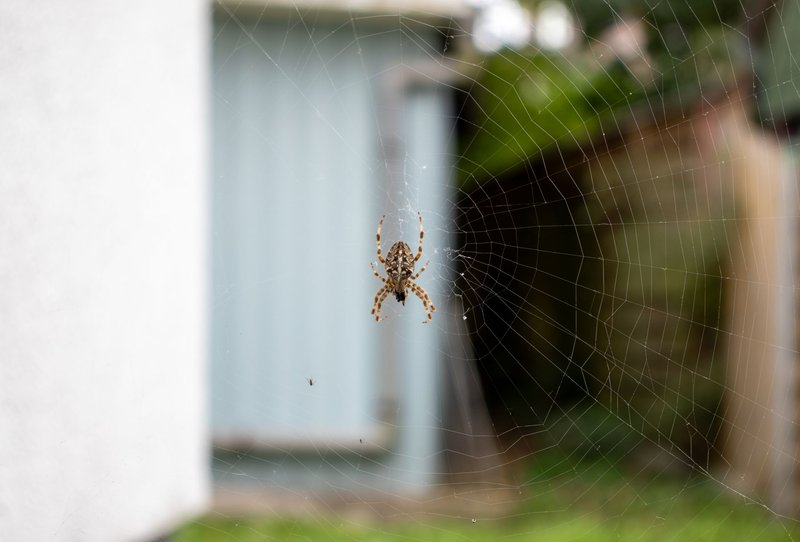
Most spiders indoors are not lost garden spiders. They’re a small set of species that have lived alongside humans for so long they barely exist in the wild anymore. Here’s who you’re sharing the lease with.
Common house spider (Parasteatoda tepidariorum). The classic cobweb in the corner of the ceiling. Brownish, round-bodied, builds the messy tangle webs you keep walking through. Completely harmless. It’s eating the gnats and mosquitoes that got in.
Cellar spider (Pholcus phalangioides). Long, impossibly thin legs and a tiny body, hanging in a loose web in your basement or under the stairs. People call them “daddy longlegs,” which causes endless confusion — true daddy longlegs (harvestmen) aren’t spiders at all and don’t even have venom. The urban legend that cellar spiders are “the most venomous spider but their fangs are too short to bite” is false on both counts. Their venom is unremarkable, and their fangs can pierce human skin; the bite just does essentially nothing.
Jumping spider (family Salticidae). Small, compact, often fuzzy, with those two big curious front eyes. They don’t build webs; they stalk and pounce. They’ll turn to look at you, which is either charming or unnerving depending on your wiring. Harmless, and arguably the most personable spider you’ll ever meet.
Wolf spider (family Lycosidae). Big, fast, ground-hunting, and the one most likely to make someone scream when it bolts out from under a moved box. Females sometimes carry an egg sac on their spinnerets and later carry the spiderlings on their backs. A wolf spider bite is possible if you grab one, and it stings like a bee sting, but it’s medically trivial.
Grass spider / funnel weaver (genus Agelenopsis). Builds the sheet-with-a-funnel webs you see beaded with dew on lawns and shrubs in late summer. Fast, shy, indoor-curious in fall. Not dangerous.
The pattern here: the spiders that share your house are pest controllers, not threats. A single house spider can knock out hundreds of insects over its life.
The spiders that are actually dangerous {#the-spiders-that-are-actually-dangerous}
In the United States, the list of spiders with venom medically significant to humans is short: widow spiders and the brown recluse. That’s it. Everything else is, at worst, a painful bite with local swelling.
Widow spiders (black widow and relatives)
The black widow (Latrodectus mactans and cousins) is the one people picture: glossy, jet-black, with a red hourglass on the underside of the abdomen. Females are the dangerous ones; males are smaller and rarely bite. They build strong, irregular cobwebs low to the ground — woodpiles, garages, under outdoor furniture, in the corners of sheds. They’re not aggressive. Most bites happen when someone reaches into a dark space and presses a hand against one.
Widow venom is a neurotoxin called latrotoxin. A bite can cause intense muscle cramping (often in the abdomen and back, sometimes mistaken for appendicitis), sweating, nausea, and high blood pressure — a syndrome called latrodectism. It’s genuinely unpleasant. It’s also rarely fatal in healthy adults; antivenom exists, and most people recover fully. The people at real risk are small children and the elderly.
Brown recluse (Loxosceles reclusa)
The brown recluse lives in the south-central US — think Missouri, Arkansas, Oklahoma, Tennessee, and surrounding states. Outside that range, “brown recluse” is wildly over-diagnosed; researchers have collected recluses by the hundreds in homes inside their range and found near-zero in homes far outside it.
The identifying mark is a dark violin shape on the cephalothorax (neck of the “violin” pointing toward the abdomen) and, definitively, six eyes arranged in three pairs instead of the usual eight. They’re uniformly tan to brown with no banding on the legs and no markings on the abdomen. If your “recluse” has spiny legs, leg bands, or an abdomen pattern, it isn’t one.
Recluse venom can cause loxoscelism — a wound where tissue around the bite dies, sometimes leaving an ulcer that takes weeks to heal. This is the dramatic outcome people fear. The honest reality: most recluse bites heal on their own with minor symptoms, and the severe necrotic cases are the minority. They’re also genuinely reclusive, hiding in undisturbed spots like boxes, closets, and woodpiles. The classic bite scenario is putting on a stored shoe or jacket.
A useful corrective from the medical literature: the CDC notes that the vast majority of spider bites are minor and heal without serious problems, and that many wounds blamed on spiders turn out to be something else entirely — frequently a MRSA skin infection, which mimics a “spider bite” so well that misdiagnosis is common.
Spider bite symptoms and first aid {#spider-bite-symptoms-and-first-aid}
Here’s a plain-language reference for what different bites tend to do and what to do about them.
| Bite type | Typical symptoms | Severity | What to do |
|---|---|---|---|
| Common spider (house, wolf, jumping, etc.) | Brief sting, mild redness, small bump | Trivial | Wash with soap and water, ice if it itches. Done. |
| Black widow | Bite stings, then 1–3 hrs later: muscle cramps, abdominal rigidity, sweating, nausea | Moderate to serious | Clean the area, apply ice, take a pain reliever, and get to urgent care — especially for kids, elderly, or severe symptoms. |
| Brown recluse | Often painless at first; over hours/days a red, blistering, or darkening sore may form | Variable; usually mild, occasionally necrotic | Clean it, ice it, elevate, and see a doctor if the wound darkens, spreads, or you develop fever. |
A few things worth knowing regardless of the species:
- Most “spider bites” weren’t witnessed. If you didn’t see a spider bite you, a doctor genuinely can’t confirm it was one. Two small puncture marks aren’t proof.
- Watch the wound, not the spider. Spreading redness, red streaks, pus, fever, or a wound that worsens over days points to infection and needs medical care, whatever caused it.
- Skip the folk remedies. No bleach, no gasoline, no “drawing out the venom.” Soap, water, ice, elevation, and time handle the overwhelming majority of cases.
If you have the spider — or what’s left of it — bag it. A positive ID changes treatment, and it spares you a week of worrying it was a recluse when it was a sac spider.
How to keep spiders out {#how-to-keep-spiders-out}
You won’t get to zero spiders, and you don’t want to. But if they’re concentrating indoors, the move is to make your home boring to them: no bugs to eat, no gaps to enter, no clutter to hide in.
- Cut the food supply. Spiders follow prey. Swap white outdoor bulbs for yellow “bug” bulbs that draw fewer insects, fix screens, and deal with whatever’s attracting flies and mosquitoes in the first place. Fewer bugs, fewer spiders.
- Seal the entry points. Caulk gaps around windows, doors, pipes, and vents. Add weatherstripping and door sweeps. This is the single most effective thing you can do, and it also lowers your heating bill.
- De-clutter the hiding spots. Garages, basements, closets, and storage boxes are prime real estate. Store items in sealed plastic bins instead of cardboard, and keep firewood and debris away from the foundation.
- Vacuum the webs. Knock down webs and egg sacs (look for round, papery sacs) with a vacuum. It’s faster than chemicals and it removes the next generation.
- Skip the chemical fog. Broad indoor pesticide spraying is mostly theater against spiders, which don’t groom poison off surfaces the way insects do. Targeted sealing and cleaning beats fumigation. The University of California’s IPM program reaches the same conclusion: physical exclusion outperforms insecticides for spider control.
For widows and recluses specifically: wear gloves when reaching into woodpiles, sheds, or long-stored boxes, and shake out shoes and gloves that have sat in a garage. That one habit prevents most serious bites.
Why spiders are worth keeping around {#why-spiders-are-worth-keeping-around}
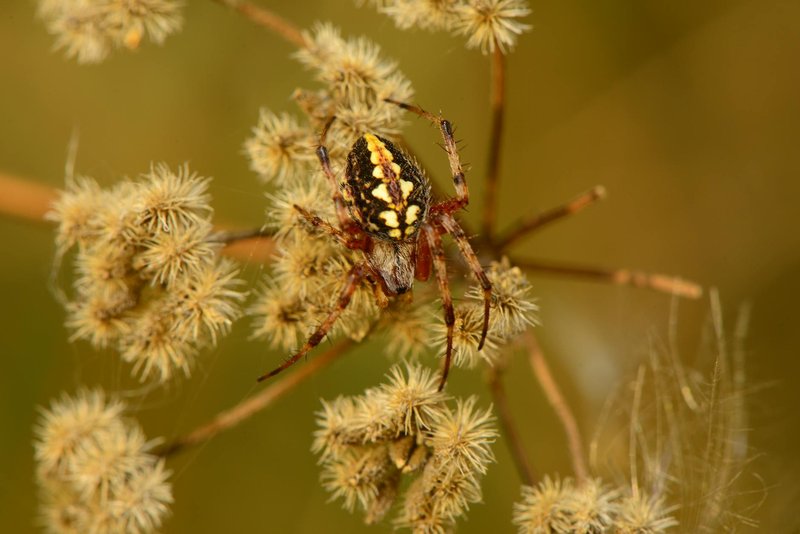
Step back from the bite anxiety and the picture changes. Spiders are among the most effective predators on land, and almost all of what they eat is stuff you’d rather not have around.
The numbers are staggering. A frequently cited estimate from researchers Martin Nyffeler and Klaus Birkhofer, published in the journal The Science of Nature, puts the global spider population’s annual prey consumption at 400 to 800 million metric tons of insects and other invertebrates. For scale, all of humanity eats roughly 400 million tons of meat and fish a year. The world’s spiders out-eat the entire human species, and their menu is mostly flies, mosquitoes, moths, aphids, and agricultural pests.
That’s free pest control on a planetary scale. In farm fields, spiders suppress crop-damaging insects. In your home, they intercept the mosquitoes and gnats before they find you. Pull spiders out of the equation and the insect populations they hold down don’t just persist — they boom.
They’re also load-bearing in food webs, sitting in the middle of countless food chains as both predator and prey: they feed birds, lizards, and other animals up the chain while keeping the insects below them in check. And their silk is a genuine engineering marvel: dragline silk has a tensile strength competitive with steel by weight and a toughness that outperforms it, which is why materials scientists have spent decades trying to reproduce it.
None of this requires you to love spiders. It just reframes the one in the corner from “threat” to “unpaid exterminator with great structural-engineering credentials.”
Quick answers {#quick-answers}
Are spiders poisonous? Almost all are venomous (they inject venom into prey), but only a couple have venom dangerous to humans, and “poisonous” is the wrong word — spiders aren’t harmful to touch or eat.
Which spiders are actually dangerous in the US? Widow spiders (black widow and relatives) and the brown recluse. Everything else is, at worst, a painful but harmless bite.
Is a daddy longlegs the most venomous spider? No. The most common “daddy longlegs,” the harvestman, isn’t even a spider and has no venom glands. The cellar spider that shares the nickname has ordinary, harmless venom. The myth is just a myth.
Should I kill house spiders? Generally no. They’re eating the insects you don’t want, and a relocated spider outdoors does the same job. Save intervention for confirmed widows or recluses in living spaces.
How do I know if it’s a brown recluse? Six eyes in three pairs, a violin marking, uniform tan-brown color, no leg bands, no abdomen pattern — and you’re in its south-central US range. Fail any of those and it almost certainly isn’t one.
The takeaway holds: out of roughly 50,000 spider species, you can identify the small handful that matter, treat the rest as the quiet pest control they are, and get on with your day. The spider in the corner already has.