The Seychelles checklist runs to 286 species, but almost nobody flies 4,000 miles to tick off the full list. They come for two things: the 14 birds found nowhere else on Earth, and the seabird colonies so dense they blot out the sun on takeoff. The granite islands — Mahé, Praslin, La Digue — hold the endemics, survivors of conservation rescues that pulled several species back from a literal handful of individuals. The flat coral islands and reserves out north hold the seabirds, millions of them.
This guide splits the birds the way the islands actually do: endemics you’ll have to work for, seabirds you can’t miss, and the common residents filling in everything between. Each entry tells you what to look for and where to find it. There’s also a section on which islands earn the boat fare, and a quick-reference table at the bottom for the planners.
Table of Contents
- Seychelles Endemic Birds
- Iconic Seychelles Seabirds
- Common Residents You’ll See Everywhere
- Best Islands for Birdwatching
- Conservation Comebacks: The Warbler and the Magpie Robin
- Quick-Reference Table
- When to Go
Seychelles Endemic Birds
These eight are the prize. Every one is endemic to the Seychelles granitic islands, several are restricted to a single island or reserve, and a few were nearly lost entirely. If you see all eight, you’ve birded Seychelles properly.
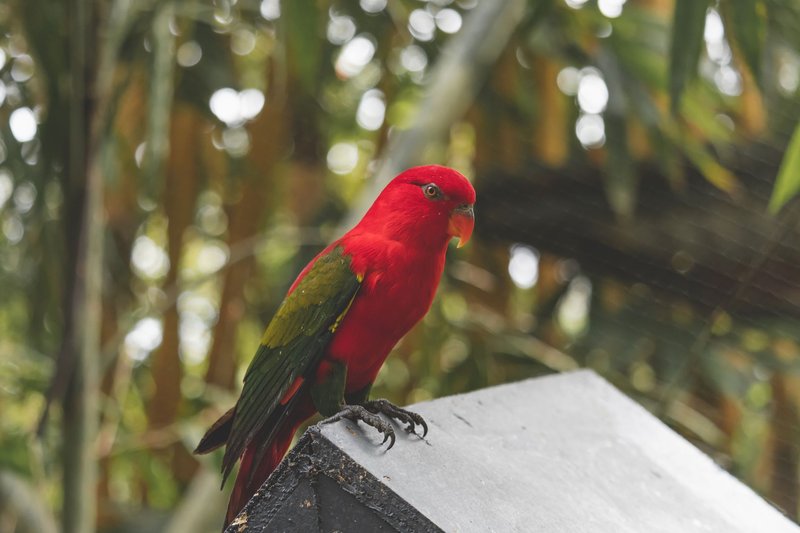
Seychelles Magpie Robin
A glossy black bird the size of a thrush, with a bold white wing patch and a habit of marching across forest floors and lawns to grab insects. It’s tame to the point of comedy — on Cousin and Frégate it’ll work the ground a couple of meters from your feet, flipping leaf litter. This is the conservation poster bird: the population bottomed out at around 12–15 individuals on Frégate Island in the 1960s. It’s now spread across five islands. Look for it on Cousin, Cousine, Aride, Denis, and Frégate.
Seychelles Warbler
Plain olive-brown and easy to overlook, which makes its story all the more dramatic. By 1968 the entire species was down to roughly 26 birds clinging to a single bush-covered corner of Cousin Island. Conservationists bought the island, let the native vegetation recover, and the warbler exploded. It’s now on Cousin, Aride, Denis, and Frégate. Listen for the loud, churring song coming from dense scrub — you’ll hear it long before you see it.
Seychelles Black Paradise Flycatcher
The “veuve,” as locals call it (French for “widow”). The male is the spectacle: jet-black plumage and absurdly long tail streamers that trail well past the body, flickering through the shade of badamier woodland. Females and juveniles are chestnut and white with a black head. This one is essentially restricted to La Digue, where the Veuve Reserve protects the marshy native forest it depends on. Fewer than 300 mature birds exist. La Digue is the only realistic place to see it.
Seychelles Fody
A small finch-like bird; the breeding male flushes yellow-gold around the face and throat, while everyone else stays sparrow-brown. Locally it’s the “tok-tok” for its call. It forages in the open, often near seabird colonies where it scavenges, and it’s gotten comfortable around people. Cousin, Cousine, Frégate, and D’Arros hold the strongest populations.
Seychelles Scops Owl
The “syer,” named for its repeated, rasping saw-like call that carries through Mahé’s misty highland forest at night. It’s tiny, mottled brown, and was actually presumed extinct for much of the 20th century before being rediscovered in 1959. It lives only in the Morne Seychellois forest on Mahé. Seeing one means a guided night walk and a lot of patience; hearing one is far more likely.
Seychelles Kestrel
The smallest falcon in the world, barely bigger than a starling, with rich chestnut upperparts and a slate-grey head. Locally it’s the “katiti.” Unlike most kestrels it hunts from a perch rather than hovering, dropping onto lizards and large insects. It’s mostly confined to Mahé and Silhouette, and it has adapted to nesting in buildings, so the rooftops of Victoria are a decent place to scan.
Seychelles White-eye
A small grey-green bird with the faint pale eye-ring its name promises. It went through a scare similar to the magpie robin — by the 1990s it survived on just two islands and numbered in the low hundreds. Translocations have since established new populations on Frégate, Cousine, and North Island. It moves in restless little flocks through the canopy.
Seychelles Blue Pigeon
Big, handsome, and hard to miss once you spot one: deep blue-grey body, white shoulders, and a bare red wattle around the eye and crown that looks almost cartoonish. It feeds on fruit high in the canopy across the main granitic islands — Mahé, Praslin, La Digue — so a fruiting tree is your best bet.
Iconic Seychelles Seabirds
If the endemics are about scarcity, the seabirds are about sheer numbers. The reserves of Aride, Cousin, and Bird Island host breeding colonies that run into the hundreds of thousands. This is the spectacle most visitors remember.
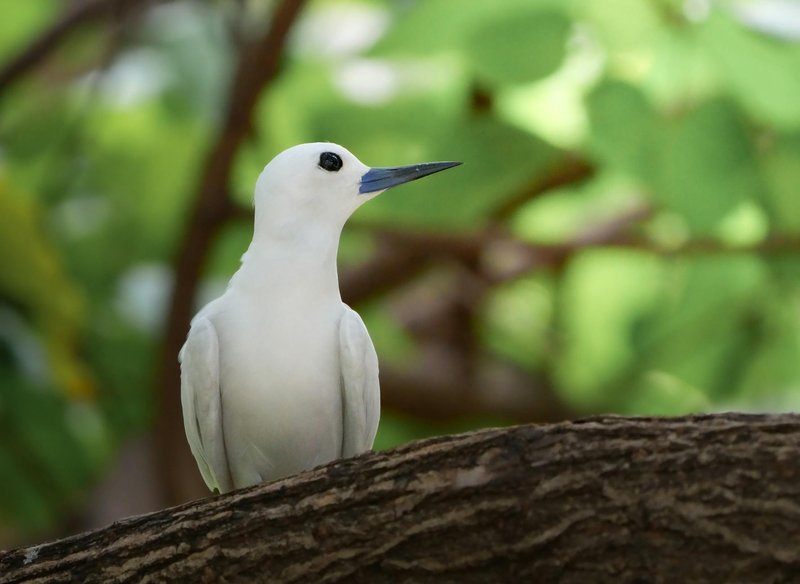
Fairy Tern (White Tern)
The national bird, and the one you’ll photograph most. Pure white with a black bill and dark, ink-spot eyes that give it a permanently startled expression. Its nesting strategy is famously reckless: it lays a single egg directly onto a bare branch, no nest at all, and somehow it works. You’ll see fairy terns hovering curiously over your head on Cousin and La Digue, close enough to feel the air move.
Sooty Tern
The volume of the colonies. On Bird Island, more than a million pairs of sooty terns arrive to breed between roughly May and October, and the noise is a physical thing — a roaring, ceaseless wall of calls. They’re sharply marked, black above and white below. The Seychellois harvest their eggs under a regulated quota, a tradition that predates the resorts and remains one of the islands’ most distinctive natural resources. The IUCN tracks the species as a useful barometer of seabird-colony health across the region.
Lesser Noddy
A sooty-brown tern with a pale grey-white cap, nesting in dense, chattering colonies in trees and shrubs. Aride Island holds one of the largest lesser noddy colonies in the western Indian Ocean — hundreds of thousands of pairs. Walk the reserve trail in season and they’re nesting at eye level on either side of you.
White-tailed Tropicbird
Slender, brilliant white, with two long tail streamers trailing behind like ribbons. It nests in rock crevices and tree hollows on the granitic islands, so unlike most seabirds here you can find it nesting inland, not just on the offshore reserves. Watch for its stiff, fluttering flight along coastal cliffs on Mahé and Praslin.
Frigatebird
Unmistakable: huge, angular, and almost prehistoric in the air, with a deeply forked tail. Males inflate a scarlet throat pouch in display. Frigatebirds don’t breed in large numbers in the central granitic islands but roost in spectacular numbers on Aldabra and around the outer islands, and they’re often seen harassing other seabirds mid-air to steal their catch.
Red-footed Booby
The other great Aldabra seabird. White-bodied with — as advertised — bright red feet and a pale blue bill. Aldabra Atoll, a UNESCO World Heritage site, holds one of the largest red-footed booby colonies on the planet, alongside the world’s biggest population of giant tortoises. Reaching it takes a serious expedition, but for hardcore birders it’s the holy grail.
Common Residents You’ll See Everywhere
Not every memorable bird is rare. These four turn up around hotels, gardens, and roadsides, and they’re worth knowing so you don’t waste a long-lens shot on a bird you’ll see a hundred more times.
Madagascar Fody
The red bird everyone photographs first, mistaking it for something special. Breeding males are a vivid scarlet; it’s an introduced species, widespread and tame, and it’s actually a competitor that complicates conservation for the native Seychelles Fody. Bright, common, and everywhere there’s food.
Seychelles Sunbird
Tiny, dark, and constantly busy, with a down-curved bill for sipping nectar and a metallic sheen that flashes purple-blue in good light. It’s the “kolibri” locally, though it’s a sunbird, not a hummingbird. It’s genuinely endemic and common, so it’s the one easy endemic — you’ll likely see it from your balcony.
Madagascar Turtle Dove
A warm pinkish-brown dove that walks hotel lawns and forest tracks without much fear. The local population has hybridized heavily with introduced doves, so “pure” birds are now mostly limited to the outer islands.
Cattle Egret
White, long-necked, and following the cattle and lawnmowers of Mahé and Praslin for the insects they flush. Common across the granitic islands and a useful reference point for sizing up other waders.
Best Islands for Birdwatching
Where you go matters more than how long you stay. Three special reserves do most of the heavy lifting.
Cousin Island is the original conservation success — a former coconut plantation bought in 1968, now a tightly managed reserve run by Nature Seychelles. It’s where the warbler was saved. Day visits are guided, numbers are capped, and you can reliably see the magpie robin, warbler, fody, and fairy terns at close range. Reached by boat from Praslin.
Aride Island is the seabird island: the northernmost granitic island and home to the largest seabird populations in the group, including those vast lesser noddy and tropical shearwater colonies. It’s more weather-dependent — landings depend on the swell — but in season it’s the densest seabird experience in Seychelles.
Bird Island is a private coral island at the northern edge of the bank, run as a small eco-lodge, and the place for the sooty tern spectacle from May to October. It’s also where you’ll meet Esmeralda, reputedly one of the world’s oldest and heaviest giant tortoises, plodding around the airstrip.
For the Black Paradise Flycatcher, none of these work — that’s a La Digue bird, found in the Veuve Reserve. And the Scops Owl and Kestrel mean staying on Mahé and arranging time in the Morne Seychellois highlands.
Conservation Comebacks: The Warbler and the Magpie Robin
Two of these birds came within a few dozen individuals of vanishing, and both stories explain why Seychelles birding feels different from anywhere else.
The Seychelles Warbler was, by 1968, down to about 26 birds on a single island. Conservationists bought Cousin, restored the native woodland, and let the population recover — then translocated birds to start new colonies as insurance. It’s one of the most studied wild bird populations in the world; the long-running Cousin study has generated decades of peer-reviewed research, much of it indexed on PubMed. The species went from one island to four and from near-extinction to least-concern.
The Magpie Robin’s low point was even starker: roughly a dozen birds on Frégate in the 1960s, hammered by introduced rats and cats. A dedicated recovery program — predator eradication, supplementary feeding, careful translocation — rebuilt it across five islands. Neither bird is fully out of the woods, but seeing one today means seeing the direct result of a rescue that almost didn’t happen.
Quick-Reference Table
| Bird | Type | Where to See It | Best Season |
|---|---|---|---|
| Magpie Robin | Endemic | Cousin, Frégate, Aride | Year-round |
| Seychelles Warbler | Endemic | Cousin, Aride, Denis | Year-round |
| Black Paradise Flycatcher | Endemic | La Digue (Veuve Reserve) | Year-round |
| Seychelles Fody | Endemic | Cousin, Cousine, Frégate | Year-round |
| Scops Owl | Endemic | Mahé (Morne Seychellois) | Year-round (night) |
| Seychelles Kestrel | Endemic | Mahé, Silhouette | Year-round |
| Seychelles White-eye | Endemic | Frégate, Cousine, North | Year-round |
| Seychelles Blue Pigeon | Endemic | Mahé, Praslin, La Digue | Year-round |
| Fairy Tern | Seabird | Cousin, La Digue (everywhere) | Year-round |
| Sooty Tern | Seabird | Bird Island | May–Oct |
| Lesser Noddy | Seabird | Aride | Apr–Oct |
| White-tailed Tropicbird | Seabird | Mahé, Praslin cliffs | Year-round |
| Frigatebird | Seabird | Aldabra, outer islands | Year-round |
| Red-footed Booby | Seabird | Aldabra Atoll | Year-round |
| Seychelles Sunbird | Resident | Gardens, everywhere | Year-round |
| Madagascar Fody | Resident | Everywhere | Year-round |
| Madagascar Turtle Dove | Resident | Lawns, tracks | Year-round |
| Cattle Egret | Resident | Pastures, lawns | Year-round |
When to Go
For the endemics, timing barely matters — they’re resident year-round, and a still, dry morning is your friend regardless of month. For the seabird spectacle, the window is the southeast monsoon, roughly May to October, when the sooty terns and noddies arrive to breed and the colonies hit full volume. That same season brings cooler, breezier weather and choppier seas, which can occasionally scrub a landing on Aride. The shoulder months of April and November tend to offer the calmest crossings.
If you only have time for one combination, base on Praslin for the easy boat to Cousin, day-trip to La Digue for the flycatcher, and add a night or two on Bird Island in season. That itinerary alone gets you most of the birds on this list — endemics, seabirds, and the comeback stories behind them.