Non-metals are the elements that don’t behave like metals: they conduct heat and electricity poorly, they shatter instead of bending when solid, and in chemical reactions they tend to gain electrons rather than lose them. On the periodic table they sit on the upper right, plus hydrogen, which sits alone in the top-left corner and still counts.
Most lists say there are 17. Some say 14, some say 23. That mismatch isn’t a mistake, it’s a naming choice, and it’s explained below.
Table of Contents
- TLDR
- Where non-metals sit on the periodic table
- List of non-metals: all 17 in one table
- Why sources disagree on how many there are
- Properties of non-metals vs metals
- The three groups of non-metals
- Uses of non-metals in everyday life
- Non-metallic materials are a different thing
- FAQ
TLDR
- Non-metals are elements that are poor conductors, brittle as solids, usually dull, and tend to form negative ions or share electrons.
- The standard count is 17: hydrogen, helium, carbon, nitrogen, oxygen, fluorine, neon, phosphorus, sulfur, chlorine, argon, selenium, bromine, krypton, iodine, xenon and radon.
- At room temperature, 11 are gases, 1 is a liquid (bromine) and 5 are solids (carbon, phosphorus, sulfur, selenium, iodine).
- The famous exceptions: graphite conducts electricity, iodine is shiny, diamond is the hardest natural material, and bromine is a liquid.
- The six metalloids (boron, silicon, germanium, arsenic, antimony, tellurium) sit between metals and non-metals and are counted separately.
Where non-metals sit on the periodic table
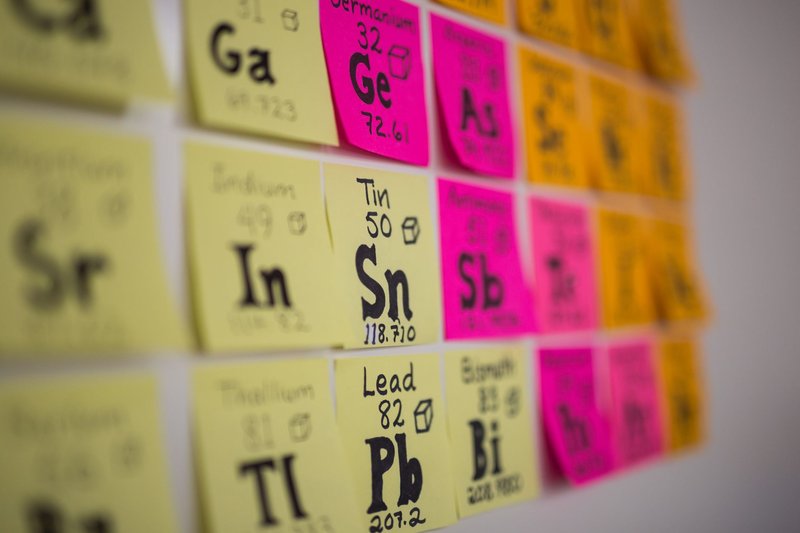
Find the “staircase” line that starts under boron and steps down and to the right toward astatine. Everything above and to the right of it is a non-metal, apart from the metalloids hugging the line itself. The last column, the noble gases, is entirely non-metal. So is the halogen column next to it (fluorine, chlorine, bromine, iodine), and a scatter of elements in groups 14 to 16: carbon, nitrogen, oxygen, phosphorus, sulfur and selenium.
Then there’s hydrogen, the oddball. It’s printed above lithium because it has one valence electron, but its behavior is non-metallic. It’s a gas made of H₂ molecules, it bonds covalently with other non-metals, and it holds onto its electron too tightly to act like an alkali metal. Under the pressures inside Jupiter it’s believed to turn metallic, but nobody meets it that way on Earth.
Non-metals take up a small corner of the table, but they make up most of what you can see and breathe. Oxygen, carbon, hydrogen and nitrogen alone account for about 96% of your body mass.
List of non-metals: all 17 in one table
This is the list most chemistry courses use. States are at room temperature (about 20 °C).
| Element | Atomic number | State | Group | Common use | Common compound |
|---|---|---|---|---|---|
| Hydrogen (H) | 1 | Gas | Other non-metal | Making ammonia, rocket and fuel-cell fuel | Water (H₂O) |
| Helium (He) | 2 | Gas | Noble gas | Cooling MRI magnets, balloons | None in practice |
| Carbon (C) | 6 | Solid | Other non-metal | Steel, fuels, pencils, filters | Carbon dioxide (CO₂) |
| Nitrogen (N) | 7 | Gas | Other non-metal | Fertilizer, food packaging | Ammonia (NH₃) |
| Oxygen (O) | 8 | Gas | Other non-metal | Respiration, steelmaking, medicine | Water (H₂O) |
| Fluorine (F) | 9 | Gas | Halogen | Toothpaste, non-stick coatings | Sodium fluoride (NaF) |
| Neon (Ne) | 10 | Gas | Noble gas | Glowing signs | None in practice |
| Phosphorus (P) | 15 | Solid | Other non-metal | Fertilizer, matches | Phosphates |
| Sulfur (S) | 16 | Solid | Other non-metal | Sulfuric acid, rubber hardening | Sulfuric acid (H₂SO₄) |
| Chlorine (Cl) | 17 | Gas | Halogen | Water disinfection, PVC plastic | Sodium chloride (NaCl) |
| Argon (Ar) | 18 | Gas | Noble gas | Welding shield gas, light bulbs | None in practice |
| Selenium (Se) | 34 | Solid | Other non-metal | Glassmaking, dietary supplements | Sodium selenite |
| Bromine (Br) | 35 | Liquid | Halogen | Flame retardants | Silver bromide |
| Krypton (Kr) | 36 | Gas | Noble gas | High-speed photography flashes | Very rare fluorides |
| Iodine (I) | 53 | Solid | Halogen | Antiseptics, thyroid health | Potassium iodide (KI) |
| Xenon (Xe) | 54 | Gas | Noble gas | Headlights, spacecraft ion thrusters | Xenon difluoride (XeF₂) |
| Radon (Rn) | 86 | Gas | Noble gas | No practical use, a health hazard | None in practice |
Why sources disagree on how many there are
The 17 above is the most common answer. The other numbers come from four judgment calls:
- Metalloids. Add boron, silicon, germanium, arsenic, antimony and tellurium and you get 23. Most textbooks keep them in their own category instead.
- Selenium. Some sources file it under metalloids. Move it and the count drops to 16.
- Radon. It’s radioactive and rarely taught, so some short lists skip it. That gives 15.
- Hydrogen. A few sources leave it out because of its position in group 1. That gives 14.
So “14 to 17” is the same list with different things trimmed off. Oganesson (element 118) is excluded everywhere: only a handful of atoms have ever been made, and its properties are predictions, not measurements.
When a quiz asks “how many non-metals are there,” the safe answer is 17, and the safer move is to check which list your textbook uses.
Properties of non-metals vs metals
The rules of thumb are simple. The exceptions are what exams love to test.
| Property | Metals | Non-metals | Notable exception |
|---|---|---|---|
| Appearance | Shiny (lustrous) | Dull | Iodine is a lustrous, dark gray solid |
| Electrical conductivity | Good | Poor (insulators) | Graphite conducts well |
| Heat conductivity | Good | Poor | Diamond conducts heat better than copper |
| When struck | Malleable and ductile | Brittle if solid | None, brittle solids are the rule |
| Hardness | Varies, often hard | Usually soft | Diamond is the hardest natural material |
| State at room temperature | Solid (mercury is the exception) | Mostly gases; one liquid, a few solids | Bromine is a liquid |
| Melting point | Generally high | Generally low | Carbon sublimes only above about 3,600 °C |
| Typical ion | Positive (loses electrons) | Negative (gains electrons) | Hydrogen can form H⁺ or H⁻ |
| Oxides | Mostly basic | Mostly acidic | Carbon monoxide and water are not acidic |
A few of these deserve a closer look.
Carbon plays both sides. Diamond and graphite are both pure carbon, arranged differently. Diamond is an electrical insulator and the hardest natural material. Graphite, the stuff in pencils, is soft, slippery and conducts electricity along its layers. Different allotropes, completely different personalities.
Bromine and mercury are the only two elements that are liquid at room temperature. One is a metal, one is a non-metal, and bromine is a red-brown liquid that gives off fumes you don’t want to smell.
Iodine is the one non-metal that looks like a metal at a glance. Heat it gently and the solid skips the liquid stage and turns straight into purple vapor.
The oxide rule is the easiest chemical test. Burn sulfur and dissolve the resulting gas in water and you get an acid. Do the same with a metal such as magnesium and you get a base. That’s why non-metal oxides like CO₂ and SO₂ are behind carbonated water’s tang and acid rain, respectively.
The three groups of non-metals
Noble gases
Helium, neon, argon, krypton, xenon and radon have full outer electron shells, so they barely react with anything. That’s why they’re called noble. Xenon was the first to break the rule: chemist Neil Bartlett made a xenon compound in 1962, and the idea that noble gases were totally inert ended there.
- Helium: cools the superconducting magnets in MRI scanners, since it stays liquid at about 4 kelvin. It’s also the lifting gas in party balloons. Most of the world’s supply is recovered from natural gas, as USGS helium data shows.
- Neon: the red-orange glow of classic “open” signs. Other colors in tube signs use other gases or phosphor coatings.
- Argon: about 0.93% of the air you breathe, and the shield gas in welding that keeps oxygen away from hot metal.
- Krypton: fills some high-performance bulbs and photography flash tubes.
- Xenon: bright white vehicle headlights, and ion thrusters on spacecraft.
- Radon: no useful job. It’s a radioactive gas that seeps out of rock and into basements, and the EPA says it’s the leading cause of lung cancer among people who don’t smoke.
Halogens
Fluorine, chlorine, bromine and iodine are one electron short of a full shell, which makes them extremely reactive. Fluorine is the most electronegative element on the table. Their name means “salt-former,” and they do exactly that: chlorine plus sodium makes table salt.
- Fluorine: fluoride in toothpaste, and the fluorine in Teflon-type non-stick coatings (PTFE).
- Chlorine: kills bacteria in tap water and swimming pools, and is a building block of PVC pipe.
- Bromine: used in flame retardants, and silver bromide was the light-sensitive compound in traditional photographic film.
- Iodine: an antiseptic for wounds, and an essential part of thyroid hormones. That’s why table salt is often iodized, as the NIH iodine fact sheet explains.
The “other” non-metals
Hydrogen, carbon, nitrogen, oxygen, phosphorus, sulfur and selenium don’t share a column, which is why they get a catch-all label. They’re also the chemistry of life.
- Hydrogen: most of it goes into making ammonia and refining fuels. It’s also the most abundant element in the universe.
- Carbon: the backbone of every organic molecule, and the ingredient that turns iron into steel (steel is iron with a small percentage of carbon, up to about 2%).
- Nitrogen: makes up 78% of the atmosphere and is the key element in fertilizer. Liquid nitrogen, at -196 °C, flash-freezes food and preserves biological samples.
- Oxygen: about 21% of air. It powers cellular respiration and is blown into furnaces to make steel.
- Phosphorus: a component of DNA, ATP and bones. The strike strip on a matchbox contains red phosphorus.
- Sulfur: most of it becomes sulfuric acid, used above all in fertilizer production, according to USGS sulfur data. It’s also what hardens rubber in the vulcanization process.
- Selenium: adds color control in glass and is a trace nutrient in your diet.
Uses of non-metals in everyday life

Pick any object near you and trace it back.
- Food on your plate: crop yields depend on nitrogen, phosphorus and sulfur compounds. Industrial nitrogen fixation (the Haber-Bosch process) combines atmospheric nitrogen with hydrogen to make ammonia, the base of most synthetic fertilizer.
- Steel in buildings and cars: carbon in small amounts, oxygen to burn off impurities in the furnace.
- Tap water: chlorine, or chlorine compounds, kills pathogens before water reaches your faucet. Fluoride, from fluorine, is added in many places to protect teeth.
- Plastics: polyethylene is hydrogen and carbon. PVC adds chlorine. Teflon adds fluorine.
- Batteries and electronics: carbon is the anode in lithium-ion batteries (graphite). Silicon, a metalloid, is the base of computer chips.
- Hospitals: oxygen therapy, helium-cooled MRI machines, iodine antiseptics.
- Fuel: hydrocarbons burn carbon and hydrogen with oxygen. Hydrogen itself is used in fuel cells and as rocket fuel.
Non-metallic materials are a different thing
Search results for “non-metals” sometimes mix in a second topic: non-metallic materials in engineering. That’s a different category. Ceramics, rubber, glass and plastics are materials, often made of many elements bonded together. They’re called non-metallic because they aren’t metal alloys, not because they’re a single non-metal element.
Plastics, for example, are mostly carbon and hydrogen chains, sometimes with chlorine, fluorine, oxygen or nitrogen. The material is non-metallic, but it’s a compound. Elements go on the periodic table, materials don’t.
FAQ
How many non-metals are there? Seventeen in the standard list. Counts of 14 to 16 drop hydrogen, radon or selenium, and 23 includes the six metalloids.
Is hydrogen a non-metal? Yes. It sits in group 1 because of its single electron, but it’s a diatomic gas that forms covalent bonds and behaves like a non-metal under normal conditions.
Is carbon a non-metal? Yes. Its forms include diamond, graphite and graphene. Graphite conducts electricity, which is the best-known exception to the “non-metals are insulators” rule.
Which non-metal is a liquid at room temperature? Bromine. It’s the only one.
Are metalloids non-metals? No, not in most classification systems. Metalloids like silicon have properties between the two categories, and silicon’s semiconductor behavior is why it’s used in chips.
Is water a non-metal? No. Water is a compound made of two non-metals, hydrogen and oxygen. The category “non-metal” applies to elements.
What are some everyday examples of non-metals? The oxygen you inhale, the carbon in pencil lead, sulfur in matches, the iodine in antiseptic, and the chlorine in pool water.