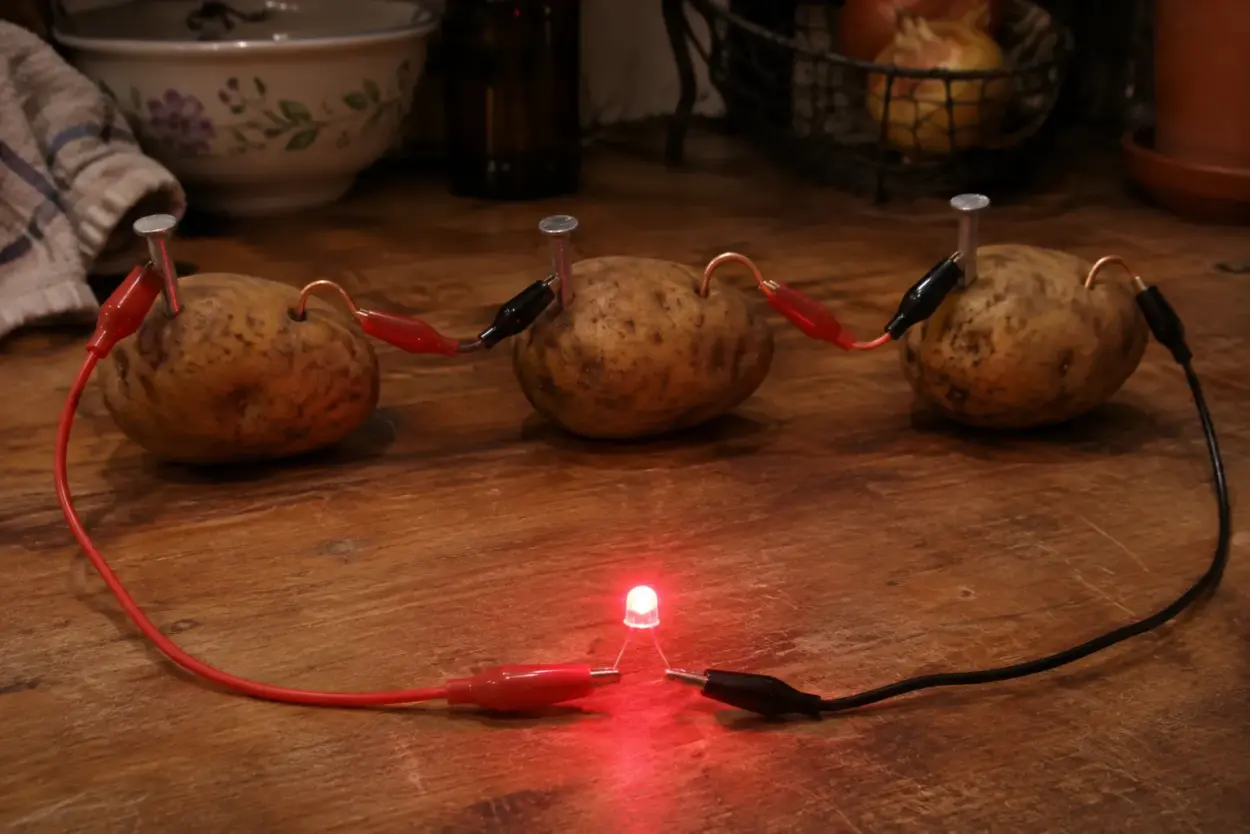
Short answer: push a galvanized (zinc-coated) nail and a piece of copper about 1 inch (2.5 cm) apart into a raw potato. The pair makes a cell of about 0.8 volts that you can read on a multimeter. Join three potatoes in series, copper of one to zinc of the next, to get about 2.3 volts: enough to light a red LED or run a small LCD clock.
I have built potato batteries on lab benches and kitchen counters for years, and the result depends on three details more than on the potato: real zinc on one side, real copper on the other and tight, clean connections. This guide covers a single cell, a three-potato battery that lights an LED, a potato clock, the boiled potato trick that multiplies the current, a science fair experiment and the chemistry: why the energy comes from the zinc and not from the potato.
At a glance
What you need
- 3 raw potatoes (any variety)
- 3 galvanized nails, 2 to 3 inches long
- 3 pieces of thick copper wire or copper strip (or pre-1982 pennies)
- 4 alligator clip leads
- 1 red LED or a small LCD clock
- A multimeter (optional, but it shows what is happening)
Steps
- Push a nail and a copper piece into each potato, 1 inch apart.
- Clip the copper of potato 1 to the nail of potato 2, and so on.
- Clip the free copper to the LED’s long leg.
- Clip the free nail to the LED’s short leg.
- Dim the room and look for the glow.
The one change that helps most
Boil the potatoes for about 8 minutes and let them cool before you build. Boiling breaks down the cell membranes inside the potato so ions move through it more easily. Hebrew University researchers measured up to ten times more power from treated potato than from raw potato.
This guide contains Amazon affiliate links. 33Science earns a commission on qualifying purchases. See our affiliate disclosure.
Materials and tools
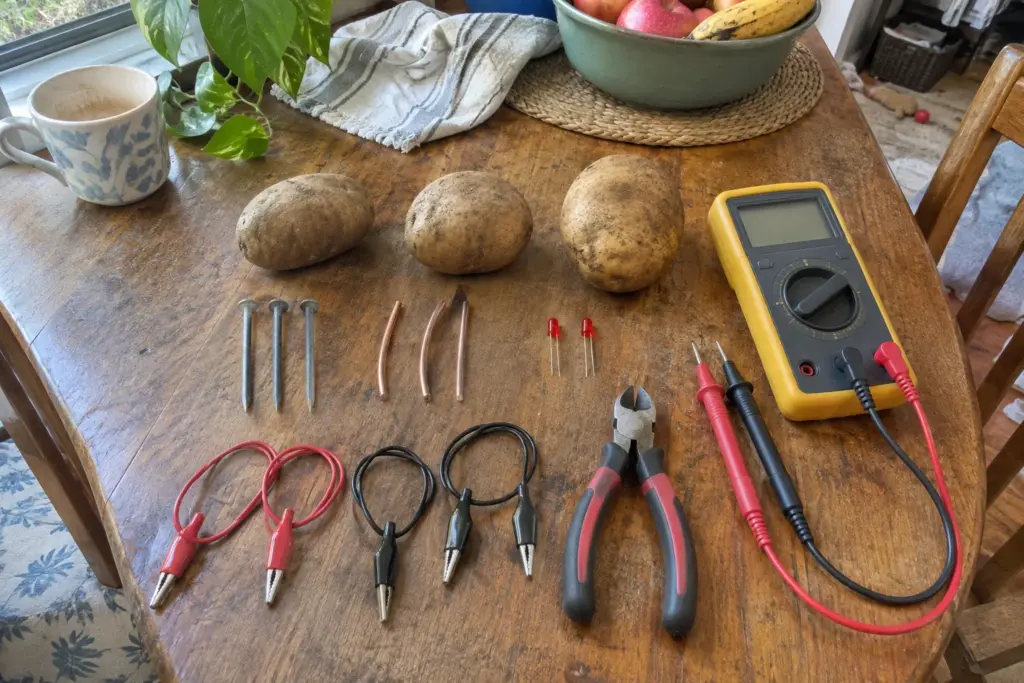
Zinc electrode
Zn, as the coating on a galvanized nail
1 per potatoGalvanized nails are steel dipped in molten zinc. The zinc is the fuel of the battery: it dissolves as the cell runs. Plain bright steel nails give a much weaker cell.
Copper electrode
Cu, as wire, strip or an old penny
1 per potatoBare copper wire of 12 to 14 gauge (house wiring with the insulation stripped) pushes in easily. US pennies minted after 1982 are 97.5% zinc with a thin copper skin, so use copper wire or a pre-1982 penny.
Electrolyte
Potato juice: water, potassium salts, organic acids
1 potato per cellThe potato is the salt bridge that lets ions move between the metals. Any potato works; firm, fresh ones give steadier readings than soft or sprouting ones.
Wires and load
Alligator clip leads, LED or LCD clock
4 leads, 1 loadClip leads make every connection without tape. A red LED needs the least voltage of any color, and an LCD clock draws almost no current.
Tools
- A digital multimeter to read voltage and current. Without one you only see whether the LED glows.
- Wire cutters and a wire stripper for the copper
- A pot of water and a stove if you try the boiled version
- Optional: a potato clock kit, which comes with zinc and copper strips, leads and a low-power clock
What you are building
A potato battery is a voltaic cell, the same kind Alessandro Volta stacked into the first battery in 1800. Two different metals sit in a liquid that conducts ions. Zinc gives up electrons more readily than copper, so electrons flow out of the zinc, through your wire and LED, and into the copper. Our list of strong electrolytes covers what makes a liquid conduct.
How to make a potato battery (one cell)
- Clean the metals. Rub the copper with fine sandpaper or steel wool until it is bright. Tarnish adds resistance. Leave the zinc coating on the nail alone.
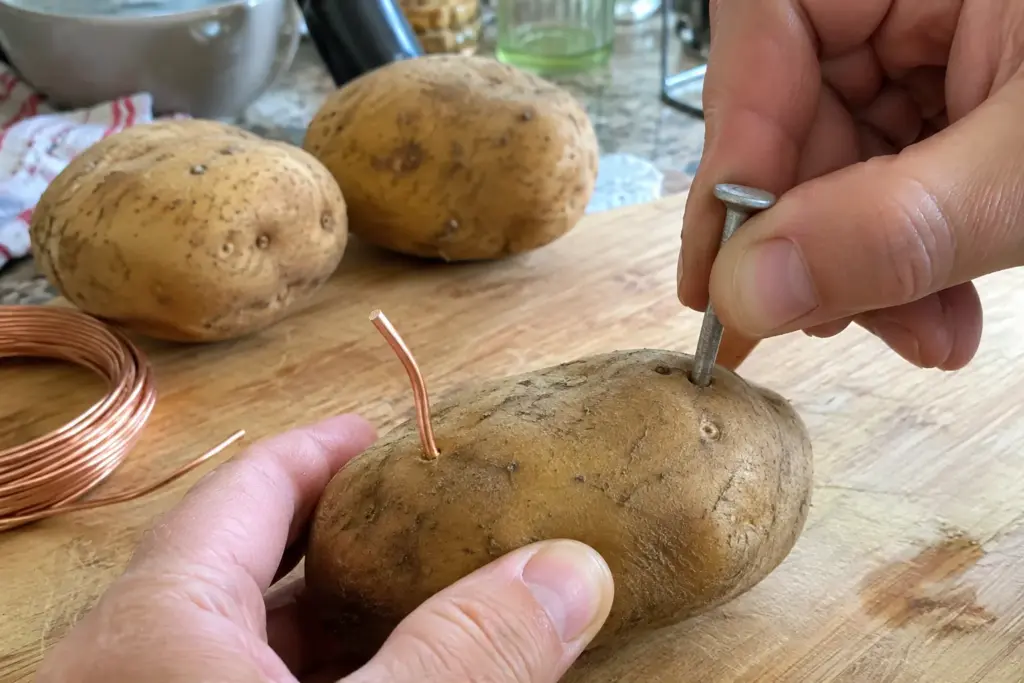
- Insert the zinc. Push the galvanized nail about 1.5 inches (4 cm) into one end of the potato.
- Insert the copper. Push the copper wire or penny into the same potato about 1 inch (2.5 cm) from the nail. The two metals must not touch inside the potato, or the cell shorts out.
- Measure the voltage. Set the multimeter to DC volts (the 2 V or 20 V range). Touch the red probe to the copper and the black probe to the nail. A fresh potato reads about 0.7 to 0.9 V.
- Check the polarity. Swap the probes and the reading turns negative. Copper is the positive terminal and zinc is the negative terminal.
Why one potato is not enough
One potato will not light an LED. A single cell makes about 0.8 V and a red LED needs about 1.8 V to turn on. This is the most common reason a first potato battery “does not work”. You need several potatoes in series.
How to light an LED with potatoes
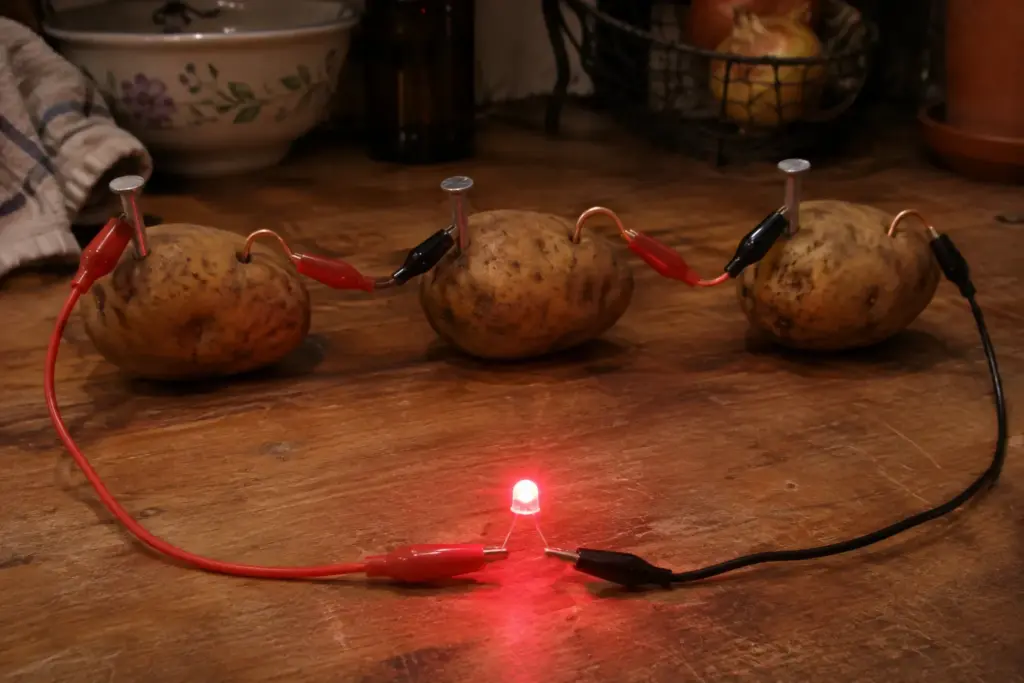
Cells in series add their voltages. Three potatoes give about 2.3 V, which is above the turn-on voltage of a red LED.
- Build three cells. Put a nail and a copper piece in each of three potatoes, as above. Line them up in a row.
- Connect them in series. Clip a lead from the copper of potato 1 to the nail of potato 2. Clip another from the copper of potato 2 to the nail of potato 3. Always copper to zinc, never copper to copper.
- Check the total. Measure from the nail of potato 1 to the copper of potato 3. It should read about 2.1 to 2.6 V. If it reads less than one potato, one connection is reversed.
- Connect the LED. Clip the free copper (positive) to the LED’s long leg and the free nail (negative) to the short leg. An LED is a diode and only conducts one way.
- Darken the room. The current is a fraction of a milliamp, so the glow is faint. Turn off the lights and look straight down into the LED.
| LED color | Turn-on voltage | Potatoes in series |
|---|---|---|
| Red | About 1.8 V | 3 |
| Yellow or green | About 2.0 to 2.2 V | 3 to 4 |
| Blue or white | About 2.8 to 3.6 V | 5 to 6 |
Brighter, not just on
If the glow is too faint, build a second row of three potatoes and connect the two rows in parallel: both free copper ends to the long leg, both free nails to the short leg. Series adds voltage; parallel adds current, and current is what makes the LED brighter.
How to make a potato clock
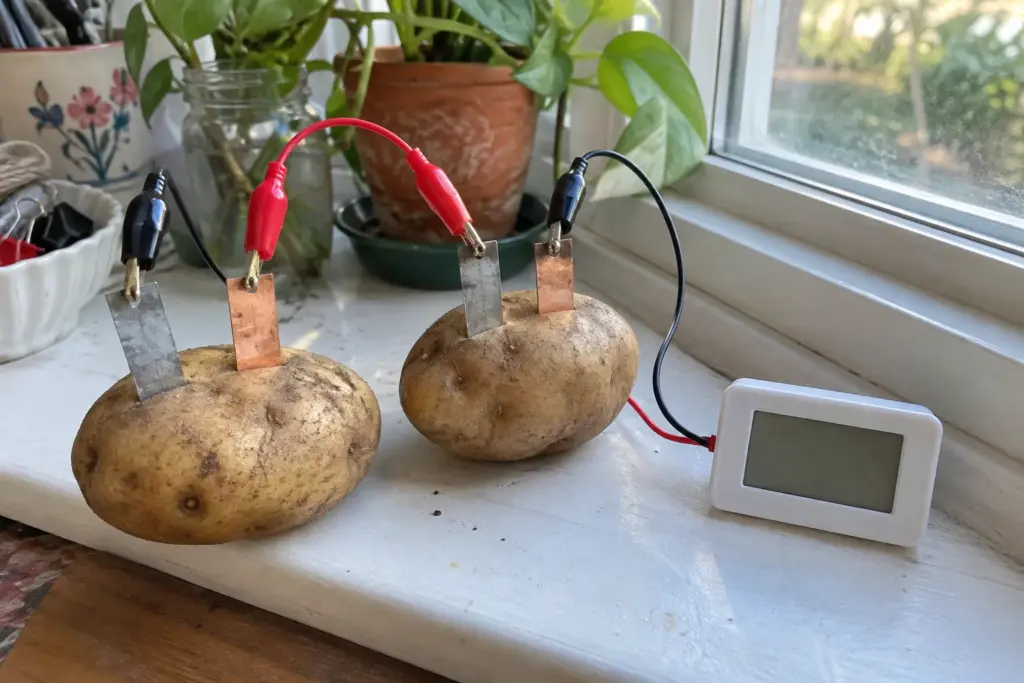
A small LCD clock runs on 1.5 V and draws only microamps, which suits a potato battery far better than an LED. Two potatoes in series are usually enough.
- Remove the clock battery. Open the battery compartment and note which contact is marked + and which is -.
- Build two cells in series. Two potatoes, copper of the first clipped to the nail of the second.
- Connect the clock. Clip the free copper to the clock’s + contact and the free nail to the – contact.
- Set the time. The display comes on within a second. A good setup keeps the clock running for days, until the potatoes dry out or the zinc near the nail is used up.
The boiled potato trick
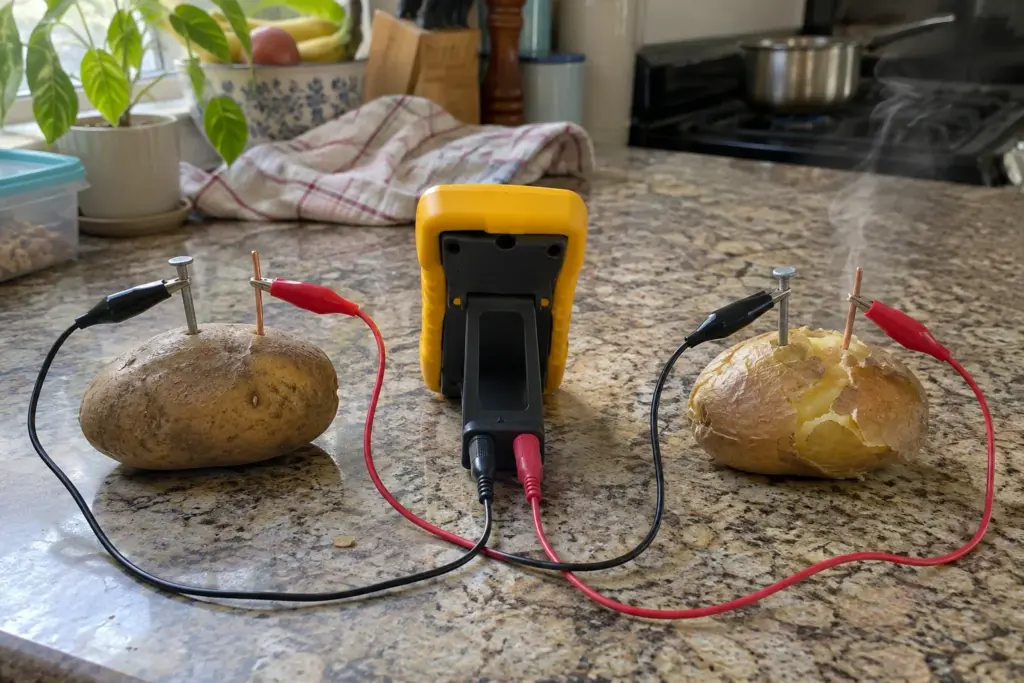
In 2010 a team from the Hebrew University of Jerusalem and UC Berkeley tested raw potato slices against slices whose cell membranes had been destroyed by heat or by electric pulses. The treated potato delivered up to ten times the power of raw potato at the same voltage. The open-circuit voltage stayed near 0.76 V in every case; what changed was the internal resistance.
- Boil the potatoes. Put whole potatoes in boiling water for about 8 minutes. They should be cooked on the outside but still firm enough to hold a nail.
- Cool them. Let them reach room temperature before you handle them.
- Build and compare. Make one cell from a raw potato and one from a boiled potato with identical metals and spacing. Measure the voltage and the current of each.
Why boiling works
A raw potato is made of living cells wrapped in membranes, and ions have to weave through the narrow spaces between them. Boiling ruptures the membranes, so the ions in the cell sap join the circuit and travel a shorter, more open path. Lower resistance means more current at the same voltage.
Potato battery science fair experiment
A potato battery becomes a real experiment when you change one variable and measure the current, not just the voltage. Voltage depends mostly on the two metals, so most changes show up in the current.
- Ask a question. For example: “Does the distance between the electrodes change the current?” or “Do boiled potatoes make more current than raw ones?”
- Set the meter. Measure open-circuit voltage on DC volts. For current, move the red probe to the mA socket, set the meter to DC milliamps and connect it straight across the cell. The reading is the short-circuit current.
- Change one thing. Test electrode spacing of 1, 2 and 4 cm, or raw vs boiled, or potato vs lemon vs apple. Keep the same metals, the same depth and the same meter.
- Repeat. Measure three cells for each condition and take each reading after 30 seconds, when it settles.
- Calculate. Divide voltage by short-circuit current to get the internal resistance of each cell. Graph it against the variable you changed.
| Variable | What usually happens | Why |
|---|---|---|
| Electrodes closer together | More current | Shorter ion path, lower resistance |
| Bigger electrodes | More current | More metal surface for the reactions |
| Boiled potato | Much more current | Broken membranes free the ions |
| Lemon instead of potato | Similar voltage, often more current | Lemon juice is more acidic (pH about 2) |
| Steel nail instead of zinc | Much less voltage | Iron gives up electrons less readily than zinc |
| Copper and copper | Nearly zero | Identical metals make no voltage |
The last row is the control that proves the point: the metals make the voltage. A potato with two copper wires gives almost nothing. Our page on types of electrochemical analysis shows how chemists use the same voltage-and-current measurements in the lab.
The science of a potato battery
In three sentences
Zinc atoms on the nail give up electrons and dissolve into the potato as zinc ions. The electrons travel through the wire to the copper, where hydrogen ions from the potato’s acids pick them up and form hydrogen gas. The potato carries ions between the metals and closes the circuit.
The reactions
At the zinc nail (the anode, negative terminal), zinc is oxidized:
Zn → Zn2+ + 2e−
At the copper (the cathode, positive terminal), hydrogen ions from the potato’s organic acids are reduced:
2H+ + 2e− → H2
Overall:
Zn + 2H+ → Zn2+ + H2 E° = 0.76 V
Zinc losing electrons and hydrogen gaining them is a redox reaction, the same type that drives rusting and every commercial battery. Our list of redox reaction examples has more.
Why the voltage is 0.76 V, not 1.10 V
Textbooks often show the Daniell cell, zinc in zinc sulfate and copper in copper sulfate, which makes 1.10 V. A potato contains almost no dissolved copper, so copper ions cannot be the thing that is reduced. The copper only hands electrons to hydrogen ions. Goodisman showed this for lemon cells in 2001, and Golberg and colleagues measured an open-circuit voltage of about 0.76 V for zinc/copper potato cells (range 0.65 to 0.89 V): the standard potential of zinc against a hydrogen electrode. Silver or carbon in place of copper works too, because the copper is only a surface for the hydrogen reaction.
How acidic is a potato?
Potato flesh has a pH of about 5.4 to 5.9, mildly acidic. That is a hydrogen ion concentration of roughly 10−5.6 mol/L, about 2.5 micromoles per liter, which is why the current is small: the hydrogen ions near the copper are used up quickly and have to diffuse in from the rest of the potato. Lemon juice at pH 2 to 2.6 holds thousands of times more hydrogen ions, which is one reason lemon cells often deliver more current. Our examples of acids page lists the acids in common foods.
Internal resistance: why the voltage drops under load
A potato cell behaves like a 0.8 V source with a resistor of a few thousand ohms built in. If a raw potato reads 0.8 V open and 0.4 mA short-circuit, its internal resistance is:
R = V / I = 0.8 V / 0.0004 A = 2,000 Ω
The most power the cell can deliver comes when the load matches that resistance. The voltage then splits in half:
Pmax = V2 / 4R = (0.8)2 / (4 × 2,000) = 0.00008 W = 0.08 mW
A phone charges at around 10 W, about 125,000 times more. This is why a potato lights an LED faintly and runs a clock well, but cannot charge a phone or light a flashlight bulb.
Where the energy comes from
The energy comes from the zinc, not from the potato. Each zinc atom that dissolves releases two electrons, so one gram of zinc can supply:
(1 g / 65.38 g/mol) × 2 × 96,485 C/mol ≈ 2,950 C ≈ 820 mAh
At 0.3 mA, even 0.1 g of zinc would last more than 250 hours. In practice a potato battery fades sooner because hydrogen bubbles coat the copper, the hydrogen ions near it run out and the potato dries. The hydrogen is a tiny amount: 0.3 mA for one hour makes about 0.13 mL of gas. Our pages on chemical energy and electrical energy cover both sides of that conversion.
Myth: the potato makes the electricity
A potato battery is often described as “potato power”, as if the potato’s starch or sugar were being burned. It is not. Swap the potato for a cup of salt water or vinegar and the cell still works, because the zinc is the fuel and the potato is only the electrolyte.
Troubleshooting
| Problem | Cause | Fix |
|---|---|---|
| Meter reads 0 V | Metals touching inside the potato, or two of the same metal | Space them 1 inch apart; check one is zinc and one is copper. |
| About 0.1 to 0.3 V | Steel nail without zinc, or a post-1982 penny | Use a galvanized nail and solid copper wire. |
| Three potatoes read less than one | One cell connected backward | Every lead goes copper to zinc; trace them in order. |
| Voltage is fine but LED stays dark | LED reversed, or room too bright | Flip the LED legs; darken the room. |
| LED glows, then fades | Hydrogen bubbles and depleted acid at the copper | Pull the copper out, wipe it and reinsert it in fresh potato. |
| Readings jump around | Loose clips or tarnished copper | Sand the copper bright; clip onto bare metal. |
| Clock flickers or resets | Not enough voltage | Add a potato in series or boil the potatoes. |
The wiring mistake that cancels the battery
Joining copper to copper or zinc to zinc between potatoes makes the cells fight each other, and the total voltage drops instead of adding. Measure the total after every new connection: it should climb by about 0.8 V each time.
Safety
Before you start
- Do not eat the potatoes. Zinc and copper dissolve into the flesh around the metals. Throw the potatoes in the trash or compost once you are done.
- Sharp points. Nails and cut copper wire can puncture skin. An adult should push the nails in for young children and cut the wire.
- Hot potatoes. Boiled potatoes hold heat inside long after the skin feels cool. Let them rest before you insert anything.
- Electrical risk is negligible. A few volts at a fraction of a milliamp cannot shock you. Never connect potatoes, wires or the LED to a wall outlet.
- Wash your hands after handling galvanized nails and copper.
The potato battery pairs well with the baking soda volcano, an acid reaction you can see, and the balloon powered car, stored energy turned into motion. For a kit that goes further into electrochemistry, see our best chemistry sets for kids.
More practical science: browse all our everyday science how-tos, from household chemistry to experiments you can build at home.
Frequently asked questions
Push a galvanized nail and a piece of copper wire about an inch apart into a raw potato. The zinc on the nail and the copper form a cell of about 0.8 volts. Connect three potatoes in series, copper to zinc, to get enough voltage for a red LED.
One potato with zinc and copper electrodes makes about 0.7 to 0.9 volts. The voltage depends on the metals, not on the size of the potato.
Three potatoes in series light a red LED, which needs about 1.8 volts. Blue and white LEDs need about 3 volts, so they take five or six potatoes.
Zinc gives up electrons more easily than copper. The electrons flow through the wire from the zinc to the copper, where hydrogen ions from the potato pick them up. The potato carries ions between the two metals and completes the circuit.
No. The energy comes from zinc dissolving at the nail. The potato is the electrolyte, and salt water or vinegar works in its place.
No. A potato cell delivers less than a tenth of a milliwatt, and a phone charges at around 10 watts. You would need well over a hundred thousand potato cells.
Yes. Boiling breaks the cell membranes in the potato so ions move more freely. Researchers measured up to ten times more power from treated potato than from raw potato.
Only a US penny made before 1982, which is 95% copper. Newer pennies are 97.5% zinc with a thin copper coating, so they work poorly as the copper electrode.
Both make about the same voltage with zinc and copper. Lemons are more acidic and often give more current, while potatoes are firmer and hold the electrodes better.
A raw potato battery running a small LCD clock lasts several days to a couple of weeks. It fades as the copper gets coated with hydrogen bubbles and the potato dries out.
Sources
- Golberg, Rabinowitch and Rubinsky, Journal of Renewable and Sustainable Energy 2, 033103 (2010). Zn/Cu-vegetative batteries, bioelectrical characterizations, and primary cost analyses
- Goodisman, Journal of Chemical Education 78, 516 (2001). Observations on lemon cells
- Science Buddies. Potato battery
- All About Circuits. Lessons in Electric Circuits, Volume VI: Potato battery
- Clemson Cooperative Extension. pH values of common foods and ingredients
- Vishay Intertechnology. Standard LEDs (typical forward voltages)
- Wikipedia. Penny (United States coin): composition since 1982
- Israel21c. Where there is a potato, there could be light (Hebrew University boiled potato battery)