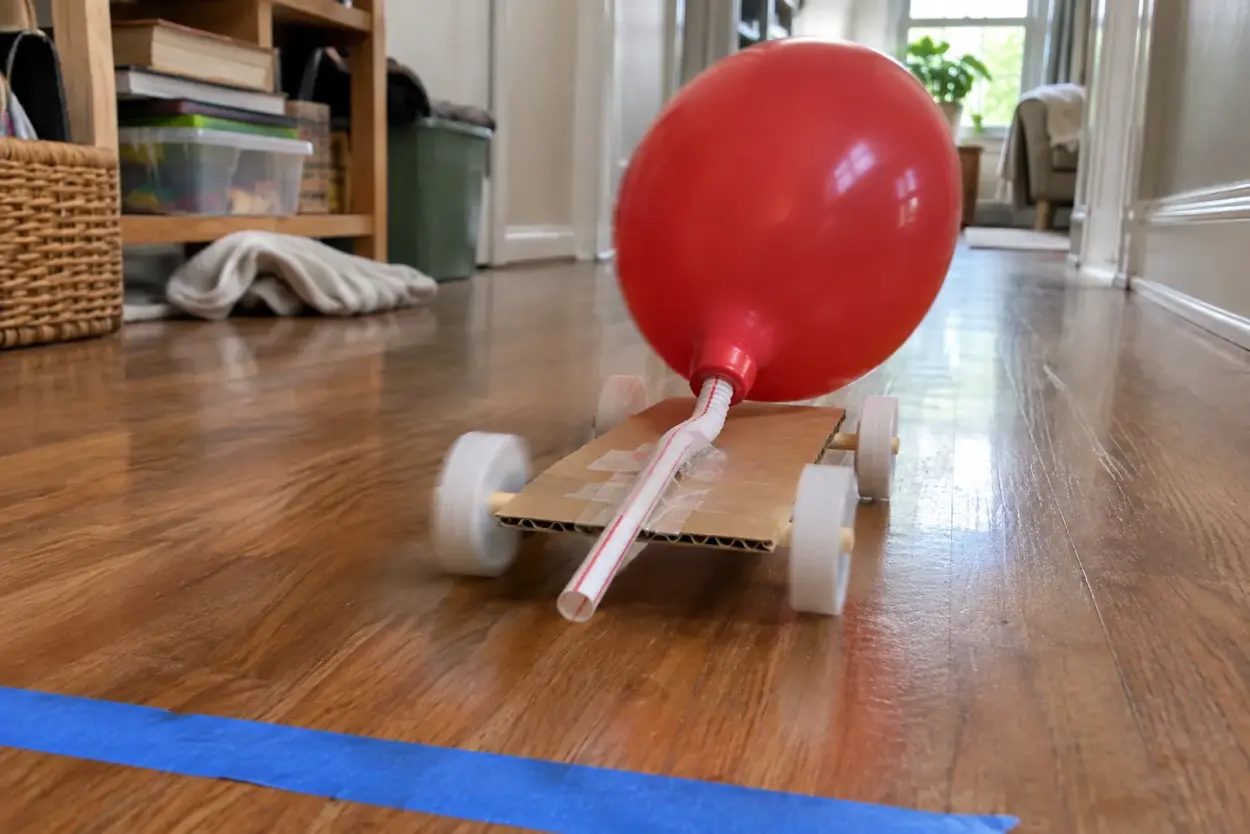
Short answer: tape two drinking straws across the bottom of a piece of cardboard, slide a wooden skewer through each one and push a bottle cap onto each end as wheels. Tape a balloon over the end of a bendy straw, tape that straw on top of the car pointing backward, blow the balloon up through the straw and let go. Air rushing out the back pushes the car forward several meters across a smooth floor.
I have built balloon cars with students for years, and the ones that win races are never the fancy ones. They are light, their wheels spin for several seconds after a flick and their nozzle points straight back, level with the floor. This guide covers the classic cardboard car, a water bottle version, the design changes that add distance, a science fair experiment with a data table and the physics behind it: Newton’s third law, how much thrust a balloon actually makes and why a car that should reach 10 meters per second rolls at walking pace.
At a glance
What you need
- 1 piece of stiff cardboard, about 4 x 8 inches (10 x 20 cm)
- 3 plastic drinking straws, one of them bendy
- 2 wooden skewers
- 4 matching plastic bottle caps
- 1 12 inch latex balloon
- Tape and a rubber band (hot glue optional)
Steps
- Tape two straws across the cardboard as axle holders.
- Push skewers through and fix a cap on each end.
- Tape the balloon to the bendy straw.
- Tape the straw on top, pointing back.
- Blow up the balloon, set the car down and let go.
Test the roll first
Before you add the balloon, set the car on the floor and give it a gentle push. It should roll straight for at least a meter and the wheels should keep spinning for a few seconds when you flick them. A car that fails this test will fail with the balloon too, because a balloon only pushes with about the weight of three nickels.
This guide contains Amazon affiliate links. 33Science earns a commission on qualifying purchases. See our affiliate disclosure.
Materials and tools
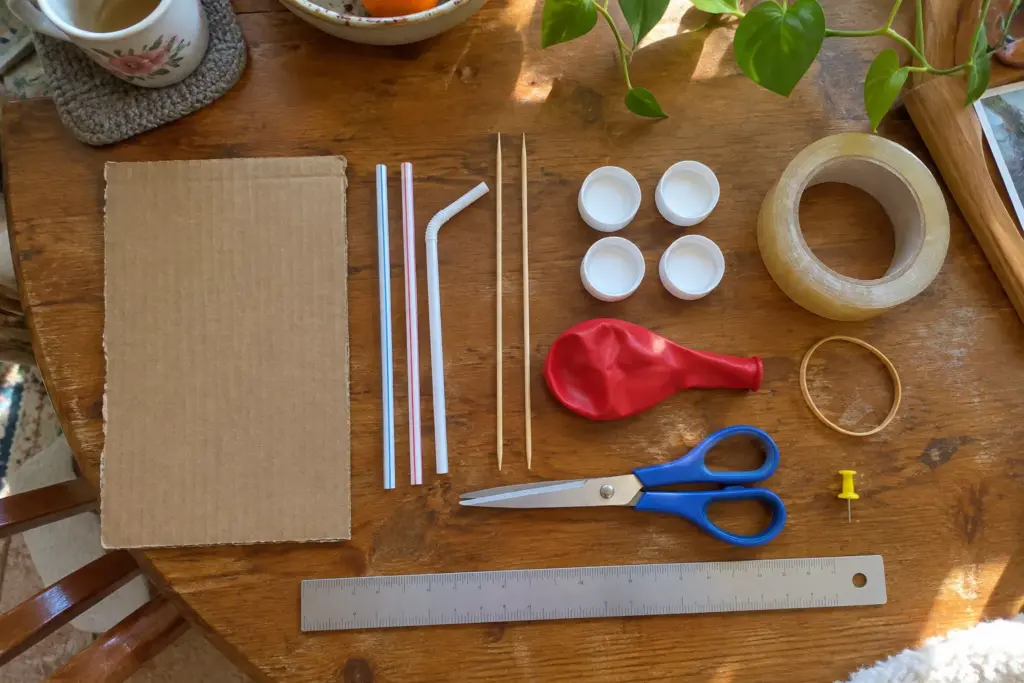
Body
Corrugated cardboard, foam tray or a plastic bottle
About 4 x 8 inLight and stiff. A panel cut from a cereal box bends; a shipping box or a foam produce tray holds its shape. Every gram you leave off is a gram the balloon does not have to push.
Axles and bearings
Wooden skewers inside plastic straws
2 skewers, 2 strawsThe skewer turns inside the straw, and that sliding joint is the bearing. Straws that are slightly wider than the skewer let it spin with almost no rubbing.
Wheels
Bottle caps, old CDs or cardboard circles
4 matchingPlastic caps from water or soda bottles are round, rigid and all the same size. Old CDs are the upgrade for distance (see below).
Engine
Latex balloon on a bendy straw
1 balloon, 1 strawA 12 inch round balloon holds enough air for several meters. The bendy straw is the nozzle that aims the air straight back.
Tools
- Strong tape: packing tape or duct tape
- A rubber band or a small zip tie to seal the balloon to the straw
- Scissors for the cardboard and to trim the skewers
- A thumbtack or small nail to start the hole in each bottle cap
- Optional: a low-temperature glue gun for the wheels, a ruler and a marker
- For testing: a tape measure and a long, smooth floor such as a hallway or a gym
How it moves
A balloon car is a rocket on wheels. The stretched rubber squeezes the air inside, the air escapes backward through the straw and, by Newton’s third law, the escaping air pushes the balloon and the car forward. Everything else in the build is about wasting as little of that push as possible on friction. Our list of forces in physics covers each force acting on the car.
How to build a balloon powered car
- Cut the body. Cut a rectangle of stiff cardboard about 4 x 8 inches (10 x 20 cm). Run the corrugation lines along the long side so the body does not sag.
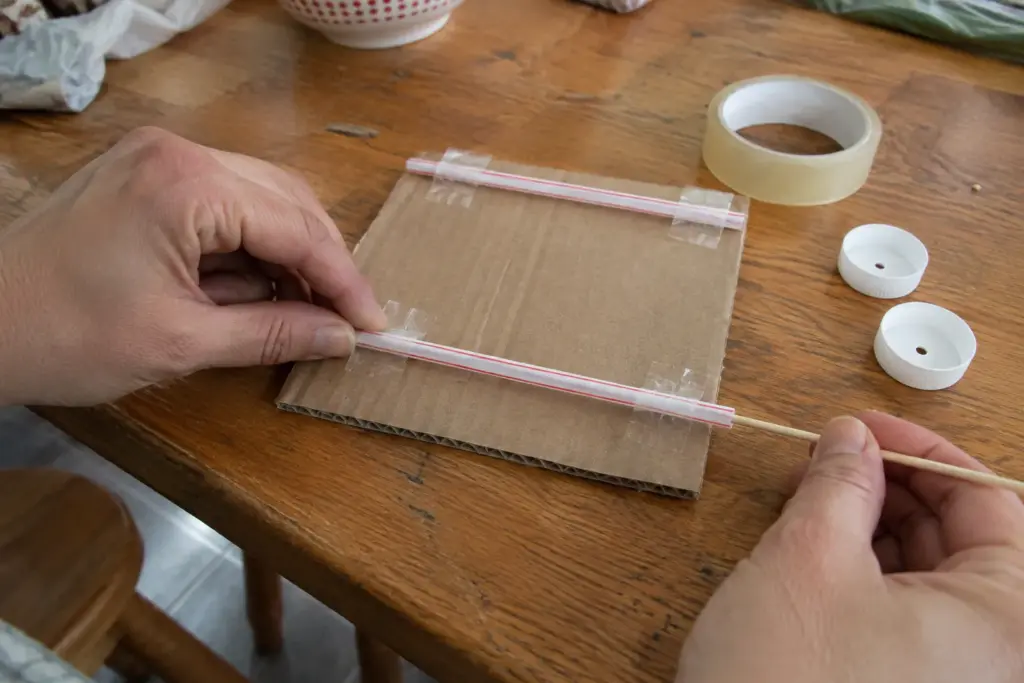
- Attach the axle straws. Cut two straws 1/2 inch (1 cm) wider than the body. Tape one across the underside about 1 inch from the front edge and the other 1 inch from the back. Use a ruler: the two straws must be exactly parallel or the car curves.
- Make the wheels. Press a thumbtack through the exact center of each bottle cap, then widen the hole with the point of a skewer until the skewer fits snugly. An adult should do this part. An off-center hole makes the car bounce.
- Fit the axles. Slide a skewer through each straw and push a cap onto both ends, open side facing in. Trim the skewer so about 1/4 inch sticks out past each cap. Leave a gap of about 1/8 inch (3 mm) between each cap and the straw so the wheel does not rub.
- Fix the wheels to the axles. Add a dab of glue where each cap meets the skewer. The wheel and axle turn together as one piece and only the skewer spins inside the straw. Check that all four wheels touch the floor.
- Build the engine. Slide the neck of the balloon about 1 inch over the short end of the bendy straw. Wrap a rubber band tightly around it, then a layer of tape. Blow through the long end to check for leaks.
- Mount the engine. Tape the straw on top of the car along the center line, balloon toward the front and the open end of the straw sticking 1 to 2 inches past the back edge. Bend the straw so the opening points straight back and level, not down at the floor.
The mistake that stops the car
Do not tape or glue the skewer to the cardboard. The axle has to spin freely inside its straw. If the wheels are glued straight to a fixed axle, they drag across the floor and the car will not move.
How to launch the car
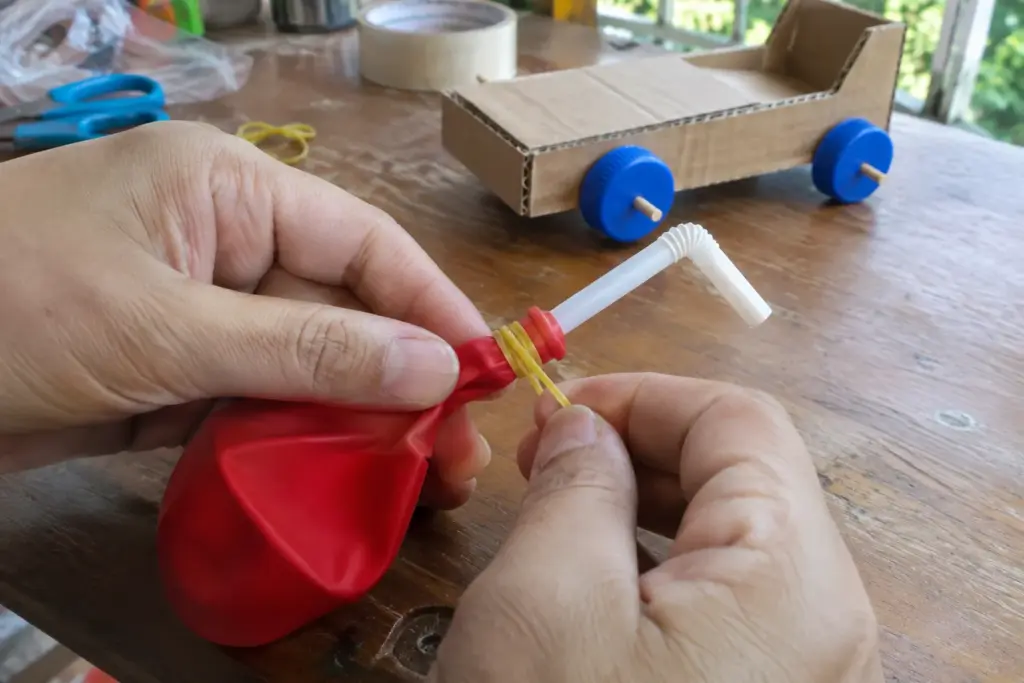
- Stretch the balloon. Blow it up fully two or three times and let the air out. A pre-stretched balloon is much easier to inflate through a straw.
- Inflate through the straw. Blow into the open end of the straw until the balloon is about 9 inches across (a circumference of about 28 inches, or 70 cm). Pinch the straw shut with your fingers.
- Set it down. Place the car on a hard, smooth floor with the nozzle pointing back and nothing behind it.
- Let go. Release the straw and take your hands away cleanly. Do not push. The car starts slowly, speeds up and coasts for a meter or so after the balloon empties.
- Measure. Mark the start line with tape and measure to the back wheels where the car stops.
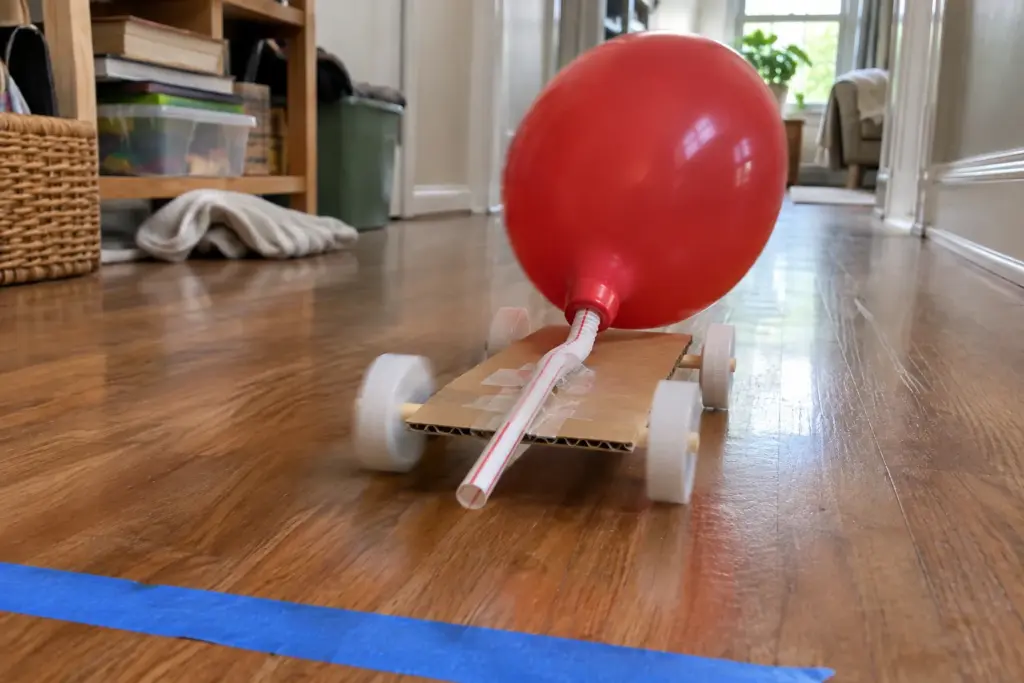
Read the sound
If the balloon empties in under a second with a loud raspberry sound, the nozzle is too wide. If the car sits still and hisses, it is too narrow or the car is too heavy. A plain drinking straw is the right size for a car under about 2 ounces (60 g).
Water bottle balloon car
A 16.9 oz (500 mL) plastic water bottle makes a body that is light, rigid and long enough for the balloon. The build uses the same parts as the cardboard car.
- Prepare the bottle. Remove the label and the cap. Lay the bottle on its side.
- Add the axle straws. Tape two straws across the bottom side of the bottle, one near the neck and one near the base. Cut them about 1/2 inch wider than the bottle.
- Fit the axles and wheels. Slide in the skewers and attach the caps exactly as in the cardboard car. Big wheels help here because the bottle sits higher.
- Add the engine. Tape the balloon to the bendy straw and tape the straw along the top of the bottle with the nozzle sticking out past the base. Some builders push the straw into the open neck and out through a hole in the base; it looks cleaner but adds no distance.
How to make a balloon car go farther
Distance comes from three things: more push, less friction and less mass. These changes are in order of how much distance they usually add.
| Change | Why it works | How to do it |
|---|---|---|
| Free-spinning wheels | Axle friction is the biggest loss on a homemade car | Wider straws, straight skewers, a 3 mm gap between wheel and straw |
| Bigger wheels | Friction at a thin axle is multiplied by the axle-to-wheel ratio | Swap caps for old CDs with a cap glued in the center hole |
| Less weight | Each gram needs thrust to speed up | Foam tray or thin corrugated body, no extra tape |
| Straight, level nozzle | Thrust aimed down or sideways is wasted | Bend the straw so the jet points straight back |
| More air | More air means a longer push | Inflate to 9 to 10 inches; a second balloon inside the first adds squeeze |
| Smooth floor | Carpet deforms under the wheels and soaks up energy | Race on tile, wood or a gym floor |
| Wheel alignment | A car that curves runs into walls and scrubs speed | Axle straws parallel, all four wheels touching the floor |
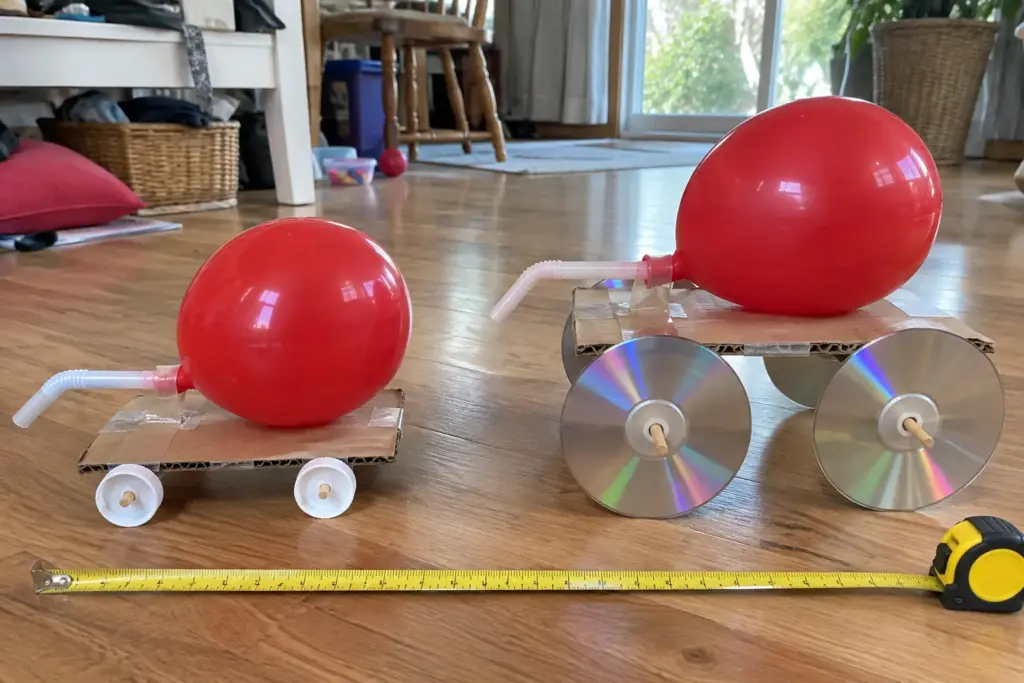
Why big wheels roll farther
The wheel works as a lever against axle friction. The rubbing happens at the skewer, about 1.5 mm from the center, but the car feels it at the edge of the wheel. A 15 mm bottle cap divides that friction by 10; a 60 mm CD divides it by 40. Our guide to frictional force has the formulas.
Balloon car science fair experiment
A balloon car turns into a real experiment when you change one thing at a time and measure the result. The cleanest question is how the amount of air in the balloon changes the distance.
- Write the question and a prediction. For example: “If I double the air in the balloon, will the car go twice as far?”
- Pick three inflation sizes. Use a string or a cloth tape measure around the widest part of the balloon: 18, 24 and 30 inches (45, 60 and 75 cm) of circumference. Mark the string so each fill is the same.
- Keep everything else the same. Same car, same balloon, same floor, same start line, same release.
- Run each size five times. Measure the distance to the back wheels and write each result down. Five runs smooth out bad releases.
- Average and graph. Average each set and plot distance against balloon volume. Then compare your graph to the prediction.
| Circumference | Diameter | Air in the balloon |
|---|---|---|
| 18 in (45 cm) | 5.6 in (14.3 cm) | About 1.5 L |
| 24 in (60 cm) | 7.5 in (19.1 cm) | About 3.6 L |
| 30 in (75 cm) | 9.4 in (23.9 cm) | About 7.1 L |
Volume grows with the cube of the diameter, so the 30 inch fill holds almost five times the air of the 18 inch fill, not two. Most cars do not go five times as far, because the balloon’s drag and the friction grow along with the speed. That gap between prediction and result is what makes a strong conclusion. Other variables to test: straw width (regular vs. wide bubble tea straw), wheel size (caps vs. CDs) and body weight (add coins).
The science of a balloon powered car
In three sentences
Stretched rubber squeezes the air inside the balloon to a pressure slightly above the room. The air escapes through the straw at high speed, carrying momentum backward, and the car gains the same momentum forward. The balloon’s own air drag and the axle friction decide how much of that momentum turns into distance.
Newton’s third law
When the balloon pushes air out of the straw, the air pushes back on the balloon with a force of the same size in the opposite direction. That is Newton’s third law, and it is how every rocket and jet engine works. The car is not pushed by air hitting the wall or the floor behind it; it moves just as well with nothing behind it at all. NASA uses the same balloon car to teach rocket propulsion. Our list of scientific laws has more everyday examples of the three laws of motion.
How much thrust a balloon makes
A party balloon holds its air only a few kilopascals above atmospheric pressure, which is about 101 kPa. Rubber balloons have an unusual pressure curve: the pressure peaks early in inflation and then falls as the balloon grows, which is why the first breath is the hardest. Using 3 kPa as a typical value, the air leaves the straw at about:
v = √(2ΔP / ρ) = √(2 × 3,000 Pa / 1.2 kg/m3) ≈ 70 m/s
The thrust is the momentum the jet carries away each second. For a straw with a 6 mm inner diameter (an opening of 2.8 × 10⁻⁵ m2):
F = ρ v2 A = 2ΔP × A = 2 × 3,000 × 2.8 × 10-5 ≈ 0.17 N
That is the weight of about 17 grams, or three US nickels. It explains the most important rule of balloon cars: the car has to be light and roll freely, because the engine is weak. The straw passes about 2 liters of air per second, so a 7 liter balloon empties in roughly 3 to 4 seconds.
Narrow straw or wide straw?
| Nozzle | Thrust | Push lasts (7 L balloon) |
|---|---|---|
| Thin stirrer straw, 3 mm | About 0.04 N | About 14 s |
| Drinking straw, 6 mm | About 0.17 N | About 3.5 s |
| Bubble tea straw, 12 mm | About 0.68 N | About 0.9 s |
In the ideal case the total push (thrust times time) is the same for every straw: about 0.6 newton-seconds for 7 liters of air. A thin straw gives a weak push for a long time and may not overcome the friction that holds the car still. A wide straw gives a hard shove that is over in a second and sends the car fast, where air drag is highest. A regular drinking straw sits in the useful middle for a light car.
Why the car is slower than the math says
About 0.6 newton-seconds of push on a 50 gram car would, with no losses, give it a speed above 10 m/s. A real balloon car moves at walking pace, about 1 to 2 m/s. The difference goes to three places:
- The balloon’s drag. A 9 inch balloon riding on top of the car is a big sphere pushing through air. Its drag grows with the square of the speed: about 0.05 N at 2 m/s, and at about 4 m/s it would equal the whole thrust. The balloon itself sets the speed limit.
- Friction. Rolling resistance and the skewers rubbing in their straws take a steady share. This is the part your build controls.
- Losses in the straw. Air rubbing along a long, bent straw loses pressure before it leaves, so the real jet is slower than 70 m/s. A short straw with a gentle bend wastes less.
Where the energy goes
The stretched balloon stores elastic potential energy on the order of the pressure times the volume: 3,000 Pa × 0.007 m3 ≈ 20 joules. A 50 gram car rolling at 2 m/s carries 0.1 joules of kinetic energy, half a percent of the store. Most of the energy leaves as the kinetic energy of the fast air jet. This is a general property of rockets: a jet moving 70 m/s pushing a vehicle moving 2 m/s is very inefficient, and rockets only become efficient when the vehicle’s speed approaches the exhaust speed. Our pages on elastic potential energy and kinetic energy cover both ends of that conversion.
Myth: it pushes off the air behind it
A common explanation says the car moves because the air pushes against the air behind it. It does not. A balloon car works in a vacuum chamber, and rockets work in space where there is no air at all. The push comes from throwing mass backward, not from having something to push against.
Troubleshooting
| Problem | Cause | Fix |
|---|---|---|
| Car does not move | Axles taped to the body or wheels rubbing | Free the skewers; leave a gap between wheel and straw. |
| Car curves to one side | Axle straws not parallel or a wheel off-center | Re-tape the straws with a ruler; redrill the bad cap. |
| Car wobbles and bounces | Hole not in the center of the cap | Mark the center with a ruler across two diameters before piercing. |
| Balloon empties but car barely moves | Car too heavy or carpet floor | Cut weight; race on a hard floor. |
| Air leaks at the balloon neck | Loose seal on the straw | Rubber band first, then tape over it. |
| Car pops a wheelie or tips back | Nozzle aimed down or balloon too far back | Level the nozzle; move the balloon toward the front. |
| Balloon flops onto a wheel | Balloon hangs over the side | Center the straw and tape the balloon neck to the body. |
Common mistake
Adding more tape to “strengthen” the car is the usual way a working car gets slower. Each strip of packing tape adds weight, and the balloon has very little push to spare. Tape only what holds something in place.
Safety
Before you start
- Balloons and young children. Uninflated or broken balloons are a choking and suffocation hazard for children under 8. Keep spare balloons away from them and pick up every piece of a popped balloon.
- Latex allergy. Blowing up a latex balloon can trigger a serious reaction in people with latex allergy. Use a latex-free balloon or let someone else inflate it.
- Sharp parts. Skewer points and thumbtacks can puncture skin and eyes. An adult should pierce the caps; snip the sharp tips off the skewers once the wheels are on.
- Glue guns. Hot glue causes burns. A low-temperature glue gun or strong tape is safer for kids.
- Do not share straws. Each builder inflates their own car through their own straw.
Balloon cars are a natural next step after the baking soda volcano: the volcano shows a gas being made, the car shows a gas doing work. For more builds that teach forces and motion, see our list of toys for kids who love science.
More practical science: browse all our everyday science how-tos, from household chemistry to experiments you can build at home.
Frequently asked questions
Tape two straws across a piece of cardboard, slide a wooden skewer through each one and fix a bottle cap wheel on each end. Tape a balloon to a bendy straw, tape the straw on top of the car pointing backward, inflate the balloon through the straw and let go.
Air escaping backward from the balloon pushes the car forward, an example of Newton’s third law. The balloon pushes the air out, and the air pushes back on the balloon with an equal and opposite force.
A piece of stiff cardboard or a plastic bottle, three drinking straws, two wooden skewers, four bottle caps, a balloon, tape and a rubber band. All of them are household or recycled items.
Make the wheels spin freely, use bigger wheels such as old CDs, keep the car light, point the nozzle straight back and race on a smooth hard floor. Axle friction is usually the biggest loss.
The axles are usually stuck. The skewers must turn freely inside the straws and the wheels must not rub against the straws or the body. A car that is too heavy for the balloon also stays put.
Usually yes. A bigger wheel reduces the effect of friction at the axle, so more of the balloon’s push goes into motion. Very large wheels add weight, so they must stay light.
A well-built cardboard car with one 12 inch balloon rolls about 3 to 6 meters on a smooth floor. Light cars with CD wheels and a larger balloon travel farther.
All three. It stays still until a force acts on it (first law), it speeds up more when it is lighter (second law) and it moves forward because the air is pushed backward (third law).
Not always. A wider straw gives more thrust for a shorter time, and a narrow straw gives less thrust for longer. A regular drinking straw works best for a light homemade car.
Yes. Old CDs, cardboard circles traced from a cup or plastic lids all work as wheels. They need a centered hole and should all be the same size.
Sources
- NASA Glenn Research Center. Rocket car (balloon car activity)
- NASA Glenn Research Center. Newton’s third law of motion
- NASA Glenn Research Center. Newton’s third law and rocket propulsion
- Science Buddies. Balloon-powered car challenge
- Science Buddies. Build a balloon car
- Science World. Balloon-powered car
- Merritt and Weinhaus, American Journal of Physics 46, 976 (1978). The pressure curve for a rubber balloon
- US Consumer Product Safety Commission. Small parts and choking hazard labeling (balloons, 16 CFR 1500.19)
- American College of Allergy, Asthma and Immunology. Latex allergy