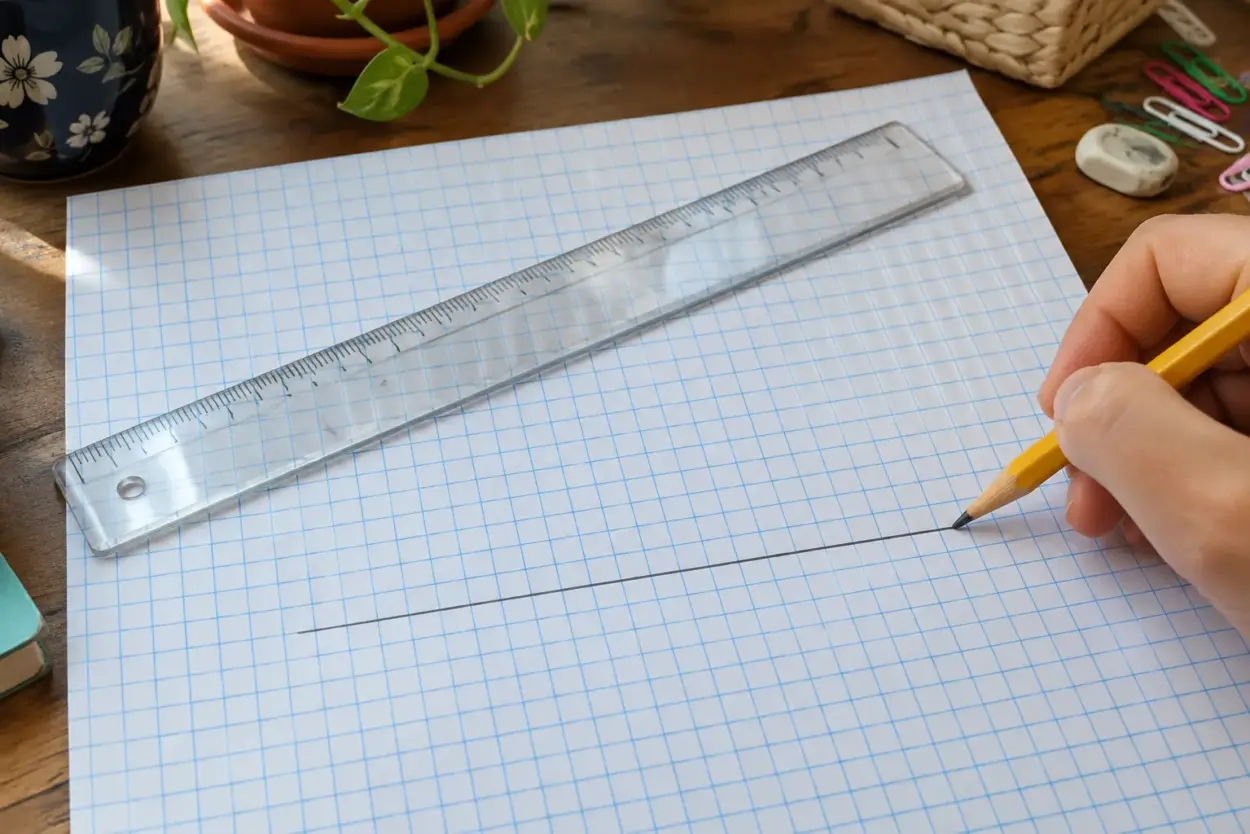
Short answer: Every graph paper printable on this page is a free PDF in US Letter and A4, with no sign-up. For most homework and sketching, download the 1/4 inch grid (4 squares per inch). Metric users usually want 5 mm. When you print, set the scale to Actual size or 100% so the squares come out at their true size.
There are 18 templates: eight square grids from 1 mm to 1 inch, three coordinate planes, and specialty sheets for engineering, isometric drawing, dot grids, hexagons, polar plots and semi-log data. Each one is drawn as a vector file, so the lines stay sharp at any printer resolution and a quarter inch on the file is a quarter inch on paper. The most common printing mistake is leaving “Fit to page” switched on, which shrinks every square by a few percent.
This article contains Amazon affiliate links. 33science earns a commission on qualifying purchases. See our affiliate disclosure.
Square grid graph paper (1/4 inch, 1/5 inch, 1 cm, 1 mm)
Square grid paper, also called quad-ruled or quadrille paper, is the sheet most people mean by “graph paper”. The inch grids have a darker line every inch so you can count large distances without counting every small square. The 1 mm sheet adds a medium line every 5 mm and a bold line every centimeter, the layout of classic millimeter paper.
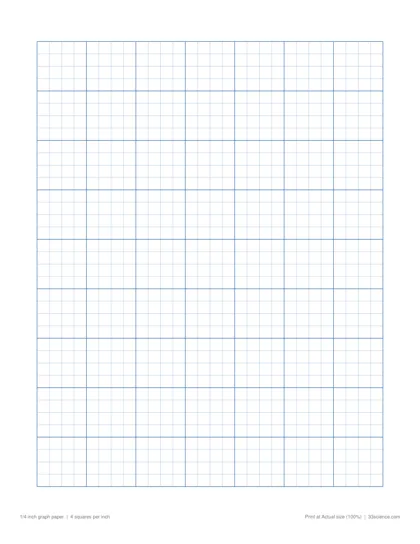
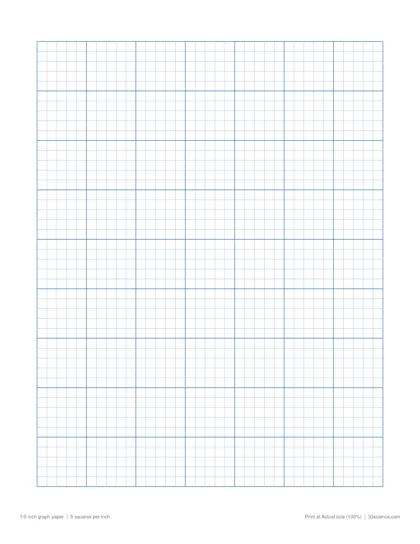
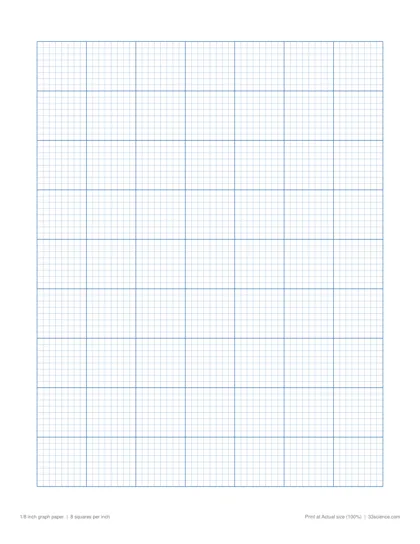
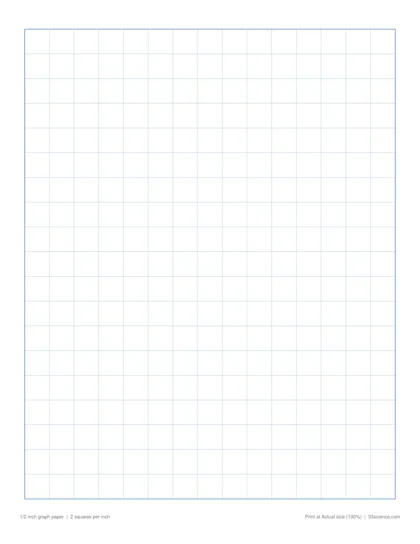
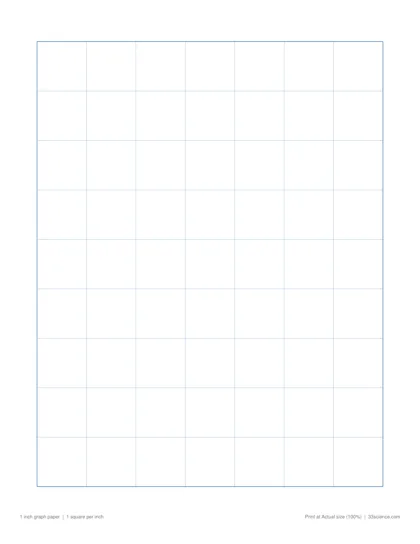
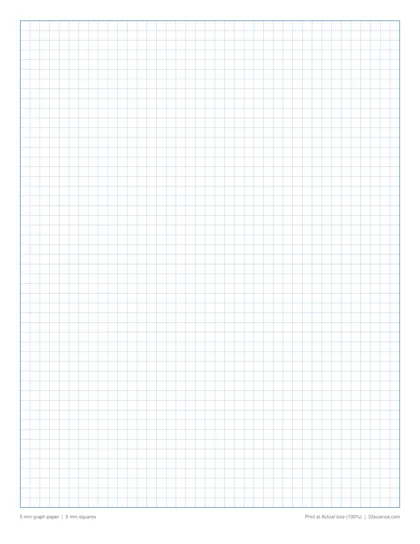
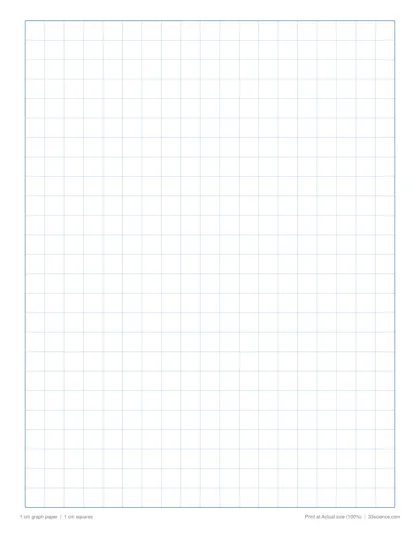
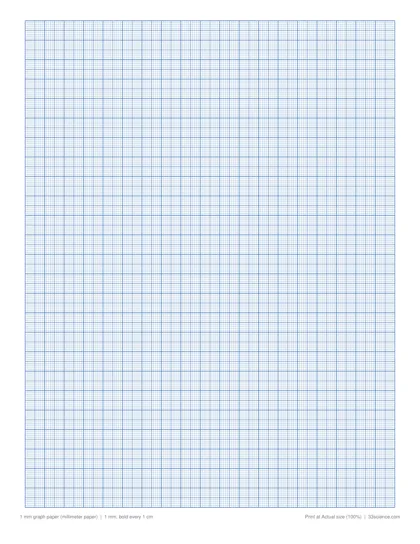
Every grid fills the page edge to edge in whole squares, with a margin of at least 0.4 inch that home printers can reach. Lines are light blue with darker major lines, which reads well on screen and prints as clean gray on a black-and-white printer.
Coordinate plane graph paper
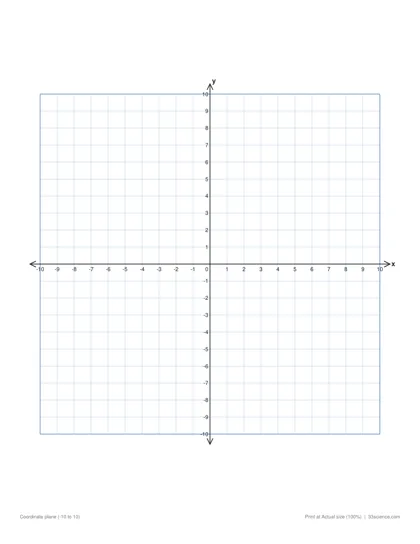
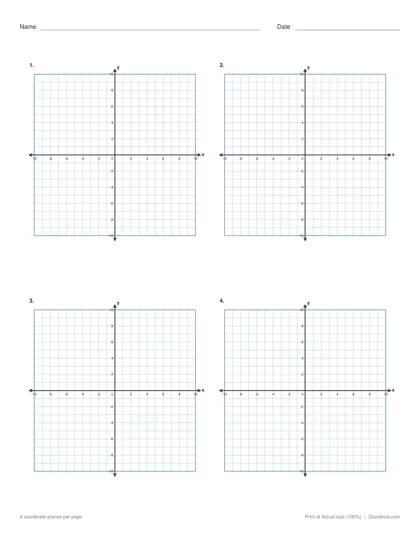
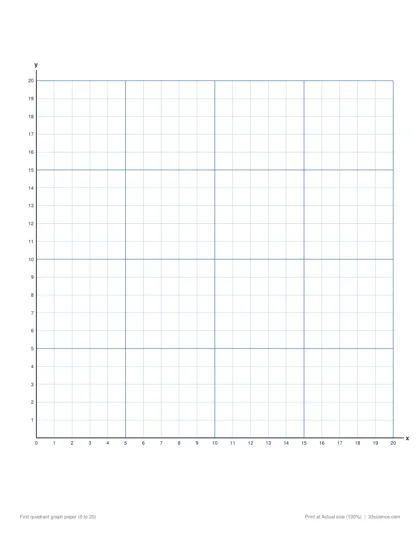
Coordinate plane sheets come with the x and y axes already drawn and numbered, which saves the first five minutes of every graphing assignment. Use the single large plane for one detailed graph, the four-per-page sheet for a set of homework problems, and the first-quadrant sheet when all your values are positive, such as plotting science lab data against time.
Specialty graph paper: isometric, polar, semi-log and more
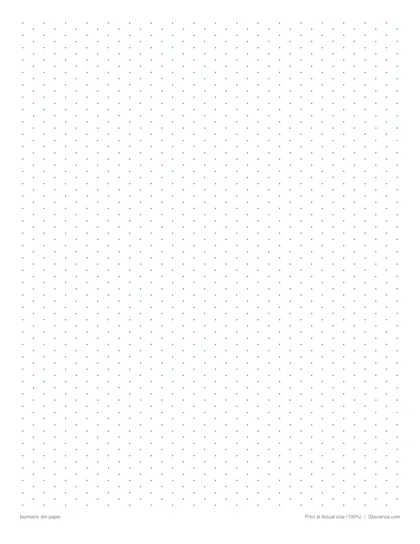
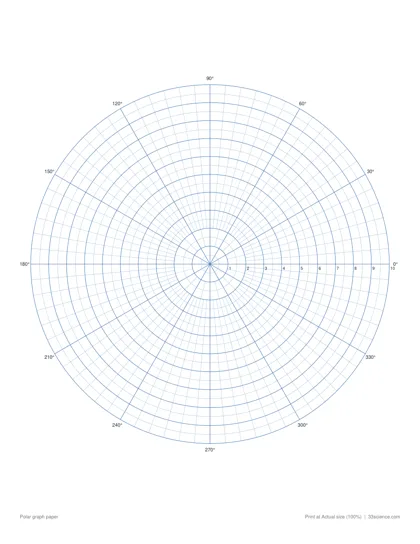
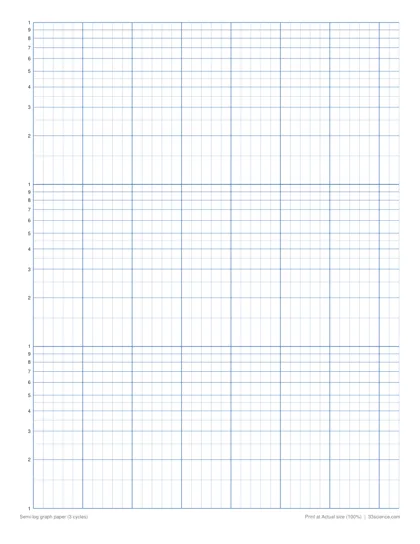
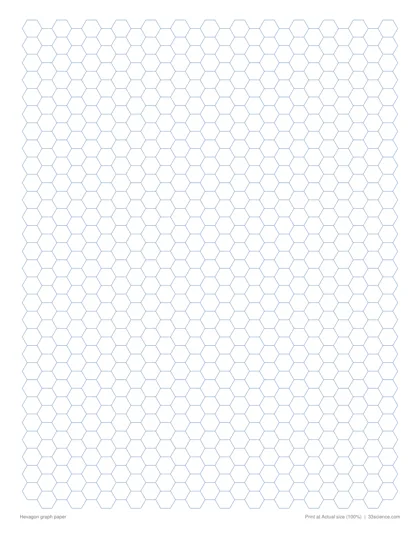
Specialty grids solve one job each. Pick the sheet by what you are drawing:
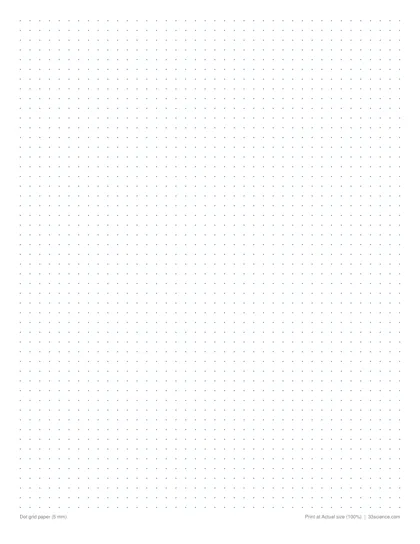
Download the specialty sheets here, each in both paper sizes:
Which graph paper size should you use?
Use 1/4 inch for general math and science work, larger squares for young children and smaller squares when you need detail. The square size should match the smallest thing you need to draw or write in a single box.
| Grid | Square size | Best for |
|---|---|---|
| 1 inch | 25.4 mm | Kindergarten, counting, board games |
| 1/2 inch | 12.7 mm | Early elementary, large handwriting, bar graphs |
| 1 cm | 10 mm | Area and perimeter, base-ten blocks, multiplication arrays |
| 1/4 inch | 6.35 mm | Algebra graphs, science lab charts, floor plans, general use |
| 1/5 inch | 5.08 mm | Engineering and physics work, scale drawings in tenths |
| 5 mm | 5 mm | Metric homework, notes, sketching |
| 1/8 inch | 3.18 mm | Small handwriting, detailed plans, pixel art |
| 1 mm | 1 mm | Precise plots, technical drawing, measuring from a graph |
For floor plans, 1/4 inch makes a simple scale: one square equals one foot. Cross-stitch and knitting charts work on 1/8 inch or 5 mm, where one square is one stitch. If you go through a lot of sheets, a pad of quad-ruled paper costs less than printer ink, and an engineering computation pad has the grid printed on the back so it shows faintly through the front.
How to print graph paper at the right size
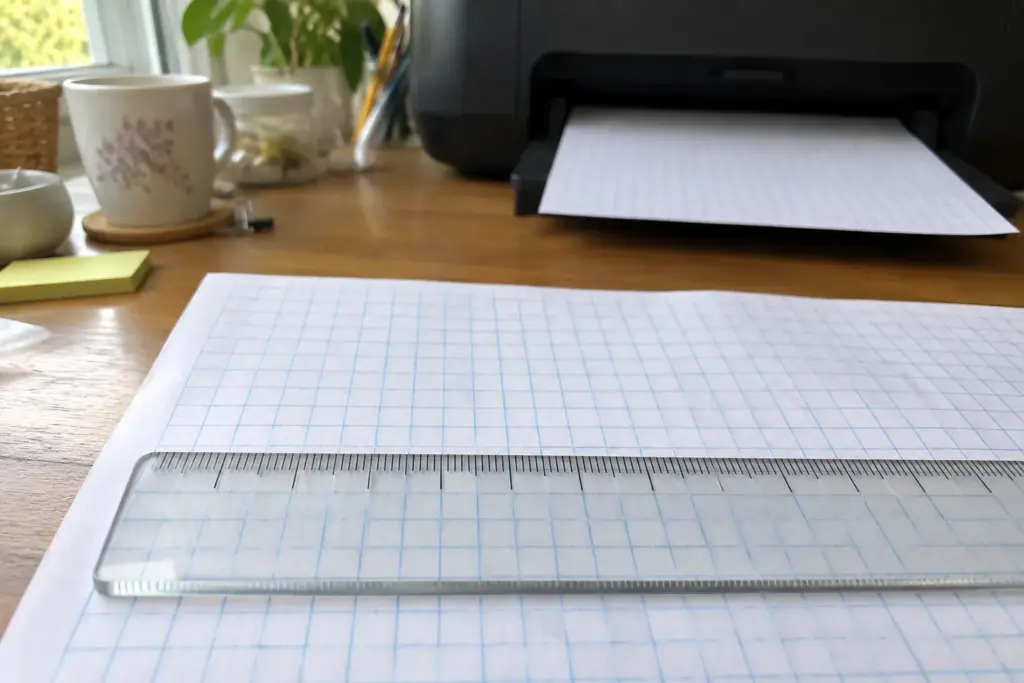
Print at Actual size (100%) with the paper size set to match the file. Most PDF viewers default to “Fit” or “Shrink oversized pages”, which scales the whole sheet down by 3 to 6 percent. That is invisible on a single square but adds up to a quarter inch or more across the page, which matters for scale drawings.
Frequently asked questions
The most common grid is 1/4 inch, or 4 squares per inch, printed on US Letter paper. Outside North America the usual choice is a 5 mm grid on A4.
Yes. All 18 PDF templates download directly with no account, email or watermark, and you can print as many copies as you need for home or classroom use.
The print dialog is scaling the page to fit the printable area. Set the scale to Actual size or 100 percent and turn off any fit or shrink option in both the PDF viewer and the printer settings.
They are the same thing. Graph paper, grid paper, quad-ruled paper and quadrille paper all describe a sheet printed with a regular grid of squares.
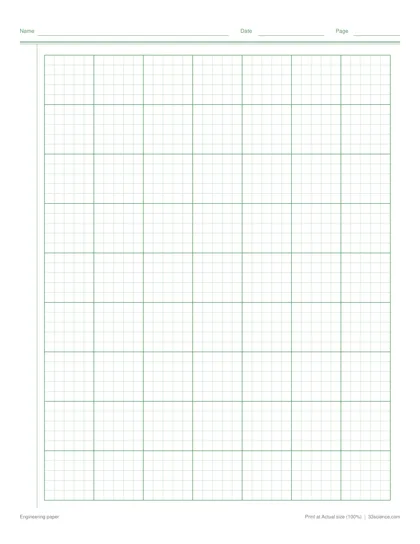
Engineering paper normally has 5 squares per inch, with a darker line every inch. It is printed in pale green with a header for the name, date and page number.
Yes. Download the A4 version of the sheet so it fits the page without scaling. Printing a Letter file on A4 paper either shrinks the grid or cuts off the bottom rows.
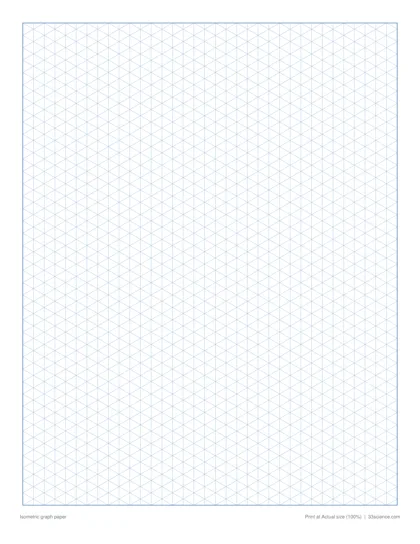
Isometric paper is used to draw three-dimensional objects such as cubes and block structures. Its lines run at 30 degrees either side of vertical, so the three visible faces of a cube line up with the grid.
Use semi-log paper, which has a logarithmic y axis and a linear x axis. Exponential growth or decay appears as a straight line, and the slope gives the rate.
Sources
- Adobe. Scale or resize printed pages in Acrobat
- ISO. ISO 216: Writing paper and certain classes of printed matter, trimmed sizes
- University of Guelph, Department of Physics. Graphing with logarithmic paper tutorial
- Carleton College, SERC. How do I use semi-log or log-log plots?
- Wikipedia. Graph paper