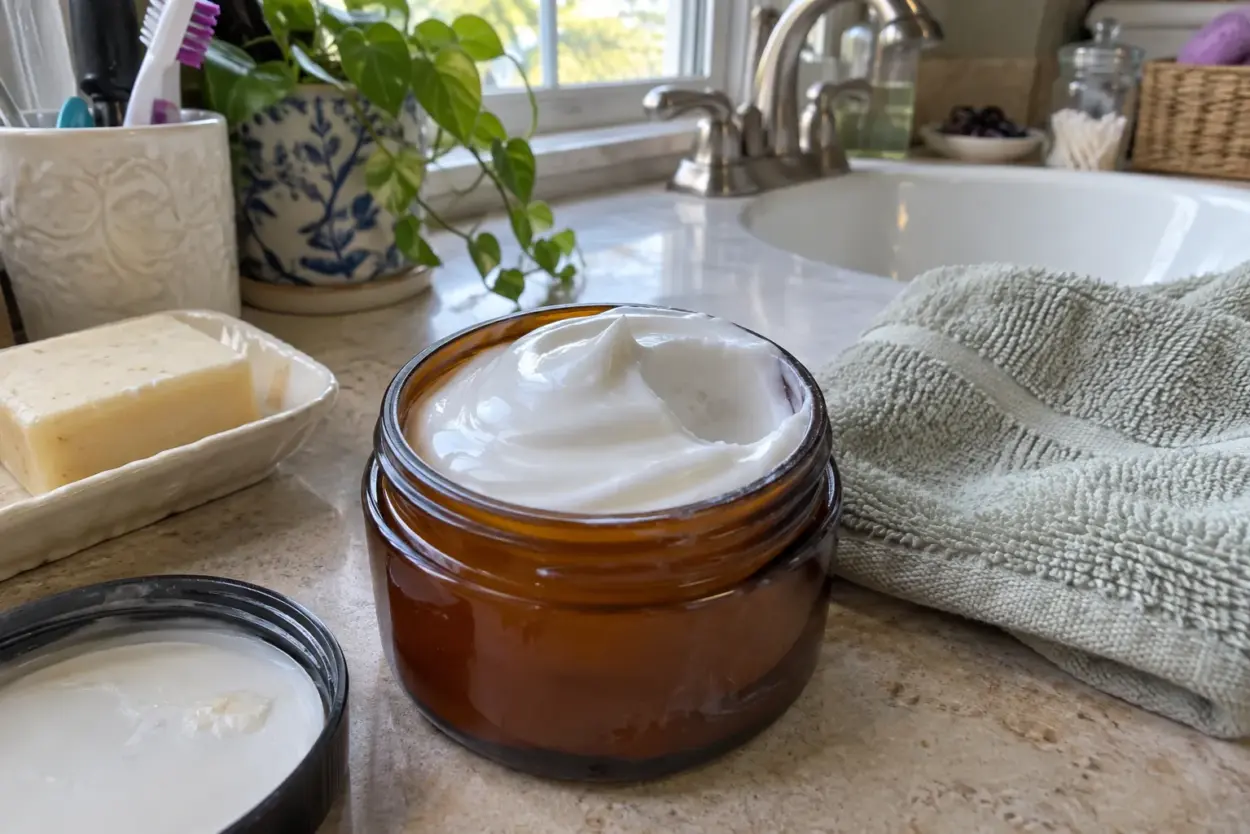
Short answer: heat 71 g of distilled water with 5 g of glycerin in one beaker, and 6 g of shea butter, 10 g of sweet almond oil, 5 g of emulsifying wax and 2 g of cetyl alcohol in another, both to 70 to 75 °C. Pour the water into the oils, blend for 2 minutes, stir as it cools and add 1 g of preservative below 40 °C. That makes 100 g (3.5 oz) of non-greasy hand cream in about 45 minutes.
I make hand cream every winter, and the part beginners skip is the part that matters most. A cream is mostly water, so it needs an emulsifier to hold the oil and water together and a preservative to stop mold from growing in the jar. Recipes that whip shea butter with coconut oil make a balm, which works but feels greasy. This guide covers a true cream, a water-free balm for people who would rather skip the preservative, the variations worth making and the skin chemistry behind every ingredient.
At a glance
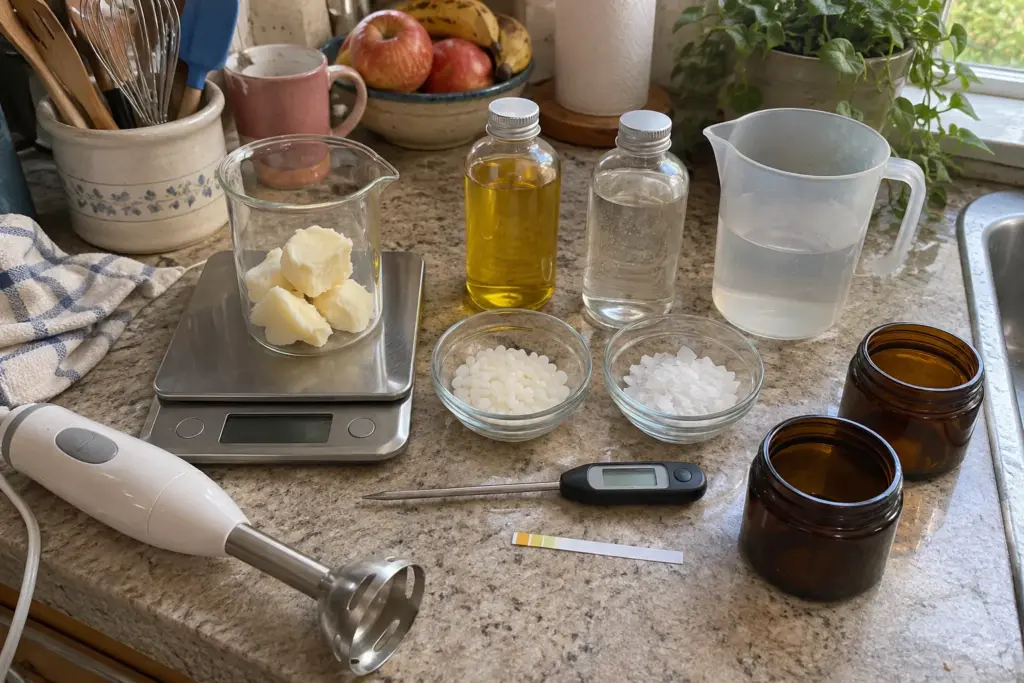
What you need
- 71 g distilled water and 5 g glycerin
- 6 g shea butter and 10 g sweet almond oil
- 5 g emulsifying wax NF and 2 g cetyl alcohol
- 1 g broad-spectrum preservative (not optional)
- A 0.1 g scale, two beakers, a thermometer and a stick blender
Steps
- Weigh the water phase and the oil phase into separate beakers.
- Heat both to 70 to 75 °C in a water bath.
- Pour the water into the oils and blend for 2 minutes.
- Stir until it cools below 40 °C, then add the preservative.
- Check the pH, then jar it.
Use a scale
Weigh everything in grams. Emulsifying wax and cetyl alcohol come as pellets and flakes that pack differently in every spoon, and a 1 g error in a 100 g batch is a 20% change in the emulsifier. A jewelry scale that reads to 0.1 g makes every batch repeatable.
This guide contains Amazon affiliate links. 33Science earns a commission on qualifying purchases. See our affiliate disclosure.
Ingredients and tools
Distilled water
H2O
71 g (71%)The main ingredient of every cream. It is what makes a cream absorb fast and feel light. Tap water brings minerals and microbes into a product you will keep for months.
Vegetable glycerin
Glycerol, C3H8O3
5 g (5%)A humectant: its three hydroxyl groups bind water and pull it into the outer layer of skin. Above about 8% a cream turns tacky.
Shea butter and sweet almond oil
Triglycerides
6 g + 10 g (16%)The emollients. They fill the gaps between dry skin flakes and leave a thin film that slows water loss. Shea butter adds body and a rich feel; the liquid oil keeps the cream from setting too hard.
Emulsifying wax NF
Cetearyl alcohol (and) polysorbate 60
5 g (5%)Holds oil and water together. A complete emulsifier in one ingredient and the most forgiving choice for a first cream. Beeswax is not an emulsifier and cannot replace it.
Cetyl alcohol
Hexadecan-1-ol, C16H34O
2 g (2%)A waxy fatty alcohol that thickens the cream and gives it a soft, powdery finish. It is not a drying alcohol like ethanol.
Preservative
For example phenoxyethanol, caprylyl glycol and sorbic acid (Optiphen Plus)
1 g (1%)Required in anything that contains water. Fingers dip into a hand cream jar every day, and water plus oil plus glycerin is a growth medium for bacteria and mold.
What is in shea butter
Shea butter is mostly two fatty acids, oleic (about 34 to 62%) and stearic (about 25 to 56%), plus 2 to 17% unsaponifiable compounds such as triterpene alcohols, depending on origin and refining. The stearic acid is why it is solid at room temperature and why unrefined shea sometimes forms gritty crystals when it cools too slowly.
Tools
- A digital scale that reads to 0.1 g
- Two heat-proof glass beakers or jars and a saucepan for a water bath
- A probe thermometer
- A small stick blender or a milk frother
- pH test strips and a little citric acid for adjusting
- A jar, tin or tube for the cream, washed and wiped with rubbing alcohol
How to make hand cream
Clean every tool and jar, then spray or wipe them with 70% rubbing alcohol and let them air dry. This recipe makes 100 g. Double every number for a 200 g (7 oz) batch.
- Weigh the water phase. Tare a beaker and add 71 g of distilled water and 5 g of glycerin. Write down the weight of the beaker and its contents.
- Weigh the oil phase. In a second beaker, weigh 6 g of shea butter, 10 g of sweet almond oil, 5 g of emulsifying wax and 2 g of cetyl alcohol.
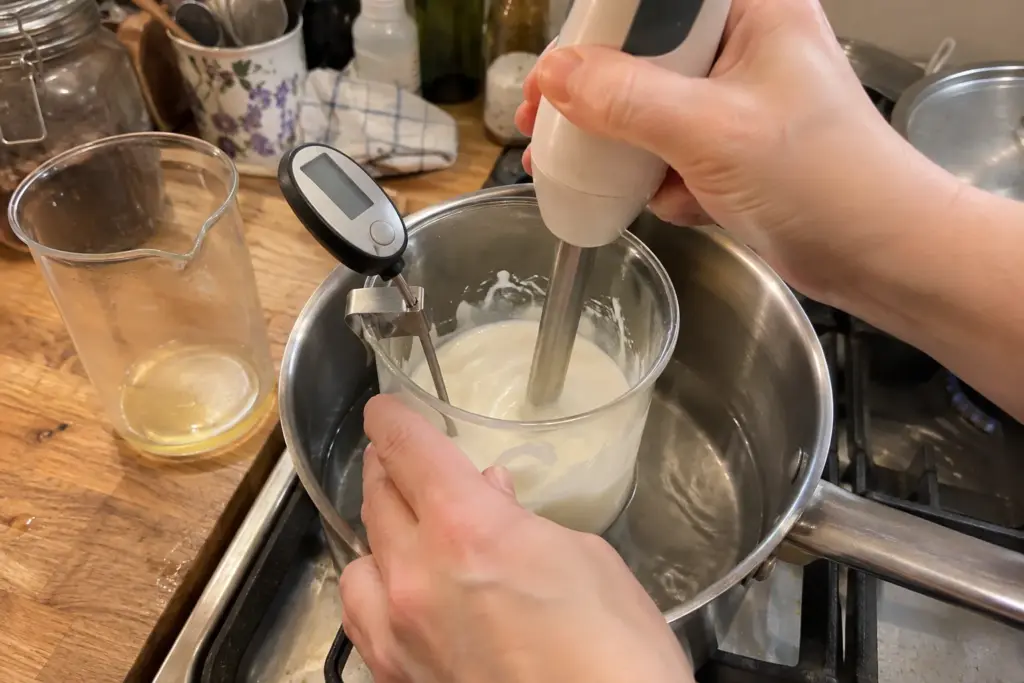
- Heat both to 70 to 75 °C. Set both beakers in a saucepan of simmering water. The waxes melt at about 50 to 60 °C. Hold both phases at 70 to 75 °C for 15 to 20 minutes so every wax crystal melts and the water phase gets a heat treatment.
- Top up the water. Weigh the water beaker again and add hot distilled water to replace what evaporated. Skipping this makes the cream thicker than planned.
- Combine and blend. Pour the water phase into the oil phase and blend with the stick blender for 1 to 2 minutes, in short bursts, keeping the head under the surface. The mix turns milky white at once.
- Stir while it cools. Take the beaker out of the bath and stir with a spatula every few minutes. The emulsion thickens from milk to lotion to cream between about 50 and 35 °C.
- Add the preservative. Below 40 °C, stir in 1 g of preservative and any fragrance or essential oil.
- Check the pH and jar it. Mix a pea-sized blob with a teaspoon of distilled water and dip a pH strip. Aim for 5.0 to 5.5. Spoon the cream into jars and leave the lids off until it reaches room temperature.
Judge it the next day
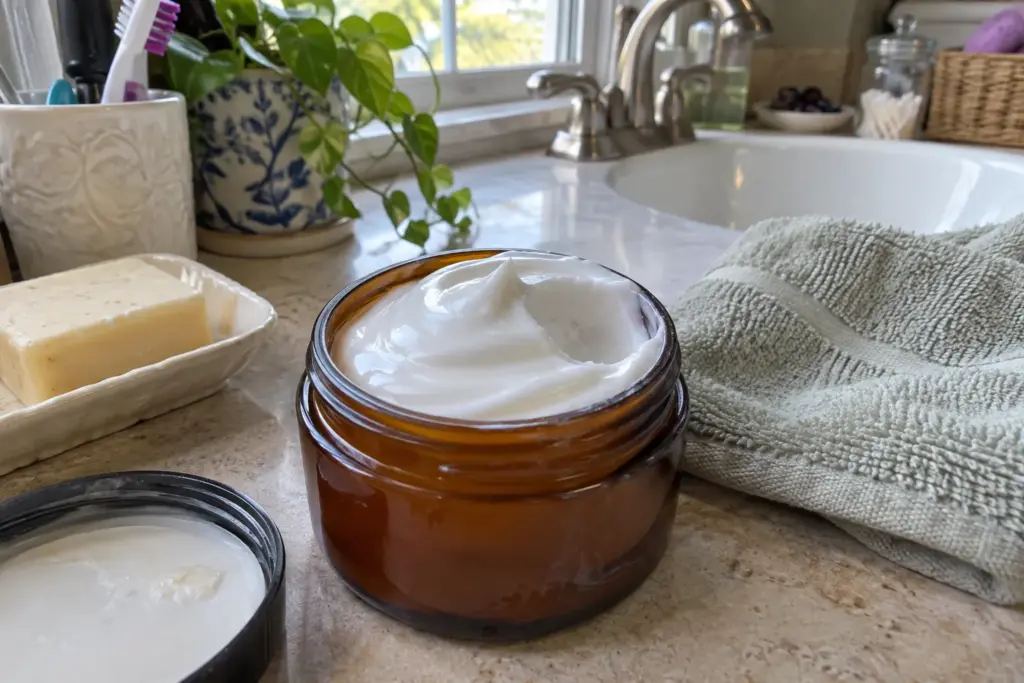
The cream keeps thickening for 24 hours as the fatty alcohols crystallize. Judge the texture the next day, not in the beaker. For a thinner, pumpable lotion, cut the cetyl alcohol to 0.5 g and add 1.5 g of water.
How to make a water-free hand balm
A balm has no water, so microbes cannot grow in it and it needs no preservative. It also cannot hydrate on its own. It works best rubbed into damp hands right after washing, or as an overnight treatment for cracked knuckles. For a 100 g batch:
- Weigh. 50 g of a liquid oil such as sweet almond or sunflower, 35 g of shea butter and 15 g of beeswax pellets.
- Melt. Melt everything in a water bath until clear, about 70 °C. Take it off the heat.
- Add an antioxidant. Stir in 0.5 g of vitamin E (tocopherol). It slows the oils from going rancid. It does not preserve against microbes.
- Pour and chill. Pour into tins and put them in the fridge for 30 minutes. Fast cooling keeps shea butter from turning grainy.
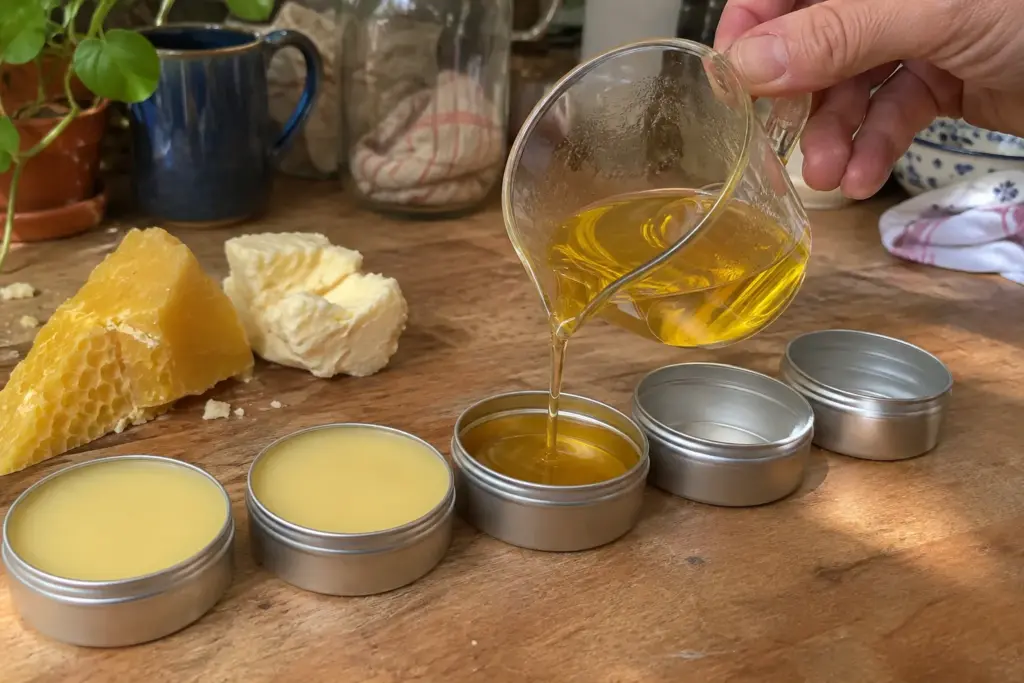
For a softer balm, drop the beeswax to 10 g and raise the oil to 55 g. For a firmer stick that slides into a lip-balm style tube, raise the beeswax to 25 g.
Recipe variations
Change the cream by swapping weight between ingredients and keeping the total at 100 g. Take any additions out of the water.
| Goal | Change | Why it works |
|---|---|---|
| Cracked, working hands | Add 2 g dimethicone in the cool-down phase | A silicone film that slows water loss without grease; 1% or more qualifies as a skin protectant under FDA rules |
| Faster absorbing | Swap shea for 6 g more almond oil; cut cetyl alcohol to 1 g | Less solid fat, thinner film |
| Richer night cream | Raise the almond oil to 16 g and the emulsifying wax to 7 g | Keep the wax near a quarter of the oil weight plus 1% |
| Soothing | Add 0.5 g allantoin to the water phase | Softens and loosens dry flakes; FDA allows 0.5 to 2% as a skin protectant |
| Extra hydration | Add 2 g panthenol (vitamin B5) in the cool-down phase | A second humectant that is less tacky than more glycerin |
| Scented | Add up to 0.5 g of essential oil below 40 °C | Higher amounts raise the risk of skin irritation |
Scale the emulsifier with the oil
Keep the emulsifying wax at roughly a quarter of the weight of all the oils and butters. Add oil without adding wax and the cream separates within days.
Two tests for your cream
The dilution test: which kind of emulsion did you make?
A cream is either oil droplets in water (oil-in-water, the light kind) or water droplets in oil (water-in-oil, the greasy kind used in cold creams). A drop of water tells them apart.
- Set up two glasses. One with a little water, one with a little oil.
- Add the cream. Drop a pea-sized blob into each and stir with a toothpick.
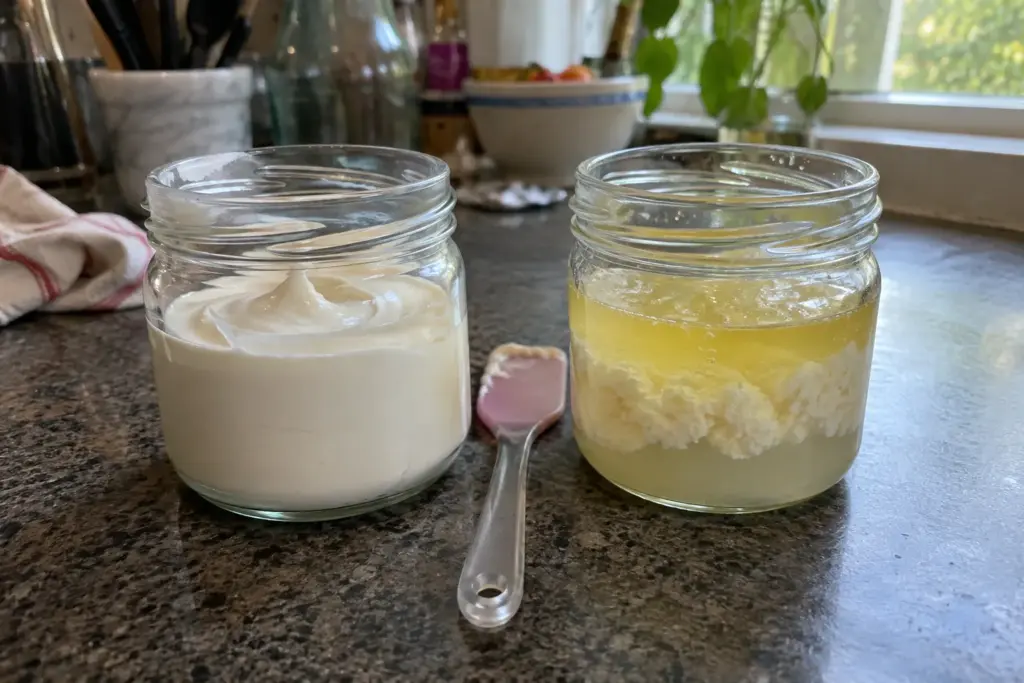
- Read the result. An oil-in-water cream breaks up into a milky cloud in water and stays a lump in oil. A water-in-oil cream does the opposite. The liquid that dissolves the cream is the continuous phase.
The stress test: will it separate?
Fill a small spare jar, then put it in the freezer overnight and in a warm spot near 40 °C (a sunny windowsill or the top of the fridge) the next day. Repeat for three cycles. A stable cream looks and feels the same after three cycles. Oil beading on top, a watery layer or a curdled texture means the batch will separate in the jar within weeks.
The science: how hand cream works
In three sentences
Skin dries out when water escapes through gaps in its outer layer. Hand cream fixes this three ways: humectants pull water in, emollients smooth the surface and occlusives seal water in. An emulsifier packs all three into one light cream.
Why hands dry out
The outer layer of skin, the stratum corneum, is 10 to 20 layers of flat dead cells held together by lipids: ceramides, cholesterol and free fatty acids. Dermatologists call it the brick and mortar model. The lipid mortar is the barrier that keeps water inside the body. Healthy skin still loses some water through it, a flow called transepidermal water loss.
Every hand wash strips some of those lipids, and soap and detergents also raise the skin surface pH, which averages just below 5. Cold air holds little moisture and pulls more water out. Once the outer layer drops below about 10% water, cells curl at the edges, the surface scales and cracks open along knuckles and fingertips.
Humectants, emollients and occlusives
| Type | What it does | In this recipe |
|---|---|---|
| Humectant | Binds water and draws it into the stratum corneum | Glycerin |
| Emollient | Fills gaps between skin flakes so the surface feels smooth | Almond oil, shea butter, cetyl alcohol |
| Occlusive | Forms a film that slows water loss | Shea butter, emulsifying wax; dimethicone or beeswax in the variants |
Glycerin does more than attract water. It speeds the repair of the lipid barrier and helps the enzymes that shed old skin cells work in dry conditions. Petrolatum is the strongest occlusive: at 5% or more it cuts water loss by over 98%. Lanolin, mineral oil and silicones manage about 20 to 30%, and plant oils sit at the weaker end, which is why an oil and wax balm works best on damp skin that already holds water.
Emulsifiers make oil and water mix
Oil and water separate because water molecules attract each other far more strongly than they attract oil. An emulsifier is a molecule with a water-loving head and an oil-loving tail. In emulsifying wax, polysorbate 60 carries a head of about 20 linked ethylene oxide units and a stearic acid tail. Blending tears the oil into droplets a few micrometers across, and the emulsifier coats each one, heads out, so the droplets cannot merge.
Chemists rank emulsifiers by HLB, the hydrophilic-lipophilic balance, on a scale from 0 to 20. Emulsifiers with an HLB of about 8 to 18 make oil-in-water creams; below about 6 they make water-in-oil. Polysorbate 60 sits near 15. The cetearyl alcohol in the wax packs between the polysorbate molecules and into layered gel networks in the water, which is what turns a runny emulsion into a thick cream that holds its shape.
Why the droplets stay put
Oil droplets are lighter than water and slowly rise, a process called creaming. Stokes’ law gives their speed:
v = 2r2(ρwater − ρoil)g / 9η
The speed grows with the square of the droplet radius r and falls with the viscosity η. Halve the droplet size and creaming slows fourfold. Raise the viscosity a thousandfold, as the cetyl alcohol network does when the cream sets, and droplets that would rise a centimeter in an hour in water take more than a month to move the same distance. That is why the stick blender and the thickener matter as much as the emulsifier.
Why both phases go in hot
Emulsifying wax and cetyl alcohol are solid until about 50 to 60 °C. If the water is cooler than the oils, the waxes freeze into flakes the moment the two meet and the cream turns grainy or never forms. Heating both phases to the same 70 to 75 °C keeps every wax molecule free to move to the oil-water surface. The preservative goes in last because heat can evaporate or break down several common preservatives and fragrances.
Why the preservative is not optional
Bacteria and fungi need water to grow, and a cream is 70% water with glycerin and fats to feed on. Fingers carry skin bacteria into the jar every day. The FDA names microbial contamination as a common reason for cosmetic recalls, and contaminated creams can cause skin and eye infections before any mold is visible.
Vitamin E, rosemary extract and grapefruit seed extract are often sold as natural preservatives. They are not. Vitamin E and rosemary are antioxidants that slow oils from going rancid. Lab tests of commercial grapefruit seed extracts traced their antimicrobial effect to synthetic preservatives such as benzethonium chloride added during manufacture. A balm with no water is the only homemade skin product that is safe without one.
Homemade vs store-bought hand cream
| Feature | Homemade cream | Store-bought cream |
|---|---|---|
| Ingredients | Seven, all known | Often 20 or more |
| Preservative testing | None; you rely on the supplier’s use rate | Challenge-tested for each formula |
| Shelf life | About 3 to 6 months once opened | Usually 12 months or more after opening |
| Packaging | Usually an open jar | Often a tube or pump that keeps fingers out |
| Fragrance | Only what you add | Common, with fragrance-free options |
| Cost per gram | Lower | Higher for boutique brands, similar for drugstore basics |
A drugstore cream with glycerin, petrolatum or dimethicone works as well as anything you make at home. The reasons to make your own are control over the ingredients, a texture you like and the fun of building an emulsion. The limit is testing: a commercial maker challenge-tests the preservative against real microbes, which a home kitchen cannot do.
Use a tube
Pack the cream in a tube instead of a jar, and put it on after every hand wash. Fewer fingers in the product means less contamination, and the American Academy of Dermatology rates thick tube creams above thin pump lotions for dry hands.
Troubleshooting
| Problem | Cause | Fix |
|---|---|---|
| Cream separated into layers | Too little emulsifier, or phases at different temperatures | Rewarm to 70 °C and reblend; add 1 g more emulsifying wax next time |
| Grainy or gritty | Shea butter crystallized while cooling slowly | Heat and hold the oil phase longer, then stir while cooling |
| Too thin | Not set yet, or too little cetyl alcohol | Wait 24 hours; add 1 g cetyl alcohol to the next batch |
| Too thick or waxy | Too much cetyl alcohol or shea butter, or water lost to evaporation | Top up evaporated water; cut cetyl alcohol to 1 g |
| Greasy feel | Too much oil for your skin | Cut the oils to 12 g and the emulsifying wax to 4 g |
| Sticky | Too much glycerin | Lower glycerin to 3 g |
| Spots, sour smell or color change | Microbial growth | Throw it out. Add the preservative at the full rate below 40 °C next time |
No preservative, no cream
Do not leave out the preservative or swap it for vitamin E. An unpreserved cream can grow bacteria within days in a warm bathroom, long before you see or smell anything.
Safety
Before you start
- Hot wax burns. Melted oils at 75 °C stick to skin. Use a water bath, never direct heat, and keep children away from the stove. Cool a burn under running water for 20 minutes.
- Use preservatives at the supplier’s rate. Phenoxyethanol is limited to 1% in cosmetics in the EU. More is not safer.
- Patch test. Rub a little on the inside of your forearm and wait 48 hours before using it daily, especially with essential oils or nut oils.
- Nut allergies. Sweet almond oil and shea butter come from tree nuts. Use sunflower or jojoba oil for anyone with a tree nut allergy.
- Label and date the jar. Write the date made and throw the cream out after 6 months or at any change in smell or color.
See a doctor for hands that crack and bleed, blister or stay red after two weeks of regular moisturizing. Those are signs of hand eczema or contact dermatitis, which need more than a cream.
The same emulsion chemistry holds hair conditioner together. Our guide to how to make conditioner uses a positively charged emulsifier that binds to hair, and examples of emulsions shows the same structure in mayonnaise, milk and paint.
More practical science: browse all our everyday science how-tos, from household chemistry to experiments you can build at home.
Frequently asked questions
Not a stable cream. Oil and water separate without an emulsifier, and beeswax is not one. Without emulsifying wax, make a water-free balm of oil, shea butter and beeswax instead.
Yes, in any cream or lotion that contains water. Water, oils and glycerin feed bacteria and mold, and a jar opened with fingers every day gets contaminated within days. Water-free balms do not need one.
No. Vitamin E is an antioxidant that slows oils from going rancid. It does not stop bacteria, yeast or mold from growing.
Both are oil-in-water emulsions. Lotion has more water and less oil and wax, so it is thinner and pours. Cream has more oil and thickener, so it holds its shape and leaves a stronger barrier on the skin.
About 3 to 6 months with a broad-spectrum preservative, less in an open jar kept in a warm bathroom. Throw it out at any change in smell, color or texture.
Usually too little emulsifier for the amount of oil, or the water and oil phases were at different temperatures when combined. Keep emulsifying wax near a quarter of the oil weight and heat both phases to 70 to 75°C.
Yes, in place of part of the almond oil. Coconut oil is solid below 24°C, so it makes the cream firmer, and some people find it clogs pores on the face, though that matters less on hands.
Shea butter forms crystals when it melts incompletely or cools slowly. Hold the oil phase at 70 to 75°C for 15 to 20 minutes and stir the cream as it cools.
An occlusive that seals water in. Petrolatum is the strongest, cutting water loss by about 98 percent, and dimethicone or beeswax help too. Apply right after washing while the skin is still damp.
Distilled water is better. Tap water carries minerals that can affect the texture and microbes that add load for the preservative, which shortens shelf life.
Sources
- US FDA (eCFR). 21 CFR 347.10 Skin protectant active ingredients
- US FDA. Microbiological safety and cosmetics
- Halla N et al. Cosmetics preservation: a review on present strategies. Molecules, 2018
- Fluhr JW, Darlenski R, Surber C. Glycerol and the skin: holistic approach to its origin and functions. Br J Dermatol, 2008
- Sethi A et al. Moisturizers: the slippery road. Indian J Dermatol, 2016
- Ghadially R, Halkier-Sorensen L, Elias PM. Effects of petrolatum on stratum corneum structure and function. J Am Acad Dermatol, 1992
- Lambers H et al. Natural skin surface pH is on average below 5. Int J Cosmet Sci, 2006
- von Woedtke T et al. Antimicrobial efficacy of grapefruit seed extract and its relation to preservative substances contained. Pharmazie, 1999
- American Academy of Dermatology. Skin care tips for your hands
- University of Liege (ORBi). African shea butter: properties and extraction technologies