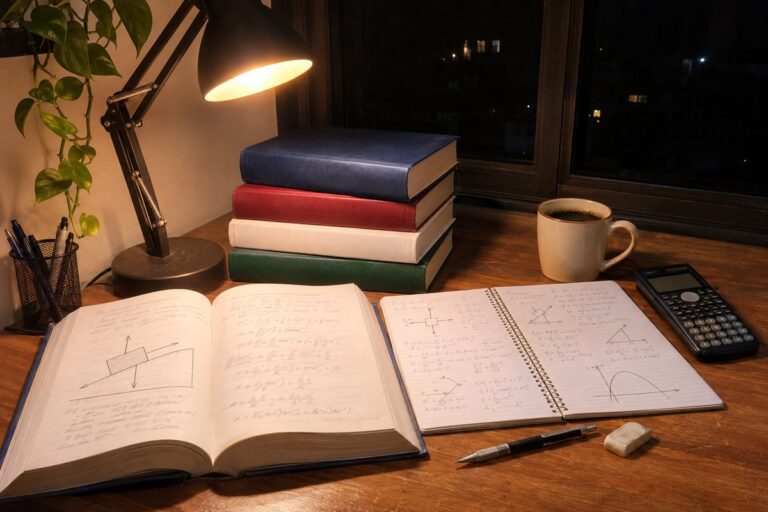
Physics has about a dozen major branches, and they split cleanly into three groups: classical physics (mechanics, thermodynamics, electromagnetism, optics, acoustics), modern physics (relativity, quantum mechanics, nuclear and particle physics, condensed matter, cosmology) and interdisciplinary physics (astrophysics, biophysics, geophysics, medical physics, econophysics). This guide covers those fields of physics one by one. If you landed here looking for “fields” as in gravitational or magnetic fields, there’s a short section on that near the end.
Contents
- TLDR
- How physicists divide the subject
- Classical physics
- Modern physics
- Interdisciplinary physics
- Summary table of the fields of physics
- How the fields overlap
- Physical fields: the other meaning
TLDR
- Classical physics covers things you can see and measure at human scale: motion, heat, light, sound, electricity.
- Modern physics took over when objects got very fast, very small, very dense or very large: relativity, quantum theory, the nucleus, the universe.
- Interdisciplinary fields apply physics to another science: stars, cells, the Earth, patients, markets.
- The boundaries are loose. Most real research, and nearly every piece of technology, uses several fields at once.
How physicists divide the subject
The split between “classical” and “modern” is historical, not logical. Classical physics is the body of theory finished by roughly 1900: Newton’s mechanics, the laws of heat, Maxwell’s theory of electricity and light. Modern physics is what came after, once experiments started producing results that the old theories couldn’t explain, like the way hot objects glow or the way light behaves inside atoms.
Classical physics didn’t get thrown out. Engineers still design bridges with Newton, not Einstein. It’s a very good approximation across a huge range of everyday conditions, and it’s still an active research area.

Classical physics
Mechanics
Mechanics studies how objects move and what makes them move: forces, momentum, energy, rotation, fluids. It’s usually the first physics course anyone takes, and it’s the reason a ball follows a curve, a spinning skater speeds up when she pulls in her arms, and a cable-stayed bridge stays up.
Everyday example: structural engineering, car crash testing, and the trajectory calculations behind every space launch.
Thermodynamics
Thermodynamics deals with heat, temperature, energy and entropy. Its laws set hard limits: no engine converts all its heat into work, and heat doesn’t flow from cold to hot on its own. Statistical mechanics, a close relative, explains those laws by looking at the behavior of enormous numbers of particles.
Everyday example: refrigerators, car engines, power plants and the reason your coffee goes cold rather than getting hotter.
Electromagnetism
Electricity and magnetism turned out to be one phenomenon. James Clerk Maxwell showed in the 1860s that a single set of equations describes both, and that light is an electromagnetic wave. Radio, microwaves, X-rays and visible light are the same thing at different wavelengths.
Everyday example: electric motors, power grids, wireless charging, Wi-Fi.
Optics
Optics studies light: how it bends through lenses, reflects off mirrors, splits into colors and interferes with itself. Geometric optics treats light as rays and handles lens design. Wave optics handles diffraction and interference. Modern optics also includes quantum effects, which is where it starts blending into the next section.
Everyday example: eyeglasses, camera lenses, microscopes, and the fiber-optic cables that carry most internet traffic between continents.
Acoustics
Acoustics is the physics of sound and vibration. It covers how pressure waves travel through air, water and solids, and why a violin and a trumpet playing the same note sound different. Architects use it to shape concert halls; doctors use ultrasound, which is just sound above the range of human hearing.
Everyday example: noise-canceling headphones, sonar, prenatal ultrasound, the shape of an opera house.
Modern physics
Relativity
Einstein’s special relativity (1905) says that the speed of light is the same for every observer, and that time and space adjust to make that true. General relativity (1915) describes gravity as the curvature of spacetime. You won’t notice either at walking speed, but you depend on both.
Everyday example: GPS. Satellite clocks run slightly fast relative to clocks on the ground because they sit higher in Earth’s gravity, and slightly slow because of their orbital speed. The net effect is about 38 microseconds per day. Without correcting for it, GPS positions would drift by kilometers within a day.
General relativity also predicted gravitational waves. LIGO detected them in 2015, and the project earned the 2017 Nobel Prize in Physics.
Quantum mechanics
Quantum mechanics describes matter and energy at the scale of atoms and smaller. Energy comes in discrete packets, particles behave like waves, and outcomes are described by probabilities. It’s the best-tested theory in science, and it’s also the one that still produces arguments about what it means. For readers who want to explore those arguments without heavy math, these quantum physics books for beginners are a good place to start.
Everyday example: lasers, LEDs, and the transistors in every phone and computer. A laser works through stimulated emission, an effect Einstein described in 1917 using quantum ideas.
Nuclear and particle physics
These two are related but separate. Nuclear physics studies the nucleus: how protons and neutrons bind, why some atoms decay, how fission and fusion release energy. Particle physics goes smaller and asks what matter is made of at the most basic level. Its main framework is the Standard Model, which CERN describes as the theory of the fundamental particles and the forces acting between them. The Higgs boson, the last missing piece, was found at CERN’s Large Hadron Collider in 2012.
Everyday example: nuclear power, smoke detectors, carbon dating, and PET scans in hospitals.
Condensed matter physics
Condensed matter physics studies what happens when huge numbers of atoms pack together into solids and liquids, the same states of matter you meet every day. It’s the largest subfield of physics by number of working researchers. Properties like conductivity, magnetism and superconductivity don’t exist for a single atom. They emerge from the crowd.
Everyday example: semiconductors, solar cells, flash memory, and the superconducting magnets inside MRI machines.
Cosmology
Cosmology studies the universe as a whole: its origin, its age, its structure and its fate. It rests on general relativity and particle physics together. The big discoveries include the expansion of the universe, the cosmic microwave background left over from the early universe, and the finding that the expansion is speeding up, which won the 2011 Nobel Prize in Physics. The cause, which physicists call dark energy, is still unexplained.
Everyday example: there isn’t one, honestly. Cosmology is the field where the payoff is the answer itself. Its tools, though, like sensitive detectors and large-scale data analysis, spill into other industries.
Interdisciplinary physics
These fields borrow physics methods and point them at problems from other sciences. Many university departments run them as joint programs.
Astrophysics
Astrophysics applies physics to stars, planets, galaxies and black holes. It overlaps with cosmology, but astrophysics focuses on individual objects and how they work, such as why a star burns for billions of years and then collapses.
Everyday example: space telescopes, satellite instruments, and the sensors developed for them that later show up in medical imaging.
Biophysics
Biophysics uses physics to explain living systems: how proteins fold, how nerve signals travel, how molecular motors move cargo inside a cell, how a gecko sticks to a wall. Tools like X-ray crystallography and optical tweezers came out of physics labs.
Everyday example: the structural biology that underlies drug design, and the imaging methods used to see inside living cells.
Geophysics
Geophysics studies the Earth itself with physical methods: earthquakes, the planet’s magnetic field, volcanoes, ice sheets, and the interior structure we can’t dig to. Seismic waves from earthquakes are how we know the Earth has a liquid outer core.
Everyday example: earthquake early warning, oil and mineral exploration, and groundwater mapping.
Medical physics
Medical physicists make sure imaging and radiation treatments work safely and accurately. They calibrate radiotherapy machines, plan radiation doses for cancer patients, and develop imaging methods such as MRI, CT and PET. It’s one of the few physics careers that sits inside a hospital, and it usually requires graduate training plus clinical certification.
Everyday example: the radiation plan for a cancer patient and every MRI scan you’ve heard described as “just magnets and radio waves.”
Econophysics
Econophysics applies statistical physics to financial markets and economic data. It treats markets as systems with many interacting parts, and it looks for patterns like the heavy-tailed distribution of market crashes. It’s the youngest and most debated field on this list, and economists don’t all welcome it.
Everyday example: risk models, fraud detection and the quantitative analysis used at trading firms.
Summary table of the fields of physics
| Field | What it studies | Everyday or tech example | Typical career path |
|---|---|---|---|
| Mechanics | Motion, forces, energy | Bridges, vehicles, spaceflight | Mechanical, civil or aerospace engineering |
| Thermodynamics | Heat, temperature, entropy | Engines, refrigerators | Energy, HVAC, power engineering |
| Electromagnetism | Electric and magnetic phenomena, light | Motors, power grids, Wi-Fi | Electrical engineering, telecommunications |
| Optics | Behavior of light | Lenses, fiber optics | Photonics, imaging, optical engineering |
| Acoustics | Sound and vibration | Ultrasound, sonar, concert halls | Audio engineering, architecture, underwater systems |
| Relativity | Spacetime, gravity, high speeds | GPS, gravitational-wave detection | Academic research, aerospace, navigation |
| Quantum mechanics | Atoms and subatomic behavior | Lasers, transistors | Semiconductor industry, quantum computing |
| Nuclear and particle physics | Nuclei and fundamental particles | Nuclear power, PET scans | National labs, energy, medical isotopes |
| Condensed matter | Solids, liquids, materials | Chips, solar cells, MRI magnets | Materials science, electronics R&D |
| Cosmology | Origin and fate of the universe | Large-scale data analysis | Academic research, data science |
| Astrophysics | Stars, galaxies, black holes | Space telescopes | Observatories, space agencies, data science |
| Biophysics | Physics of living systems | Protein imaging, drug design | Pharma, biotech, research labs |
| Geophysics | Earth’s interior and surface processes | Earthquake monitoring, exploration | Energy, mining, hazard monitoring |
| Medical physics | Radiation and imaging in medicine | MRI, radiotherapy planning | Hospitals, clinical physics |
| Econophysics | Statistical patterns in economies | Risk models | Finance, quantitative analysis |
A physics degree doesn’t lock you into one row. The U.S. Bureau of Labor Statistics tracks physicists and astronomers as a relatively small occupation, because many physics graduates end up with titles like engineer, data scientist or software developer instead.
How the fields overlap
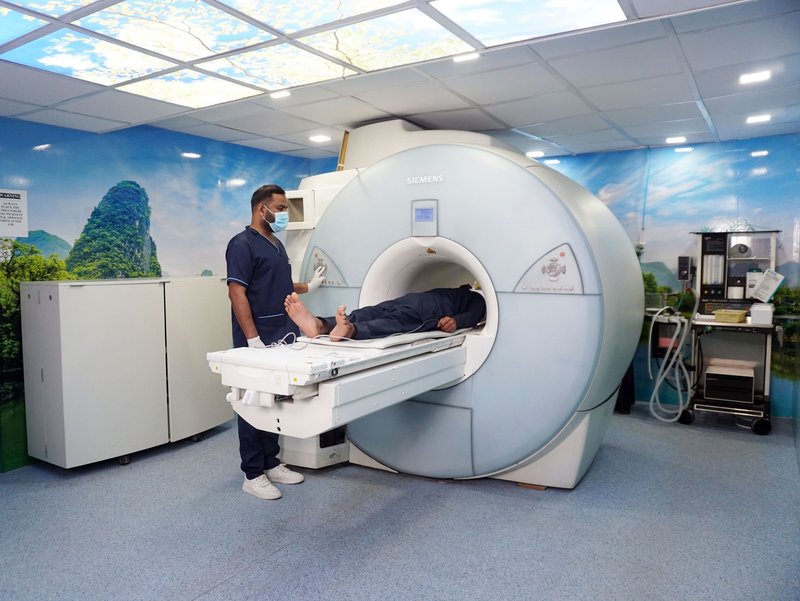
Take an MRI scanner. The magnet is a superconductor, which is condensed matter physics. The signal comes from the quantum behavior of hydrogen nuclei, which is quantum and nuclear physics. The radio pulses and detection coils are electromagnetism. The image reconstruction is math and signal processing. The person making sure the dose and settings are safe is a medical physicist.
GPS is the same story: relativity for the clocks, electromagnetism for the radio signals, mechanics for the orbits, and quantum physics for the atomic clocks aboard each satellite.
A few other overlaps worth knowing:
- Optics and quantum mechanics merge in quantum optics, which gives us lasers and the basis for quantum communication.
- Astrophysics, cosmology and particle physics share a question: what is dark matter? Telescopes, underground detectors and colliders are all hunting for it.
- Thermodynamics and biophysics meet in how cells use energy, since a living cell is an engine too.
- Mechanics and geophysics meet in earthquake modeling, where rock behaves like a spring that eventually snaps.
Physical fields: the other meaning
In physics, a “field” is also a concept: a quantity that has a value at every point in space. The ones you meet first are:
- Gravitational field: the pull a mass exerts on other masses around it. Near Earth’s surface it gives every falling object the same acceleration.
- Electric field: the push or pull a charge exerts on other charges. It’s what makes your hair stand up near a balloon.
- Magnetic field: the influence of moving charges and magnets. A compass needle follows Earth’s.
- Quantum fields: in modern particle physics, the most basic things are fields, and particles are ripples in them. An electron is a ripple in the electron field, a photon a ripple in the electromagnetic field.
So “fields of physics” can mean branches or can mean these. They connect, too: classical electromagnetism is the study of electric and magnetic fields, and quantum field theory is the framework that merges quantum mechanics with relativity.