Analytical chemistry tells us what is in a sample and how much of it is there. Nearly every decision about safety, health, and quality depends on that answer: whether tap water is safe to drink, whether a pill contains the dose on the label, whether a blood test result is real. Without reliable measurement, those decisions are guesses.
Table of Contents
- TLDR
- What analytical chemists actually do
- Medicines: checking purity and dose
- Food safety: finding what shouldn’t be there
- Environmental monitoring: lead, PFAS, and air
- Forensics and toxicology
- Clinical diagnostics
- Materials and battery research
- Regulation runs on measurement
- Why analytical chemistry is important most when it fails
- Careers and where the field is heading
- FAQ
TLDR
- Analytical chemistry answers two questions: what is in this sample (qualitative) and how much (quantitative).
- Drug safety, food safety, clean water, criminal evidence, medical tests, and battery development all depend on those answers.
- The tools are chromatography (separating a mixture), mass spectrometry (weighing molecules), and spectroscopy (reading how matter interacts with light).
- When the measurement is wrong or skipped, people get hurt. Flint, Michigan is the standard example.
What analytical chemists actually do
Qualitative analysis identifies a substance. Quantitative analysis measures its amount. Most real problems need both: “there’s lead in this water” matters far less than “there’s lead at 40 parts per billion, and the legal limit is 15.”
The scale is the hard part. Analytical chemists routinely hunt for substances at parts per billion or parts per trillion. One part per trillion is roughly one drop of water in 20 Olympic swimming pools. Finding that drop, and being sure it’s the right drop, takes three families of tools:
- Chromatography separates a mixture into its components, the way a long race spreads runners out by speed. Gas and liquid versions exist, and both can separate diastereomers, which share a formula but differ in shape.
- Mass spectrometry measures the mass of molecules and their fragments, which works like a fingerprint for identifying them.
- Spectroscopy shines light or radio waves at a sample and reads what comes back. Different molecules absorb different wavelengths.
The tools are usually combined. Chromatography feeds a mass spectrometer, so the mixture is sorted first and each piece identified second.
The field’s importance shows up in its Nobel Prizes. Archer Martin and Richard Synge won the 1952 Nobel Prize in Chemistry for partition chromatography. The 2002 prize went partly to John Fenn and Koichi Tanaka for methods that let mass spectrometers handle large biological molecules such as proteins.
Medicines: checking purity and dose
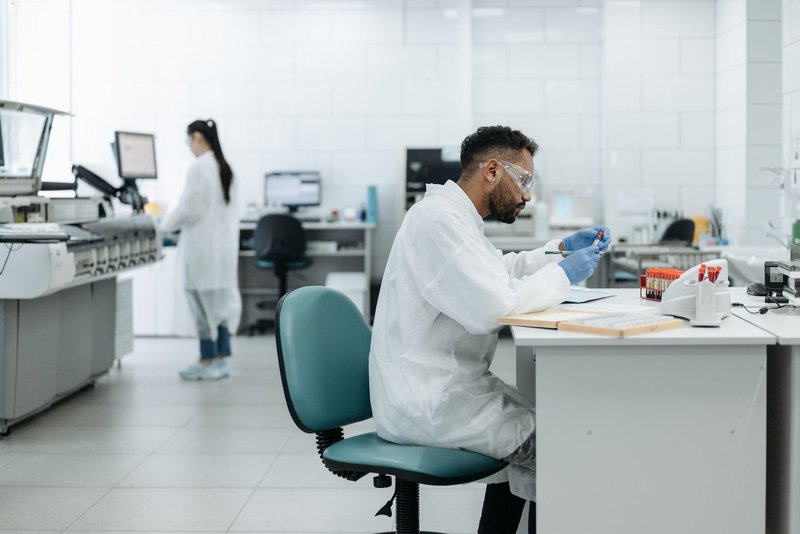
A tablet is mostly not the drug. It holds the active ingredient, fillers, binders, and trace leftovers from manufacturing. Analytical chemists confirm three things: the right compound is present, the amount matches the label, and the impurities stay under strict limits.
High-performance liquid chromatography (HPLC) is the workhorse here. Every batch of a prescription drug gets tested before release.
The 2018 valsartan recalls show why. Manufacturers found a probable carcinogen, N-nitrosodimethylamine (NDMA), in a blood pressure drug taken by millions of people. It was an unintended by-product of a manufacturing change, present at trace levels. Chromatography paired with mass spectrometry is how it was found, and how regulators now screen other drugs for the same class of contaminant.
Food safety: finding what shouldn’t be there
Food labs test for pesticide residues, heavy metals, mycotoxins from mold, allergens, and added substances. They also check for fraud: whether “extra virgin” olive oil is cut with cheaper oil, or whether honey contains added syrup.
The nutrition panel on a package is analytical chemistry too. Protein, fat, sugar, and sodium values come from lab methods.
Environmental monitoring: lead, PFAS, and air
Water is the most familiar case. The EPA’s lead drinking water guidance rests on lab measurements, because lead has no taste, color, or smell. You can’t detect it with your senses at any concentration that matters.
PFAS, the “forever chemicals” used in nonstick coatings and firefighting foam, are an even tougher target. In 2024 the EPA set an enforceable limit of 4 parts per trillion for two of them, PFOA and PFOS, in drinking water. A regulation like that only works if labs can measure at that level reliably. That limit exists partly because instruments got good enough to see the problem.
Air quality monitors, soil testing at old industrial sites, and ocean mercury surveys all work the same way. Someone has to measure what’s there before anyone can say whether it’s safe.
Forensics and toxicology
When police stop a driver, blood alcohol is measured by gas chromatography in many labs. After an overdose, a toxicology lab identifies which drugs are in the blood, often at nanogram-per-milliliter concentrations. Fentanyl is potent enough that the amounts involved are tiny.
Forensic chemistry also identifies seized drugs, gunshot residue, paint fragments, and fibers. The same discipline underlies anti-doping tests in sport, where labs look for banned compounds and their breakdown products in urine.
The standard here is higher than in most fields. The result has to hold up in court, so labs document every step, from how the sample was stored to how the instrument was calibrated.
Clinical diagnostics
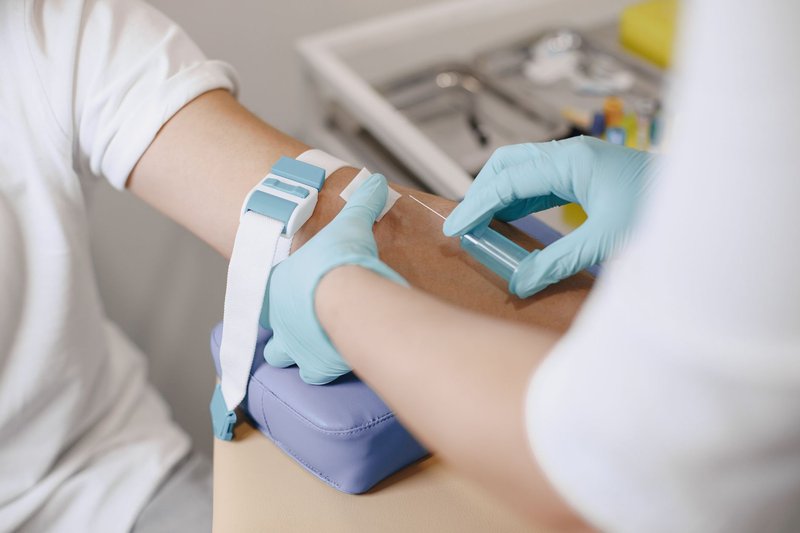
A cholesterol panel, a blood glucose reading, and a kidney function test are all analytical chemistry applied to a body fluid. Home glucose meters are small electrochemical sensors, and they’re one of the most widely used analytical instruments in the world.
Newborn screening is a stronger example. A few drops of blood on a paper card go to a lab, where tandem mass spectrometry checks for dozens of rare metabolic disorders at once. Several of them are treatable with diet or medication if caught in the first days of life, and cause lasting harm if missed.
Materials and battery research
Analytical methods don’t only protect people. They also help build things.
Battery developers use spectroscopy and X-ray techniques to watch what happens inside an electrode as it charges and degrades. Trace impurities in lithium compounds can shorten a cell’s life, so manufacturers measure them with techniques such as ICP mass spectrometry. Semiconductor makers do something similar: a few stray atoms in a silicon wafer can ruin a chip.
Better batteries, cleaner catalysts, and stronger alloys all depend on knowing precisely what a material is made of and how that changes over time.
Regulation runs on measurement
Every legal limit in this article, from lead in water to impurities in drugs, is meaningless without a trusted method for checking it. That’s why a large share of lab work is validation: proving that a method is accurate, repeatable, and sensitive enough before anyone relies on it.
Regulators set limits. Analytical chemists make those limits enforceable.
| Field | Question it answers | Typical technique |
|---|---|---|
| Pharmaceuticals | Is the dose right, and are impurities below the limit? | HPLC, LC-MS |
| Food safety | Are there pesticides, toxins, or adulterants? | GC-MS, LC-MS, ICP-MS |
| Environment | How much lead, PFAS, or mercury is present? | ICP-MS, LC-MS/MS |
| Forensics and toxicology | Which drug or poison, and how much? | GC-MS, LC-MS |
| Clinical diagnostics | What is the concentration of a marker in blood? | Mass spectrometry, electrochemical sensors |
| Materials and batteries | What is it made of, and how is it degrading? | Spectroscopy, X-ray methods |
Why analytical chemistry is important most when it fails
Two cases show what happens when measurement goes wrong.
Flint, Michigan (2014 to 2015). The city switched its water source without adequate corrosion control, and lead leached from old pipes. Residents reported discolored water for months. A research team led by Marc Edwards at Virginia Tech ran independent tests in homes and found lead far above the EPA action level of 15 parts per billion, with one sample at 13,200. The testing made the crisis undeniable. The earlier failure was in sampling and monitoring practices that let the problem go unseen.
Melamine in milk (2008). In China, melamine was added to diluted milk and infant formula. The reason it worked is a detail of analytical chemistry: a common protein test measures nitrogen, and melamine is nitrogen-rich, so it made watered-down milk look high in protein. Roughly 300,000 infants were affected and six died, according to Chinese government figures. A test that measured the wrong thing was exploited.
Both cases show the same point. Measurement only protects people when it’s the right measurement, taken correctly, and acted on.
Careers and where the field is heading
Analytical chemists work in pharmaceutical quality control, environmental agencies, forensic labs, hospitals, food companies, and instrument manufacturers. Specialists have written for years about a shortage of trained analysts, and the work spans chemistry, instrumentation, statistics, and increasingly programming.
Three trends are shaping the field:
- Automation. Robotic sample handling lets labs run thousands of samples with fewer manual steps.
- AI and chemometrics. Machine learning helps interpret complex spectra and flag outliers that a person scanning data would miss.
- Portable instruments. Handheld spectrometers and small sensors move testing out of the lab and into fields, factories, and airports.
If you want to understand why analytical chemistry is important, look at the number of decisions in your day that rely on a number someone measured: the water you drank, the medicine you took, the food on your plate.
FAQ
What is the difference between qualitative and quantitative analysis? Qualitative analysis identifies what is in a sample. Quantitative analysis measures how much. A drug test that says “fentanyl present” is qualitative. A report that says “4 nanograms per milliliter” is quantitative.
What is analytical chemistry used for in daily life? It checks the safety of drinking water, confirms that medicines contain the right dose, screens food for contaminants, and supports blood tests at the doctor. Most people encounter its results without knowing it.
What techniques do analytical chemists use? The main ones are chromatography, mass spectrometry, and spectroscopy, often combined in a single instrument such as GC-MS or LC-MS.
Is analytical chemistry a good career? It offers steady demand across pharmaceuticals, environmental testing, forensics, and healthcare. Employers value hands-on skill with instruments and a solid grasp of statistics.
How small an amount can analytical chemistry detect? Modern instruments routinely measure parts per billion and parts per trillion, and some specialized methods go lower. The limit depends on the substance, the sample, and the method.