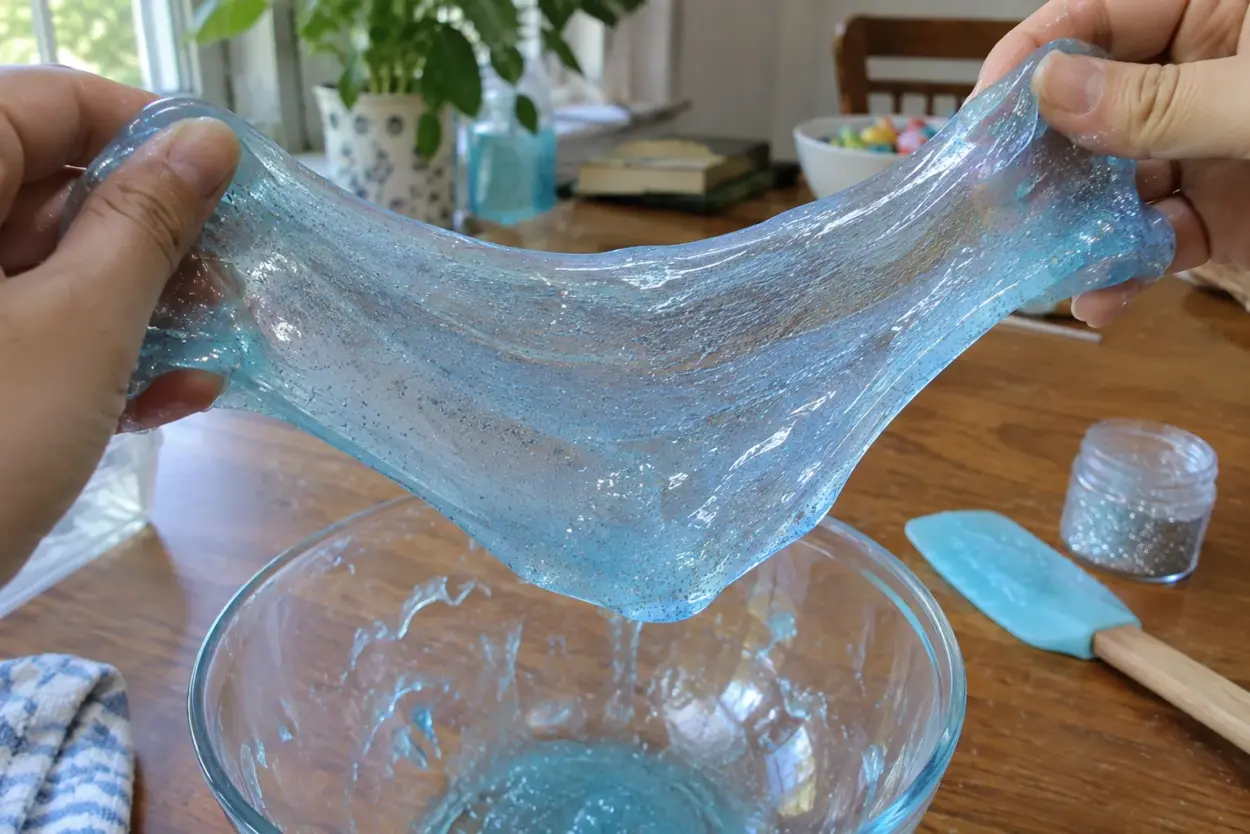
Short answer: pour ½ cup (120 mL) of clear school glue into a bowl, then stir in gel hand sanitizer one tablespoon at a time, about 2 to 3 tablespoons in total, until the glue pulls away from the bowl in stringy clumps. Knead the mass with your hands for 2 to 3 minutes and it turns into a stretchy, borax-free slime. The alcohol in the sanitizer forces the glue’s polymer chains out of the water and onto each other.
I have made this slime more times than I can count, mostly with kids who wanted slime on a day the house had no contact solution. It works because of one property of the glue polymer: it dissolves in water and refuses to dissolve in alcohol. The result is softer and shorter-lived than classic borax slime, and that trade-off is worth knowing before you start. This guide covers the two-ingredient recipe, a borate boost that makes it last for days, the ratios for different textures and the polymer chemistry behind every step.
At a glance
What you need
- ½ cup clear PVA school glue (white glue works, opaque)
- 2 to 3 tbsp gel hand sanitizer, 60% to 70% alcohol
- 1 to 2 drops food coloring (optional)
- 1 tsp glitter (optional)
- A bowl, a spoon or silicone spatula and an airtight container
Steps
- Pour the glue into the bowl and add color.
- Stir in 1 tbsp of hand sanitizer.
- Add a second tbsp and stir until clumps form.
- Knead by hand for 2 to 3 minutes.
- Store in a sealed container.
Gel, not liquid
Use a thick gel sanitizer, not a liquid or spray. The gel carries a thickener (carbomer) that helps the slime hold together, and a gel is easy to add in measured spoonfuls.
This guide contains Amazon affiliate links. 33Science earns a commission on qualifying purchases. See our affiliate disclosure.
Ingredients and tools
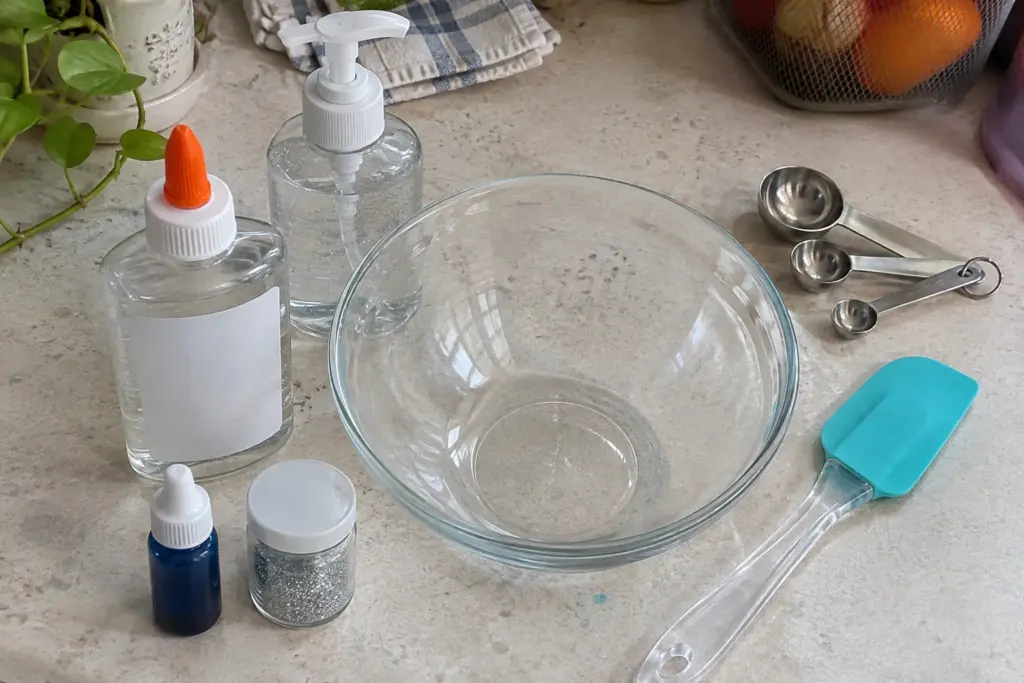
Clear school glue
Polyvinyl alcohol (PVA) in water
½ cup (120 mL)The slime itself. PVA is a long chain polymer with an OH group on every second carbon, which is why it dissolves in water and why the glue pours. Clear glue gives a glassy slime; white glue gives an opaque, slightly rubbery one.
Gel hand sanitizer
Ethanol or isopropanol, water, carbomer
2 to 3 tbsp (30 to 45 mL)The activator. Its alcohol is a poor solvent for PVA, so where sanitizer meets glue the chains pull together into a rubbery network. Pick a clear gel with 60% to 70% alcohol on the label and no exfoliating beads.
Food coloring
Water-soluble dye
1 to 2 dropsAdd it to the glue before the sanitizer so it spreads evenly. More than a few drops stains hands.
Glitter or foam beads
Polyester or polystyrene
1 tspOptional. Stir it into the glue first; glitter added after the slime forms clumps in one spot.
Tools
- A glass or ceramic mixing bowl (plastic works, but glue sticks to scratched plastic)
- Measuring spoons and a ½ cup measure
- A silicone spatula or a sturdy spoon
- An airtight container with a snap or screw lid
- A plastic tablecloth or tray if kids are mixing
Check the glue
Not every clear glue is PVA. Glue sticks, rubber cement and “tacky” craft glues use other polymers and do not react with alcohol the same way. Washable school glue labeled clear or white is the one that works.
How to make hand sanitizer slime
- Pour the glue. Squeeze ½ cup (120 mL) of clear school glue into the bowl.
- Add color and glitter. Stir in 1 to 2 drops of food coloring and the glitter now, while the glue is still liquid.
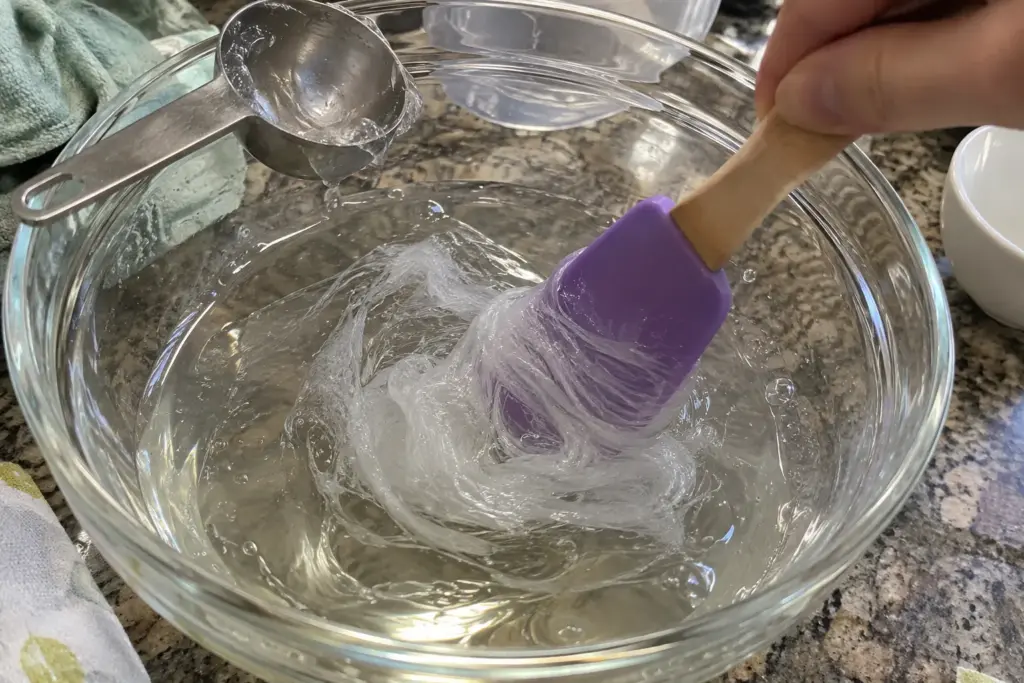
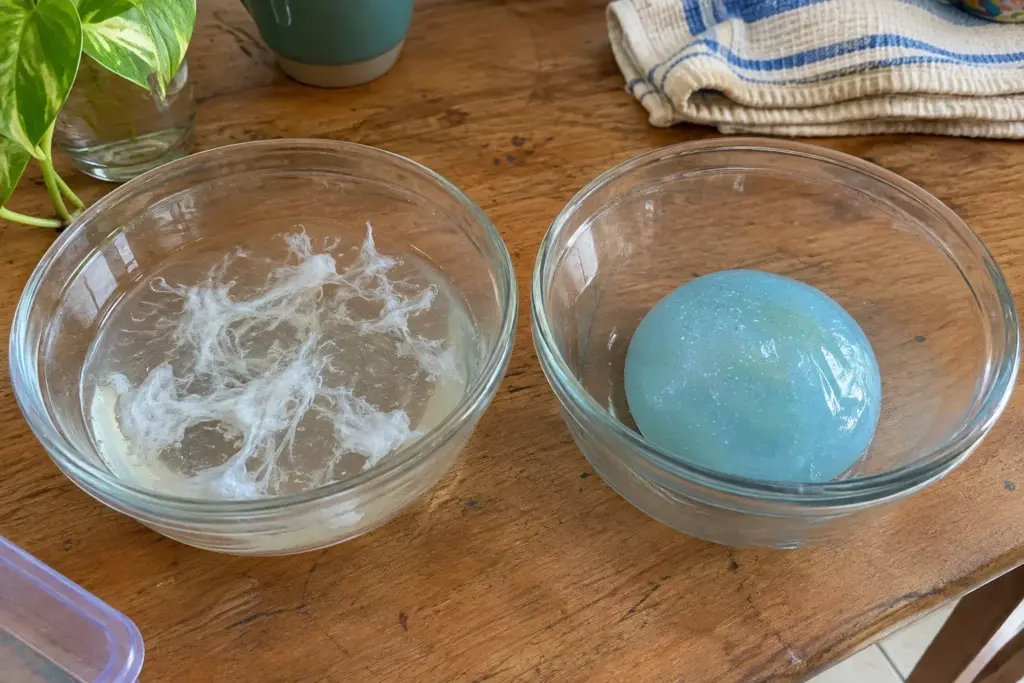
- Add the first tablespoon of sanitizer. Spoon 1 tablespoon of gel hand sanitizer onto the glue and stir steadily for 30 seconds. Stringy white or cloudy streaks appear where the two meet.
- Add the second tablespoon. Stir again. Within a minute the glue collects into a soft, sticky mass that wraps around the spatula and leaves the sides of the bowl.
- Knead it. Lift the mass out and knead, stretch and fold it with your hands for 2 to 3 minutes. It feels wet and stringy at first, then turns smooth and stretchy as the clumps merge.
- Adjust. Still sticky after 3 minutes of kneading? Work in 1 more teaspoon of sanitizer at a time, up to a third tablespoon. Tearing or rubbery? Knead in 1 teaspoon of glue or a few drops of water.
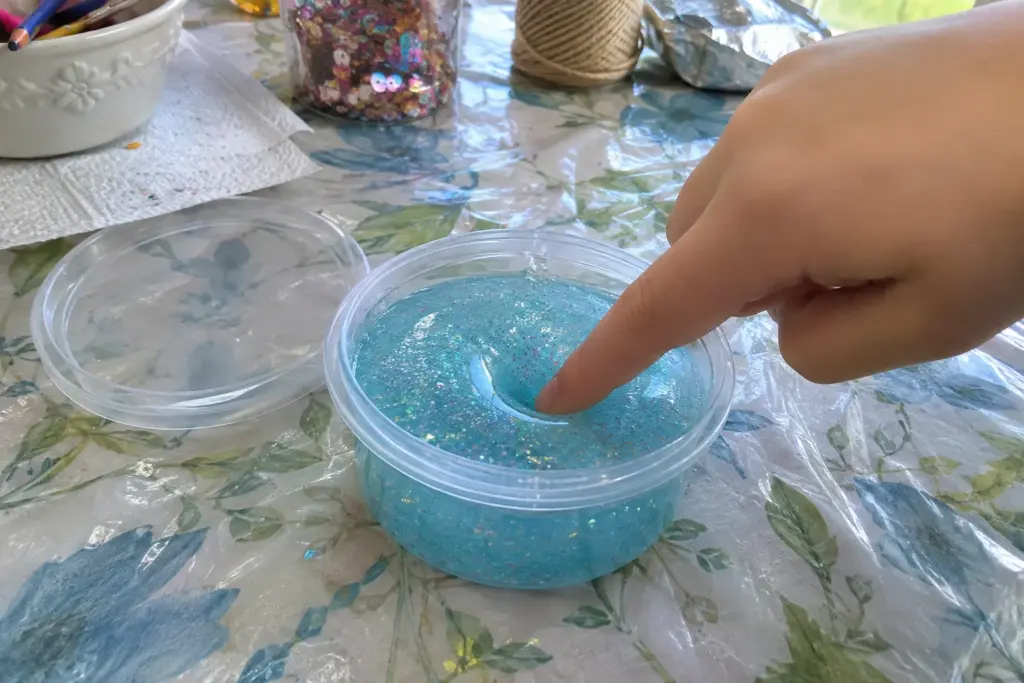
- Play, then seal. Use it the same day and store it in an airtight container between sessions.
Knead before you add more
Most failed batches are not kneaded long enough. The alcohol only reaches the glue where it touches it, so the first minute of kneading is what spreads it through the whole mass. Resist adding more sanitizer until you have kneaded for a full 2 minutes.
Borate boost: hand sanitizer slime that lasts for days
Alcohol slime is a physical gel: the chains are held together by hydrogen bonds that loosen as the alcohol evaporates. A pinch of baking soda and a little contact solution adds a second set of cross-links made by borate ions, and the slime keeps its stretch for several days in a sealed container. It is no longer borax-free, so skip this step if that was the point.
- Make the sanitizer slime. Follow the recipe above through the kneading step.
- Sprinkle the baking soda. Flatten the slime in the bowl and sprinkle ¼ teaspoon of baking soda over it.
- Add the contact solution. Add ½ teaspoon of contact lens solution whose label lists boric acid and sodium borate.
- Knead again. Fold and knead for 2 minutes. The slime firms up, stops leaving residue on your hands and snaps back when pulled.
Read the solution label
Contact solution without boric acid and sodium borate does nothing. Saline-only and hydrogen peroxide lens solutions have no borate in them, and adding more of them just makes the slime wetter.
Ratios for different textures
All amounts are per ½ cup (120 mL) of clear glue and assume a 60% to 70% alcohol gel. Higher-alcohol sanitizers act faster, so start with the low end of each range.
| Texture | Hand sanitizer | Extras | How it behaves |
|---|---|---|---|
| Gooey, oozing | 1½ to 2 tbsp | None | Drips through fingers, sticks a little, best for stretching |
| Classic stretchy | 2 to 2½ tbsp | None | Holds a ball for a few seconds, stretches into sheets |
| Firm, rubbery | 3 tbsp | None | Tears when pulled fast, bounces slightly; dries out fastest |
| Long-lasting | 2 tbsp | ¼ tsp baking soda + ½ tsp contact solution | Firm, not sticky, keeps several days sealed |
| Soft and fluffy | 2 tbsp | 1 tsp hand lotion kneaded in | Softer, more matte, less stringy |
Doubling the batch works if you double everything and add the sanitizer one tablespoon at a time. Large additions at once make a tough outer skin around liquid glue in the middle.
The science of hand sanitizer slime
In short
PVA chains stay spread out in water because water forms hydrogen bonds with their OH groups. Alcohol is a poorer partner, so where it mixes in, the chains bond to each other instead and tangle into a loose network. That network is the slime. Borate slime ties the same chains together chemically; sanitizer slime does it with solvent alone.
What glue is made of
Clear school glue is a solution of polyvinyl alcohol in water. Each PVA molecule is a chain of thousands of repeating units:
–[CH2–CH(OH)]n–
Every second carbon carries a hydroxyl group. Water molecules hydrogen-bond to those hydroxyls and keep each chain surrounded and separate, so the chains slide past one another and the glue pours. White school glue is a slightly different product, droplets of polyvinyl acetate suspended in water with PVA as the stabilizer, which is why it makes an opaque slime.
Why alcohol turns glue into slime
Polymer chemists describe a solvent as good or poor for a given polymer. Water is a good solvent for PVA. Ethanol and isopropanol are poor ones: they also have an OH group, but their carbon chains crowd it, and they hydrogen-bond to PVA less well than water does. When the liquid around a chain becomes alcohol-rich, the chain’s hydroxyls find it easier to bond to the hydroxyls of a neighboring chain. Chains collapse onto each other and form small, partly crystalline junctions.
A US patent on PVA hydrogels puts a number on it: alcohol above about 40 weight percent of the solvent typically precipitates PVA out of solution. A whole batch of sanitizer slime never gets that strong. Here is the math for 2 tablespoons of 70% ethanol gel stirred into ½ cup of glue:
30 mL × 0.70 = 21 mL ethanol × 0.789 g/mL ≈ 16.6 g ethanol
16.6 g ÷ (16.6 g + about 100 g water) ≈ 14% alcohol in the solvent
At 14% the glue would stay liquid if the two were blended instantly. They are not. At the spot where a spoonful of gel lands, the local alcohol concentration is close to 70%, far past the 40% line, and the PVA there snaps into rubbery strands. Kneading folds those strands through the rest of the glue, and they act as junction points that hold the whole mass together. That is why the slime starts stringy and only turns smooth after a few minutes of kneading.
What the gel thickener adds
Gel sanitizers are thickened with carbomer, a cross-linked polyacrylic acid neutralized with a base such as triethanolamine. Carbomer swells into soft microgel particles that make the sanitizer thick. Its carboxyl groups can also hydrogen-bond with PVA hydroxyls, so the gel contributes extra sticking points that a thin liquid sanitizer does not. A spray or liquid sanitizer still contains alcohol, but it spreads through the glue too fast and leaves a wetter, weaker slime.
Why it is stretchy and drippy at the same time
Slime is a viscoelastic material. Pull it quickly and the junctions between chains do not have time to let go, so it stretches and can even snap. Leave it on a table and the hydrogen bonds break and reform, the chains slip past each other and the blob slowly flattens like a thick liquid. Borate slime behaves the same way for the same reason: its cross-links are reversible, only stronger.
Why it does not last
Ethanol evaporates faster than water: its vapor pressure at 20 °C is about 5.9 kPa, against 2.3 kPa for water. As the alcohol leaves, the PVA chains rehydrate and the junctions loosen, so an open batch slackens and gets sticky within hours. Leave it out longer and the water goes too, and the surface dries into a rubbery skin. A sealed container slows both. The borate boost adds cross-links that do not depend on alcohol:
B(OH)3 + H2O → B(OH)4− + H+
Boric acid from the contact solution becomes the borate ion once baking soda raises the pH. Each borate ion bonds to two pairs of neighboring OH groups on two different chains and links them, and those links stay put when the alcohol is gone.
Myth: hand sanitizer slime is germ-free
It is not. Sanitizer kills germs at 60% alcohol or more, the threshold the CDC gives for hand sanitizer. Inside the slime the alcohol is diluted to roughly 14% in the calculation above, and most of it evaporates within the first hour of play. After that the slime is a damp polymer that collects skin oils and bacteria like any other slime. Wash hands before and after playing, and throw the slime out when it smells or changes color. To actually sanitize hands, use a proper homemade hand sanitizer spray at 75% alcohol.
Hand sanitizer slime vs borax slime
| Hand sanitizer slime | Borax or contact solution slime | |
|---|---|---|
| What links the chains | Hydrogen bonds forced by alcohol | Borate ions bonded to OH groups |
| Ingredients | Glue + gel sanitizer | Glue + borax solution, or contact solution + baking soda |
| Texture | Softer, stringier, glossier | Firmer, cleaner snap, less residue |
| How long it lasts | One day open, 2 to 3 days sealed | One to two weeks sealed |
| Smell | Alcohol smell for the first hour | Little or none |
| Main hazard | Flammable; toxic if swallowed | Borate skin irritation with heavy use; toxic if swallowed |
Sanitizer slime is the quick option when there is no borax or contact solution in the house, and a good demonstration of solvent quality for a science lesson. For a slime that lasts a week, borate is the better chemistry. Neither one is edible or safe for children who still put things in their mouths.
Troubleshooting
| Problem | Cause | Fix |
|---|---|---|
| Glue stays runny | Liquid or low-alcohol sanitizer, or a non-PVA glue | Use a 60% to 70% gel and washable school glue |
| Stringy clumps in liquid glue | Not kneaded long enough | Knead for 2 to 3 full minutes before adding more |
| Sticky after kneading | Too little alcohol | Add 1 tsp of sanitizer at a time, kneading between additions |
| Tears and feels rubbery | Too much sanitizer | Knead in 1 tsp of glue or a few drops of warm water |
| Lumpy white specks | Sanitizer added all at once | Keep kneading; next time add 1 tbsp at a time |
| Goes sticky overnight | Alcohol evaporated, chains rehydrated | Knead in 1 tsp of sanitizer, or use the borate boost |
| Hard skin on top | Container not sealed | Peel off the skin; store airtight |
| Strong alcohol smell | High-alcohol sanitizer | Let it air for 10 minutes away from flames before play |
One spoonful at a time
Dumping 3 tablespoons of sanitizer in at once is the mistake that ruins a batch. The outside of the glue turns into a tough skin that seals liquid glue inside, and no amount of kneading fixes it. Add one tablespoon, stir, then the next.
Safety
Before you start
- Flammable. Ethanol and isopropanol are highly flammable liquids (GHS H225). Mix away from candles, gas burners and space heaters, and keep fresh slime away from flames until the alcohol smell is gone.
- Toxic if swallowed. A small amount of hand sanitizer can cause alcohol poisoning in a child, with drowsiness, low blood sugar, seizures or coma. US poison centers handled more than 16,000 hand sanitizer exposures in children 12 and under in 2023. If someone swallows sanitizer or slime, call Poison Control at 1-800-222-1222, or 911 if they are drowsy, seizing or struggling to breathe.
- Eyes. Both alcohols cause serious eye irritation (H319). Wash hands before touching eyes; if sanitizer or slime gets in an eye, rinse with running water for 15 minutes.
- Vapors. Isopropanol can cause drowsiness or dizziness (H336), and the FDA has reported headaches and nausea from sanitizer vapors in closed spaces. Mix in a ventilated room.
- Skin. Alcohol dries skin, and the borate boost can irritate skin with long play. Wash hands with soap and water afterward.
- Methanol. Check the sanitizer against the FDA list of products contaminated with methanol, which is absorbed through skin and causes blindness.
- Age. An adult measures and adds the sanitizer. Not for children who still mouth objects.
Throw old slime in the trash, not down the sink, where the glue can coat pipes. Slime on fabric comes out with warm water, since PVA redissolves in water once the alcohol is gone; scrape off what you can first, then soak. White vinegar helps release borate-boosted slime.
More practical science: browse all our everyday science how-tos, from household chemistry to experiments you can build at home.
Frequently asked questions
Yes. Stir 2 to 3 tablespoons of gel hand sanitizer into half a cup of clear or white school glue, one tablespoon at a time, then knead for 2 to 3 minutes. The alcohol makes the glue polymer bond to itself and form slime.
You cannot make a stretchy slime without glue or another long-chain polymer. Mixing gel sanitizer with cornstarch gives a moldable dough that crumbles and hardens as the alcohol evaporates, not a slime.
About 2 to 3 tablespoons per half cup of glue. Add it one tablespoon at a time and knead between additions, since the amount depends on the alcohol strength of the sanitizer.
Glue is polyvinyl alcohol dissolved in water. Alcohol is a poor solvent for that polymer, so where sanitizer mixes in, the chains hydrogen-bond to each other instead of to water and tangle into a stretchy network.
Poorly. Liquid and spray sanitizers spread through the glue too fast and lack the carbomer thickener, so they give a wet, weak slime. A thick gel with 60 to 70 percent alcohol works best.
It is safe for supervised older children who do not put things in their mouths. Hand sanitizer is flammable and can cause alcohol poisoning if swallowed, so an adult should handle the sanitizer and everyone should wash hands afterward.
Yes, the basic glue and sanitizer recipe contains no borax or borate. Adding contact lens solution with boric acid to make it last longer brings borate back in.
The alcohol evaporated and the glue chains took up water again. Knead in a teaspoon of sanitizer, store the slime in an airtight container, or add a quarter teaspoon of baking soda and half a teaspoon of borate contact solution.
About a day left open and 2 to 3 days in an airtight container. The borate-boosted version keeps for several days longer.
No. The alcohol is diluted far below the 60 percent needed to kill germs and evaporates within about an hour, so the slime collects bacteria like any other slime.
Sources
- US Patent 4,851,168. Novel polyvinyl alcohol compositions and products prepared therefrom
- PubChem. Polyvinyl alcohol
- PubChem. Ethanol
- PubChem. Isopropyl alcohol
- Scientific American. Slime: is it a solid, liquid or both?
- Centers for Disease Control and Prevention. Hand sanitizer guidelines and recommendations
- American Academy of Pediatrics, HealthyChildren.org. Keep hand sanitizer out of children’s reach
- PIRG. Poison control centers probed 16,000 cases with kids and hand sanitizer in 2023
- US Food and Drug Administration. FDA warns that vapors from alcohol-based hand sanitizers can have side effects
- US Food and Drug Administration. Hand sanitizers consumers should not use