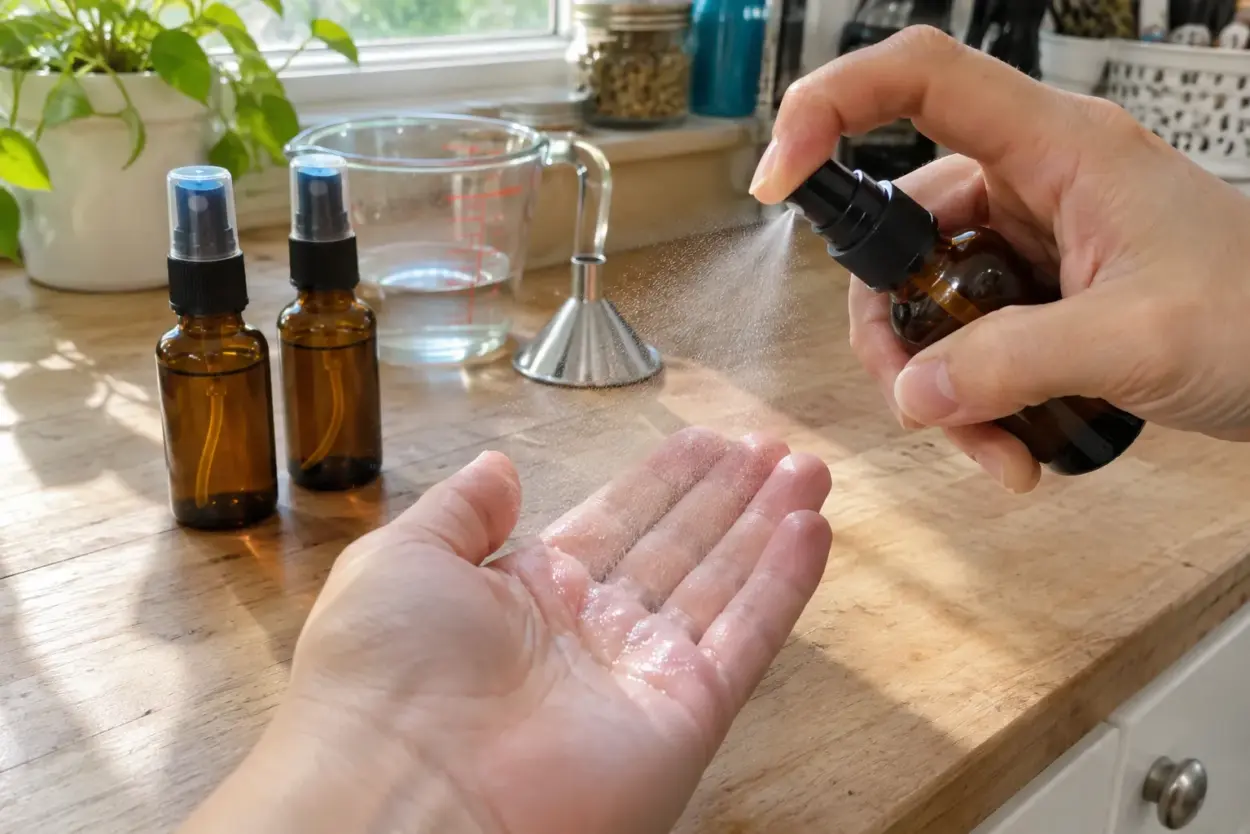
Short answer: mix ¾ cup plus 1 teaspoon of 99% isopropyl alcohol, 2 teaspoons of 3% hydrogen peroxide and ¼ teaspoon of glycerin in a measuring cup, then top up to the 1-cup line with distilled water. That is the World Health Organization formula at 75% alcohol, with the glycerin cut to the level that tested best. Pour it into a fine-mist spray bottle, wait 72 hours and spray until both hands stay wet for 20 to 30 seconds.
I keep a spray bottle of this in the car and one by the lab bench, and I mix it from the WHO recipe and nothing else. Most online sanitizer recipes fail on one number: the alcohol ends up below 60% once the aloe, oils and water go in. The WHO liquid formula is thin by design, which makes it a poor fit for a pump and a perfect fit for a sprayer. This guide covers the isopropyl recipe, the ethanol version, a kitchen-scale test that tells you how many sprays make a real dose and the chemistry of why 75% alcohol works better than 99%.
At a glance
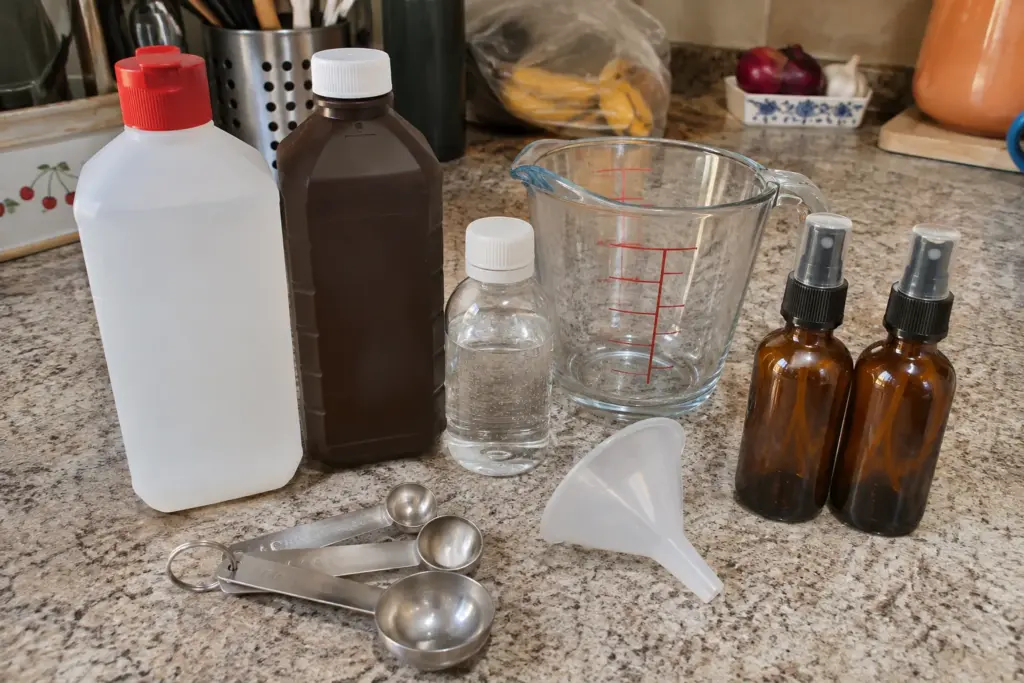
What you need
- ¾ cup + 1 tsp 99% isopropyl alcohol (or 3/4 cup + 4 tsp of 91%)
- 2 tsp 3% hydrogen peroxide
- ¼ tsp vegetable glycerin
- About 3 tbsp distilled or boiled water, cooled
- A glass measuring cup and an 8 oz fine-mist spray bottle
Steps
- Pour the alcohol into the measuring cup.
- Add the peroxide and glycerin.
- Top up to exactly 1 cup with water and stir.
- Bottle it, label it and wait 72 hours.
- Spray until hands are wet and rub until dry.
Read the label first
Use only isopropyl alcohol (isopropanol) or ethanol. Never use methanol or hardware-store “denatured alcohol” that lists it: the FDA has recalled sanitizers contaminated with methanol because it is absorbed through the skin and causes blindness and death. Rubbing alcohol labeled 70% cannot reach 75% and is used straight; see other alcohols.
This guide contains Amazon affiliate links. 33Science earns a commission on qualifying purchases. See our affiliate disclosure.
Ingredients and tools
Isopropyl alcohol, 99% or 91%
Isopropanol, C3H8O
182 mL per cup (99%)The active ingredient. It kills bacteria and enveloped viruses by wrecking their proteins and membranes. The WHO formula targets 75% in the finished spray, so you need a stronger starting alcohol to leave room for the other ingredients.
Hydrogen peroxide, 3%
H2O2
2 tsp (10 mL) per cupNot there for your hands. At 0.125% in the finished mix it kills bacterial spores that may be in the alcohol, the water or the bottle, which alcohol alone cannot do. Use the ordinary brown pharmacy bottle.
Vegetable glycerin
Glycerol, C3H8O3
¼ tsp per cupA humectant that keeps alcohol from drying skin out with repeated use. More is not better: glycerin slows the alcohol down, and the original WHO dose of 1.45% tested less effective than half that.
Distilled water
H2O
To the 1-cup lineAlcohol needs water to kill microbes. Distilled water, or tap water boiled and cooled, keeps out minerals and microbes. The amount is whatever brings the batch to exactly one cup.
Why alcohol works
Isopropanol and ethanol both carry a hydroxyl (OH) group that bonds with water and a short carbon chain that dissolves fats. That dual nature is what lets them slip through the fatty envelope of a flu or coronavirus particle and the membrane of a bacterium, then pull apart the proteins inside.
Tools
- A 2-cup glass measuring cup with clear 1-cup and milliliter lines
- A set of measuring spoons with a ¼ teaspoon
- A small funnel
- One or two amber glass fine-mist spray bottles. PET, HDPE and polypropylene plastic bottles also hold alcohol well; avoid polystyrene, which alcohol cracks.
- A label or marker
How to make hand sanitizer spray with isopropyl alcohol
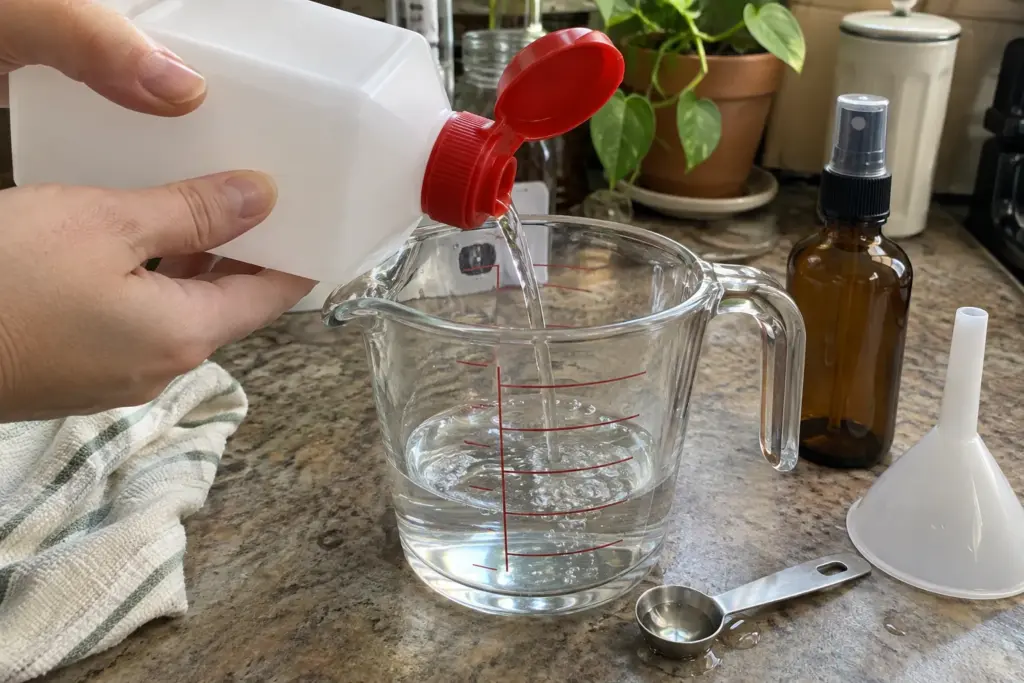
- Clean the bottle. Wash the spray bottle and its nozzle with hot soapy water, rinse and let them dry. Rinse once with a splash of alcohol if you can spare it.
- Measure the alcohol. Pour ¾ cup plus 1 teaspoon (182 mL) of 99% isopropyl alcohol into the measuring cup. With 91% alcohol use ¾ cup plus 4 teaspoons (198 mL).
- Add the peroxide. Add 2 teaspoons (10 mL) of 3% hydrogen peroxide.
- Add the glycerin. Add ¼ teaspoon (1.2 mL) of glycerin. It is thick, so let the spoon drain into the cup and stir until no streaks remain.
- Top up with water. Add distilled or cooled boiled water until the liquid reaches the 1-cup (240 mL) line at eye level. That takes about 3 tablespoons with 99% alcohol and about 2 with 91%. Stir.
- Bottle and label. Funnel it into the spray bottle, cap it and write “hand sanitizer, 75% alcohol, flammable” and the date on it.
- Wait 72 hours. Leave the bottle closed for three days before use. That is how long the peroxide needs to kill any spores in the batch.
The amounts scale the WHO’s 10-liter recipe for formulation II (isopropyl alcohol) down to one cup, with one change: the glycerin is 0.5% instead of 1.45%. Suchomel and colleagues tested both WHO formulas against the European hand rub standards and found the original glycerin dose dragged the alcohol’s killing power down. Cutting glycerin to 0.5% to 0.725% let both formulas pass.
Amounts for other batch sizes
| Batch | 99% isopropyl | 3% peroxide | Glycerin | Water |
|---|---|---|---|---|
| 4 oz (120 mL) | 6 tbsp + ½ tsp (91 mL) | 1 tsp (5 mL) | ⅛ tsp (0.6 mL) | To 120 mL, about 1½ tbsp |
| 8 oz (240 mL) | ¾ cup + 1 tsp (182 mL) | 2 tsp (10 mL) | ¼ tsp (1.2 mL) | To 240 mL, about 3 tbsp |
| 16 oz (480 mL) | 1½ cups + 2 tsp (364 mL) | 4 tsp (20 mL) | ½ tsp (2.5 mL) | To 480 mL, about 6 tbsp |
| 32 oz (960 mL) | 3 cups + 4 tsp (727 mL) | 2 tbsp + 2 tsp (40 mL) | 1 tsp (4.9 mL) | To 960 mL, about ¾ cup |
Where accuracy counts
Measure the alcohol in milliliters if your cup has them. A tablespoon off in the alcohol moves the final strength by about 6 percentage points, while the same error in the water barely matters because you top up to the line anyway.
Hand sanitizer spray with ethanol or 70% rubbing alcohol
WHO formulation I uses ethanol at 80%. Any alcohol you use has to keep the finished spray at 60% or above, the CDC minimum, and ideally at 70% to 80%. This table gives the 1-cup recipe for each common starting alcohol, always with 2 teaspoons of peroxide and ¼ teaspoon of glycerin and topped up to 240 mL with water.
| Starting alcohol | Amount per cup | Finished strength | Verdict |
|---|---|---|---|
| 99% isopropyl | ¾ cup + 1 tsp (182 mL) | 75% | Best choice; WHO formula II |
| 91% isopropyl | ¾ cup + 4 tsp (198 mL) | 75% | Works the same; less water added |
| 70% isopropyl rubbing alcohol | 1 cup, nothing else | About 70% | Usable straight. Skip the peroxide and water; add only ¼ tsp glycerin |
| 95% ethanol (190 proof grain alcohol) | ¾ cup + 5 tsp (202 mL) | 80% | WHO formula I; gentler smell |
| 75.5% ethanol (151 proof) | 1 cup, nothing else | About 75% | Usable straight with ¼ tsp glycerin |
| 40% vodka (80 proof) | Any | 40% or less | Does not work. Below the 60% threshold |
| Methanol, denatured alcohol with methanol | Never | Toxic | Absorbed through skin; FDA recalls |
Drinking-grade grain alcohol is pure ethanol and safe on skin. Hardware-store denatured alcohol is ethanol mixed with other solvents, often methanol, which makes it toxic. If the label does not state its contents, it does not go on your hands.
Why you top up to the line
Mixing alcohol and water shrinks the volume: 50 mL of ethanol plus 50 mL of water gives about 96 mL, not 100. The small alcohol molecules tuck into the hydrogen-bonded network of water. This is why the WHO recipe adds alcohol first and fills to a final volume instead of adding up fixed amounts.
Spray dose test: how many sprays is enough?
A spray bottle is the easiest way to under-dose. The European test standard for hand rubs uses 3 mL, and WHO asks for enough to keep hands wet through a 20 to 30 second rub. Fine-mist caps are built to put out small doses, so weigh yours once and you will know the number for good.
- Zero the scale. Put a small glass bowl on a kitchen scale that reads to 0.1 g or 1 g and press tare.
- Spray 10 times. Spray 10 full pumps into the bowl from close range so the mist lands inside.
- Read the weight. The finished spray weighs about 0.87 g per milliliter, so multiply grams by 1.15 to get milliliters. Divide by 10 for the dose per spray.
- Do the math. Divide 2.5 mL by the dose per spray. That is how many sprays one hand rub needs, split between both palms.
- Check it on your hands. Spray that many times, start a timer and rub. Your hands should still be wet at 20 seconds. If they dry sooner, add two sprays.
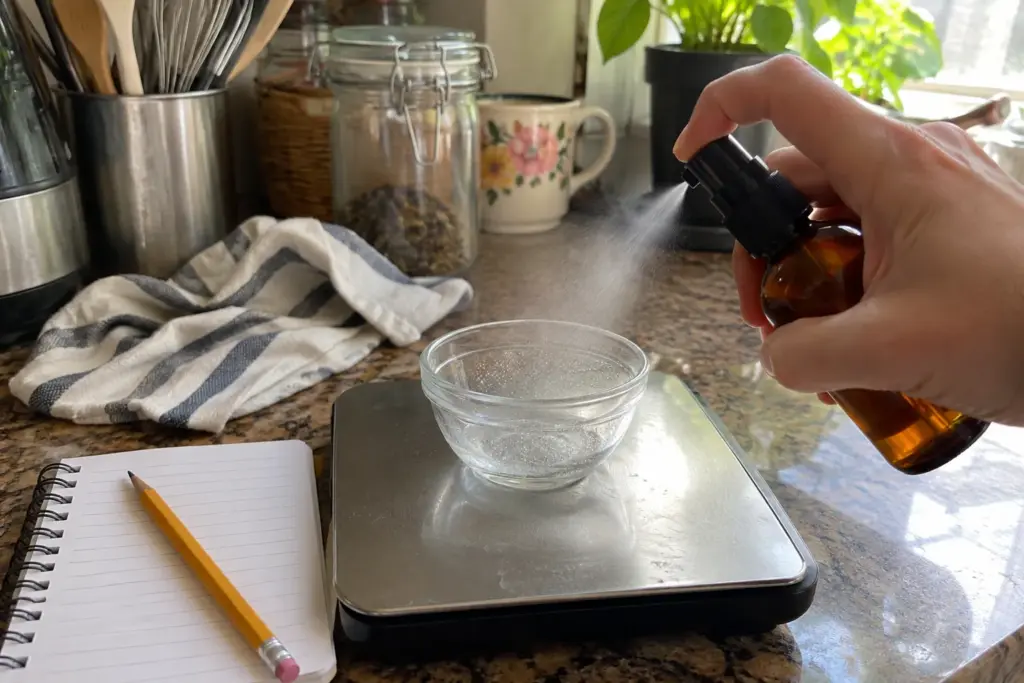
Most people spray once or twice and rub for five seconds. That leaves the backs of the hands, the thumbs and the fingertips untouched, and the alcohol evaporates before it has done its job. The dose test turns a guess into a number.
How to use hand sanitizer spray
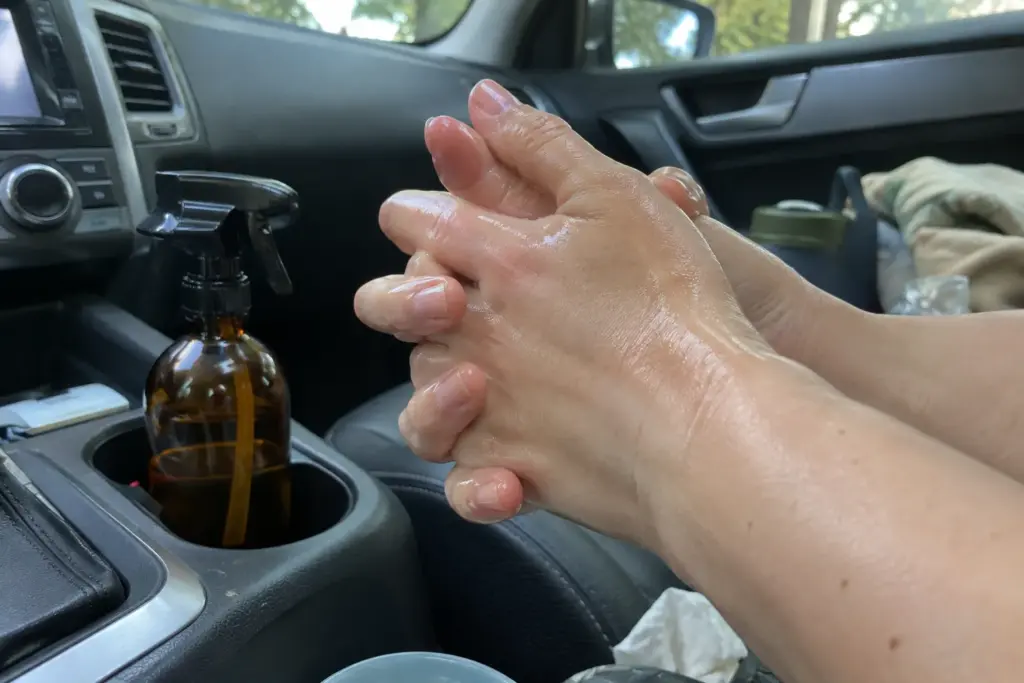
- Spray both palms. Give the number of sprays your dose test gave you, split between both palms.
- Rub palm to palm. Then the back of each hand with the other palm, fingers interlaced.
- Do the thumbs and tips. Rotate each thumb inside the other fist, then rub the fingertips into the opposite palm.
- Keep going until dry. That takes 20 to 30 seconds. Do not wipe or rinse it off.
When to wash instead
Sanitizer does not replace washing in every case. The CDC says soap and water work better on visibly dirty or greasy hands and against norovirus, Cryptosporidium and C. difficile, none of which alcohol kills well. Wash with soap and water after the bathroom, before eating and when someone in the house has a stomach bug.
The science of hand sanitizer
In short
Alcohol kills microbes by denaturing their proteins and dissolving their membranes. It needs water to do this, which is why 60% to 90% works and 99% does not. Glycerin protects skin but slows the alcohol, so the best formulas use as little as possible.
Why 75% beats 99%
Proteins hold their shape through hydrogen bonds. Water lets alcohol molecules move into a protein and break those bonds, and the unfolded protein clumps and stops working. Pure alcohol coagulates the outer proteins of a cell so quickly that it seals the cell and protects what is inside. It also evaporates in a few seconds, before it has had enough contact time. A 70% to 80% mix strikes the balance: enough alcohol to denature, enough water to penetrate and slow evaporation.
The dilution math
Every recipe here comes from one equation, where C is concentration and V is volume:
C1 × V1 = C2 × V2
For a 240 mL batch at 75% from 99% alcohol: V1 = 0.75 × 240 mL ÷ 0.99 = 182 mL. From 91% it is 198 mL. The same equation shows why aloe-based recipes fail: two parts 91% alcohol to one part aloe gel gives 0.91 × 2 ÷ 3 = 61%, on the edge of the threshold before any evaporation from an open bowl.
What alcohol kills and what it misses
Enveloped viruses, the ones wrapped in a fatty membrane such as influenza, coronaviruses and RSV, fall apart in under 30 seconds at these strengths, as Kampf’s 2018 review of ethanol showed. Most bacteria die as fast. Non-enveloped viruses have no fat to dissolve: norovirus and hepatitis A survive much better, and ethanol does better against them than isopropanol. Bacterial spores, including C. difficile, survive both.
| Microbe | Example | Alcohol at 70 to 80% |
|---|---|---|
| Enveloped viruses | Flu, coronaviruses, RSV | Inactivated within 30 seconds |
| Most bacteria | E. coli, Staphylococcus aureus | Killed within 30 seconds |
| Non-enveloped viruses | Norovirus, hepatitis A | Partly; ethanol better than isopropanol |
| Protozoan cysts | Cryptosporidium | Not reliably |
| Bacterial spores | C. difficile | No effect; wash with soap |
Glycerin and hydrogen peroxide
Glycerin is a small molecule with three hydroxyl groups. It stays on skin after the alcohol evaporates and holds water there, which stops the cracking that frequent sanitizer use causes. The trade-off is that it thickens the film and slows the alcohol’s contact with microbes. Suchomel’s group showed in 2013 and again in 2020 that cutting glycerin from 1.45% to 0.5% to 0.725% made the WHO formulas pass the European standards they had failed.
Hydrogen peroxide at 0.125% does almost nothing on hands. Its job is in the bottle: over 72 hours it oxidizes any bacterial spores that came in with the ingredients or the container. After that it slowly breaks down:
2 H2O2 → 2 H2O + O2
Myths
- “Essential oils make it antibacterial.” Tea tree and thyme oil show activity in a petri dish at concentrations far above what is safe on skin. In a sanitizer the alcohol does the work.
- “Vodka works in a pinch.” At 40% alcohol it does not meet the threshold at any dose.
- “Stronger is better.” 99% alcohol on its own is less effective than 75% and dries skin faster.
- “Sanitizer kills everything.” It misses norovirus, spores and Cryptosporidium, and it does not remove dirt or grease.
Homemade vs store-bought hand sanitizer
| Homemade WHO spray | Store-bought gel or spray | |
|---|---|---|
| Alcohol | 75% isopropyl or 80% ethanol | 60% to 80%, stated on the label |
| Quality control | Only as good as your measuring | Tested batch, regulated as an OTC drug |
| Texture | Thin liquid, needs a sprayer | Gel or spray |
| Additives | Glycerin and peroxide only | Thickeners, fragrance, skin conditioners |
| Cost per ounce | Lower, especially from a large alcohol bottle | Higher |
The FDA advises consumers not to make their own hand sanitizer because a mixing error leaves it ineffective, and it has received reports of skin burns from homemade versions. Those failures come from recipes that improvise. The WHO formula was written for local production by pharmacies and hospitals, and it works when the alcohol is measured exactly. If you cannot measure to the teaspoon or are unsure of your alcohol’s strength, buy a labeled product with at least 60% alcohol.
Why spray, not gel
Gels need a thickener such as carbomer and a neutralizer to set, which is hard to get right at home. Aloe vera gel thickens a little but dilutes the alcohol and clouds the mix. The thin WHO liquid in a spray bottle covers hands evenly and skips the problem.
Troubleshooting
| Problem | Cause | Fix |
|---|---|---|
| Hands feel sticky after drying | Too much glycerin | Keep it at ¼ tsp per cup; remake the batch |
| Hands dry in under 10 seconds | Too few sprays | Run the dose test and add sprays |
| Skin stings | Cracked or broken skin | Normal on cuts; use lotion at night; wash with soap instead for a while |
| Hands crack with frequent use | No glycerin, or glycerin left out | Add ¼ tsp glycerin per cup |
| Mix turns cloudy | Tap water minerals or aloe | Use distilled water; leave out aloe |
| Sprayer clogs | Thick additives or dried glycerin in the nozzle | Rinse the nozzle in warm water; keep the recipe thin |
| Smell fades and spray feels weaker | Alcohol evaporating from a loose cap | Cap tightly; make small batches |
Do not dilute it
Adding aloe, oil or extra water to soften the smell or the feel is the most common way to ruin a batch. Each addition pulls the alcohol down. Keep the recipe to the four ingredients and moisturize your hands separately.
Safety
Before you start
- Highly flammable. Isopropanol (flash point about 12 °C, 53 °F) and ethanol (about 13 °C, 55 °F) are classed H225, highly flammable liquid and vapor. Mix away from burners, candles and cigarettes, and rub hands until fully dry before touching a stove.
- Eye irritant. Both alcohols are classed H319. Spray away from the face. Rinse eyes with running water for 15 minutes if splashed.
- Vapors. Isopropanol vapor causes drowsiness and dizziness (H336). Mix by an open window.
- Poisonous if swallowed. A few sips of sanitizer can poison a small child. Keep it high, label it and never store it in a drink bottle. In the US, call Poison Control at 1-800-222-1222.
- No methanol or 1-propanol. The FDA lists both as toxic contaminants in recalled sanitizers.
- Hot cars. Car heat cannot ignite a closed bottle, but it swells the bottle and drives off alcohol. Keep it in the glove box or a door pocket out of the sun.
Store bottles capped, away from heat and light. The WHO formula is stable, but alcohol escapes through loose caps and spray nozzles, so make a cup or two at a time and replace a batch that smells weak.
More practical science: browse all our everyday science how-tos, from household chemistry to experiments you can build at home.
Gel sanitizer has one more use at home: its alcohol turns PVA glue into a stretchy polymer network. See how to make hand sanitizer slime and why the result is not germ-free.
Frequently asked questions
Mix 3/4 cup plus 1 teaspoon of 99% isopropyl alcohol, 2 teaspoons of 3% hydrogen peroxide and 1/4 teaspoon of glycerin, then add distilled water to make exactly 1 cup. Pour it into a fine-mist spray bottle and wait 72 hours before use.
For 10 liters, WHO formulation I uses 8,333 mL of 96% ethanol, 417 mL of 3% hydrogen peroxide and 145 mL of 98% glycerol, topped up with water. Formulation II uses 7,515 mL of 99.8% isopropyl alcohol instead of the ethanol.
Yes, but use it nearly straight. Any water, aloe or peroxide pulls it further down, so add only a little glycerin, about 1/4 teaspoon per cup, and nothing else.
At least 60% alcohol, according to the CDC. The WHO formulas use 75% isopropyl alcohol or 80% ethanol, which kill microbes faster.
Water helps alcohol enter cells and unfold their proteins. Pure alcohol seals the outer layer of a cell too fast and evaporates before it has enough contact time.
No. Vodka is about 40% alcohol, well below the 60% minimum. Only 190 proof or 151 proof grain alcohol is strong enough.
The WHO recommends a 72-hour wait so the hydrogen peroxide has time to kill any bacterial spores that came in with the ingredients or the bottle.
It is better not to. Aloe dilutes the alcohol, often below 60%, clouds the mix and clogs fine-mist sprayers. Glycerin moisturizes in a much smaller amount.
Enough to keep both hands wet for 20 to 30 seconds of rubbing, about 2.5 to 3 mL. Weigh 10 sprays on a kitchen scale to find how many sprays your bottle needs.
Not reliably. Norovirus has no fatty envelope for alcohol to dissolve, so the CDC recommends washing with soap and water when norovirus is around.
Sources
- World Health Organization. Guide to local production: WHO-recommended handrub formulations
- Suchomel M et al. (2020). Evaluation of World Health Organization-recommended hand hygiene formulations. Emerging Infectious Diseases 26(9)
- Suchomel M et al. (2013). Modified World Health Organization hand rub formulations comply with European efficacy requirements. Infection Control and Hospital Epidemiology 34(3)
- Kampf G (2018). Efficacy of ethanol against viruses in hand disinfection. Journal of Hospital Infection 98(4)
- Centers for Disease Control and Prevention. Hand sanitizer guidelines and recommendations
- US Food and Drug Administration. Hand sanitizers consumers should not use
- US Food and Drug Administration (archived). Q&A for consumers: hand sanitizers and COVID-19
- PubChem. Isopropyl alcohol
- PubChem. Ethanol