As an Amazon Associate we earn from qualifying purchases. Disclosure
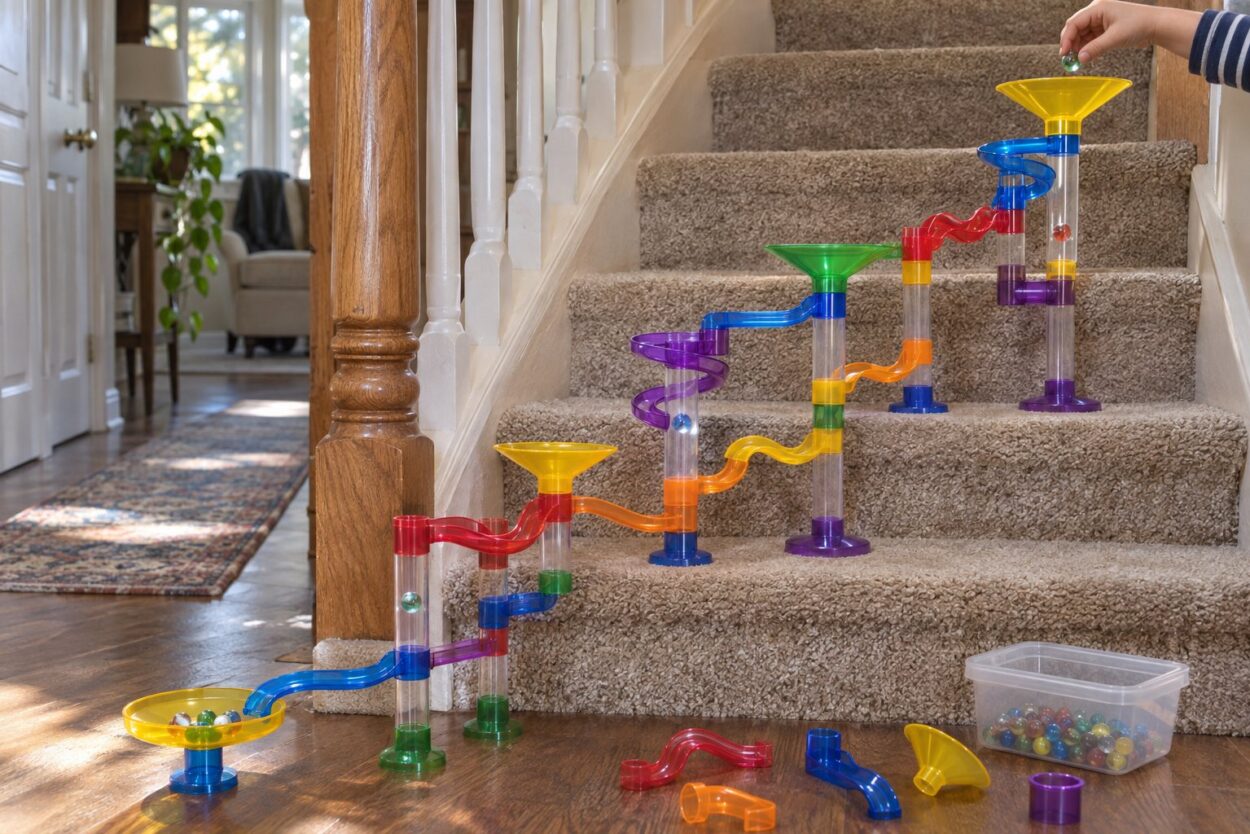
Last February my son Sami, then six, spent a rainy week rolling marbles down our staircase. He lined the steps with cereal boxes, propped a cookie sheet at the bottom and kept a tally on an envelope of how far each marble went. By the end of the week he had worked out, without anyone telling him, that a marble dropped from a higher step goes faster and flies off a sharp turn. That is what a marble run teaches: a child builds a path, lets go and watches gravity, speed and friction decide what happens.
The best marble run for most kids aged 8 and up is the Ravensburger GraviTrax Starter Set, a tile-based system with magnetic and gravity tricks that keeps getting harder as the child gets better. For ages 4 to 7, the Marble Genius Super Set gives the most building for the money and builds tall fast. For toddlers and preschoolers, the GraviTrax Junior Starter Set XXL is the best first marble run, and children under 3 should start with a big-ball tower like the Kidoozie Whirl ‘N Go instead of real marbles.
I trained as a geoscientist and spent my lab years measuring things that fall, melt and flow. At home I have two kids, Noor, 11, and Sami, now 7, and a lot of marbles under the couch. The 14 marble runs below are grouped by age and type, with the maker’s age rating on every pick and the physics each one teaches.
Quick picks
| Pick | Best for | Maker age |
|---|---|---|
| GraviTrax Starter Set | Best overall, ages 8 to 12 | 8+ |
| Marble Genius Super Set | Best value, ages 4 to 8 | 4+ |
| National Geographic Glow Marble Run | Glow in the dark | 8+ |
| JOYIN 236-Piece Elevator Run | Motorized lift | 3+ |
| GraviTrax Junior XXL | Ages 3 to 7 | 3+ |
| Kidoozie Whirl ‘N Go | Under 3, no marbles | 9 to 24 months |
| Hape Quadrilla Vertigo | Wooden | 4+ |
| Tumble Trax | Fridge or whiteboard | 5 to 10 |
| GraviTrax PRO Starter Set | Tweens and teens | 8+ |
Types of marble runs
Marble runs come in five main kinds. They differ in how the pieces connect, how big the balls are and how much a child has to plan before anything moves.
- Tube-and-funnel sets (Marble Genius, JOYIN, Marble Mania, National Geographic) stack plastic columns and snap clear tubes, funnels and spinners between them. They build tall fast and give the most pieces for the money. A tall tower held together only by friction can lean and fall when a child bumps it.
- Tile systems (GraviTrax) lay track between height tiles on a flat base grid. Builds stay lower but hold their shape, and the action pieces use magnets, cannons and catapults, so each run becomes a set of physics puzzles.
- Toddler systems (GraviTrax Junior, VTech Marble Rush, ball-drop towers) use chunky pieces that small hands can press together. Ball towers with big balls are the only kind made for kids under 3.
- Wooden runs (Hape Quadrilla, music-tree towers) are heavy, steady and last for years. They have fewer tricks than plastic sets and are loud on a hard floor.
- Wall runs (Tumble Trax, National Geographic Magnetic) stick to a fridge or whiteboard. The run stays up for days because nobody steps on it, and each piece has to catch a falling marble rather than guide a rolling one.
Best marble runs for kids 8 and up
By 8, most kids can follow a build plan alone and start changing it on purpose. This is the age when a marble run turns from a toy you watch into a toy you test, and the sets below reward that.
Best overall
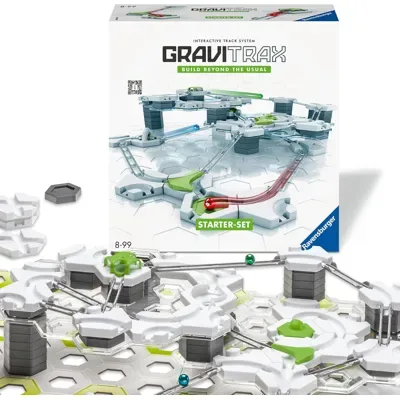
1. Ravensburger GraviTrax Starter Set
GraviTrax builds on a grid of hexagonal base plates. Kids stack height tiles, lay rails between them and add action pieces such as a magnetic cannon that knocks one marble forward with another, splitters that send marbles down different paths and a freefall. The starter set has 122 components, enough for a run that covers a kitchen table.
It is the best marble run for kids who like to fix things. When a marble flies off a curve, the child has to work out whether it came in too fast, whether the curve is too tight or whether the drop before it is too steep, then change one of those. Every GraviTrax add-on works with every other set, including the PRO and POWER lines, so the system grows as the child does.
- Maker age 8+
- 122 components
- Compatible with all GraviTrax expansions
Good: real physics puzzles, builds that hold their shape, years of expansions. Not great: kids under 8 need an adult for the first builds, and runs are lower and less dramatic than tube towers.
Check on Amazon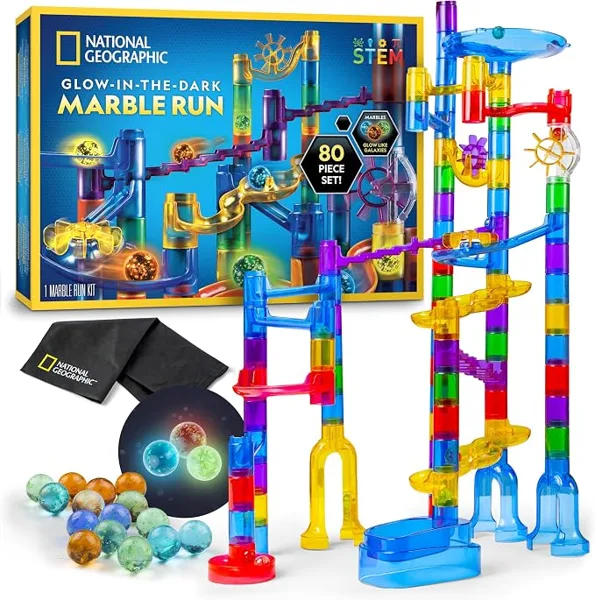
Best glow-in-the-dark
2. National Geographic Glow-in-the-Dark Marble Run
This is the most-bought marble run on Amazon, with more than 14,000 ratings at 4.7 stars. It is a tube-and-funnel set with 5 bases, 15 action pieces, 45 clear track pieces and 15 glow-in-the-dark glass marbles in 6 colors. The pieces fit tightly, so a finished tower stands up to some bumping.
The glow marbles charge under a lamp and then trace their path through a dark room, which turns a run into a bedtime ritual. A learning guide in the box explains the physics of motion and has a few experiments to run on the track. A storage bag holds everything.
- Maker age 8+
- 5 bases, 15 action pieces, 45 track pieces, 15 glow marbles
- Storage bag and learning guide
Good: tight-fitting pieces, glow marbles, a guide that explains the science. Not great: the 8+ rating is about the glass marbles and small parts; many 6-year-olds can build it with help.
Check on AmazonGlow marbles get lost under furniture fast. National Geographic sells a refill pack of 25 glow marbles that fits this set and most tube-and-funnel runs.
Best for tweens and teens
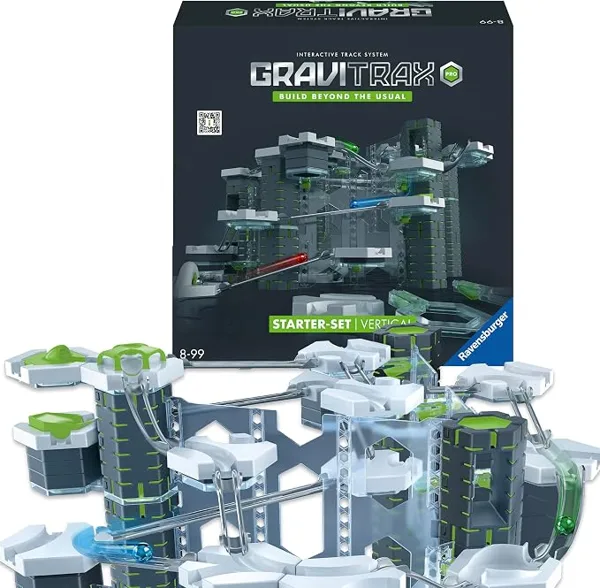
3. Ravensburger GraviTrax PRO Starter Set
GraviTrax PRO adds pillars and balconies so a run can climb upward instead of only spreading across the table. The set has 152 components, and the vertical pieces let a run cross over and under itself, which takes more planning than a flat build.
Pick PRO over the regular starter set for a child of 10 or older who likes hard builds, or as the second set for a kid who already owns GraviTrax. All of the pieces work with the regular GraviTrax system.
- Maker age 8+
- 152 components
- Works with every GraviTrax set
Good: taller, more complex builds that still hold together. Not great: harder for a first set; younger kids are happier with the regular starter.
Check on Amazon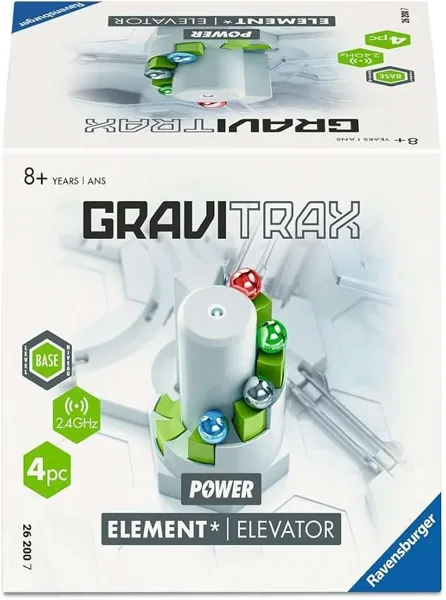
Best GraviTrax upgrade
4. GraviTrax POWER Elevator
The POWER Elevator is an electronic lift that carries marbles from the bottom of a GraviTrax run back to the top, so the run keeps going without a child resetting it. The POWER line also includes electronic triggers and switches, which give older kids a first taste of programming a sequence.
This is an add-on, not a starter. It makes sense once a child has built a few runs with the GraviTrax or PRO starter and wants to make one that runs on its own.
- Maker age 8+
- Works with GraviTrax and GraviTrax PRO
- Electronic; needs a starter set to build a run
Good: turns a run into a loop and introduces simple triggers and switches. Not great: useless without a starter set.
Check on AmazonBest marble runs for ages 4 to 7
Between 4 and 7, kids want height, noise and a marble they can follow with their eyes. Clear tube-and-funnel sets give all three. A 4-year-old builds them with a parent; by 6 or 7 most kids follow the picture plans alone and start making their own.
Best value
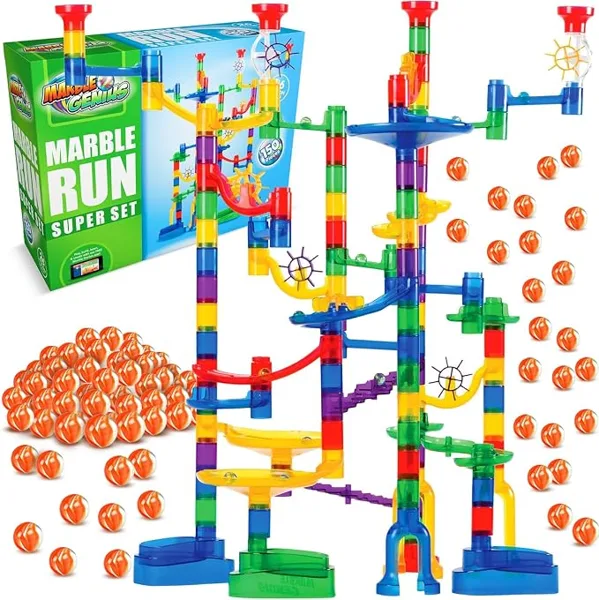
5. Marble Genius Super Set
Marble Genius is the best-known tube-and-funnel brand, with close to 16,000 ratings at 4.7 stars across its sets. The Super Set has 150 translucent pieces, including tubes, funnels and curved track, plus glass marbles. A free Marble Genius app gives step-by-step builds and challenges for kids who get stuck.
It is the set to buy when you want the biggest tower for the money and a child who builds with you. The clear pieces let kids watch the marble the whole way down, which is where most of the fun is at this age. Marble Genius also sells larger sets, such as the 300-piece Extreme Set, and the pieces work together.
- Maker age 4+
- 150 translucent pieces, glass marbles
- Free app with build instructions
Good: lots of pieces, tall builds, clear tubes, an app for ideas. Not great: tall towers lean and need a wide base; it does not connect to GraviTrax.
Check on Amazon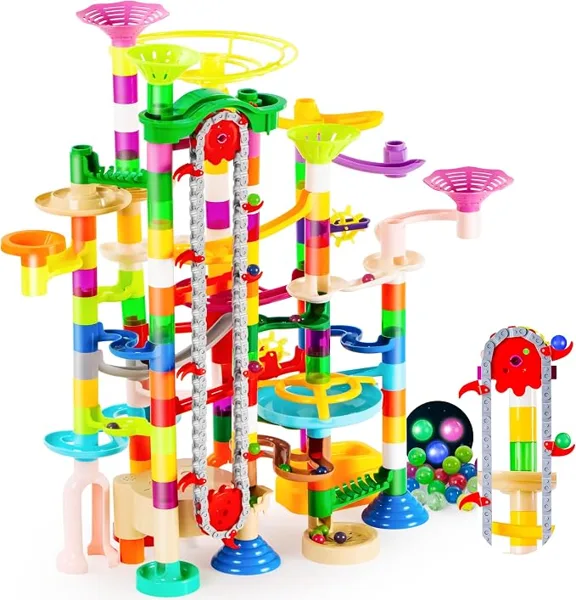
Best with a motorized lift
6. JOYIN 236-Piece Glowing Marble Run with Elevator
The JOYIN set adds a motorized elevator to a big tube-and-funnel kit. It has 176 track pieces and 60 marbles: 15 plastic, 30 glow-in-the-dark and 15 glass. The elevator lifts marbles back to the top so the run loops without anyone carrying them up.
A looping run is good for younger kids who want to watch rather than rebuild, and the pile of marbles means a lost one does not end the game. National Geographic sells a similar motorized marble run with 150 pieces if you prefer that brand.
- Maker age 3+
- 176 track pieces, 60 marbles
- Motorized elevator
Good: endless loops, lots of marbles, glow play. Not great: many small marbles in a house with toddlers; keep it on a table, not the floor.
Check on Amazon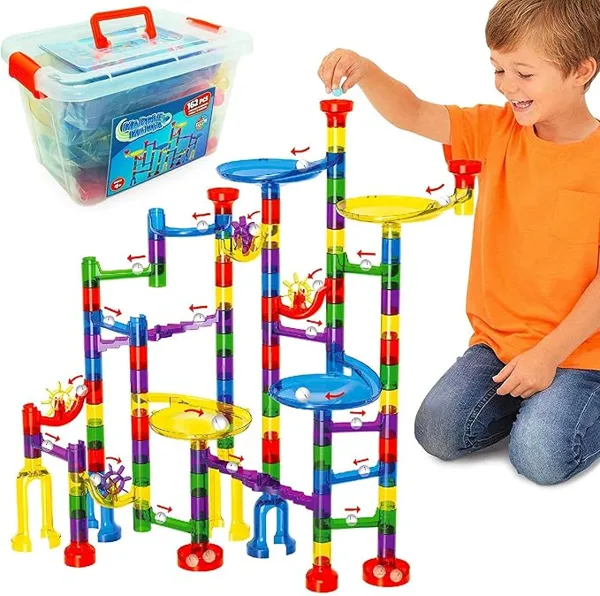
Best for storage
7. Marble Mania 162-Piece Marble Run
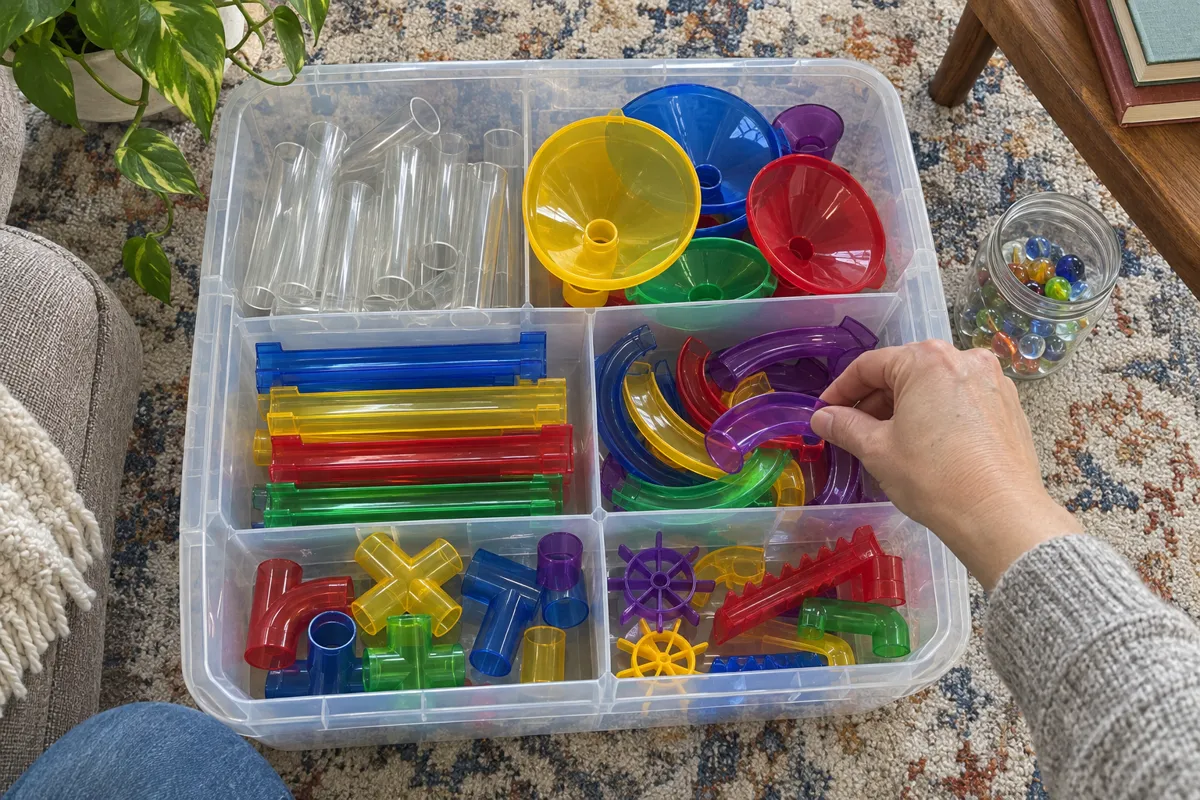
Marble Mania has 90 building pieces and 72 marbles, with a full-color guidebook for 4 runs. The selling point is the plastic tub: every piece and marble goes back in one box with a lid, which matters more than any trick piece in a family room.
The see-through pieces push together firmly and pull apart without tools, which suits a 4- or 5-year-old building alongside an adult.
- Maker age 4+
- 90 building pieces, 72 marbles
- Storage tub and guidebook
Good: one tub for everything, plenty of marbles. Not great: fewer action pieces than Marble Genius.
Check on AmazonBest marble runs for toddlers and preschoolers
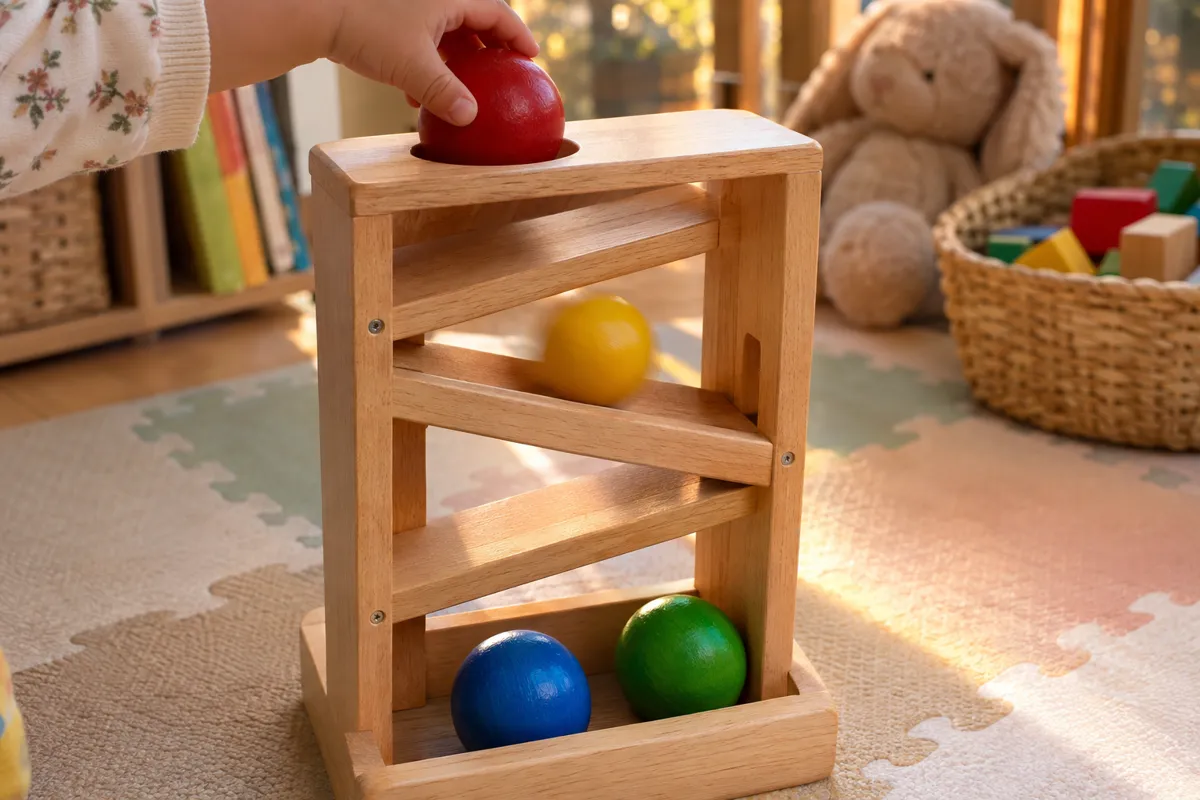
Children under 3 should not play with marbles at all. A standard toy marble is small enough to block a child’s airway, and U.S. law bans selling marble toys for children under 3. Toddlers still love the idea of dropping a ball and watching it roll, so the toys below use either large balls or chunky systems built for preschool hands.
Best for under 3
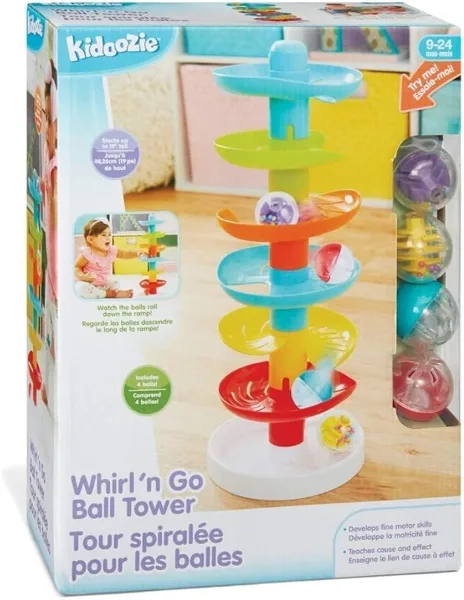
8. Kidoozie Whirl ‘N Go Ball Tower
A ball drops in the top and spirals down six colored levels, coming out at a different spot on each one. The four clear balls are filled with beads that rattle as they roll. There are no batteries, lights or marbles.
This is cause and effect at its simplest: drop, watch, drop again. Babies from 9 months learn to track the ball with their eyes, and toddlers learn to aim for the top hole. It is the toy to buy before any real marble run.
- Maker age 9 to 24 months
- Six levels, four rattle balls
- No batteries
Good: safe big balls, no setup, no batteries. Not great: outgrown by about age 3.
Check on Amazon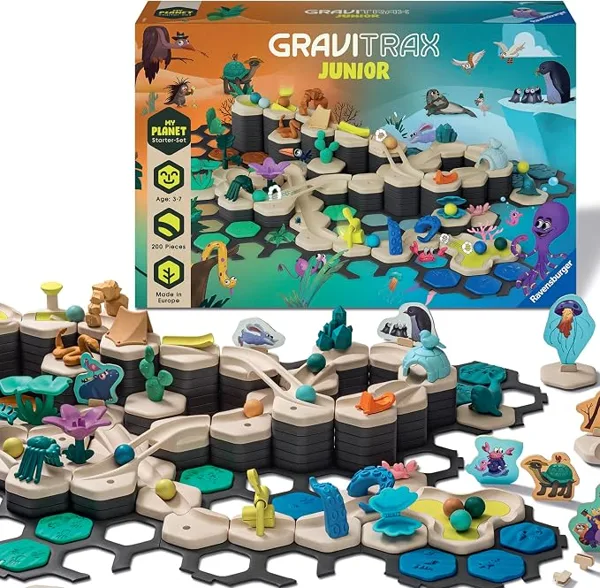
Best first marble run, ages 3 to 7
9. GraviTrax Junior Starter Set XXL
GraviTrax Junior is Ravensburger’s preschool system: chunky track, large base plates and themed pieces that turn a run into a jungle, desert or ocean world. The XXL My Planet set has 200 components made with a wood-based bioplastic, enough for two kids to build at once.
Junior pieces are wide and forgiving, so a 4-year-old can build a working run without an adult rescuing every curve. It is the best marble run for a preschooler who wants to build rather than just watch. Smaller Junior starter sets, such as My Jungle, cost less if you want to try it first.
- Maker age 3+
- 200 components
- Themed worlds, bioplastic pieces
Good: pieces sized for preschool hands, builds that work on the first try. Not great: kids outgrow the simple runs by about 7.
Check on Amazon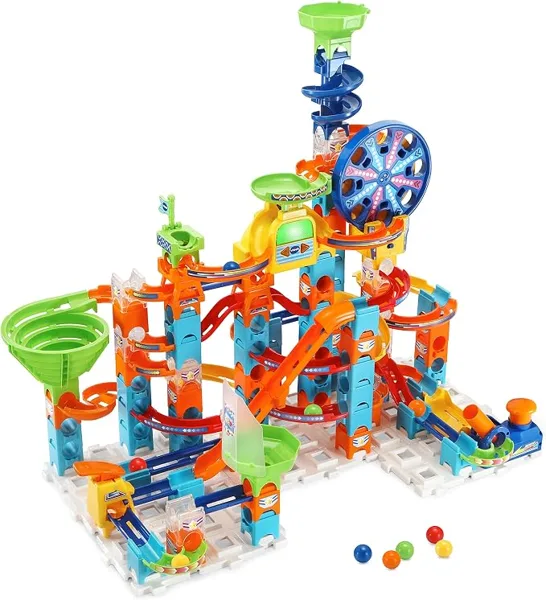
Best with lights and sounds
10. VTech Marble Rush Ultimate Set
The Marble Rush Ultimate Set has 135 building pieces, a spinning Ferris wheel, a musical light-show cone, launchers and fast tracks, plus 10 marbles. The blocks are color-coded, and the guide walks kids through three builds from beginner to advanced before they design their own.
The lights and music hold a 4-year-old’s attention while they learn to connect pieces in the right order. The finished builds are wide, so plan on floor space.
- Maker age 4 to 8
- 135 building pieces, 10 marbles
- Needs 2 AA and 3 AAA batteries
Good: color-coded builds, Ferris wheel, guided plans for beginners. Not great: batteries, and the electronics do some of the entertaining that a plain run leaves to the child.
Check on AmazonWooden and magnetic marble runs
Wooden runs suit families who want one toy that lasts for years and gets handed down. Magnetic runs suit small homes and classrooms, because they build on a wall or snap together on any table without falling over.
Best wooden marble run
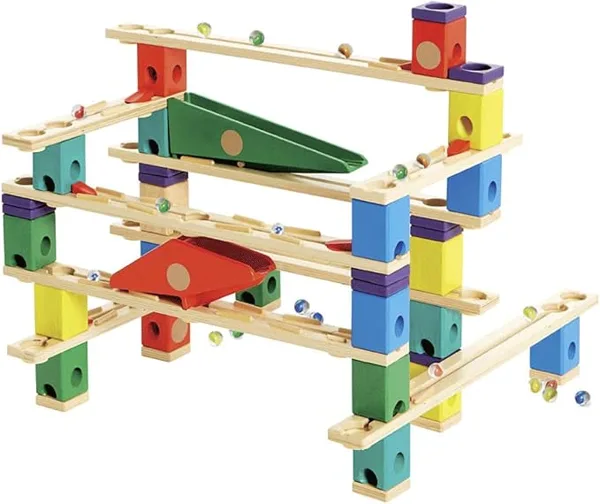
11. Hape Quadrilla Vertigo
Quadrilla is a wooden block system with grooves cut into the blocks for the marble to roll through. The Vertigo set has 134 pieces, including three twisting funnels, a seesaw and accelerators, with an idea booklet and a free app. It won an Oppenheim Platinum Seal, and every Quadrilla set connects to every other.
Wood is heavier than plastic, so Quadrilla towers stand steady once they are built and survive years of play. The trade-off is a slower build: each block has to sit square on the one below it, and the run must go on a hard, flat surface.
- Maker age 4+
- 134 wooden pieces
- Works with all Quadrilla sets
Good: solid, quiet to handle, lasts for years. Not great: slower to build than snap-together plastic, and it needs a hard floor or table.
Check on Amazon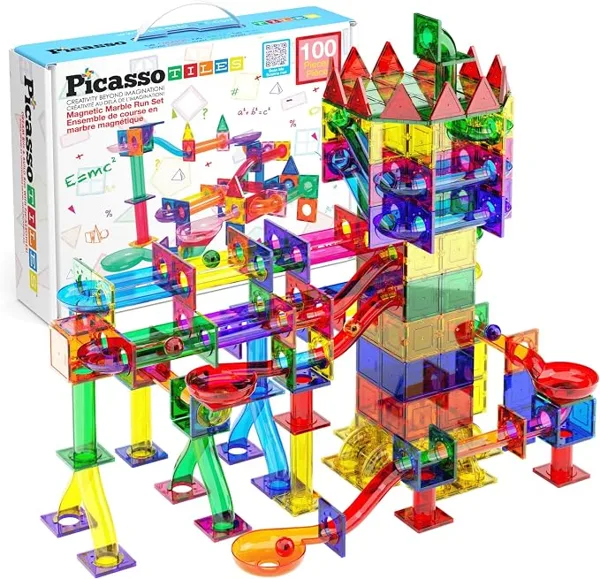
Best magnetic tiles run
12. PicassoTiles 100-Piece Marble Run
This set combines magnetic building tiles with slopes, funnels and U-turns, and comes with 5 steel balls. The tiles click together by magnet, so a preschooler can build a run that holds without lining up connectors. The pieces fit other PicassoTiles sets.
If your child already plays with magnetic tiles, this is the easiest way to add marble runs to them. Runs stay low compared with tube sets, and the variety of track is smaller.
- Maker age 3+
- 100 pieces, 5 steel balls
- Works with other PicassoTiles sets
Good: magnets remove the frustration of lining up pieces. Not great: low runs and less track variety than tube sets.
Check on Amazon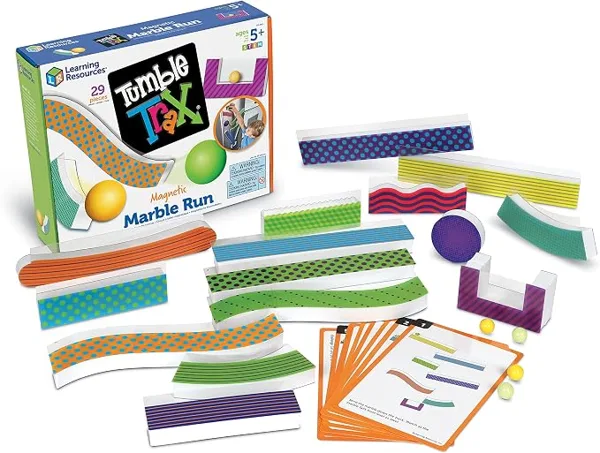
Best for the fridge
13. Learning Resources Tumble Trax
Tumble Trax is a set of foam magnetic track pieces that stick to a fridge, whiteboard or any steel surface. Activity cards set maze and track challenges, such as getting a marble from one point to another, and then kids design their own.
It is a good first wall run for ages 5 to 10 and a common sight in classrooms. Moving one piece an inch changes where the marble lands, which makes it a quick lesson in angles.
- Maker age 5 to 10
- Foam magnetic track, challenge cards
- Needs a magnetic surface
Good: stays up on the fridge, quick to change. Not great: many stainless steel fridges are not magnetic; test with a fridge magnet first.
Check on Amazon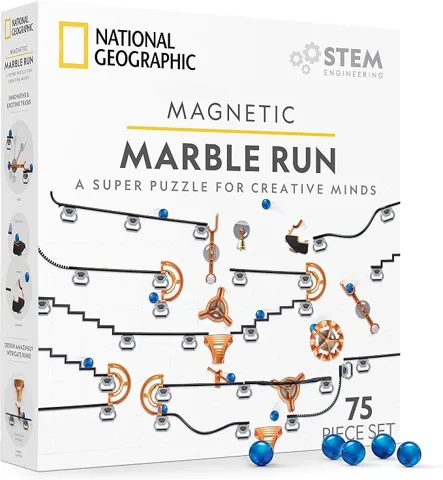
Best wall run for older kids
14. National Geographic Magnetic Marble Run
This wall run has 42 tracks and connectors, 17 trick pieces and 15 marbles that build on any vertical magnetic surface. Snap-fit connectors join the pieces, and a learning guide explains the physics and engineering behind each trick.
It is the wall run to pick for a child of 10 or older, or as the step up from Tumble Trax. The run can stay on the fridge for a week and get rebuilt a piece at a time.
- Maker age 10+
- 42 tracks and connectors, 17 trick pieces, 15 marbles
- Needs a magnetic surface
Good: more tricks than any other wall run here. Not great: rated 10+, and the same stainless-steel fridge problem.
Check on AmazonWhich marble run for which age
Age matters more for marble runs than for most toys, because the marble itself is the hazard. U.S. federal rules ban toy marbles and small balls for children under 3 (16 CFR 1500.18), and marble toys for older children must carry the warning “Choking hazard. This toy is a marble. Not for children under 3 yrs.” (16 CFR 1500.19).
| Age | Best pick |
|---|---|
| Under 3 | A big-ball tower, no marbles: Kidoozie Whirl ‘N Go |
| 3 to 4 | Chunky pieces an adult helps with: GraviTrax Junior XXL or PicassoTiles |
| 4 to 7 | Clear tube-and-funnel towers: Marble Genius Super Set or VTech Marble Rush |
| 5 to 10 | A wall run on the fridge: Tumble Trax |
| 8 to 12 | Physics puzzles: GraviTrax Starter Set or National Geographic Glow |
| 12 and up | Tall, complex builds: GraviTrax PRO plus the POWER Elevator |
The maker’s age is the minimum, not the best age. Most tube-and-funnel sets say 4+ on the box, but a 4-year-old builds them with a parent, while a 6- or 7-year-old can follow the picture plans alone. GraviTrax says 8+, and most kids under 8 need an adult to get the first run working.
The science in a marble run
A marble at the top of a run has gravitational potential energy. As it drops, that energy turns into motion. A rolling marble splits its motion between moving forward and spinning, so a solid ball that rolls without slipping reaches a speed of about √(10/7 × g × h) at the bottom of a drop of height h. That is a little slower than a ball sliding down a frictionless chute, because some of the energy goes into the spin. Drop a marble 30 centimeters and it leaves the ramp at about 2 meters per second.
Two rules follow, and kids find both out by building:
- Height sets the speed, not the marble. A heavy steel ball and a light glass marble rolled from the same height reach almost the same speed, because mass cancels out of the energy equation. Galileo timed balls on ramps four centuries ago and found the same thing.
- Speed decides whether a curve holds. A marble going around a curve needs the track wall to push it inward. Double the speed and the push it needs goes up four times. When a marble flies off a curve, the fix is less height before it, a wider curve or a higher wall.
Friction takes a little energy out at every piece, which is why a long run slows down even on a steady slope and why every run eventually needs a new drop or a lift. Rolling friction is much smaller than sliding friction, which is why marbles roll so far in the first place. Our page on the friction formula and the types of friction covers the numbers, and the difference between static and kinetic friction explains why a marble resting in a funnel needs a nudge to start.
A ramp experiment to try before you buy
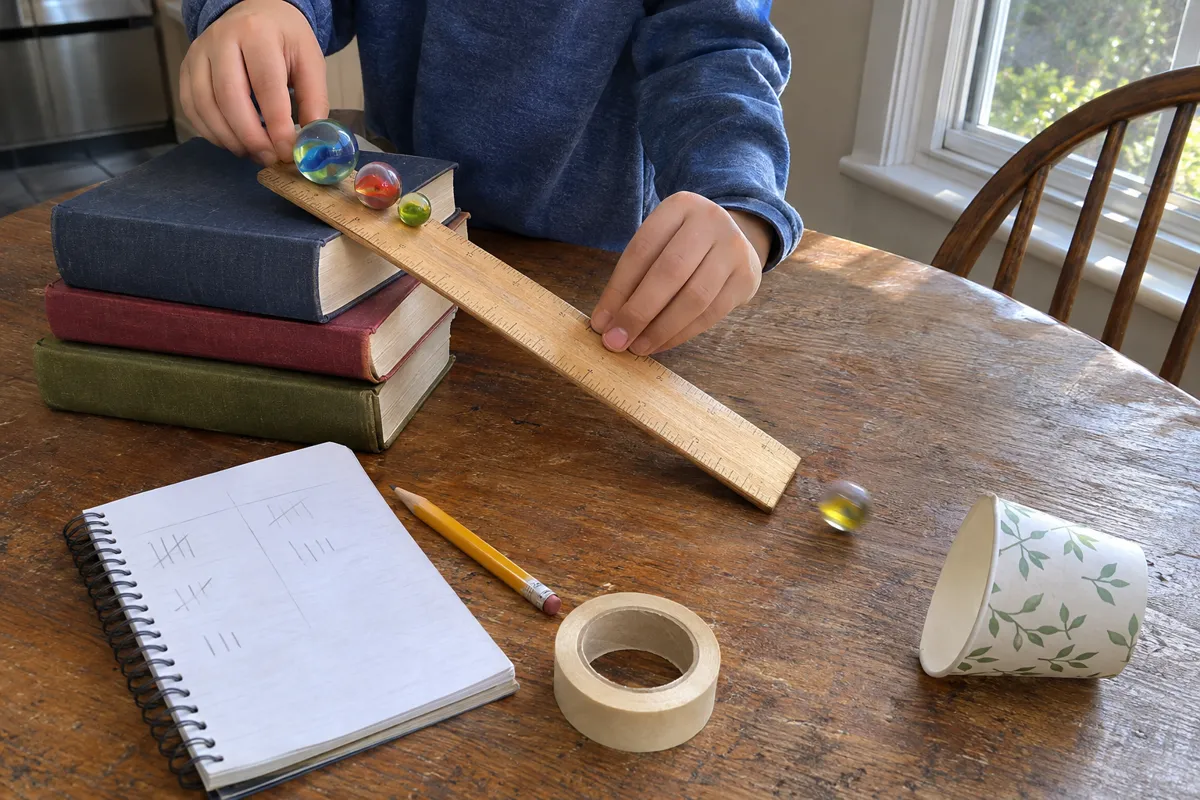
Prop a ruler on a stack of books, roll a marble down it into a paper cup lying on its side and measure how far the cup slides. Then change one thing: add a book, try a bigger marble, put a towel at the bottom. Kids who enjoy this will love a marble run, and the run will keep giving them the same kind of question, one curve at a time.
Spatial play of this kind has measurable effects. In a large, representative U.S. sample, Jirout and Newcombe (2015) found that children who often played with blocks, puzzles and construction toys scored higher on spatial reasoning, a skill linked to later success in science and math.
How to choose a marble run
- Pick one system and stay with it. Marble Genius, GraviTrax, Quadrilla and the magnetic sets do not connect to each other. A second set from the same brand doubles what a child can build; a set from another brand starts a new pile.
- More pieces is not always better. A 300-piece tube set builds taller, but tall towers fall. For a 4- or 5-year-old, a 100- to 150-piece set is plenty.
- Check the marbles. Glass marbles roll faster and quieter; plastic marbles are lighter and bounce out of curves more. Most sets include spares, and lost marbles are the main reason runs stop getting played with.
- Think about storage. A set with a tub or bag gets put away. A set without one ends up in the vacuum cleaner.
- Batteries change the toy. Elevators and light-up pieces keep a run going on its own. That is fun to watch, but a plain run makes the child do the thinking.
If you are shopping for a child whose interests go beyond marbles, our guides to toys for kids who love science and science gifts for kids cover circuits, magnets, rockets and rocks, and the best science kits for kids covers hands-on experiment sets. All of our guides are on the buying guides page.
Marble run safety
- No marbles under 3. Keep marble sets out of reach of younger siblings, and count marbles at the end of play.
- Watch magnets. Magnetic tiles and wall runs seal their magnets inside plastic or foam. If a piece cracks and a magnet comes loose, throw it away; two swallowed magnets can pull together through the intestines.
- Build tall towers on the floor. A tower that falls from a table scatters marbles across the room.
- Check batteries. Motorized pieces should have screw-closed battery doors.
FAQ
The Ravensburger GraviTrax Starter Set is the best marble run for kids aged 8 and up, because its magnetic and gravity pieces turn every run into a physics puzzle and it expands for years. For ages 4 to 7, the Marble Genius Super Set gives the most building for the money. For ages 3 to 7, GraviTrax Junior is the easiest system to build alone.
Most marble runs with real marbles are rated for ages 4 and up, and GraviTrax is rated 8 and up. Children under 3 should not use marbles at all; U.S. rules ban marble toys for that age. A big-ball tower like the Kidoozie Whirl ‘N Go is the right toy for babies and toddlers from 9 months.
Marble runs with standard marbles are not safe for children under 3, because a marble can block a small child’s airway. Toddlers can use ball-drop towers with balls too large to swallow. From age 3, chunky systems such as GraviTrax Junior or PicassoTiles are suitable with an adult nearby.
GraviTrax is better for kids 8 and up who want physics challenges; its tile system holds its shape and its action pieces use magnets and momentum. Marble Genius is better for kids 4 to 8 who want tall towers and lots of pieces for the money. The two systems do not connect to each other.
Usually not. GraviTrax, Marble Genius, Hape Quadrilla and the magnetic wall runs each use their own connectors. Sets within one brand are designed to combine: every GraviTrax set works with GraviTrax PRO, and every Quadrilla set connects to every other.
Kids learn how height turns into speed, why marbles fly off tight curves, how friction slows a long run and how to test one change at a time. Building also trains spatial reasoning; children who play more with construction toys score higher on spatial tests, a skill linked to success in science and math.
Build on a hard, flat floor, give tall towers a wide base, keep columns short at first and connect neighboring towers so they brace each other. Tile systems like GraviTrax and magnetic sets fall over far less than stacked tube towers.
A plastic marble run is better for most kids because clear tubes let them watch the marble and sets build taller with more tricks. A wooden marble run like Hape Quadrilla is better for durability and hand-me-downs; it stands steady and lasts for years, but builds more slowly and has fewer action pieces.
Sources
- Amazon product listings, maker age ratings and piece counts for every product above, checked November 2026.
- U.S. Code of Federal Regulations, 16 CFR 1500.18, Banned toys and other banned articles intended for use by children.
- U.S. Code of Federal Regulations, 16 CFR 1500.19, Misbranded toys and other children’s articles (marble warning label).
- U.S. Consumer Product Safety Commission, Magnets Information Center.
- OpenStax, University Physics Volume 1, 11.1 Rolling Motion.
- Jamie J. Jirout and Nora S. Newcombe, “Building Blocks for Developing Spatial Skills: Evidence From a Large, Representative U.S. Sample,” Psychological Science 26 (2015).