Bosons are particles with whole-number spin (0, 1, 2) that are allowed to share the same quantum state. Many of them also carry the fundamental forces: light is made of bosons, and so is the glue that holds atomic nuclei together. Every other particle in the universe falls into the opposite camp, the fermions.
TLDR
- A boson is any particle with integer spin. Photons, gluons, W and Z bosons, and the Higgs boson are the elementary ones.
- Bosons can pile into a single quantum state. Fermions (electrons, quarks, protons) can’t.
- That one difference explains lasers, superfluid helium, superconductors, and Bose-Einstein condensates.
- The name honors Satyendra Nath Bose, an Indian physicist who worked out the statistics in 1924.
Table of contents
- Bosons vs. fermions
- The elementary bosons
- Why the Higgs is the odd one out
- Composite bosons
- What bosons do in the real world
- Where the name comes from
- FAQ
Bosons vs. fermions
Every known particle has a property called spin. It isn’t literal spinning, but it behaves like a built-in amount of angular momentum, and it comes in two flavors. Particles with integer spin are bosons. Particles with half-integer spin (1/2, 3/2) are fermions.
That sounds like bookkeeping, but it changes how the particles behave when many identical ones get together.
| Bosons | Fermions | |
|---|---|---|
| Spin | Integer (0, 1, 2) | Half-integer (1/2, 3/2) |
| Statistics | Bose-Einstein | Fermi-Dirac |
| Share one quantum state? | Yes, any number | No, one per state |
| Examples | Photon, gluon, W and Z, Higgs, helium-4 atom | Electron, quark, neutrino, proton, helium-3 atom |
| Typical role | Carry forces (and give mass, in the Higgs case) | Make up matter |
Picture a theater. Fermions each need their own seat, and once a seat is taken, the next particle has to sit elsewhere. That rule, the Pauli exclusion principle, is why electrons stack into shells around an atom and why the periodic table has the shape it does. Bosons have no assigned seating. They’ll all crowd into the best seat in the house if it’s available, and they actually prefer to.
The elementary bosons
Physicists know of four kinds of elementary bosons (particles with no known internal parts), plus one hypothetical candidate. The first three are called gauge bosons, and each one carries a force.
Photon. The photon carries electromagnetism. It has spin 1 and no mass, which gives the electromagnetic force unlimited range. Light, radio, X-rays, and the push between two magnets are all photons being exchanged.
Gluon. Gluons carry the strong force, which binds quarks into protons and neutrons. There are eight types, and they’re massless too, but you’ll never see one on its own. The strong force pulls harder as quarks move apart, so its effective reach stops at about the size of a proton, roughly a femtometer.
W and Z bosons. These three particles (W+, W-, and Z) carry the weak force, the one behind radioactive beta decay and the nuclear reactions that power the Sun. Unlike photons and gluons, they’re heavy: the W is about 85 times a proton’s mass, and the Z is about 97 times. That mass keeps the weak force’s range down to around a thousandth of a proton’s width. CERN discovered both in 1983.
Graviton (hypothetical). If gravity works like the other forces, it should have a spin-2 boson. Nobody has detected one, and no current experiment comes close to being able to. It stays on the list as a prediction, not a particle.
Why the Higgs is the odd one out
The Higgs boson doesn’t carry a force the way the others do. It has spin 0, the only elementary particle that does, and it’s an excitation of the Higgs field, which fills all of space. Particles that interact with that field acquire mass. W and Z bosons interact strongly with it, which is why they’re heavy. Photons don’t interact with it at all, which is why they’re massless.
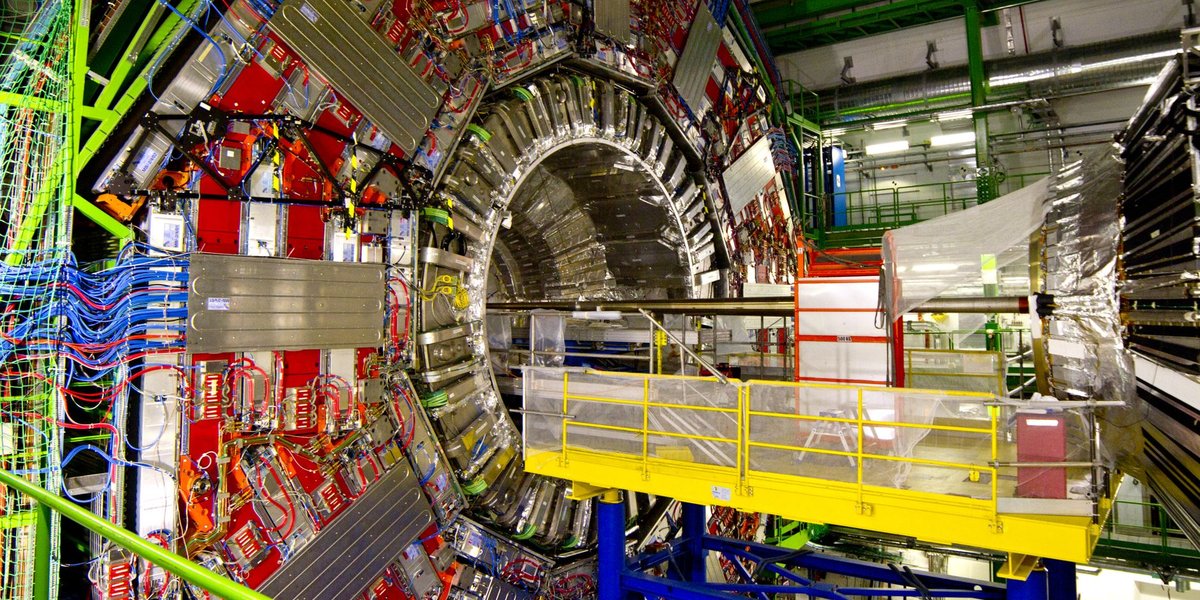
Peter Higgs and others predicted the particle in 1964. CERN’s Large Hadron Collider found it in 2012, at a mass of about 125 GeV, and the 2013 Nobel Prize in Physics went to Higgs and François Englert for the theory. The discovery completed the Standard Model, the framework that sorts all known particles and three of the four forces.
Composite bosons
Bosons aren’t only elementary. Any particle made of smaller pieces counts as a boson if its total spin comes out to a whole number. The rule is simple: add up the fermions inside. An even number of fermions gives a boson, and an odd number gives a fermion.
- Mesons are a quark bound to an antiquark: two fermions, so a boson. The pion is the best-known example.
- Helium-4 has two protons, two neutrons, and two electrons: six fermions, so the whole atom is a boson.
- Helium-3 has one fewer neutron: five fermions, so it’s a fermion. Same element, completely different behavior at low temperatures.
That helium pair is one of the cleanest demonstrations in physics. Cool helium-4 below about 2.17 kelvin and it becomes a superfluid, flowing with zero viscosity and creeping up the walls of its container. Helium-3 does the same thing only below about 2 millikelvin, a thousand times colder, because its atoms first have to pair up into boson-like couples.
What bosons do in the real world
Bosons’ willingness to share a state isn’t a curiosity. It’s built into technology you use.
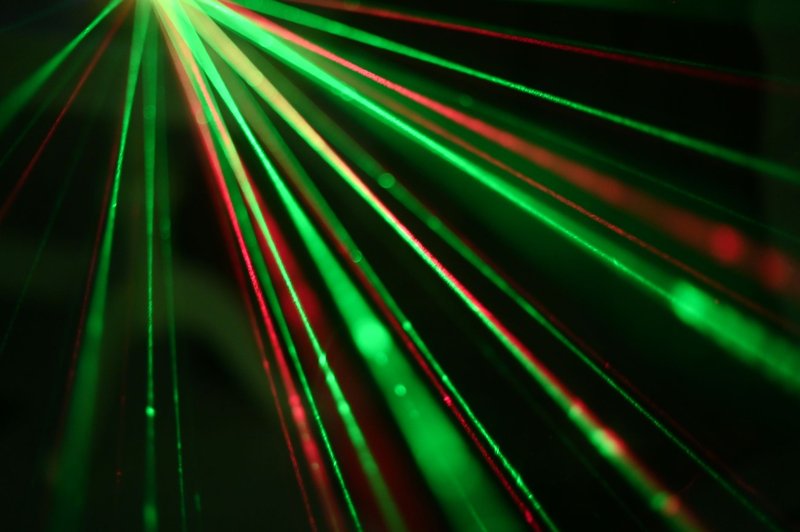
Lasers. When a photon passes an excited atom, it can trigger the atom to emit a second photon in exactly the same state: same color, same direction, same phase. Because photons are bosons, that copy is favored, and the process snowballs. The result is a beam where trillions of photons act in lockstep.
Superconductors. Electrons are fermions and repel each other, so they shouldn’t share anything. But inside certain materials at low temperatures, they form Cooper pairs, two electrons bound together. A pair has integer spin, so it acts like a boson. The pairs condense into one collective state and move through the material with no electrical resistance. That’s how MRI magnets and particle accelerator rings run.
Bose-Einstein condensates. If you cool a cloud of boson atoms to within a hair of absolute zero, they stop acting like separate particles and collapse into the lowest-energy state together, behaving like a single giant wave. Einstein predicted this in 1924 and 1925. Eric Cornell and Carl Wieman made the first one in 1995 with rubidium atoms cooled to roughly 170 billionths of a degree above absolute zero, and they shared the 2001 Nobel Prize in Physics with Wolfgang Ketterle, who produced one in sodium at MIT a few months later.
Where the name comes from
In 1924, Satyendra Nath Bose, a physicist at the University of Dhaka, derived Planck’s law for blackbody radiation by treating light as a gas of identical, indistinguishable particles. Journals turned his paper down. He mailed it to Einstein, who translated it into German, got it published, and extended the idea to atoms. The counting rules for these particles became known as Bose-Einstein statistics.
Paul Dirac later coined the word “boson” for any particle that follows them, and the matching term “fermion” honors Enrico Fermi, who co-developed the rules for the other group. Bose never received a Nobel Prize, though several Nobel-winning discoveries rest on his work.
FAQ
What is a boson in simple terms? A particle with integer spin that can share its quantum state with any number of identical particles. Many bosons also carry forces between other particles.
What’s the difference between bosons and fermions? Fermions have half-integer spin and obey the Pauli exclusion principle, so no two can occupy the same state. Bosons have integer spin and can. Fermions build matter; bosons mostly carry forces.
Is the Higgs boson a force carrier? Not in the usual sense. The gauge bosons (photon, gluon, W, Z) carry forces. The Higgs boson is a ripple in the Higgs field, which is what gives other particles their mass.
Is the graviton a boson? Theory says it should be a spin-2 boson, but it hasn’t been observed. It remains hypothetical.
Why is it called a boson? After Satyendra Nath Bose. Paul Dirac coined the term for particles that follow Bose-Einstein statistics.
Are atoms bosons? Some are. An atom is a boson if it contains an even total number of protons, neutrons, and electrons. Helium-4 is. Helium-3 isn’t.