As an Amazon Associate we earn from qualifying purchases. Disclosure
Last spring my aunt, a retired primary school teacher, sent me a photo from a wellness fair. It showed a pendant on a velvet card labeled “quantum energy balancing,” next to a leaflet saying quantum physics proves your thoughts shape reality. Her message underneath was one line: “Is this true, and is there a book that would tell me what quantum physics actually says?” She had no math past school algebra and no interest in learning calculus at seventy-one. She wanted the real thing, explained honestly, without being talked down to.
That is the problem with most quantum physics books for beginners. Search for one on Amazon and the first page is full of short self-published titles with near-identical covers, mixed in with books that use “quantum” to sell healing, manifesting or consciousness. The good books exist, but they are written for very different readers: some need no math at all, some need a little algebra, and some are real textbooks that teach you to calculate.
The best quantum physics book for beginners with no math is How to Teach Quantum Physics to Your Dog by Chad Orzel. It covers every big idea (wave-particle duality, uncertainty, superposition, entanglement, tunneling) through conversations with his dog and real experiments, and it never asks you to solve anything. For the story of how quantum theory was discovered, read Manjit Kumar’s Quantum. If you want to learn quantum mechanics itself, with the math, the best first book is Quantum Mechanics: The Theoretical Minimum by Leonard Susskind and Art Friedman, which teaches the linear algebra it needs as it goes.
I have a PhD in particle physics from Imperial College London, taught first-year undergraduate labs for three years and spent five years at CERN calibrating particle detectors. The 25 quantum physics and quantum mechanics books below are sorted by how much math they ask of you, from none to a first university course. Each entry says who it suits, what it covers and where it falls short, with the edition to buy. You will also find the books to skip, what Reddit’s physicists recommend, the free courses worth pairing with a book and a reading order.
Quick picks
| Pick | Best for | Math |
|---|---|---|
| How to Teach Quantum Physics to Your Dog | Best first book, no math | None |
| Quantum (Manjit Kumar) | The history and the people | None |
| Q is for Quantum | Understanding entanglement with no math | None |
| QED (Feynman) | A Nobel physicist explaining light | None |
| Beyond Weird | Clearing up the myths | None |
| Quantum Theory: A Very Short Introduction | Shortest overview | Very little |
| What Is Real? | The measurement problem and interpretations | None |
| The Quantum Universe | A first taste of the math | Algebra |
| Quantum Mechanics: The Theoretical Minimum | Best first book with real math | Algebra, some calculus |
| Introduction to Quantum Mechanics (Griffiths) | First university textbook | Calculus, linear algebra |
| Quantum Physics for Babies | Young children and gifts | None |
Which quantum book to start with
Every quantum physics book makes a trade between how much math it uses and how much it can show you. Without math, a book can describe what experiments find and what physicists think it means, but it has to ask you to take the rules on trust. With math, you can see where the strangeness comes from, but you need algebra at least and linear algebra soon after. Pick the level that matches what you want to get out of it.
- You want to know what quantum physics says and why people call it strange. Start with a no-math book: Orzel’s dog book, Ball’s Beyond Weird or Ford’s The Quantum World. These are the books for non-scientists, and they are the right answer for most people searching for a beginner’s quantum book.
- You like stories and people. Read the history: Kumar’s Quantum covers 1900 to 1935, the years when Planck, Einstein, Bohr, Heisenberg and Schrödinger built the theory and argued over it.
- You want to argue about what it means. Read the interpretation books: Becker’s What Is Real?, Carroll’s Something Deeply Hidden and Rovelli’s Helgoland, ideally two of them, because each author has a side.
- You want to see the math without a course. The Quantum Universe, Quanta and Fields and Quantum Computing for Everyone use real equations but explain every step.
- You want to learn quantum mechanics. Start with The Theoretical Minimum, then move to Griffiths or McIntyre. Expect to work problems with a pencil, and expect it to take months.
A second rule: check the date. Quantum physics changed a lot as a public subject after 1982, when Alain Aspect’s experiments tested entanglement, and again after 2022, when Aspect, John Clauser and Anton Zeilinger shared the Nobel Prize in Physics for that work. Books written before the 1990s treat entanglement as a puzzle in thought experiments. Recent ones describe it as a lab tool behind quantum computers and quantum encryption. For a quick primer on how quantum rules differ from everyday physics, read our explainer on the differences between quantum physics and classical physics.
Best quantum physics books for non-scientists
These books need no math beyond the odd number. They are written for adults who are curious, and several are written by working physicists. If you only read one, read the first.
Best first quantum physics book
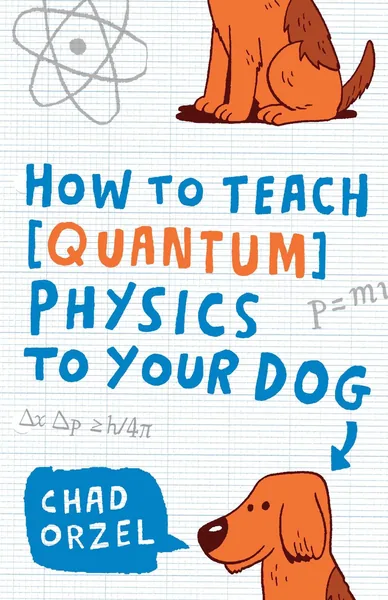
1. How to Teach Quantum Physics to Your Dog
Chad Orzel is a physics professor at Union College who did his PhD in laser cooling of atoms. Each chapter is a conversation with his dog Emmy, who asks the questions a beginner would ask (can I tunnel through the fence to the bunnies?) and gets real answers. Between the conversations Orzel explains the physics properly and describes the actual experiments that established each idea.
It covers wave-particle duality, the double-slit experiment, the uncertainty principle, the Copenhagen and many-worlds interpretations, the quantum Zeno effect, entanglement and Bell’s theorem, teleportation and virtual particles. The final chapter takes apart quantum mysticism and “quantum healing” claims, which makes it the book I would hand to anyone who has seen “quantum” on a wellness leaflet. The dog device annoys some readers; the explanations underneath are sound.
- Chad Orzel
- Scribner, paperback (2010), 256 pages
- No equations; covers every major quantum idea
Good: the clearest no-math explanation of what quantum physics says, by a working physicist, with a chapter on the pseudoscience. Not great: the talking dog is too cute for some readers, and it predates the 2022 Nobel and today’s quantum computers.
Check on Amazon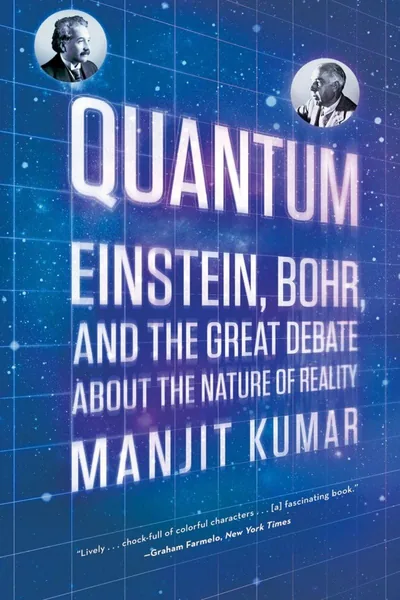
Best history of quantum physics
2. Quantum: Einstein, Bohr, and the Great Debate about the Nature of Reality
Manjit Kumar tells the story of quantum theory from Max Planck’s reluctant 1900 guess about energy coming in packets to the 1927 Solvay Conference, where Einstein and Niels Bohr began the argument they kept up until Einstein’s death. Along the way you meet Heisenberg working out matrix mechanics on the island of Heligoland, Schrödinger writing his wave equation on a ski holiday, Pauli, Dirac and de Broglie.
Because the physics comes through the people, each idea arrives with the problem it was invented to solve, which is how most readers find it easiest to remember. The later chapters cover Bell’s theorem and the experiments that settled the Einstein-Bohr debate in Bohr’s favor. It is long for a first book but reads like a biography, not a textbook.
- Manjit Kumar
- W. W. Norton, paperback (2011), 448 pages
- No equations; history from 1900 to Bell’s theorem
Good: the best-written history of quantum theory, and the ideas stick because you meet them through the people who fought over them. Not great: long, and it explains the history of the ideas more than the ideas themselves.
Check on Amazon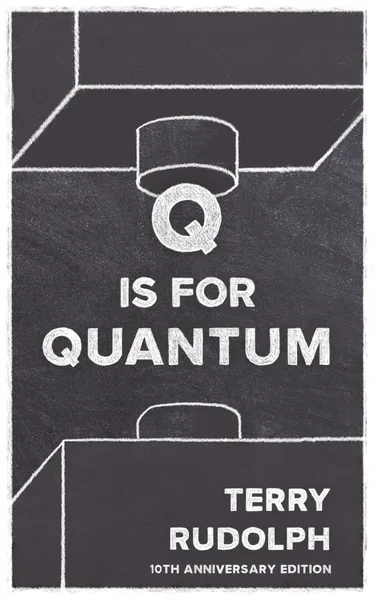
Best for understanding it without math
3. Q is for Quantum
Terry Rudolph is a quantum physicist at Imperial College London and a co-founder of the quantum computing company PsiQuantum. His short book does something no other popular book does: it teaches the actual logic of quantum mechanics using black and white balls going through boxes, with no math at all. By the end you have worked through superposition, interference, entanglement and why quantum computers can do things ordinary ones cannot.
It reads less like a story and more like a puzzle book. You have to follow each step, and the reward is that you understand the reasoning instead of taking an author’s word for it. The last third covers what the theory might mean and Rudolph’s own views on it. It is self-published by a serious physicist, which is unusual, and it is the book physicists most often suggest to someone who wants more than metaphors.
- Terry Rudolph
- Terence Rudolph, paperback (2017), 164 pages
- No equations; teaches the logic with a ball-and-box game
Good: the only no-math book that lets you reason through quantum effects yourself, and it is short. Not great: you have to concentrate on every page, and the presentation is plain.
Check on Amazon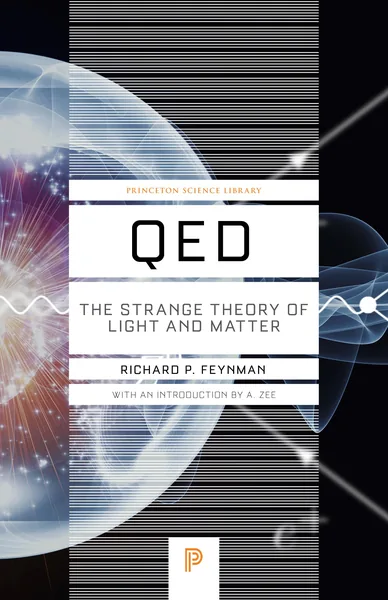
Best by a Nobel physicist
4. QED: The Strange Theory of Light and Matter
Richard Feynman gave four public lectures on quantum electrodynamics, first in New Zealand in 1979 and again at UCLA, the theory of light and electrons that won him the 1965 Nobel Prize. This book is those lectures. He explains how light reflects off glass and bends through water using nothing but little arrows on paper that you add up, and those arrows are the same calculation physicists do with full math.
It is the most honest popular book on quantum physics, because Feynman tells you at the start that nobody understands why nature works this way and he will only show you how it does. The first two lectures suit anyone. The last two, on electrons and the forces between particles, are harder. The 2014 Princeton edition adds an introduction by physicist Anthony Zee.
- Richard P. Feynman, introduction by A. Zee
- Princeton University Press, paperback (2014 edition), 190 pages
- No equations; diagrams with arrows stand in for the math
Good: a real method for thinking about quantum behavior, from the physicist who invented much of it. Not great: it covers light and electrons only, not the whole subject, and the last two lectures demand rereading.
Check on Amazon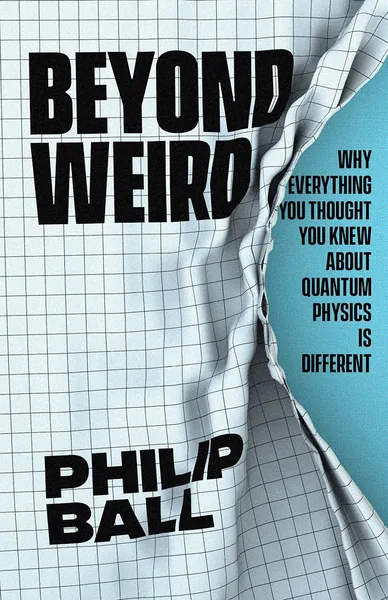
Best for clearing up the myths
5. Beyond Weird
Philip Ball was an editor at Nature for twenty years and trained in chemistry and physics. His argument is that the usual popular explanations (“a particle is in two places at once,” “observing it changes it,” “the cat is both dead and alive”) are wrong or misleading, and he replaces them with what physicists working on the foundations of quantum theory say now: that it is a theory about information and what can be known.
It is the best antidote to quantum woo and the best book for readers who found the standard metaphors unsatisfying. It also covers decoherence, which explains why the everyday world looks classical.
- Philip Ball
- University of Chicago Press, hardcover (2018), 384 pages
- No equations; focuses on what quantum theory does and does not say
Good: corrects the myths that the other popular books repeat, and covers decoherence well. Not great: better as a second book than a first, and the hardcover is the format in print in the US.
Check on Amazon
Plainest explanation of particles
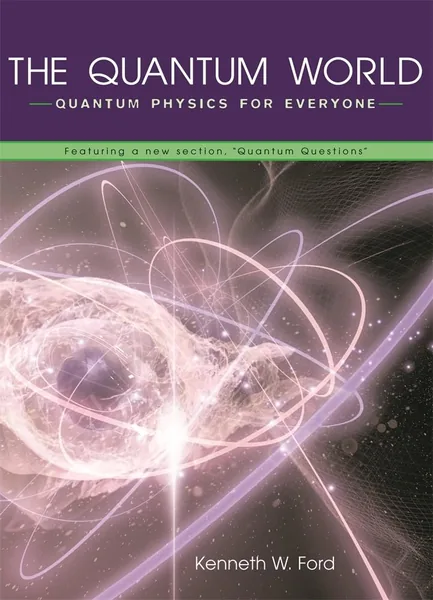
6. The Quantum World: Quantum Physics for Everyone
Kenneth Ford worked with John Wheeler on the hydrogen bomb project and taught physics for decades, including at a high school after he retired. His book explains quantum physics through the particles themselves: what electrons, photons, quarks and neutrinos are, how they are counted, why they have spin, how they decay and what the quantum rules say about each.
Where other authors dwell on paradoxes, Ford explains how the quantum world works day to day. It pairs well with our explainer on elementary particles.
- Kenneth W. Ford
- Harvard University Press, paperback (2005), 304 pages
- Almost no equations; built around particles and their properties
Good: concrete and calm, written by a physicist who taught teenagers. Not great: less about interpretations and entanglement than newer books.
Check on Amazon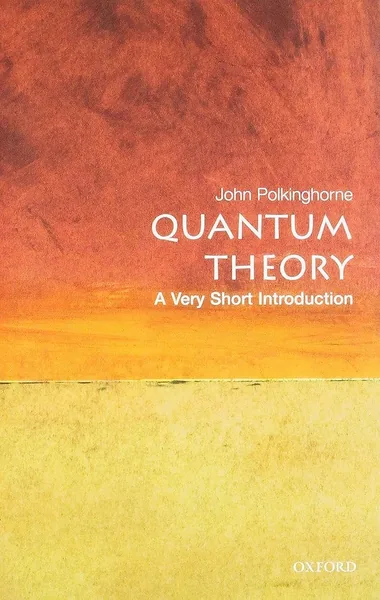
Shortest overview
7. Quantum Theory: A Very Short Introduction
John Polkinghorne was a Cambridge professor of mathematical physics who worked on the theory of elementary particles. In about 100 pages of text he covers how classical physics broke down, the double-slit experiment, the principles of the theory, the measurement problem, the main interpretations, entanglement and quantum computing as it stood in 2002. A short mathematical appendix shows the formulas for readers who want them.
It is the fastest route to a correct picture of the whole subject. The price of brevity is that some sections compress a lot into a page, and readers with no physics often need to read a chapter twice. Polkinghorne later became an Anglican priest, but he keeps theology out of this book.
- John Polkinghorne
- Oxford University Press, paperback (2002), 128 pages
- Little math in the text, a short math appendix
Good: a complete, accurate overview you can finish in an evening or two. Not great: dense in places, and the quantum computing section is out of date.
Check on Amazon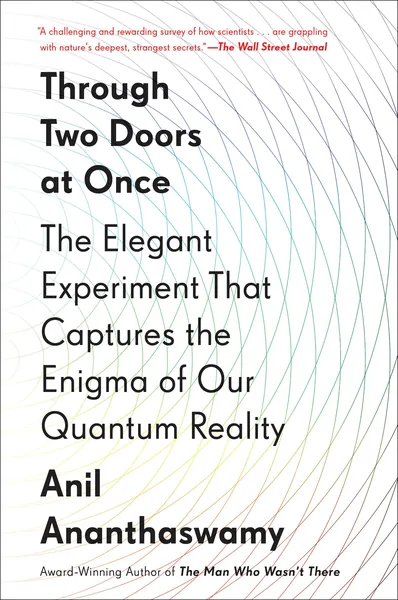
Best on the double-slit experiment
8. Through Two Doors at Once
Anil Ananthaswamy is a science journalist and former New Scientist editor. His whole book follows one experiment, the double-slit, from Thomas Young’s demonstration with sunlight around 1801 to modern versions with single photons, molecules and delayed-choice setups. He visits the labs that run them and explains what each version rules out.
Because every interpretation of quantum mechanics has to explain this one experiment, following it is a tidy way to meet all of them: Copenhagen, pilot waves, many worlds, collapse theories and QBism. It suits readers who prefer a single thread to a survey. You can run a version of the experiment yourself with a laser pointer and kitchen foil, explained in the at-home section below.
- Anil Ananthaswamy
- Dutton, paperback (2019), 304 pages
- No equations; one experiment, every interpretation
Good: concrete, with real labs and real people, and it makes the interpretations easy to compare. Not great: one experiment means less on quantum technology and the history before 1925.
Check on Amazon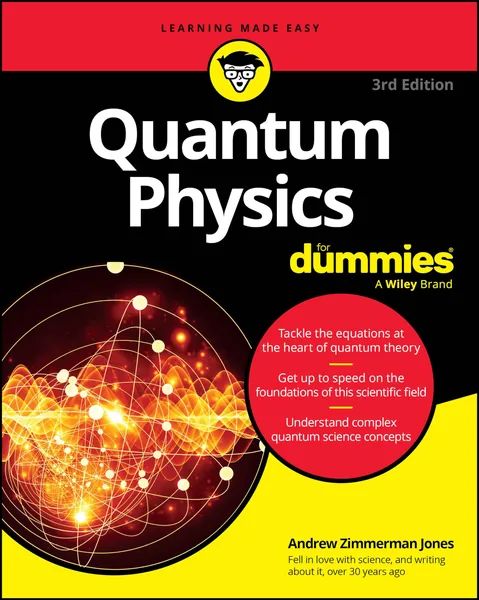
Best reference-style beginner book
9. Quantum Physics For Dummies (3rd edition)
The 2024 third edition was rewritten by Andrew Zimmerman Jones, who also wrote String Theory For Dummies, and it is a different book from Steven Holzner’s 2009 and 2013 editions. Holzner’s versions were math textbooks in disguise, which is why so many readers gave them poor reviews. The new one explains the ideas first, adds the history and covers quantum computing, quantum cryptography and current experiments, with equations kept to the sections that need them.
Like all Dummies books it is built to be dipped into: short sections, summaries and cross-references. That makes it a good reference to keep next to a narrative book like Kumar’s. Make sure you buy the edition with Jones on the cover.
- Andrew Zimmerman Jones
- For Dummies (Wiley), paperback, 3rd edition (2024), 352 pages
- Light math; current through quantum computing
Good: the most up-to-date general beginner book in this list, easy to look things up in. Not great: the Dummies format breaks the story into pieces, and older editions still turn up in searches.
Check on Amazon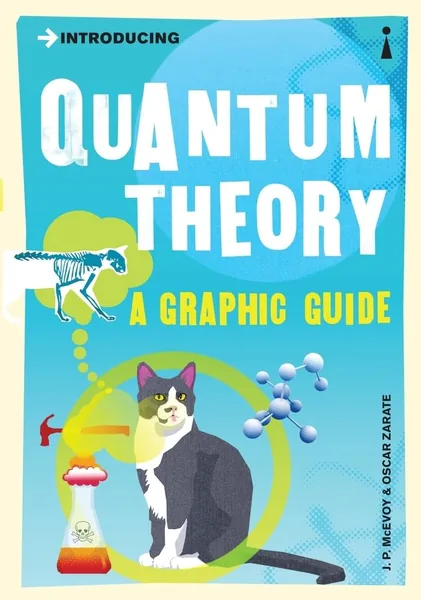
Best illustrated introduction
10. Introducing Quantum Theory: A Graphic Guide
J.P. McEvoy wrote the text and Oscar Zarate drew this comic-style history, which runs from blackbody radiation and Planck through Bohr’s atom, Heisenberg, Schrödinger and the Einstein-Bohr debates to Bell’s theorem. Every page mixes drawings of the physicists with diagrams of the experiments and short quotes.
It suits visual readers and teenagers, and it is quicker than any prose history. The cartoons carry real content. It stops before modern quantum technology.
- J.P. McEvoy and Oscar Zarate
- Icon Books, paperback, 4th edition (2007), 176 pages
- Comic format; history from 1900 to Bell
Good: the fastest way into the history, with drawings that help the ideas stick. Not great: crowded pages, and nothing on quantum computing or recent experiments.
Check on Amazon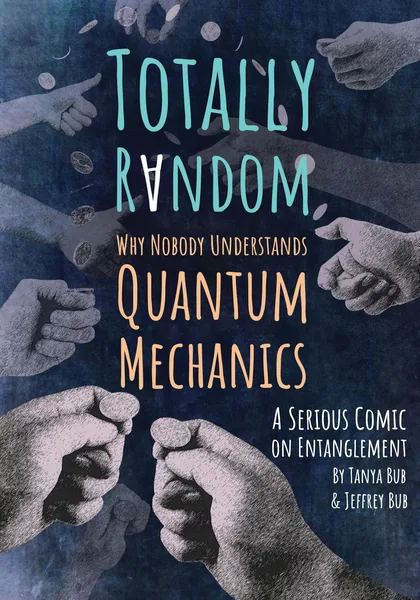
Best graphic book on entanglement
11. Totally Random: Why Nobody Understands Quantum Mechanics
Jeffrey Bub is a philosopher of physics at the University of Maryland who has written on quantum foundations for fifty years; his daughter Tanya Bub drew it. They call it “a serious comic on entanglement,” and it is exactly that: two characters play with a pair of “quantum boxes” until the reader can see why entangled correlations cannot be explained by hidden instructions, which is the content of Bell’s theorem.
- Tanya Bub and Jeffrey Bub
- Princeton University Press, paperback (2018), 272 pages
- Comic format; entanglement and Bell’s theorem in depth
Good: makes Bell’s theorem something you can follow step by step. Not great: covers one topic, and the comic pacing is slow in the middle.
Check on AmazonBooks about what quantum mechanics means
Physicists agree on how to use quantum mechanics and disagree about what it says reality is like. This is called the measurement problem: the math describes a particle as a spread of possibilities, yet every measurement finds one definite result. The books below take positions. Read at least two, because each author makes his own view sound like the obvious one. Our article on myths about quantum mechanics covers the misreadings that come out of these debates.
Best on the interpretation debate
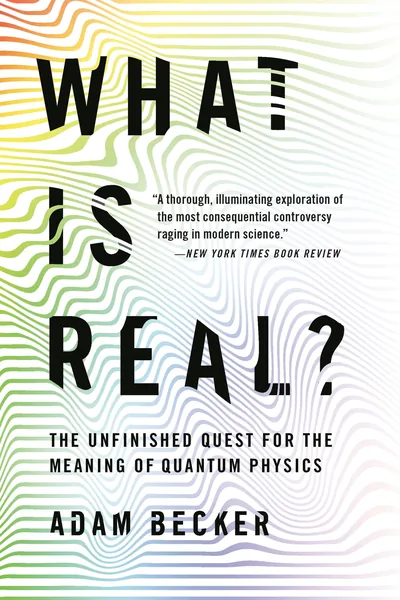
12. What Is Real?
Adam Becker has a PhD in computational cosmology and writes about physics. His book is the history of the argument over what quantum mechanics means, from 1927 to today, and it is a pointed one: Becker argues that Bohr’s Copenhagen interpretation won by authority more than evidence and that physicists who questioned it, such as David Bohm, Hugh Everett and John Bell, had their careers damaged for it.
It is the best introduction to the interpretations, because it explains each one through the person who proposed it and the reasons it was ignored or revived. Some physicists think Becker is unfair to Bohr. That argument is part of the subject, and the book will leave you able to follow it.
- Adam Becker
- Basic Books, paperback (2019), 384 pages
- No equations; history and philosophy of quantum interpretations
Good: a lively, readable account of the debate most popular books skip. Not great: openly one-sided against Copenhagen.
Check on Amazon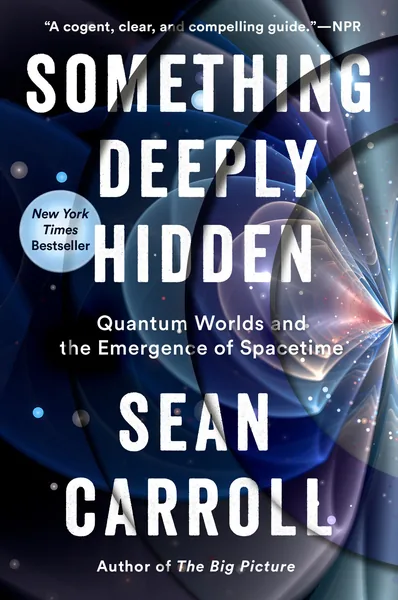
Best case for many worlds
13. Something Deeply Hidden
Sean Carroll is a theoretical physicist at Johns Hopkins and the Santa Fe Institute. He argues that quantum mechanics should be taken at face value: the wave function never collapses, and every measurement splits the universe into branches, which is Hugh Everett’s many-worlds interpretation. He explains it from scratch, with decoherence and entanglement, and devotes the later chapters to how space and time might emerge from quantum entanglement.
It has more Amazon ratings than any other book in this guide, and the first half is one of the clearest explanations of the measurement problem in print. Read it with Becker or Rovelli to hear the other sides. The last third, on quantum gravity, is speculative and harder.
- Sean Carroll
- Dutton, paperback (2020), 368 pages
- No equations; argues for the many-worlds interpretation
Good: lays out the measurement problem as clearly as any book, by a working physicist. Not great: an argument for one view, and the quantum gravity chapters lose many beginners.
Check on Amazon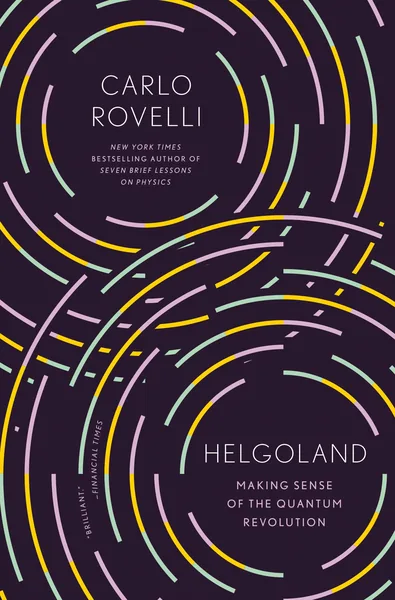
Shortest interpretation book
14. Helgoland
Carlo Rovelli, author of Seven Brief Lessons on Physics, opens with the 23-year-old Werner Heisenberg on the North Sea island of Helgoland in 1925, where he worked out the first version of quantum mechanics. He then lays out his own relational interpretation: objects have properties only in relation to other objects, so there is no view of reality from nowhere.
It is short and beautifully written, and it sets out the alternatives fairly before arguing for Rovelli’s. The second half moves into philosophy, including the Buddhist philosopher Nagarjuna and Lenin’s attack on Alexander Bogdanov, a follower of Ernst Mach, which some readers love and others skip. Translated from Italian.
- Carlo Rovelli, translated by Erica Segre and Simon Carnell
- Riverhead Books, paperback (2022), 256 pages
- No equations; the relational interpretation
Good: the most readable book on interpretations, and short. Not great: the philosophy chapters drift away from physics.
Check on AmazonJohn Gribbin’s In Search of Schrödinger’s Cat (1984) introduced a generation to quantum physics and still sells. Its history chapters hold up; its ending predates decoherence, quantum computing and the loophole-free Bell tests of 2015, so read it for the story and a newer book for where the field stands.
Books with a little math
These three books use real equations but explain each one. They suit readers who remember high school algebra and want to see why the quantum rules produce what they do, without committing to a course.
Best first taste of the math
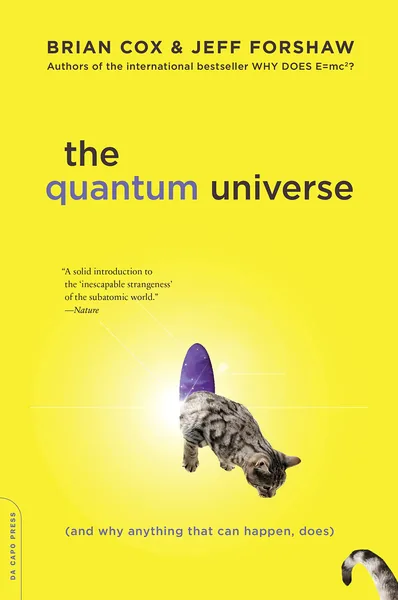
15. The Quantum Universe: (And Why Anything That Can Happen, Does)
Brian Cox and Jeff Forshaw are particle physicists at the University of Manchester. They build quantum theory from Feynman’s idea that a particle takes every possible path, drawn as clocks whose hands add up, and use it to derive real results: why atoms are stable, why some materials conduct electricity, how transistors work and why white dwarf stars do not collapse.
It is the most ambitious popular quantum book: it actually calculates things. The first half is manageable with school algebra. The middle chapters, on electrons in atoms and solids, get hard, and Cox and Forshaw know it; they tell readers it is fine to skim the math on a first read. The calculation of a white dwarf’s maximum mass near the end is one of the best payoffs in popular physics.
- Brian Cox and Jeff Forshaw
- Da Capo, paperback (2013), 272 pages
- Some algebra; builds the theory and applies it
Good: shows you how quantum theory produces real predictions, not only what it says. Not great: difficulty jumps in the middle chapters.
Check on Amazon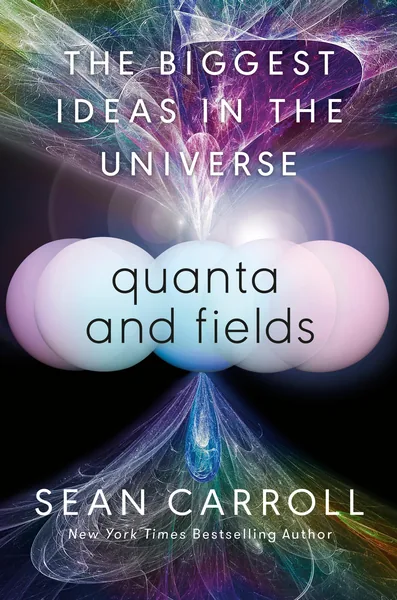
Best for reading equations, not solving them
16. Quanta and Fields
The second volume of Sean Carroll’s Biggest Ideas in the Universe series grew out of video lectures he recorded during 2020. His promise is that he will show you the real equations of physics and teach you to read them, without expecting you to solve them. This volume covers the wave function, measurement, entanglement, quantum fields, the particles of the Standard Model, symmetry and renormalization.
It goes further into modern physics than any other book here: quantum field theory, the framework that describes all known particles, is normally graduate material. Readers who enjoyed Something Deeply Hidden and wanted more substance are its audience. It works best after one no-math book. You can read it without volume 1, Space, Time, and Motion, though it refers back to it.
- Sean Carroll
- Dutton, hardcover (2024), 304 pages
- Equations shown and explained, not exercised
Good: real physics up to quantum field theory for a general reader. Not great: dense, and only in hardcover in the US for now.
Check on Amazon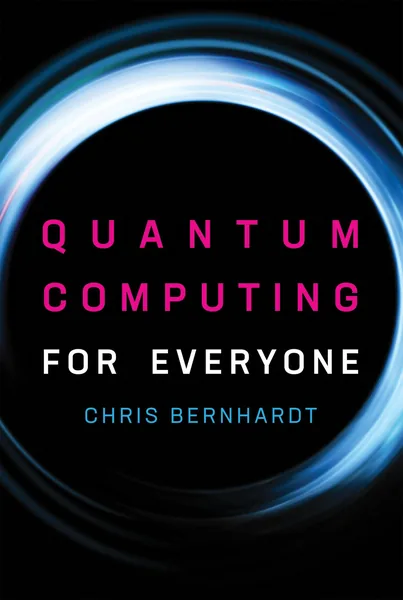
Best bridge to the real math
17. Quantum Computing for Everyone
Chris Bernhardt is a mathematician at Fairfield University, and his book teaches the core of quantum mechanics the way quantum computing courses do: with qubits, spin, vectors and a few small matrices. He explains every piece of math from high school level, then uses it for entanglement, Bell’s inequality, quantum gates, quantum key distribution and the algorithms of Deutsch, Grover and Shor.
It is the best book for programmers, engineers and anyone curious about quantum computers. It is also, quietly, the best preparation for Susskind’s Theoretical Minimum, because it covers the same linear algebra at a gentler pace. When a software developer in the CERN computing group asked me where to start before the quantum computing hype passed him by, this was my first suggestion. Our guide to the best quantum computing books for beginners covers that field in more depth.
- Chris Bernhardt
- MIT Press, paperback (2020), 216 pages
- High school algebra, vectors and 2×2 matrices, all explained
Good: teaches the real formalism with minimal math, and quantum computing as a bonus. Not great: nothing on waves or atoms, the other half of quantum physics.
Check on AmazonBest quantum mechanics books for beginners (with math)
“Quantum mechanics” usually means the mathematical theory, and these books teach it: you work problems, not only read. Treat them as a course. Plan for an hour a day for several months, keep a notebook and do the exercises. The order below runs from the gentlest to the first true university textbook. If you are also building up the rest of physics, our guide to the best physics books for self-study covers mechanics, electromagnetism and the math books that come before this level.
Best first quantum mechanics book with math
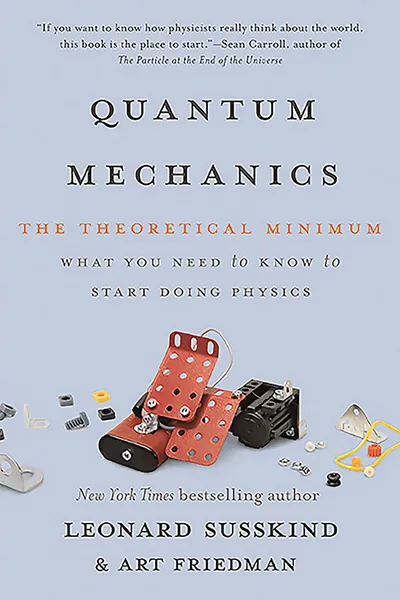
18. Quantum Mechanics: The Theoretical Minimum
Leonard Susskind is a Stanford theoretical physicist and one of the founders of string theory. The Theoretical Minimum books come from his continuing-education lectures for adults in the Bay Area, written up with Art Friedman, a software engineer who took the course. This is the second book in the series, and it does not require the first.
It starts with spin, the simplest quantum system, instead of waves, which means the first chapters need only vectors and matrices, and Susskind teaches those himself. From there it builds the actual rules: states, measurements, uncertainty, time evolution, entanglement (with a full chapter on Bell’s theorem), and finally particles moving in space and the harmonic oscillator. Each chapter has exercises without printed answers; worked solutions from readers are easy to find online. His free lecture videos at theoreticalminimum.com follow the book closely.
- Leonard Susskind and Art Friedman
- Basic Books, paperback (2015), 384 pages
- Needs algebra; teaches linear algebra; some calculus in later chapters
Good: the real theory for a motivated adult, with free lectures that match it. Not great: no answers to exercises in the book, and the later chapters on wave functions assume calculus.
Check on Amazon
Best for explaining every step
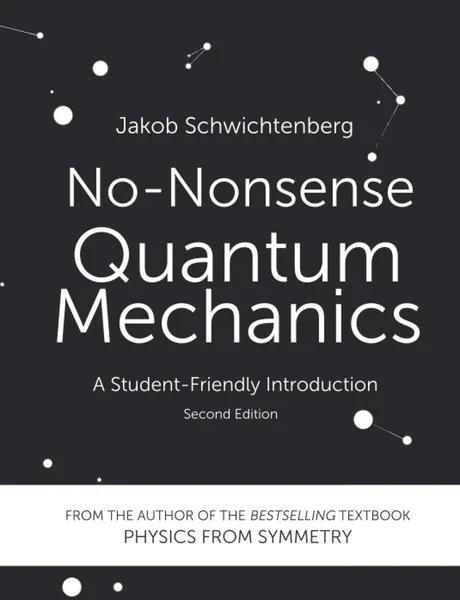
19. No-Nonsense Quantum Mechanics
Jakob Schwichtenberg has a PhD in particle physics from the Karlsruhe Institute of Technology and writes textbooks for self-learners. This one is the opposite of a terse classic: every calculation is written out, every idea is explained more than once, and the margins carry reminders of the math you need. It covers the three formulations of quantum mechanics (wave functions, matrices and path integrals) and shows how they connect.
It suits readers who stalled in a standard textbook because steps were skipped. Pair it with a book that has problems. Make sure you buy the “Student-Friendly Introduction, Second Edition,” not the older 2018 version with a different subtitle.
- Jakob Schwichtenberg
- No-Nonsense Books, paperback, 2nd edition, 266 pages
- Needs calculus; explains the linear algebra
Good: no skipped steps, ideal when other books leave you lost. Not great: wordy, and light on exercises.
Check on Amazon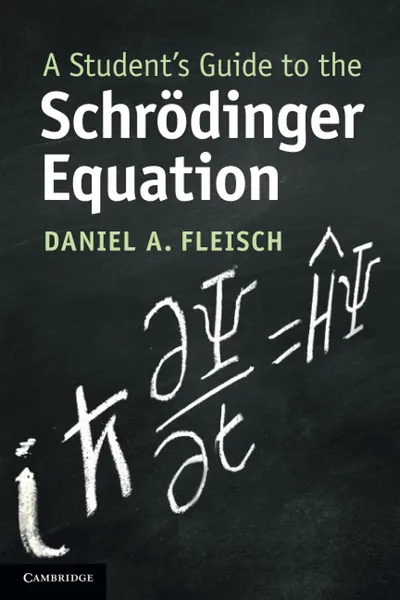
Best short math companion
20. A Student’s Guide to the Schrödinger Equation
Daniel Fleisch taught physics at Wittenberg University and writes the Cambridge Student’s Guides, which take one equation or topic and explain it slowly. This one covers the math you need for wave mechanics (vectors, operators, Dirac notation, functions as vectors) and then the Schrödinger equation itself, solved for the standard cases: the infinite well, the finite well and the harmonic oscillator.
It is not a full course, but it fills the gap most self-learners fall into, which is the jump from algebra to operators and Dirac’s bra-ket notation. Each chapter has problems, with full solutions free on the book’s website. Read it before or alongside Griffiths.
- Daniel A. Fleisch
- Cambridge University Press, paperback (2020), 236 pages
- Needs calculus; teaches the linear algebra and notation
Good: the clearest explanation of the notation that stops most beginners, with solutions online. Not great: covers wave mechanics only, not spin or entanglement.
Check on Amazon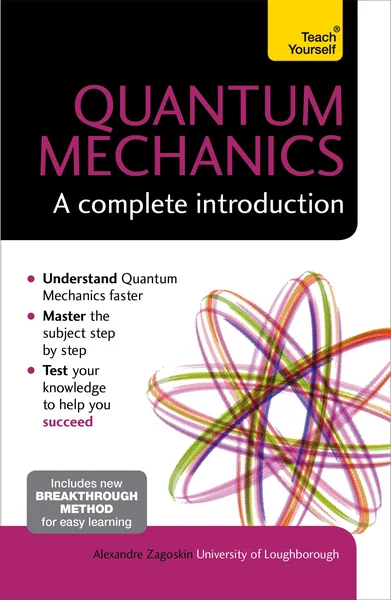
Best Teach Yourself course
21. Quantum Mechanics: A Complete Introduction
Alexandre Zagoskin is a physicist at Loughborough University who works on superconducting qubits. His book is part of the Teach Yourself series, so every chapter opens with what you will learn, ends with a short quiz and adds key-idea boxes along the way. It covers the standard first course plus topics most introductions leave out, including quantum computing, density matrices and the relationship between quantum and classical mechanics.
It assumes calculus and moves fast for its length. It suits readers who like structure and short sessions.
- Alexandre Zagoskin
- Teach Yourself (John Murray), paperback (2015), 256 pages
- Needs calculus; moves to university level quickly
Good: structured for self-study, with quizzes and wide coverage. Not great: fast for complete beginners, and few long problems.
Check on Amazon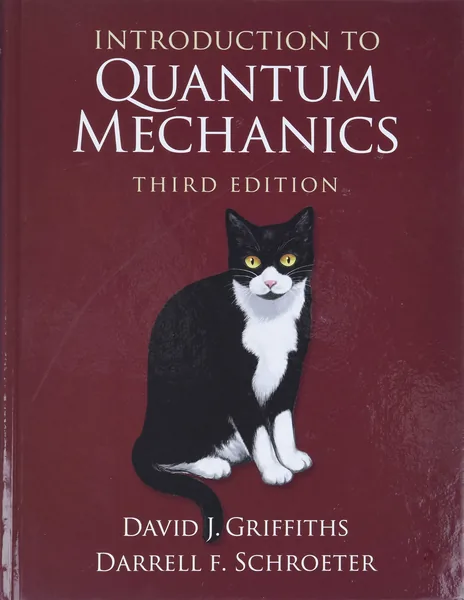
Best first university textbook
22. Introduction to Quantum Mechanics (Griffiths and Schroeter)
Griffiths is the standard undergraduate quantum mechanics textbook in American universities, and the one self-learners mean when they say “the real thing.” It starts with the wave function and the Schrödinger equation, solves the standard problems, then covers the formalism, the hydrogen atom, angular momentum and spin, identical particles and approximation methods. The third edition, with Darrell Schroeter, adds a chapter on symmetries and more problems.
The writing is conversational and the problems are excellent, which is why it dominates. It expects you to know multivariable calculus and differential equations and to pick up linear algebra from its appendix, which many readers find too short; Fleisch’s Student’s Guide fills that gap. Official solutions are sold only to instructors, so check your work against a study group or online discussions. The epilogue on interpretations is short but fair.
- David J. Griffiths and Darrell F. Schroeter
- Cambridge University Press, hardcover, 3rd edition (2018), 508 pages
- Needs calculus and differential equations; linear algebra in an appendix
Good: the clearest standard textbook, with hundreds of good problems. Not great: starts with waves, which makes the formalism feel abstract later, and no public solutions.
Check on Amazon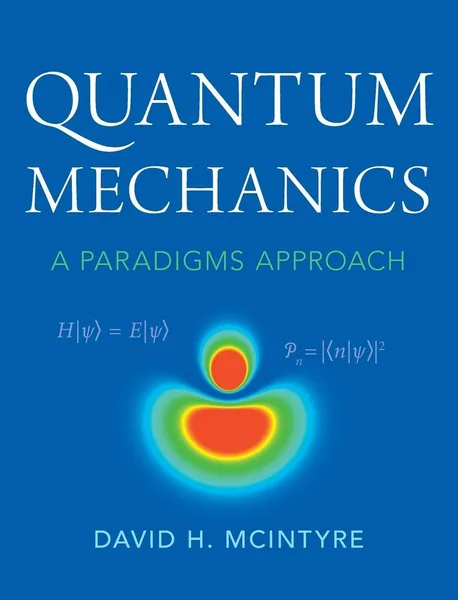
Best spin-first textbook
23. Quantum Mechanics: A Paradigms Approach
David McIntyre teaches at Oregon State University, whose Paradigms in Physics program rebuilt the undergraduate course around spin first. His textbook starts with the Stern-Gerlach experiment and two-state systems, the same route as Susskind, then moves to wave functions, the hydrogen atom, perturbation theory and a modern chapter on entanglement and quantum information.
It is the natural next step after The Theoretical Minimum, because it continues in the same direction at university depth. Many instructors think spin-first teaching makes the math clearer than Griffiths’s waves-first order. The 2022 Cambridge printing is the edition in print; the earlier Pearson edition is the same book.
- David H. McIntyre
- Cambridge University Press, hardcover (2022 printing), 590 pages
- Needs calculus; linear algebra from the start
Good: spin-first order, modern topics and clear examples. Not great: fewer online resources and solutions than Griffiths.
Check on Amazon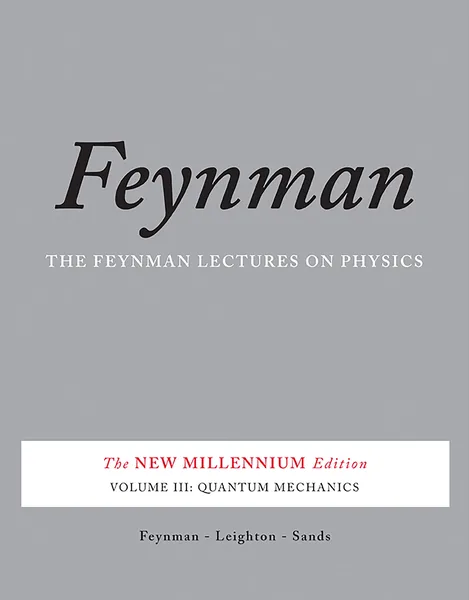
Best second view
24. The Feynman Lectures on Physics, Vol. III: Quantum Mechanics
The third volume of Feynman’s lectures to Caltech undergraduates in the early 1960s was the first textbook to start quantum mechanics with two-state systems and amplitudes, decades before it became fashionable. Feynman builds the theory from the double-slit experiment and then the ammonia molecule, spin and the hydrogen atom, explaining why each rule must be the way it is.
It is wonderful to read and poor as a first course: there are no exercises in the book, and Feynman skips steps a student would need. Use it as a second explanation next to Susskind or Griffiths. The full text is free to read online at Caltech; buy the print edition only if you prefer paper.
- Richard P. Feynman, Robert B. Leighton and Matthew Sands
- Basic Books, hardcover, New Millennium Edition (2011), 400 pages
- Needs calculus; no exercises
Good: the deepest explanations of why the rules work, and free online. Not great: no problems, so you cannot learn to calculate from it alone.
Check on AmazonTwo more that come up often: Nouredine Zettili’s Quantum Mechanics: Concepts and Applications (3rd edition, 2022) is a thousand-page book of worked problems that many students use next to Griffiths for practice, and John Townsend’s A Modern Approach to Quantum Mechanics is another spin-first textbook, older and pricier than McIntyre’s. For quantum computing at university level, the standard text is Nielsen and Chuang’s Quantum Computation and Quantum Information, which you should only open after a first course.
Quantum books for kids
Best for young children and gifts
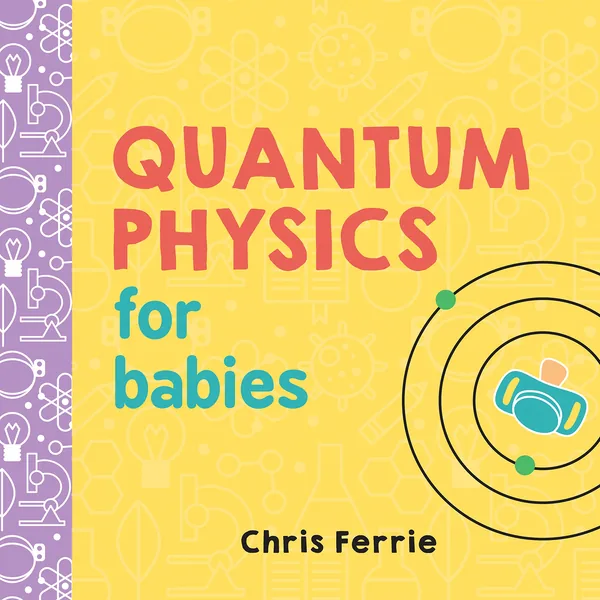
25. Quantum Physics for Babies
Chris Ferrie is a quantum physicist at the University of Technology Sydney, and he started the Baby University series by writing books for his own children. This board book explains that atoms have energy levels and electrons jump between them, with bold, simple pictures and one sentence a page. The physics is correct, which is more than many children’s science books manage.
Babies will enjoy the colors and shapes, toddlers and preschoolers the words, and adults the joke. It is the most-reviewed quantum book on Amazon and a common gift for physicist parents. The sequel, Quantum Entanglement for Babies, does the same for entanglement and is the better second book than the general physics titles in the series.
- Chris Ferrie
- Sourcebooks Explore, board book (2017), 24 pages
- Ages 0 to 3, with real physics
Good: accurate, sturdy and a gift parents laugh at. Not great: 24 pages, so it is a gift or a bedtime book, not a lesson.
Check on AmazonFor teenagers who like fiction, George Gamow’s Mr Tompkins in Paperback sends a bank clerk into dream worlds where Planck’s constant is so large that billiard balls spread out like waves. The humor is from the 1940s; the idea of making quantum effects big enough to see still builds intuition.
Quantum books to skip
A quantum book can be popular and still mislead you. These are the ones to avoid or read with a warning.
- Short self-published “Quantum Physics for Beginners” titles. Search Amazon for quantum physics books for beginners and the first results are dozens of 100- to 150-page paperbacks with similar titles, often in three-book bundles, by authors with no physics background you can find. Many are padded and some contain basic errors. Every book in this guide is by a physicist or an established science writer.
- Quantum mysticism. Fritjof Capra’s The Tao of Physics (1975), Gary Zukav’s The Dancing Wu Li Masters (1979) and the film What the Bleep Do We Know!? (2004) and its companion book link quantum physics to Eastern philosophy, consciousness or healing. The physics in them is either dated or bent to fit. Nothing in quantum mechanics says your thoughts change matter. Orzel’s last chapter and Ball’s Beyond Weird explain why.
- Michio Kaku’s Quantum Supremacy (2023). A bestseller, but quantum computing researchers criticized it heavily for overstating what quantum computers can do and mixing them up with other technologies. Scott Aaronson, a leading quantum computing theorist, titled his review “tl;dr DO NOT BUY.” Read Bernhardt’s Quantum Computing for Everyone instead.
- Older editions of Quantum Physics For Dummies. Steven Holzner’s 2009 and 2013 editions are math-heavy textbooks under a beginner’s title. Buy the 2024 third edition by Andrew Zimmerman Jones.
- Advanced textbooks as a first book. Sakurai’s Modern Quantum Mechanics, Shankar’s Principles of Quantum Mechanics and Dirac’s The Principles of Quantum Mechanics are excellent and all assume a full undergraduate background. Beginners who start there usually stop on page twenty.
What Reddit recommends
We tallied book recommendations in 133 Reddit threads where people asked for quantum physics or quantum mechanics books, mostly from r/Physics, r/AskPhysics, r/QuantumPhysics, r/PhysicsStudents and r/suggestmeabook. A book counts once per thread in which someone names it. 58 of the threads asked specifically for beginner or layperson books.
| Book | Threads | Type |
|---|---|---|
| Griffiths, Introduction to Quantum Mechanics | 76 | Textbook |
| Shankar, Principles of Quantum Mechanics | 50 | Advanced textbook |
| Sakurai, Modern Quantum Mechanics | 42 | Graduate textbook |
| Susskind and Friedman, The Theoretical Minimum | 35 | Math, for adults |
| Townsend, A Modern Approach | 33 | Textbook |
| Feynman, QED | 31 | No math |
| Feynman Lectures, Vol. III | 31 | Textbook |
| McIntyre, A Paradigms Approach | 25 | Textbook |
| Zettili, Concepts and Applications | 23 | Problems |
| Greene, The Fabric of the Cosmos / The Elegant Universe | 19 | No math |
| Carroll, Something Deeply Hidden | 13 | No math |
| Orzel, How to Teach Quantum Physics to Your Dog | 10 | No math |
Reddit’s physicists split the question in two. For understanding the ideas, QED is the most recommended book by far. For learning to calculate, the advice in thread after thread is the same path: Susskind first if your math is shaky, then Griffiths, then Shankar or Sakurai much later. Shankar and Sakurai rank high because they come up in every thread, usually with a warning that they are not first books. Linear algebra is named as the key prerequisite in 70 of the 133 threads, more than any other topic. Interpretation books by Carroll, Becker and Rovelli are recommended with a note that each argues for one side, and The Tao of Physics, What the Bleep and Michio Kaku draw more warnings than recommendations.
The math you need for quantum mechanics
For the no-math books in this list you need nothing beyond curiosity. For the books with math, here is what each level asks of you, in the order you will meet it.
- Algebra and complex numbers. Quantum amplitudes are complex numbers, so you need to be comfortable with i, adding and multiplying complex numbers and their magnitude. A week’s work if you have school algebra.
- Linear algebra. Quantum states are vectors, and measurements are matrices. You need vectors, matrix multiplication, eigenvalues and eigenvectors and the idea of a basis. This is the single biggest barrier for self-learners, and the best free start is the Essence of Linear Algebra video series by 3Blue1Brown. Susskind and Bernhardt teach what you need in their books.
- Calculus. Waves, the Schrödinger equation and particles moving in space need derivatives, integrals and basic differential equations. Griffiths, Fleisch and Zagoskin assume a first-year calculus course.
- Probability. Quantum mechanics predicts probabilities, so averages, spread and normalization come up from the first chapter. Most books explain what they need.
A common mistake is to spend a year on prerequisites before touching quantum mechanics. Start Susskind or Bernhardt with algebra alone and fill gaps as they appear. If calculus is the missing piece, our math books for self-study guide lists where to learn it.
Free quantum courses and resources
Free material is excellent for quantum mechanics. None of it replaces a book you work through, but each pairs well with one.
- Leonard Susskind’s Theoretical Minimum lectures. The Stanford continuing-education course that the book is based on, ten lectures on video. Watch a lecture, then read the matching chapter.
- MIT OpenCourseWare 8.04 Quantum Physics I. Allan Adams’s 2013 course with full lecture videos, problem sets and exams with solutions. It is a real university course at Griffiths level and the best free source of problems with answers.
- The Feynman Lectures, Volume III. The full text at Caltech, free.
- Quantum Country. An online essay by Andy Matuschak and Michael Nielsen (co-author of the standard quantum computing textbook) that teaches quantum computing from scratch, with spaced-repetition questions built into the text so you remember what you read.
- PhET simulations. The University of Colorado’s free Quantum Wave Interference simulation lets you fire single photons or electrons at a double slit and watch the pattern build up dot by dot.
- IBM Quantum Composer. A drag-and-drop tool for building quantum circuits and running them on real quantum computers, free with an account. Useful once you have read Bernhardt.
For a picture of what electrons in an atom look like under quantum rules, try our interactive atom 3D model.
Try the double-slit experiment at home
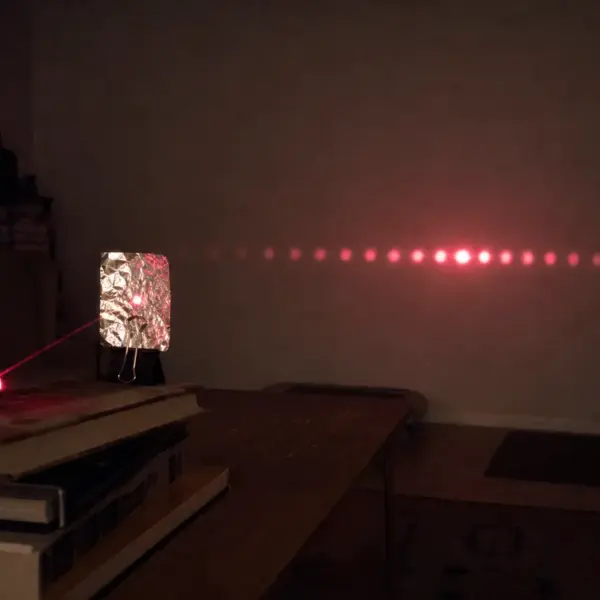
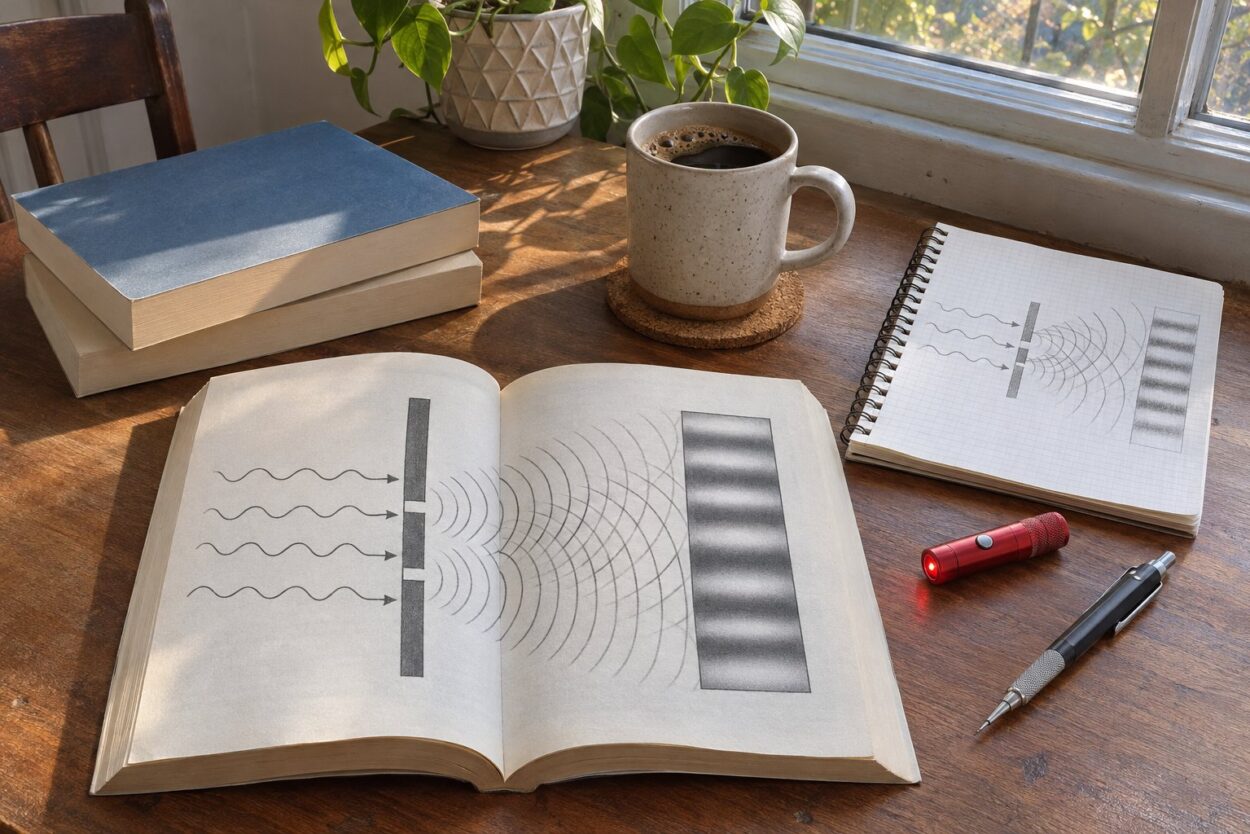
When I taught first-year labs, the double-slit session was the one students talked about afterwards. We used a laser and a commercial slide with two slits a fraction of a millimeter apart. The students expected two bright lines on the wall. They got a row of bright and dark bands, and when they covered one slit with a card, the bands vanished and a single smeared patch remained. The dark bands are places where light from the two slits cancels out, which only waves do. Feynman called this experiment the one that holds “the only mystery” of quantum mechanics, and every book in this guide comes back to it.
You can do a rough version on a kitchen counter in ten minutes. You need a laser pointer, kitchen foil, a razor blade or craft knife, tape, a piece of card with a window cut out and a dark room with a pale wall.
- Tape a smooth piece of foil over the window in the card.
- Hold two razor blades together and cut down through the foil once, so you get two parallel cuts very close together. Or cut one slit, then a second as close to it as you can manage. Closer slits give wider bands.
- Stand the card upright and prop the laser pointer on books so it shines through the slits onto a wall two or three meters away.
- Turn off the lights. You should see a row of spots separated by dark gaps. Cover one slit with a strip of tape and watch the pattern change.
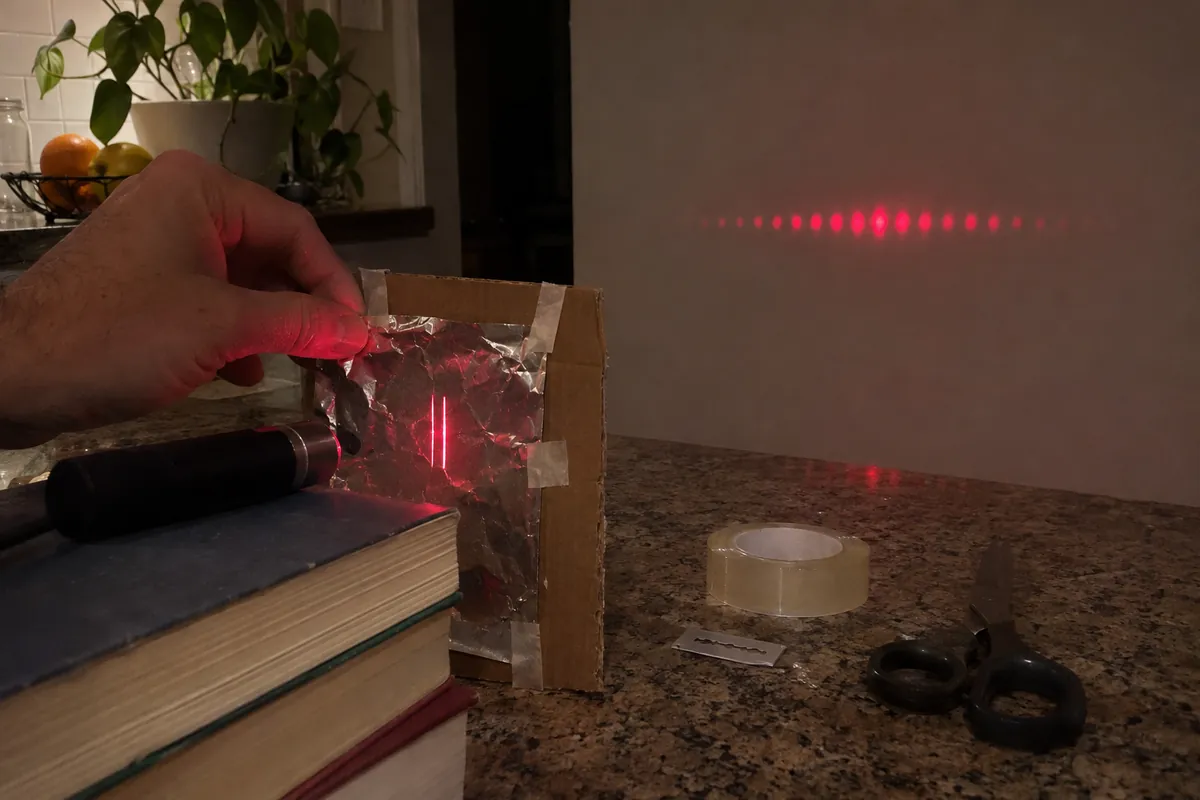
Never look into the beam or point it at anyone’s eyes, and keep it away from children. Use an ordinary low-power pointer; the FDA limits pointers sold in the US to 5 milliwatts, and online listings claiming more are a hazard. What you are seeing at home is light behaving as a wave. The quantum part, which you cannot do in a kitchen, is that the same pattern builds up when photons or electrons are sent through one at a time. The PhET simulation above shows that version, and Through Two Doors at Once tells the story of the labs that did it.
For the full build with step-by-step photos, diagrams of why the bands appear, a wavelength calculator and a home quantum eraser, see our guide to the double-slit experiment at home.
A reading order
Pick the track that matches your goal. Each step assumes you finished the one before it.
For non-scientists (no math), about three months of evening reading:
- How to Teach Quantum Physics to Your Dog, for the ideas.
- Quantum by Manjit Kumar, for the history and the people.
- Q is for Quantum or Beyond Weird, to replace the metaphors with the real logic.
- What Is Real? and Something Deeply Hidden, to see two sides of what it means.
For readers who want the math, about six to twelve months at an hour a day:
- One no-math book from the list above, so you know where you are going.
- Quantum Computing for Everyone, to learn vectors and matrices in a quantum setting.
- Quantum Mechanics: The Theoretical Minimum with Susskind’s free lectures. Do every exercise.
- A Student’s Guide to the Schrödinger Equation, once you have calculus.
- Griffiths or McIntyre, with MIT 8.04’s problem sets for practice.
Reading in this order means you never meet a new idea and new math at the same time. You know what entanglement is from the popular books before you see it as a tensor product, and you have used matrices on qubits before you use them on waves. For a wider reading list across all of science, see our science books for non-scientists, and for the subfields you can go into after this, our overview of the branches of quantum physics.
My aunt read Orzel’s book first and Kumar’s second. The pendant stayed at the wellness fair.
FAQ
For beginners with no math, the best quantum physics book is How to Teach Quantum Physics to Your Dog by Chad Orzel, which explains every major idea through real experiments without equations. For beginners who want to learn the math, the best first book is Quantum Mechanics: The Theoretical Minimum by Leonard Susskind and Art Friedman.
How to Teach Quantum Physics to Your Dog by Chad Orzel and Quantum by Manjit Kumar are the best quantum physics books for non-scientists. Orzel explains the ideas; Kumar tells the history of how Einstein, Bohr and others discovered them. Philip Ball’s Beyond Weird is the best second book because it corrects the common myths.
Yes, if you are willing to learn the math. You need algebra and linear algebra to start and calculus for the wave side of the subject. Susskind’s Theoretical Minimum with his free Stanford lectures, followed by Griffiths with MIT OpenCourseWare 8.04’s problem sets and solutions, is a complete self-study course. Expect it to take six months to a year at an hour a day.
Complex numbers, linear algebra (vectors, matrices, eigenvalues), calculus including basic differential equations, and some probability. Linear algebra matters most. Popular books like Orzel’s or Kumar’s need no math at all.
Griffiths’s Introduction to Quantum Mechanics is the standard first university textbook, but it assumes calculus, differential equations and some linear algebra. It is a good beginner’s book for someone who has finished first-year university physics and math. For anyone with less background, start with Susskind’s Theoretical Minimum.
Quantum Mechanics: The Theoretical Minimum is the best book for beginners who want real quantum mechanics. It teaches the linear algebra it uses and starts with spin, the simplest quantum system. It is hard work: plan on doing every exercise and watching the free lectures that match each chapter.
Yes. QED: The Strange Theory of Light and Matter is four public lectures with no equations, and the first two suit anyone. It covers light and electrons rather than all of quantum physics, so it pairs well with a broader book like Orzel’s.
Avoid short self-published “quantum physics for beginners” titles by authors with no physics background, books that link quantum physics to healing, manifesting or consciousness, such as The Tao of Physics and What the Bleep Do We Know!?, and Michio Kaku’s Quantum Supremacy, which quantum computing researchers criticized for its errors.
Quantum Physics for Babies by Chris Ferrie, a quantum physicist, suits children up to about three and is accurate. Teenagers who like stories enjoy George Gamow’s Mr Tompkins in Paperback, and Introducing Quantum Theory: A Graphic Guide works for readers from about thirteen.
You can understand what quantum physics says, what experiments found and why physicists argue over its meaning without math, and the books for non-scientists in this guide do that well. Terry Rudolph’s Q is for Quantum goes furthest, teaching the actual logic with a game instead of equations. To calculate anything, or to see why the rules have to be the way they are, you need linear algebra.
Sources
- Amazon product pages for each book, checked November 2026 (editions, page counts, publishers and ratings).
- Reddit threads asking for beginner quantum physics and quantum mechanics books, summarized in the What Reddit recommends section.
- Nobel Prize Outreach, The Nobel Prize in Physics 2022 (Aspect, Clauser, Zeilinger).
- Nobel Prize Outreach, The Nobel Prize in Physics 1965 (Tomonaga, Schwinger, Feynman).
- Feynman, Leighton and Sands, The Feynman Lectures on Physics, Volume III, Caltech.
- MIT OpenCourseWare, 8.04 Quantum Physics I, Spring 2013.
- Leonard Susskind, The Theoretical Minimum: Quantum Mechanics, Stanford Continuing Studies.
- Andy Matuschak and Michael Nielsen, Quantum Computing for the Very Curious.
- University of Colorado Boulder, PhET Quantum Wave Interference.
- Scott Aaronson, Book Review: “Quantum Supremacy” by Michio Kaku, Shtetl-Optimized, 2023.
- U.S. Food and Drug Administration, Laser Products and Instruments.