Quick Answer
Elementary particles fall into three families, and nothing splits smaller than they do:
- Quarks — up, down, charm, strange, top, bottom (the building blocks of protons and neutrons)
- Leptons — electron, muon, tau, and their three matching neutrinos
- Bosons — photon, gluon, W and Z bosons, and the Higgs boson
That’s it. Fifth-generation quarks don’t exist. Protons aren’t on this list — they’re built out of quarks, which makes them composite, not elementary. More on that below, because it trips up more people than any other part of this topic.
Table of Contents
- What “Elementary” Actually Means
- Quarks: The Particles That Never Travel Alone
- Leptons: The Particles That Do Travel Alone
- Bosons: The Particles That Carry Forces
- Quick Comparison Table
- Why a Proton Isn’t Elementary (And a Quark Is)
- FAQ
What “Elementary” Actually Means
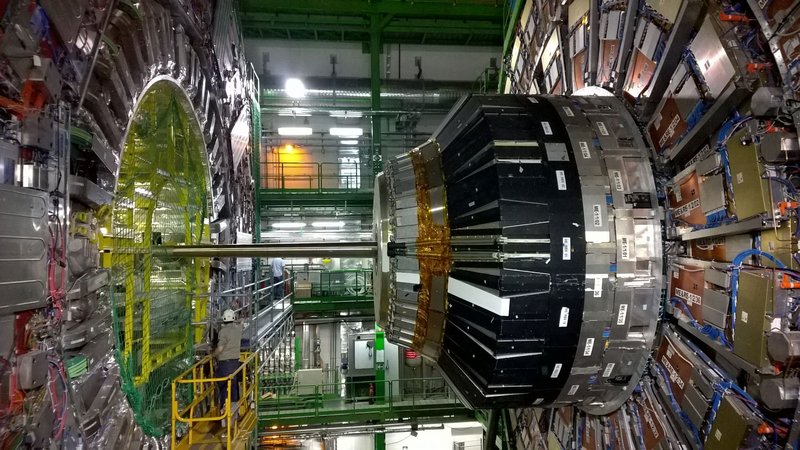
A particle earns the label “elementary” by failing to break apart, no matter how hard anyone hits it. Physicists have been trying since the 1960s, slamming particles together at close to the speed of light inside colliders like the Large Hadron Collider. Quarks, leptons, and the force-carrying bosons have never shown a crack. No substructure, no smaller pieces rattling around inside.
Compare that to a proton, which looks solid on a chemistry-class diagram but is actually a churning knot of three quarks held together by an exchange of gluons — and, at high enough energy, a sea of additional quark-antiquark pairs popping in and out of existence. Quanta Magazine’s reporting on proton structure calls it one of the most complicated objects in physics precisely because it isn’t simple at all. That complexity is the tell. Elementary particles don’t have internal weather. They just are what they are.
The Standard Model — the working theory that organizes all of this — recognizes 17 elementary particles, spanning across multiple branches of quantum physics. Six quarks, six leptons, four force-carrying bosons, and the Higgs. Every atom, every molecule, every physical object you’ve ever touched reduces to some combination of the first twelve, glued together by the last five.
Quarks: The Particles That Never Travel Alone
Quarks come in six types, physicists call them “flavors,” arranged in three pairs by increasing mass:
- Up and down — the lightest pair, and the only ones stable matter actually uses. Two ups and a down make a proton; one up and two downs make a neutron.
- Charm and strange — heavier, unstable, produced in collisions and cosmic ray showers, and gone within fractions of a second.
- Top and bottom — the heaviest pair. The top quark alone weighs about as much as a gold atom, packed into something with no measurable size, and it decays so fast it never even forms a bound particle.
Quarks carry fractional electric charge — up-type quarks sit at +2/3, down-type at −1/3 — which was strange enough when Murray Gell-Mann proposed it in 1964 that even he wasn’t sure it was physical rather than mathematical bookkeeping. They also carry a property called color charge (nothing to do with visible color) that comes in three types, and the strong force conspires to keep colored particles locked inside colorless combinations. That’s why you’ll never isolate a single quark sitting on a lab bench. They only exist bundled together.
Leptons: The Particles That Do Travel Alone
Leptons are the other matter family, and unlike quarks, they’re happy on their own. Six of them, split into three generations:
- Electron and electron neutrino — the electron is the one you actually interact with daily: current flowing through a wire, the charge holding your chemistry together, despite numerous myths and misconceptions about electrons. The neutrino is its ghostly, nearly massless partner.
- Muon and muon neutrino — the muon is basically a heavy electron, about 207 times the mass, that showers down from cosmic rays hitting the atmosphere and decays in about 2.2 microseconds.
- Tau and tau neutrino — heavier still, unstable, mostly seen in particle accelerators rather than nature.
Neutrinos deserve their own mention because they’re strange even by subatomic standards. Trillions pass through your body every second, and almost none of them interact with anything, because neutrinos only feel the weak force and gravity — not electromagnetism, not the strong force. That’s what lets them sail through a planet like it isn’t there.
Bosons: The Particles That Carry Forces
Quarks and leptons are matter. Bosons are what makes matter interact with other matter, and each one is tied to a specific force:
- Photon — carries the electromagnetic force. Every bit of light, radio, and X-ray is made of photons, and they’re massless, which is why light moves at, well, the speed of light.
- Gluon — carries the strong force, gluing quarks together inside protons and neutrons. Also massless, but unlike photons, gluons carry color charge themselves, which is part of why the strong force gets stronger with distance instead of weaker.
- W and Z bosons — carry the weak force, responsible for radioactive decay and the nuclear reactions that power the sun. Unusually heavy for elementary particles — the W boson weighs about 85 times more than a proton — which is why the weak force only acts over incredibly short distances.
- Higgs boson — discovered at CERN in 2012, decades after being predicted. It’s the excitation of a field that fills all of space, and particles that interact with that field get mass as a result. No interaction, no mass — which is exactly why photons stay massless.
Quick Comparison Table
| Particle | Symbol | Charge | Relative Mass | Force / Role |
|---|---|---|---|---|
| Up quark | u | +2/3 | Very light | Strong, weak, EM |
| Down quark | d | −1/3 | Very light | Strong, weak, EM |
| Top quark | t | +2/3 | Heaviest quark | Strong, weak, EM |
| Electron | e⁻ | −1 | Light | Weak, EM |
| Electron neutrino | νₑ | 0 | Nearly massless | Weak only |
| Muon | μ⁻ | −1 | ~207× electron | Weak, EM |
| Photon | γ | 0 | Massless | Carries EM force |
| Gluon | g | 0 | Massless | Carries strong force |
| W boson | W± | ±1 | ~85× proton | Carries weak force |
| Higgs boson | H | 0 | ~133× proton | Gives particles mass |
Why a Proton Isn’t Elementary (And a Quark Is)
This is the distinction most explainers skip, and it’s the one that actually matters for understanding the periodic table.
A proton is made of two up quarks and one down quark, bound by gluons. That’s not a technicality — it’s the whole reason a proton has structure that scientists can probe, deform, and (in principle) break apart under enough energy, the way Big Think’s coverage of proton physics describes gluons dominating the proton’s internal dynamics even more than the quarks do. Neutrons are the same story: two down quarks and one up. Both are baryons, a category of composite particle built from three quarks.
A quark, by contrast, has never shown any internal structure under any collision energy achieved so far. Same for the electron. You can smash an electron into another particle at the highest energies the LHC can manage, and it comes out an electron — not a spray of smaller pieces. That’s the operational test physicists actually use: does it break, or doesn’t it. Protons break. Quarks don’t.
The confusion usually comes from chemistry class, where protons, neutrons, and electrons get taught together as “the three particles that make up atoms.” That’s true and useful for chemistry, but it’s a different question from which particles are fundamental. Electrons belong on the elementary list. Protons and neutrons don’t — they’re one level down, made of things that are.
FAQ
Is a proton an elementary particle? No. A proton is a composite particle made of two up quarks and one down quark, held together by the strong force. Only the quarks themselves are elementary.
Is the Higgs boson an elementary particle? Yes. Despite being discovered decades after the other Standard Model particles, the Higgs boson has no known substructure and is classified as elementary — it’s the particle associated with the field that gives other particles mass.
What’s the difference between elementary and composite particles? Elementary particles have no smaller parts — quarks, leptons, and bosons are the current list. Composite particles are built from two or more elementary particles bound together, like protons, neutrons, and atomic nuclei.
Are neutrons elementary particles? No, for the same reason as protons. A neutron is made of one up quark and two down quarks.
How many elementary particles are there in total? Seventeen, according to the Standard Model: six quarks, six leptons, four force-carrying bosons (photon, gluon, W, Z), and the Higgs boson.
Sources: