Nearly every organic reaction you’ll meet in a first course is a variation on four moves: atoms get added, removed, swapped, or reshuffled. Learn to see which move is happening and a page of reagents stops looking like noise.
Here are the four core classes side by side.
| Type | What changes | Reactants → products | Quick example |
|---|---|---|---|
| Addition | A pi bond breaks; two new groups attach | 2 → 1 | CH₂=CH₂ + HBr → CH₃CH₂Br |
| Elimination | Two groups leave; a pi bond forms | 1 → 2 (or more) | CH₃CH₂Br → CH₂=CH₂ + HBr |
| Substitution | One group replaces another | 2 → 2 | CH₃Br + OH⁻ → CH₃OH + Br⁻ |
| Rearrangement | Atoms reorganize within one molecule | 1 → 1 | butane → isobutane |
Table of Contents
- How to read the table
- Addition reactions
- Elimination reactions
- Substitution reactions
- Rearrangement reactions
- Other categories: condensation, redox, pericyclic, polymerization
- When reactions combine types
- How to identify the type of organic reaction
- Practice problems with answers
- FAQ
How to read the table
The reactant and product counts are the fastest clue. Addition is two things becoming one. Elimination is one thing becoming two. Substitution is a swap, so the count stays the same. Rearrangement keeps a single molecule but changes its connectivity.
The classification describes what happens to the carbon skeleton and its attached groups. It says nothing yet about how it happens. That’s the job of the mechanism, and each class has more than one. OpenStax’s organic chemistry text uses this same four-way scheme as its starting point, and it holds up well because most other categories are either special cases or combinations of these four.
Addition reactions
In an addition reaction, two molecules join to make one, and a pi bond (usually C=C or C=O) is used up. Each carbon of the old double bond picks up a new group. The product is more saturated than the starting material.
How to spot it: a double or triple bond on the left, only single bonds on the right, and nothing left over.
Ethene plus bromine is the classic case: CH₂=CH₂ + Br₂ → BrCH₂CH₂Br. Add hydrogen over a palladium catalyst and you get hydrogenation, which is how liquid vegetable oils become spreadable fats.
Electrophilic addition
Alkenes are electron-rich, so they attack electron-poor reagents. The pi bond reaches out to an electrophile such as H⁺ from HBr, forming a carbocation, and the bromide then closes in on that carbocation.
With an unsymmetrical alkene like propene, the hydrogen lands on the carbon that already has more hydrogens. That puts the positive charge on the more substituted carbon, which is more stable. This is Markovnikov’s rule, and you can derive it from carbocation stability instead of memorizing it. Propene + HBr gives mostly 2-bromopropane, not 1-bromopropane.
Nucleophilic addition
Carbonyl groups work the other way. The carbon in C=O is partly positive because oxygen pulls electrons toward itself, so a nucleophile attacks the carbon. Adding a Grignard reagent (R–MgBr) to an aldehyde, then protonating, gives an alcohol. Adding cyanide gives a cyanohydrin.
Rule of thumb: C=C reacts with electrophiles, C=O reacts with nucleophiles.
Elimination reactions
Elimination is addition run in reverse. Two atoms or groups leave neighboring carbons, and a double bond forms between them. The classic version removes H and a leaving group (a halide, or water from an alcohol), so a haloalkane or alcohol becomes an alkene.
How to spot it: single bonds on the left, a new C=C on the right, and a small molecule such as H₂O or HBr released.
Heat 2-bromopropane with ethanolic KOH and you get propene, KBr, and water. The solvent matters: the same haloalkane in aqueous hydroxide tends toward substitution instead. Heat also favors elimination, because it produces more molecules and so more entropy.
E2
E2 happens in one step. A strong base pulls off a hydrogen while the leaving group departs from the adjacent carbon, all at once. The rate depends on both the substrate and the base. The H and the leaving group need to sit on opposite faces of the molecule (anti-periplanar), which is why ring conformations control which alkene you get from substituted cyclohexanes.
E1
E1 takes two steps. The leaving group departs first, leaving a carbocation, then a weak base removes a neighboring proton. The rate depends only on the substrate. It needs a substrate that forms a stable carbocation (tertiary, usually) and it competes with SN1 from the same intermediate.
E1cB
A third variant starts with deprotonation. A base removes an acidic hydrogen to form a carbanion, then the leaving group departs. It shows up when the hydrogen is acidic and the leaving group is poor, as in the dehydration step after an aldol reaction, where the carbanion sits next to a carbonyl.
Substitution reactions
In substitution, one atom or group is swapped for another, and the number of pi bonds stays the same. The count of reactants and products stays the same too.
How to spot it: a group disappears from one position and a different one appears in the same position.
Nucleophilic substitution: SN2 vs SN1
Here a nucleophile replaces a leaving group on an sp³ carbon. The two mechanisms give different outcomes, so it pays to tell them apart.
| SN2 | SN1 | |
|---|---|---|
| Steps | One | Two (carbocation intermediate) |
| Rate depends on | Substrate and nucleophile | Substrate only |
| Best substrate | Methyl, primary | Tertiary |
| Nucleophile | Strong | Weak is fine |
| Stereochemistry | Inversion | Mostly racemization |
| Solvent | Polar aprotic | Polar protic |
SN2 is a backside attack: the nucleophile arrives opposite the leaving group, and the carbon flips like an umbrella in the wind. That’s why a chiral carbon inverts. SN1 goes through a flat carbocation that can be attacked from either face, so a single enantiomer tends to produce a mixture.
Steric hindrance decides most cases. A tertiary carbon is too crowded for backside attack, so it goes SN1. A methyl carbon can’t form a stable carbocation, so it goes SN2.
Electrophilic substitution
This is the characteristic reaction of benzene. The aromatic ring is too stable to give up a double bond in an addition (that would destroy aromaticity), so an electrophile replaces a hydrogen instead. Benzene with Br₂ and FeBr₃ gives bromobenzene and HBr. Nitration and Friedel–Crafts alkylation follow the same pattern.
Radical substitution
Methane and chlorine under UV light give chloromethane and HCl through a radical chain. It’s a substitution by outcome, though the mechanism looks nothing like SN2.
Rearrangement reactions
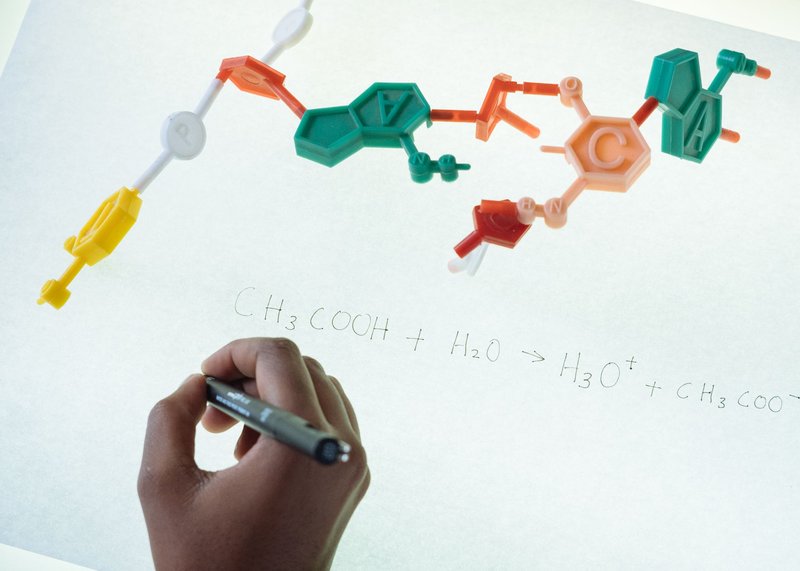
A rearrangement reorganizes the atoms of a single molecule into an isomer. Nothing is added or lost. A group moves from one atom to a neighbor, or a ring opens or closes.
How to spot it: reactant and product have the same molecular formula but different structures.
The most common version in introductory courses is the carbocation shift. A secondary carbocation can pull a hydrogen (or methyl group) with its bonding electrons from the neighboring carbon, turning into a tertiary one. This is why some alkene additions give products that look “wrong” at first: the intermediate rearranged before the nucleophile arrived.
Other named examples include the pinacol rearrangement and the Beckmann rearrangement, which converts an oxime into an amide and is the key step in making caprolactam for nylon-6.
Other categories: condensation, redox, pericyclic, polymerization
These categories overlap with the big four rather than replacing them. They’re classified by what the reaction accomplishes or by its mechanism type.
Condensation. Two molecules join and release a small molecule, usually water. Esterification (acid + alcohol → ester + water) and the aldol reaction are condensations. In mechanistic terms, they are usually additions followed by eliminations.
Oxidation and reduction. In organic chemistry, oxidation typically means gaining bonds to oxygen or losing hydrogen. Ethanol becoming acetaldehyde is an oxidation. Hydrogenating an alkene is a reduction reaction. Redox describes electron bookkeeping, so a single reaction can be both a redox process and, say, an addition.
Pericyclic reactions. Electrons move around a cyclic transition state in one concerted step, with no intermediates. The Diels–Alder reaction between a diene and an alkene forms a six-membered ring and earned Otto Diels and Kurt Alder the 1950 Nobel Prize in Chemistry. Cope and Claisen rearrangements also belong here.
Polymerization. Many small monomers link into a long chain. Addition polymerization (ethylene → polyethylene) repeatedly applies the addition reaction. Condensation polymerization (a diamine and a diacid → nylon, plus water) repeats a condensation.
When reactions combine types
Real reactions often chain two basic types, and this is where the labels start to pay off.
Take an ester reacting with ammonia to give an amide. The nucleophile (NH₃) adds to the carbonyl carbon first, which is nucleophilic addition. The tetrahedral intermediate then collapses and expels the alkoxide, which is elimination. The overall result is one group replaced by another, so the net reaction is a substitution at an acyl carbon, called nucleophilic acyl substitution. LibreTexts notes this briefly, but the point is general: a net substitution can hide an addition step and an elimination step.
Aspirin is a clean real-world case. Salicylic acid’s hydroxyl group attacks acetic anhydride, and acetate leaves. That’s addition-elimination again, giving an ester. Many amide bonds in drug molecules are made by the same pathway.
So classify twice if needed: by net result (substitution) and by mechanism (addition, then elimination).
How to identify the type of organic reaction
Work through these questions in order.
- Compare reactant and product formulas. Same formula, different structure? Rearrangement. Stop here.
- Look at the pi bonds. Did the product gain a double bond (C=C or C=O formation from single bonds)? Probably elimination. Did the reactant lose a double bond and the product gain two new single bonds? Addition.
- No change in pi-bond count? If a group was swapped for another, it’s substitution.
- Count the pieces. Two reactants combining into one product points to addition. One reactant splitting off a small molecule points to elimination. Two in, two out points to substitution.
- Look at the conditions for the subtype. Strong base and heat: E2. Strong nucleophile on a primary carbon: SN2. Tertiary substrate in a polar protic solvent: SN1 or E1. Benzene ring: electrophilic substitution. Carbonyl: nucleophilic addition.
- Check for a combination. If a carbonyl carbon ends up with a different substituent, expect addition followed by elimination.
Practice problems with answers
1. CH₃CH₂OH + HBr → CH₃CH₂Br + H₂O
Substitution. OH is replaced by Br, and two molecules go in, two come out. A primary alcohol with a strong nucleophile points to SN2 (after the OH is protonated to make a better leaving group).
2. Cyclohexene + Br₂ → 1,2-dibromocyclohexane
Addition. The pi bond is consumed and two bromines attach, one to each carbon. This is electrophilic addition.
3. (CH₃)₃C–Br + KOH (ethanol, heat) → (CH₃)₂C=CH₂ + KBr + H₂O
Elimination. A strong base and heat on a tertiary halide give an alkene. E2 is the likely mechanism.
4. Ethyl acetate + NH₃ → acetamide + ethanol
Net substitution, via nucleophilic addition followed by elimination (nucleophilic acyl substitution).
5. Cyclopentadiene + maleic anhydride → bicyclic adduct
Pericyclic cycloaddition (Diels–Alder). Two reactants form one product with no leaving group, so it also looks like an addition on paper. The concerted cyclic mechanism is what puts it in its own class.
FAQ
What are the four main types of organic reactions? Addition, elimination, substitution, and rearrangement. Other categories such as condensation, redox, pericyclic, and polymerization overlap with them.
What’s the difference between SN1 and SN2? SN2 is one concerted step with inversion of configuration and works best on methyl and primary carbons. SN1 goes through a carbocation in two steps, favors tertiary carbons, and gives mostly racemized products.
How do I tell elimination from substitution? Check whether a new double bond forms. If it does, it’s elimination. If a group is simply swapped, it’s substitution. Strong, bulky bases and heat favor elimination.
Is condensation a separate type? It’s a useful label, but mechanistically most condensations are an addition followed by an elimination of a small molecule like water.
Why does benzene undergo substitution and not addition? Addition would break the ring’s aromatic stabilization. Substitution keeps the ring intact.