As an Amazon Associate we earn from qualifying purchases. Disclosure
Last winter a former student from my first-year lab section emailed me. He is a software developer now, close to forty, and he wanted to learn physics properly, on his own, in the evenings. He had already bought the most famous physics books there are and stalled in the first volume. His question was simple: which book should he have started with, and what should come after it?
The best physics book for self-study is a calculus-based introductory textbook with worked examples and hundreds of problems, and the one I recommend first is Fundamentals of Physics by Halliday, Resnick and Walker. If you want a full course with lectures attached, read R. Shankar’s Fundamentals of Physics I alongside his free Yale lectures. If you need the math first, start with Calculus Made Easy. If you want to read before you calculate, start with Six Easy Pieces or Thinking Physics. And if you want the shortest road to the ideas of modern theoretical physics, read Leonard Susskind’s The Theoretical Minimum.
I have a PhD in particle physics from Imperial College London. I taught first-year undergraduate labs for three years and spent five years at CERN calibrating particle detectors. The 21 books below are the reply I sent him, expanded: what to read first, which textbook to work through, how to go from introductory physics to the upper-level courses of a physics degree, and which free courses and textbooks to use with the books. Each one is in print on Amazon, with the edition to buy.
Quick picks
| Pick | Best for | Level |
|---|---|---|
| Fundamentals of Physics (Halliday) | Best overall for self-study | Intro, calculus |
| Fundamentals of Physics I (Shankar) | Best book with free lectures | Intro, calculus |
| University Physics (Young and Freedman) | Most complete intro textbook | Intro, calculus |
| Six Easy Pieces | Best first read | No math |
| Thinking Physics | Best for intuition | No math |
| Calculus Made Easy | The math you need first | Math |
| The Theoretical Minimum | Best for adults who want theory | Intermediate |
| An Introduction to Mechanics (Kleppner) | Best second mechanics book | Honors intro |
| Electricity and Magnetism (Purcell) | Best E&M after the intro | Honors intro |
| Introduction to Quantum Mechanics (Griffiths) | Best first real quantum book | Upper level |
What self-study physics takes
The first thing I told my former student had nothing to do with books. Physics is learned by solving problems, not by reading about them. A university course works because it forces you to hand in problem sets every week. On your own, the book has to do that job, so the most important feature of a self-study physics book is not its prose. It is the quality of its worked examples, the number of its end-of-chapter problems and whether you can check your answers.
Three things decide which books on this list are right for you.
- Your math. Real physics is written in calculus. If you are comfortable with algebra and trigonometry but have never taken calculus, learn the basics of derivatives and integrals before or alongside your first textbook. If you have no algebra, start with the no-math books and an algebra course, and come back.
- Your goal. To understand the ideas, a popular book and The Theoretical Minimum may be enough. To be able to solve problems the way a physics graduate can, you need the textbook path: an introductory textbook, then the upper-level books.
- Your time. A first-year university physics course is about two semesters. Working five to eight hours a week, most adults take nine to twelve months to get through one intro textbook properly, problems included.
Most people who teach themselves physics follow the same order a physics degree does: introductory mechanics and electromagnetism with calculus, then a harder second pass at the same subjects, then the upper-level core of classical mechanics, electrodynamics, quantum mechanics and thermal physics. The sections below follow that order.
Best physics books to read before a textbook
These assume no calculus. They are the right start if it has been years since your last math class, or if you want to know what physics is about before you commit to a thousand-page textbook.
Best first read
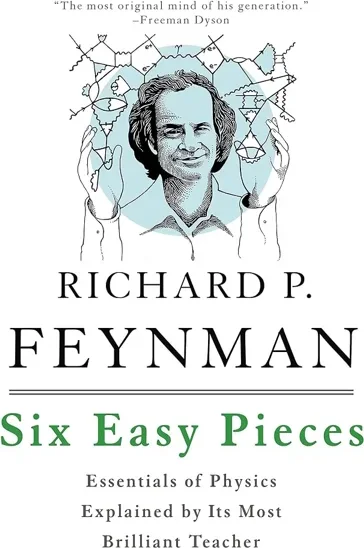
1. Six Easy Pieces
Richard Feynman taught the introductory physics course at Caltech from 1961 to 1963, and the lectures became The Feynman Lectures on Physics. Six Easy Pieces collects six of the chapters that need no math: atoms in motion, basic physics, the relation of physics to other sciences, conservation of energy, the theory of gravitation and quantum behavior.
It is the best short answer to “what is physics about?” and the gentlest way to meet Feynman before you decide whether to tackle the full lectures. Read it in a week, then pick a textbook.
- Richard P. Feynman, Robert B. Leighton and Matthew Sands
- Basic Books, 4th edition 2011, 176 pages
- Atoms, energy, gravitation and quantum behavior, without equations to solve
Good: short, and the clearest explanation of why atoms explain almost everything. Not great: there are no problems, so it teaches you about physics rather than how to do it.
Check on Amazon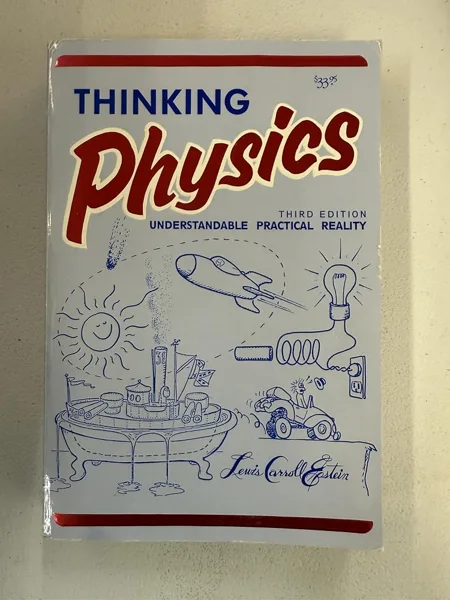
Best for intuition
2. Thinking Physics
Lewis Carroll Epstein’s book is a collection of several hundred puzzles, each with a hand-drawn illustration and a multiple-choice question on one page and the answer on the next. Does a ball thrown upward take longer to rise or to fall? Which way does a helium balloon move in a car that brakes? You guess, then turn the page.
Most people get a third of them wrong, and that is the point. Each wrong answer corrects an intuition that would otherwise trip you up in a textbook. It works for a curious teenager and for an engineer who wants to check how well they really understand mechanics.
- Lewis Carroll Epstein
- Insight Press, 3rd edition 2002, 582 pages
- Mechanics, fluids, heat, vibrations, light, electricity, magnetism and relativity as puzzles
Good: the best book here for building intuition before the math. Not great: no calculus, so it complements a textbook rather than replacing one.
Check on Amazon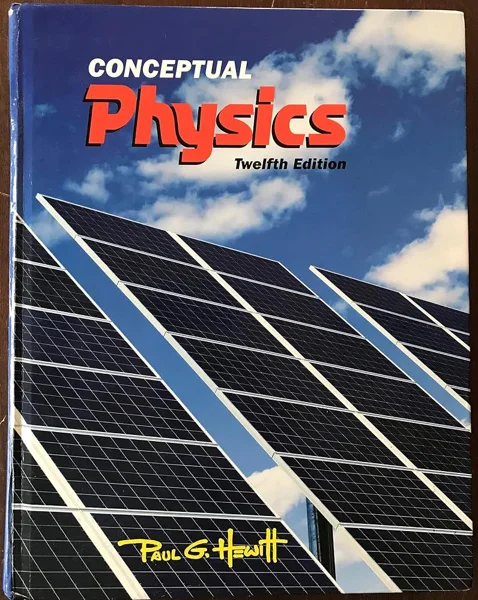
Best algebra-free textbook
3. Conceptual Physics
Paul Hewitt developed Conceptual Physics at City College of San Francisco for students who were not going to be scientists, and it has been the standard concept-first college textbook for decades. It covers the whole of introductory physics, from mechanics to nuclear physics, explained with sketches and everyday examples, and uses only simple algebra.
Choose it if you want a structured first course with review questions but are not ready for calculus. After it, a calculus-based textbook will feel like learning to calculate things you already understand.
- Paul G. Hewitt
- Pearson, 12th edition hardcover
- Full intro physics course with conceptual questions and light algebra
Good: the clearest explanations of any textbook here. Not great: expensive new; a used copy of the 11th or 12th edition teaches the same physics.
Check on Amazon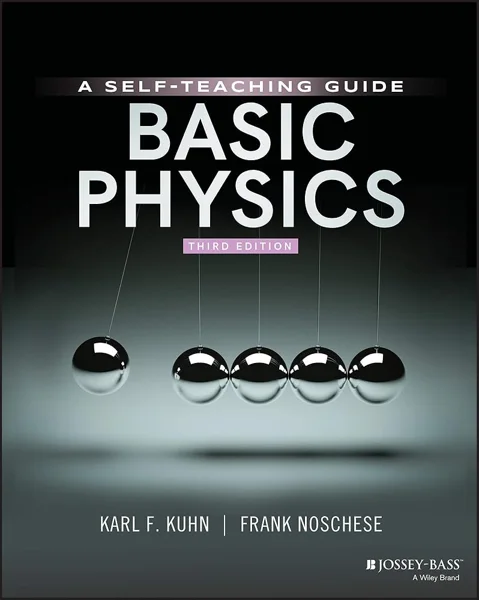
Built for self-study
4. Basic Physics: A Self-Teaching Guide
This is the one book here written from the start to be used without a teacher. It moves in short numbered steps: a few paragraphs of explanation, a question, and the answer just below it, with a self-test at the end of each chapter. Frank Noschese, a high school physics teacher, updated the 3rd edition.
It covers mechanics, heat, waves, electricity, magnetism and light with algebra and trigonometry only. It is a good choice for an adult returning to math, or for a high school student who wants to get ahead before a physics class.
- Karl F. Kuhn and Frank Noschese
- Jossey-Bass (Wiley), 3rd edition 2020, 352 pages
- Algebra-based intro physics in self-test steps
Good: you always know whether you got it right. Not great: it stays at high school level and stops before modern physics.
Check on AmazonThe math books you need
The single most common reason self-learners stall in physics is math, not physics. If a derivative or an integral makes you hesitate, fix that first. You need single-variable calculus for the intro textbooks and, later, vector calculus, linear algebra and differential equations for the upper-level books.
The math you need first
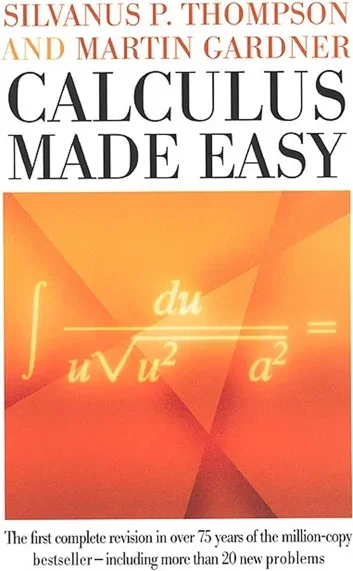
5. Calculus Made Easy
Silvanus Thompson was a physicist and engineer, and he wrote this in 1910 for people who had been scared off calculus by its notation. He explains derivatives as “a little bit of” something and builds from there, with exercises and answers. Martin Gardner revised and annotated the 1998 edition, adding a modern preface and notes.
It will get you comfortable with the derivatives and integrals the intro textbooks use in a few weeks. Pair it with a free online calculus course if you want more practice problems.
- Silvanus P. Thompson and Martin Gardner
- St. Martin’s Press, revised edition 1998, 336 pages
- Differentiation, integration and their uses, from zero
Good: the friendliest calculus book ever written, and short. Not great: it covers single-variable calculus only, so you will need more math later.
Check on Amazon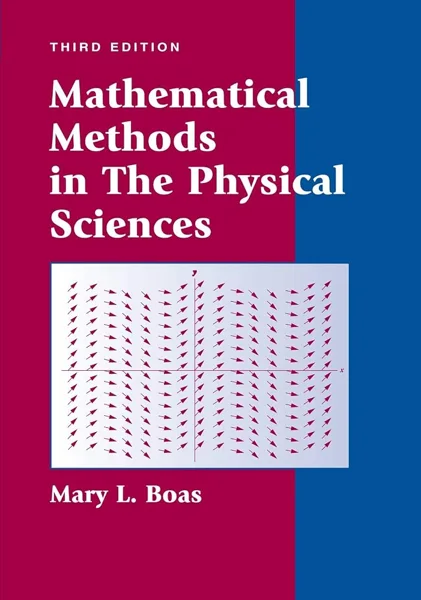
The math for the upper-level books
6. Mathematical Methods in the Physical Sciences
Mary Boas wrote this so that physics students could learn the math they need after first-year calculus without taking a separate math course for each topic: series, complex numbers, linear algebra, partial derivatives, vector calculus, Fourier series, ordinary and partial differential equations, special functions and probability. It is what most physics students use in their second year.
Read the chapter you need when a physics book asks for it. Before Griffiths’s electrodynamics, for example, work through the vector analysis chapter.
- Mary L. Boas
- Wiley, 3rd edition 2005, 864 pages
- All the math between calculus and upper-level physics
Good: clear, with many exercises and answers to some. Not great: expensive new; the 2nd edition is very close and much cheaper used.
Check on Amazon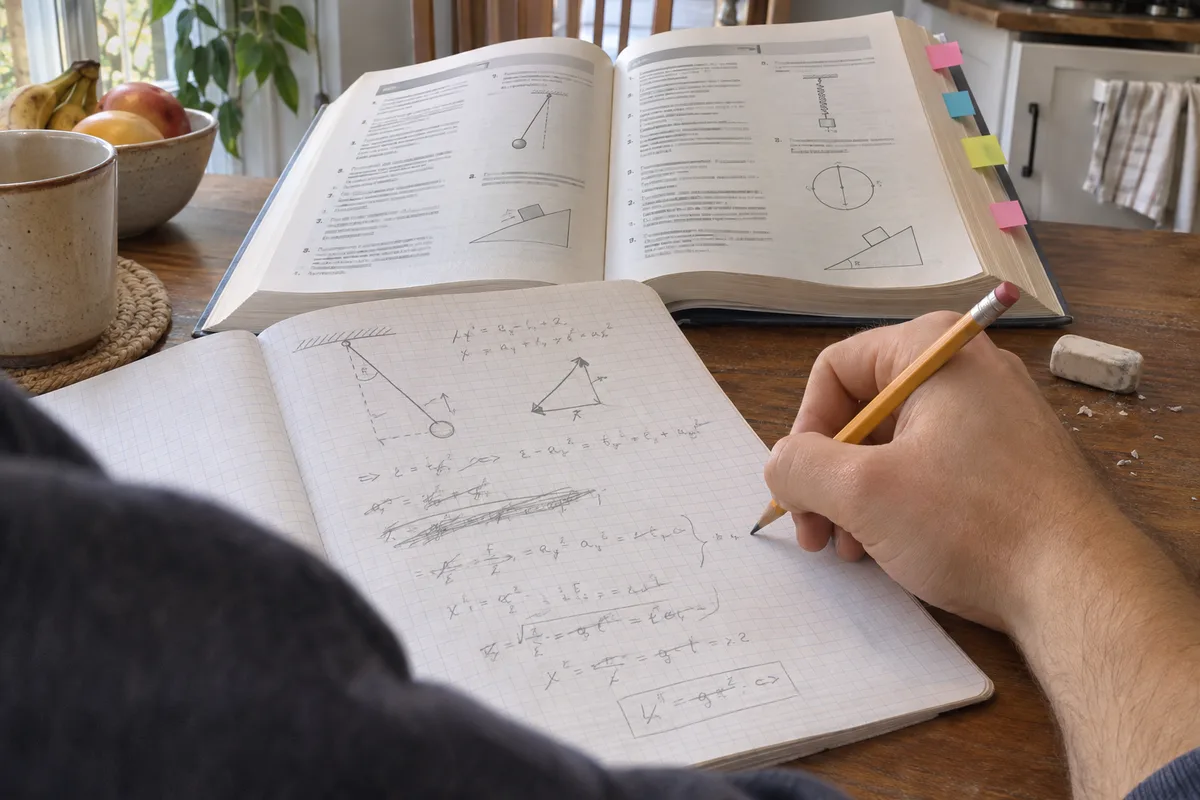
Best intro physics textbooks for self-study
This is the core of self-study physics. Pick one of these four and finish it, problems included. All of them cover the first year of a physics degree: mechanics, waves, heat, electricity and magnetism, optics and an introduction to relativity and quantum physics.
Best overall for self-study
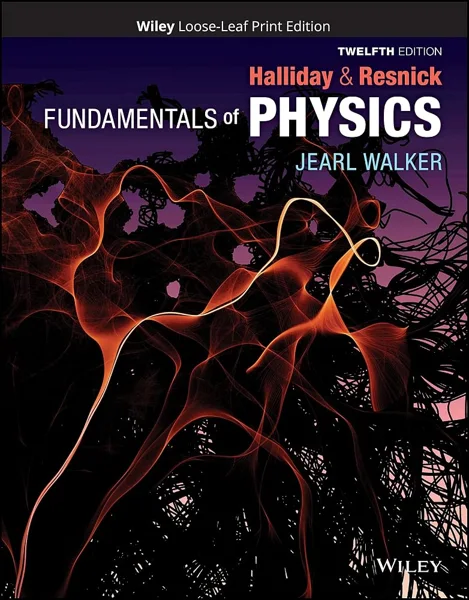
7. Fundamentals of Physics (Halliday, Resnick and Walker)
Halliday and Resnick has been the standard calculus-based introductory textbook in the United States for more than half a century, and Jearl Walker has written the recent editions. Every chapter opens with the key ideas, works sample problems step by step and ends with a large set of problems graded by difficulty, with answers to the odd-numbered ones at the back of the book.
That last detail is what makes it the best choice for self-study: you can check yourself on half of the problems in every chapter. Its explanations are short and direct, which suits a reader who wants to get to the problems. Volume 1, sold separately, covers mechanics, waves and thermodynamics and is enough for the first six months.
- David Halliday, Robert Resnick and Jearl Walker
- Wiley, 12th edition 2021, 1,312 pages (Volume 1: 720 pages)
- Mechanics to modern physics, with answers to odd-numbered problems
Good: the best problem sets of any intro textbook, with answers to half. Not great: the 12th edition costs a lot; the 10th or 11th edition is nearly the same physics. International editions cost less but often number the problems differently.
Check on Amazon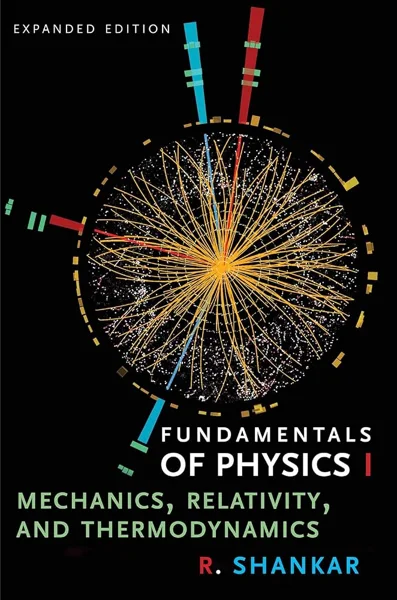
Best book with free lectures
8. Fundamentals of Physics I (Shankar)
Ramamurti Shankar’s Yale course, Physics 200, was filmed in 2006 and put online free through Open Yale Courses. This book is the course written out, chapter by chapter in the same order as the lectures. Watching a lecture and then reading the chapter is the closest thing to sitting in a university class, and Shankar is one of the best teachers of the subject alive.
Volume I covers Newtonian mechanics, special relativity and thermodynamics. Fundamentals of Physics II continues with electromagnetism, optics and quantum mechanics, matching the Physics 201 lectures.
- R. Shankar
- Yale University Press, expanded edition 2019, 528 pages
- Mechanics, relativity and thermodynamics, with problems
Good: a complete free course to go with the book. Not great: fewer problems than Halliday, and no answer key, so pair it with a textbook’s problem sets.
Check on Amazon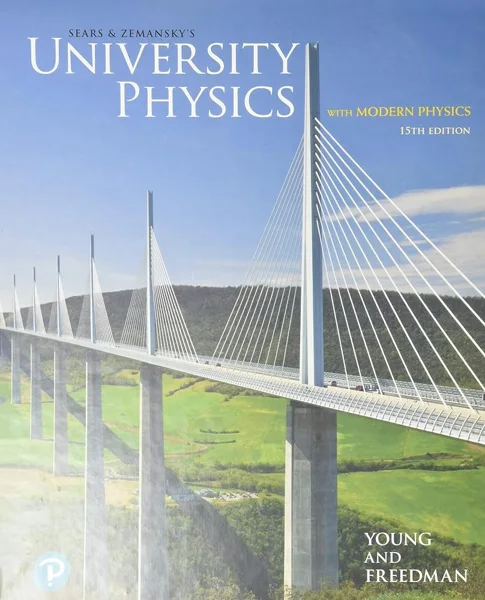
Most complete intro textbook
9. University Physics with Modern Physics (Young and Freedman)
University Physics, first written by Sears and Zemansky in the 1940s and now by Hugh Young and Roger Freedman, is Halliday’s main rival and the other textbook most universities assign. It explains more than Halliday does, and every worked example follows the same four steps: identify, set up, execute, evaluate. For a self-learner, that fixed method is a habit worth copying.
It also covers more modern physics at the end. Choose it over Halliday if you prefer longer explanations; choose Halliday if you prefer more problems with answers.
- Hugh D. Young and Roger A. Freedman
- Pearson, 15th edition 2019, 1,608 pages
- Mechanics to particle physics and cosmology
Good: the most thorough explanations of the intro textbooks. Not great: the most expensive book on this list new; any edition from the 12th on works for self-study.
Check on Amazon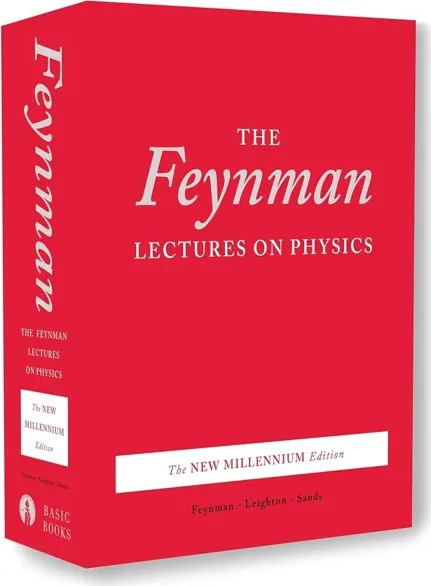
Best second reading of the intro course
10. The Feynman Lectures on Physics
The three volumes of Feynman’s Caltech course are the most famous physics books ever written, and they belong in every self-learner’s plan. They do not belong first. Feynman wrote them for some of the strongest first-year students in the country, the original course had separate problem sessions, and the books themselves contain no exercises. Many people who start here stall, as my former student did.
Read them alongside or after a standard textbook. Once you can solve the problems, Feynman shows you why the physics works the way it does, and you will see connections no textbook makes. For problems, add Exercises for the Feynman Lectures or Feynman’s Tips on Physics, which includes Feynman’s own problem-solving lectures. All three volumes are free to read online from Caltech.
- Richard P. Feynman, Robert B. Leighton and Matthew Sands
- Basic Books, New Millennium Edition 2011, three hardcover volumes, 1,552 pages
- Volume I mechanics, radiation and heat; II electromagnetism and matter; III quantum mechanics
Good: the deepest physical insight of any book here. Not great: no problems and not a first textbook. The free online edition makes the print set a choice, not a necessity.
Check on Amazon
The Theoretical Minimum route
Leonard Susskind, a theoretical physicist at Stanford, taught a series of evening courses for adults in the community who wanted to learn real physics, with equations, without enrolling in a degree. The recordings are free online and the books are the courses written up. They teach the theoretical framework of classical mechanics, quantum mechanics, special and general relativity with the minimum math needed to follow it. They suit engineers, programmers and others who remember some calculus and want the ideas more than the problem-solving drill.
Best for adults who want theory
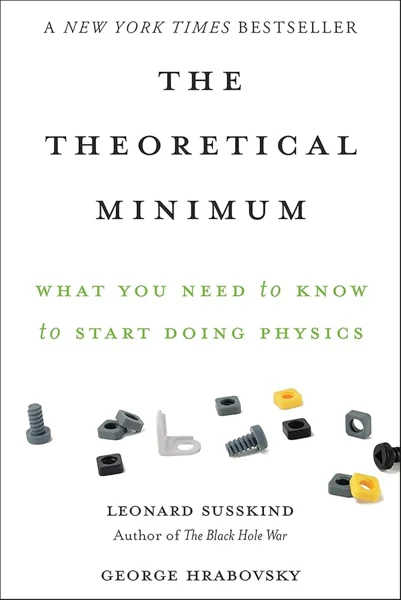
11. The Theoretical Minimum
The first book covers classical mechanics the way physicists use it: not forces and free-body diagrams, but energy, the principle of least action, Lagrangians, Hamiltonians and the symmetries behind conservation laws. Short math interludes teach the calculus as it comes up. Most intro textbooks never get to these ideas, and they are the language every later book is written in.
It is short and dense. Work the exercises with a pencil, and watch the matching Stanford lecture if a chapter does not click.
- Leonard Susskind and George Hrabovsky
- Basic Books, 2014 paperback, 256 pages
- Classical mechanics from the principle of least action, with math refreshers
Good: the fastest route to how physicists actually think about mechanics. Not great: few exercises and no solutions; some readers find the math interludes too quick.
Check on Amazon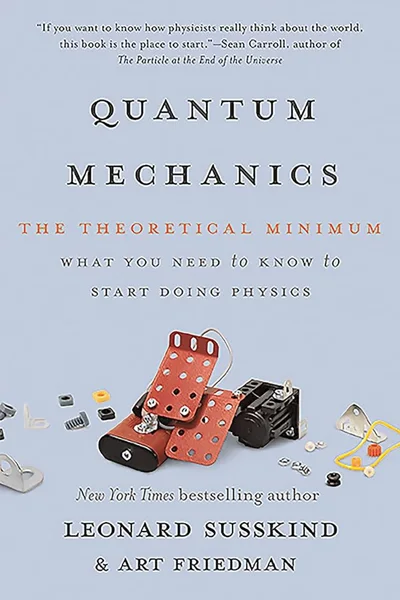
Best self-study quantum book
12. Quantum Mechanics: The Theoretical Minimum
The second book is the most popular of the series and the best introduction to how quantum mechanics really works for someone outside a university. It starts with spin, the simplest quantum system, and builds the formalism from there: states as vectors, measurements as operators, uncertainty, entanglement and time evolution. Popular quantum books describe the strangeness; this one gives you the math to see where it comes from.
The series continues with Special Relativity and Classical Field Theory and General Relativity, both in the same style.
- Leonard Susskind and Art Friedman
- Basic Books, 2015 paperback, 384 pages
- Spin, vectors and operators, entanglement, the harmonic oscillator
Good: real quantum mechanics with only linear algebra, which it teaches. Not great: it skips the wave-function problems that a course in quantum mechanics spends weeks on; Griffiths covers those.
Check on Amazon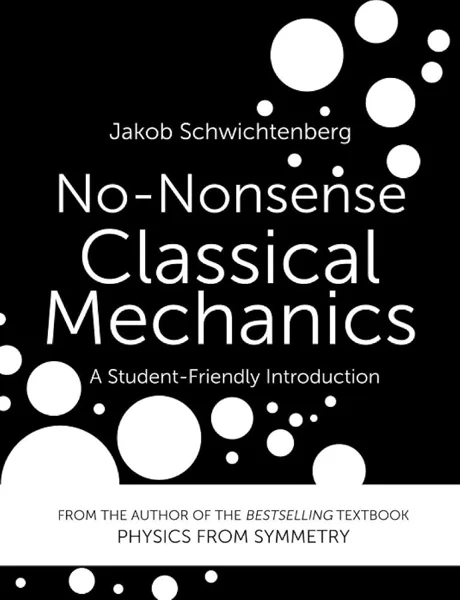
Gentlest step to advanced mechanics
13. No-Nonsense Classical Mechanics
Jakob Schwichtenberg wrote the No-Nonsense series for students who found the standard textbooks hard to learn from on their own. This volume covers the same Lagrangian and Hamiltonian mechanics as The Theoretical Minimum, more slowly, with every step of every derivation written out and a math appendix for anything you have forgotten.
It is a good bridge between an intro textbook and Taylor’s Classical Mechanics. The series also includes quantum mechanics, electrodynamics and quantum field theory volumes.
- Jakob Schwichtenberg
- Independently published, 2019, 393 pages
- Newtonian, Lagrangian and Hamiltonian mechanics, step by step
Good: no skipped steps. Not great: few problems, so it explains more than it trains.
Check on AmazonHarder intro books for a second pass
These cover introductory mechanics and electromagnetism again, at the level of the honors first-year courses at MIT and Harvard. Read them after a standard textbook, when the problems at the end of Halliday’s chapters start to feel routine. They are where you learn to solve problems you have not seen before.
Best second mechanics book
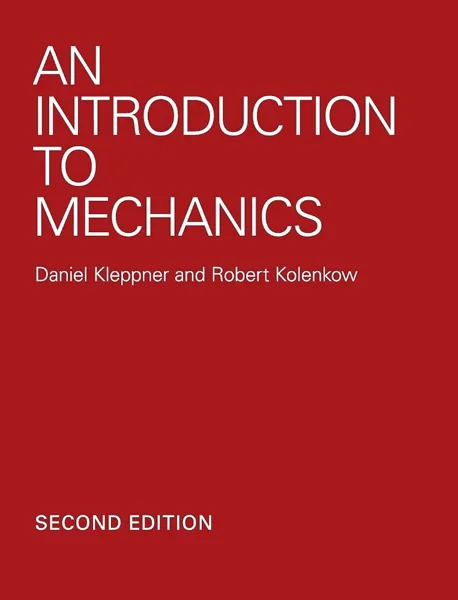
14. An Introduction to Mechanics (Kleppner and Kolenkow)
Kleppner and Kolenkow is the textbook of MIT’s honors mechanics course, and its problems are famous for being hard. Each one needs a model you have to build yourself, not a formula you can look up. Working through even half of them will teach you more mechanics than a second standard textbook.
The 2nd edition added hints and answers to some problems, which matters for self-study. Use it with calculus already behind you.
- Daniel Kleppner and Robert Kolenkow
- Cambridge University Press, 2nd edition 2013, 566 pages
- Newtonian mechanics, rotation, oscillations, special relativity
Good: the best problems in introductory mechanics. Not great: too hard as a first book; many self-learners give up here when they start with it.
Check on Amazon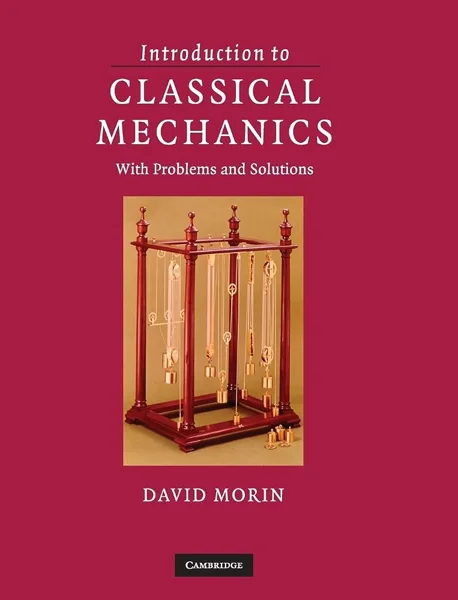
Best problems with full solutions
15. Introduction to Classical Mechanics: With Problems and Solutions
David Morin teaches at Harvard, and this book grew out of the problems he wrote for the university’s honors first-year mechanics course. Its most useful feature for a self-learner is in the title: it has hundreds of problems, and full solutions to most of them in the book. When you are stuck alone at 11 p.m., a worked solution is worth more than a teacher’s office hours next week.
It goes further than Kleppner, into Lagrangians and relativity. For an easier set of problems with solutions, Morin’s Problems and Solutions in Introductory Mechanics sits between Halliday and this book.
- David Morin
- Cambridge University Press, 2008, 734 pages
- Mechanics, Lagrangian methods, relativity, with solutions
Good: full solutions, written with care, and some of the best problems in physics. Not great: hard, and big; treat it as a problem book you return to, not a book to read cover to cover.
Check on Amazon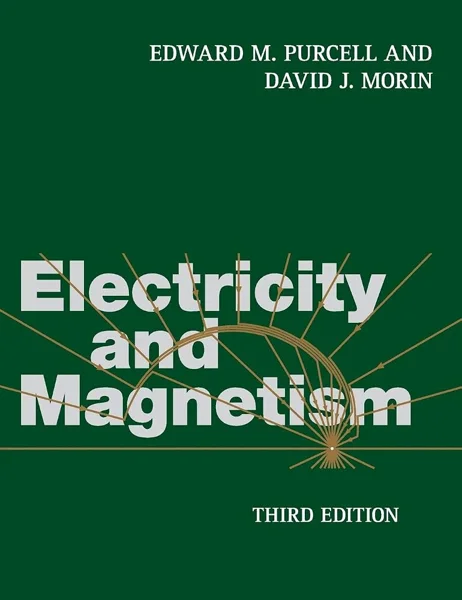
Best E&M after the intro
16. Electricity and Magnetism (Purcell and Morin)
Edward Purcell, who shared the 1952 Nobel Prize in Physics for nuclear magnetic resonance, wrote this for the Berkeley Physics Course in the 1960s. Its most famous chapter derives magnetism from electricity plus special relativity, an idea most students do not see until years later. David Morin updated it for the 3rd edition, converted it to SI units and added solutions to many problems.
It is the best book for understanding electromagnetism rather than calculating with it, and the ideal preparation for Griffiths.
- Edward M. Purcell and David J. Morin
- Cambridge University Press, 3rd edition 2013, 853 pages
- Electrostatics, circuits, magnetism from relativity, Maxwell’s equations
Good: the most insight per page of any E&M book. Not great: uses vector calculus early; learn it first from Boas or a free course.
Check on AmazonUpper-level physics books
These are the books of the second and third years of a physics degree. Together with the math in Boas, they are the core of what a physics graduate knows. Each one assumes an intro textbook behind you.
Best intermediate mechanics
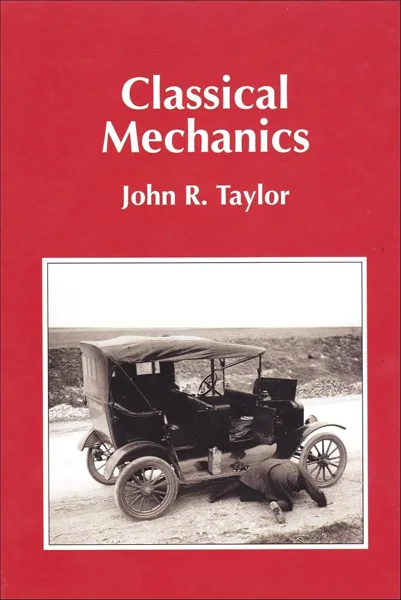
17. Classical Mechanics (Taylor)
John Taylor of the University of Colorado wrote the clearest intermediate mechanics book in print. Part I reviews Newtonian mechanics and gets you comfortable with the math; part II covers Lagrangian and Hamiltonian mechanics, oscillations, chaos, rigid bodies and continuum mechanics. Its explanations are written for a student reading alone, and every chapter has problems graded by difficulty.
A student solutions manual covers the odd-numbered problems.
- John R. Taylor
- University Science Books, 2005, 786 pages
- Lagrangian and Hamiltonian mechanics, oscillations, chaos
Good: the most readable upper-level physics textbook. Not great: expensive hardcover; part I repeats much of an intro course.
Check on Amazon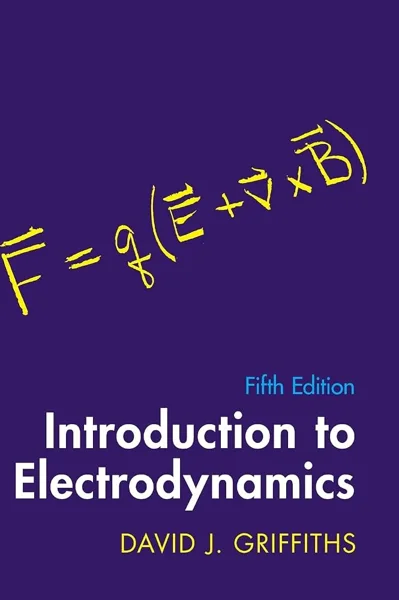
Best electrodynamics book
18. Introduction to Electrodynamics (Griffiths)
David Griffiths taught at Reed College, and his electrodynamics book is used in almost every American physics department for the junior-year course. It opens with a chapter of vector analysis, then builds from electrostatics to Maxwell’s equations, electromagnetic waves, radiation and relativistic electrodynamics. Its conversational tone makes it unusually readable for a book at this level.
The 5th edition (2023) is published by Cambridge. Older editions are fine for self-study; the 4th edition is the one most online help refers to.
- David J. Griffiths
- Cambridge University Press, 5th edition 2023, 650 pages
- Electrostatics, magnetostatics, Maxwell’s equations, radiation
Good: clear, and the problems are well chosen. Not great: no answers in the book to most problems.
Check on Amazon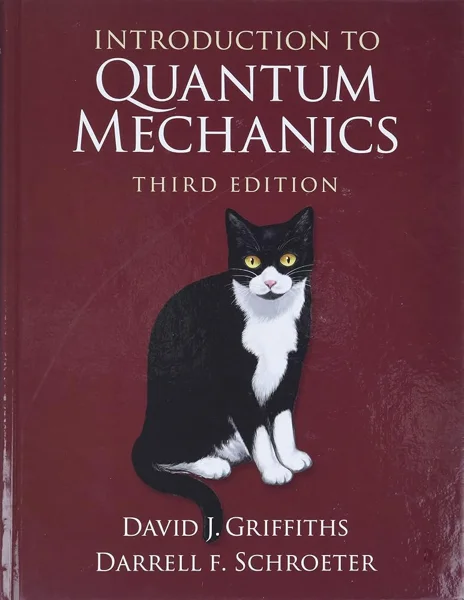
Best first real quantum book
19. Introduction to Quantum Mechanics (Griffiths and Schroeter)
The standard first course in quantum mechanics, in the same style as Griffiths’s electrodynamics. It starts with the Schrödinger equation and the wave function, works through the infinite square well, the harmonic oscillator and the hydrogen atom, then covers spin, identical particles and approximation methods. Darrell Schroeter joined as co-author for the 3rd edition.
If you have read Susskind’s quantum book, Griffiths is the problem-solving half of the same subject. You need calculus, some linear algebra and the basics of differential equations.
- David J. Griffiths and Darrell F. Schroeter
- Cambridge University Press, 3rd edition 2018, 508 pages
- Wave functions, the hydrogen atom, spin, perturbation theory
Good: the most readable quantum textbook. Not great: it teaches how to calculate and says little about what quantum mechanics means.
Check on Amazon
Best thermal physics book
20. An Introduction to Thermal Physics (Schroeder)
Daniel Schroeder of Weber State University wrote the most popular undergraduate book on thermodynamics and statistical mechanics. It explains entropy by counting the ways particles can arrange themselves, then uses that to derive temperature, heat engines, chemical equilibrium and the behavior of quantum gases. Its examples range from refrigerators to white dwarf stars.
Oxford University Press reissued it in paperback in 2021, which made it much cheaper than the original Addison-Wesley hardcover.
- Daniel V. Schroeder
- Oxford University Press, 2021 paperback, 448 pages
- Thermodynamics, entropy, statistical mechanics, quantum statistics
Good: makes entropy make sense. Not great: few worked examples for the harder problems.
Check on Amazon
Best first general relativity textbook
21. A First Course in General Relativity (Schutz)
General relativity is the goal that pulls many adults into physics. Bernard Schutz, a founding director of the Max Planck Institute for Gravitational Physics, wrote the most accessible textbook for it. It teaches special relativity again in the geometric language general relativity needs, then the tensor math, curved spacetime, Einstein’s equations, black holes, gravitational waves and cosmology.
The 3rd edition (2022) adds recent results on gravitational waves. Before it, Taylor and Wheeler’s Spacetime Physics, free from Edwin Taylor’s website, is the best preparation in special relativity.
- Bernard Schutz
- Cambridge University Press, 3rd edition 2022, 512 pages
- Special relativity, tensors, curved spacetime, black holes, gravitational waves
Good: the gentlest real GR textbook, with exercises. Not great: you need the intro course and some linear algebra and calculus of several variables first.
Check on AmazonWhat Reddit recommends
“Which book should I start with?” is asked on r/AskPhysics and r/PhysicsStudents nearly every week. We read 84 of these threads, from 2013 to 2025, and counted how many named each book. Fifty-two of them were general “where do I start” threads; the rest asked about one book or subject.
| Book | Threads | Usually recommended as |
|---|---|---|
| Feynman Lectures on Physics | 31 | A second reading, not a first textbook |
| Halliday, Resnick and Walker | 27 | The intro textbook |
| Griffiths, Quantum Mechanics | 20 | First quantum course |
| Susskind, The Theoretical Minimum | 20 | The alternative to Feynman for adults |
| Griffiths, Electrodynamics | 18 | E&M after the intro year |
| Shankar (any title) | 17 | Intro course with lectures; later, graduate quantum |
| Young and Freedman | 15 | The intro textbook |
| OpenStax University Physics (free) | 13 | The free intro textbook |
| Taylor, Classical Mechanics | 11 | Intermediate mechanics |
| Morin and Kleppner and Kolenkow | 9 each | Hard second-pass mechanics |
| Hewitt, Conceptual Physics | 9 | Before calculus |
Serway’s Physics for Scientists and Engineers came up in 13 threads too; it covers the same course as Halliday and Young and Freedman, and any one of the three will do. Among free resources, YouTube lectures were named in 32 threads, Khan Academy in 18 and MIT OpenCourseWare in 13, and Susan Rigetti’s free online physics roadmap was linked in 13.
The advice repeats as much as the books do:
- Learn the math first or alongside. Calculus, then linear algebra and differential equations, came up in more than half the threads.
- Pick one calculus-based textbook and do the problems. The top answer in one of the most upvoted threads says exactly that, and nothing else.
- Feynman is a supplement. One commenter called the lectures “great supplements. Terrible as primary textbooks”, and most agree.
- After the intro year, one book per subject. The standard list: Taylor, Morin or Kleppner for mechanics; Purcell or Griffiths for E&M; Griffiths for quantum; Schroeder for thermal physics.
- Do not start with Landau and Lifshitz or Jackson. They are graduate books. “Mistrust anyone telling you to begin with Jackson or Landau and Lifshitz,” as one reply put it.
- Buy older editions. The physics has not changed, and the price difference is large.
Several commenters also warn that pure self-study lets a misconception go uncorrected for months, and suggest a community college physics course or a study group for the first year. If one is available to you, it is good advice. If not, check your work against answer keys and post your attempts where someone can correct them.
Free physics courses and textbooks
You can learn a great deal of physics without paying for anything. These are the free resources I send self-learners to, and each one pairs with a book above.
- The Feynman Lectures on Physics, all three volumes, free to read online from Caltech.
- OpenStax University Physics, a free calculus-based intro textbook in three volumes from Rice University. It covers the same ground as Halliday, with answers to the odd-numbered problems. If money is tight, use it as your main textbook.
- Open Yale Courses, Physics 200 and 201, Shankar’s lectures, with problem sets and exams. They match his two books.
- MIT OpenCourseWare, the full MIT physics curriculum with lecture videos, problem sets and solutions: 8.01 (mechanics), 8.02 (electricity and magnetism), 8.03 (waves), 8.04 (quantum physics) and more.
- The Theoretical Minimum, Susskind’s Stanford lectures on video, the courses behind his books.
- Spacetime Physics by Taylor and Wheeler, the classic introduction to special relativity, free from Edwin Taylor’s website.
- Paul’s Online Math Notes, free notes and practice problems for calculus I to III and differential equations.
A free textbook does not make a paid one pointless. Many self-learners keep one book on paper for the main course and use the free ones for a second explanation of whatever is not clicking.
A self-study physics plan for the first two years
This is the plan I sent my former student, at five to eight hours a week. Faster readers with strong math will move quicker; few adults move slower and keep going, because physics rewards steady weekly work far more than occasional long weekends.
| When | Read and work | Goal |
|---|---|---|
| Weeks 1 to 4 | Six Easy Pieces or Thinking Physics; Calculus Made Easy | Know what you are learning; derivatives and integrals |
| Months 2 to 7 | Halliday Volume 1 (or Shankar I with the Yale lectures) | Mechanics, waves and heat, with problems |
| Months 8 to 12 | Halliday Volume 2 (or Shankar II); Feynman Lectures alongside | Electricity, magnetism, optics, intro modern physics |
| Year 2, first half | Kleppner or Morin; Boas chapters on vectors and linear algebra | Solve problems you have not seen before |
| Year 2, second half | Purcell; Taylor; Susskind’s quantum book | E&M properly; Lagrangian mechanics; the structure of quantum mechanics |
| Year 3 and on | Griffiths (both), Schroeder, Schutz | The upper-level core of a physics degree |
Do not try to finish every problem in every chapter. Do the worked examples yourself before reading the solution, then at least a third of the end-of-chapter problems, mixing easy and hard ones. If you cannot do any of the hard ones in a chapter, reread the chapter before moving on.
How to self-study physics from a book
When I taught first-year labs, the students who struggled were rarely short of intelligence. They read the chapter twice, highlighted it, and then could not start the first problem. Reading physics feels like learning it, and it is not. These habits close the gap.
- Cover the worked examples. Read the problem statement, cover the solution and try it yourself first. Then compare.
- Write every step. Draw the diagram, list what you know, write the physics principle you are using before any numbers. Most mistakes come from skipped steps.
- Check units and limits. Does your answer have the right units? Does it do the sensible thing when a mass goes to zero or an angle goes to 90 degrees? This catches most algebra errors without an answer key.
- Get stuck on purpose, but not for long. Twenty or thirty minutes stuck on a problem is useful. Two hours is not. Look at a hint or a solution, then redo the problem from a blank page the next day.
- Measure something. Physics is an experimental science, and a few cheap experiments make the equations real.
- Find people. r/PhysicsStudents, r/AskPhysics and the Physics Forums homework section will help with a problem if you show your attempt.
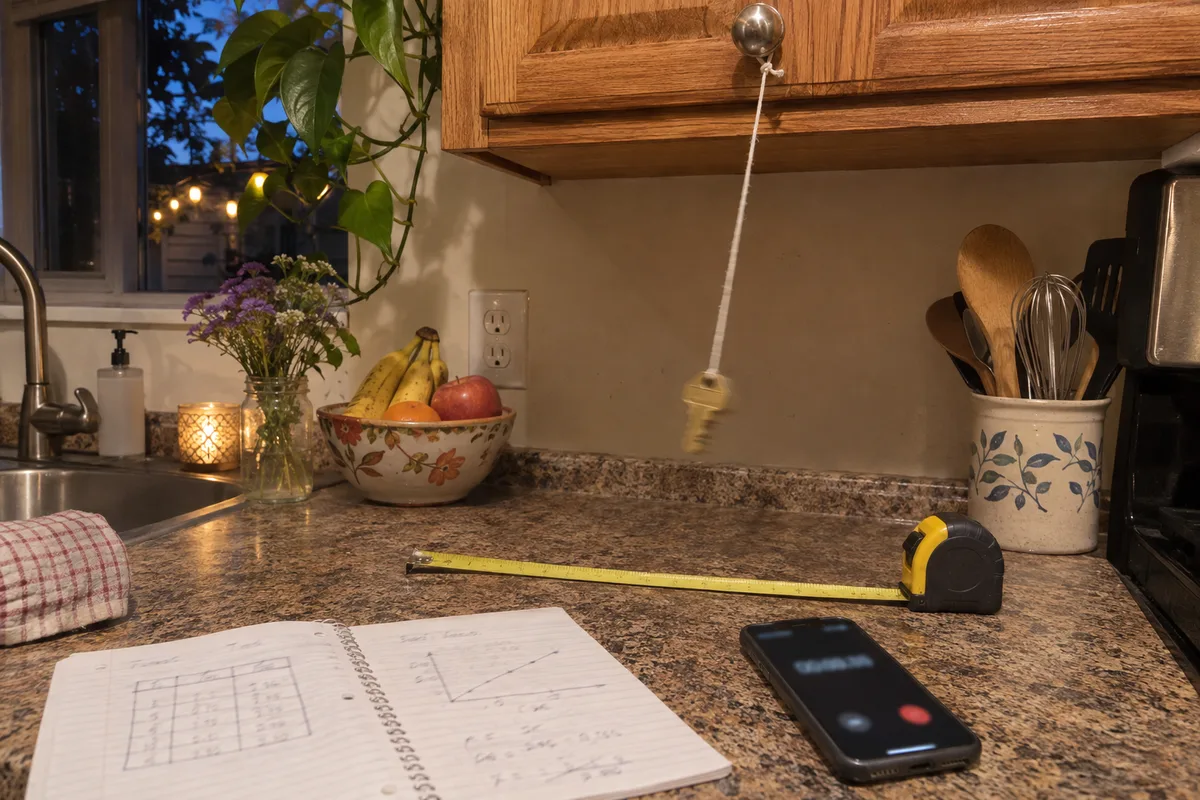
The first experiment I gave my former student needs no equipment: tie a key to a string, hang it from a cabinet knob, time ten swings with a phone and divide by ten. Then change the length of the string and do it again. The period of a pendulum depends on its length and on gravity but not on the mass of the key, and seeing the formula from your textbook match your kitchen is worth an evening of reading. A standard deviation calculator will tell you how much your timings scatter.
For a wider look at what physics covers before you choose a direction, see our list of physics topics and the complete list of forces in physics. For why it is worth the effort, read the benefits of studying physics. If you want lighter science reading for the evenings when problems are too much, our science books for non-scientists includes several physics titles.
FAQ
Fundamentals of Physics by Halliday, Resnick and Walker, because it has the best worked examples and problem sets of any intro textbook, with answers to the odd-numbered problems. For a course with lectures, use R. Shankar’s Fundamentals of Physics with his free Yale lectures.
Yes. Everything taught in an undergraduate physics degree is in textbooks and free online courses. What self-learners miss is the weekly problem set and someone to check their work, so choose books with answers or solutions and solve problems every week. Lab work is the hardest part to reproduce at home.
Algebra and trigonometry for the conceptual books, and single-variable calculus for the intro textbooks. You can learn calculus alongside your first physics textbook. The upper-level books also need vector calculus, linear algebra and differential equations, which Boas’s Mathematical Methods in the Physical Sciences covers.
As a second book, yes. As a first book, usually not. The lectures were written for very strong Caltech first-year students, the original course had separate problem sessions, and the books contain no exercises. Work through a standard textbook first or alongside, and read the free online edition before buying the boxed set.
Both cover the same course. Halliday has shorter explanations and more problems with answers at the back; Young and Freedman explains more and uses a fixed four-step method in every example. If you learn by doing, choose Halliday. If you learn by reading, choose Young and Freedman.
It is good for beginners who remember some calculus and want to understand the ideas of modern physics. It is not a replacement for a textbook if you want to solve problems, because it has few exercises and no solutions. Many self-learners read it alongside an intro textbook.
About nine to twelve months for one calculus-based intro textbook at five to eight hours a week, problems included. The upper-level core of a physics degree (classical mechanics, electrodynamics, quantum mechanics, thermal physics) takes most self-learners another two to three years at the same pace.
Quantum Mechanics: The Theoretical Minimum by Leonard Susskind and Art Friedman, if you want the structure of the theory with only the linear algebra it teaches you. Introduction to Quantum Mechanics by Griffiths and Schroeter, if you have calculus and want to solve problems the way a physics student does. Read Susskind first and Griffiths second.
Not for self-study. Introductory physics has not changed in decades, and an edition or two behind the newest teaches the same physics at a fraction of the price. The exception is Schroeder’s Thermal Physics, whose 2021 Oxford paperback is cheaper than older copies.
Halliday and Young and Freedman print answers to odd-numbered problems and sell student solutions manuals. Morin’s Introduction to Classical Mechanics includes full solutions to most of its problems, and Taylor’s Classical Mechanics has a student solutions manual. MIT OpenCourseWare publishes solutions to its problem sets.
Sources
- Amazon product pages for each book, checked November 2026 (editions, page counts, publishers).
- 84 Reddit threads on self-studying physics in r/AskPhysics, r/PhysicsStudents and r/Physics, 2013 to 2025.
- Susan Rigetti, Physics, a self-study roadmap.
- Caltech, The Feynman Lectures on Physics, online edition.
- Open Yale Courses, PHYS 200: Fundamentals of Physics I, R. Shankar, 2006.
- OpenStax, University Physics Volume 1, Rice University.
- Leonard Susskind, The Theoretical Minimum lecture series, Stanford Continuing Studies.
- The Nobel Prize, The Nobel Prize in Physics 1952 (Bloch and Purcell).