Optics is the study of light and how it behaves, and the list of optics topics is longer than most syllabi let on. Textbooks give you a flat run of chapters: reflection, refraction, lenses, interference, diffraction, polarization. Research groups sort the same material by application: metrology, medical imaging, communications, lasers. Neither tells you how the pieces connect or which ones to learn first.
This post sorts optics into five branches, explains each topic in a couple of sentences, ties it to something you’ve actually seen, and tags how hard it is. A comparison table and a learning path come after.
Table of Contents
- How the Five Branches Fit Together
- Branch 1: Geometrical (Ray) Optics
- Branch 2: Physical (Wave) Optics
- Branch 3: Quantum Optics
- Branch 4: Applied Optics
- Branch 5: Optical Engineering and Technology
- Branches Compared
- Where to Start: A Learning Path
- FAQ
How the Five Branches Fit Together
The branches are really one question asked at different scales: what is light doing here?
When the objects are much bigger than light’s wavelength (a lens, a mirror, a window), you can treat light as straight rays and get accurate answers with school-level geometry. When the objects are close to the wavelength in size (a thin soap film, a slit, a CD groove), light acts as a wave and you need interference and diffraction. When you count individual photons, you’re in quantum optics. Applied optics and optical engineering then take all three and build things.
Difficulty tags below use three levels: Beginner (high school algebra and geometry), Intermediate (calculus and basic wave physics), Advanced (quantum mechanics or heavy math).
Branch 1: Geometrical (Ray) Optics
Geometrical optics ignores the wave nature of light and follows rays as straight lines that bend or bounce at surfaces. It’s the oldest branch and the easiest entry point. It breaks down only when features get as small as the wavelength of light, roughly 400 to 700 nanometers.
Reflection (Beginner). Light bounces off a surface so the angle in equals the angle out. A bathroom mirror is the example, and so is the reason a flat pond shows a clean upside-down copy of the trees.
Refraction (Beginner). Light changes direction when it passes between materials, because it travels more slowly in glass or water than in air. A straw that looks broken at the waterline is refraction, and Snell’s law gives the exact bend.
Total internal reflection (Beginner). Past a critical angle, light can’t leave a dense material and reflects back inside it instead. This is why a diamond sparkles and why light stays trapped inside a fiber-optic cable.
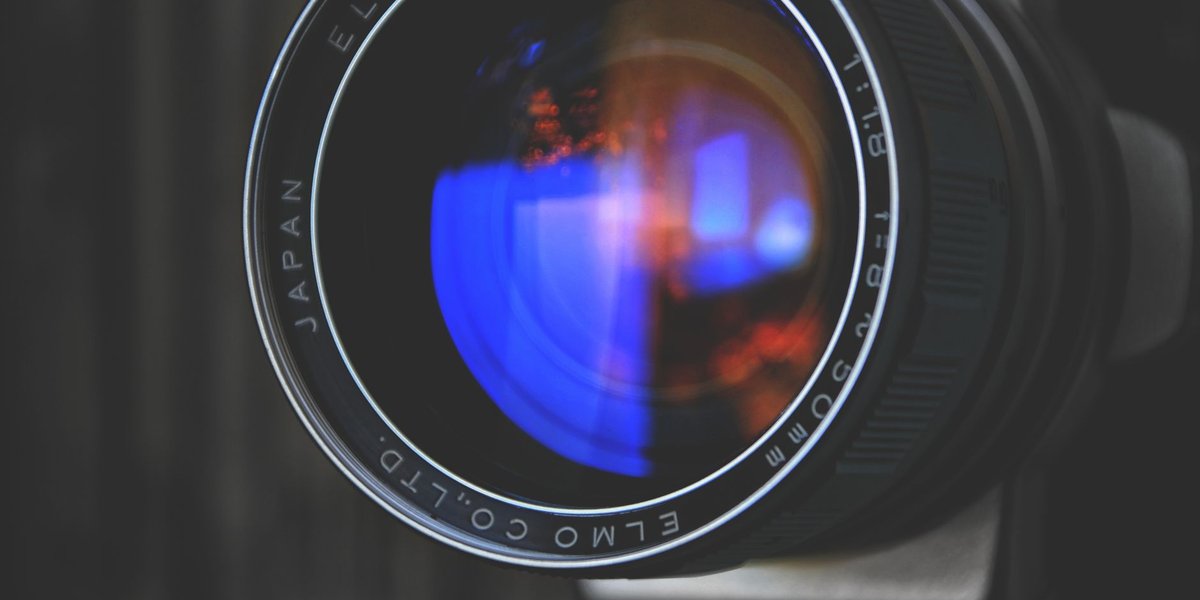
Lenses and mirrors (Beginner to Intermediate). Curved surfaces focus or spread rays, and the thin-lens equation links object distance, image distance and focal length. Eyeglasses, magnifying glasses and camera lenses all follow it.
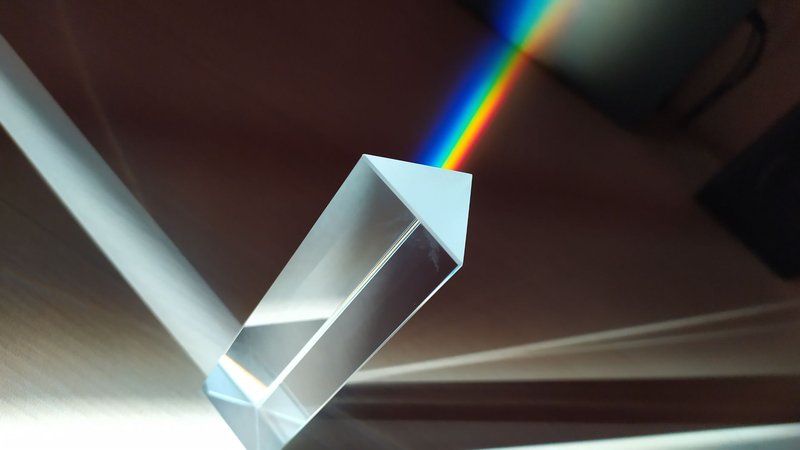
Dispersion (Beginner). Different colors refract by slightly different amounts, so a prism splits white light into a spectrum. Rainbows come from sunlight doing this inside raindrops, with one internal reflection on the way.
Aberrations (Intermediate). Real lenses don’t focus perfectly: spherical aberration, coma, astigmatism and chromatic aberration smear the image. The colored fringes you see on a cheap pair of binoculars are chromatic aberration.
Optical instruments (Intermediate). Telescopes, microscopes and cameras are lenses and mirrors combined in sequence. Working out how two lenses make a distant object look bigger is a classic ray-optics exercise.
Branch 2: Physical (Wave) Optics
Physical optics treats light as a wave, so it explains what rays can’t. The central idea is superposition: when two waves overlap, they add, and the result can be brighter or darker than either one alone.
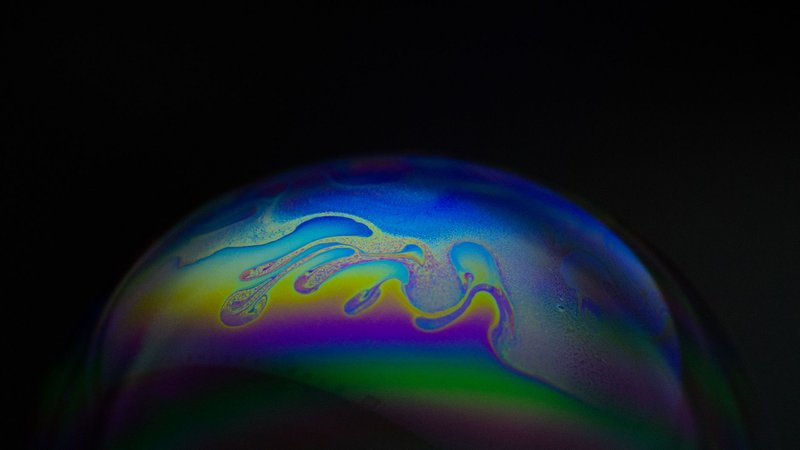
Interference (Intermediate). Two light waves meeting in step reinforce each other, and out of step they cancel. The rainbow swirls on a soap bubble or an oil slick come from light reflecting off the front and back of a film only a few hundred nanometers thick. Anti-reflective coatings on glasses use the same effect on purpose.
Diffraction (Intermediate). Light spreads out when it passes an edge or a narrow opening. It’s why a laser pointer shone through a hair produces a row of dots, and why the tiny grooves on a CD split reflected light into colors.
Polarization (Intermediate). Light waves oscillate in a particular direction, and a polarizer keeps only one. Polarized sunglasses cut glare because light reflected off water or roads is mostly polarized horizontally, and the lenses block that direction. Most LCD screens also depend on polarization.
Coherence (Intermediate to Advanced). Coherence measures how steady the phase relationship in a light beam is. Laser light has high coherence, which is why it can produce clean interference patterns over long distances. A light bulb barely has any.
Holography (Advanced). A hologram records the interference pattern between a reference beam and light scattered from an object, then rebuilds the original wavefront. The shiny security strip on a credit card is a simple example.
Branch 3: Quantum Optics
Quantum optics deals with light as photons, and with how light and matter exchange energy one quantum at a time. It’s the hardest branch to enter, mostly because of the math. The ideas themselves are short to state.
Photons and the photoelectric effect (Intermediate). Light hitting a metal can knock electrons loose, but only if each photon carries enough energy, regardless of how bright the beam is. Einstein’s explanation of this is why solar panels and the light sensor in a phone camera work at all. Common misconceptions about quantum mechanics can cloud understanding of how photons behave.
Lasers (Intermediate to Advanced). A laser works by stimulated emission: one photon triggers an excited atom to release an identical photon, and the process cascades. Barcode scanners, laser printers and eye surgery all depend on it.
Spectroscopy (Intermediate). Atoms absorb and emit light at specific wavelengths, so the spectrum of a source acts like a fingerprint. Astronomers use it to tell what distant stars are made of, and chemists use it to identify compounds in a lab.
Nonlinear optics (Advanced). At very high intensities, materials respond to light in ways that change its color. A green laser pointer is typically an infrared laser whose light passes through a crystal that doubles its frequency. The 2018 Nobel Prize in Physics recognized chirped pulse amplification and optical tweezers, both tools built on strong-field optics.
Quantum light and entanglement (Advanced). Single-photon sources and entangled photon pairs are the raw material of quantum cryptography and some approaches to quantum computing. Few experiments outside university labs involve it directly, but it shapes where optics research is heading.
Branch 4: Applied Optics
Applied optics takes the physics above and aims it at a measurement or a job. This is the branch where optics topics turn into career paths.
Optical metrology (Intermediate). Interferometers measure distances and surface flatness to a fraction of a wavelength. The largest example is LIGO, which uses laser interferometry with arms 4 kilometers long to detect gravitational waves, stretching of space smaller than a proton’s width.
Biomedical optics (Intermediate to Advanced). Optical coherence tomography images layers of the retina without touching the eye, and it’s now routine in eye clinics. Pulse oximeters, the clip on your fingertip in a hospital, shine red and infrared light through tissue to estimate blood oxygen.
Remote sensing and LiDAR (Intermediate). LiDAR fires laser pulses and times their return to build a 3D map. It’s used in self-driving car research, archaeological surveys under forest canopy, and the depth sensor on some phones.
Imaging and photography (Beginner to Intermediate). Sensor design, lens choice, depth of field and exposure all come back to ray optics and a bit of wave optics. Computational photography now fixes some lens flaws in software.
Vision science (Beginner to Intermediate). The eye is a lens system with a variable focus, and myopia and farsightedness are focusing errors that glasses correct with a lens of the opposite power. Several surprising anatomical details about eyes deepen understanding of how biological optical systems function.
Branch 5: Optical Engineering and Technology
Optical engineering is about designing, building and manufacturing the components and systems. Where applied optics asks what you can measure, this branch asks how to build the device that does it, and make it affordable.
Lens and system design (Intermediate to Advanced). Engineers use ray-tracing software to optimize multi-element lenses, balancing aberrations against size and cost. A modern phone camera module packs several tiny plastic lens elements into a few millimeters.
Fiber optics (Intermediate). Glass fibers thinner than a human hair carry light over long distances by total internal reflection. Charles Kao’s work on low-loss glass fiber, recognized in the 2009 Nobel Prize in Physics, made long-distance fiber communication practical. Your home internet connection likely rides on fiber for part of its trip.
Photonics and integrated optics (Advanced). Photonics uses light the way electronics uses current, and integrated photonic chips put lasers, waveguides and detectors on a single piece of silicon. Data centers increasingly use them to move information between servers.
Displays and LEDs (Intermediate). Screens are optical systems: backlights, polarizers, color filters and light-emitting layers working together. Choosing OLED or LCD is an optics tradeoff.
Optical coatings and materials (Intermediate). Thin layers of metal oxides control which wavelengths reflect or pass through. They’re on camera lenses, solar panels and the tint of architectural glass.
Sensors and detectors (Intermediate). CCD and CMOS sensors convert photons to electrical signals. The CCD’s invention shared in the 2009 Nobel Prize in Physics as well.
Branches Compared
| Branch | Core idea | Key equations | Everyday use |
|---|---|---|---|
| Geometrical optics | Light travels as rays | Snell’s law, thin-lens equation | Glasses, cameras, telescopes |
| Physical optics | Light is a wave | Double-slit condition, grating equation | Anti-glare coatings, polarized sunglasses, CDs |
| Quantum optics | Light comes in photons | E = hf, rate equations for lasers | Lasers, solar cells, spectroscopy |
| Applied optics | Light as a measuring tool | Interferometer phase, time-of-flight | LiDAR, eye scans, pulse oximeters |
| Optical engineering | Building optical devices | Ray tracing, waveguide conditions | Fiber internet, phone cameras, displays |
Where to Start: A Learning Path
You don’t need to take the branches in numerical order. This sequence works for most self-learners.
- Reflection and refraction. Get Snell’s law and mirror geometry down first. Everything else builds on them.
- Lenses and the thin-lens equation. Draw ray diagrams by hand until the image position becomes predictable.
- Interference and diffraction. Do the double-slit experiment with a laser pointer and two pencil marks on foil, if you can. Seeing the pattern is worth ten pages of equations.
- Polarization and dispersion. Short topics that connect rays to waves.
- Lasers and photons. Move to the quantum side once you’re comfortable with waves. Read about the photoelectric effect before attempting stimulated emission.
- Pick an application. Fiber communications, medical imaging, LiDAR or lens design each have their own next steps. Choose the one that matches the career you’re considering.
A handful of specialist courses, such as nonlinear optics and quantum optics proper, need quantum mechanics first. Skip them until you’ve covered the first five steps.
FAQ
What are the main branches of optics? Geometrical (ray) optics, physical (wave) optics and quantum optics are the three fundamental branches. Applied optics and optical engineering use them for measurement and device design.
What’s the difference between geometrical and physical optics? Geometrical optics treats light as rays and works when objects are much larger than the wavelength. Physical optics treats light as waves and is needed for interference, diffraction and polarization.
Is optics hard to learn? The ray-optics basics are accessible with high school math. Wave optics needs calculus and some wave physics. Quantum optics requires quantum mechanics.
Are optics and photonics the same thing? They overlap heavily. Optics is the broader study of light’s behavior. Photonics usually refers to technology that generates, controls and detects light, especially for communications and computing.
What jobs use optics? Optical engineers, laser technicians, imaging scientists, ophthalmic researchers, telecommunications engineers and sensor designers all work with it, along with astronomers and camera or display developers.