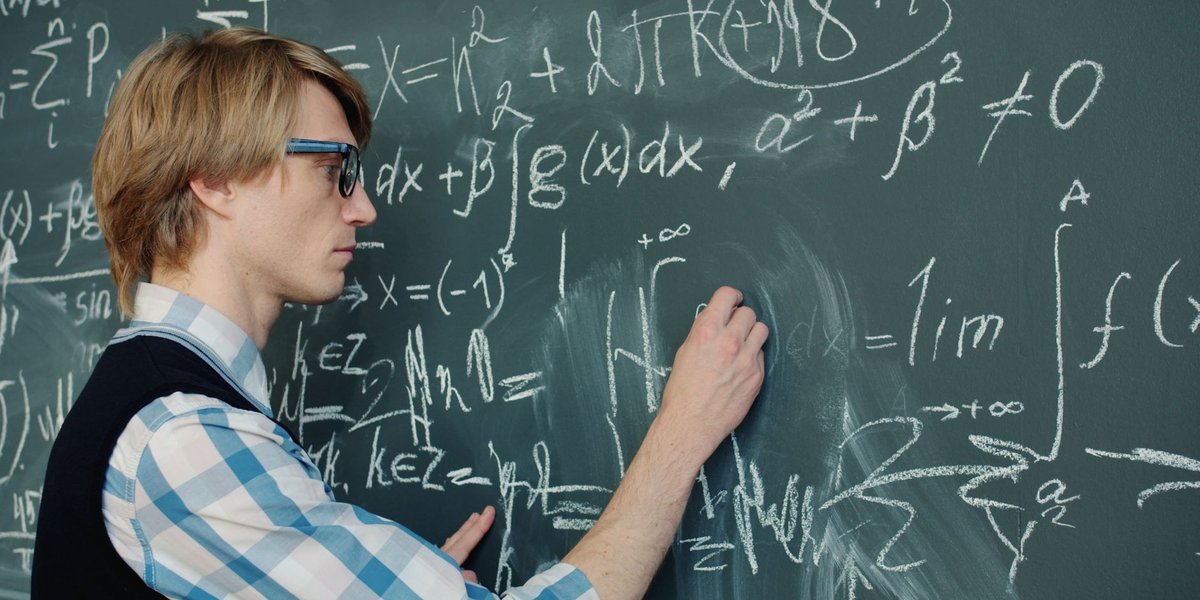
Formal sciences study abstract systems built from axioms, definitions and rules of inference. Their claims are settled by proof, not by experiment, so a theorem stays true whether or not anyone ever observes a single example of it.
That’s the key split. Physics asks what the universe does. Formal science asks what must follow from a given set of rules. The formal science topics below cover seven branches, plus three borderline fields that sit on the edge of the list.
Table of contents
- What makes a science “formal”
- Logic
- Mathematics
- Statistics
- Theoretical computer science
- Information theory
- Decision theory and game theory
- Systems science
- The borderline cases
- Formal science vs natural and social science
- Are the formal sciences really sciences?
- Where to start
What makes a science “formal”
A formal system has three parts: a set of symbols, rules for combining them, and a starting set of statements (axioms) you accept without proof. Everything else is derived. Chess works this way. So does Euclidean geometry.
Natural sciences test ideas against the world and can be overturned by one stubborn measurement. Formal sciences can’t be overturned that way. If a proof is valid, the theorem holds. If it isn’t, someone finds the gap, and that’s the only kind of “falsification” the field recognizes.
Sources disagree on exactly which fields belong. Wikipedia’s list names 13, including AI and cryptography, while other lists add game theory, linguistics or data science. This guide takes the core of what most lists agree on and flags the disputed ones separately.
Logic

Logic is the study of valid reasoning: which conclusions follow from which premises, regardless of what the premises are about. Everything else on this list leans on it.
- Propositional logic. Statements are true or false, joined by AND, OR, NOT and IF-THEN. Real-world use: every digital circuit is a physical version of it.
- Predicate (first-order) logic. Adds “for all” and “there exists,” so you can reason about objects and their properties. Used to write formal specifications for software and to state mathematical axioms.
- Modal logic. Handles “necessarily” and “possibly.” Applied in verifying that systems can never reach an unsafe state.
- Proof theory. Studies proofs as objects in their own right. Proof assistants such as Lean and Coq are built on it and check mathematical proofs line by line.
- Model theory. Asks what structures make a set of statements true. Used in database theory and in classifying mathematical structures.
- Set theory. The foundation most of mathematics is formally built on. Its 1900s paradoxes are why axioms matter.
- Gödel’s incompleteness theorems. In 1931 Gödel showed that any consistent system rich enough to do arithmetic contains true statements it can’t prove. The Stanford Encyclopedia of Philosophy has a careful walkthrough.
Mathematics
Mathematics is the largest formal science and the one the others borrow from. It studies quantity, structure, space and change through definitions and proofs.
- Number theory. Properties of integers and primes. RSA encryption, which protects most online payments, rests on how hard it is to factor the product of two huge primes.
- Algebra. Structures like groups and rings, plus the familiar equation-solving. Group theory describes the symmetries of molecules and crystals.
- Calculus and analysis. The mathematics of change and limits. Engineers use it to model everything from bridge loads to heat flow. For how it differs from statistics, see calculus compared with statistics.
- Geometry and topology. Shape, distance and what survives stretching. Topology explains why a coffee mug and a donut count as the same object.
- Linear algebra. Vectors and matrices. It runs 3D graphics and the training of machine-learning models.
- Combinatorics and graph theory. Counting arrangements and studying networks of nodes and edges. Google’s original PageRank treated the web as a graph.
- Probability theory. The rules for uncertain events. It’s the base layer under statistics, insurance and quantum mechanics.
- Applied vs pure. Pure math chases structure for its own sake. Applied math points the same tools at a problem. The line moves: number theory was “useless” until cryptography needed it.
Statistics
Statistics is the science of drawing conclusions from data while being honest about uncertainty. It’s formal because its methods are mathematical results about what any sample can and can’t tell you, even though its inputs come from the real world.
- Descriptive statistics. Means, medians, spread. Every census summary and sports average is this.
- Sampling. How to learn about a population from a small piece of it. Election polls live or die on this.
- Hypothesis testing. A procedure for deciding whether an effect is bigger than chance would produce. Clinical trials use it to judge a new drug.
- Confidence intervals. A range that reflects how precise an estimate is. The “margin of error” in a poll is one.
- Regression. Fitting a line or curve to find relationships between variables. Economists, epidemiologists and sports analysts all lean on it.
- Bayesian inference. Updates a probability as evidence arrives. Spam filters work this way: each suspicious word nudges the odds up.
- Experimental design. Planning an experiment so the data can answer the question. Randomized controlled trials are the best-known example.
Theoretical computer science
This is the part of computer science that asks what computation is and what it can do, with no regard for any particular machine.
- Computability. Which problems can any algorithm solve at all? The Church-Turing thesis holds that Turing machines capture everything “effectively calculable.”
- The halting problem. Turing proved in 1936 that no program can decide, for every program, whether it will finish or run forever. It’s why perfect bug-detecting software can’t exist.
- Complexity theory. How resource costs grow with problem size. The P vs NP question carries a $1 million Clay Institute prize and remains open.
- Algorithms and data structures. Analyzing how fast a method runs. The gap between a quadratic and a log-linear sort decides whether a search engine is usable.
- Automata and formal languages. Simple abstract machines and the patterns they recognize. Regular expressions and compilers are built on them.
- Cryptographic theory. Defines what “secure” means mathematically, and proves that a scheme is secure if some problem is hard.
- Type theory. Rules that stop programs from combining the wrong kinds of data. It’s why a typed language can reject whole classes of bugs before the code runs.
Information theory
Claude Shannon founded this field in 1948 with “A Mathematical Theory of Communication,” available from Harvard’s math department. His central move was to measure information as surprise, not meaning.
- Entropy. The average unpredictability of a source, measured in bits. A fair coin flip carries one bit; a coin that lands heads 99% of the time carries far less.
- Source coding and compression. Entropy sets the floor for how small data can get without loss. ZIP files and Huffman coding work toward that limit.
- Channel capacity. Every noisy channel has a maximum rate of error-free transmission. Shannon proved it exists before anyone knew how to reach it.
- Error-correcting codes. Add structured redundancy so errors can be detected and fixed. QR codes still scan when part of the square is torn.
- Mutual information. How much knowing one variable tells you about another. Used in feature selection for machine learning.
- Kolmogorov complexity. The length of the shortest program that produces a given string. Random-looking data can’t be compressed, and this is the formal reason.
Decision theory and game theory
Decision theory covers how a rational agent should choose under uncertainty. Game theory extends it to cases where other agents’ choices affect yours.
- Expected utility. Weigh each outcome by its probability and its value to you. The standard model in economics and insurance pricing.
- Decision trees. Map choices, chances and payoffs to compare options. Common in medicine and business planning.
- Nash equilibrium. A set of strategies where no player gains by switching alone. John Nash formalized it in 1950, and the Stanford Encyclopedia of Philosophy covers its extensions.
- The prisoner’s dilemma. Two players each do better by betraying the other, yet both lose if both betray. It models arms races, price wars and shared-resource problems.
- Mechanism design. Building the rules so self-interested players produce a good outcome. Spectrum auctions run by regulators since the 1990s were designed this way.
- Bayesian games. Players with hidden information, like bidders who don’t know each other’s valuations.
- Evolutionary game theory. Strategies spread by reproduction instead of reasoning. Biologists use it to explain cooperation and aggression in animal populations.
Systems science
Systems science studies how parts interact to produce behavior that none of the parts has alone. It overlaps with engineering and ecology but works with general, abstract models.
- Control theory. Designing feedback so a system holds a target. A thermostat, cruise control and an aircraft autopilot are all examples.
- Cybernetics. Norbert Wiener’s 1948 framework for feedback and communication in machines and animals. It seeded much of what followed.
- System dynamics. Stocks, flows and delays modeled as equations. Jay Forrester’s work on it led to the 1972 “Limits to Growth” study.
- State estimation. Working out the true state of a system from noisy measurements. The Kalman filter was used in Apollo navigation and still sits inside phone GPS.
- Network science. Studies how connection patterns shape spread and resilience, from epidemics to power grids.
- Chaos and nonlinear dynamics. Simple deterministic rules that make long-range prediction impossible. Weather forecasting hits this wall at roughly two weeks.
- Operations research. Optimization of schedules, routes and resources. Airlines use it to assign crews and aircraft.
The borderline cases
Three fields show up on some lists and not others. Each has a reason.
Linguistics. Formal grammar, which describes the rules of syntax mathematically, is clearly formal. But linguistics as a whole studies how people actually speak, which is empirical. Computational linguistics sits across the line.
Cryptography. The theory is pure mathematics and complexity theory. Real cryptography also depends on hardware, implementation and human behavior, which are empirical problems.
Data science. It borrows statistics and computer science, but its day-to-day work is applied and domain-specific: cleaning messy data, building models, checking them against real outcomes. That makes it more of a practice than a formal science.
Formal science vs natural and social science
| Formal sciences | Natural sciences | Social sciences | |
|---|---|---|---|
| Subject | Abstract systems | Physical world | Human behavior and society |
| Method | Axioms and proof | Observation and experiment | Surveys, experiments, case studies |
| How claims are settled | Logical deduction | Empirical testing | Empirical testing, often with statistics |
| Can new data overturn a result? | No, only a flaw in the proof can | Yes | Yes |
| Typical question | Does this follow from these rules? | How does this work in nature? | Why do people do this? |
| Examples | Logic, mathematics, statistics | Physics, chemistry, biology | Economics, sociology, psychology |
The table is clean, and real research isn’t. Statistics is formal in structure but is mostly used inside empirical work. Game theory is mathematics until an economist tests it on real bidders.
Are the formal sciences really sciences?
This is an old argument. One camp says no. Karl Popper’s test for science was falsifiability, meaning a claim must be capable of being refuted by observation, and a theorem can’t be. By that standard, Popper’s criterion pushes mathematics and logic outside science.
The other camp points out that “science” has meant organized, systematic knowledge much longer than it has meant experiments. Formal fields use rigorous methods, build cumulative knowledge, and make progress that anyone can check. They also supply the language that physics, biology and economics are written in.
Neither side is wrong about the facts. They disagree about the definition. For practical purposes, universities group these fields with the sciences, and most working scientists treat them as part of the toolkit.
Where to start
You don’t need to take these in list order, but this sequence builds sensibly:
- Logic first. Learn propositional logic and truth tables. It takes a weekend and gives you the vocabulary of proof.
- Discrete math. Sets, functions, graphs and basic counting. This is the bridge to computer science.
- Probability and statistics. Start with conditional probability and Bayes’ rule, then move to hypothesis testing. You’ll use this in everything else.
- Calculus and linear algebra. Needed for control theory, machine learning and most applied work. A self-study math book guide sorted by level makes this step easier to plan.
- Pick a branch. Computability and complexity if you like puzzles, information theory if you like codes and signals, game theory if you like strategy, control or systems theory if you like machines that regulate themselves.
For free material, MIT OpenCourseWare and Khan Academy both cover the early steps. For career relevance, statistics and theoretical computer science lead most directly to jobs in data, software and research, while operations research and control theory feed engineering roles.
Formal science topics look abstract from the outside, but the same few ideas, proof, probability, information and feedback, sit underneath most of the technology you use. Choose the branch closest to a question you already care about and start there.