
Vapor pressure and absolute humidity
| Air temp (°F) | 30% RH | 50% RH | 70% RH | 90% RH |
|---|---|---|---|---|
| 50 | 19.8 | 32.1 | 40.6 | 47.2 |
| 60 | 28.5 | 41.3 | 50.2 | 57.1 |
| 70 | 37.1 | 50.5 | 59.8 | 66.9 |
| 80 | 45.8 | 59.7 | 69.3 | 76.8 |
| 90 | 54.4 | 68.9 | 78.9 | 86.7 |
| 100 | 63.0 | 78.0 | 88.5 | 96.5 |
Show the math
g = ln(RH / 100) + a × T / (b + T), then Td = b × g / (a - g). a = 17.625, b = 243.04 °C; T and Td in °C.T = 77 °F = 25 °C, RH = 60%. a × T / (b + T) = 1.644; ln(0.6) = -0.5108; g = 1.133; Td = 243.04 × 1.133 / (17.625 - 1.133) = 16.698 °C = 62.1 °F = 289.85 KT - Td = 25 - 16.698 = 8.302 °C (14.94 °F)es(T) = 6.1094 × exp(a × T / (b + T)) = 31.62 hPa; e = RH / 100 × es = 18.97 hPa100 × e / (461.5 × (T + 273.15)) × 1000 = 13.79 g/m³Td is about T - (100 - RH) / 5 = 25 - 8 = 17 °C. Good to about 1 °C for 0 to 30 °C and RH above 50%.The constants keep saturation vapor pressure within 0.4% from -40 to 50 °C. Other published constant sets move the dew point by 0.03 to 0.2 °C.Short answer: The dew point is the temperature at which air becomes saturated and water vapor starts to condense. It comes from air temperature and relative humidity: at 77 °F (25 °C) and 60% relative humidity the dew point is 62.1 °F (16.7 °C). A quick estimate is the air temperature minus (100 minus RH) divided by 5, which gives 62.6 °F (17 °C) here.
Relative humidity changes with the temperature of the air, so the same RH can feel pleasant at 50 °F and miserable at 90 °F. The dew point measures the moisture itself, which is why forecasters use it to describe how humid the air feels.
This article contains Amazon affiliate links. 33science earns a commission on qualifying purchases. See our affiliate disclosure.
How to use the dew point calculator
The dew point formula
The calculator uses the Magnus formula with the Alduchov-Eskridge constants a = 17.625 and b = 243.04 °C, as given by Lawrence (2005). With T in °C and RH in percent, compute g = ln(RH / 100) + a × T / (b + T). The dew point is then Td = b × g / (a − g).
Worked example: at 25 °C the saturation vapor pressure is 31.62 hPa. At 60% relative humidity the air holds 18.97 hPa of vapor, and the dew point is the temperature at which saturation vapor pressure falls to that value: 16.7 °C, or 62.1 °F.
The saturation vapor pressure fit stays within 0.4% from -40 to 50 °C, and the dew point differs by up to 0.2 °C between the published sets of constants (CIRES vapor pressure comparison). Air pressure and altitude are not inputs: a pressure change shifts the dew point by less than 0.1 °C. The quick estimate from the short answer was 0.3 °C off here and holds to about 1 °C for 0 to 30 °C with RH above 50%.
What a dew point means for comfort
The National Weather Service describes air with a dew point at or below 55 °F as dry, 55 to 65 °F as sticky and 65 °F or higher as oppressive (NWS La Crosse). The calculator uses these bands and shows the label next to the result.
| Band | Dew point (°F) | Dew point (°C) | Example |
|---|---|---|---|
| Dry / comfortable | 55 or below | 12.8 or below | 68 °F at 45% RH: 45.9 °F |
| Sticky | 55 to 65 | 12.8 to 18.3 | 77 °F at 60% RH: 62.1 °F |
| Oppressive | 65 or above | 18.3 or above | 86 °F at 70% RH: 75.1 °F |
Dew points in °F by air temperature and humidity. Bold values are oppressive.
| Air temperature | 30% RH | 50% RH | 70% RH | 90% RH |
|---|---|---|---|---|
| 60 °F | 28.5 | 41.3 | 50.2 | 57.1 |
| 70 °F | 37.1 | 50.5 | 59.8 | 66.9 |
| 80 °F | 45.8 | 59.7 | 69.3 | 76.8 |
| 90 °F | 54.4 | 68.9 | 78.9 | 86.7 |
Calculate relative humidity from dew point
To use the page as a relative humidity calculator, set the solve-for option to relative humidity. The formula inverts to RH = 100 × exp(a × Td / (b + Td) − a × T / (b + T)) (University of Miami). Air at 77 °F (25 °C) with a dew point of 68 °F (20 °C) has a relative humidity of 73.8%.
The third mode finds the air temperature. A dew point of 59 °F (15 °C) with 60% relative humidity means the air is at 73.7 °F (23.2 °C).
Spread, condensation and frost point
Dew forms when a surface cools to the dew point of the air touching it, and fog forms when the air itself cools that far. The spread, air temperature minus dew point, shows how much cooling is left. At 30 °C and 90% relative humidity the dew point is 28.2 °C, a spread of only 1.8 °C, so any surface a couple of degrees cooler than the air gets wet.

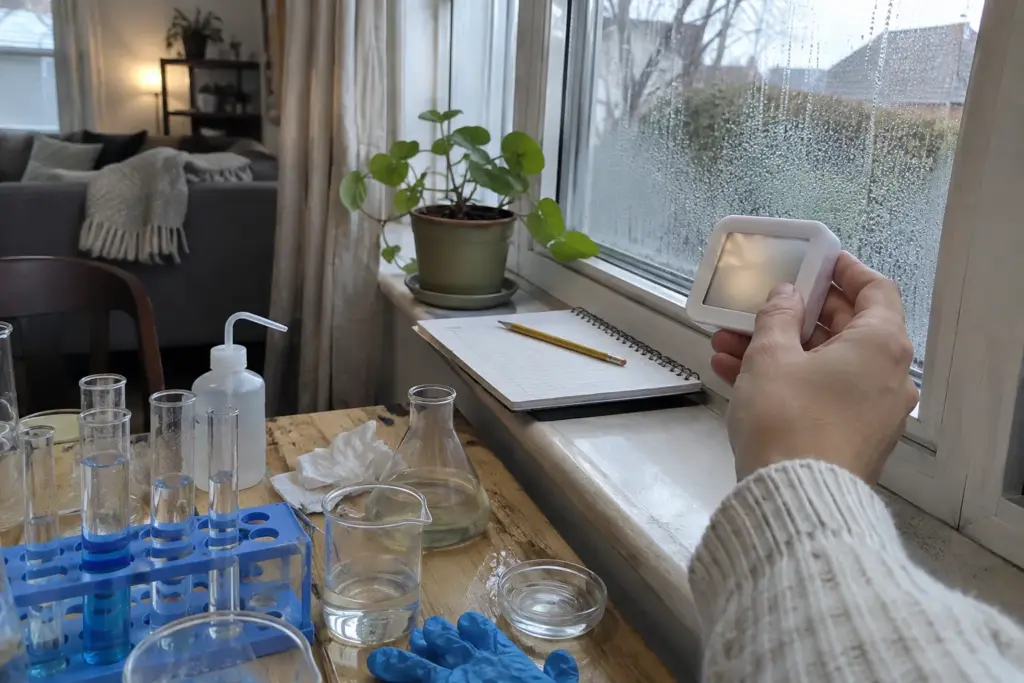
Indoors the same rule explains wet windows: a pane below the room dew point collects condensation.

Below 0 °C vapor deposits as ice at the frost point, which is slightly higher than the dew point. At 20 °C and 20% relative humidity the dew point is -3.7 °C and the frost point is -3.2 °C. At -5 °C and 80% the dew point is -7.9 °C and the frost point is -7 °C. The calculator shows the frost point whenever the dew point is below freezing, using the WMO ice formula (CIRES).
Check it with an ice water test
A shiny metal can, water, ice and a thermometer measure the dew point at home. Fill the can with room-temperature water, add ice a little at a time while stirring, and watch the outside of the can. The water temperature when mist first films the metal is close to the dew point of the room air.
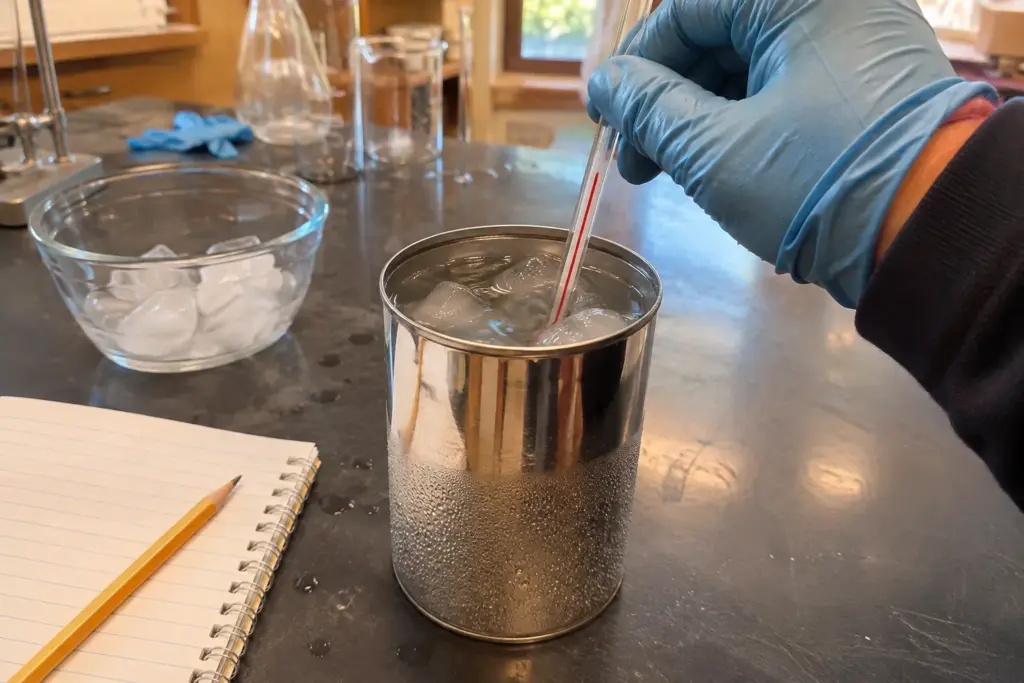
Enter the room temperature and that dew point, solve for relative humidity, and compare the result with your hygrometer. A large gap means the hygrometer is off or the can cooled too fast.
Common mistakes
A hygrometer in direct sun or beside a heater reads the wrong temperature, and the dew point inherits the error.
Sources
- AMS. Lawrence, Relative Humidity and the Dewpoint Temperature in Moist Air (BAMS, 2005)
- National Weather Service La Crosse. Why dew point versus humidity
- CIRES. Vapor pressure of water formulations
- University of Miami. McNoldy, Humidity formulas
Frequently asked questions
The dew point is the temperature to which air must cool for water vapor to start condensing into liquid. It measures how much moisture the air holds, regardless of how warm it is.
Compute g = ln(RH / 100) + a x T / (b + T) with a = 17.625 and b = 243.04, then the dew point is b x g / (a – g), with T in degrees Celsius. At 25 °C and 60% relative humidity the dew point is 16.7 °C (62.1 °F).
A dew point at or below 55 °F feels dry and comfortable, 55 to 65 °F feels sticky and 65 °F or higher feels oppressive, according to the National Weather Service.
No. Relative humidity compares the vapor in the air with the most it could hold at that temperature, so it changes as the air warms or cools. The dew point stays fixed until moisture is added or removed.
Dew point states the moisture content directly, so a dew point above 65 °F feels muggy at any hour. Relative humidity swings with the daily temperature cycle and can mislead.
No. A dew point above the air temperature would mean relative humidity over 100%. The two are equal when the air is saturated.
The spread is the air temperature minus the dew point. A spread of a few degrees means fog, dew or condensation on cold surfaces is likely.
The frost point is the temperature at which vapor deposits as ice, used when the dew point is below 0 °C. It is slightly higher than the dew point: -3.2 °C against -3.7 °C at 20 °C and 20% relative humidity.