As an Amazon Associate we earn from qualifying purchases. Disclosure. Amazon changes prices daily, so this guide does not list them.
The best lab coat for most women is the Dickies Contemporary Fit 37-inch twill. It has princess seams and a sewn-down back belt, reaches the knee, comes in sizes XS to 3XL and is a 60/40 cotton-polyester blend that suits biology, teaching and general lab work. For chemistry with open flames, buy the 100% cotton Lab Coat Project Curie. For work with pyrophorics or large volumes of solvents, buy a flame-resistant coat such as the Bulwark FR women’s chemical protection coat.
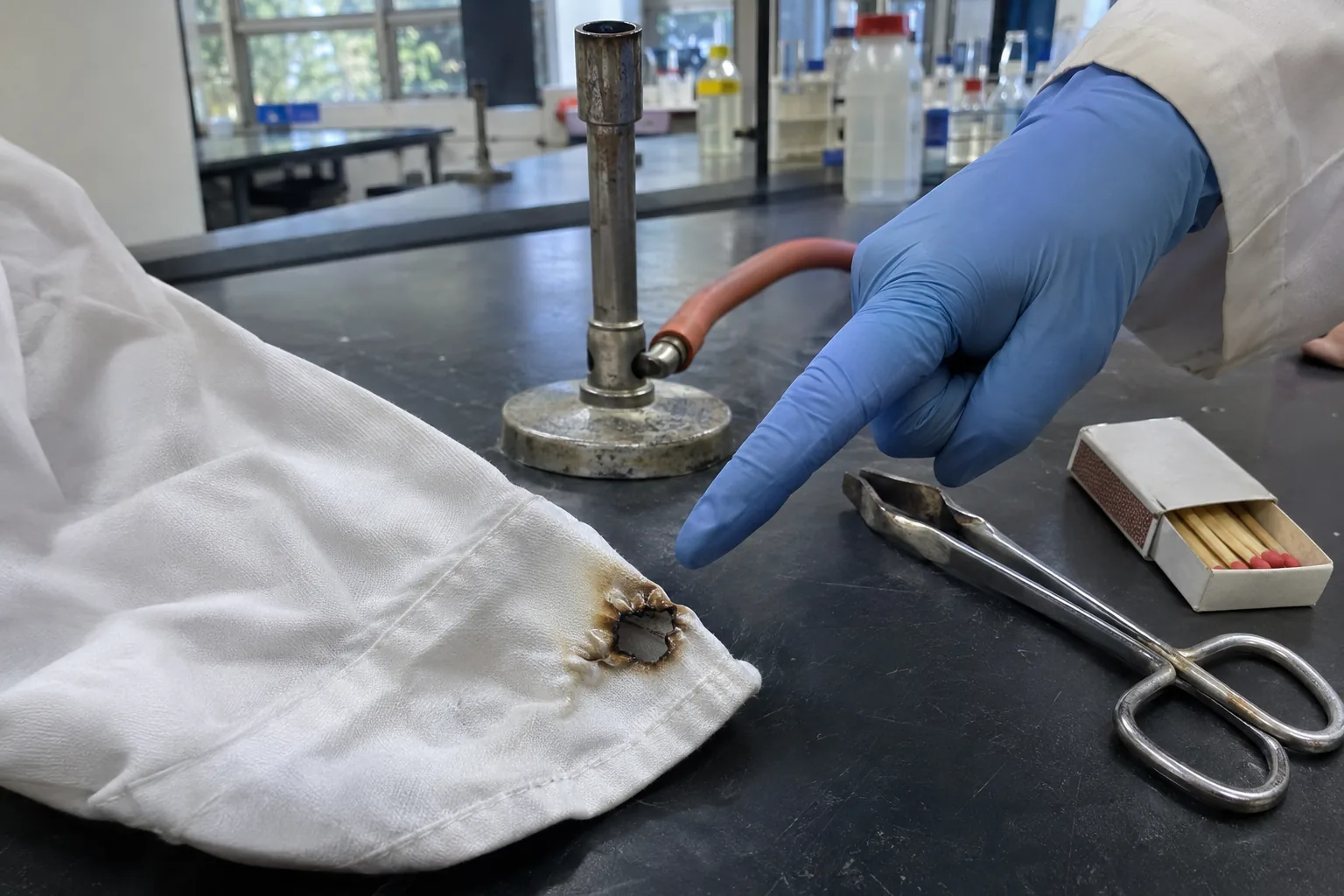
My first lab coat was a unisex medium from a department stockroom. The sleeves covered my knuckles, the shoulder seams sat halfway down my arms and the hem hit mid-thigh. In my first Bunsen burner practical as a demonstrator I reached across the bench for a clamp, and the loose cuff swung through the flame. The polyester blend did not catch. It shrank into a hard brown crust and stuck to the hair on my wrist. I was not hurt, and I had a cotton coat with snug cuffs the following week.
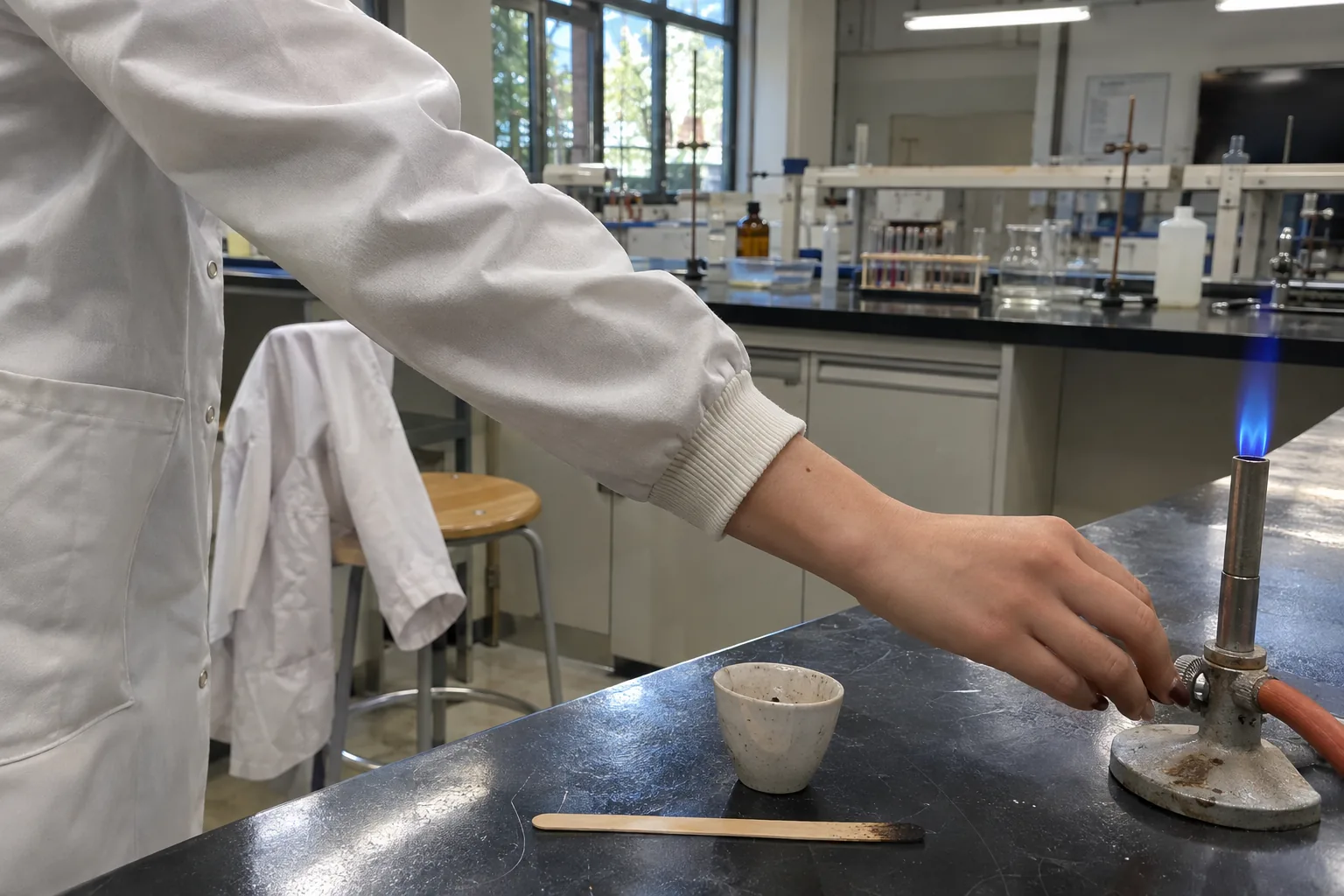
That week taught me the two things this guide is built on. Fabric decides what a coat protects you from, and cut decides whether you can work in it. A coat that fits your shoulders and ends at your wrists gets worn and buttoned. A coat cut for someone else gets left open, sleeves pushed up, which defeats the point of wearing one. The eight coats below are sorted by the kind of lab you work in.
Quick picks
| Lab coat | Best for | Fabric |
|---|---|---|
| Dickies Contemporary Fit 37″ | Best overall, biology and teaching | 60% cotton, 40% polyester |
| Lab Coat Project Curie | Chemistry with flames | 100% cotton |
| Bulwark FR chemical protection coat | Fire risk and solvents | Meta-aramid flame resistant |
| Grey’s Anatomy by Barco Hannah | Stretch and the widest size range | 55% polyester, 45% cotton |
| Adar Universal Stretch tab-waist | Most cotton in a stretch coat | 55% cotton, 42% polyester, 3% spandex |
| Healing Hands Flo | Clinical and cell culture labs | Stretch polyester twill |
| VOGRYE women’s lab coat | Budget and classroom use | 65% polyester, 35% cotton |
| Greenour disposable lab coats | Spares and one-off visits | Polypropylene nonwoven |
What to check before you buy a women’s lab coat
Fabric decides the protection
Chemistry departments argue about fabric more than about anything else on a lab coat, and the argument has a physical basis. Cotton chars when it burns. Polyester is a thermoplastic: it softens, shrinks away from the heat and fuses to whatever is under it, which is your skin. USC’s chemistry department puts it plainly: a cotton coat is not as fire resistant as Nomex or treated cotton, but unlike a synthetic blend it will not melt and adhere to the wearer.
The policies that follow from this differ by school. The University of Pennsylvania requires 100% cotton for most chemical handling and fire-resistant coats for open flame, liquid pyrophorics or large volumes of flammable liquids. The University of Toronto rates polyester-cotton blends as common and suitable for clinical labs and biological work, but not for flammables. Read your own department’s rule before you order, because a coat that is fine in one lab can be banned in the next.
| Fabric | Use it for | Avoid it for |
|---|---|---|
| 100% cotton | General chemistry, Bunsen burners, small volumes of solvents | Pyrophorics and large flammable volumes |
| Flame-resistant aramid or treated cotton | Open flame, pyrophorics, large flammable volumes | Nothing, but it costs the most |
| Polyester-cotton blend | Biology, teaching labs without flames, cell culture, clinical work | Flames and hot work |
| 100% polyester | Fluid-barrier use with biological samples | Any heat source |
| Disposable polypropylene | Short visits, dry particles, spares | Flames and daily wear |
Women’s cut or unisex
A unisex coat is patterned on a male torso. The shoulders are wide, the chest is straight, the armholes are deep and the waist hangs loose. On many women that means sleeves that run long and a front that gapes when you lean over a bench. A women’s coat adds princess seams or darts, a shaped waist, a back belt and narrower shoulders, so it sits close without pulling.
Unisex is still the right choice in two cases. If you are broad through the shoulders, a unisex coat in a smaller size may fit better than any women’s cut. If you layer a sweater under the coat in a cold building, the extra room helps. Everything else is easier in a women’s cut.
Length
Lab coats come in two lengths. Hip-length coats around 30 to 33 inches suit teaching, clinical work and anyone who sits at a bench. Knee-length coats from 36 to 40 inches cover the thighs, which are what a splash from a bench height hits first. For chemistry, buy knee length. A short coat leaves your trousers or skirt as the only thing between you and the spill.
Cuffs and closures
Knit cuffs hold the sleeve at the wrist and keep it out of reagents and flames. Open cuffs are fine for a short coat in a teaching room and a poor idea around a burner. For the front, snaps beat buttons in a chemistry lab, because a snap front tears open in one pull if you need to get a coat off fast. Buttons are fine elsewhere.
Best lab coats for women in chemistry labs
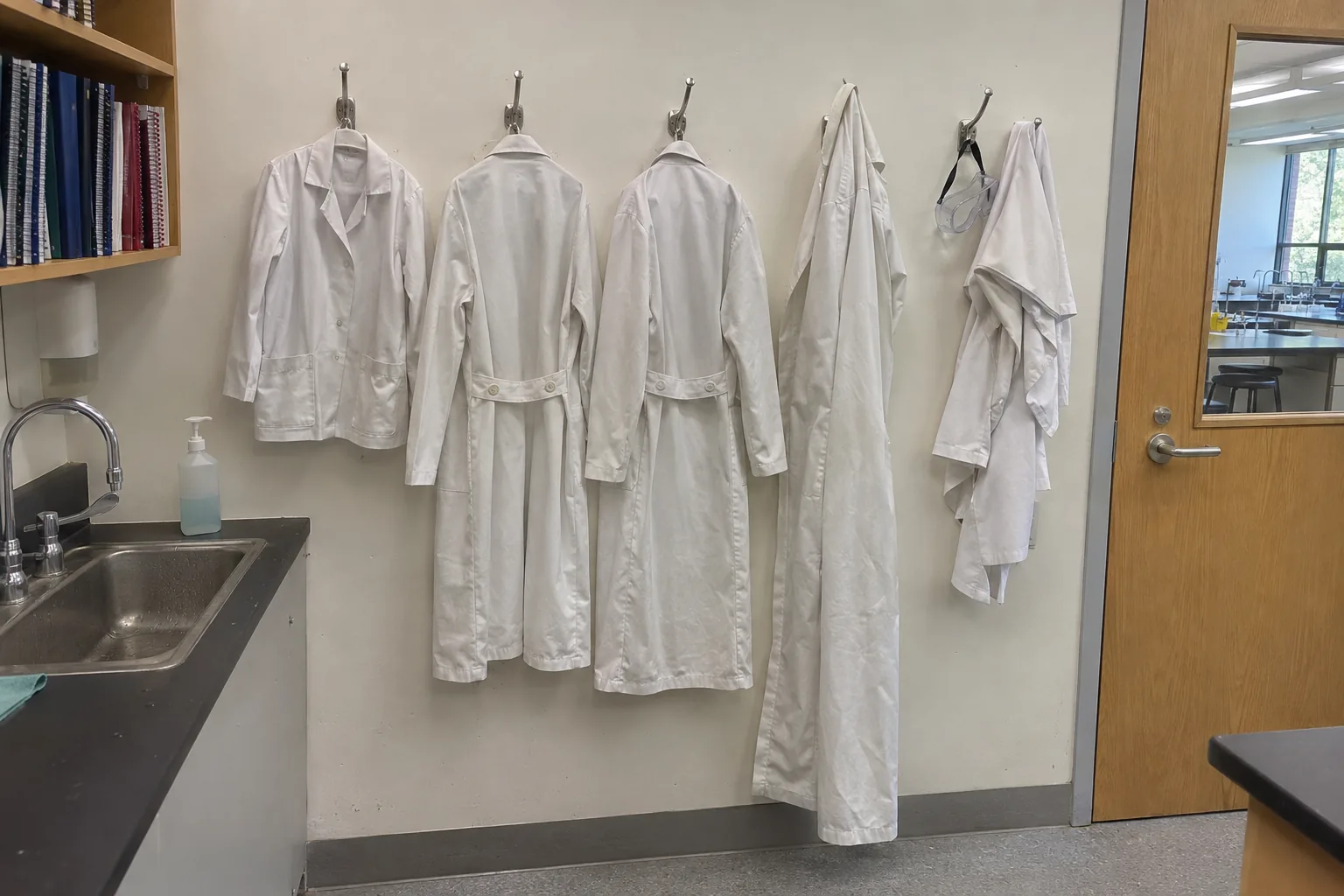
These two coats are for labs where fire is a real hazard. One is cotton for flames in a teaching lab, and one is flame resistant for harder work.
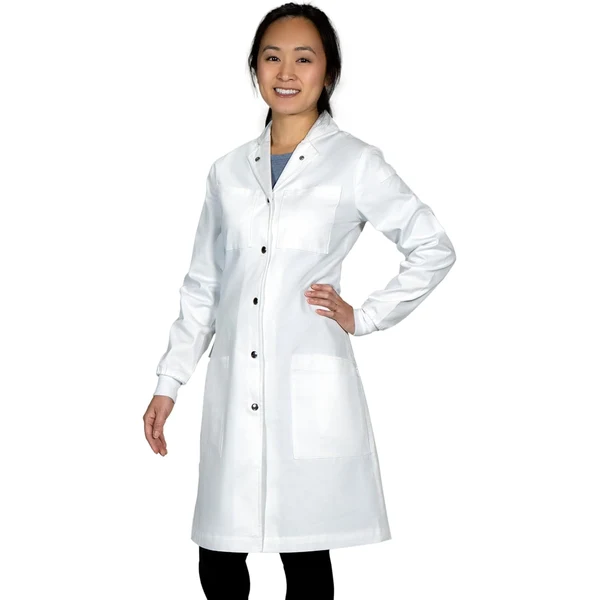
Best for chemistry labs
1. The Lab Coat Project Curie (Genius Lab Gear)
The Curie is built for the rule most undergraduate chemistry courses start with: 100% cotton, metal snaps, knit cuffs and a knee-length hem. It has a princess cut, an adjustable belt that cinches the waist and a convertible collar that flips up to close the neck. The maker says the design came from surveys of more than 1,000 researchers and 12 design revisions, and the result shows in the details. There are six pockets, sized for a phone, earbuds, an A5 notebook and a row of pens. Two loops sit on the shoulders for a marker or a badge.
Cotton does not melt onto skin, which is why chemistry departments ask for it around Bunsen burners. It is not flame resistant, so it is the right coat for a teaching lab and the wrong one for pyrophorics. Sizes run from XXS to 4XL, and it also comes in black, sapphire blue, faded pink and spruce green.
- 100% cotton, metal snap front, rib knit cuffs, knee length
- Six pockets, shoulder loops, adjustable belt
- XXS to 4XL, no stretch
Good: meets the cotton, snap and long-hem rules in one coat, and it is cut for women. Not great: a newer listing with far fewer ratings than the big sellers, and cotton wrinkles and has no give in the shoulders.
Check on Amazon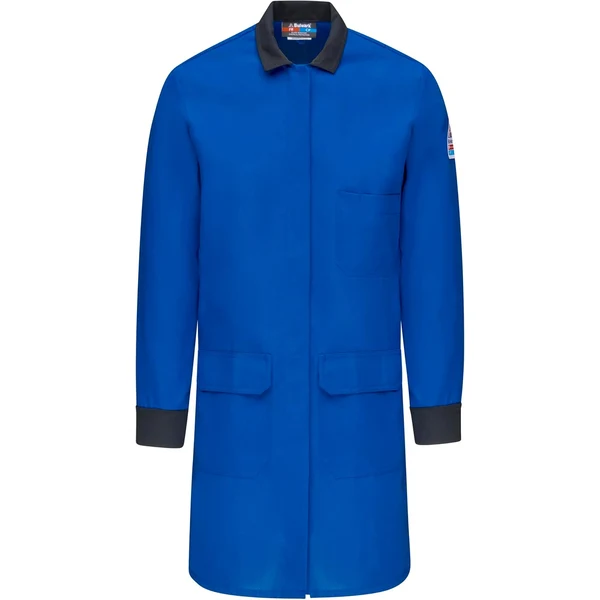
Best flame-resistant pick
2. Bulwark FR Women’s Chemical Protection Lab Coat
This coat is for the labs where cotton is not enough. The body is 93% meta-aramid, 5% para-aramid and 2% anti-static fiber, a Nomex-type fabric that does not melt or drip and stops burning when the flame is removed. A concealed snap front lets you open it in one pull. The knit cuffs are flame resistant too, which matters because the cuff is the part most likely to meet a flame. Pass-throughs let you reach the inner pockets without opening the coat, and the black collar marks it as a chemical protection coat.
It costs more than anything else here, and it is the only coat in this guide that belongs in a lab with liquid pyrophorics or large volumes of flammable liquids. If you want a more feminine cut, Bulwark also makes a women’s Nomex lab coat with princess seams.
- 93% meta-aramid, 5% para-aramid, 2% anti-static
- Concealed snaps, flame-resistant knit cuffs, splash-resistant pocket pass-throughs
- Chest pocket with a pencil stall and two flap pockets
Good: inherently flame resistant, so the protection does not wash out. Not great: it sits in the premium tier, the listing is new with few ratings, and the straight cut is less shaped than the other women’s coats.
Check on AmazonBest fitted lab coats for biology, teaching and general lab work
If your lab has no open flames and no pyrophorics, a polyester-cotton blend is the normal choice. It resists wrinkles, survives a hot wash and costs less than cotton. These five are cut for women, from the Dickies with the most cotton to the Healing Hands with the least.
Best overall
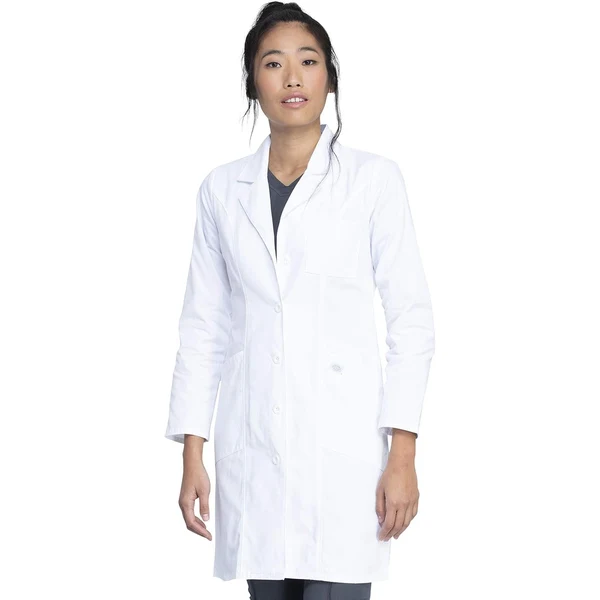
3. Dickies Contemporary Fit Women’s 37″ Twill Lab Coat
The Dickies coat has the highest cotton content of the blends here at 60% cotton and 40% polyester, in a brushed twill. It is 37 inches long, so it reaches the knee on most women, and it has front princess seams, a back yoke and a sewn-down back belt that shape the waist. It also has notched lapels, a button front and four outside pockets: a chest pocket, two large front pockets and a utility pocket on the left. Instrument loops are hidden inside the right pocket.
Sizes run from XS to 3XL, and more than 1,800 buyers rate it 4.5 stars. Reviewers describe the fabric as thick and well made, which fits the twill weave. It is a blend, so keep it out of flame work. For biology, anatomy, physiology and teaching labs, it is the coat to start with.
- 60% cotton, 40% polyester brushed twill, 37 inches long
- Princess seams, sewn-down back belt, four outside pockets
- XS to 3XL
Good: the most cotton and the best shaping of the blends, with a knee-length hem. Not great: button front rather than snaps, and no stretch in the fabric.
Check on Amazon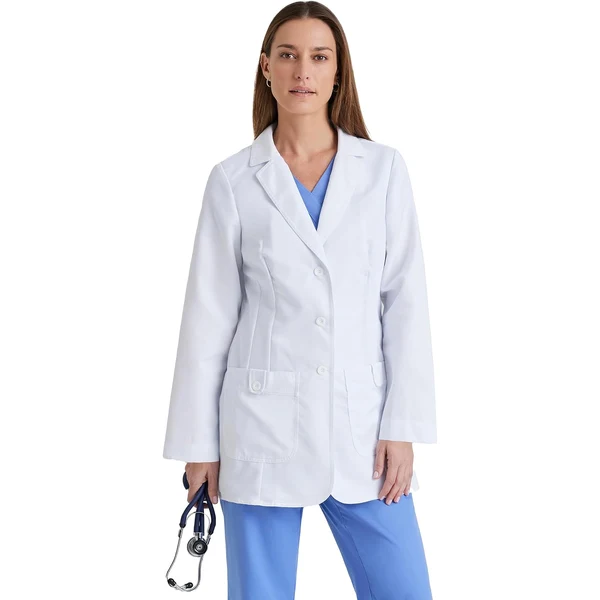
Best stretch and sizes
4. Grey’s Anatomy by Barco Hannah Lab Coat
The Hannah is a 31.5-inch coat in a 55% polyester, 45% cotton brushed twill with natural stretch and a back vent, which gives you room to reach across a bench or lean into a microscope. It has a tapered shape, a waist seam and darts at the front and back for a fitted line, plus a soil-release finish that keeps the white from yellowing. It comes in sizes from XXS to 5XL, the widest range in this guide.
It is a hip-length coat, so it covers less than the Dickies or the Curie. That suits teaching, clinical and cell culture work, and not much else. Reviewers praise the soft feel and the look, and they disagree about sizing, so read the size chart against your measurements instead of ordering your usual size.
- 55% polyester, 45% cotton twill with natural stretch
- 31.5 inches long, darts, waist seam, back vent
- XXS to 5XL
Good: stretch and the broadest size run, and it keeps its look through many washes. Not great: short for chemistry, and fit is inconsistent between buyers.
Check on Amazon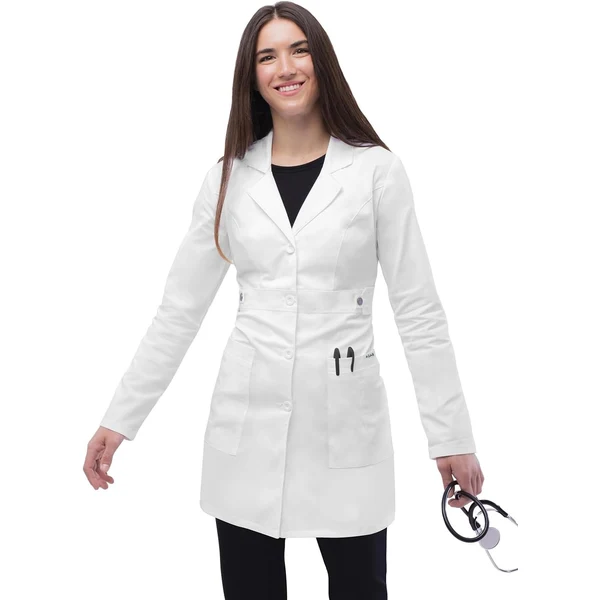
Best cotton-rich stretch
5. Adar Universal Stretch 36″ Tab-Waist Lab Coat
Adar gets stretch without giving up much cotton: 55% cotton, 42% polyester and 3% spandex in a twill the maker calls cotton-rich. It is 36 inches long, with princess seams in front and back, a back belt inset and a decorative snap tab at the waist. It is a plain design with two roomy lower patch pockets and a notched lapel, and it is tagless, so nothing scratches your neck.
Of the coats in this section only the Dickies has more cotton, and the spandex adds a little give for movement. Reviewers are split on the fabric: some like it and some find it thin, and they are split on sizing too, with some saying it runs big. Order against the chart.
- 55% cotton, 42% polyester, 3% spandex
- 36 inches long, princess seams, back belt inset, tagless
- Two patch pockets, snap tab at the waist is decorative
Good: stretch plus the second-highest cotton content in the blends, at knee-ish length. Not great: only two pockets, and the fabric is lighter than the Dickies.
Check on Amazon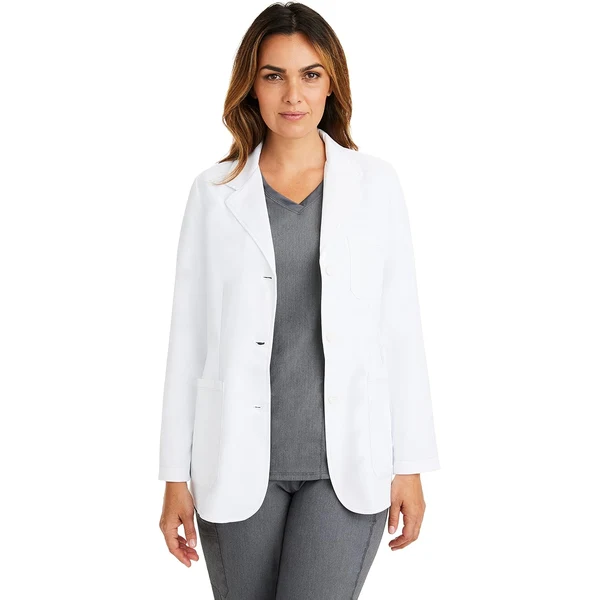
Best for clinical and cell culture labs
6. Healing Hands Flo Lab Coat
The Flo is the most comfortable coat here for a full day of sitting, pipetting and charting. The listing describes a 2-way stretch twill of 97% polyester and 3% spandex that wicks moisture, with a relaxed fit, a button front and four pockets: patch pockets, a chest pocket and an inside pocket. It is the highest rated coat in this guide at 4.7 stars from more than 1,100 ratings.
It is nearly all polyester, so it belongs in the clinical and biological column of the fabric table. Polyester also resists splashes of water-based reagents and culture media well. Keep it away from burners, hot plates and any solvent that could ignite.
- Stretch twill, listed as 97% polyester and 3% spandex
- Relaxed fit, button front, four pockets
- Moisture wicking and easy care
Good: comfortable stretch and the best rating of the group. Not great: synthetic fabric means no flames, and the relaxed fit is less shaped than the princess-seam coats.
Check on Amazon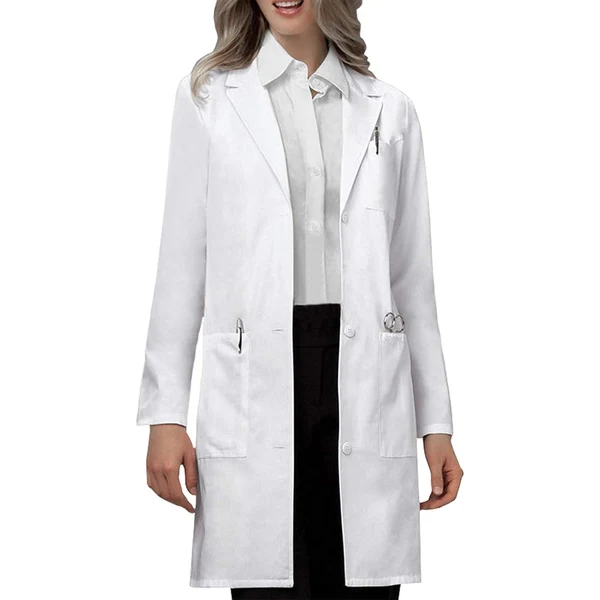
Best budget and classroom pick
7. VOGRYE Women’s Medical Lab Coat
The VOGRYE is the most-reviewed women’s lab coat in our search, with more than 12,000 ratings at 4.4 stars. It is a 65% polyester, 35% cotton blend with long sleeves, a button front and three pockets. The maker says it is cut with a waist and shoulder width scaled to each size, and that the fabric resists pilling and fading.
It is the coat for a high school or first-year lab that needs a basic white coat at the lowest cost, and for anyone buying a second or third coat to rotate between washes. The cut is plainer than the Dickies or the Hannah, and the fabric is a standard blend, so the same flame rules apply.
- 65% polyester, 35% cotton, machine washable
- Three pockets, long sleeves, button front
- More than 12,000 ratings
Good: the most proven coat here and the easiest on a budget. Not great: less shaping than the dedicated fitted coats and a high polyester share.
Check on AmazonBest disposable lab coats
Best disposable pick
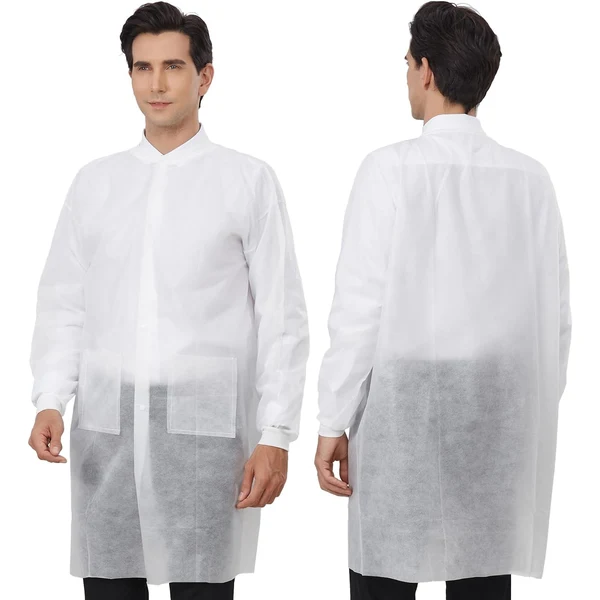
8. Greenour Disposable Lab Coats, 10-Pack
These are knee-length coats of low-linting, anti-static polypropylene nonwoven, with knit cuffs and collar, three pockets and a four-snap front. They come in sizes S to 2XL, and 487 buyers rate them 4.5 stars. The listing says they protect against splashes and dry particles and are sturdy enough to reuse several times.
A disposable coat is a spare, not a daily coat. Keep two in a drawer for a lab visit, a guest, a messy practical or the day your own coat is at the cleaners. It is unisex and cut straight, and a polypropylene coat melts near flame like any other synthetic.
- Polypropylene nonwoven, low linting, anti-static
- Knit cuffs and collar, four snaps, three pockets
- S to 2XL, 10 in a pack
Good: cheap per coat, with a snap front and knit cuffs. Not great: straight unisex cut, and it is not for flames or daily wear.
Check on AmazonHow to size a women’s lab coat
Women’s lab coat sizing is not standard across brands, and reviews on nearly every coat above disagree about fit. Skip your usual size and use the chart on the listing.
- Measure at the bust or chest, waist and hips. Use the largest of the three to pick the size, then check the others against the chart.
- Measure over what you wear in lab. If a sweater goes under the coat in winter, measure over it.
- Check the sleeve. The cuff should end at the wrist bone with your arms forward. A sleeve that covers your knuckles is a hazard at a bench.
- Check the length. For chemistry, the hem should reach at least the knee. The Dickies and Adar run 36 to 37 inches, and the Hannah is 31.5.
- Size down in unisex coats. A unisex small is often close to a women’s medium in chest width and longer in the sleeve.
Lab coat care and when to replace it
A lab coat that has touched chemicals is a contaminated garment. Many universities launder coats through a service, and some pay for it. Penn’s rules include a laundry service at no cost to lab employees. If your department has a service, use it, and do not wash a contaminated coat with the family laundry. Otherwise wash it alone on hot, and keep it out of your bag, your car and your kitchen between uses. Step by step, including stains and flame-resistant coats: how to wash a lab coat.
Replace a coat after a chemical splash that soaked through, when it has scorch marks or holes, and when the cuffs fray or the snaps no longer open cleanly. For a flame-resistant coat, follow the label. Bleach and fabric softener can reduce the flame resistance of treated fabrics, so check before you use either. OSHA’s personal protective equipment rule puts the choice of protective clothing on a hazard assessment, so ask your lab’s safety officer which fabric your work needs.
Coats are one part of your protective kit. Pair a coat with splash goggles from our guide to the best lab safety goggles, and see our laboratory equipment list for the rest of a bench setup. If you are buying for a chemist, a good coat also fits our best gifts for chemists. If you want a men’s cut, see our best lab coats for men.
The coat is one piece of the outfit. What to wear in a laboratory covers the shoes, pants, goggles and gloves that go with it.
FAQ
The Dickies Contemporary Fit 37-inch twill is the best lab coat for most women. It has princess seams, a back belt, a knee-length hem and sizes from XS to 3XL in a 60/40 cotton-polyester blend. For chemistry with flames, the 100% cotton Lab Coat Project Curie is the better choice.
Chemistry labs with open flames should use 100% cotton or a flame-resistant coat, because polyester melts and sticks to skin. Polyester-cotton blends are common and acceptable in biology, teaching and clinical labs without flames. Check your department’s policy, since some schools allow only cotton.
Knee length, about 36 to 40 inches, is the best choice for chemistry because it covers the thighs from bench-height splashes. Hip-length coats of about 30 to 33 inches suit teaching, clinical work and desk-heavy lab roles.
Yes. Women’s coats add princess seams or darts, a shaped waist, a back belt and narrower shoulders. Unisex coats are straight cut from a male pattern, and many women find the sleeves long and the front loose. A unisex coat can still be right if you are broad through the shoulders or want to layer under it.
Measure your bust or chest, waist and hips over what you wear in lab, and pick the size from the listing’s size chart using the largest measurement. Brands differ, and reviewers disagree about fit on several of these coats. The cuff should end at your wrist bone.
Not if it has touched chemicals. Many universities launder lab coats through a service, and some provide it at no cost. A coat that has never been used for chemical work can go in a hot wash on its own. Never wash it with household laundry.
Disposable coats work as spares, for guests and for messy one-off tasks. They are not for daily use or flames, and polypropylene melts near heat. Keep a few on hand and wear a washable coat for regular lab work.
Replace a coat after a splash that soaked through, after any scorch, burn or hole, and when the cuffs fray or the snaps stop working. A coat in regular use usually lasts a few years if it is laundered correctly.
Only if you work with liquid pyrophorics, open flame or large volumes of flammable liquids. Penn requires flame-resistant coats for that work. A teaching chemistry lab usually needs cotton, and a biology lab usually needs a poly-cotton blend.