As an Amazon Associate we earn from qualifying purchases. Disclosure
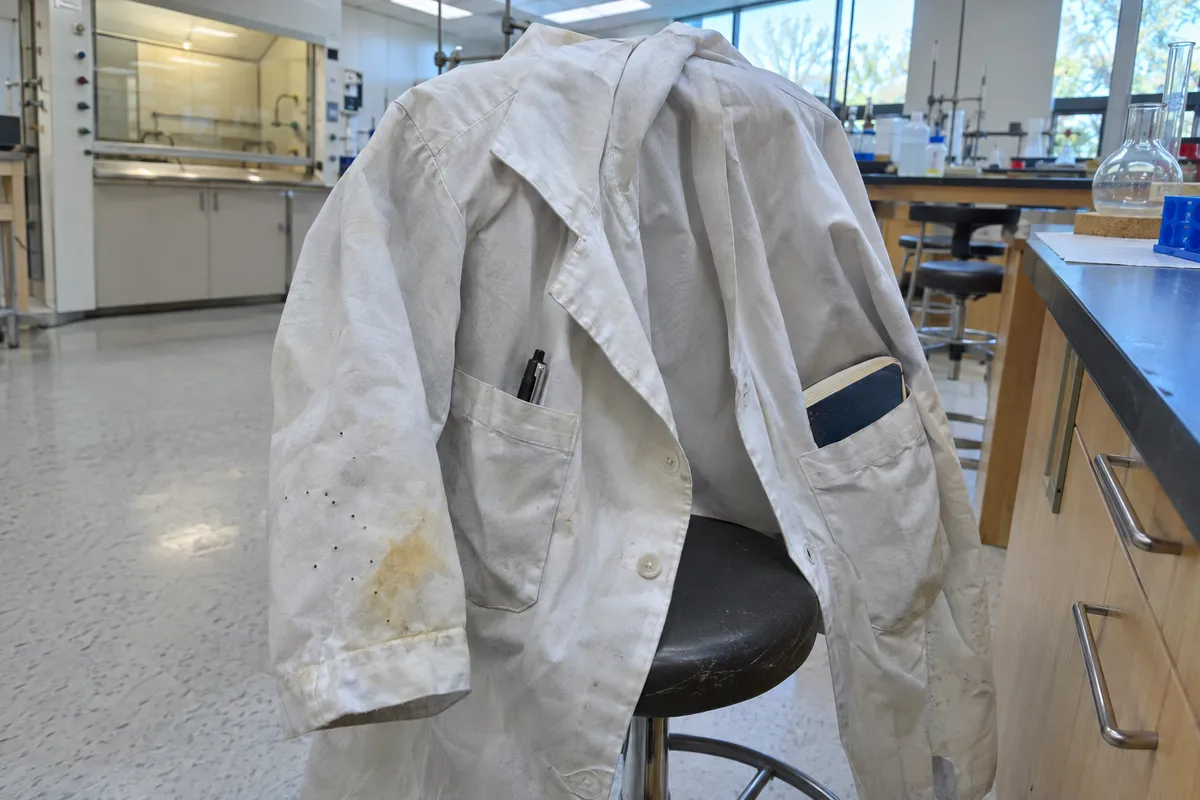
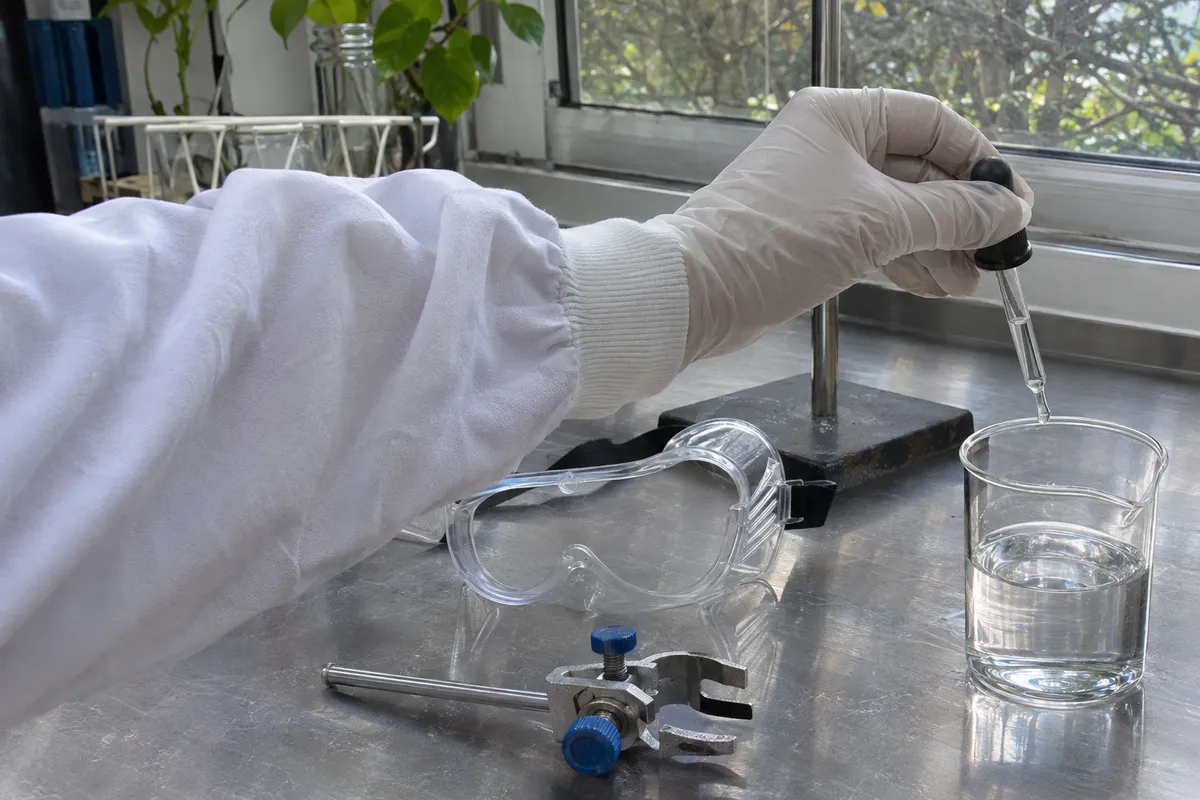
In my second term as an undergraduate lab demonstrator, a first-year borrowed the stockroom’s last spare coat. It was two sizes too big, and the sleeves covered his knuckles. Halfway through a titration he reached across the bench and dragged his right cuff through a puddle of 1 molar hydrochloric acid. He didn’t notice, and the coat didn’t show anything. Three days later he washed it and the cuff came apart in his hands.
Cotton absorbs acid, and as the water evaporates the acid gets stronger inside the fibers and breaks them down. A rinse at the sink straight after a splash would have saved the coat. A sleeve that stopped at his wrist would have kept it out of the puddle in the first place.
That is most of what matters when you buy a men’s lab coat: the fabric, the sleeve and the fit. The best lab coat for most men in a chemistry lab is the Lab Coat Project men’s coat, a 100% cotton coat with knit cuffs and snaps. For flames and flammable solvents, buy the Bulwark flame-resistant coat. For a cheap everyday coat, the VOGRYE is the most reviewed. The eight picks below cover chemistry, biology, teaching labs and visitors.
Quick picks
| Lab coat | Best for | Fabric |
|---|---|---|
| The Lab Coat Project men’s coat | Chemistry labs, Bunsen burners | 100% cotton twill |
| Bulwark FR 7 oz cotton lab coat | Flames and flammable solvents | Flame-resistant cotton |
| Red Kap cuffed lab coat | Snaps and knit cuffs for general labs | 80/20 polyester-cotton |
| VOGRYE men’s lab coat | Students and everyday use | 65/35 polyester-cotton |
| Dickies EDS 40-inch lab coat | Long coverage, classic look | 65/35 polyester-cotton |
| Healing Hands Luke | Comfort and movement in dry labs | 97/3 polyester-spandex |
| Barco Verse | Tailored fit, biology and clinics | Polyester stretch blend |
| Greenour disposable lab coats | Visitors, messy one-off jobs | Polypropylene |
How to choose a men’s lab coat
Four things decide whether a lab coat works: the fabric, how it closes, how long it is and how it fits through the shoulders and sleeves. Pockets and color come after.
Fabric: cotton, polyester blend or flame-resistant
Fabric is the one choice that is about safety and not comfort. Polyester melts. In a fire, a polyester-heavy coat shrinks and sticks to skin, which turns a surface burn into a deep one. Cotton chars instead and keeps its shape. University safety offices say the same thing: Arizona State’s lab coat guide warns against synthetic blends wherever fire is possible, and UCLA’s lab coat page treats them as a fuel source once lit.
| Fabric | Use it for | Examples here |
|---|---|---|
| 100% cotton | Teaching labs and any lab with burners or solvents | Lab Coat Project |
| Flame-resistant cotton | Pyrophoric reagents, large solvent volumes, flash-fire risk | Bulwark |
| Polyester-cotton blend | Biology, physics, electronics and general lab work with no flames | Red Kap, VOGRYE, Dickies |
| Polyester-spandex | Clinics and dry labs where comfort matters most | Healing Hands, Barco |
| Polypropylene (disposable) | Visitors and short messy jobs, never near flames | Greenour |
A flame-resistant coat is not a chemical-resistant coat. MIT’s lab coat guidance notes that a flame-resistant label says nothing about acid or solvent resistance. Treat any lab coat as a barrier for small splashes. For corrosives in volume, add an apron and work in the fume hood.
Closure: snaps or buttons
Snaps release when a coat catches or needs to come off fast. If a sleeve is soaked with something nasty, a snap coat comes open in one pull. Buttons look sharper and cost less, and they are fine for dry labs. In a chemistry lab, choose snaps.
Length: knee length or longer
A lab coat should reach the knee. Shorter consultation coats leave your thighs open to drips from a bench edge. If you are over six feet tall, check the length in the listing: the 41-inch VOGRYE and the 41.5-inch Red Kap run longer than the 38-inch Barco.
Sleeves and cuffs
Knit cuffs grip the wrist so a sleeve doesn’t drag across the bench or swing into a flame. Open cuffs are cooler and easier to roll up, but they are what pulled that acid across the bench in my story. In a wet lab, knit cuffs or snap cuffs are worth having.
Fit
Most lab coats are sold as unisex and cut straight, which is why they hang off narrow shoulders and bunch under a wide back. A true men’s cut has wider shoulders, longer arms and a straighter body. If you are between sizes, size down for a cleaner fit and size up only if you wear a hoodie or sweater under it. The size chart further down covers measuring.
Best lab coats for men in chemistry labs
These three are for labs with heat, flames or solvents. Two are cotton, and the third is a polyester-cotton coat for general labs where flames are not in play.

Best overall for chemistry labs
1. The Lab Coat Project Men’s 100% Cotton Lab Coat
This is the coat I would give my brother. It is 100% cotton twill at 6.7 ounces per square yard, with metal snaps, knit cuffs and a knee-length body. The collar converts to a Howie-style stand-up collar. It has six pockets, including slots for pens and a phone, two shoulder loops for a badge or marker and a hip loop that holds safety glasses or a pipette.
The design comes from a crowdsourced project that surveyed more than 1,000 researchers and used fit data from over 600 men. The result is a men’s cut with wider shoulders and longer arms, plus a hidden adjustable belt that pulls the waist in so it doesn’t flap. The listing says it meets the usual freshman chemistry lab rules: 100% cotton, metal snaps, knit cuffs and knee length.
My brother Dev is 6 feet 3 inches and starting a chemistry master’s this year. He tried five coats in my kitchen, and this was the only one where the cuffs stayed at the wrist with his arms held out in front, as if over a flask.
- 100% cotton twill, 6.7 oz, snap front, knit cuffs
- Six pockets, shoulder loops and hip utility loop
- Cut for men, with a hidden adjustable belt and back pleat
Good: meets cotton, snap and cuff rules in one coat; the fit is made for men and not borrowed from a unisex pattern. Not great: it is not flame resistant, only cotton, and it sits at the premium end of this guide.
Check on Amazon
Best flame-resistant lab coat
2. Bulwark Flame Resistant 7 oz Cotton Lab Coat
Plain cotton is better than polyester near a flame, but it is not flame resistant, and it will burn. A flame-resistant coat is treated or built so it stops burning when the flame goes away. My partner is a synthetic organic chemist, and their group wears a coat like this one whenever they handle tert-butyllithium, which ignites in air.
The Bulwark is 7-ounce flame-resistant cotton with a five-button front, a lapel collar, hemmed sleeve ends and side vents. The listing says it is certified by Underwriters Laboratories to NFPA 2112, the standard for garments worn where a flash fire is possible, with an arc rating of 7.7 calories per square centimeter. You can read the NFPA 2112 summary on the CDC’s PPE-Info site.
It is cut loose. That helps for layering and for getting it off fast, and it looks like a work coat and not a tailored one.
- Flame-resistant cotton, 7 oz, NFPA 2112 listed
- Five buttons, lapel collar, side vents, hemmed sleeves
- Left chest pocket and two patch pockets
Good: the only coat here that stops burning on its own; the listing says it can be washed again and again. Not great: buttons and not snaps, hemmed cuffs and not knit, and flame resistant is not acid or solvent proof.
Check on Amazon
Best snap-front coat with knit cuffs
3. Red Kap Specialized Cuffed Lab Coat
Red Kap has made work uniforms for decades, and this is the kind of plain coat that stockrooms and teaching labs buy in bulk. It is 80% polyester and 20% combed cotton, so it shrugs off wrinkles and dries fast. Snaps replace buttons, which means nothing to sew back on and a fast exit if you need one. The knit cuffs sit at the wrist.
It is 41.5 inches long with a chest pocket and two lower pockets, all outside. The fit is straight and true to size according to buyers. It is sold as unisex, which means broad-shouldered men get the best result from it.
The polyester content is the limit. This is the coat for a general teaching lab, a materials lab or a biology lab, and a poor choice next to a burner. If your lab requires 100% cotton, take the Lab Coat Project instead.
- 80% polyester, 20% combed cotton, 41.5 inches long
- Snap front, knit cuffs, no side vents
- Chest pocket plus two lower pockets
Good: snaps and cuffs at a plain price, durable and low maintenance. Not great: synthetic blend, so no burners and no pyrophoric work, and it comes in unisex sizing.
Check on Amazon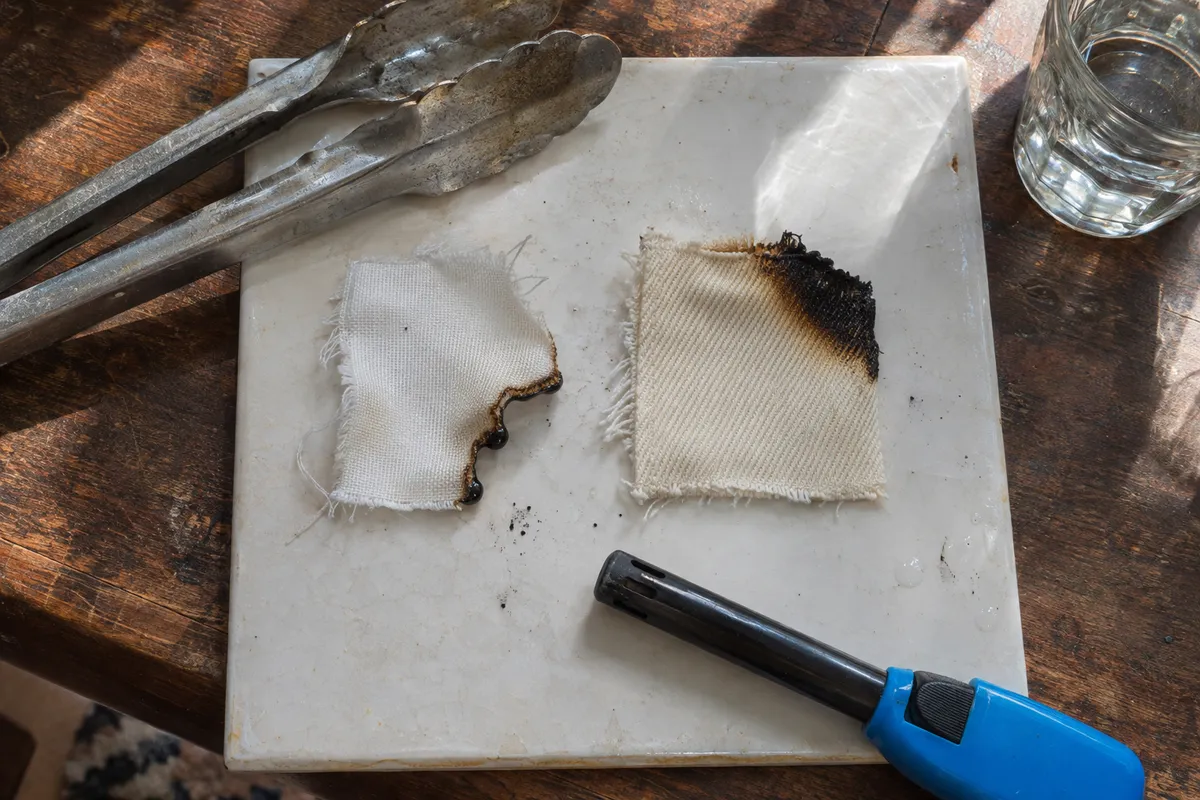
Best everyday and budget lab coats for men
For biology, physics, electronics and teaching, where nobody lights anything, a polyester-cotton coat costs less and lasts longer between washes. These two are the best known.

Best budget lab coat
4. VOGRYE Men’s Lab Coat with 3 Pockets
With more than 10,000 reviews and a 4.4 rating, the VOGRYE is the most reviewed men’s lab coat in our Amazon search, and the listing shows more than 2,000 bought in the past month. It is 65% polyester and 35% cotton, 41 inches long, with three front buttons, a notched lapel and a kick pleat at the hem.
It comes in sizes XS to 4XL, so it covers big men as well as slim ones, and in white, black or navy. The shoulders are cut roomy and the sleeves run long on tall wearers. The seller recommends ordering one size down for a closer fit and one size up if you layer. Two large lower pockets hold a phone or notebook, and a flat inner chest pocket takes a badge.
The listing itself calls it a light classroom coat and says to choose something heavier for open chemicals. Take that seriously. It is a coat for lectures, labs without flames and general bench work.
- 65% polyester, 35% cotton, medium weight, 41 inches long
- XS to 4XL, white, black or navy
- Two lower pockets and a flat inner chest pocket
Good: huge review base, wide size run, cheap enough to own two. Not great: synthetic blend, buttons, open cuffs, and the maker says it is not for heavy chemical work.
Check on Amazon
Best classic long lab coat
5. Dickies EDS 40-Inch Professional Lab Coat
The Dickies is a straightforward long white coat. It is 40 inches from shoulder to hem in a 65/35 polyester-cotton poplin, with a notched lapel, a four-button front, a back yoke and a kick pleat for walking and reaching. A chest pocket takes pens and tools, and two lower patch pockets have side entry so you can reach your trouser pockets without unbuttoning.
The back yoke is the detail to notice. It is a separate panel across the upper back that lets the shoulders move without pulling the front open. Cheaper coats skip it, and you feel it when you reach for a shelf.
Like the VOGRYE, it is a dry-lab coat. It looks right in a research office, a teaching lab or a biology bench, and it has the same polyester-blend limit around flames.
- 65% polyester, 35% cotton poplin, 40 inches long
- Four buttons, notched lapel, back yoke, kick pleat
- Chest pocket and two side-entry patch pockets
Good: a classic, tidy look with real mobility features; over 4,700 ratings at 4.5. Not great: unisex cut, buttons, no cuffs, and no flames.
Check on AmazonBest stretch and tailored lab coats for dry labs and clinics
If you spend your day at a computer, a microscope or a patient, a stretch fabric makes more difference than flame resistance. These coats are for that kind of work.
Best stretch lab coat
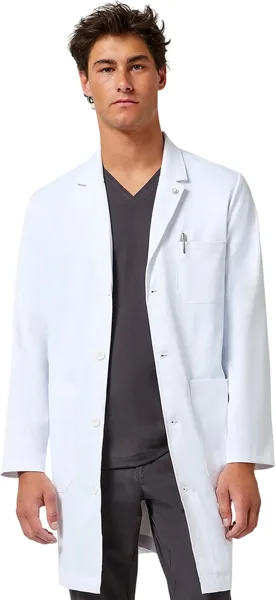
6. Healing Hands Luke Men’s Lab Coat
The Luke is a 97% polyester, 3% spandex twill with two-way stretch. It is a relaxed fit with five pockets: two patch pockets, a chest pocket and a dedicated cell phone pocket. Hidden side slits let you reach your trouser pockets, and the fabric is wrinkle resistant and machine washable.
It gets worn more than a stiffer coat simply because it is comfortable. For a postdoc running cell culture, a lab manager who is on a laptop half the day or a student in an imaging lab, that matters. It has far fewer reviews than the Red Kap or Dickies, but the 4.6 rating across 45 reviews is consistent.
It is almost entirely synthetic. Keep it away from burners and open flames, and from any lab that requires cotton.
- 97% polyester, 3% spandex twill, two-way stretch
- Five pockets including a phone pocket
- Hidden side slits, relaxed fit, wrinkle resistant
Good: the most comfortable coat here, with a pocket that fits a phone. Not great: 45 reviews is a small base, buttons only and no flame use.
Check on Amazon
Best tailored lab coat
7. Barco Verse Men’s Lab Coat
The Barco Verse is cut closer to the body than the other coats here, with defined shoulder lines, a notched lapel and finished interior seams. It is 38 inches at the center back with a 26-inch sleeve, in a 90% polyester and 10% stretch blend with a soil-release and water-resistant finish. There are three pockets, including top-entry waist pockets that fit a tablet.
The listing prints the sleeve and length numbers, so check them against your own measurements. At 38 inches it is shorter than the Red Kap or the VOGRYE, so very tall men may want one of those instead.
This is a coat for biology, teaching hospitals and anyone who presents in front of a room. It is not for a chemistry bench.
- 90% polyester, 10% stretch fiber, 38 inches at center back
- Three pockets, side slits, vents at the back and sleeves
- Soil-release and water-resistant finish
Good: the sharpest fit of the group, stretch and vents for movement. Not great: 43 reviews, shorter length, and not for flames or heavy chemical work.
Check on AmazonBest disposable lab coat
Best disposable lab coats
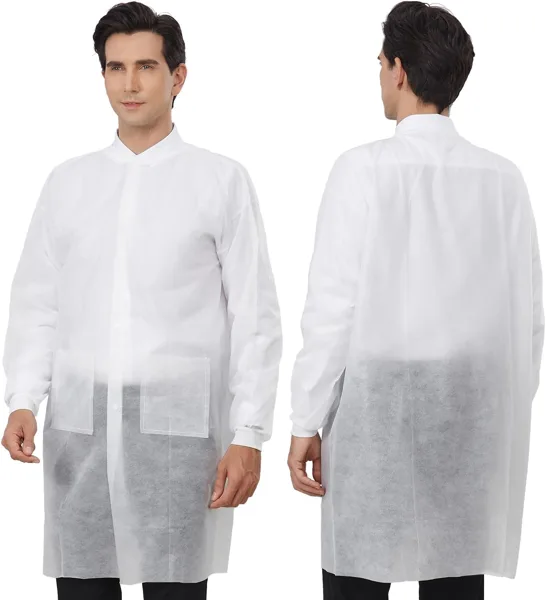
8. Greenour Disposable Lab Coats, 10-Pack
Disposable coats are the right answer for visitors, parents on a school lab day and any job where you expect to throw the coat away: painting, cleaning, a messy demo. The Greenour pack of 10 is made from polypropylene non-woven fabric with a knit collar and knit wrists, three pockets and a four-snap front. The listing gives the length as 82 centimeters for size Large, which is about knee length.
At CERN, a box of disposable coats sat at the door of the detector hall for visitor days. They did their job, but broad-shouldered visitors ripped them at the back seam in about five minutes, so size up if you are broad through the back.
The listing describes the fabric as low-linting and anti-static, and the coats can be worn more than once. They are a barrier for splashes and dust. They will melt, so never use one near a flame.
- Polypropylene non-woven, 10 coats per pack, sizes S to 2XL
- Knit collar and wrists, three pockets, snap front
- Disposable and latex free
Good: one pack covers a class or a year of visitors, and nothing to wash. Not great: not breathable, not for flames, and they tear if you pull hard at the back.
Check on AmazonLab coat size chart for men
Brand charts differ, so check the one on the listing before ordering. This chart is the typical US men’s range and is a starting point.
| Size | Chest (inches) | Typical height |
|---|---|---|
| Small | 34 to 36 | 5’6″ to 5’9″ |
| Medium | 38 to 40 | 5’8″ to 5’11” |
| Large | 42 to 44 | 5’10” to 6’1″ |
| X-Large | 46 to 48 | 6’0″ to 6’3″ |
| 2X-Large | 50 to 52 | 6’1″ and up |
| 3X-Large | 54 to 56 | 6’1″ and up |
To measure, wrap a tape around your chest at the fullest point, under the arms and over the shoulder blades. Then measure sleeve length from the base of your neck, across the shoulder and down to your wrist bone. Compare that to the sleeve number if the listing gives one (the Barco states 26 inches).
When Dev tried on coats, the test that told us the most was simple. He stood with his arms straight out in front, as if holding a flask, and I checked two things: do the cuffs still cover his wrist bone, and does the back pull across the shoulder blades? Two coats failed the first test and one failed the second.
Between sizes? Take the smaller size if the coat is cotton, since cotton relaxes with wear. Take the larger size if you wear a sweater under the coat in a cold lab.
How to care for a lab coat and when to replace it
- Rinse chemical splashes immediately. Water flushes most acids and bases out of cotton. Left to dry, they weaken the fibers, which is what happened to my student’s cuff.
- Wash it separately from your clothes. A coat carries traces of whatever is on your bench. Use the washer on hot and give it a rinse cycle, and check your lab’s policy first since many require the coat to be laundered by the institution. The full routine, with stains and flame-resistant coats, is in how to wash a lab coat.
- Never launder a flame-resistant coat with fabric softener or bleach. Both can reduce a coat’s flame resistance. Follow the care tag.
- Keep it in the lab. Don’t wear a lab coat in a cafeteria, library or at home. It carries what it picked up at the bench.
- Replace it when it is damaged. Holes, thin patches near the cuffs and pockets, stains that won’t wash out and burn marks are all reasons to replace the coat. A hole is a way for a splash to reach your skin. My own coat went into retirement when the pinholes in the left sleeve got big enough to put a finger through.
The right coat is one part of lab safety, and goggles are the other. For eye protection, see our best lab safety goggles, and for the rest of the setup, our best gifts for chemists covers gear that suits a bench. Women’s cuts are covered in our best lab coats for women. If you are working with strong acids, read our list of strong acids to know what you are handling, and see all our buying guides for more gear.
Before you buy, check what the lab requires. Our guide to what to wear in a laboratory covers pants, shoes, fabrics and gloves that go with the coat.
FAQ
Measure your chest at its fullest point and match it to the brand’s size chart. Most men fall between Medium (38 to 40 inches) and X-Large (46 to 48 inches). If you are between sizes, choose the smaller one for a cotton coat and the larger one if you layer.
A lab coat should end at the knee or slightly below. Coats around 38 to 42 inches from the shoulder to the hem cover most men. Shorter consultation coats around 30 inches leave your thighs exposed and are not suitable for chemistry.
Cotton is better wherever there is a flame, hot plate or flammable solvent, because polyester melts and sticks to skin. Polyester blends are better for dry work: they resist wrinkles, dry fast and cost less. For flash-fire risk, buy flame-resistant cotton.
Many university teaching labs do, along with snaps or buttons, knit cuffs and knee length. Check the syllabus or the lab manual before you buy, because a coat that does not meet the rule can be refused at the door.
A flame-resistant coat is made from fabric that stops burning when the flame is removed, and it is tested to a standard such as NFPA 2112. A normal cotton coat is not treated and will burn. Flame-resistant coats are not automatically resistant to acid or solvents.
Snaps are better in a chemistry lab. They let you remove the coat fast if it is soaked, and they don’t leave loose buttons. Buttons are fine in dry labs and look more formal.
Look for a coat that is 40 inches or longer and check the sleeve length. The Red Kap at 41.5 inches and the VOGRYE at 41 inches are among the longer picks here, and the Lab Coat Project is cut with longer arms for men.
Often yes, but many labs require institutional laundering for coats used with hazardous materials. If you wash a coat at home, wash it alone, and never wash it with food or family clothing.
Yes. A men’s cut has wider shoulders, longer arms and a straighter body. Many coats are sold as unisex, which fit most men, but narrow-shouldered or very tall men often prefer a men’s specific cut.
They protect against dust and small splashes, and they suit visitors and short jobs. They are made of plastic fibers that melt, so they should never be worn near flames or hot surfaces.
Sources
- Amazon product listings, fabric content, lengths, sizes and ratings for every coat above, checked November 2026.
- Arizona State University Environmental Health and Safety, Laboratory coat selection.
- UCLA Environment, Health and Safety, Laboratory coat types and fit.
- MIT Environment, Health and Safety, Laboratory coat selection, use and care.
- CDC NIOSH PPE-Info, NFPA 2112: Standard on flame-resistant garments for protection of industrial personnel against short-duration thermal exposures from fire.