TLDR
Dubnium (Db, element 105) has no commercial, medical, or industrial use. It’s used only in basic research, where scientists study a few atoms at a time to test how superheavy elements behave. Nobody has ever held a visible sample of it.
Contents
- Why dubnium has no practical uses
- What researchers do with dubnium
- Why a few atoms still matter
- How dubnium is made
- Dubnium fact table
- Is dubnium dangerous?
- FAQ
Why dubnium has no practical uses
The uses of dubnium come down to one: research. Three things rule out anything else.
First, dubnium doesn’t exist in nature. It’s synthetic, made by smashing lighter nuclei into heavier ones in a particle accelerator.
Second, the yield is tiny. A single experiment produces a handful of atoms, sometimes one at a time, and chemists have to work with whatever turns up before it decays.
Third, it doesn’t last. The longest-lived isotope, dubnium-268, has a half-life of roughly 16 to 28 hours, depending on the measurement. Most isotopes used in chemistry experiments last seconds to a minute or so. Dubnium-262, a common choice, has a half-life of around 30 seconds.
Add the price of the target materials and the accelerator time, and you get an element that can’t be stockpiled, shipped, or sold. Its neighbors tell a different story. Niobium sits directly above dubnium on the periodic table, and it goes into steel pipelines, jet engine alloys, and the superconducting magnets in MRI scanners. Tantalum, one row below niobium, is in phone capacitors and surgical implants. Dubnium belongs to the same column and does none of that.
What researchers do with dubnium
Dubnium’s job is to answer one question: does element 105 behave the way its position says it should?
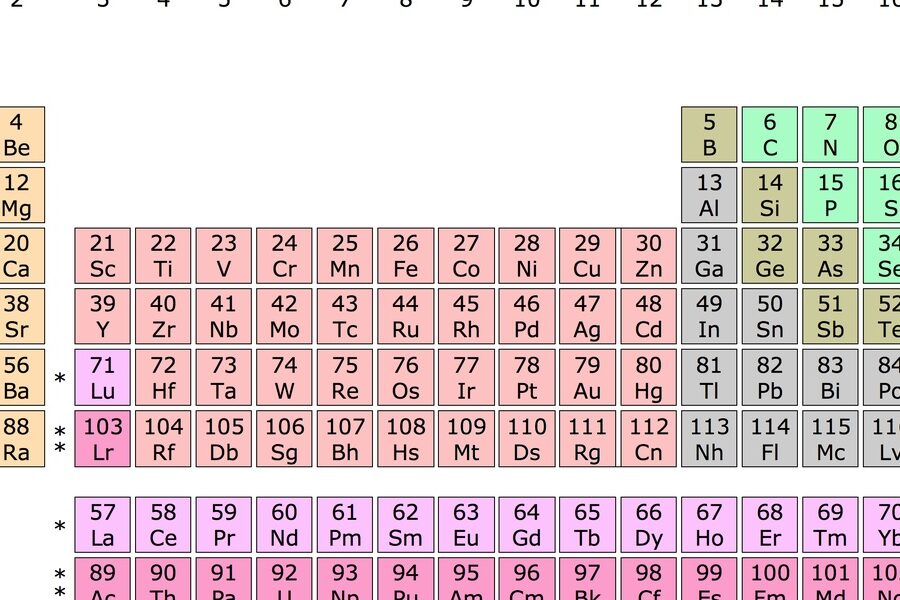
Dubnium sits in group 5 with vanadium, niobium, and tantalum, so chemists expect it to resemble niobium and tantalum. Testing that with a few atoms takes some ingenuity. Two approaches stand out.
Gas-phase chemistry. Researchers convert freshly made atoms into volatile compounds, such as chlorides or oxychlorides, and send them down a heated column. How far the compounds travel before sticking shows how volatile they are, and that can be compared against niobium and tantalum run under the same conditions. This is the oxychloride volatility work often cited in dubnium studies.
Solution chemistry. Other experiments dissolve dubnium atoms in acids and watch how they behave on resins or in liquid extractions. Some of these results fit the group 5 pattern. Others don’t line up neatly with niobium or tantalum, which is exactly why the experiments are worth repeating.
These are single-atom-scale experiments. Each run is fast, and the results are statistical: you count decays across many repeats rather than weigh anything.

Why a few atoms still matter
Dubnium’s real value is as a test case for relativistic effects. In heavy atoms, the inner electrons move at a large fraction of the speed of light. That changes the shape and energy of electron orbitals, and in turn the chemistry. At some point, an element can stop acting like the one above it. Dubnium is one of the checkpoints for where, and how much, that happens.
It also feeds a larger question about the limits of the periodic table: how heavy can a nucleus get and still hold together? Theory predicts an “island of stability,” a region of superheavy nuclei near 114 to 126 protons and 184 neutrons where half-lives could stretch much longer. Dubnium-268 has 163 neutrons, so it sits well short of that island. Measuring how stability changes from isotope to isotope tells nuclear physicists whether the models are right.
How dubnium is made
Both of the original syntheses used fusion reactions on heavy actinide targets:
- Californium-249 plus nitrogen-15. The Berkeley group reported this route in 1970, producing dubnium-260.
- Americium-243 plus neon-22. The Dubna team in the Soviet Union used this reaction in 1968 and 1970.
The nuclei fuse into an excited compound nucleus, which boils off a few neutrons and settles into an isotope of element 105. The target material, such as californium or berkelium, is itself produced in high-flux reactors in tiny quantities, which is a large part of the cost.
Dubnium fact table
| Property | Value |
|---|---|
| Symbol | Db |
| Atomic number | 105 |
| Group / period | 5 / 7 |
| Type | Synthetic, superheavy (transactinide) |
| Longest-lived isotope | Db-268, about 16 to 28 hours |
| Discovery | 1968 (Dubna), confirmed 1970 (Berkeley) |
| Named after | Dubna, Russia, home of the Joint Institute for Nuclear Research |
| Official name adopted | 1997 |
The name was contested for decades. Dubna and Berkeley both claimed the discovery, and Berkeley proposed “hahnium” after Otto Hahn. IUPAC settled on dubnium in 1997. More atomic data is available from Jefferson Lab’s element reference.
Is dubnium dangerous?
Technically it’s intensely radioactive, and its decays include spontaneous fission. In practice, the risk is negligible, because there’s never enough of it to matter and it’s gone within hours at most. The radiation hazards in a dubnium lab come from the targets and the accelerator, not from the element itself.
FAQ
What is dubnium used for? Basic research only. Scientists study its chemistry and nuclear properties to test periodic trends and models of superheavy nuclei.
Does dubnium have any medical or industrial use? No. It can’t be produced in usable amounts, and it decays too fast.
How long does dubnium last? The longest-lived known isotope, dubnium-268, has a half-life of about 16 to 28 hours. Isotopes used in chemistry experiments last seconds to about a minute.
Why is it called dubnium? It’s named for Dubna, the Russian city where the Joint Institute for Nuclear Research is based. IUPAC made the name official in 1997.
Is dubnium a metal? It’s expected to be a dense transition metal in group 5, though no one has seen a bulk sample to confirm it.