
Show the math
percent error = |measured − accepted| / |accepted| × 100|9.6 − 9.81| / |9.81| × 100 = 0.21 / 9.81 × 100 = 2.14%(9.6 − 9.81) / |9.81| × 100 = -2.14% (below the accepted value)The percent is rounded to 3 significant figures (auto). Change this in the Significant figures box. Absolute error is not rounded.Short answer: Percent error = |measured − accepted| / |accepted| × 100. For a measured 9.6 m/s2 against an accepted 9.81 m/s2, the error is 0.21 and the percent error is 2.14%, with the measured value below the accepted one.
Percent error compares a value you measured with a value accepted as correct, such as a handbook constant or a theoretical yield. It is the standard way to report accuracy in a chemistry or physics lab. The usual mistakes are dividing by the wrong number and dropping the sign when the report asks for direction. This page covers the formula, the steps, signs, zero, rounding and what to write in the report.
How to use the percent error calculator
Percent error formula
The percent error formula and the percent error equation are the same expression. Subtract the accepted value from the measured value, divide by the size of the accepted value and multiply by 100. The accepted value is whatever the lab treats as correct: a constant from a reference table, a theoretical yield or a target you set yourself, such as the concentration you planned with the dilution calculator. LibreTexts writes it with absolute value bars.
The absolute version is the textbook answer and is never negative. The signed version keeps the direction: positive means the measured value is above the accepted one and negative means below. Hope College keeps the sign in its lab guide, so check which one your course uses.
How to calculate percent error step by step
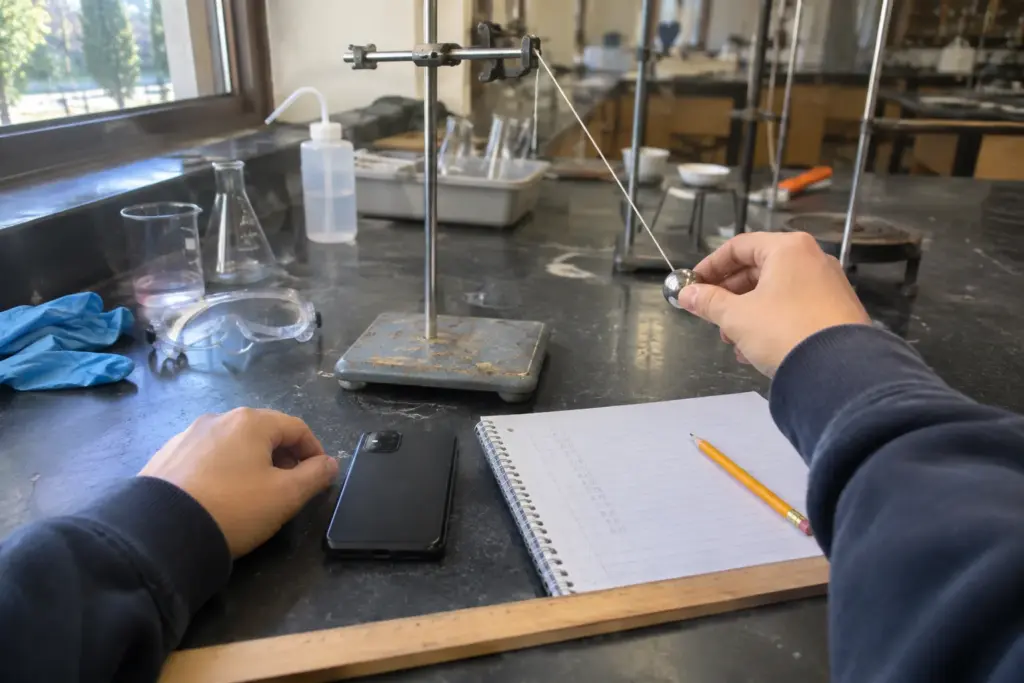
The default example is a pendulum measurement of gravity. Taking the accepted value as 9.80665 m/s2 from NIST instead of 9.81 gives 2.11%. A different accepted value gives a different percent error, so use the one your lab manual specifies.
| Example | Measured | Accepted | Absolute error | Percent error |
|---|---|---|---|---|
| Gravity | 9.6 m/s2 | 9.81 m/s2 | 0.21 | 2.14% (-2.14% signed) |
| Aluminum density | 2.45 g/cm3 | 2.70 g/cm3 | 0.25 | 9.26% (-9.26% signed) |
| Nitrogen density, mean of 3 trials | 0.10947 g/L | 0.1100 g/L | 0.000533 | 0.485% (-0.485% signed) |
The aluminum row is a classic textbook problem from CK-12: a student measures a density of 2.45 g/cm3 for a metal whose accepted value is 2.70 g/cm3, a 9.26% error.
Percent error with multiple trials
With several trials, average them first and take the percent error of the mean. Each trial can also get its own percent error, which shows how much the runs scatter. Three nitrogen density trials against 0.1100 g/L give a mean of 0.10947 g/L and a percent error of 0.485%.
| Trial | Density (g/L) | Signed percent error | Percent error |
|---|---|---|---|
| Trial 1 | 0.1093 | -0.636% | 0.636% |
| Trial 2 | 0.1102 | +0.182% | 0.182% |
| Trial 3 | 0.1089 | -1.00% | 1.00% |
| Mean | 0.10947 | -0.485% | 0.485% |
Keep the extra digits in the mean until the end. Rounding it to 0.1095 first, as some lab guides do, changes the answer to 0.455%. Percent error measures accuracy, the distance from the accepted value. The scatter among trials is precision, which the standard deviation calculator measures.
Can percent error be negative?
Yes, when you keep the sign. A negative percent error means the measured value is below the accepted one and a positive one means above. The default example is -2.14%. Most textbooks report the absolute value, so the answer is positive. Use the signed result when the report asks you to discuss direction.
Percent error has no upper limit. A measured value of 0 gives -100%, and a measured 25 against an accepted 10 gives 150%. When the accepted value is negative, the formula divides by its absolute value, so positive still means above. Measuring −270 against an accepted −273.15 is an absolute error of 3.15 and a signed percent error of +1.15%.
Why divide by the accepted value, and what if it is zero
The accepted value is the reference, so the percent error answers how large the miss is compared with the right answer. Dividing by the measured value changes the result. Dividing the default example by 9.6 gives 2.19% instead of 2.14%. At a bigger gap the difference grows: a measured 240 against an accepted 200 is 20.0%, and swapping the two gives 16.7%. The order of the inputs matters.
If you have no accepted value at all, such as two trials of an unknown sample, percent error does not apply. Use percent difference, described next.
Percent error vs percent difference vs percent change
The three formulas look alike and answer different questions. Percent error and percent change both divide the gap by a reference value: the accepted value in one and the starting value in the other. Percent difference has no reference value, so it divides by the average of the two and gives the same answer in either order.
| Percent error | Percent difference | Percent change | |
|---|---|---|---|
| Formula | |measured − accepted| / |accepted| × 100 | |A − B| / ((A + B) / 2) × 100 | (new − old) / |old| × 100 |
| Divides by | The accepted value | The average of the two values | The old (starting) value |
| Use when | A measurement is compared with a known or theoretical value | Two values are equally trustworthy, such as two trials or two methods | A quantity moved from a starting value, such as a population over time |
| Sign | Absolute by default; signed shows above or below | No sign; swapping the values changes nothing | Signed: positive is an increase, negative a decrease |
Ask which value is correct. If one is, use percent error. If neither is, use percent difference (Math Is Fun). If the question is how much something grew or shrank, use percent change (Math Is Fun). Some lab manuals call a comparison with a true value percent difference or percent discrepancy (Las Positas College), so go by the formula, not the name. Relative error is the same fraction as percent error before the × 100. Margin of error in a survey is a separate sampling statistic.
To compare two values when neither is the accepted one, the percent difference calculator returns the percent difference, the absolute difference and the average.
To measure how far a value moved from its starting point, the percent change calculator returns the percent increase or decrease and the absolute change.
Significant figures in a percent error
There is no formal rule for rounding a percent error. The usual practice is to match the least precise input, and the general rules for dividing and subtracting are in OpenStax. In the default example the measured value 9.6 has 2 significant figures, so 2.1% is the matching answer. Follow your instructor when a rule is given. Round only the final result and keep full digits in the steps.
| Significant figures | Percent error |
|---|---|
| 1 | 2% |
| 2 | 2.1% |
| 3 (calculator default) | 2.14% |
| 4 | 2.141% |
To count the digits in your inputs, use the significant figures calculator. To round to a set number of places, use the rounding calculator.
What is a good percent error?
No single cutoff exists. It depends on the instrument and the course. Published guidance gives rough benchmarks.
| Percent error | Typical reading | Source |
|---|---|---|
| About 5% or less | Acceptable in many first-year labs | University of Calgary |
| Under 0.5% | Expected in second-year analytical work | University of Calgary |
| Over 10% | Suggests a mistake in the procedure or the calculation | Las Positas College |
The default 2.14% sits inside the first-year range. When a result lands above 10%, check four things first: a unit mismatch between the two values, the wrong accepted value, a misread scale and the divisor.
How to write percent error in a lab report
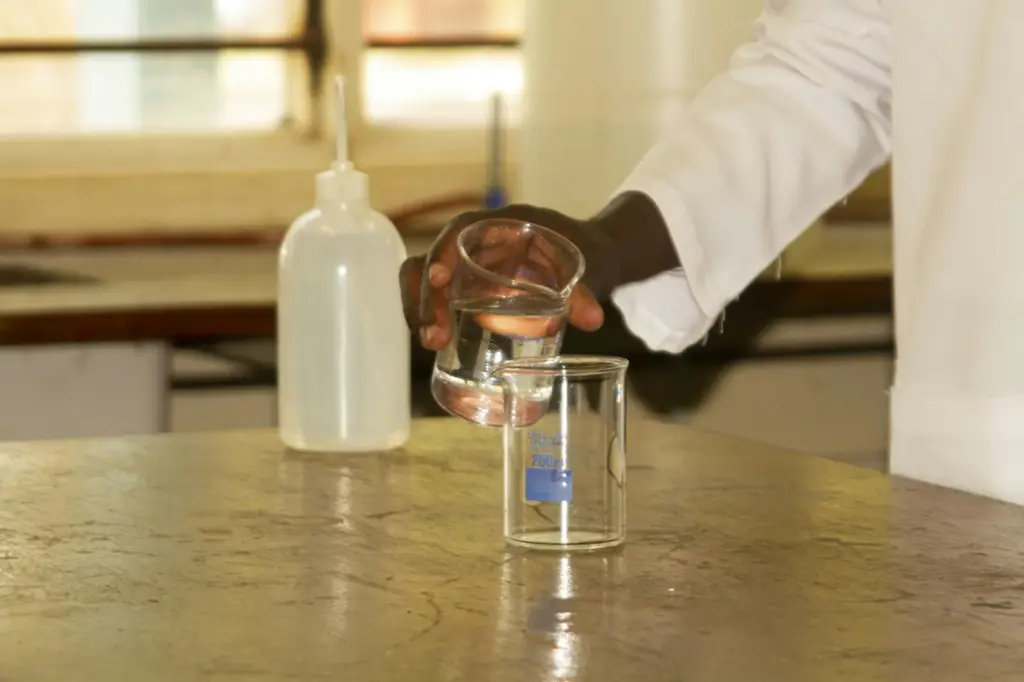
Give the measured value, the accepted value with its source, the working and a sentence on direction. For the default example the working is |9.6 − 9.81| / 9.81 × 100 = 2.14%.
Then explain the gap. When every trial lands on the same side of the accepted value, suspect a systematic cause such as an uncalibrated instrument or heat loss. When the trials scatter on both sides, suspect random reading error. The analysis step of the scientific method is where this discussion belongs.
Sources
- LibreTexts, University of Pittsburgh at Bradford. Percent Error
- LibreTexts, CK-12. Percent Error
- LibreTexts, Hope College. Accuracy and Precision
- Wikipedia. Approximation error
- NIST. Standard acceleration of gravity
- Math Is Fun. Percentage Difference
- Math Is Fun. Percentage Change
- OpenStax. University Physics Volume 1, Significant Figures
- University of Calgary. Accuracy and Precision
- Las Positas College. Understanding Experimental Error
Frequently asked questions
Percent error is the size of the gap between a measured value and an accepted value, shown as a percentage of the accepted value. It tells you how accurate a measurement is.
Percent error = |measured – accepted| / |accepted| x 100. The signed version drops the outer bars and keeps the direction.
Subtract the accepted value from the measured value, divide by the accepted value and multiply by 100. For a measured 9.6 and an accepted 9.81, the result is 2.14%.
Yes, if you keep the sign. A negative result means the measured value is below the accepted value, and the textbook answer is the absolute value.
Percent error is undefined because the formula divides by the accepted value. Report the absolute error instead.
No. Percent error compares a measurement with an accepted value and divides by that value. Percent difference compares two values with no reference and divides by their average.
Under about 5% is acceptable in many first-year labs and under 0.5% is expected in second-year analytical work. A result above 10% usually points to a mistake.
There is no fixed rule. Match the least precise input, or follow your instructor; the default example is 2.1% with 2 significant figures.