Radioactive decay is an unstable nucleus shedding energy or particles until it settles into something more stable. The best way to understand it is to watch specific isotopes do it, so here are 15 examples of radioactive decay, each with its nuclear equation, half-life, and the place you’ll actually run into it.
They’re grouped by decay type: alpha, beta-minus, beta-plus, electron capture, gamma, and a pair of rare modes. If you’re studying for an exam, the quick-reference table and the worked equation come first. If you’re just curious, skip to the bananas.
Contents
- Examples of radioactive decay at a glance
- How to balance a nuclear equation
- Alpha decay examples
- Beta-minus decay examples
- Beta-plus decay and electron capture examples
- Gamma decay examples
- Rare decay modes
- Half-life with a concrete example
- Decay chains and everyday sources
- Mistakes that circulate online
Examples of radioactive decay at a glance
Each type of decay changes the nucleus in a fixed way. Learn this table and most nuclear equations become bookkeeping. The EPA’s overview of radioactive decay covers the same basics if you want a second reference.
| Decay type | Particle emitted | Change in mass number (A) | Change in atomic number (Z) | Stopped by |
|---|---|---|---|---|
| Alpha | Helium-4 nucleus (2 protons, 2 neutrons) | −4 | −2 | A sheet of paper, skin |
| Beta-minus | Electron plus antineutrino | 0 | +1 | A few millimeters of aluminum |
| Beta-plus | Positron plus neutrino | 0 | −1 | Aluminum foil; the positron also annihilates with an electron almost at once |
| Electron capture | Neutrino only (the nucleus absorbs an inner electron) | 0 | −1 | The neutrino passes through nearly everything |
| Gamma | High-energy photon | 0 | 0 | Thick lead or concrete reduces it |
Alpha particles are the heaviest and slowest, which is why they’re the least penetrating. They’re also the most damaging if the source gets inside your body, because all that energy dumps into a few cells.
How to balance a nuclear equation
Two rules cover every case: the mass numbers on both sides must add up to the same total, and so must the atomic numbers (charges).
Worked example: americium-241 undergoes alpha decay. What’s the daughter nucleus?
- Write what you know:
²⁴¹Am (Z = 95) → X + ⁴He (Z = 2) - Balance mass: 241 = A + 4, so A = 237.
- Balance charge: 95 = Z + 2, so Z = 93.
- Look up element 93 on the periodic table. It’s neptunium.
Result: ²⁴¹Am → ²³⁷Np + ⁴He
A beta-minus case works the same way, with one twist. Lead-214 decays by beta-minus: ²¹⁴Pb (Z = 82) → X + e⁻ + ν̄. The electron has mass number 0 and charge −1, and the antineutrino has neither. Mass: 214 = A + 0, so A = 214. Charge: 82 = Z − 1, so Z = 83, which is bismuth. Result: ²¹⁴Pb → ²¹⁴Bi + e⁻ + ν̄.
Notice the neutron inside the nucleus turned into a proton. That’s what beta-minus decay is.
Alpha decay examples
Alpha decay happens in heavy nuclei, mostly above lead on the periodic table. The nucleus ejects a helium-4 nucleus, losing two protons and two neutrons. It does not lose electrons.
1. Uranium-238 to thorium-234
²³⁸U → ²³⁴Th + ⁴He
Check: 238 = 234 + 4 and 92 = 90 + 2.
Half-life: 4.47 billion years, about the age of the Earth. That’s why there’s still uranium to mine. It’s also why geologists can date rocks: a zircon crystal traps uranium when it forms, and the lead that piles up afterward is a clock. U-238 is the first step in a 14-step chain that ends at stable lead-206.
2. Radium-226 to radon-222
²²⁶Ra → ²²²Rn + ⁴He
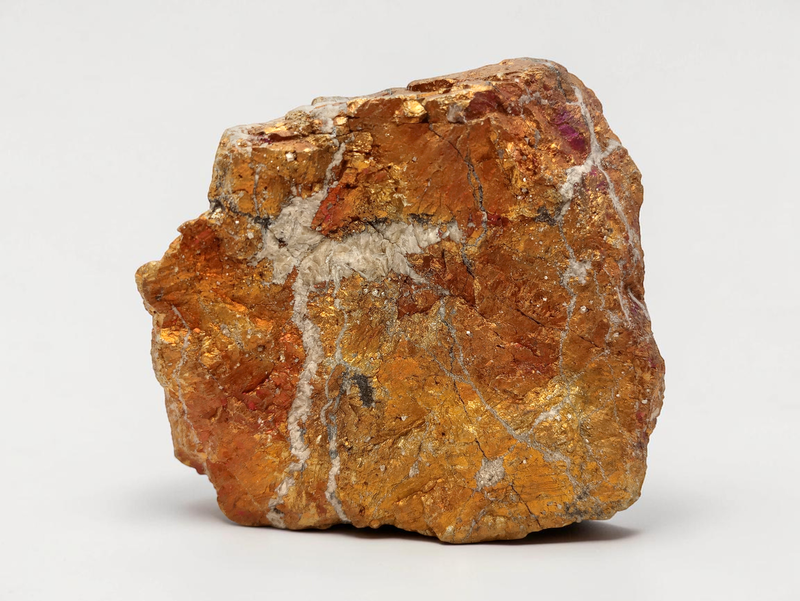
Half-life: about 1,600 years. Radium is a daughter product in the uranium-238 chain, and it’s the element Marie and Pierre Curie isolated from tons of pitchblende. It glowed, and for a few decades it went into luminous watch-dial paint. The workers who painted those dials paid for it.
3. Radon-222 to polonium-218
²²²Rn → ²¹⁸Po + ⁴He
Half-life: 3.82 days. Radon is a gas, so it seeps out of the ground and collects in basements. It’s the one decay on this list that most homeowners have a real chance of measuring. According to the EPA, radon is the leading cause of lung cancer among nonsmokers, and the agency recommends fixing homes that test at or above 4 picocuries per liter.
4. Americium-241 to neptunium-237
²⁴¹Am → ²³⁷Np + ⁴He
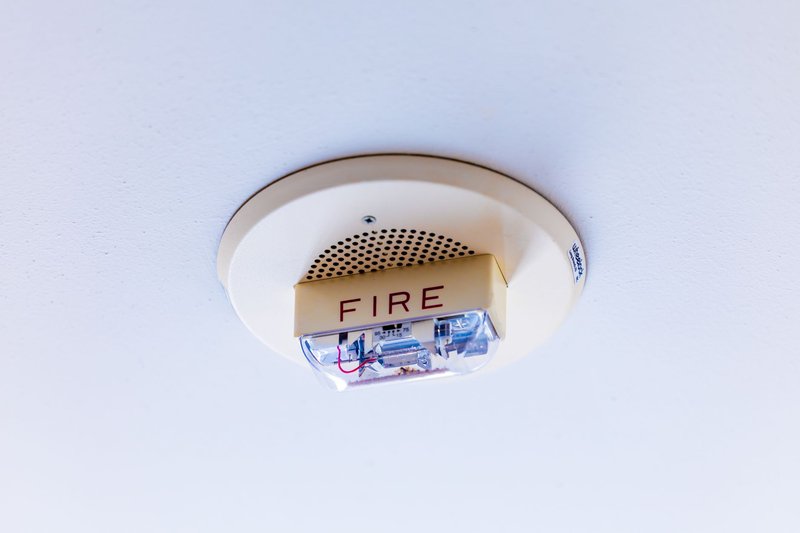
Half-life: about 432 years. This is the isotope in your smoke detector, not a beta emitter as some pages claim. A detector holds roughly a third of a microgram. The alpha particles ionize the air in a small chamber so a tiny current flows, and smoke particles disrupt that current and trip the alarm. The plastic casing stops the alphas, which is why the device is safe on a ceiling.
5. Polonium-210 to lead-206
²¹⁰Po → ²⁰⁶Pb + ⁴He
Half-life: 138 days. Polonium-210 is brutally short-lived by geological standards, so a sample loses half its activity in under five months. It’s also the isotope used in the 2006 London poisoning of Alexander Litvinenko. An alpha emitter is nearly harmless on your skin and lethal once swallowed.
6. Plutonium-238 to uranium-234
²³⁸Pu → ²³⁴U + ⁴He
Half-life: 87.7 years. Each alpha particle slams into the surrounding material and turns into heat. Spacecraft convert that heat to electricity in radioisotope thermoelectric generators. Voyager 1 and 2, launched in 1977, still run on it, and their power output falls a little every year, in line with the half-life.
Beta-minus decay examples
Beta-minus decay happens in nuclei with too many neutrons. Every element has isotopes with different neutron counts, and the isotope guide by element lists the natural isotopes of each one. A neutron converts into a proton, and the nucleus ejects an electron and an antineutrino. The mass number stays put and the atomic number goes up by one.
7. Carbon-14 to nitrogen-14
¹⁴C → ¹⁴N + e⁻ + ν̄
Half-life: 5,730 years. Cosmic rays hit nitrogen in the upper atmosphere and make C-14, which plants absorb as CO₂ and animals eat. While an organism lives, its C-14 level matches the atmosphere. After death, the C-14 decays and nothing replaces it. Measure what’s left and you can date wood, bone, or cloth back about 50,000 years. Willard Libby won the 1960 Nobel Prize in Chemistry for developing the method, and the EPA’s carbon-14 page explains how it forms.
8. Tritium (hydrogen-3) to helium-3
³H → ³He + e⁻ + ν̄
Half-life: 12.3 years. Tritium emits one of the weakest beta particles known, too feeble to get through skin or even the glass wall of a tube. That’s why it lights up self-powered emergency exit signs and some watch dials: the beta particles hit a phosphor coating and make it glow, for years, with no battery.
9. Potassium-40 to calcium-40
⁴⁰K → ⁴⁰Ca + e⁻ + ν̄
Half-life: 1.25 billion years. About 0.01% of all natural potassium is K-40, so anything containing potassium is slightly radioactive. A banana carries roughly 15 becquerels (15 decays per second), and your own body holds around 4,000. The banana dose is real but tiny, about 0.1 microsievert, a small fraction of a chest X-ray.
K-40 is a good reminder that one isotope can decay more than one way. About 89% of K-40 decays go to calcium-40 by beta-minus, as above. The other roughly 11% go to argon-40 by electron capture, and that branch is the basis of potassium-argon dating of volcanic rock.

Beta-plus decay and electron capture examples
Nuclei with too many protons have two ways to fix the imbalance. They can turn a proton into a neutron by emitting a positron (the antimatter twin of the electron), or by swallowing one of their own inner electrons. Either way, the atomic number drops by one.
10. Fluorine-18 to oxygen-18
¹⁸F → ¹⁸O + e⁺ + ν
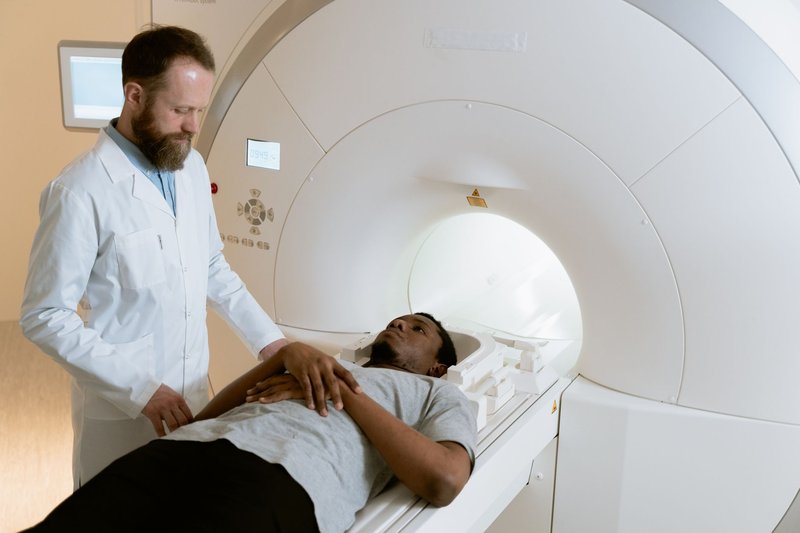
Half-life: 110 minutes. This is the isotope behind most PET scans. It’s attached to a glucose analog and injected, and it collects in tissue that burns a lot of sugar, like tumors and active brain regions. Each emitted positron meets an electron within a millimeter or so, and the pair annihilates into two gamma photons flying in opposite directions. The scanner detects those pairs and traces them back to their origin. A 110-minute half-life means hospitals need a cyclotron nearby, because F-18 is half gone by the time a delivery truck gets across town.
11. Beryllium-7 to lithium-7 (electron capture)
⁷Be + e⁻ → ⁷Li + ν
Half-life: 53 days. Cosmic rays continuously break up nitrogen and oxygen atoms in the atmosphere, producing Be-7, which rains out and can be measured in surface soil and air filters. Here’s the detail that makes it a good teaching example: beta-plus decay needs the nucleus to release at least 1.022 MeV, and Be-7 only has 0.86 MeV available. So positron emission is off the table and electron capture is the only route.
Gamma decay examples
Gamma decay changes neither mass number nor atomic number. A nucleus that’s already in an excited state drops to a lower energy level and emits a photon. It usually follows an alpha or beta decay, which leaves the daughter nucleus excited.
12. Technetium-99m to technetium-99
⁹⁹ᵐTc → ⁹⁹Tc + γ
Half-life: 6 hours. The “m” stands for metastable, an excited nuclear state that lingers long enough to be useful. Tc-99m emits a 140 keV gamma ray, an energy that passes out of the body easily and registers well on a gamma camera. It’s used in tens of millions of diagnostic scans a year, for bones, heart, and thyroid. Hospitals keep a molybdenum-99 generator on site and “milk” the technetium from it as needed. The leftover Tc-99 has a half-life of 211,000 years but is so weakly radioactive that it’s a minor waste concern.
13. Cobalt-60 to nickel-60 (beta, then gamma)
⁶⁰Co → ⁶⁰Ni* + e⁻ + ν̄, then ⁶⁰Ni* → ⁶⁰Ni + γ + γ
Half-life: 5.27 years. The asterisk marks an excited nucleus. Co-60 beta-decays into excited nickel-60, which immediately sheds two gamma rays at 1.17 and 1.33 MeV. Those energetic photons are used for external radiotherapy, for sterilizing surgical equipment, and for irradiating food. It’s a clean example of how gamma decay usually shows up in practice: as the second half of a two-step process.
Rare decay modes
These don’t appear in most introductory courses, but they’re real, and they show that the nucleus has more options than the standard three.
14. Californium-252 (spontaneous fission)
²⁵²Cf → ¹⁴⁴Ba + ¹⁰⁴Mo + 4n (one of many possible splits)
Half-life: 2.65 years. About 97% of Cf-252 decays are alpha decays, but roughly 3% are spontaneous fission, where the nucleus splits in two and releases several neutrons. The fragments vary from event to event, so the equation above is only one possibility. Check: 144 + 104 + 4 = 252 and 56 + 42 = 98. Because it produces neutrons without a reactor, Cf-252 is used as a portable neutron source to start up nuclear reactors and to analyze materials.
15. Cobalt-53m (proton emission)
⁵³ᵐCo → ⁵²Fe + p
Half-life: about 0.25 seconds. A nucleus with a severe excess of protons can simply spit one out. Cobalt-53m was the first proton emitter ever observed, in 1970. Check: 53 = 52 + 1 and 27 = 26 + 1. Proton emission only occurs far from the stable region of the chart of nuclides, so these isotopes exist for fractions of a second and have to be made in accelerators.
Half-life with a concrete example
Half-life is the time it takes for half of a sample’s nuclei to decay. It doesn’t depend on how much you start with, and it can’t be sped up or slowed down by heating or chemistry.
Take carbon-14, with a half-life of 5,730 years. Start with 100 grams’ worth of C-14 atoms in a wooden beam:
- After 5,730 years: 50 g remain.
- After 11,460 years: 25 g remain.
- After 17,190 years: 12.5 g remain.
An archaeologist who measures a beam at 25% of the modern C-14 level knows it’s about two half-lives old, so roughly 11,500 years. Note that the half-life doesn’t tell you which atoms decay. Each nucleus decays at random, and the half-life describes the odds across billions of them.
Short half-lives mean intense radioactivity that fades fast, like F-18 at 110 minutes. Long half-lives mean weak activity that lasts, like K-40 at 1.25 billion years. Dangerous isn’t the same as long-lived. For the broader picture of why some nuclei are unstable to begin with, see radioactive isotopes: examples, half-lives, and uses.
Decay chains and everyday sources
Many heavy nuclei don’t reach a stable isotope in one step. The U-238 chain is the classic case. It passes through 14 decays, 8 alpha and 6 beta, and the examples above fit inside it: uranium-238 decays through thorium, protactinium, and uranium-234 to radium-226, then to radon-222, polonium-218, and onward through lead-214 and bismuth-214 to polonium-210, and finally to stable lead-206.
That chain is the reason radon exists in your basement at all. Uranium in the soil keeps replenishing the radium, which keeps replenishing the radon.
Radioactive decay in everyday life comes from a short list:
- Radon seeping from soil into buildings (alpha).
- Potassium-40 in bananas, nuts, potatoes, and your own body (beta, with a small electron capture share).
- Americium-241 in ionization smoke detectors (alpha).
- Tritium in glowing exit signs (beta).
- Carbon-14 in every living thing (beta).
Mistakes that circulate online
Several top-ranking pages for this topic contain errors. Here are the three that come up most often.
- “Alpha decay loses two electrons.” It loses two protons and two neutrons, a helium-4 nucleus. Atomic number drops by 2, mass number drops by 4. Electrons aren’t involved.
- “Smoke detectors use beta decay.” They use americium-241, an alpha emitter.
- Misspelled americium. It’s americium, named after the Americas, not “amerisium” or “americum.”
If a page gets the particle wrong, check its equations too. A mismatch between the mass numbers on each side is the quickest sign that something has gone off the rails.