As an Amazon Associate we earn from qualifying purchases. Disclosure
Two years ago a viewer of my math videos emailed me. She had left school at sixteen, worked in logistics for twenty years and now wanted to learn math properly, starting from fractions. Which book should she use? I sent back a careful list of eleven titles, sorted by level. Her reply was one line: “Which one do I open tomorrow morning?”
She was right. A list of good math books is easy to find. What a self-taught learner needs is the one book for the level they are at today and the one that comes after it. If you are starting from scratch or relearning school math, open Math Refresher for Adults or, if you want the reasons behind the rules, Serge Lang’s Basic Mathematics. For calculus, read Calculus Made Easy first and then work through Stewart. Before any university-level math, learn proofs with Book of Proof.
I am a professor of applied mathematics, on leave to make videos about the math in everyday life, and most of the email I get is some version of hers. This guide sorts the best math books for self study by level, from arithmetic to real analysis, with what Reddit’s math communities recommend most, the free textbooks worth using and a path that takes you from one book to the next.
Quick picks
| Pick | Best for | Level |
|---|---|---|
| Math Refresher for Adults | Relearning arithmetic fast | Arithmetic to pre-algebra |
| Basic Mathematics (Lang) | Relearning school math properly | Algebra to trigonometry |
| AoPS Introduction to Algebra | Mastering algebra | Algebra 1 and 2 |
| No Bullshit Guide to Math and Physics | Getting from algebra to calculus | Precalculus to calculus |
| Calculus Made Easy | First look at calculus | Calculus |
| Stewart Calculus | A full calculus course | Calculus |
| Book of Proof | Learning to write proofs | Proofs |
| Strang, Introduction to Linear Algebra | First linear algebra course | Linear algebra |
| Linear Algebra Done Right | Reddit’s most named book | Linear algebra |
| A Mind for Numbers | Learning how to study math | Any level |
Where to start: a five-question placement check
The most common mistake in self-taught math is starting one level too high. A calculus book is unreadable if the algebra underneath is shaky, and most people who quit calculus quit because of algebra. Before you buy anything, take ten minutes with a pencil and these five problems. Stop at the first one you cannot do.
- Add the fractions 3/4 + 2/5.
- Solve for x: 3(x − 4) = 2x + 5.
- Factor x² − 5x + 6 and find both values of x that make it zero.
- What is sin 30°, and what is log₂ 32?
- What is the slope of the curve y = x² at the point x = 3?
Answers: 23/20; x = 17; (x − 2)(x − 3), so x = 2 or 3; 1/2 and 5; 6.
- Stuck on 1: start with arithmetic and fractions. Math Refresher for Adults or AoPS Prealgebra. Our mixed fraction calculator shows every step if you want to check your work.
- Stuck on 2 or 3: start with algebra. Algebra I For Dummies, Practical Algebra or Lang.
- Stuck on 4: start with precalculus and trigonometry.
- Stuck on 5: you are ready for calculus.
- All five: you can start calculus or, if you have had calculus, go straight to proofs and linear algebra.
Best math books to relearn math from scratch
These are the books for adults who want school math back: fractions, percentages, equations and the algebra that everything after it depends on. They split into two kinds. Refreshers (Fisher, Sterling, the Wiley guide) show you how to do each thing and give you lots of practice. Lang and Art of Problem Solving teach why it works, which takes longer but leaves nothing to relearn later.
Best for relearning arithmetic
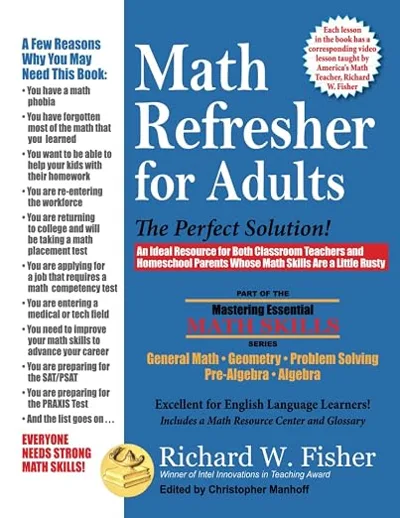
1. Math Refresher for Adults
Richard Fisher wrote this for adults who left school with gaps and now need math back for a job test, a nursing or trade program or the GED. It starts with whole numbers and works through fractions, decimals, percents, ratios, integers, basic geometry and the first steps of algebra.
Each topic gets a short worked example and then a page of practice, with the answers in the back. There is no theory and no padding. For someone whose last math class was twenty years ago, it is the fastest way to find and fill the holes.
- Richard W. Fisher
- Math Essentials, 2018, 270 pages
- Covers arithmetic through pre-algebra, with answers
Good: short lessons, lots of practice, every answer included. Not great: it stops at basic algebra and explains rules rather than why they work.
Check on Amazon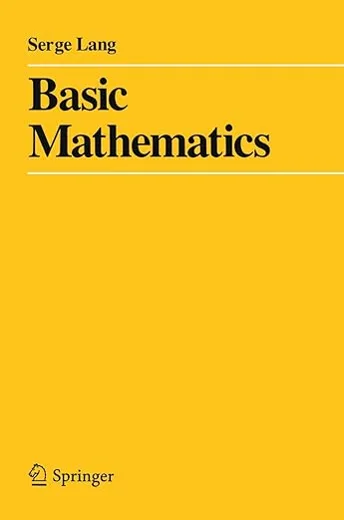
Reddit’s top relearning book
2. Basic Mathematics
Serge Lang was a Yale mathematician who wrote more than forty textbooks, and this is the one he wrote for students who arrive at university without solid high school math. It covers numbers, linear equations, real numbers, quadratic equations, geometry, coordinates, trigonometry, functions and an introduction to proofs.
What makes it different from a refresher workbook is that Lang proves things. You learn why the rules for fractions work and why the angles of a triangle add to 180 degrees. In our Reddit count it was named in 13 of 114 self-study threads, more than any other adult relearning book.
- Serge Lang
- Springer, 1988 (corrected printing 1998), 496 pages
- Covers algebra, geometry, trigonometry and first proofs
Good: rigorous, complete and it prepares you for proof-based math later. Not great: terse, few worked examples and no answers to most exercises.
Check on Amazon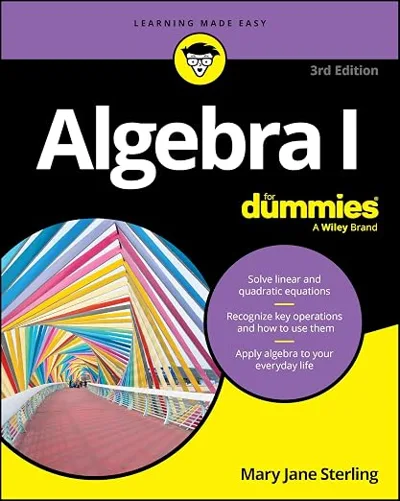
Plainest algebra book
3. Algebra I For Dummies
Mary Jane Sterling taught math at Bradley University for more than thirty years, and her For Dummies books are the friendliest way into first-year algebra. This third edition, published in June 2026, covers signed numbers, fractions, exponents, solving equations and inequalities, factoring, quadratics and word problems.
Each chapter explains one idea, shows a few worked examples and points out the mistakes most people make. If algebra was the class where you got lost, this is a gentle second attempt. Pair it with the separate Algebra I Workbook For Dummies if you want more practice.
- Mary Jane Sterling
- For Dummies, 3rd edition, 2026, 384 pages
- Covers first-year algebra
Good: clear, patient explanations and a new edition. Not great: not many practice problems in the main book.
Check on Amazon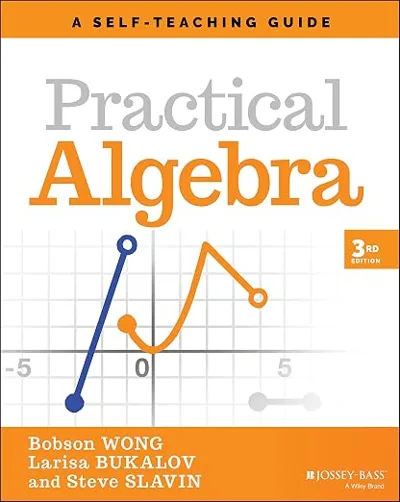
Best algebra workbook for adults
4. Practical Algebra: A Self-Teaching Guide
The Wiley Self-Teaching Guides are built for one reader working alone. Each short section ends with questions, and the answers sit directly below, so you check yourself before moving on. The third edition, rewritten by New York City teachers Bobson Wong and Larisa Bukalov, covers algebra from signed numbers to quadratics, exponents and radicals.
It suits a reader who wants to work through algebra in order, checking each step, without a teacher. Lang explains more and Sterling reads easier, but this is the book that keeps you working problems.
- Bobson Wong, Larisa Bukalov, Peter H. Selby, Steve Slavin
- Wiley, 3rd edition, 2022, 512 pages
- Self-check questions on every page
Good: designed for self-study, with instant answer checks. Not great: few ratings so far and a dry layout.
Check on Amazon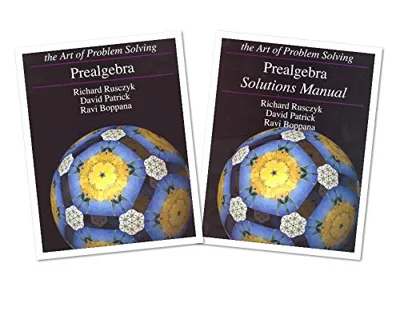
Best for strong beginners and teens
5. Art of Problem Solving: Prealgebra (text and solutions)
Art of Problem Solving books were written for math-contest students, and they teach by asking you to solve a problem before the book explains it. Prealgebra covers arithmetic, number theory, fractions, exponents, ratios, basic geometry, counting and statistics, with a solutions manual for every exercise.
They are the books Reddit names most for anyone who wants to understand school math deeply rather than just pass it (19 of 114 threads named an AoPS title). For a motivated teenager or an adult who enjoys puzzles, the set builds real problem-solving skill. The 2-book set includes the solutions manual, which you need for self-study.
- Richard Rusczyk, David Patrick, Ravi Boppana
- Art of Problem Solving, 608-page text plus solutions manual
- Covers prealgebra through problem solving
Good: the best problems at this level and full solutions. Not great: slower than a refresher; adults who only need to pass a test should pick Fisher.
Check on Amazon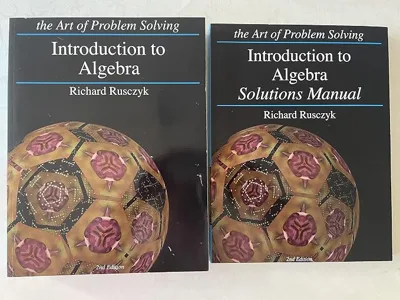
Most thorough algebra course
6. Art of Problem Solving: Introduction to Algebra (text and solutions)
The next AoPS book covers what most schools split into Algebra 1 and much of Algebra 2: linear equations, systems, inequalities, functions, quadratics, polynomials, exponents, logarithms, sequences and series. It runs to 656 pages and every chapter ends with a set of challenge problems.
This is the algebra book for a reader who wants to finish algebra with no weak spots before starting calculus. Work through Prealgebra first unless fractions and negative numbers are already easy.
- Richard Rusczyk
- Art of Problem Solving, 2nd edition text plus solutions manual
- Covers Algebra 1 and most of Algebra 2
Good: deep, complete and full solutions. Not great: long; budget six months or more at a steady pace.
Check on AmazonIsrael Gelfand’s short Algebra (written with Alexander Shen for a Soviet correspondence school) shows up often in Reddit threads next to Lang. It is excellent, but new copies are hard to find in the US; if you see a used one, it is worth buying as a second algebra book.
Best books to get from algebra to calculus
Precalculus is where self-taught learners stall. It is a grab bag of functions, exponentials, logarithms and trigonometry, and every calculus book assumes you know all of it. You need one book that covers the whole range and, ideally, a separate one for trigonometry.
Best bridge to calculus
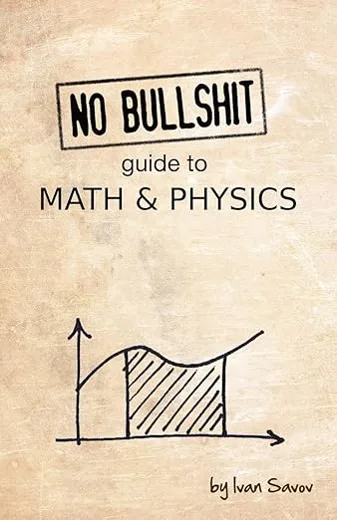
7. No Bullshit Guide to Math and Physics
Ivan Savov wrote this after years of tutoring students who needed high school math, calculus and mechanics fast. It starts with a long review of high school math (numbers, equations, functions, geometry, trigonometry), then teaches vectors, mechanics, differential calculus and integral calculus, each in a compact, conversational chapter.
For an adult who wants to get from algebra to calculus in one book, it is the most direct route. Savov wrote a matching No Bullshit Guide to Linear Algebra in the same style.
- Ivan Savov
- Minireference, 5th edition, 528 pages
- Covers high school math review, mechanics and calculus
Good: fast, readable and practical. Not great: covers each topic once; you will want a calculus book with more exercises.
Check on Amazon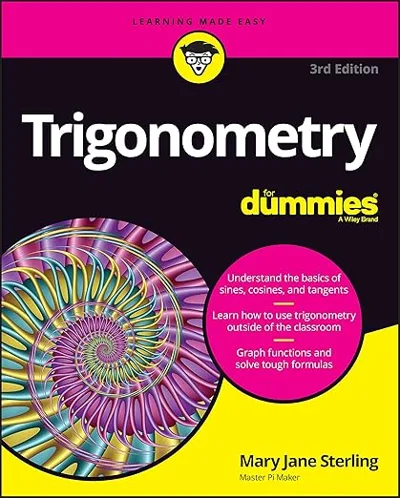
Best trigonometry book
8. Trigonometry For Dummies
Trigonometry is the topic most adult learners skipped or forgot, and calculus leans on it heavily. Sterling covers angles and radians, right-triangle trig, the unit circle, the six functions and their graphs, identities and solving trig equations.
Read it after algebra and before calculus. If the free OpenStax Precalculus is too dense, this is the plainer way to cover the same ground.
- Mary Jane Sterling
- For Dummies, 3rd edition, 2023, 400 pages
- Covers precalculus trigonometry
Good: clear explanations of the unit circle and identities. Not great: it covers trig only; you still need functions, exponentials and logs from a precalculus book.
Check on AmazonThe free option here is very good. OpenStax Precalculus 2e and the Stitz-Zeager Precalculus are both complete textbooks with answers, and both are named in Reddit threads as often as any paid precalculus book.
Best calculus books for self study
Learn calculus in two passes. The first gives you the ideas: what a derivative is, what an integral is and why they are inverses of each other. The second gives you the techniques and hundreds of problems. Thompson and Kline are first-pass books, Stewart and Banner are second-pass books and Spivak is a third pass for readers heading toward a math degree.
Best first calculus book
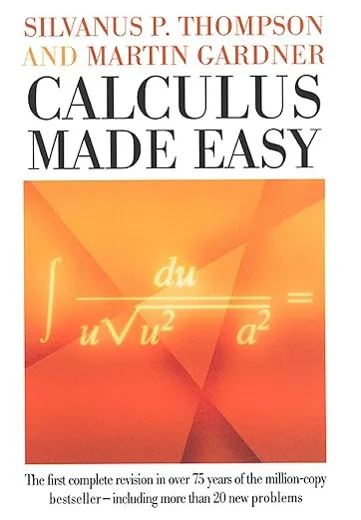
9. Calculus Made Easy
Silvanus Thompson was a physicist who published this in 1910 with the motto “What one fool can do, another can.” It teaches the ideas of differentiation and integration with almost no formal machinery, using small quantities you can picture instead of limits. Martin Gardner revised it in 1998, adding new opening chapters and notes that bring the notation up to date.
More than a century later it is still the gentlest book on calculus, and the 1914 edition is free on Project Gutenberg. Read it before a full textbook and the textbook will make sense faster.
- Silvanus P. Thompson, Martin Gardner
- St. Martin’s Press, 1998 revised edition, 336 pages
- Covers derivatives and integrals, informally
Good: short, funny and builds intuition. Not great: not a full course; there are few exercises and no rigor.
Check on Amazon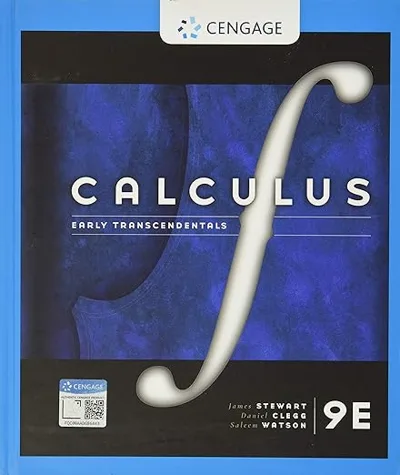
Best calculus textbook for self-study
10. Calculus: Early Transcendentals (Stewart)
Stewart is the textbook most US universities use for first-year calculus, and in our Reddit count it was named in 20 of 114 threads, more than any other standard calculus text. It covers limits, derivatives, integrals, series, vectors, partial derivatives and multiple integrals, with thousands of graded exercises and answers to the odd-numbered ones in the back.
For self-study that answer key matters more than anything else. You can check every second problem. The 9th edition is current; the 8th edition (2015) covers the same material and is the one to look for used.
- James Stewart, Daniel Clegg, Saleem Watson
- Cengage, 9th edition, 2020, 1,376 pages
- Covers single-variable and multivariable calculus
Good: complete, clear and full of exercises with answers. Not great: heavy, expensive new and explains procedures more than ideas.
Check on Amazon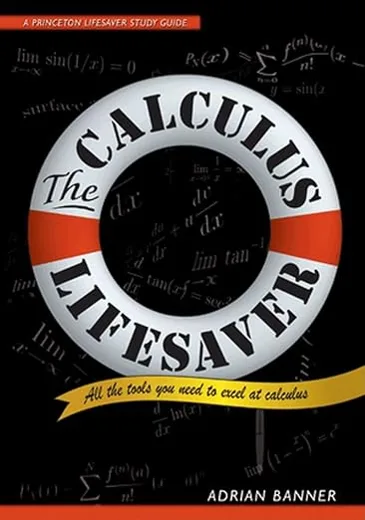
Best calculus companion
11. The Calculus Lifesaver
Adrian Banner wrote this from his review sessions at Princeton, and it reads like a patient tutor explaining every step a textbook skips. It covers single-variable calculus, from limits and continuity through derivatives, integrals, techniques of integration and series, with hundreds of worked examples.
It works best beside Stewart or a video course: when a section does not make sense, read Banner on the same topic. Banner’s recorded Princeton lectures are free on YouTube.
- Adrian Banner
- Princeton University Press, 2007, 754 pages
- Covers single-variable calculus with worked examples
Good: explains the steps other books skip. Not great: no multivariable calculus and few practice exercises of its own.
Check on Amazon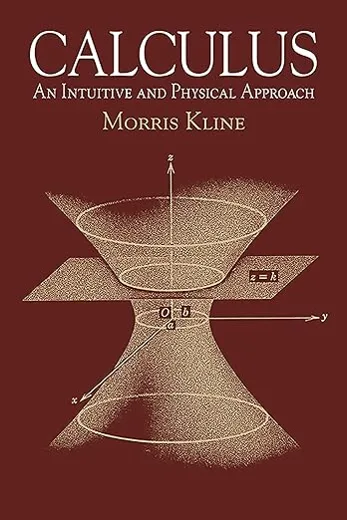
Best calculus for intuition
12. Calculus: An Intuitive and Physical Approach
Morris Kline taught at New York University for decades and believed calculus should be learned through the physical problems that created it. Every idea arrives with a reason: motion, falling bodies, areas, volumes and planetary orbits. The Dover edition is a cheap paperback of 960 pages.
It is the calculus book for a reader who asks “what is this for?” before learning a technique. Answers to many exercises are in the back.
- Morris Kline
- Dover, 2nd edition, 1998, 960 pages
- Covers single-variable calculus through applications
Good: motivates every idea and costs little. Not great: dated typesetting and notation.
Check on Amazon
Best for a second, deeper pass
13. Calculus (Spivak)
Spivak is the calculus book mathematicians love, and Reddit named it in 20 of 114 threads. It builds calculus from the properties of numbers with full proofs, and its exercises are famous for being hard and rewarding.
It is not a first calculus book. Many of the most upvoted Reddit answers make the same point: Spivak and Apostol are for people who have already done calculus and want to understand it properly. Read it after Stewart and a proof book, and buy the separate Combined Answer Book.
- Michael Spivak
- Publish or Perish, 4th edition, 2008, 680 pages
- Covers single-variable calculus with proofs
Good: the best problems in calculus and real understanding. Not great: too hard as a first book; the answer book is sold separately.
Check on AmazonFree video courses carry a lot of weight here. Professor Leonard’s full-length calculus lectures on YouTube were named in 15 of the Reddit threads we read, and MIT’s 18.01 Single Variable Calculus is free with problem sets and solutions. If you want to know where calculus leads, our pieces on differential equations and the differences between calculus and statistics are short reads.
Best books for learning proofs
Everything in school math is calculation. Almost everything in university math is proof. That switch is where most self-taught learners stop, because the textbooks after calculus assume you can already read and write a proof. One proof book closes the gap. Read it after calculus, or alongside it if calculus is going well.
Best first proof book
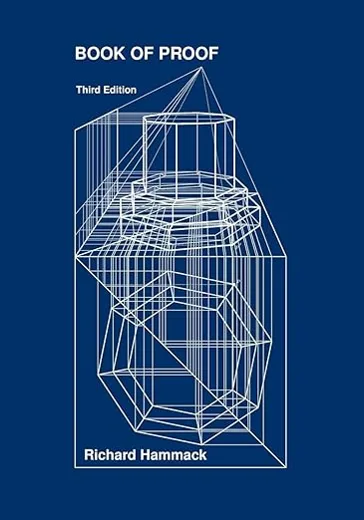
14. Book of Proof
Every self-study path hits the same wall after calculus: university math is written in proofs, and nobody teaches you how to write one. Richard Hammack teaches at Virginia Commonwealth University and wrote this book to fix that. It covers sets, logic, counting, direct proof, contrapositive, contradiction, induction, relations, functions and cardinality.
The explanations are clear and there are solutions to the odd-numbered exercises. Hammack keeps a free PDF of the full book on his website; the printed copy is for people who prefer paper, and it is cheap.
- Richard Hammack
- 3rd edition, 2018, 382 pages
- Free PDF from the author
Good: clear, complete and free to try. Not great: only odd answers; check even ones on Math Stack Exchange.
Check on Amazon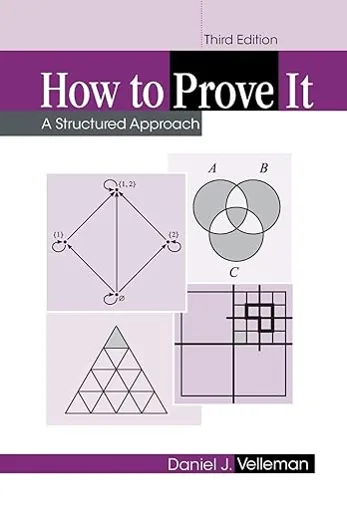
Reddit’s top proof book
15. How to Prove It: A Structured Approach
Daniel Velleman, of Amherst College, teaches proof as a set of strategies tied to the logical form of the statement: what to do when you must prove “for all”, “there exists”, “if and only if” or “not”. It covers logic, sets, relations, functions, induction and infinite sets.
Reddit named it in 14 of 114 threads, the most of any proof book. It is more systematic than Book of Proof and a little drier. Many readers use both: Hammack for the first pass, Velleman when a proof will not start.
- Daniel J. Velleman
- Cambridge University Press, 3rd edition, 2019, 468 pages
- Covers logic and proof strategy
Good: teaches how to start a proof, step by step. Not great: slow early chapters on logic.
Check on Amazon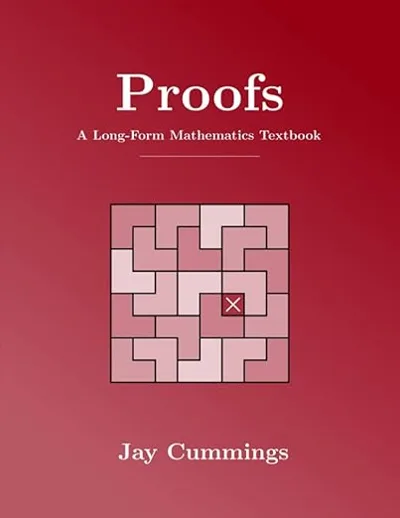
Most readable proof book
16. Proofs: A Long-Form Mathematics Textbook
Jay Cummings teaches at California State University, Sacramento, and wrote this in a conversational style, with long explanations, jokes in the margins and proofs worked out the way you would on scratch paper before the clean version.
It has more Amazon ratings than Hammack and Velleman combined, at 4.8 stars. If Hammack and Velleman feel cold, this is the one that keeps you reading.
- Jay Cummings
- Self-published, 2021, 511 pages
- Covers induction, logic, sets, functions, relations, number theory
Good: the friendliest proof book in print. Not great: no solutions in the book.
Check on Amazon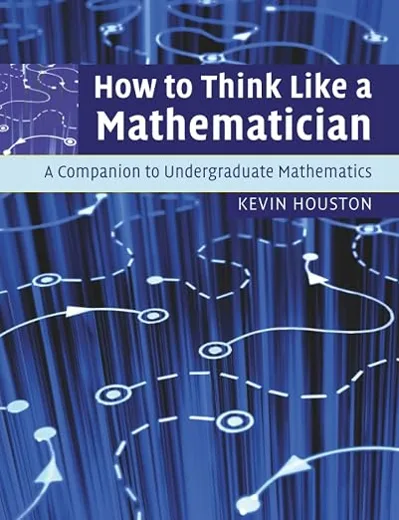
Best guide to thinking like a mathematician
17. How to Think Like a Mathematician
Kevin Houston of the University of Leeds wrote this for students starting a math degree. Alongside proof techniques, it covers the habits nobody explains: how to read a definition, how to read a theorem, how to write mathematics and how to study.
For a self-taught learner it fills in the advice a lecturer gives in the first weeks of university. The chapters are short and can be read in any order.
- Kevin Houston
- Cambridge University Press, 2009, 274 pages
- Covers reading, writing and proving
Good: teaches how to read math, which nobody else does. Not great: fewer proof exercises than Hammack.
Check on AmazonBest linear algebra books for self study
Linear algebra is the most useful math after calculus. It runs computer graphics, statistics, machine learning, engineering and quantum mechanics. Most people need two passes: one computational (matrices, elimination, eigenvalues) and one abstract (vector spaces and linear maps).
Best first linear algebra book
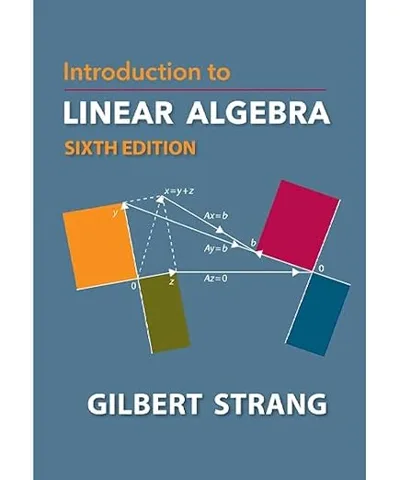
18. Introduction to Linear Algebra (Strang)
Gilbert Strang taught linear algebra at MIT for more than sixty years, and his recorded course (18.06) is among the most watched math lectures online. The 6th edition of his textbook (2023) covers vectors, matrices, elimination, vector spaces, orthogonality, determinants, eigenvalues and the singular value decomposition, with an emphasis on computation and applications.
Read it with the free MIT lectures. The book plus the videos is the closest a self-taught learner gets to taking the course.
- Gilbert Strang
- Wellesley-Cambridge Press, 6th edition, 2023, 440 pages
- Pairs with free MIT 18.06 lectures
Good: intuitive, applied and backed by free lectures. Not great: loose structure; some readers find it hard to look things up.
Check on Amazon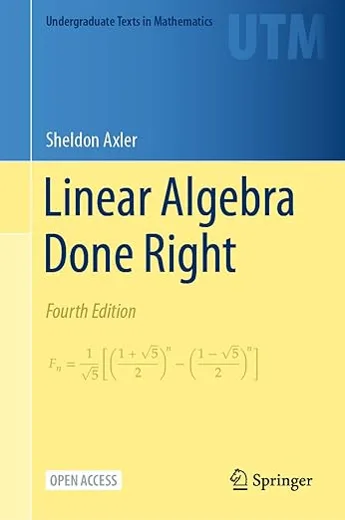
Reddit’s most named book overall
19. Linear Algebra Done Right
Sheldon Axler’s book was named in 25 of 114 Reddit threads, more than any other book in our count. It teaches linear algebra the way mathematicians use it, through linear maps and vector spaces, and famously postpones determinants to the end.
It is a second course: read it after Strang and a proof book. The 4th edition (2024) is open access, so the PDF is free on Axler’s website. The hardcover is for readers who want it on paper.
- Sheldon Axler
- Springer, 4th edition, 2024, 407 pages
- Free open-access PDF from the author
Good: elegant, proof-based and free to read. Not great: abstract for a first course in linear algebra.
Check on AmazonFor the first pass, Ivan Savov’s No Bullshit Guide to Linear Algebra is a shorter alternative to Strang, and Jim Hefferon’s Linear Algebra is a free textbook with full answers. 3Blue1Brown’s free Essence of Linear Algebra videos show what the matrix operations do geometrically; watch them before either book.
What to study after that
Once you have calculus, proofs and linear algebra, the path splits by what you want. Pure math goes to analysis and abstract algebra. Data science and machine learning go to probability and the math of optimization.
Best first analysis book
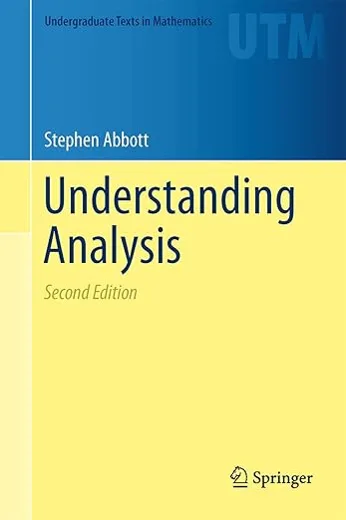
20. Understanding Analysis
Real analysis is calculus proved properly, and it is the course where most math students decide whether they love the subject. Stephen Abbott of Middlebury College wrote the analysis book that self-learners recommend most (16 of 114 Reddit threads), because each chapter opens with the question it is trying to answer.
Read it after a proof book. Walter Rudin’s Principles of Mathematical Analysis appears in nearly as many threads, but usually with a warning that it is too terse for a first course.
- Stephen Abbott
- Springer, 2nd edition, 2015, 324 pages
- Covers real analysis
Good: motivating, well written and good exercises. Not great: no official solutions for the current edition.
Check on Amazon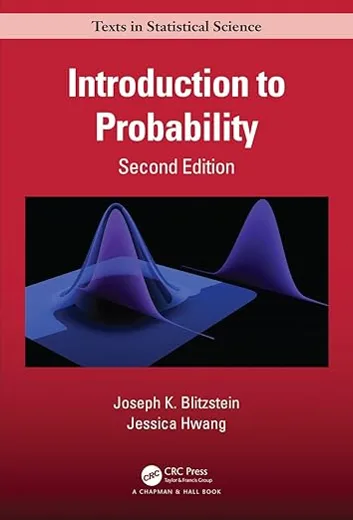
Best probability book
21. Introduction to Probability (Blitzstein and Hwang)
This is the book for Harvard’s Stat 110, one of the most popular probability courses taught anywhere. Joe Blitzstein’s lectures are free online and the authors keep a free PDF of the second edition. It covers counting, conditional probability, random variables, distributions, expectation, joint distributions, limit theorems and Markov chains.
Probability is the best next subject for anyone heading toward statistics, data science or machine learning, and it needs only calculus.
- Joseph K. Blitzstein, Jessica Hwang
- CRC Press, 2nd edition, 2019, 620 pages
- Pairs with free Stat 110 lectures
Good: intuitive explanations and great problems. Not great: long; the first chapters on counting are the hardest.
Check on Amazon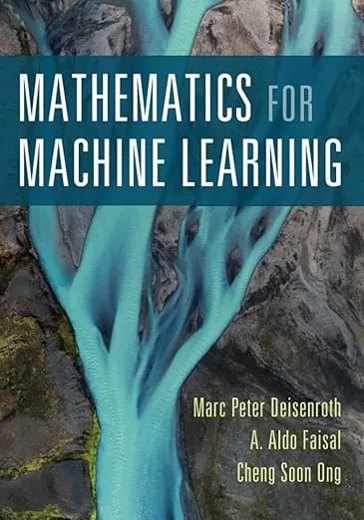
Best for machine learning
22. Mathematics for Machine Learning
Many adults return to math because they want to understand machine learning. This book collects exactly the math that requires: linear algebra, analytic geometry, matrix decompositions, vector calculus, probability and optimization, then uses them on regression, PCA, Gaussian mixtures and support vector machines.
It assumes you have seen calculus and some algebra. The authors keep a free PDF online; the print copy is for readers who want it on paper.
- Marc Peter Deisenroth, A. Aldo Faisal, Cheng Soon Ong
- Cambridge University Press, 2020, 398 pages
- Free PDF from the authors
Good: targets exactly the math ML uses. Not great: dense; it reviews rather than teaches calculus.
Check on AmazonFor abstract algebra, Charles Pinter’s A Book of Abstract Algebra (Dover) is the gentlest first book and the one Reddit names most for self-study. Terence Tao’s Analysis I builds the number system from scratch and is a good second analysis book after Abbott. If statistics is the goal, our standard deviation calculator shows the formula worked out step by step.
How to study math on your own
When I taught, the students who struggled were rarely the least able. They were the ones who read their textbook like a novel. A page of math read without a pencil has not been read. Every self-study method that works comes back to the same few habits.
- Do the exercises. Reading a solution and producing one are different skills, and only the second one counts. Aim for at least half the exercises in each section, and check every one you can.
- Use books with answers. Self-study without an answer key is guessing. This is why Stewart, AoPS and Book of Proof are on this list and some famous books are not.
- Work a little every day. One adult in an evening class I taught, a nurse, went from fractions to first-year calculus in about eighteen months by doing twenty-five minutes before every shift. Daily short sessions beat weekend marathons.
- Keep a notebook. Date every page and write out full solutions. A year from now it is the best record of what you know.
- Pair a book with a video course. Reddit’s most repeated advice, in roughly 40 of the threads we read, is to use a textbook for problems and a video course for explanation.
- When stuck, change the problem. Try a smaller case, draw a picture or work backward. That is Polya’s advice, and it works at every level.
Best book on how to study math
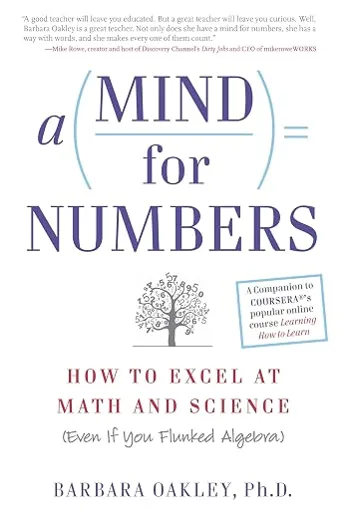
23. A Mind for Numbers
Barbara Oakley failed high school math, served in the army and later became an engineering professor. This book is about how people learn math: focused and diffuse thinking, chunking, spaced practice, testing yourself and why rereading and highlighting do not work.
It is the book I would hand to anyone who says they are “not a math person”. It became the basis of Learning How to Learn, one of the most taken courses on Coursera.
- Barbara Oakley
- TarcherPerigee, 2014, 336 pages
- Covers study methods for math and science
Good: practical study habits backed by research. Not great: it teaches how to study, not any math.
Check on Amazon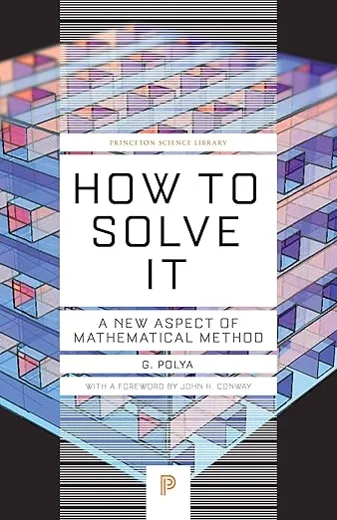
Classic on problem solving
24. How to Solve It
George Polya was a Hungarian mathematician who taught at Stanford, and this 1945 book lays out a four-step method for solving problems: understand the problem, devise a plan, carry it out, look back. The second half is a dictionary of heuristics such as working backwards, solving a simpler problem and drawing a figure.
It is short and worth rereading at every stage. Keep it nearby when you start proofs.
- George Polya
- Princeton University Press, 2014 reprint, 288 pages
- Foreword by John H. Conway
Good: a method you will use for life. Not great: examples are mostly high school geometry.
Check on Amazon
Math books to read alongside a textbook
A textbook teaches you to do math. These books show you why it matters and where it goes, and they are what keeps many self-taught learners going through the slow chapters. Read one in the evening while you work through a textbook in the morning.
Best math book to read for pleasure
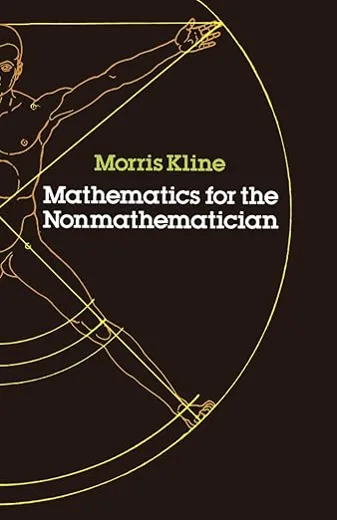
25. Mathematics for the Nonmathematician
Kline wrote this for liberal arts students who would never take another math course. It tells the history of mathematics, from Greek geometry through algebra, coordinate geometry and calculus, and asks you to do real problems along the way.
It is the right book if you want to understand what math is and why it developed, rather than pass an exam.
- Morris Kline
- Dover, 1985, 672 pages
- Covers math history with exercises
Good: gives math a story and a purpose. Not great: not a structured course.
Check on Amazon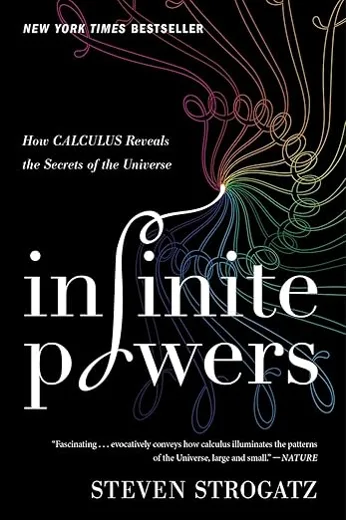
Best popular book on calculus
26. Infinite Powers
Steven Strogatz is a Cornell mathematician and one of the best math writers alive. Infinite Powers tells the story of calculus from Archimedes to Newton and Leibniz to modern GPS and CT scans, with the central idea explained in words and pictures.
Read it before or alongside a calculus course. It does not teach techniques, but it makes clear what calculus is for.
- Steven Strogatz
- Mariner Books, 2020, 400 pages
- Popular history of calculus
Good: beautifully written and very clear. Not great: no exercises.
Check on Amazon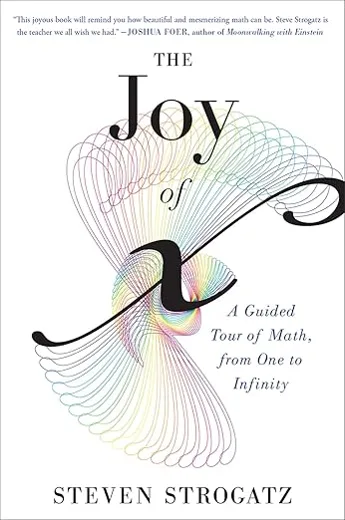
Best tour of math
27. The Joy of x
Strogatz’s earlier book grew out of a New York Times column. In 30 short chapters it walks from counting through algebra, geometry, calculus, statistics and topology, each with one clear idea and a real-world example.
It is the best book to read in the evenings while you work through a textbook during the day, because it shows where your current chapter leads.
- Steven Strogatz
- Mariner Books, 2013, 336 pages
- 30 short chapters across all of math
Good: short chapters, wide range. Not great: light on depth by design.
Check on Amazon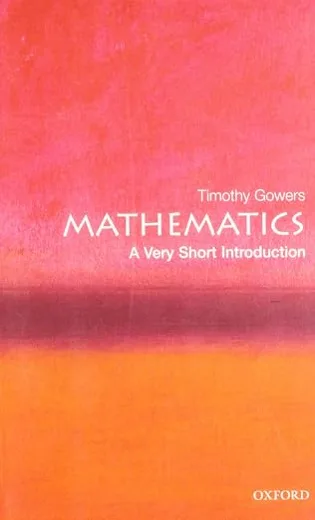
Best short overview
28. Mathematics: A Very Short Introduction
Timothy Gowers won the Fields Medal in 1998. In 160 pages he explains what mathematicians actually do: abstraction, proof, approximation, infinity and dimension. It is the clearest short explanation of the difference between school math and university math.
Read it in a weekend before starting proofs.
- Timothy Gowers
- Oxford University Press, 2002, 160 pages
- Covers what mathematics is
Good: short and written by a Fields Medalist. Not great: a few chapters assume some comfort with algebra.
Check on AmazonFor more books like these across all the sciences, see our list of the best science books for non-scientists.
What Reddit recommends
We read 114 self-study threads from r/learnmath, r/math and smaller math subreddits, posted between 2011 and 2025, and counted how many threads named each book in at least one comment. The threads skew toward people asking about university topics, so proof and analysis books rank higher than they would among pure beginners.
| Book | Threads | Level |
|---|---|---|
| Linear Algebra Done Right (Axler) | 25 | Linear algebra |
| Calculus (Spivak) | 20 | Calculus, proof-based |
| Calculus (Stewart) | 20 | Calculus |
| Principles of Mathematical Analysis (Rudin) | 19 | Analysis |
| Understanding Analysis (Abbott) | 16 | Analysis |
| How to Prove It (Velleman) | 14 | Proofs |
| Book of Proof (Hammack) | 13 | Proofs |
| Basic Mathematics (Lang) | 13 | School math |
| Introduction to Linear Algebra (Strang) | 12 | Linear algebra |
| Calculus (Apostol) | 11 | Calculus, proof-based |
| Analysis I (Tao) | 11 | Analysis |
Free resources came up even more often. Khan Academy was named in 45 threads, more than any book, followed by MIT OpenCourseWare (19), OpenStax (18), Professor Leonard (15) and 3Blue1Brown (12). Art of Problem Solving titles appeared in 19 threads, usually recommended for building algebra from the ground up.
Three pieces of advice repeat across the threads. Use a textbook with a video course rather than either one alone. Do the exercises, not just the reading. And do not start with Rudin or Spivak: the most upvoted answers in several threads say both are for people who have already done calculus once.
Free math textbooks for self study
You can learn everything from arithmetic to a first course in linear algebra without buying a book. Several of the books above are free from their authors, and the rest of this list is free and legal.
- Khan Academy: videos and practice from arithmetic to calculus and linear algebra, with mastery tracking.
- OpenStax: Prealgebra, Elementary Algebra, Intermediate Algebra, College Algebra, Precalculus and Calculus (three volumes), all with answers.
- Stitz-Zeager Precalculus: a complete precalculus textbook with answers.
- Paul’s Online Math Notes: notes and worked problems for algebra, Calculus I to III and differential equations. Our complex numbers guide uses them for extra practice.
- Calculus Made Easy (1914 edition) on Project Gutenberg.
- MIT 18.01 and MIT 18.06: full calculus and linear algebra courses with lectures, problem sets and exams.
- Book of Proof: the full book as a free PDF from the author.
- Hefferon’s Linear Algebra and Linear Algebra Done Right: both free from their authors.
- Introduction to Probability and Mathematics for Machine Learning: free PDFs from the authors.
The free textbooks are good enough that the case for buying a book is mostly about paper. A printed book on the table gets opened more often than a PDF in a browser tab, and it is easier to keep a notebook beside it. Buy print for the book you are working through now and use the free ones for reference and extra problems.
A self-study math path, from arithmetic to university math
The viewer who emailed me finished her arithmetic refresher in about four months and is now working through algebra. That is the realistic pace for an adult with a job: one book at a time, every day for twenty or thirty minutes. Here is the full path, with rough times at that pace.
- Arithmetic and pre-algebra (2 to 4 months): Math Refresher for Adults or AoPS Prealgebra.
- Algebra (4 to 8 months): Algebra I For Dummies or Practical Algebra, then Lang’s Basic Mathematics. AoPS Introduction to Algebra if you want depth.
- Precalculus and trigonometry (3 to 5 months): No Bullshit Guide to Math and Physics, Trigonometry For Dummies or OpenStax Precalculus.
- Calculus (6 to 12 months): Calculus Made Easy, then Stewart with The Calculus Lifesaver and Professor Leonard or MIT 18.01.
- Proofs (2 to 4 months): Book of Proof, with How to Prove It when you get stuck.
- Linear algebra (4 to 6 months): Strang with MIT 18.06, then Axler.
- Next: Understanding Analysis for pure math, Introduction to Probability for statistics, Mathematics for Machine Learning for ML.
That is three to four years from fractions to university-level math at half an hour a day, which sounds long until you compare it with the twelve years school takes to reach calculus. Skip any step your placement check says you already know.
More guides like this one are on our buying guides page, and our science and math tools page has calculators that show their working, plus printable puzzles such as the algebra word search.
FAQ
It depends on your level. To relearn school math, Serge Lang’s Basic Mathematics is the most recommended book, and Math Refresher for Adults by Richard Fisher is the fastest. For calculus, start with Calculus Made Easy and then work through Stewart’s Calculus. For university math, start with Book of Proof by Richard Hammack.
Yes. With a book that has answers, a free video course such as Khan Academy and twenty to thirty minutes of practice a day, an adult can go from fractions to calculus in about two years. The key is starting at the right level and doing the exercises, not just reading.
In 114 self-study threads on r/learnmath and r/math, the most named books were Axler’s Linear Algebra Done Right (25 threads), Spivak’s Calculus (20), Stewart’s Calculus (20), Rudin’s Principles of Mathematical Analysis (19) and Abbott’s Understanding Analysis (16). For relearning school math, Lang’s Basic Mathematics and the Art of Problem Solving books are the usual answers. Khan Academy was named in 45 threads.
Stewart’s Calculus: Early Transcendentals is the best full course for self-study because it has thousands of exercises with answers to the odd-numbered ones. Read Calculus Made Easy by Silvanus Thompson first for the ideas, and keep The Calculus Lifesaver by Adrian Banner nearby for extra explanations.
Arithmetic and fractions, then algebra, then precalculus and trigonometry, then calculus. After calculus, learn proofs, then linear algebra, then choose analysis, abstract algebra, probability or statistics depending on your goal. Geometry can be studied alongside algebra.
It is good for adults who want to relearn high school math properly, because it explains why the rules work and introduces proofs. It is terse and has few worked examples, so a reader who struggles with fractions should start with an easier refresher and come to Lang afterwards.
Not usually. Most people learn computational calculus first and proofs after. Read a proof book before any proof-based course such as Spivak’s Calculus, linear algebra with Axler or real analysis.
Yes. OpenStax, Stitz-Zeager, Book of Proof, Hefferon’s Linear Algebra and Linear Algebra Done Right are all free from their authors and match paid textbooks in quality. Many people still prefer a printed copy of the book they are working through, because it is easier to keep open next to a notebook.
Sources
- Amazon product pages for each book, checked November 2026 (editions, page counts, ratings).
- 114 self-study book threads on r/learnmath, r/math, r/mathematics, r/mathbooks, r/calculus and r/askmath, 2011 to 2025.
- Silvanus P. Thompson, Calculus Made Easy, Project Gutenberg.
- Sheldon Axler, Linear Algebra Done Right, 4th edition (open access).
- Richard Hammack, Book of Proof.
- MIT OpenCourseWare, 18.06SC Linear Algebra.
- OpenStax, free math textbooks.