Arkansas sits at a genuine crossroads. The Ozarks feed into the Delta, the Delta feeds into the Mississippi Flyway, and the whole state ends up hosting more than 420 recorded species — some that never leave, some that only pass through for a few weeks a year, and some that show up exactly when the lakes freeze up north.
That timing matters more than most bird guides let on. A “common Arkansas bird” checklist is only half the story if it doesn’t tell you when to look. Bald Eagles aren’t hard to find on the White River — in January. Prothonotary Warblers own the Cache River swamps — from May to August, then they’re gone. This guide covers 30 species you’re realistically going to see in Arkansas, organized by when they’re around, plus where in the state to go looking and how to pull a few of them into your own backyard.
Table of Contents
- Seasonal Cheat Sheet
- Year-Round Residents
- Summer Arrivals
- Winter Visitors
- Flyway Migrants
- Where to Go Looking in Arkansas
- Setting Up a Backyard That Birds Actually Use
Seasonal Cheat Sheet
Print this, keep it in the car. “Peak window” means the stretch when your odds of a sighting are best, not the only time the bird is technically present.
| Species | Status in Arkansas | Peak Window |
|---|---|---|
| Northern Cardinal | Year-round | All year |
| Carolina Wren | Year-round | All year |
| Carolina Chickadee | Year-round | All year |
| Tufted Titmouse | Year-round | All year |
| Blue Jay | Year-round | All year |
| American Crow | Year-round | All year |
| Red-bellied Woodpecker | Year-round | All year |
| Downy Woodpecker | Year-round | All year |
| Pileated Woodpecker | Year-round | All year |
| Northern Mockingbird | Year-round | All year |
| Eastern Bluebird | Year-round | All year |
| Mourning Dove | Year-round | All year |
| Red-shouldered Hawk | Year-round | All year |
| Great Blue Heron | Year-round | All year |
| Wild Turkey | Year-round | Spring gobbling season |
| Barred Owl | Year-round | Dusk, all year |
| Ruby-throated Hummingbird | Summer breeder | Late April–September |
| Prothonotary Warbler | Summer breeder | May–August |
| Indigo Bunting | Summer breeder | May–August |
| Summer Tanager | Summer breeder | May–August |
| Purple Martin | Summer breeder | April–July |
| Eastern Kingbird | Summer breeder | May–August |
| Barn Swallow | Summer breeder | April–September |
| Bald Eagle | Winter visitor (some year-round) | December–February |
| Dark-eyed Junco | Winter visitor | November–March |
| White-throated Sparrow | Winter visitor | November–March |
| Yellow-rumped Warbler | Winter visitor | October–April |
| Snow Goose | Flyway migrant | January–February |
| Sandhill Crane | Flyway migrant | November & February |
| American White Pelican | Flyway migrant | March & October |
Year-Round Residents
These are the birds that don’t read a calendar. See one in your yard in July, it’s still there in January — same bird, arguably.
1. Northern Cardinal
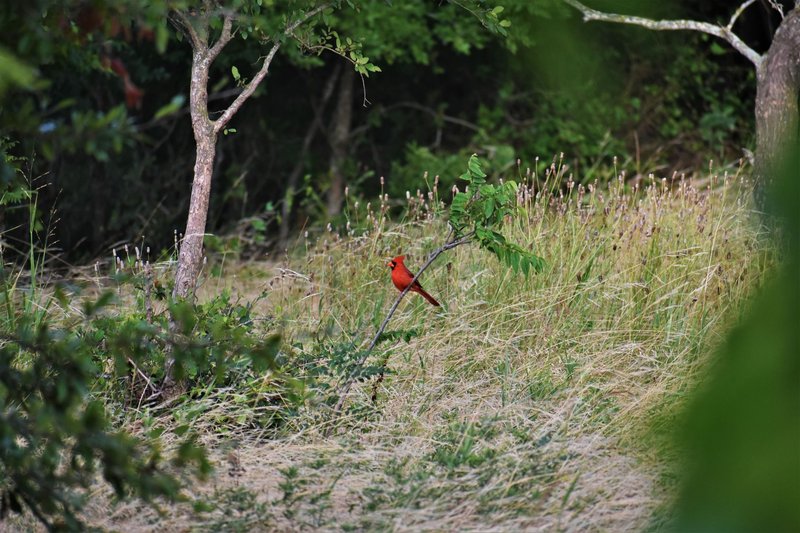
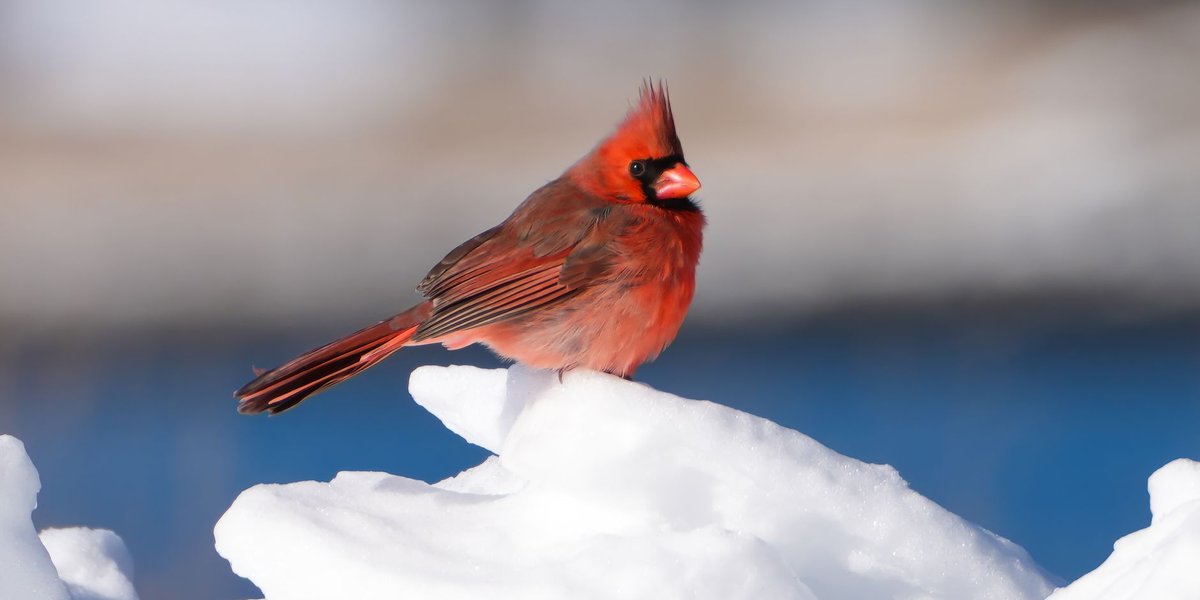
Length 8.3–9.1 inches, wingspan 9.8–12.2 inches, weight around 1.5 ounces. The male is unmistakable: solid red body, black mask, thick orange-red bill built for cracking sunflower seeds. Females are warm buff-brown with red highlights on the wings, crest, and tail. The song is a clear, whistled cheer-cheer-cheer, birdie-birdie-birdie — both sexes sing, which is unusual for songbirds. It’s also the official state bird of Arkansas, which makes it the one entry on this list you’re required to recognize.
2. Carolina Wren
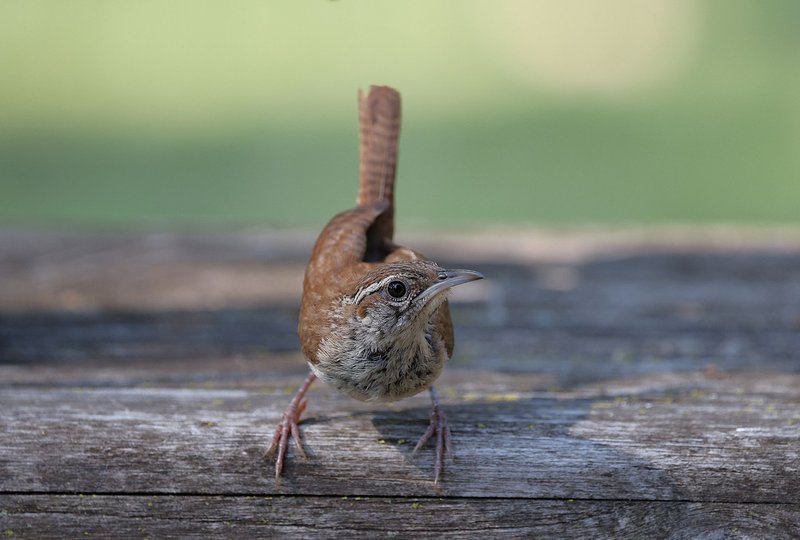
Length 4.7–5.5 inches, wingspan 11 inches, weight under an ounce. Rusty-brown above, buffy below, with a bold white eyebrow stripe and a tail it habitually cocks straight up. The voice is absurd for the body size — a loud, rolling teakettle-teakettle-teakettle that carries across a whole yard. Carolina Wrens are cavity nesters that will use a mailbox, a hanging planter, or a boot left on the porch too long. Cold snaps hit them hard; a run of hard winters can crash the local population, then it rebuilds within a few years.
3. Carolina Chickadee
Length 3.9–4.7 inches, wingspan 6.3 inches, weight about 0.35 ounces. Black cap and bib, white cheeks, gray back — nearly identical to the Black-capped Chickadee found farther north, and the two species hybridize where their ranges overlap in northern Arkansas. Song is a simple four-note whistle, fee-bee fee-bay, higher and faster than its northern cousin’s. Chickadees cache thousands of seeds each fall and rely on spatial memory to find them again, which is a lot of trust to put in a brain the size of a peanut.
4. Tufted Titmouse
Length 5.5–6.3 inches, wingspan 9.8 inches, weight 0.7–0.9 ounces. Soft gray overall with a peachy wash on the flanks, a black forehead patch, and a pointed crest that gives the whole bird a slightly alarmed expression. The call is a loud, repeated peter-peter-peter. Titmice are bold at feeders — they’ll grab a sunflower seed and fly off to hammer it open against a branch rather than eat it on the spot, which is why you’ll see one bird making a dozen feeder trips in ten minutes.
5. Blue Jay
Length 9.8–11.8 inches, wingspan 13.4–16.9 inches, weight 2.5–3.5 ounces. Blue above, white below, black necklace, crest that raises and lowers with mood. The call most people know is a harsh jay-jay-jay, but Blue Jays are excellent mimics and regularly imitate Red-shouldered Hawks — some researchers think it’s a trick to clear a feeder of competitors. They cache acorns by the thousands and are given real credit for helping oak forests spread north after the last glaciation, one buried nut at a time.
6. American Crow
Length 15.8–20.9 inches, wingspan 33.5–39.4 inches, weight 11.1–21.9 ounces. All black, heavy bill, fan-shaped tail in flight. The call is the flat, familiar caw-caw everyone already knows. Crows are among the most cognitively capable birds on the continent — they recognize individual human faces, hold what look like funerals around dead crows, and pass grudges against specific people down to their offspring. Arkansas crows roost communally in winter, sometimes in flocks running into the thousands.
7. Red-bellied Woodpecker
Length 9.4 inches, wingspan 13–16.5 inches, weight 2–3.2 ounces. Zebra-striped black-and-white back, pale gray-buff face and belly, red cap running from the bill to the nape in males (just the nape in females). The “red belly” the name promises is a faint wash you’ll rarely actually see — Red-headed Woodpecker was already taken by a different, fully red-headed bird. Call is a rolling, churring kwirr. Common at suet feeders and one of the most frequently misidentified backyard birds in the state because of that name.
8. Downy Woodpecker
Length 5.5–6.7 inches, wingspan 9.8–11.8 inches, weight under an ounce. Smallest woodpecker in North America — black-and-white with a short, stubby bill, males sporting a small red patch on the back of the head. Nearly identical to the larger Hairy Woodpecker; the bill length is the reliable tell, roughly a third the head length on a Downy versus almost as long as the head on a Hairy. Drums in short bursts and calls a soft, descending whinny.
9. Pileated Woodpecker
Length 15.8–19.3 inches, wingspan 26–29.5 inches, weight 8.8–12.3 ounces. Crow-sized, mostly black with white stripes down the neck and a flaming red crest — the bird Woody Woodpecker was modeled on. It excavates rectangular holes in dead trees big enough to put a fist through, looking for carpenter ants. The call is a loud, wild kuk-kuk-kuk-kuk that echoes through bottomland forest. Big Woods habitat in eastern Arkansas holds strong numbers of these.
10. Northern Mockingbird
Length 8.3–10.2 inches, wingspan 12.2–13.8 inches, weight 1.6–2 ounces. Gray above, pale below, with white wing patches that flash open in flight and during territorial displays. A male can learn 150-plus distinct song phrases over its lifetime, stitching together snippets copied from other birds, car alarms, and squeaky gates, each one repeated two to six times before switching. Fiercely territorial — they’ll dive-bomb cats, dogs, and joggers who wander too close to a nest.
11. Eastern Bluebird
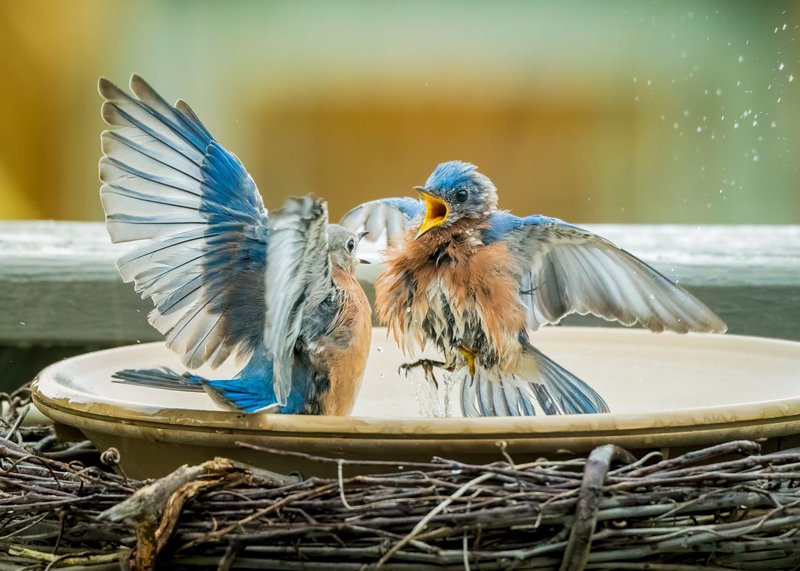
Length 6.3–8.3 inches, wingspan 9.8–12.6 inches, weight 1–1.1 ounces. Males are vivid sky-blue above with a rusty-orange throat and breast; females show the same pattern in muted gray-blue. Song is a soft, warbled chur-chee, chur-chur-chee. Bluebird numbers cratered mid-20th century when House Sparrows and starlings took over their nest cavities, then rebounded hard once nest-box programs took off — a rare, genuinely successful backyard conservation story, and one Arkansas birders can take partial credit for.
12. Mourning Dove
Length 9.1–13.4 inches, wingspan 17.7 inches, weight 3–6 ounces. Slim, soft grayish-brown, small head, long pointed tail edged in white. The call — a low, mournful coo-OOO-oo-oo-oo — is often mistaken for an owl by people who’ve never actually seen the bird making it. Wings make a sharp whistling sound on takeoff. One of the most widespread and abundant birds in North America, and also a legal game bird in Arkansas during fall hunting season.
13. Red-shouldered Hawk
Length 16.9–24 inches, wingspan 37–43.7 inches, weight 17–27.3 ounces. Reddish-barred underparts, checkered black-and-white wings, a banded tail. The call is a piercing, repeated kee-yah — the exact sound Blue Jays love to fake. Prefers wooded bottomlands near water, which describes a lot of eastern Arkansas. Pairs are territorial and monogamous, often reusing the same nest site for years running.
14. Great Blue Heron
Length 3.2–4.5 feet, wingspan 5.5–6.6 feet, weight 4.6–5.5 pounds. Slate-blue-gray, long S-curved neck, dagger bill, stilt legs. Stands motionless in shallow water for minutes at a stretch before striking at a fish with a strike speed too fast to follow with the naked eye. The call is a harsh, guttural croak, usually given when startled into flight. Nests colonially in tall trees — a “heronry” of two dozen nests in one stand of dead timber is a normal sight along Arkansas’s rivers.
15. Wild Turkey
Length 3.6–3.7 feet, wingspan 4.9–5.7 feet, weight 5.5–24 pounds (males run far heavier than females). Dark, iridescent body plumage that flashes bronze and green in direct light, bare blue-and-red head, fan tail displayed during spring courtship. The gobble carries close to a mile on a still morning. Arkansas’s turkey population was reduced to a few thousand birds by the 1940s through habitat loss and unregulated hunting, then restored to well over 100,000 through decades of trap-and-transplant restocking — one of the state wildlife agency’s clearer wins.
16. Barred Owl
Length 16.9–19.7 inches, wingspan 39–43.3 inches, weight 1.1–2.3 pounds. Round-headed, no ear tufts, brown-and-white barring on the chest that gives way to vertical streaking on the belly. The call is the famous who-cooks-for-you, who-cooks-for-you-all, delivered in a rhythmic, almost conversational cadence. Strictly nocturnal and tied to mature bottomland and swamp forest — the Big Woods region of eastern Arkansas holds one of the healthier populations left in the country.
Summer Arrivals
These arrive on a schedule tight enough to set a calendar by, breed, then clear out before the first hard freeze.
17. Ruby-throated Hummingbird
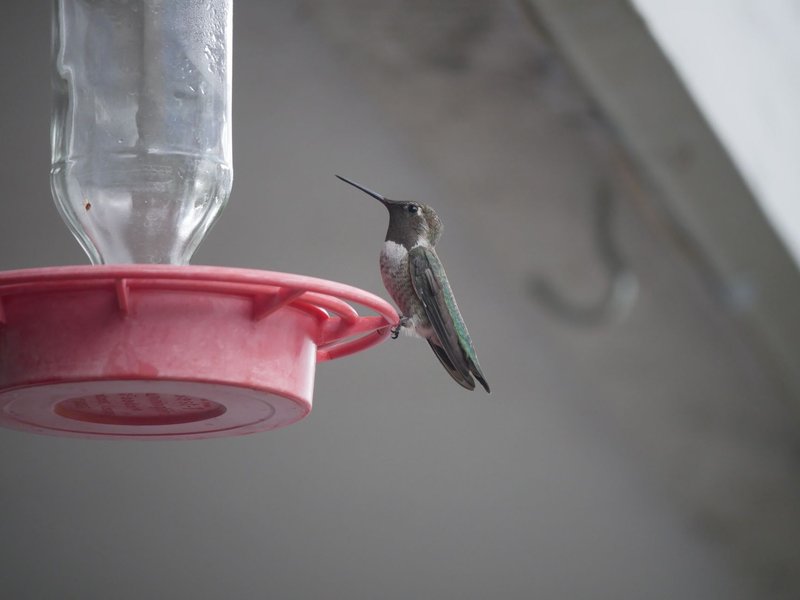
Length 2.8–3.5 inches, wingspan 3.1–4.3 inches, weight 0.1–0.2 ounces — about as much as a nickel. Males show an iridescent ruby-red throat patch that looks black in poor light; females lack it entirely. Wings beat around 50 times per second, producing the namesake hum. Before crossing the Gulf of Mexico each fall, they roughly double their body weight in stored fat, then fly up to 500 miles nonstop over open water, a flight lasting 18 to 22 hours. First arrivals typically hit Arkansas in early April.
18. Prothonotary Warbler
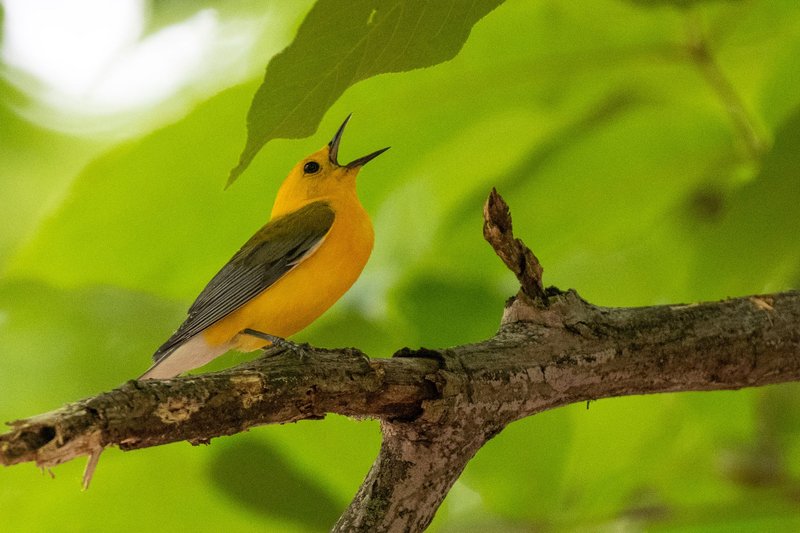
Length 5.1 inches, wingspan 8.7–9.1 inches, weight about 0.5 ounces. Head and underparts a saturated golden-yellow, wings blue-gray, no wing bars. The song is a loud, ringing series of single-note sweet-sweet-sweet-sweet phrases. This is the one warbler in North America that nests in tree cavities over standing water instead of building an open cup nest, and Arkansas’s cypress swamps — the Cache River bottomlands especially — hold some of the densest breeding concentrations anywhere in its range.
19. Indigo Bunting
Length 4.7–5.1 inches, wingspan 7.5–9.1 inches, weight 0.4–0.7 ounces. Breeding males are a deep, electric blue with no true blue pigment involved — the color comes entirely from light scattering off the feather structure, which is why the bird can look nearly black in shade and brilliant blue in direct sun. Females are plain warm brown. Song is a bright, paired-phrase warble, each couplet repeated twice. Common along forest edges, roadsides, and overgrown fields statewide through summer.
20. Summer Tanager
Length 6.7 inches, wingspan 11–12.2 inches, weight 0.9–1.2 ounces. Males are rose-red all over, no black anywhere on the bird — the trait that separates them from the black-winged male Scarlet Tanager. Females and immature males are mustard-yellow. Diet leans heavily on bees and wasps, which the bird catches in flight and beats against a branch to disable before eating; it’s one of the few North American songbirds specialized enough to raid wasp nests directly. Song is a robin-like series of clear, burry phrases.
21. Purple Martin
Length 7.5–8.3 inches, wingspan 15.3–16.1 inches, weight 1.6–2.1 ounces. The largest North American swallow. Adult males are glossy dark purple-blue overall; females and young birds are duller with pale gray underparts. In the eastern U.S., Purple Martins nest almost exclusively in human-supplied housing — gourd clusters or multi-compartment martin houses — a dependency built up over centuries since Native American and, later, European settlers began putting up nest structures. A well-managed martin colony in an Arkansas backyard can run into dozens of pairs.
22. Eastern Kingbird
Length 7.5–9.1 inches, wingspan 13–15 inches, weight 1.2–1.9 ounces. Slate-gray above, clean white below, black tail with a crisp white terminal band. Despite the plain look, kingbirds are aggressive — they’ll chase hawks and crows well outside their own territory, harassing anything that flies too close to the nest. Perches conspicuously on fence lines and wires over open pasture, sallying out after flying insects and returning to the same perch.
23. Barn Swallow
Length 5.9–7.5 inches, wingspan 11.4–12.6 inches, weight 0.6–0.7 ounces. Steel-blue back, cinnamon underparts and throat, deeply forked tail — the most recognizable swallow silhouette in North America. Builds a mud cup nest almost exclusively on man-made structures now: barn rafters, bridge undersides, culverts. A single bird can cover over 600 miles a day during migration, feeding on insects snatched out of the air on the wing the entire way.
Winter Visitors
Arkansas is where a lot of northern birds go to avoid a real winter. Some of these species breed in Canada or the upper Midwest and only show face here between November and March.
24. Bald Eagle
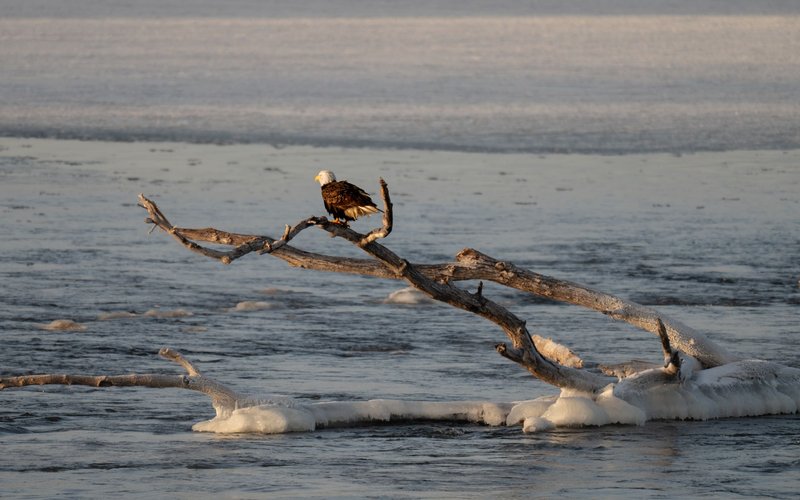
Length 2.6–3.1 feet, wingspan 5.9–7.5 feet, weight 6.6–13.9 pounds. White head and tail contrasting with a dark brown body — but only on adults; juveniles are mottled brown all over and take four to five years to grow into the classic look, which trips up a lot of new birders. The call is a surprisingly weak, high-pitched chittering, nothing like the movie-eagle scream (that sound is usually a dubbed-in Red-tailed Hawk). Bald Eagles were down to 487 breeding pairs nationwide by 1963 before DDT bans and habitat protection pulled the species back from the edge — the population had climbed past 9,700 pairs by the time it came off the endangered species list in 2007. Arkansas hosts one of the largest wintering concentrations in the South, mostly along major lakes and the White River.
25. Dark-eyed Junco
Length 5.5–6.3 inches, wingspan 7.1–9.8 inches, weight 0.6–1 ounce. The eastern form seen in Arkansas — “slate-colored” — is uniform dark gray above and on the breast, sharply cut off from a white belly, with a pale pink bill and white outer tail feathers that flash in flight. Nicknamed “snowbirds” because their arrival roughly tracks the first cold fronts. Feeds almost entirely on the ground beneath feeders rather than at the feeder itself, kicking through leaf litter for fallen seed.
26. White-throated Sparrow
Length 6.3–7.1 inches, wingspan 7.9–9.4 inches, weight 0.8–1.1 ounces. Brown-streaked body, sharp white throat patch, yellow spot between the eye and bill. The song is a clear, whistled Old-Sam-Peabody-Peabody-Peabody (or, per Canadian field guides, Oh-sweet-Canada-Canada-Canada — same bird, regional mnemonic). Arrives in Arkansas by late October and sticks around common winter feeder flocks through March, often mixed in with juncos.
27. Yellow-rumped Warbler
Length 4.7–5.9 inches, wingspan 7.5–9.1 inches, weight 0.4–0.5 ounces. Winter birds are drab brown-gray overall, but the bright yellow rump patch — the field mark that earns the nickname “butter-butt” — stays visible year-round and is the fastest way to confirm the ID even on a dull individual. Unlike most warblers, it can digest the waxy coating on bayberries and wax myrtle fruit, which lets it winter farther north than any other North American warbler species, Arkansas included.
Flyway Migrants
These birds don’t live in Arkansas and don’t winter here either, most years — they’re using the state as a layover on the Mississippi Flyway, the migration corridor that carries roughly 40% of North America’s waterfowl and shorebirds between Canadian breeding grounds and Gulf Coast wintering areas.
28. Snow Goose
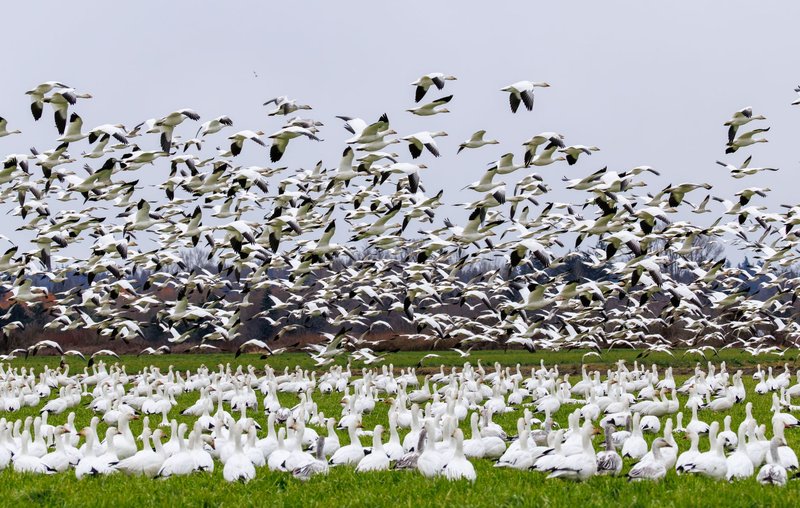
Length 2.2–2.7 feet, wingspan 4.4–4.9 feet, weight 4.4–7.9 pounds. Pure white body with black wingtips visible in flight (a separate dark “blue” color morph also occurs, in browner overall plumage). Travels in flocks that can number in the tens of thousands, flying in long, wavering lines and producing a constant, high-pitched barking chorus audible from well over a mile away. Peak numbers pass through eastern Arkansas rice country in January and February, often stopping to feed in flooded fields alongside White-fronted Geese.
29. Sandhill Crane
Length 3.3–4 feet, wingspan 5.9–6.9 feet, weight 6.6–14.4 pounds. Tall and gray with a distinctive bald red crown patch, often stained rusty-brown from preening with iron-rich mud. Flies with its long neck fully extended, unlike a heron, which folds its neck back into an S. The call is a loud, rolling, prehistoric-sounding bugle that can carry two miles or more. Arkansas sees them mainly as passage migrants in November and again in February, moving between staging areas farther north and wintering grounds in Texas and along the Gulf.
30. American White Pelican
Length 4.2–5 feet, wingspan 8–9.5 feet, weight 11–20 pounds. One of the largest birds in North America by wingspan, second only to the California Condor among species regularly seen on the continent. Brilliant white with black flight feathers visible only when the wings are spread, and a massive orange bill and pouch. Unlike Brown Pelicans, they don’t dive for fish — they swim in coordinated groups, herding fish into shallow water before scooping them up. Arkansas’s larger reservoirs see flocks of dozens to hundreds during spring and fall passage.
Where to Go Looking in Arkansas
The Big Woods of eastern Arkansas — the bottomland hardwood forest strung along the Cache River, White River, and Bayou DeView — is the single best birding landmass in the state. Cache River National Wildlife Refuge alone covers roughly 73,000 acres of cypress swamp and hardwood forest, and its combination of boardwalk trails and canoe routes makes it the reliable spot for Prothonotary Warblers in summer and dense wintering waterfowl in the cold months. It’s also the site of the disputed 2004 Ivory-billed Woodpecker rediscovery — no confirmed sighting has held up since, but the search put the Big Woods on the map for serious birders nationally.
For Bald Eagles specifically, work the White River and the larger reservoirs — Lake Ouachita, Bull Shoals, Beaver Lake — from December through February, when northern eagles that summer near the Great Lakes push south looking for open water. Petit Jean State Park and Mount Magazine State Park add elevation to the mix, which makes them dependable for raptor migration in fall and for species like Barred Owl and Wild Turkey year-round. If you’re after the winter goose and crane spectacle, the flooded rice fields of the eastern Delta are the move in January.
Setting Up a Backyard That Birds Actually Use
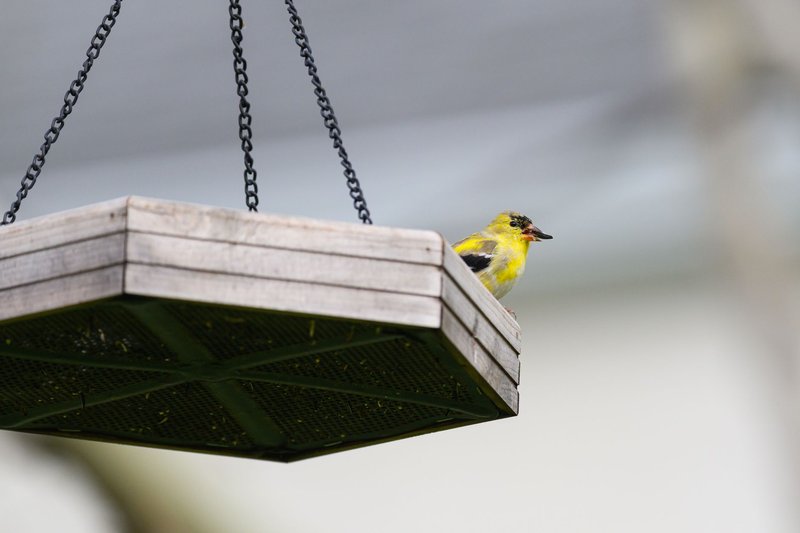
Black-oil sunflower seed pulls the broadest mix — cardinals, chickadees, titmice, and both woodpecker species on this list will all take it, and the thin shell means less waste under the feeder than striped sunflower. Add a suet cage from fall through spring and you’ll pull in Red-bellied and Downy Woodpeckers reliably, especially in the colder months when insect prey is scarce. Nyjer seed in a mesh feeder targets American Goldfinches and, in winter, Dark-eyed Juncos and White-throated Sparrows working the ground beneath it.
Placement matters more than seed choice. Keep feeders within 3 feet of a window (birds that strike glass from that close aren’t moving fast enough to be hurt) or more than 10 feet away (enough distance to react) — the danger zone is everything in between. A hummingbird feeder with a 4-to-1 water-to-sugar ratio, no red dye needed, will pull in Ruby-throated Hummingbirds from April through the first frost. And if you’ve got the yard space, a martin house or gourd rack put up before mid-March gives Purple Martins a shot at finding you before they’ve already committed to a colony down the road.