
Show the math
CFU/mL = C / (n × V × d). C = colonies, n = plates, V = mL per plate, d = dilution of the plate.Exponent n = 4: d = 10−4 = 1/10,000V = 0.1 mL1 × 0.1 mL × 10−4 = 1×10⁻⁵ mLC = 8484 / 1×10⁻⁵ mL = 8,400,000 CFU/mL2 significant figures, ISO rule (5 rounds up): 8,400,000 → 8,400,000 = 8.4×10⁶log10(8,400,000) = 6.924| Plate dilution | Expected colonies | Count check |
|---|---|---|
| 10−2 | 8,400 | TNTC |
| 10−3 | 840 | TNTC |
| 10−4 | 84 | in range |
| 10−5 | 8.4 | TFTC |
| 10−6 | 0.84 | TFTC |
Short answer: CFU/mL = colonies / (volume plated in mL × dilution), where the dilution is the fraction on the plate, such as 10⁻⁴. 84 colonies at a 10⁻⁴ dilution, plated at 0.1 mL, gives 8.4 × 10⁶ CFU/mL (8,400,000 CFU/mL).
A plate count converts colonies back to the concentration of the original sample. Most wrong answers come from three slips: mixing up the dilution exponent and the dilution factor, forgetting to convert microlitres to millilitres, and counting a plate that sits outside the countable range.
This article contains Amazon affiliate links. 33science earns a commission on qualifying purchases. See our affiliate disclosure.
How to use the CFU calculator
The CFU/mL formula
CFU/mL = colonies / (volume plated × dilution). The denominator is the volume of the original sample that reached the plate. Dividing by a dilution such as 10⁻⁴ is the same as multiplying by the dilution factor, so the formula is also written colonies × dilution factor / volume plated. The USDA and university lab manuals use the same relation (USDA APHIS, LibreTexts).
Worked example: 84 colonies at 10⁻⁴, with 0.1 mL plated, gives 84 / (0.1 × 10⁻⁴) = 84 / 0.00001 = 8,400,000 CFU/mL, or 8.4 × 10⁶. The common volumes are 1 mL for a pour plate and 0.1 mL (100 µL) or 0.2 mL (200 µL) for a spread plate. Convert microlitres to millilitres before dividing.
| Method | Colonies | Volume plated | Dilution | CFU/mL |
|---|---|---|---|---|
| Worked example | 84 | 0.1 mL | 10⁻⁴ | 8.4 × 10⁶ |
| Spread plate | 32 | 200 µL (0.2 mL) | 10⁻⁶ | 1.6 × 10⁸ |
| Pour plate | 150 | 1 mL | 10⁻⁶ | 1.5 × 10⁸ |
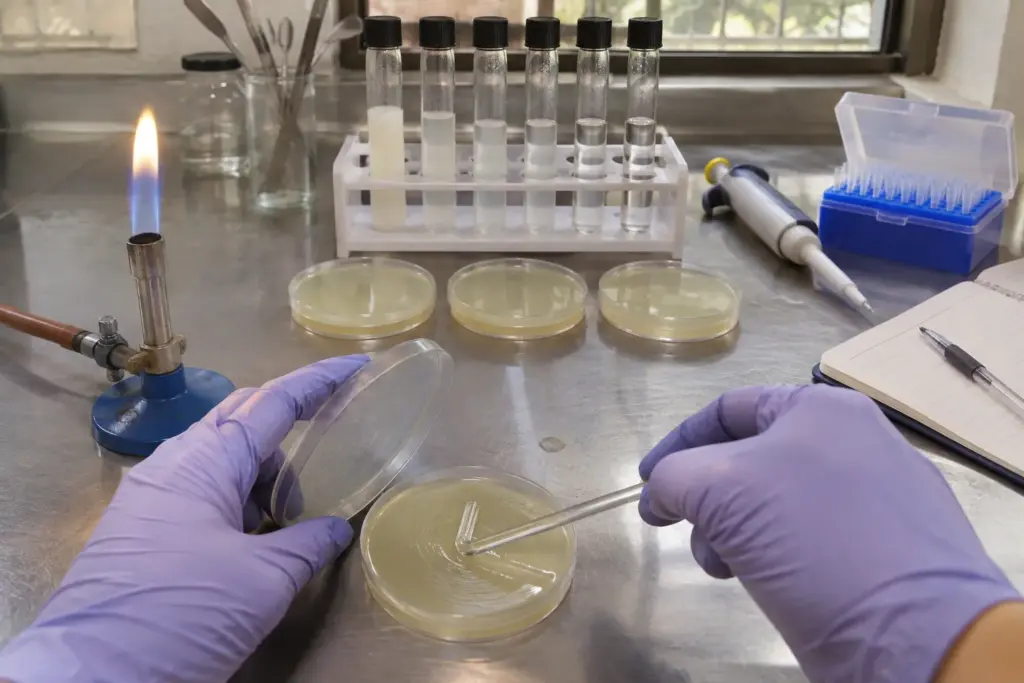
To get the total in the whole sample, multiply CFU/mL by the sample volume. 8.4 × 10⁶ CFU/mL in 10 mL is 8.4 × 10⁷ CFU in total. A sterile L-shaped spreader per plate avoids flaming glass between samples.
How to read the dilution: exponent, factor or steps
The dilution is the dilution of the suspension that was plated, not the stock tube you started from. It is written three ways, and the calculator takes all three.
| Notation | Example | Enter | Same as |
|---|---|---|---|
| Exponent | 10⁻⁴ | 4 (the exponent n) | 1:10,000 |
| Factor | 1:10,000 | 10,000 | 10⁻⁴ |
| Serial steps | 4 tenfold steps | 4 steps of 10 | 10⁻⁴ |
Steps work for other ratios too: 5 twofold steps give a factor of 32, so 60 colonies from 1 mL gives 1,920 CFU/mL. For a tenfold series, 6 steps give a factor of 1,000,000. The dilution calculator builds the tube-by-tube table, and the scientific notation calculator converts the answer between forms.
Countable range: 30-300, 25-250 or 15-300
Count only plates inside the range your method names. Below it the sampling error is large, and above it colonies crowd and merge. The calculator flags a result as an estimate when the mean per plate is outside the range you choose.
| Range | Used by |
|---|---|
| 30-300 | USDA, AOAC |
| 25-250 | APHA, older FDA BAM |
| 15-300 | ISO 7218, FDA BAM 2025+ |
FDA changed the Bacteriological Analytical Manual from 25-250 in the 2001 text (BAM Chapter 3, 2001) to 15-300 in the current edition (BAM Chapter 3, 2026), which matches ISO 7218: at least one dish with 15 or more colonies and none above 300. Teaching labs usually use 30-300, the calculator default, so check your own protocol.
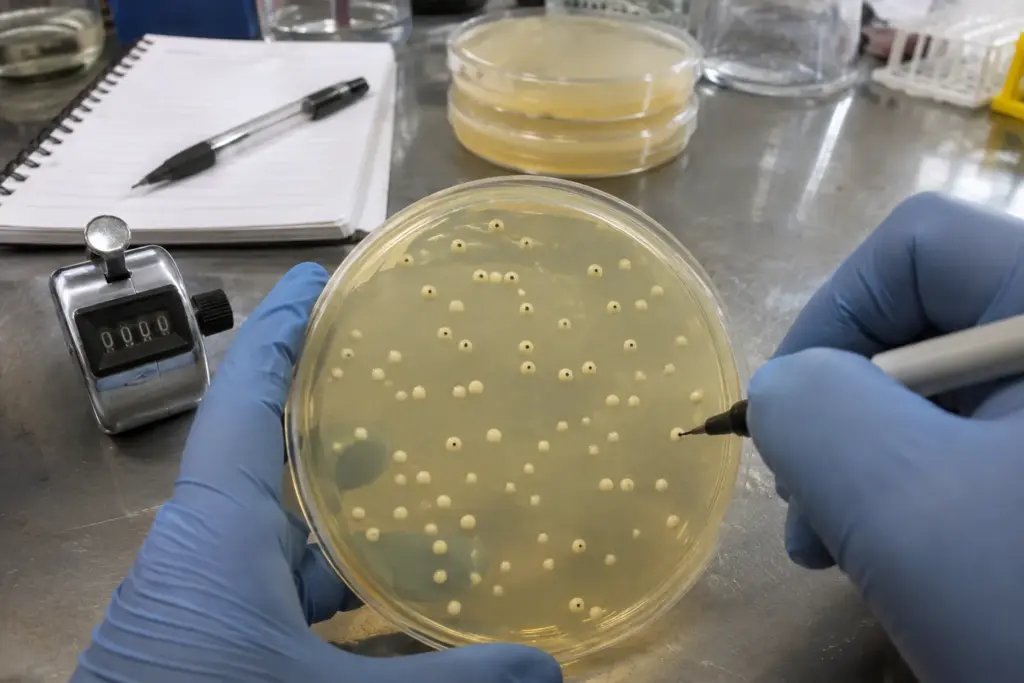
Pick a dilution that puts the expected count in range. A handheld tally counter and a marker make a 200-colony plate quick to count.
| Plate dilution | CFU/mL if 30-300 colonies on 0.1 mL (spread plate) | CFU/mL if 30-300 colonies on 1 mL (pour plate) |
|---|---|---|
| 10⁻² | 3 × 10⁴ to 3 × 10⁵ | 3 × 10³ to 3 × 10⁴ |
| 10⁻³ | 3 × 10⁵ to 3 × 10⁶ | 3 × 10⁴ to 3 × 10⁵ |
| 10⁻⁴ | 3 × 10⁶ to 3 × 10⁷ | 3 × 10⁵ to 3 × 10⁶ |
| 10⁻⁵ | 3 × 10⁷ to 3 × 10⁸ | 3 × 10⁶ to 3 × 10⁷ |
| 10⁻⁶ | 3 × 10⁸ to 3 × 10⁹ | 3 × 10⁷ to 3 × 10⁸ |
Two dilutions: pooled mean or average of the results
When two consecutive dilutions both give countable plates, ISO 7218 and FDA BAM pool them. Add all the colonies and divide by the pooled sample volume: N = sum of colonies / (V × (n1 + 0.1 × n2) × d1), where n1 and n2 are the plates counted at each dilution and the 0.1 holds for a second dilution that is tenfold weaker (ISO 7218 amendment).
Example: 144 + 118 colonies on 2 plates at 10⁻² and 26 + 20 colonies on 2 plates at 10⁻³, 1 mL each. That is 308 colonies in 0.022 mL of sample, or 14,000 CFU/mL. The ISO 7218 example, 422 colonies over two dilutions, works out to 19,181 CFU/mL and is reported as 19,000. The calculator gives the same figure.
| Method | How it combines the plates | Example result (CFU/mL) |
|---|---|---|
| Pooled (ISO 7218, FDA BAM) | Total colonies over total sample volume | 14,000 |
| Per-dilution average (Standard Methods 9215B) | Calculate each dilution, then average the two results | 18,050 |
Pooling gives the plates with more sample more weight. Averaging gives both dilutions equal weight, as in the Georgia EPD procedure. The calculator pools by default.
CFU/g for solid samples
For a solid, weigh a portion, blend it into diluent and treat that suspension as the first dilution. 25 g in 225 mL of diluent is a 1:10 homogenate, 10⁻¹, because 25 / (25 + 225) = 0.1. FDA uses the same ratio for 50 g + 450 mL = 10⁻¹ (BAM Chapter 1). Every later dilution multiplies onto it, and the result is per gram.
Example: 124 colonies on 2 plates, 1 mL each, plated from 10⁻² of the homogenate. The overall dilution is 10⁻³, the mean is 62 colonies per plate and the answer is 6.2 × 10⁴ CFU/g (62,000). In solid mode the calculator adds the 1:10 step for you, so you enter only the plate dilution of the homogenate, here the exponent 2.
TFTC, TNTC and zero colonies
TFTC means too few to count and TNTC means too numerous to count. The formula still returns a number for such plates, but it is an estimate and is reported as one.
| Plate | What to do | Example |
|---|---|---|
| Zero colonies | Report less than 1 / (volume plated × dilution), not zero. | 1 mL at 10⁻² gives less than 100 CFU/mL. |
| Below the range (TFTC) | Compute it as usual and mark it estimated. | 22 colonies from 0.1 mL undiluted is an estimated 220 CFU/mL. |
| Above the range (TNTC) | Drop the plate and use the next dilution as an estimate. | TNTC at 10⁻² and 640 colonies at 10⁻³ gives 640,000 CFU/mL. |
Spreader plates, where one colony creeps across the agar, are not counted. Dropping a TNTC plate is an approximation: FDA’s 2026 chapter gets 120,000 CFU/mL by maximum likelihood where the simple rule gives 124,000.
Rounding to 2 significant figures and log10 CFU
Plate counts carry about two significant figures, so round only the final result. ISO rounds a 5 up (the Georgia EPD procedure does too). FDA BAM rounds an exact 5 to the even digit, and the calculator offers both.
| Unrounded | ISO (half up) | FDA BAM (half even) |
|---|---|---|
| 14,500 | 15,000 | 14,000 |
| 15,500 | 16,000 | 16,000 |
| 14,400 | 14,000 | 14,000 |
| 14,600 | 15,000 | 15,000 |
Report the result as scientific notation, 8.4 × 10⁶ rather than 8,400,000, so the order of magnitude is visible. log10 CFU/mL turns it into a number you can subtract: 8.4 × 10⁶ CFU/mL is 6.92. A drop of one log10 unit is a tenfold reduction. The significant figures calculator applies the rounding rules to any number, and the percent error calculator compares duplicate plates.
Why one colony is not always one cell
A colony forming unit is whatever gave rise to a colony. That can be one cell, a pair, a chain or a clump that stayed together through dilution and plating. CFU therefore counts viable units that grow on that medium under those conditions, and it undercounts cells that are dead, damaged or unable to grow there.
Sources
- FDA. Bacteriological Analytical Manual, Chapter 3: Aerobic Plate Count (January 2026)
- FDA. Bacteriological Analytical Manual, Chapter 3: Aerobic Plate Count (2001)
- FDA. Bacteriological Analytical Manual, Chapter 1: Food Sampling and Preparation of Sample Homogenate
- ISO. ISO 7218:1996/Amd 1:2001 (sample)
- USDA APHIS. CVB-SOP-0104.03 plate count procedure
- Georgia EPD. SOP 5-002, SM 9215B heterotrophic plate count, pour plate method
- LibreTexts. Lab 9: Standard Plate Count (UC Davis manual)
- LibreTexts. Plate Count (Viable Count)
Frequently asked questions
CFU stands for colony forming unit, the viable cell or group of cells that grows into one visible colony on an agar plate. CFU/mL is the number of such units per millilitre of the original sample.
Divide the colonies by the volume plated in mL times the dilution of the plate: CFU/mL = colonies / (volume x dilution). 84 colonies at a 10^-4 dilution, plated at 0.1 mL, gives 8.4 x 10^6 CFU/mL (8,400,000 CFU/mL).
Weigh the solid, blend it into diluent for a homogenate, and count the homogenate dilution as the first dilution. 124 colonies on 2 plates at an overall 10^-3 dilution, 1 mL plated, gives 6.2 x 10^4 CFU/g (62,000 CFU/g).
Count the tenfold steps and enter that number as the exponent. 4 tenfold steps is the same as 10^-4 and a factor of 10,000.
Most labs count plates with 30-300 colonies (USDA, AOAC), while APHA, older FDA BAM use 25-250 and ISO 7218, FDA BAM 2025+ use 15-300. Follow the range named in your own protocol.
TNTC means too numerous to count, usually more than 300 colonies on a plate, and TFTC means too few to count, below the lower limit of the range. Both give estimates, and a plate with no colonies is reported as less than 1 / (volume plated x dilution).
Not always. A colony can grow from one cell, a chain or a clump, so CFU counts viable units that grow on the medium, not individual cells.